

Razer announced the Razer | Wuthering Waves Collection on July 2, 2026, a Kuro Games collaboration that turns Denia, one of Wuthering Waves’ newest Resonators, into a four-piece lineup of officially licensed gaming peripherals. The collection is not a new hardware platform so much as a branded overlay on familiar Razer gear: chair, keyboard, mouse, and mouse mat. That distinction matters, because this launch says less about breakthrough peripheral engineering than it does about where PC gaming hardware is now headed. The desk has become another live-service surface.
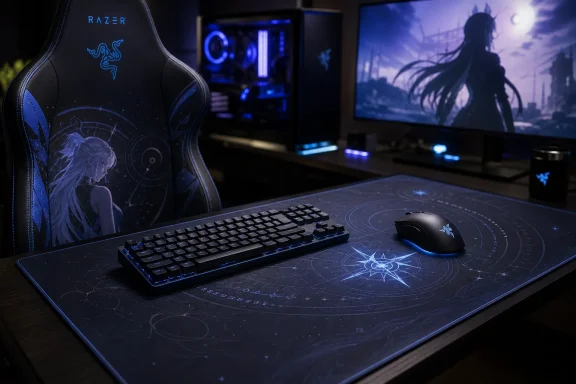
The new collection, detailed by Razer’s own newsroom and covered by XiaomiToday, includes the Razer Iskur V2 X – Wuthering Waves Edition, BlackWidow V4 TKL HyperSpeed – Wuthering Waves Edition, Viper V3 Pro SE – Wuthering Waves Edition, and Gigantus V2 XXL – Wuthering Waves Edition. Each product is wrapped in Denia-inspired artwork rather than positioned as a functionally distinct device from its standard counterpart.
That makes this a relatively straightforward licensing play on paper. Razer takes known hardware, Kuro Games lends a character and world aesthetic, and fans get a sanctioned way to make their desk look like part of Solaris-3. But the timing and packaging are more interesting than the bill of materials.
Gaming peripherals used to be sold primarily through performance claims: DPI, polling rate, switch actuation, wireless latency, frame-winning ergonomics. Those claims still appear here, but they are no longer the whole pitch. The modern peripheral is also a badge, a collectible, a social-media prop, and a loyalty marker.
Razer understands this better than most companies in the PC ecosystem. Its hardware has long lived at the intersection of enthusiast utility and lifestyle branding, from Chroma lighting to esports tie-ins to licensed product drops. The Wuthering Waves collection simply makes the strategy explicit: the battlestation is not just where the game is played, but where the player performs belonging to the game.
That is why this collaboration feels different from the older model of slapping a franchise emblem on a black mouse. Character-led hardware turns a peripheral into a piece of fandom expression. The player is not merely buying “Wuthering Waves gear”; they are buying a Denia-coded desk.
Razer’s language leans heavily into resolve, control, endurance, and precision. Addie Tan, Razer’s Global Head of Lifestyle Division, framed the collaboration as a celebration of the Wuthering Waves universe and community, saying Denia’s determination maps naturally onto how players approach performance. That is marketing copy, of course, but it is also the whole concept in miniature.
The hardware does not need Denia to function. Denia needs hardware to become physically present in a player’s room. That is the commercial exchange.
The BlackWidow V4 TKL HyperSpeed – Wuthering Waves Edition brings the keyboard slot, with low-latency wireless connectivity, a compact tenkeyless layout, and hot-swappable mechanical switches. For PC players, this is the most practical item in the set. A TKL layout frees desk space for mouse movement, while hot-swap support gives enthusiasts at least some room to tune the typing feel.
The Viper V3 Pro SE – Wuthering Waves Edition occupies the performance-mouse role. Razer describes it around lightweight construction and wireless speed, which fits the Viper line’s competitive positioning. Even in a collection aimed at fans and collectors, the mouse is where Razer has to preserve credibility with players who still care about weight, sensor performance, and consistency.
The Gigantus V2 XXL – Wuthering Waves Edition completes the desk visually. Oversized mouse mats have become the cheapest way to transform a setup’s appearance, because they occupy the largest uninterrupted surface in the player’s field of view. In a themed collection, the mat is not a supporting accessory; it is the canvas that makes the whole desk read as intentional.
This is where the collaboration crosses from merchandise into live-service economics. A themed keyboard is already a fan purchase. A themed keyboard with an exclusive profile sigil becomes a bridge between physical ownership and digital identity.
The sigil is especially telling. It is not merely a pile of consumable resources; it is a visible marker. The player can display it, meaning the purchase can travel back into the game’s social layer. That turns the peripheral into something closer to an account-linked collectible.
The model is familiar across modern gaming. Cosmetic scarcity, limited-time bundles, platform-specific rewards, and branded drops all work by tightening the loop between purchase and identity. Razer’s role is to move that loop off the screen and onto the desk, then back into the game through a code.
Peripheral collaborations are one replacement. They are expensive enough to feel premium, useful enough to justify the purchase, and visible enough to function as décor. Unlike a statue that sits on a shelf, a keyboard or mouse mat becomes part of the player’s daily interaction with the game.
That usefulness is important. It gives licensed hardware an argument that pure collectibles sometimes lack. A Denia mouse mat is still a mouse mat. A Wuthering Waves keyboard is still a keyboard. The fan premium is layered onto something the buyer might plausibly use anyway.
This also makes the category attractive to companies like Razer. The hardware development cost is lower when the underlying products already exist. The licensing and artwork do the differentiation. If demand is strong, the company benefits from a higher-emotion product without having to invent an entirely new device.
This is why these collaborations land particularly well in PC gaming. Console hardware is comparatively fixed, and mobile gaming hardware is limited by form factor. The Windows desk is modular, expressive, and endlessly photographed. It invites personalization.
That personalization has practical consequences. Every themed device brings another configuration layer, another firmware utility, another account, another support channel, and sometimes another background process. Razer Synapse, game launchers, anti-cheat systems, RGB controllers, and peripheral firmware all now coexist on the same machine.
For casual users, this is just part of the setup ritual. For sysadmins and security-minded enthusiasts, it is a reminder that the gaming PC has become a dense stack of vendor software. The Wuthering Waves collection itself is not unusual in that respect, but it belongs to a larger trend: hardware aesthetics are increasingly inseparable from software ecosystems.
The Wuthering Waves drop makes that obvious. Chair, keyboard, mouse, mouse mat: these are the four items most visible in a desk photo. Razer does not need to sell a monitor or PC case to make the setup feel complete. It only needs to control the surfaces the player touches and the surfaces the camera sees.
This is a powerful position. Many peripheral companies can license a mouse. Fewer can sell a coordinated desktop identity. Razer’s lifestyle strategy, sometimes mocked for its gamer-brand excess, is exactly what makes this sort of collaboration viable.
The risk is saturation. If every month brings another anime-styled, game-branded, limited-edition desk collection, the novelty weakens. Fans may still buy the characters they love, but the broader market starts to see the template. Razer’s challenge is to make each collaboration feel like more than a reskin.
A player who sees Denia artwork every time they sit down is being reminded of the game before the launcher opens. That is softer than a notification and more durable than a banner ad. It is ambient retention.
The collaboration also helps Wuthering Waves occupy the same cultural territory as bigger, more established fandoms. Official peripherals imply scale. They tell players, implicitly, that this is a game with enough community gravity to justify hardware.
That signal can be valuable. In live-service games, perception of momentum matters. Players are more likely to keep investing time and money in a world that appears active, supported, and culturally alive. Hardware collaborations are one way to project that vitality beyond patch notes and character trailers.
That is not unique to Razer. It is the defining bargain of licensed hardware. The buyer is paying for both utility and affection, and the affection can make the utility seem better than it is.
The safest reading of this collection is therefore simple: if you already like the underlying Razer products, the Wuthering Waves editions add official artwork and in-game rewards. If you do not like the underlying form factors, the theme will not magically fix them. A mouse that does not fit your grip remains a bad mouse for you, no matter how good the character art looks.
That point is especially relevant for the chair. Gaming chairs are highly body-dependent, and lumbar support that works for one person can feel wrong for another. A themed chair is harder to treat as an impulse collectible because it dominates a room and has direct comfort consequences.
That premium will determine whether this collection is a fan-friendly collaboration or a collector-tax exercise. Limited editions often command higher prices, and buyers have grown used to paying extra for official art, scarcity, and bundled digital items. But there is a ceiling, especially when the base hardware is already familiar.
Regional availability will matter too. Wuthering Waves has a global audience, and licensed gaming hardware can become frustrating when a collaboration is announced broadly but sold unevenly. Import costs, warranty limitations, keyboard layouts, and local stock can all complicate what appears online as a simple product drop.
The keyboard is a particularly regional product. Layout expectations vary across markets, and a tenkeyless board that makes sense in one region may be less appealing in another if language support or keycap availability is limited. Razer’s official sales channels will need to clarify those details quickly.
That does not make it cynical by default. Fans like objects. Players like building spaces around the worlds they spend time in. A well-made licensed peripheral can be both useful and emotionally satisfying.
But buyers should keep the hierarchy straight. The hardware comes first. The artwork and rewards are additions, not substitutes for fit, comfort, reliability, and price discipline.
 Razer Sells the Battlestation as Fandom Infrastructure
The new collection, detailed by Razer’s own newsroom and covered by XiaomiToday, includes the Razer Iskur V2 X – Wuthering Waves Edition, BlackWidow V4 TKL HyperSpeed – Wuthering Waves Edition, Viper V3 Pro SE – Wuthering Waves Edition, and Gigantus V2 XXL – Wuthering Waves Edition. Each product is wrapped in Denia-inspired artwork rather than positioned as a functionally distinct device from its standard counterpart.That makes this a relatively straightforward licensing play on paper. Razer takes known hardware, Kuro Games lends a character and world aesthetic, and fans get a sanctioned way to make their desk look like part of Solaris-3. But the timing and packaging are more interesting than the bill of materials.
Gaming peripherals used to be sold primarily through performance claims: DPI, polling rate, switch actuation, wireless latency, frame-winning ergonomics. Those claims still appear here, but they are no longer the whole pitch. The modern peripheral is also a badge, a collectible, a social-media prop, and a loyalty marker.
Razer understands this better than most companies in the PC ecosystem. Its hardware has long lived at the intersection of enthusiast utility and lifestyle branding, from Chroma lighting to esports tie-ins to licensed product drops. The Wuthering Waves collection simply makes the strategy explicit: the battlestation is not just where the game is played, but where the player performs belonging to the game.
Denia Is the Design Hook, Not the Hardware Story
The collection’s stated inspiration is Denia, described by Razer as the game’s newest Resonator. In Wuthering Waves terminology, Resonators are the playable character archetypes through which Kuro Games builds both combat identity and fandom attachment. Denia gives Razer a character-specific visual anchor, which is much easier to merchandise than a generic game logo.That is why this collaboration feels different from the older model of slapping a franchise emblem on a black mouse. Character-led hardware turns a peripheral into a piece of fandom expression. The player is not merely buying “Wuthering Waves gear”; they are buying a Denia-coded desk.
Razer’s language leans heavily into resolve, control, endurance, and precision. Addie Tan, Razer’s Global Head of Lifestyle Division, framed the collaboration as a celebration of the Wuthering Waves universe and community, saying Denia’s determination maps naturally onto how players approach performance. That is marketing copy, of course, but it is also the whole concept in miniature.
The hardware does not need Denia to function. Denia needs hardware to become physically present in a player’s room. That is the commercial exchange.
Familiar Razer Gear Gets a Gacha-Era Costume
The Razer Iskur V2 X – Wuthering Waves Edition is the chair in the lineup, pitched around ergonomic support and integrated lumbar support for extended play. This is the most literal version of the “long session” promise: a gaming chair wrapped in character art, sold to players who already understand that action RPGs, dailies, events, and progression loops can turn evening play into a ritual.The BlackWidow V4 TKL HyperSpeed – Wuthering Waves Edition brings the keyboard slot, with low-latency wireless connectivity, a compact tenkeyless layout, and hot-swappable mechanical switches. For PC players, this is the most practical item in the set. A TKL layout frees desk space for mouse movement, while hot-swap support gives enthusiasts at least some room to tune the typing feel.
The Viper V3 Pro SE – Wuthering Waves Edition occupies the performance-mouse role. Razer describes it around lightweight construction and wireless speed, which fits the Viper line’s competitive positioning. Even in a collection aimed at fans and collectors, the mouse is where Razer has to preserve credibility with players who still care about weight, sensor performance, and consistency.
The Gigantus V2 XXL – Wuthering Waves Edition completes the desk visually. Oversized mouse mats have become the cheapest way to transform a setup’s appearance, because they occupy the largest uninterrupted surface in the player’s field of view. In a themed collection, the mat is not a supporting accessory; it is the canvas that makes the whole desk read as intentional.
The Reward Code Is the Quietly Important Part
Razer is also bundling in-game rewards with qualifying purchases. According to the company, buyers receive a limited-edition Wuthering Waves sigil for their in-game profile, while additional rewards may vary by product and include Astrite, Shell Credits, Advanced Energy Cores, and Advanced Resonance Potions.This is where the collaboration crosses from merchandise into live-service economics. A themed keyboard is already a fan purchase. A themed keyboard with an exclusive profile sigil becomes a bridge between physical ownership and digital identity.
The sigil is especially telling. It is not merely a pile of consumable resources; it is a visible marker. The player can display it, meaning the purchase can travel back into the game’s social layer. That turns the peripheral into something closer to an account-linked collectible.
The model is familiar across modern gaming. Cosmetic scarcity, limited-time bundles, platform-specific rewards, and branded drops all work by tightening the loop between purchase and identity. Razer’s role is to move that loop off the screen and onto the desk, then back into the game through a code.
Licensed Hardware Is Becoming the New Collector’s Edition
For years, the collector’s edition was a box: statue, art book, soundtrack, steel case, maybe a cloth map. As more games moved toward digital distribution and live-service updates, that model lost some of its centrality. The player no longer needs a disc box to feel attached to a game world.Peripheral collaborations are one replacement. They are expensive enough to feel premium, useful enough to justify the purchase, and visible enough to function as décor. Unlike a statue that sits on a shelf, a keyboard or mouse mat becomes part of the player’s daily interaction with the game.
That usefulness is important. It gives licensed hardware an argument that pure collectibles sometimes lack. A Denia mouse mat is still a mouse mat. A Wuthering Waves keyboard is still a keyboard. The fan premium is layered onto something the buyer might plausibly use anyway.
This also makes the category attractive to companies like Razer. The hardware development cost is lower when the underlying products already exist. The licensing and artwork do the differentiation. If demand is strong, the company benefits from a higher-emotion product without having to invent an entirely new device.
The Windows Desk Is Now a Media Platform
For WindowsForum readers, the interesting angle is not only the Razer branding. It is the evolution of the PC desk itself. The Windows gaming setup has become a media platform in its own right, shaped by RGB software, launchers, Discord presence, streaming overlays, wallpapers, keyboard profiles, and now physical product skins tied to live-service games.This is why these collaborations land particularly well in PC gaming. Console hardware is comparatively fixed, and mobile gaming hardware is limited by form factor. The Windows desk is modular, expressive, and endlessly photographed. It invites personalization.
That personalization has practical consequences. Every themed device brings another configuration layer, another firmware utility, another account, another support channel, and sometimes another background process. Razer Synapse, game launchers, anti-cheat systems, RGB controllers, and peripheral firmware all now coexist on the same machine.
For casual users, this is just part of the setup ritual. For sysadmins and security-minded enthusiasts, it is a reminder that the gaming PC has become a dense stack of vendor software. The Wuthering Waves collection itself is not unusual in that respect, but it belongs to a larger trend: hardware aesthetics are increasingly inseparable from software ecosystems.
Razer’s Advantage Is That It Already Owns the Desk
Razer is not entering this category from the outside. The company already sells mice, keyboards, chairs, headsets, mats, laptops, capture gear, and streaming accessories. That means a licensed collection can be presented as a full environment rather than a one-off product.The Wuthering Waves drop makes that obvious. Chair, keyboard, mouse, mouse mat: these are the four items most visible in a desk photo. Razer does not need to sell a monitor or PC case to make the setup feel complete. It only needs to control the surfaces the player touches and the surfaces the camera sees.
This is a powerful position. Many peripheral companies can license a mouse. Fewer can sell a coordinated desktop identity. Razer’s lifestyle strategy, sometimes mocked for its gamer-brand excess, is exactly what makes this sort of collaboration viable.
The risk is saturation. If every month brings another anime-styled, game-branded, limited-edition desk collection, the novelty weakens. Fans may still buy the characters they love, but the broader market starts to see the template. Razer’s challenge is to make each collaboration feel like more than a reskin.
Kuro Games Gets Something More Durable Than an Ad Campaign
For Kuro Games, the benefit is not just merchandise revenue or brand visibility. A peripheral collection puts Wuthering Waves into the physical routines of PC players. That matters for a live-service game competing for daily attention.A player who sees Denia artwork every time they sit down is being reminded of the game before the launcher opens. That is softer than a notification and more durable than a banner ad. It is ambient retention.
The collaboration also helps Wuthering Waves occupy the same cultural territory as bigger, more established fandoms. Official peripherals imply scale. They tell players, implicitly, that this is a game with enough community gravity to justify hardware.
That signal can be valuable. In live-service games, perception of momentum matters. Players are more likely to keep investing time and money in a world that appears active, supported, and culturally alive. Hardware collaborations are one way to project that vitality beyond patch notes and character trailers.
The Performance Claims Still Have to Survive Contact With Buyers
The danger in any licensed peripheral is that fandom can obscure product judgment. A player who would carefully compare switch feel, mouse shape, sensor performance, chair dimensions, and mat texture in a standard purchase may be tempted to buy the themed version first and rationalize the ergonomics later.That is not unique to Razer. It is the defining bargain of licensed hardware. The buyer is paying for both utility and affection, and the affection can make the utility seem better than it is.
The safest reading of this collection is therefore simple: if you already like the underlying Razer products, the Wuthering Waves editions add official artwork and in-game rewards. If you do not like the underlying form factors, the theme will not magically fix them. A mouse that does not fit your grip remains a bad mouse for you, no matter how good the character art looks.
That point is especially relevant for the chair. Gaming chairs are highly body-dependent, and lumbar support that works for one person can feel wrong for another. A themed chair is harder to treat as an impulse collectible because it dominates a room and has direct comfort consequences.
Pricing and Availability Are the Missing Variables
Razer has said regional availability and pricing will be announced through official sales channels. That leaves the most practical question unanswered for many buyers: how much of a premium will the Wuthering Waves treatment carry over standard models?That premium will determine whether this collection is a fan-friendly collaboration or a collector-tax exercise. Limited editions often command higher prices, and buyers have grown used to paying extra for official art, scarcity, and bundled digital items. But there is a ceiling, especially when the base hardware is already familiar.
Regional availability will matter too. Wuthering Waves has a global audience, and licensed gaming hardware can become frustrating when a collaboration is announced broadly but sold unevenly. Import costs, warranty limitations, keyboard layouts, and local stock can all complicate what appears online as a simple product drop.
The keyboard is a particularly regional product. Layout expectations vary across markets, and a tenkeyless board that makes sense in one region may be less appealing in another if language support or keycap availability is limited. Razer’s official sales channels will need to clarify those details quickly.
The Fan Desk Gets Its Own Patch Notes
The Razer | Wuthering Waves Collection is best understood as a small but revealing launch. It is not a reinvention of PC peripherals. It is evidence that the peripheral business increasingly operates on the same rhythms as the games it serves: character drops, limited cosmetics, digital bonuses, and community signaling.That does not make it cynical by default. Fans like objects. Players like building spaces around the worlds they spend time in. A well-made licensed peripheral can be both useful and emotionally satisfying.
But buyers should keep the hierarchy straight. The hardware comes first. The artwork and rewards are additions, not substitutes for fit, comfort, reliability, and price discipline.
- Razer’s Wuthering Waves lineup consists of four themed versions of existing peripheral categories: chair, wireless TKL keyboard, wireless mouse, and XXL mouse mat.
- The collection is officially tied to Kuro Games and is inspired by Denia, one of Wuthering Waves’ newest Resonators.
- Every qualifying purchase includes an exclusive in-game sigil, while some products may add resources such as Astrite, Shell Credits, Advanced Energy Cores, and Advanced Resonance Potions.
- Razer has not yet provided universal pricing or regional availability, so buyers should wait for local sales-channel details before assuming cost or stock.
- The practical value depends on whether the standard versions of these products already suit the buyer’s needs, because the themed artwork does not change the fundamentals of fit and performance.
References
- Primary source: xiaomitoday.com
Published: 2026-07-03T17:00:49.674311
Razer Launches Official Wuthering Waves Gaming Peripheral Collection Featuring Denia-Inspired Designs - XiaomiToday
Razer and Kuro Games unveil the first official Wuthering Waves gaming peripherals with Denia-inspired designs and exclusive in-game rewards.xiaomitoday.com - Related coverage: razer.com
Resonance in Hand: The Razer | Wuthering Waves Collection Arrives - Razer Newsroom
Razer partners with Kuro Games to bring the world of Wuthering Waves to life through the first-ever official lineup of character-inspired gaming peripherals, crafted for control, confidence, and performance.www.razer.com - Related coverage: prydwen.gg
Resonators Explained | Wuthering Waves (WuWa)
The Resonators (characters) system in Wuthering Waves explained.www.prydwen.gg - Related coverage: allthings.how
Best weapons for Denia in Wuthering Waves
A breakdown of Denia's top rectifier options, from her signature Forged Dwarf Star to F2P-friendly substitutes.allthings.how - Related coverage: wuthering.gg
Denia Build and Info - Wuthering Waves
Denia in Wuthering Waves is a 5 Fusion character who wields a Rectifier as their weapon type. Find the best Build for Denia wuthering.gg
- Related coverage: soren.com
- Related coverage: gamemarket.gg
Denia Signature Weapon "Forged Dwarf Star" Info: 3.3 Update | GameMarket.gg
Uncover the full power of the new Wuthering Waves 3.3 Resonator, Denia! Our detailed kit breakdown covers her unique Stagecraft and Breakdown forms,...gamemarket.gg - Related coverage: sportsdunia.com
Wuthering Waves 3.3 Drip Marketing Denia Details: Element, Weapon, and More
Kuro Games has revealed the drip marketing details of the new 5-star Denia arriving with the upcoming Wuthering Waves 3.3 update.www.sportsdunia.com - Related coverage: gadgetren.com
Razer | Wuthering Waves Collection Resmi Diumumkan, Berikan Sentuhan Khas Resonator Denia
Razer resmi mengumumkan deretan produk hasil kolaborasi pertama mereka bersama Wuthering Waves buatan Kuro Games mulai dari keyboard hingga kursi gaming.gadgetren.com - Related coverage: gamsgo.com
Wuthering Waves Denia: Character Preview & Everything We Know
Everything we know about Denia in Wuthering Waves 3.3, including her rumored kit, combat mechanics, expected banner date, and how to plan your Astrite ahead of her release.www.gamsgo.com
- Related coverage: tomshardware.com
Razer Phantom White collection launches — translucent gaming peripherals include Basilisk V3 Pro 35K mouse, BlackWidow V4 75% keyboard | Tom's Hardware
Looks like it's the '90s again.www.tomshardware.com - Related coverage: decantbar.co.uk
Wuthering Waves Leaks What to Expect from Upcoming Content and Characters
Uncover the latest Wuthering Waves leaks! Get exclusive details on all upcoming content, new characters, and exciting features. Don't miss out!decantbar.co.uk
