

ReactOS, the open-source reimplementation of Microsoft’s Windows NT architecture, was shown on June 10, 2026 running Valve’s original Half-Life in-game on a Dell OptiPlex with a Sandy Bridge Core i5 and NVIDIA GeForce 8400GS graphics card. That is a small gaming milestone and a much larger systems milestone. The point is not that a 1998 shooter can run in 2026; the point is that a clean-room NT clone can now push a real-time OpenGL workload through its own kernel, driver stack, and Win32 implementation on bare metal. For a project often treated as a curiosity, this is the kind of proof that changes the conversation from “will it ever work?” to “what parts now work well enough to matter?”
The obvious reaction is to shrug. Half-Life is old enough to vote, rent a car, and complain about younger engines not respecting level design. It runs today on Linux through Steam, through Wine, and through other compatibility paths that are vastly more practical for anyone who simply wants to revisit Black Mesa.
ReactOS is doing something different. Wine maps Windows application behavior onto Unix-like operating systems; ReactOS is trying to reproduce the operating system those applications expected to find in the first place. When the Windows build of Half-Life runs on ReactOS, it is not merely being coaxed through a compatibility layer. It is calling into ReactOS’s own Win32 libraries, graphics subsystem, kernel interfaces, and driver model.
That distinction is why this achievement matters. The game is not the destination; it is the workload. A real-time 3D OpenGL application exercises timing, memory management, display drivers, input, file access, windowing, and the messy contracts between user mode and kernel mode. Utilities can make an operating system look compatible. Games have a way of exposing the places where compatibility is still theater.
The reported test system also tells its own story. A Core i5-2400 and GeForce 8400GS are not modern hardware, but they are exactly the kind of commodity PC components that define ReactOS’s practical frontier: late Windows XP and early Windows 7-era machines, where proprietary driver stacks still exist and the hardware is simple enough to be understood, yet complex enough to make success meaningful.
The Half-Life run appears to be the downstream effect of ReactOS’s recent work on GPU driver compatibility. Earlier this year, the project and its community pointed to major progress with Windows XP and Server 2003-era graphics drivers, including work around KMDF and WDDM-related plumbing. That phrasing matters because a GPU driver is not a single isolated blob. It expects a web of kernel services, memory behavior, device initialization, interrupt handling, and display interfaces to behave in recognizably Windows-like ways.
OpenGL on Windows adds another layer of expectation. A game such as Half-Life talks through Windows graphics APIs and an installable client driver path before hardware acceleration becomes visible on screen. ReactOS therefore had to be compatible not just with the application, but with the driver’s assumptions about the operating system below it.
That is why “it runs Half-Life” is more substantial than it sounds. The demo validates a chain: Win32 application behavior, window management, input, OpenGL dispatch, NVIDIA driver interaction, and kernel services all surviving long enough to produce interactive gameplay. For a hobby OS, that is a screenshot. For an NT clone, it is a systems integration test with a crowbar.
That is why the project’s timeline looks glacial when compared with desktop Linux distributions, BSD releases, or even niche hobby kernels. ReactOS is not just writing an operating system; it is writing an operating system whose success is judged by how accurately it behaves like another one. Worse, that “another one” is Windows, a platform whose real behavior is often defined as much by legacy quirks as by documentation.
Compatibility projects eventually learn that applications do not always depend on what the API manual says. They depend on what Windows actually did on a particular version, on a particular driver path, under a particular edge case. If an application accidentally relied on a bug in Windows, then a compatible replacement may need to reproduce that bug. Clean design is not the highest virtue here. Fidelity is.
ReactOS’s clean-room constraint makes that work slower and more legally delicate. The project cannot simply read Microsoft source code and retype an open-source equivalent. It must infer behavior from public documentation, testing, observation, and reverse engineering boundaries that avoid proprietary code. That makes each subsystem less like normal software development and more like reconstructing a machine from its shadow.
The project’s history reflects the weight of that burden. After a 2006 controversy over alleged use of disassembled Windows code, ReactOS paused development for an internal audit and tightened its intellectual-property procedures. That episode still hangs over the project because ReactOS’s value depends on trust. If it is not clean, it is not an open-source Windows alternative; it is a lawsuit waiting to happen.
ReactOS shares some user-mode code history and cooperation with Wine, but its ambition diverges at the kernel boundary. Wine does not provide a Windows NT kernel. ReactOS does. That means ReactOS must care about Windows drivers, boot behavior, kernel APIs, system calls, device stacks, and the lower layers that Wine can often route around by relying on Linux.
In practical terms, Wine and Proton are the tools most users should reach for today. They run more software, support vastly more modern hardware indirectly through Linux, and benefit from commercial investment that ReactOS does not have. If your goal is to play old Windows games, ReactOS is not the convenient answer.
But ReactOS has a different historical and technical value. It asks whether the Windows application and driver ecosystem can be preserved independently of Microsoft’s operating system licensing and product lifecycle. Wine preserves the application layer by mapping it elsewhere. ReactOS tries to preserve the platform itself.
That difference becomes especially important for legacy hardware, old industrial systems, specialized Windows applications, and software preservation. Plenty of software was written not merely for “Windows apps” in the abstract, but for specific expectations about drivers, services, file paths, registry behavior, and NT-era system semantics. A working open-source NT clone has a different preservation profile than a compatibility layer.
That target gives ReactOS a coherent engineering surface. Windows XP-era drivers and applications are old enough to be studied, tested, and run on affordable used hardware. They also predate much of the modern complexity of Windows graphics, security, and driver isolation. If ReactOS can become reliable there, it will have achieved something genuinely useful before it tries to chase the modern desktop.
The downside is obvious. Modern Windows software expects NT 6.x and later behavior, modern DirectX stacks, recent browser assumptions, stronger security models, contemporary hardware support, and a driver ecosystem that moved on long ago. Even if ReactOS can run Half-Life, that does not imply it can run a modern Chromium browser comfortably, handle current anti-cheat systems, or support a recent GPU in the way Windows 10 or 11 does.
This is where enthusiasts sometimes overstate the case. ReactOS is not about to become the escape hatch for every user unhappy with Windows telemetry, ads, accounts, or hardware requirements. It remains alpha software, and the project itself warns users to treat it as experimental. A milestone is not a product launch.
Still, the Server 2003 target makes the project more credible, not less. ReactOS is not trying to swallow the entire Windows universe at once. It is trying to get one historically important layer of that universe right enough that real applications and real drivers stop immediately falling apart. The Half-Life demo suggests that, at least in one hardware and software configuration, the stack has crossed that threshold.
ReactOS’s reported GPU progress matters because Windows compatibility without driver compatibility is a partial answer. Many legacy applications can be virtualized, wrapped, or replaced. Hardware-bound systems are harder. Manufacturing equipment, lab instruments, kiosks, medical-adjacent devices, and old field systems often depend on device drivers that were written for a narrow Windows generation and never updated again.
That does not mean ReactOS should be deployed in those contexts today. It should not. Alpha software has no business becoming the silent foundation of production infrastructure, especially where safety, compliance, or uptime matters. But the direction is still important. An open NT-compatible system with improving driver support could eventually become a lab, migration, recovery, or preservation tool for organizations trapped between aging hardware and unsupported Windows releases.
The more immediate implication is testing. If ReactOS can load more XP and Server 2003-era drivers, it becomes a way to observe the old Windows driver world under open-source conditions. Bugs can be inspected. Failures can be traced. Behaviors that were previously locked inside a proprietary OS can be studied in a system that the community can instrument and modify.
That is the quiet value of ReactOS. It does not need to replace Windows on modern desktops to matter. It only needs to make opaque Windows-era software and hardware more understandable, recoverable, and portable than they are today.
The gap between stable releases has always been part of the ReactOS problem. Nightly builds may contain exciting progress, but stable releases are what outside observers use to judge whether the project is alive, coherent, and testable. A compatibility project can have brilliant patches scattered across branches and still fail to persuade users if it cannot ship.
The project’s recent funding and staffing signals also matter. ReactOS Deutschland e.V. bringing a developer into a full-time contract role is not the same thing as a corporate engineering department, but it is a meaningful step for a project that has spent most of its life depending on volunteer attention. Compatibility work rewards persistence more than glamour. Paid continuity can be the difference between a promising subsystem and a maintained one.
That is why the Half-Life milestone should be read alongside the release cadence and driver work. It is not an isolated stunt. It is evidence that the project is finding seams where long-running architectural work can produce visible, testable results. The question is whether ReactOS can turn more of those seams into repeatable releases.
ReactOS sits in that uncomfortable space between nostalgia and infrastructure. On one side are retrocomputing enthusiasts who want old software to feel native again. On the other are organizations with legacy dependencies that cannot be wished away. Both groups benefit from an open implementation that can be studied, patched, and preserved.
Half-Life is a useful symbol precisely because it is not obscure enterprise middleware. It is a well-known Windows game with a real engine, real rendering needs, and a cultural footprint large enough that people understand the benchmark intuitively. If ReactOS can run that, it invites a broader question: what else from the Windows XP era can be made to live again without requiring a licensed copy of Windows XP?
The answer today is still uneven. Some applications run. Some fail. Some hardware works. Some does not. But software preservation is rarely won in a single leap. It is won by accumulating compatibility until the exceptions become narrower and better understood.
ReactOS’s advantage is that its ceiling is conceptually high. If the NT-compatible foundation matures, applications and drivers that expect Windows-like internals have somewhere to land. Its disadvantage is that every inch of that foundation is expensive to build.
Daily use remains a different standard. A modern desktop OS has to handle web browsing, security updates, hardware diversity, power management, file synchronization, printers, GPU acceleration, multiple displays, installers, crashes, and the thousand paper cuts that users do not forgive. ReactOS still falls short of that standard.
There is also the security problem. Reimplementing an older Windows-compatible platform means inheriting parts of an old threat model while trying not to inherit its vulnerabilities. A system designed for compatibility with XP-era software must be careful not to become compatible with XP-era assumptions about trust. For enthusiasts in a lab, that is manageable. For exposed systems, it is a red flag.
The healthiest reading of the Half-Life news is therefore neither hype nor dismissal. ReactOS has not suddenly become ready for your main PC. It has, however, demonstrated that its long-term architecture can support a workload that would have been easy to write off as perpetually out of reach.
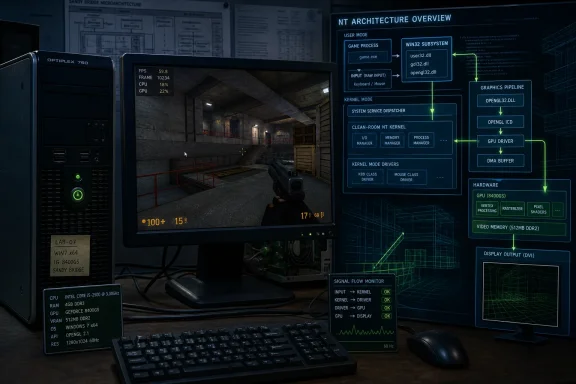 Half-Life Is the Demo, but Windows NT Is the Target
The obvious reaction is to shrug. Half-Life is old enough to vote, rent a car, and complain about younger engines not respecting level design. It runs today on Linux through Steam, through Wine, and through other compatibility paths that are vastly more practical for anyone who simply wants to revisit Black Mesa.ReactOS is doing something different. Wine maps Windows application behavior onto Unix-like operating systems; ReactOS is trying to reproduce the operating system those applications expected to find in the first place. When the Windows build of Half-Life runs on ReactOS, it is not merely being coaxed through a compatibility layer. It is calling into ReactOS’s own Win32 libraries, graphics subsystem, kernel interfaces, and driver model.
That distinction is why this achievement matters. The game is not the destination; it is the workload. A real-time 3D OpenGL application exercises timing, memory management, display drivers, input, file access, windowing, and the messy contracts between user mode and kernel mode. Utilities can make an operating system look compatible. Games have a way of exposing the places where compatibility is still theater.
The reported test system also tells its own story. A Core i5-2400 and GeForce 8400GS are not modern hardware, but they are exactly the kind of commodity PC components that define ReactOS’s practical frontier: late Windows XP and early Windows 7-era machines, where proprietary driver stacks still exist and the hardware is simple enough to be understood, yet complex enough to make success meaningful.
The Graphics Stack Finally Had to Become Real
For years, ReactOS could boot, launch programs, and perform enough Windows-like behavior to sustain both enthusiasm and skepticism. But 3D graphics is an unforgiving line in the sand. If the graphics driver stack is incomplete, the operating system does not get partial credit from the application; the screen freezes, the process crashes, or the game never gets past the menu.The Half-Life run appears to be the downstream effect of ReactOS’s recent work on GPU driver compatibility. Earlier this year, the project and its community pointed to major progress with Windows XP and Server 2003-era graphics drivers, including work around KMDF and WDDM-related plumbing. That phrasing matters because a GPU driver is not a single isolated blob. It expects a web of kernel services, memory behavior, device initialization, interrupt handling, and display interfaces to behave in recognizably Windows-like ways.
OpenGL on Windows adds another layer of expectation. A game such as Half-Life talks through Windows graphics APIs and an installable client driver path before hardware acceleration becomes visible on screen. ReactOS therefore had to be compatible not just with the application, but with the driver’s assumptions about the operating system below it.
That is why “it runs Half-Life” is more substantial than it sounds. The demo validates a chain: Win32 application behavior, window management, input, OpenGL dispatch, NVIDIA driver interaction, and kernel services all surviving long enough to produce interactive gameplay. For a hobby OS, that is a screenshot. For an NT clone, it is a systems integration test with a crowbar.
ReactOS Chose the Hard Road and Has Been Paying for It Since
ReactOS’s central wager has always been almost absurdly ambitious: recreate enough of Windows NT to run Windows applications and drivers without using Microsoft’s code. Not imitate the desktop. Not merely provide a familiar shell. Rebuild the internal contracts that decades of Windows software have come to depend on.That is why the project’s timeline looks glacial when compared with desktop Linux distributions, BSD releases, or even niche hobby kernels. ReactOS is not just writing an operating system; it is writing an operating system whose success is judged by how accurately it behaves like another one. Worse, that “another one” is Windows, a platform whose real behavior is often defined as much by legacy quirks as by documentation.
Compatibility projects eventually learn that applications do not always depend on what the API manual says. They depend on what Windows actually did on a particular version, on a particular driver path, under a particular edge case. If an application accidentally relied on a bug in Windows, then a compatible replacement may need to reproduce that bug. Clean design is not the highest virtue here. Fidelity is.
ReactOS’s clean-room constraint makes that work slower and more legally delicate. The project cannot simply read Microsoft source code and retype an open-source equivalent. It must infer behavior from public documentation, testing, observation, and reverse engineering boundaries that avoid proprietary code. That makes each subsystem less like normal software development and more like reconstructing a machine from its shadow.
The project’s history reflects the weight of that burden. After a 2006 controversy over alleged use of disassembled Windows code, ReactOS paused development for an internal audit and tightened its intellectual-property procedures. That episode still hangs over the project because ReactOS’s value depends on trust. If it is not clean, it is not an open-source Windows alternative; it is a lawsuit waiting to happen.
Wine Solved One Problem, ReactOS Is Still Solving Another
The comparison with Wine is inevitable, but it is often made too casually. Wine is a compatibility layer that lets Windows applications run on top of Linux, macOS, and other host systems by implementing Windows APIs and translating their behavior into calls the host OS can provide. Proton, Valve’s gaming-focused Wine derivative, has transformed Linux gaming precisely because that model works astonishingly well.ReactOS shares some user-mode code history and cooperation with Wine, but its ambition diverges at the kernel boundary. Wine does not provide a Windows NT kernel. ReactOS does. That means ReactOS must care about Windows drivers, boot behavior, kernel APIs, system calls, device stacks, and the lower layers that Wine can often route around by relying on Linux.
In practical terms, Wine and Proton are the tools most users should reach for today. They run more software, support vastly more modern hardware indirectly through Linux, and benefit from commercial investment that ReactOS does not have. If your goal is to play old Windows games, ReactOS is not the convenient answer.
But ReactOS has a different historical and technical value. It asks whether the Windows application and driver ecosystem can be preserved independently of Microsoft’s operating system licensing and product lifecycle. Wine preserves the application layer by mapping it elsewhere. ReactOS tries to preserve the platform itself.
That difference becomes especially important for legacy hardware, old industrial systems, specialized Windows applications, and software preservation. Plenty of software was written not merely for “Windows apps” in the abstract, but for specific expectations about drivers, services, file paths, registry behavior, and NT-era system semantics. A working open-source NT clone has a different preservation profile than a compatibility layer.
The Server 2003 Target Is a Feature and a Constraint
ReactOS currently aims at the Windows Server 2003 and NT 5.x compatibility era, which explains both the excitement and the limits of the Half-Life milestone. Server 2003 sits close enough to Windows XP to matter for a huge library of legacy applications and drivers. It is also far enough from modern Windows that nobody should mistake this for a Windows 11 replacement in waiting.That target gives ReactOS a coherent engineering surface. Windows XP-era drivers and applications are old enough to be studied, tested, and run on affordable used hardware. They also predate much of the modern complexity of Windows graphics, security, and driver isolation. If ReactOS can become reliable there, it will have achieved something genuinely useful before it tries to chase the modern desktop.
The downside is obvious. Modern Windows software expects NT 6.x and later behavior, modern DirectX stacks, recent browser assumptions, stronger security models, contemporary hardware support, and a driver ecosystem that moved on long ago. Even if ReactOS can run Half-Life, that does not imply it can run a modern Chromium browser comfortably, handle current anti-cheat systems, or support a recent GPU in the way Windows 10 or 11 does.
This is where enthusiasts sometimes overstate the case. ReactOS is not about to become the escape hatch for every user unhappy with Windows telemetry, ads, accounts, or hardware requirements. It remains alpha software, and the project itself warns users to treat it as experimental. A milestone is not a product launch.
Still, the Server 2003 target makes the project more credible, not less. ReactOS is not trying to swallow the entire Windows universe at once. It is trying to get one historically important layer of that universe right enough that real applications and real drivers stop immediately falling apart. The Half-Life demo suggests that, at least in one hardware and software configuration, the stack has crossed that threshold.
The Driver Story Is Where IT Pros Should Pay Attention
For sysadmins and enterprise IT readers, the game itself is less interesting than the driver behavior underneath it. Drivers are where operating systems become accountable to hardware reality. They are also where compatibility claims usually go to die.ReactOS’s reported GPU progress matters because Windows compatibility without driver compatibility is a partial answer. Many legacy applications can be virtualized, wrapped, or replaced. Hardware-bound systems are harder. Manufacturing equipment, lab instruments, kiosks, medical-adjacent devices, and old field systems often depend on device drivers that were written for a narrow Windows generation and never updated again.
That does not mean ReactOS should be deployed in those contexts today. It should not. Alpha software has no business becoming the silent foundation of production infrastructure, especially where safety, compliance, or uptime matters. But the direction is still important. An open NT-compatible system with improving driver support could eventually become a lab, migration, recovery, or preservation tool for organizations trapped between aging hardware and unsupported Windows releases.
The more immediate implication is testing. If ReactOS can load more XP and Server 2003-era drivers, it becomes a way to observe the old Windows driver world under open-source conditions. Bugs can be inspected. Failures can be traced. Behaviors that were previously locked inside a proprietary OS can be studied in a system that the community can instrument and modify.
That is the quiet value of ReactOS. It does not need to replace Windows on modern desktops to matter. It only needs to make opaque Windows-era software and hardware more understandable, recoverable, and portable than they are today.
The 0.4.15 Release Reset the Baseline
ReactOS 0.4.15, released in March 2025 after a long gap from the previous stable release, was important less because it made ReactOS mainstream and more because it showed the project could still consolidate years of work into a public checkpoint. The release brought improvements across Plug and Play, audio, memory management, registry stability, shell components, and bundled tools. For a project with a volunteer-heavy development model, that kind of consolidation matters.The gap between stable releases has always been part of the ReactOS problem. Nightly builds may contain exciting progress, but stable releases are what outside observers use to judge whether the project is alive, coherent, and testable. A compatibility project can have brilliant patches scattered across branches and still fail to persuade users if it cannot ship.
The project’s recent funding and staffing signals also matter. ReactOS Deutschland e.V. bringing a developer into a full-time contract role is not the same thing as a corporate engineering department, but it is a meaningful step for a project that has spent most of its life depending on volunteer attention. Compatibility work rewards persistence more than glamour. Paid continuity can be the difference between a promising subsystem and a maintained one.
That is why the Half-Life milestone should be read alongside the release cadence and driver work. It is not an isolated stunt. It is evidence that the project is finding seams where long-running architectural work can produce visible, testable results. The question is whether ReactOS can turn more of those seams into repeatable releases.
The Preservation Argument Is Getting Stronger
Microsoft’s Windows ecosystem has always been unusually good at backward compatibility, but it is not infinite. Old versions leave support. Drivers stop being signed, hosted, or installable. Hardware fails. Activation systems and online dependencies complicate restoration. The fact that Windows software once ran everywhere does not guarantee that it will remain runnable forever.ReactOS sits in that uncomfortable space between nostalgia and infrastructure. On one side are retrocomputing enthusiasts who want old software to feel native again. On the other are organizations with legacy dependencies that cannot be wished away. Both groups benefit from an open implementation that can be studied, patched, and preserved.
Half-Life is a useful symbol precisely because it is not obscure enterprise middleware. It is a well-known Windows game with a real engine, real rendering needs, and a cultural footprint large enough that people understand the benchmark intuitively. If ReactOS can run that, it invites a broader question: what else from the Windows XP era can be made to live again without requiring a licensed copy of Windows XP?
The answer today is still uneven. Some applications run. Some fail. Some hardware works. Some does not. But software preservation is rarely won in a single leap. It is won by accumulating compatibility until the exceptions become narrower and better understood.
ReactOS’s advantage is that its ceiling is conceptually high. If the NT-compatible foundation matures, applications and drivers that expect Windows-like internals have somewhere to land. Its disadvantage is that every inch of that foundation is expensive to build.
The Catch Is That Alpha Still Means Alpha
The danger with a milestone like this is that it will be mistaken for readiness. ReactOS running Half-Life on a specific machine does not mean ReactOS is ready to replace Windows, revive every XP-era gaming rig, or become the default answer for unsupported PCs. It means one difficult class of workload now has a confirmed success case.Daily use remains a different standard. A modern desktop OS has to handle web browsing, security updates, hardware diversity, power management, file synchronization, printers, GPU acceleration, multiple displays, installers, crashes, and the thousand paper cuts that users do not forgive. ReactOS still falls short of that standard.
There is also the security problem. Reimplementing an older Windows-compatible platform means inheriting parts of an old threat model while trying not to inherit its vulnerabilities. A system designed for compatibility with XP-era software must be careful not to become compatible with XP-era assumptions about trust. For enthusiasts in a lab, that is manageable. For exposed systems, it is a red flag.
The healthiest reading of the Half-Life news is therefore neither hype nor dismissal. ReactOS has not suddenly become ready for your main PC. It has, however, demonstrated that its long-term architecture can support a workload that would have been easy to write off as perpetually out of reach.
Black Mesa Gives ReactOS Its Cleanest Proof Point Yet
The concrete lessons from this milestone are narrower than the excitement, but more important than the skeptics might allow. ReactOS has earned a stronger claim to technical seriousness, while still leaving users with every reason to treat it as experimental.- ReactOS has now reportedly run the Windows version of Half-Life in-game on real consumer hardware without relying on Wine, Proton, Linux, or a Windows installation.
- The achievement matters because it exercises the Win32 graphics path, OpenGL driver handoff, input, memory behavior, and NT-compatible kernel services at the same time.
- The milestone appears tied to recent GPU driver compatibility work for XP and Server 2003-era hardware, especially around NVIDIA, Intel, and AMD devices from that older generation.
- ReactOS remains alpha software and should still be treated as a testing, research, and preservation platform rather than a daily operating system.
- The project’s real promise is not modern gaming, but the long-term preservation and study of Windows NT-era applications, drivers, and hardware dependencies.
References
- Primary source: Tech Times
Published: 2026-06-11T10:40:43.719627
ReactOS Runs Half-Life Natively: Open-Source Windows NT Clone Clears 3D Graphics Bar
ReactOS open source Windows clone ran Half-Life in-game for the first time in 30 years of development. A March 2026 GPU driver milestone implementing WDDM and KMDF unlocked the GoldSrc OpenGLwww.techtimes.com - Related coverage: phoronix.com
ReactOS 0.4.15 Released For This "Open-Source Windows" OS With Tons Of Enhancements - Phoronix
It's been over three years since the last ReactOS open-source operating system release for this platform working on API/ABI compatibility with Microsoft Windowswww.phoronix.com
- Related coverage: reactos.org
ReactOS 0.4.15 released | ReactOS Project
ReactOS is a free, opensource reimplementation of windowsreactos.org
- Related coverage: tech.slashdot.org
Intel, NVIDIA, AMD GPU Drivers Finally Play Nice With ReactOS - Slashdot
ReactOS aims to be compatible with programs and drivers developed for Windows Server 2003 and later versions of Microsoft Windows. And Slashdot reader jeditobe reports that the project has now "announced significant progress in achieving compatibility with proprietary graphics drivers."...tech.slashdot.org - Related coverage: sourceforge.net
ReactOS - Browse /ReactOS at SourceForge.net
ReactOS /ReactOS files. Browse /ReactOS files for ReactOS, An operating system based on the best Windows NT design principles sourceforge.net
- Official source: github.com
GitHub - reactos/reactos: A free Windows-compatible Operating System · GitHub
A free Windows-compatible Operating System. Contribute to reactos/reactos development by creating an account on GitHub. github.com
- Related coverage: howtogeek.com
ReactOS, the Open-Source Windows, Just Got an Update
It probably can't replace your Windows 11 PC yet, though. Or Windows 10. Or Windows 7... www.howtogeek.com
- Related coverage: theregister.com
ReactOS emits release 0.4.15 – first since 2021
: An impressive recreation of the Windows golden agewww.theregister.com - Related coverage: deskmodder.de
ReactOS wurde als Version 0.4.15 freigegeben [Update] - Deskmodder.de
(Original 22.03.2025): Mal als Info für die experimentierfreudigen unter euch. Für ReactOS wurde nach langer, oder besser gesagt nach sehr langer Zeit ein Stable Update auf die Version 0.4.15 freigegeben. Diese Version steht als Boot-Version, oder auch Live-CD bereit. ReactOS…www.deskmodder.de - Related coverage: edv-nachrichten.de
Betriebssystem ReactOS 0.4.15 erschienen * edv-nachrichten.de
edv-nachrichten.de: Betriebssystem ReactOS 0.4.15 erschienenwww.edv-nachrichten.de - Related coverage: matsuura.com.br
ReactOS 0.4.15
ReactOS é um sistema operacional de código aberto que busca ser binariamente compatível com o Microsoft Windows. O projeto publicou um novo ...www.matsuura.com.br
- Related coverage: tomshardware.com
As Windows 10 signs off, ReactOS devs are exploring a long-awaited feature in WDDM support — investigation could pave the way for newer GPU hardware compatibility | Tom's Hardware
The Windows-alternative OS makes moves to implement Microsoft's modern display driver modelwww.tomshardware.com - Related coverage: ev.reactos.org
