

Redington Limited said on July 6, 2026, that it has earned Microsoft’s Frontier Distributor designation within the Microsoft AI Cloud Partner Program, expanding its recognized role in helping channel partners across India, the Middle East, Turkey, and Africa deploy cloud, AI, security, and business applications. The announcement, reported by CXO DX and framed for investors by Trade Brains, is more than another partner-badge press release. It shows how Microsoft is trying to industrialize AI delivery through its channel, and how regional distributors are racing to become the control layer between hyperscale platforms and thousands of customers that cannot implement AI alone.
Microsoft has spent the past several years telling customers that AI will move from experimentation to production. In 2026, the company’s partner program is being reshaped around that premise. The important shift is not simply that Microsoft has more AI products to sell, but that it needs a larger field force capable of turning Copilot, Azure AI, Microsoft Fabric, Defender, Purview, Dynamics 365, and agent-building tools into working systems.
That is where the Frontier Distributor designation matters. Microsoft describes the designation as a way to identify distributors with validated capabilities across cloud, AI, and security, including technical readiness, reseller enablement, support metrics, compliance, and customer-success benchmarks. In plain English, Microsoft is saying that not every distributor is equally useful in the AI era.
The old distribution model was built around procurement scale. A reseller needed licenses, hardware, credit, logistics, and maybe some pre-sales support. The emerging AI model is messier: customers need data readiness, identity hygiene, security controls, governance, change management, integration work, and ongoing lifecycle support. That changes the distributor’s job from moving boxes and subscriptions to orchestrating capability across the channel.
Redington’s designation lands exactly in that gap. According to CXO DX, Redington said the status gives it enhanced access to Microsoft programs, incentives, and solution-architecture expertise. That may sound like partner-program boilerplate, but for smaller and mid-sized resellers, those benefits can become the difference between selling a cloud SKU and successfully delivering an AI project.
The harder question is whether the story changes the economics. Redington’s reported Q4 FY26 revenue rose strongly year over year, but operating margins remained around 2 percent, a reminder that distribution remains a brutal volume business. The company may be handling more technology spend, but the market will care about whether more of that spend becomes services, support, cloud consumption, and higher-value solution activity.
That is why the Microsoft designation is useful but not magical. It does not convert Redington overnight into a software company, nor does it guarantee margin expansion. Microsoft itself is careful in partner-program language to avoid presenting designations as endorsements or performance guarantees. A badge validates a threshold; it does not deliver the operating leverage by itself.
Still, the designation gives Redington a credible way to argue that its business mix is changing. A distributor that can help partners sell Microsoft 365 Copilot, Azure AI services, security suites, Dynamics 365, and AI-enabled business applications has a better chance of attaching training, enablement, migration, governance, and managed services around those motions. Those are the layers where value can accumulate.
Microsoft’s official blog in April described “Frontier Transformation” as the move from AI experiments to repeatable, governed capability. That phrase is pure Microsoft marketing, but it points at a real operational problem. Many organizations have bought or tested AI tools faster than they have modernized the systems those tools depend on.
That is especially true for Microsoft 365 Copilot and agentic AI scenarios. Copilot can expose the strengths and weaknesses of a tenant’s information architecture almost immediately. If SharePoint sites, Teams permissions, sensitivity labels, retention policies, and identity controls are a mess, AI does not fix the mess; it makes the mess easier to query.
A strong distributor can help resellers avoid selling AI as a magic overlay. It can provide playbooks, workshops, reference architectures, licensing guidance, security templates, and escalation paths. In regions where many customers buy through indirect channels rather than directly from Microsoft, that support structure matters enormously.
In a mature enterprise market, Microsoft can lean heavily on global systems integrators, large managed service providers, and direct enterprise account teams. In fragmented and fast-growing markets, the channel carries more weight. Local resellers often have the customer relationships, procurement knowledge, regulatory awareness, and implementation proximity that a hyperscaler cannot replicate at scale.
That creates an opening for Redington. The company already operates as a broad technology distributor and solutions provider across India, South Asia, the Middle East, Turkey, and Africa. Adding a Microsoft AI designation strengthens its ability to position itself as a regional enablement platform rather than just a supply-chain intermediary.
The timing also suits Microsoft. The company is pushing AI into small and medium businesses, regulated industries, and line-of-business workflows. Those customers are less likely to have armies of cloud architects sitting idle. They need someone to package the implementation path, and Microsoft needs partners who can make that path repeatable.
The Frontier Distributor designation appears to sit at the distribution layer of that sorting system. Microsoft says it validates broad capabilities in cloud, AI, and security and requires authorized distributors to meet technical and sales requirements across categories such as support metrics and reseller enablement. That makes it less like a trophy and more like a channel qualification.
The distinction matters because AI projects fail in ways that ordinary license sales do not. A bad license sale may waste money; a bad AI rollout can create data exposure, poor adoption, reputational damage, and shadow-IT backlash. Microsoft’s interest is obvious: if customers blame AI tools for failures caused by weak implementation, the platform suffers.
This is also why Redington’s role is potentially strategic. A distributor that can train and support many downstream partners can raise the baseline quality of Microsoft deployments in its markets. Microsoft cannot manually supervise every reseller-led Copilot or Azure AI project, so it needs high-capacity intermediaries to carry its architecture and governance assumptions into the field.
The reported quarterly numbers show the tension. Revenue growth was healthy, but operating profit rose only modestly, and profitability was under pressure compared with the year-earlier quarter, which Trade Brains said benefited from significantly higher other income. A low debt-to-equity ratio and comfortable liquidity give Redington room to invest, but they do not prove that AI distribution will materially lift margins.
The bull case is that AI and cloud pull through higher-value activity. Redington can help partners with enablement, implementation support, go-to-market activity, security readiness, and lifecycle services. Over time, those activities could make its business more defensible than pure fulfillment.
The bear case is that hyperscaler partner economics remain competitive and incentive-driven. Distributors may be asked to do more technical work while customers and resellers still resist paying much more for it. If Microsoft incentives shift, if cloud marketplaces compress margins, or if large systems integrators capture the richest transformation work, the upside could be narrower than the AI narrative suggests.
For distributors, this cuts both ways. Marketplace maturity can reduce friction and create more scalable sales motions. It can also make the channel more transparent and competitive, pressuring intermediaries that do not add visible technical or commercial value.
Redington’s Frontier status helps it defend its place in that changing model. If a distributor can help resellers build packaged offers, transact through Microsoft channels, attach implementation services, and support customers after deployment, it remains relevant. If it merely passes through licenses, the marketplace eventually becomes a threat.
The channel’s future will belong to distributors that can combine credit, reach, enablement, and architecture. That mix is hard to build. It requires technical talent, partner trust, vendor alignment, and operational discipline across multiple countries.
Copilot adoption is not just a licensing event. It reaches into Entra ID, SharePoint, OneDrive, Teams, Outlook, Defender, Purview, Intune, Edge, Power Platform, and endpoint management. Customers that have delayed cleanup of permissions, data classification, device posture, or app governance will find that AI makes the bill come due.
That is why Microsoft is investing in partner skilling and distributor readiness. The company knows that many customers will not buy AI successfully through a simple self-service motion. They will need implementation partners who understand the Microsoft stack as a living environment rather than a bundle of products.
Redington’s designation is therefore a small but telling indicator of where Microsoft expects the next wave of work to happen. The AI opportunity is not only in model capability; it is in the operational conversion of existing Microsoft estates into AI-ready environments. That is tedious, lucrative, and very much a channel business.
Redington benefits from the recognition, but Microsoft benefits from the standardization. Every distributor that reorganizes around Microsoft’s AI Cloud Partner Program becomes another node in Microsoft’s go-to-market machine. The designation helps resellers decide whom to work with, but it also helps Microsoft decide whom to empower.
This is not sinister; it is platform economics. Hyperscalers win when ecosystems align around their tools, incentives, and delivery models. Partners win when they can turn that alignment into customer value and repeatable revenue. Customers win only if the resulting projects are secure, useful, and maintainable.
That last condition is the one to watch. The AI channel can easily drift into overpromising. If every customer problem becomes a Copilot opportunity and every workflow becomes an agent story, disappointment will follow. The best distributors will be the ones that help partners qualify projects as well as sell them.
A Microsoft architecture deck does not automatically become a successful deployment in those environments. Partners need pricing guidance, localization, compliance awareness, technical escalation, and help navigating customer expectations. A distributor with real local reach can make a global platform legible to regional buyers.
That is why Redington’s positioning as a “technology aggregator” is more than branding. Aggregation in this context means pulling together vendors, resellers, cloud platforms, financing, support, and services into something a customer can actually consume. In the AI era, that aggregation becomes more valuable because the underlying stack is more complex.
The opportunity is strongest where customers know they need AI but do not know how to sequence the work. Should they start with Microsoft 365 Copilot readiness, data governance, cybersecurity uplift, Azure migration, business-process automation, or custom agents? A capable channel can turn that confusion into a roadmap.
That changes the partner economy. A distributor once focused on PCs, servers, peripherals, and licenses now has to speak the language of SaaS adoption, cloud architecture, compliance, endpoint telemetry, AI governance, and user enablement. The companies that make that transition will remain central to Microsoft’s ecosystem; those that do not will become increasingly commoditized.
Redington appears to understand this. Its portfolio already spans cloud, software, cybersecurity, data center, networking, enterprise, mobility, and lifestyle technology products. The Microsoft designation gives it a sharper credential in the part of the market where customers are expected to spend next.
But the transition will require discipline. AI infrastructure demand can lift revenue while masking weak profitability. The winners will be those that convert volume into repeatable service motions, not those that merely chase every AI SKU pushed through the channel.
Redington’s designation suggests it has convinced Microsoft that it can help with that repeatability. CXO DX reported Microsoft’s Alex Zagury describing Frontier Distributor status as recognition for elite Cloud Solution Provider distributors that help partners accelerate cloud solutions more effectively. That endorsement is valuable, but the operational burden now shifts to Redington.
It must help partners move faster without cutting corners. It must support complex enterprise and multi-country transformation projects without losing the local responsiveness that makes regional channels valuable. It must ride Microsoft’s incentives without becoming too dependent on them.
For customers and sysadmins, the advice is simple: treat the designation as a useful signal, not a substitute for due diligence. A Frontier Distributor-backed partner may have better access to Microsoft resources and stronger enablement, but every AI deployment still needs clear ownership, security review, data-governance readiness, and measurable business goals.
The practical takeaways are concrete:
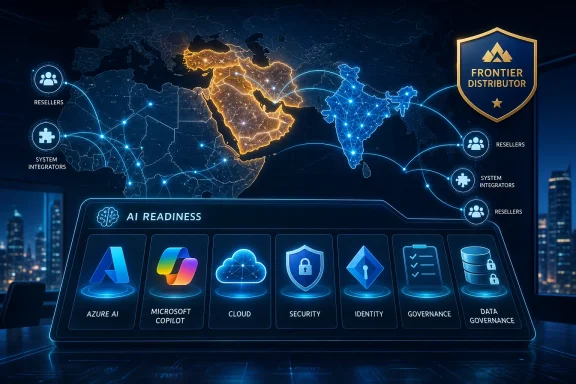 Microsoft’s AI Channel Is Becoming an Execution Machine
Microsoft has spent the past several years telling customers that AI will move from experimentation to production. In 2026, the company’s partner program is being reshaped around that premise. The important shift is not simply that Microsoft has more AI products to sell, but that it needs a larger field force capable of turning Copilot, Azure AI, Microsoft Fabric, Defender, Purview, Dynamics 365, and agent-building tools into working systems.That is where the Frontier Distributor designation matters. Microsoft describes the designation as a way to identify distributors with validated capabilities across cloud, AI, and security, including technical readiness, reseller enablement, support metrics, compliance, and customer-success benchmarks. In plain English, Microsoft is saying that not every distributor is equally useful in the AI era.
The old distribution model was built around procurement scale. A reseller needed licenses, hardware, credit, logistics, and maybe some pre-sales support. The emerging AI model is messier: customers need data readiness, identity hygiene, security controls, governance, change management, integration work, and ongoing lifecycle support. That changes the distributor’s job from moving boxes and subscriptions to orchestrating capability across the channel.
Redington’s designation lands exactly in that gap. According to CXO DX, Redington said the status gives it enhanced access to Microsoft programs, incentives, and solution-architecture expertise. That may sound like partner-program boilerplate, but for smaller and mid-sized resellers, those benefits can become the difference between selling a cloud SKU and successfully delivering an AI project.
Redington Is Trying to Escape the Gravity of Low-Margin Distribution
Trade Brains cast the announcement in market language, noting that Redington’s stock was trading around Rs 277, with a market capitalization of roughly Rs 21,659 crore and a P/E ratio below the cited peer median. That framing is unsurprising: investors are hunting for companies that can claim exposure to the AI infrastructure cycle without paying hyperscaler multiples. Redington now has a cleaner story to tell.The harder question is whether the story changes the economics. Redington’s reported Q4 FY26 revenue rose strongly year over year, but operating margins remained around 2 percent, a reminder that distribution remains a brutal volume business. The company may be handling more technology spend, but the market will care about whether more of that spend becomes services, support, cloud consumption, and higher-value solution activity.
That is why the Microsoft designation is useful but not magical. It does not convert Redington overnight into a software company, nor does it guarantee margin expansion. Microsoft itself is careful in partner-program language to avoid presenting designations as endorsements or performance guarantees. A badge validates a threshold; it does not deliver the operating leverage by itself.
Still, the designation gives Redington a credible way to argue that its business mix is changing. A distributor that can help partners sell Microsoft 365 Copilot, Azure AI services, security suites, Dynamics 365, and AI-enabled business applications has a better chance of attaching training, enablement, migration, governance, and managed services around those motions. Those are the layers where value can accumulate.
The Channel Needs Fewer Catalogs and More Architects
For WindowsForum readers, the more interesting story is not Redington’s share price. It is the way Microsoft’s AI strategy increasingly depends on channel partners who understand the unglamorous plumbing of enterprise IT. AI pilots are easy to demo; production AI is where identity, permissions, data loss prevention, audit trails, endpoint security, tenant configuration, and business-process ownership collide.Microsoft’s official blog in April described “Frontier Transformation” as the move from AI experiments to repeatable, governed capability. That phrase is pure Microsoft marketing, but it points at a real operational problem. Many organizations have bought or tested AI tools faster than they have modernized the systems those tools depend on.
That is especially true for Microsoft 365 Copilot and agentic AI scenarios. Copilot can expose the strengths and weaknesses of a tenant’s information architecture almost immediately. If SharePoint sites, Teams permissions, sensitivity labels, retention policies, and identity controls are a mess, AI does not fix the mess; it makes the mess easier to query.
A strong distributor can help resellers avoid selling AI as a magic overlay. It can provide playbooks, workshops, reference architectures, licensing guidance, security templates, and escalation paths. In regions where many customers buy through indirect channels rather than directly from Microsoft, that support structure matters enormously.
India, META, and the Geography of Microsoft’s Next AI Wave
Redington’s announcement specifically points to India, the Middle East, Turkey, and Africa as key markets. That geographic detail is not incidental. These are regions where cloud adoption, government digital programs, cybersecurity modernization, and AI investment are moving quickly, but where enterprise maturity varies sharply by industry and country.In a mature enterprise market, Microsoft can lean heavily on global systems integrators, large managed service providers, and direct enterprise account teams. In fragmented and fast-growing markets, the channel carries more weight. Local resellers often have the customer relationships, procurement knowledge, regulatory awareness, and implementation proximity that a hyperscaler cannot replicate at scale.
That creates an opening for Redington. The company already operates as a broad technology distributor and solutions provider across India, South Asia, the Middle East, Turkey, and Africa. Adding a Microsoft AI designation strengthens its ability to position itself as a regional enablement platform rather than just a supply-chain intermediary.
The timing also suits Microsoft. The company is pushing AI into small and medium businesses, regulated industries, and line-of-business workflows. Those customers are less likely to have armies of cloud architects sitting idle. They need someone to package the implementation path, and Microsoft needs partners who can make that path repeatable.
The Frontier Label Is Microsoft’s Attempt to Police AI Readiness
Partner ecosystems have a familiar weakness: everyone claims expertise. Cloud, security, AI, data, productivity, compliance — every reseller’s website now seems to contain the same vocabulary. Microsoft’s designations are partly a response to that sameness. They create a sorting mechanism for customers and resellers looking for partners whose capabilities have been measured against program criteria.The Frontier Distributor designation appears to sit at the distribution layer of that sorting system. Microsoft says it validates broad capabilities in cloud, AI, and security and requires authorized distributors to meet technical and sales requirements across categories such as support metrics and reseller enablement. That makes it less like a trophy and more like a channel qualification.
The distinction matters because AI projects fail in ways that ordinary license sales do not. A bad license sale may waste money; a bad AI rollout can create data exposure, poor adoption, reputational damage, and shadow-IT backlash. Microsoft’s interest is obvious: if customers blame AI tools for failures caused by weak implementation, the platform suffers.
This is also why Redington’s role is potentially strategic. A distributor that can train and support many downstream partners can raise the baseline quality of Microsoft deployments in its markets. Microsoft cannot manually supervise every reseller-led Copilot or Azure AI project, so it needs high-capacity intermediaries to carry its architecture and governance assumptions into the field.
The Investor Pitch Is Plausible, but the Margin Test Comes Later
Trade Brains presented Redington as a company in transition from a high-volume, low-margin hardware distributor into a technology solutions orchestrator. That is the right ambition, and the Microsoft designation gives it substance. But investors should separate a stronger strategic position from proven financial transformation.The reported quarterly numbers show the tension. Revenue growth was healthy, but operating profit rose only modestly, and profitability was under pressure compared with the year-earlier quarter, which Trade Brains said benefited from significantly higher other income. A low debt-to-equity ratio and comfortable liquidity give Redington room to invest, but they do not prove that AI distribution will materially lift margins.
The bull case is that AI and cloud pull through higher-value activity. Redington can help partners with enablement, implementation support, go-to-market activity, security readiness, and lifecycle services. Over time, those activities could make its business more defensible than pure fulfillment.
The bear case is that hyperscaler partner economics remain competitive and incentive-driven. Distributors may be asked to do more technical work while customers and resellers still resist paying much more for it. If Microsoft incentives shift, if cloud marketplaces compress margins, or if large systems integrators capture the richest transformation work, the upside could be narrower than the AI narrative suggests.
Microsoft’s Marketplace Ambition Raises the Stakes
Microsoft’s April partner-program update also emphasized Marketplace-backed motions, agent sales, and repeatable AI offers. That is important because marketplaces are becoming the procurement rail for cloud software and services. Microsoft wants partners to package solutions in ways customers can discover, buy, and deploy more quickly.For distributors, this cuts both ways. Marketplace maturity can reduce friction and create more scalable sales motions. It can also make the channel more transparent and competitive, pressuring intermediaries that do not add visible technical or commercial value.
Redington’s Frontier status helps it defend its place in that changing model. If a distributor can help resellers build packaged offers, transact through Microsoft channels, attach implementation services, and support customers after deployment, it remains relevant. If it merely passes through licenses, the marketplace eventually becomes a threat.
The channel’s future will belong to distributors that can combine credit, reach, enablement, and architecture. That mix is hard to build. It requires technical talent, partner trust, vendor alignment, and operational discipline across multiple countries.
Windows Shops Should Read This as a Copilot Deployment Signal
For many Windows-centric IT teams, the Redington story may seem distant: an Indian-listed distributor, a Microsoft partner designation, a stock-market angle. But the practical implications are close to home. Microsoft’s AI roadmap is increasingly inseparable from the Microsoft 365 and Windows enterprise stack.Copilot adoption is not just a licensing event. It reaches into Entra ID, SharePoint, OneDrive, Teams, Outlook, Defender, Purview, Intune, Edge, Power Platform, and endpoint management. Customers that have delayed cleanup of permissions, data classification, device posture, or app governance will find that AI makes the bill come due.
That is why Microsoft is investing in partner skilling and distributor readiness. The company knows that many customers will not buy AI successfully through a simple self-service motion. They will need implementation partners who understand the Microsoft stack as a living environment rather than a bundle of products.
Redington’s designation is therefore a small but telling indicator of where Microsoft expects the next wave of work to happen. The AI opportunity is not only in model capability; it is in the operational conversion of existing Microsoft estates into AI-ready environments. That is tedious, lucrative, and very much a channel business.
The Badge Helps Redington, but It Also Helps Microsoft Control the Narrative
Microsoft’s partner designations are not neutral artifacts. They are instruments of strategy. By defining what counts as a high-performing AI-era distributor, Microsoft nudges the channel toward its preferred motions: cloud consumption, security attachment, Copilot adoption, Marketplace transactions, agent-building, and governed AI deployments.Redington benefits from the recognition, but Microsoft benefits from the standardization. Every distributor that reorganizes around Microsoft’s AI Cloud Partner Program becomes another node in Microsoft’s go-to-market machine. The designation helps resellers decide whom to work with, but it also helps Microsoft decide whom to empower.
This is not sinister; it is platform economics. Hyperscalers win when ecosystems align around their tools, incentives, and delivery models. Partners win when they can turn that alignment into customer value and repeatable revenue. Customers win only if the resulting projects are secure, useful, and maintainable.
That last condition is the one to watch. The AI channel can easily drift into overpromising. If every customer problem becomes a Copilot opportunity and every workflow becomes an agent story, disappointment will follow. The best distributors will be the ones that help partners qualify projects as well as sell them.
Redington’s Real Advantage Is Regional Translation
The biggest advantage Redington may have is not the badge itself but its ability to translate Microsoft’s global program into regional execution. India, the Gulf, Turkey, and African markets are not a single sales territory with uniform buying behavior. They contain public-sector modernization projects, family-owned conglomerates, banks, telcos, SMBs, startups, and multinational subsidiaries with very different levels of cloud maturity.A Microsoft architecture deck does not automatically become a successful deployment in those environments. Partners need pricing guidance, localization, compliance awareness, technical escalation, and help navigating customer expectations. A distributor with real local reach can make a global platform legible to regional buyers.
That is why Redington’s positioning as a “technology aggregator” is more than branding. Aggregation in this context means pulling together vendors, resellers, cloud platforms, financing, support, and services into something a customer can actually consume. In the AI era, that aggregation becomes more valuable because the underlying stack is more complex.
The opportunity is strongest where customers know they need AI but do not know how to sequence the work. Should they start with Microsoft 365 Copilot readiness, data governance, cybersecurity uplift, Azure migration, business-process automation, or custom agents? A capable channel can turn that confusion into a roadmap.
The Windows Ecosystem Is Being Rewired Around AI Services
There is a broader Windows ecosystem story here. Microsoft’s center of gravity has shifted from operating-system dominance to cloud-and-AI platform control. Windows still matters, but it increasingly acts as an endpoint surface for identity, management, security, productivity, and AI experiences that live across Microsoft’s cloud.That changes the partner economy. A distributor once focused on PCs, servers, peripherals, and licenses now has to speak the language of SaaS adoption, cloud architecture, compliance, endpoint telemetry, AI governance, and user enablement. The companies that make that transition will remain central to Microsoft’s ecosystem; those that do not will become increasingly commoditized.
Redington appears to understand this. Its portfolio already spans cloud, software, cybersecurity, data center, networking, enterprise, mobility, and lifestyle technology products. The Microsoft designation gives it a sharper credential in the part of the market where customers are expected to spend next.
But the transition will require discipline. AI infrastructure demand can lift revenue while masking weak profitability. The winners will be those that convert volume into repeatable service motions, not those that merely chase every AI SKU pushed through the channel.
The Fine Print Is Where the Strategy Becomes Real
The most important word in Microsoft’s partner-program language may be repeatable. Microsoft is not looking for heroic one-off AI projects. It wants playbooks that can be sold, deployed, governed, supported, and expanded across customer segments. That is the only way to scale AI adoption beyond early adopters and large enterprises.Redington’s designation suggests it has convinced Microsoft that it can help with that repeatability. CXO DX reported Microsoft’s Alex Zagury describing Frontier Distributor status as recognition for elite Cloud Solution Provider distributors that help partners accelerate cloud solutions more effectively. That endorsement is valuable, but the operational burden now shifts to Redington.
It must help partners move faster without cutting corners. It must support complex enterprise and multi-country transformation projects without losing the local responsiveness that makes regional channels valuable. It must ride Microsoft’s incentives without becoming too dependent on them.
For customers and sysadmins, the advice is simple: treat the designation as a useful signal, not a substitute for due diligence. A Frontier Distributor-backed partner may have better access to Microsoft resources and stronger enablement, but every AI deployment still needs clear ownership, security review, data-governance readiness, and measurable business goals.
The Microsoft Badge Is Only the Opening Bid
Redington’s new status is best understood as an option on the next phase of Microsoft’s ecosystem, not as proof that the option has already paid off. The designation gives the company a stronger position in a market where AI adoption is moving from boardroom ambition to procurement and implementation. It also gives Microsoft another scaled route into regions where channel execution will determine how much AI revenue becomes durable cloud consumption.The practical takeaways are concrete:
- Redington has earned Microsoft’s Frontier Distributor designation within the Microsoft AI Cloud Partner Program, with a stated focus on India, the Middle East, Turkey, and Africa.
- Microsoft uses the designation to identify distributors with validated capabilities across cloud, AI, security, reseller enablement, support, and customer success.
- The designation may help Redington move further beyond traditional low-margin distribution, but margin expansion will depend on services attachment, execution quality, and partner adoption.
- For Microsoft customers, the news reinforces that Copilot and Azure AI deployments will increasingly be delivered through trained channel ecosystems rather than direct platform sales alone.
- For Windows and Microsoft 365 administrators, the AI opportunity still depends on tenant hygiene, identity controls, permissions, security posture, data governance, and lifecycle support.
References
- Primary source: Trade Brains
Published: 2026-07-07T05:53:14.459728
Loading…
tradebrains.in - Related coverage: channelbiz.es
Loading…
www.channelbiz.es - Official source: blogs.microsoft.com
Accelerating Frontier Transformation with Microsoft partners - The Official Microsoft Blog
AI has moved quickly from experimentation to production. Customers want measurable business outcomes, along with security, governance and responsible AI built in from day one. Microsoft partners are a meaningful differentiator to deliver these objectives. They turn ideas into deployable...blogs.microsoft.com - Related coverage: cxodx.com
Loading…
cxodx.com - Official source: partner.microsoft.com
Differentiate your capabilities with Solutions Partner designations
Attain a Solutions Partner designation and drive success with badging and benefits that help you stand out to customers.partner.microsoft.com
- Related coverage: crn.de
Loading…
www.crn.de
- Official source: learn.microsoft.com
Solutions Partner FAQs - Partner Center | Microsoft Learn
Answers to frequently asked questions about the Solutions Partner program.learn.microsoft.com - Related coverage: businesswire.com
Loading…
www.businesswire.com - Related coverage: techintelpro.com
Loading…
techintelpro.com - Related coverage: investing.com
Ingram Micro earns Microsoft Frontier Distributor designation By Investing.com
Ingram Micro earns Microsoft Frontier Distributor designationwww.investing.com - Related coverage: itpro.com
Loading…
www.itpro.com - Related coverage: s21.q4cdn.com
TD SYNNEX Achieves Microsofts Newly Established Frontier Distributor Designation 2026
PDF documents21.q4cdn.com
- Related coverage: redingtongroup.com
Loading…
redingtongroup.com - Related coverage: news.cognizant.com
Cognizant and Microsoft Expand Partnership to Advance AI Transformation and Frontier Firm Experiences - Dec 18, 2025
PDF documentnews.cognizant.com
- Official source: cdn-dynmedia-1.microsoft.com