

Redis this week tied its AI infrastructure pitch more tightly to Microsoft Azure, saying it will showcase Azure Managed Redis at Microsoft Build 2026 while also promoting its selection for Redpoint’s InfraRed 100 list of emerging infrastructure companies. The move is not just another partner-marketing lap around the AI track. Redis is trying to redefine what an in-memory database is for in the agent era: not merely a place to cache data, but a place to keep AI systems fast, contextual, and economically survivable.
For most of its life, Redis has been easy to explain and hard to replace. It sat near the application, held hot data in memory, and spared back-end databases from repetitive work. If a login session, product catalog entry, rate-limit counter, or leaderboard needed to be read constantly and updated quickly, Redis was often the answer.
AI agents complicate that old story, but they also make it more valuable. The modern agentic application does not simply retrieve a record and render a page. It receives a prompt, decides what context matters, searches across prior conversations or documents, calls tools, generates intermediate steps, and tries to produce a useful answer before the user gives up or the cloud bill gets ugly.
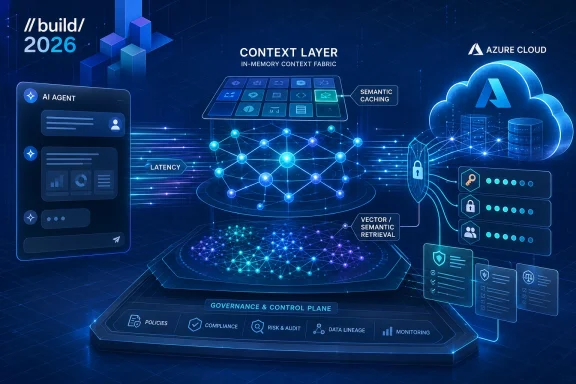
That is the opening Redis is now pressing. The company’s Build 2026 messaging around Azure Managed Redis emphasizes real-time memory, context handling, vector search, semantic caching, and retrieval-augmented generation. Those are not ornamental AI features. They are the plumbing that determines whether an agent feels responsive or sluggish, grounded or hallucinatory, affordable or ruinous at scale.
The argument is blunt: if AI agents are going to act in real time, their context layer cannot behave like a slow archive. It has to behave like operational infrastructure.
That is a meaningful shift. In the pre-agent era, Redis could be adopted by application teams almost invisibly. A developer added it for caching, queues, session state, or pub/sub, and the business rarely noticed. In the AI era, the memory and retrieval layer is no longer hidden plumbing; it is part of the product’s quality, cost model, and risk profile.
Azure Managed Redis also gives Microsoft customers a familiar operational wrapper. Microsoft operates the managed service, and Redis Enterprise capabilities sit behind Azure procurement, monitoring, identity, and networking expectations. For IT teams wary of stitching together another external AI database just to support a chatbot, that packaging matters.
The Build agenda described by Redis — a lightning talk, an on-demand developer session, and a presence in a shared Azure Data and NoSQL booth — is modest in format but strategic in placement. Redis is not trying to be the star of Build. It is trying to be seen as one of the pieces serious Azure AI applications quietly need.
That distinction matters because the AI infrastructure market is already crowded with vector databases, search engines, model gateways, orchestration frameworks, observability tools, and prompt-management platforms. Redis cannot win merely by saying it stores embeddings. Plenty of systems can store embeddings. Redis’s stronger claim is that the AI application needs a low-latency substrate for deciding which context should be brought into a model at the moment of action.
Semantic caching is the clearest example. Traditional caching says: if this exact key appears again, return the stored value. Semantic caching says: if this new prompt means nearly the same thing as an earlier one, return or reuse the earlier result. That matters for large language models because users rarely ask the same thing the same way twice.
In practice, semantic caching can reduce latency and token spending, but it also introduces judgment calls. Set the similarity threshold too loosely and an application may return a stale or subtly wrong answer. Set it too tightly and the cache barely helps. Redis’s role, then, is not magic; it is a fast decision layer that developers still have to tune responsibly.
This is where the old Redis identity helps. The company has long lived in the unforgiving world of operational latency. AI hype may be new, but the requirement to answer quickly under load is not.
Azure AI Foundry and related agent frameworks are designed to help developers build, evaluate, and deploy AI applications. Redis’s pitch complements that by focusing on what happens when the agent needs state and memory. The model may reason, but the system around it has to remember, retrieve, filter, and respond.
This is particularly relevant for WindowsForum’s core audience of administrators and IT pros. Enterprise AI does not fail only because the model gives a bad answer. It fails because access controls are unclear, latency is inconsistent, data is duplicated across fragile stores, or costs scale faster than usage value. Infrastructure choices are not glamorous, but they decide whether a pilot becomes a platform.
Redis’s Azure alignment also reflects a broader consolidation pattern. Enterprises do not want a dozen boutique AI infrastructure vendors scattered across critical workflows. They want capabilities that plug into the cloud estates they already govern. By showing up inside Azure’s AI narrative, Redis is making a case that it belongs in the approved architecture diagram.
Still, market signals matter. Enterprise buyers are trying to distinguish durable infrastructure companies from a swarm of AI-era wrappers, prototypes, and narrow point solutions. A venture firm’s recognition does not prove Redis has solved agentic infrastructure, but it does indicate that Redis is part of the conversation about who will supply the lower layers of the AI stack.
The Redpoint framing around reliability, scalability, security, and innovation is also telling. Those are the categories AI applications have to graduate into after the demo phase. A chatbot that works for 20 employees in a lab is one thing. A copilot that serves thousands of employees, respects permissions, survives traffic spikes, and avoids runaway inference costs is another.
Redis’s phrase “context orchestration at scale” is therefore both useful and dangerous. Useful because it names a real problem: agents need the right context quickly. Dangerous because it risks becoming another cloud-era abstraction that sounds complete while hiding substantial implementation work.
For buyers, the right interpretation is neither cynicism nor credulity. Redis is not suddenly an AI company because it appears on an infrastructure list. It is a mature data infrastructure company trying to apply its strongest traits — speed, proximity, operational familiarity — to a new workload class.
This is why Redis’s push into semantic cache, vector search, and real-time memory should be read as more than opportunistic branding. Agent workflows can be chatty. They may need to fetch user history, retrieve documentation, compare embeddings, check permissions, call APIs, and summarize results. Each step adds delay, cost, and failure surface.
An in-memory system cannot fix every one of those problems. It can, however, reduce the penalty for the parts that repeat or require fast comparison. If a support copilot sees thousands of near-identical questions, semantic caching can keep it from paying full model price every time. If an internal assistant needs to retrieve relevant policy fragments, vector search close to the application path can shorten the round trip.
The trick is that speed must not outrun correctness. Caching is easy when the answer is a product image or a stock page fragment. It is harder when the answer is an AI-generated recommendation, a compliance interpretation, or a troubleshooting step. Redis’s opportunity will depend partly on tooling, partly on developer discipline, and partly on whether organizations understand that AI memory needs governance as much as performance.
Redis’s best case is low-latency operational AI. If an application already uses Redis for session data, caching, rate limits, or real-time state, adding semantic cache or vector search nearby can simplify the architecture. The same layer that accelerates the app can also help accelerate the AI path.
That does not make Redis the universal answer. Search-heavy knowledge systems may still prefer Azure AI Search or another dedicated retrieval platform. Data-rich transactional systems may lean toward databases that keep vectors beside authoritative records. Analytics-heavy pipelines may land elsewhere entirely. The winning architecture depends on the workload, not the logo.
But Redis has one advantage many AI-native startups lack: it is already present in a huge number of application stacks. For teams trying to add AI capabilities without rebuilding their data architecture from scratch, that familiarity is a serious asset. The easiest infrastructure to approve is often the infrastructure an organization already knows how to operate.
These are not edge cases. They are the administrative reality of agentic systems. A cache can become a shadow memory. A vector index can leak relationships between documents. A stale answer can persist long after the authoritative source changed. The faster the system becomes, the easier it is to spread mistakes at scale.
Azure Managed Redis can fit into Microsoft’s security and operations model, but customers still need design discipline. Network isolation, identity integration, monitoring, and managed operations are necessary foundations. They are not substitutes for retention policies, evaluation harnesses, prompt-risk reviews, and access-aware retrieval.
That is why Redis’s “context orchestration” framing needs to be paired with a governance story. Context is not just data that makes an answer better. In enterprise environments, context is often privileged, regulated, incomplete, or time-sensitive. The system that retrieves it becomes part of the trust boundary.
AI infrastructure threatens that clarity. Terms like semantic caching, agent memory, context orchestration, and retrieval-augmented generation can quickly turn a straightforward product into a conceptual fog bank. Redis has to move up the stack without losing the reason developers trusted it in the first place.
The Azure Managed Redis story helps because it anchors the AI pitch in concrete capabilities. RediSearch enables search and vector similarity. RedisJSON supports document-like structures. RedisBloom and other probabilistic structures support fast approximate decisions. These are understandable building blocks, not just AI adjectives.
Still, Redis must be careful. If it sells itself as the universal memory layer for agents, it will collide with every orchestration framework, vector database, search service, and cloud-native data platform making a similar claim. If it sells itself as the fast operational context layer inside Azure AI applications, the story is narrower but more credible.
That narrower story may be enough. Infrastructure companies do not need to own the whole AI stack to win. They need to own the bottleneck everyone eventually notices.
It also matters for admins. AI workloads are already pressuring budgets, observability practices, and security reviews. Any component that promises lower latency and lower inference spend will get attention, but only if it can be monitored, governed, and scaled like the rest of the estate.
The interesting part is that Redis is not selling a new end-user AI product. It is selling the thing that makes other AI products feel usable. That is a quieter role, but in enterprise software it can be more durable.
Windows professionals have seen this pattern before. The flashy layer changes; the durable layer is where identity, data, policy, and performance meet. Redis is betting that agentic AI will repeat that pattern, and that the memory layer will become one of the new control points.
 Redis Wants to Own the Milliseconds Between Prompt and Action
For most of its life, Redis has been easy to explain and hard to replace. It sat near the application, held hot data in memory, and spared back-end databases from repetitive work. If a login session, product catalog entry, rate-limit counter, or leaderboard needed to be read constantly and updated quickly, Redis was often the answer.AI agents complicate that old story, but they also make it more valuable. The modern agentic application does not simply retrieve a record and render a page. It receives a prompt, decides what context matters, searches across prior conversations or documents, calls tools, generates intermediate steps, and tries to produce a useful answer before the user gives up or the cloud bill gets ugly.
That is the opening Redis is now pressing. The company’s Build 2026 messaging around Azure Managed Redis emphasizes real-time memory, context handling, vector search, semantic caching, and retrieval-augmented generation. Those are not ornamental AI features. They are the plumbing that determines whether an agent feels responsive or sluggish, grounded or hallucinatory, affordable or ruinous at scale.
The argument is blunt: if AI agents are going to act in real time, their context layer cannot behave like a slow archive. It has to behave like operational infrastructure.
Azure Gives Redis a Bigger Stage Than the Database Aisle
Redis’s Microsoft Build presence matters because Azure is where many enterprises are trying to turn AI pilots into governed systems. Microsoft has spent the last several years making Azure the landing zone for OpenAI-backed applications, copilots, agent frameworks, and developer tooling. Redis, by aligning Azure Managed Redis with those workflows, is positioning itself inside the enterprise AI default path rather than outside it.That is a meaningful shift. In the pre-agent era, Redis could be adopted by application teams almost invisibly. A developer added it for caching, queues, session state, or pub/sub, and the business rarely noticed. In the AI era, the memory and retrieval layer is no longer hidden plumbing; it is part of the product’s quality, cost model, and risk profile.
Azure Managed Redis also gives Microsoft customers a familiar operational wrapper. Microsoft operates the managed service, and Redis Enterprise capabilities sit behind Azure procurement, monitoring, identity, and networking expectations. For IT teams wary of stitching together another external AI database just to support a chatbot, that packaging matters.
The Build agenda described by Redis — a lightning talk, an on-demand developer session, and a presence in a shared Azure Data and NoSQL booth — is modest in format but strategic in placement. Redis is not trying to be the star of Build. It is trying to be seen as one of the pieces serious Azure AI applications quietly need.
The Cache Is Becoming a Memory System
The most important word in Redis’s new pitch is not “vector.” It is “context.” Vector search is the technical capability; context orchestration is the product story.That distinction matters because the AI infrastructure market is already crowded with vector databases, search engines, model gateways, orchestration frameworks, observability tools, and prompt-management platforms. Redis cannot win merely by saying it stores embeddings. Plenty of systems can store embeddings. Redis’s stronger claim is that the AI application needs a low-latency substrate for deciding which context should be brought into a model at the moment of action.
Semantic caching is the clearest example. Traditional caching says: if this exact key appears again, return the stored value. Semantic caching says: if this new prompt means nearly the same thing as an earlier one, return or reuse the earlier result. That matters for large language models because users rarely ask the same thing the same way twice.
In practice, semantic caching can reduce latency and token spending, but it also introduces judgment calls. Set the similarity threshold too loosely and an application may return a stale or subtly wrong answer. Set it too tightly and the cache barely helps. Redis’s role, then, is not magic; it is a fast decision layer that developers still have to tune responsibly.
This is where the old Redis identity helps. The company has long lived in the unforgiving world of operational latency. AI hype may be new, but the requirement to answer quickly under load is not.
Microsoft’s AI Stack Needs Boring Infrastructure More Than Demos
The most impressive AI demos tend to hide the infrastructure that makes them tolerable. A polished copilot session does not show the cache hit, the vector lookup, the retry, the tool call, or the fallback path. But in production, those details become the application.Azure AI Foundry and related agent frameworks are designed to help developers build, evaluate, and deploy AI applications. Redis’s pitch complements that by focusing on what happens when the agent needs state and memory. The model may reason, but the system around it has to remember, retrieve, filter, and respond.
This is particularly relevant for WindowsForum’s core audience of administrators and IT pros. Enterprise AI does not fail only because the model gives a bad answer. It fails because access controls are unclear, latency is inconsistent, data is duplicated across fragile stores, or costs scale faster than usage value. Infrastructure choices are not glamorous, but they decide whether a pilot becomes a platform.
Redis’s Azure alignment also reflects a broader consolidation pattern. Enterprises do not want a dozen boutique AI infrastructure vendors scattered across critical workflows. They want capabilities that plug into the cloud estates they already govern. By showing up inside Azure’s AI narrative, Redis is making a case that it belongs in the approved architecture diagram.
Redpoint’s InfraRed 100 Is a Signal, Not a Verdict
Redis’s inclusion in Redpoint’s InfraRed 100 list gives the company a second story to tell: outside recognition from investors watching the AI infrastructure market. These lists are not product benchmarks, and they should not be treated as neutral engineering certifications. They are market signals.Still, market signals matter. Enterprise buyers are trying to distinguish durable infrastructure companies from a swarm of AI-era wrappers, prototypes, and narrow point solutions. A venture firm’s recognition does not prove Redis has solved agentic infrastructure, but it does indicate that Redis is part of the conversation about who will supply the lower layers of the AI stack.
The Redpoint framing around reliability, scalability, security, and innovation is also telling. Those are the categories AI applications have to graduate into after the demo phase. A chatbot that works for 20 employees in a lab is one thing. A copilot that serves thousands of employees, respects permissions, survives traffic spikes, and avoids runaway inference costs is another.
Redis’s phrase “context orchestration at scale” is therefore both useful and dangerous. Useful because it names a real problem: agents need the right context quickly. Dangerous because it risks becoming another cloud-era abstraction that sounds complete while hiding substantial implementation work.
For buyers, the right interpretation is neither cynicism nor credulity. Redis is not suddenly an AI company because it appears on an infrastructure list. It is a mature data infrastructure company trying to apply its strongest traits — speed, proximity, operational familiarity — to a new workload class.
Agentic AI Turns Latency Into Product Quality
The AI industry talks constantly about model quality, but agentic systems make latency part of quality. A slow agent feels less intelligent, even when the underlying answer is correct. A fast system that retrieves the wrong memory feels reckless, even when the model is capable.This is why Redis’s push into semantic cache, vector search, and real-time memory should be read as more than opportunistic branding. Agent workflows can be chatty. They may need to fetch user history, retrieve documentation, compare embeddings, check permissions, call APIs, and summarize results. Each step adds delay, cost, and failure surface.
An in-memory system cannot fix every one of those problems. It can, however, reduce the penalty for the parts that repeat or require fast comparison. If a support copilot sees thousands of near-identical questions, semantic caching can keep it from paying full model price every time. If an internal assistant needs to retrieve relevant policy fragments, vector search close to the application path can shorten the round trip.
The trick is that speed must not outrun correctness. Caching is easy when the answer is a product image or a stock page fragment. It is harder when the answer is an AI-generated recommendation, a compliance interpretation, or a troubleshooting step. Redis’s opportunity will depend partly on tooling, partly on developer discipline, and partly on whether organizations understand that AI memory needs governance as much as performance.
The Vector Database Fight Is Really a Placement Fight
Redis is entering a crowded field. Azure customers already have multiple vector search options, including Azure AI Search, Cosmos DB variants, PostgreSQL with vector extensions, SQL capabilities, and specialized third-party databases. The question is not whether Redis can perform vector search. It is where Redis makes the most architectural sense.Redis’s best case is low-latency operational AI. If an application already uses Redis for session data, caching, rate limits, or real-time state, adding semantic cache or vector search nearby can simplify the architecture. The same layer that accelerates the app can also help accelerate the AI path.
That does not make Redis the universal answer. Search-heavy knowledge systems may still prefer Azure AI Search or another dedicated retrieval platform. Data-rich transactional systems may lean toward databases that keep vectors beside authoritative records. Analytics-heavy pipelines may land elsewhere entirely. The winning architecture depends on the workload, not the logo.
But Redis has one advantage many AI-native startups lack: it is already present in a huge number of application stacks. For teams trying to add AI capabilities without rebuilding their data architecture from scratch, that familiarity is a serious asset. The easiest infrastructure to approve is often the infrastructure an organization already knows how to operate.
Enterprise IT Will Ask the Questions the Demo Skips
The Azure connection helps Redis with procurement and credibility, but enterprise IT will still ask harder questions. What data is stored in the cache? How long does it live there? Are embeddings sensitive? Who can query them? How are stale completions invalidated? What happens when semantic similarity returns an answer that is close but not correct?These are not edge cases. They are the administrative reality of agentic systems. A cache can become a shadow memory. A vector index can leak relationships between documents. A stale answer can persist long after the authoritative source changed. The faster the system becomes, the easier it is to spread mistakes at scale.
Azure Managed Redis can fit into Microsoft’s security and operations model, but customers still need design discipline. Network isolation, identity integration, monitoring, and managed operations are necessary foundations. They are not substitutes for retention policies, evaluation harnesses, prompt-risk reviews, and access-aware retrieval.
That is why Redis’s “context orchestration” framing needs to be paired with a governance story. Context is not just data that makes an answer better. In enterprise environments, context is often privileged, regulated, incomplete, or time-sensitive. The system that retrieves it becomes part of the trust boundary.
The Real Test Is Whether Redis Can Stay Simple While Moving Upstack
Redis’s historical power came from simplicity. Developers understood the mental model: put data in memory, get it back quickly. Even as Redis grew modules and enterprise features, the core appeal remained practical and immediate.AI infrastructure threatens that clarity. Terms like semantic caching, agent memory, context orchestration, and retrieval-augmented generation can quickly turn a straightforward product into a conceptual fog bank. Redis has to move up the stack without losing the reason developers trusted it in the first place.
The Azure Managed Redis story helps because it anchors the AI pitch in concrete capabilities. RediSearch enables search and vector similarity. RedisJSON supports document-like structures. RedisBloom and other probabilistic structures support fast approximate decisions. These are understandable building blocks, not just AI adjectives.
Still, Redis must be careful. If it sells itself as the universal memory layer for agents, it will collide with every orchestration framework, vector database, search service, and cloud-native data platform making a similar claim. If it sells itself as the fast operational context layer inside Azure AI applications, the story is narrower but more credible.
That narrower story may be enough. Infrastructure companies do not need to own the whole AI stack to win. They need to own the bottleneck everyone eventually notices.
For Windows and Azure Shops, This Is a Procurement Story Disguised as an AI Story
For Microsoft-centric organizations, the practical significance is straightforward. Azure Managed Redis gives teams a way to bring Redis Enterprise-style capabilities into Azure-hosted AI applications without treating Redis as a separate island. That matters for developers building with Microsoft Foundry, Azure OpenAI, Semantic Kernel, or emerging agent frameworks.It also matters for admins. AI workloads are already pressuring budgets, observability practices, and security reviews. Any component that promises lower latency and lower inference spend will get attention, but only if it can be monitored, governed, and scaled like the rest of the estate.
The interesting part is that Redis is not selling a new end-user AI product. It is selling the thing that makes other AI products feel usable. That is a quieter role, but in enterprise software it can be more durable.
Windows professionals have seen this pattern before. The flashy layer changes; the durable layer is where identity, data, policy, and performance meet. Redis is betting that agentic AI will repeat that pattern, and that the memory layer will become one of the new control points.
Redis’s Azure Bet Comes Down to Five Operational Claims
Redis’s announcements are best understood as an infrastructure bid, not a branding exercise. The company is telling Azure customers that the same technology long used to make conventional applications faster can now make AI agents more responsive, cheaper to run, and better grounded in relevant context.- Redis is positioning Azure Managed Redis as a real-time context layer for AI agents, not merely as a conventional cache.
- The Microsoft Build 2026 presence is designed to place Redis inside Azure’s mainstream AI developer narrative.
- Semantic caching and vector search can reduce latency and model costs, but they require careful tuning to avoid incorrect reuse.
- Redpoint’s InfraRed 100 recognition strengthens Redis’s market credibility, but it should be read as a signal rather than proof of technical superiority.
- Enterprise adoption will depend on governance, observability, access control, and stale-context handling as much as raw speed.
References
- Primary source: TipRanks
Published: Sat, 30 May 2026 18:20:04 GMT
Redis Aligns With Azure AI and Earns InfraRed 100 Recognition in Push Into Agentic Infrastructure - TipRanks.com
Redis featured prominently this week for deepening its role in AI infrastructure, particularly around Microsoft’s Azure ecosystem and recognition from venture firm ...www.tipranks.com
- Official source: learn.microsoft.com
About Vector Embeddings and Vector Search in Azure Cache for Redis - Azure Managed Redis | Microsoft Learn
Learn about Azure Cache for Redis to store vector embeddings and provide similarity search.learn.microsoft.com - Related coverage: redis.io
Context Orchestration: What It Is & How It Works
Learn what context orchestration is, how it differs from RAG and prompt engineering, and how Redis powers the context engine layer for production AI systems.redis.io - Official source: azure.microsoft.com
Azure Managed Redis | Microsoft Azure
Use Azure Managed Redis for fast, scalable in-memory data with Redis innovations, high availability, and optimized TCO on a trusted cloud.azure.microsoft.com
- Official source: techcommunity.microsoft.com
Vector Similarity Search with Azure Cache for Redis Enterprise | Microsoft Community Hub
An introduction and tutorial using Azure OpenAI and Redis Enterprise techcommunity.microsoft.com
- Related coverage: docs.azure.cn
关于 Azure Cache for Redis 中的矢量嵌入和矢量搜索 - Azure Managed Redis | Azure Docs
了解 Azure Cache for Redis 如何用于存储向量嵌入并提供相似性搜索。docs.azure.cn
- Official source: cdn.techcommunity.microsoft.com
