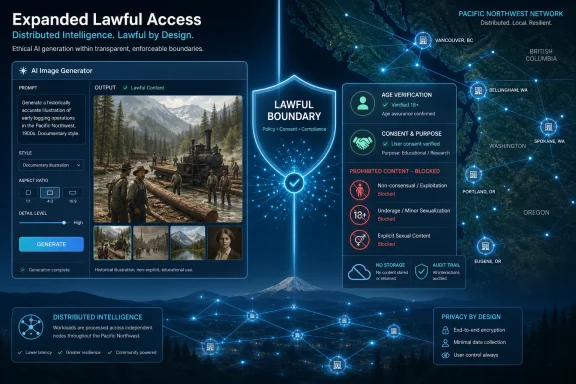
ReelTime Media said on June 4, 2026, from Bothell, Washington, that its Reel Intelligence platform has launched “Expanded Lawful Access” for image generation and subject research, positioning the service against ChatGPT, Microsoft Copilot, Google Gemini, Meta, Nvidia, and Amazon. The announcement is less a normal product update than a manifesto against the way mainstream AI has been packaged: centralized, heavily moderated, expensive to scale, and increasingly intertwined with data-center politics. ReelTime wants RI to be read as the alternative—more permissive for lawful users, more private by design, and less dependent on the chip-and-power arms race now defining the industry. The claim is bold; the evidence needs to be separated from the sales pitch.
The most important phrase in ReelTime’s announcement is not “image generation,” “distributed intelligence,” or even “green AI.” It is “lawful access.” That phrasing is doing a lot of work because it attempts to redraw the moderation debate around legality rather than platform preference.
Large AI providers have spent the last few years learning that moderation is not a side feature. It is product liability, brand management, regulatory defense, and infrastructure protection all at once. ChatGPT, Copilot, Gemini, Meta AI, and the image and video systems around them do not merely answer prompts; they enforce an evolving corporate theory of what a mainstream AI assistant should refuse.
ReelTime’s wager is that a meaningful segment of users is tired of being told no for reasons that feel vague, inconsistent, or infantilizing. The company is not promising an anything-goes machine. It says RI will still block illegal, exploitative, non-consensual, abusive, and otherwise prohibited content, and that age-verification practices will apply where required.
That distinction matters. “Uncensored AI” has become a marketing trap, attracting users who want fewer guardrails while alarming payment processors, regulators, hosting providers, and anyone responsible for child safety or consent. ReelTime is trying to occupy a narrower lane: legal adult use, lawful artistic generation, controversial historical or analytical research, and subject matter that mainstream systems may block even when the request is not illegal.
The problem is that lawful is not the same thing as safe, ethical, reputationally acceptable, or platform-compatible. A request can be legal in one jurisdiction, legally risky in another, harmful in context, or impossible to verify without collecting more identity data than privacy-minded users want to provide. ReelTime’s announcement recognizes this tension but does not resolve it.
ReelTime is aiming directly at that irritation. Its message is that Big AI has drifted from safety into over-filtering, and that the user experience has become less about capability than permission. Whether users agree will depend heavily on what they have tried to do with competing systems.
The market for less-restrictive AI is real, but it is not automatically respectable. There is demand from artists, researchers, adult creators, journalists, educators, hobbyists, and security professionals who want fewer blunt refusals. There is also demand from people who will test every boundary the moment a platform advertises looser rules.
That is why “Expanded Lawful Access” is both a product feature and a governance challenge. If RI allows more image generation and subject research than major systems, it will need to show that its controls are more precise rather than merely weaker. Precision is harder than refusal. It requires context, identity handling, jurisdictional awareness, appeals, auditability, and policy language that users can understand before they trip a wire.
ReelTime’s announcement makes a strong claim about user freedom. The unresolved question is whether RI can maintain that freedom under stress, at scale, and under adversarial prompting. Big AI’s restrictions are not only ideology; they are scars from abuse patterns.
Privacy has become one of the quiet divides in AI adoption. Consumers worry about embarrassment. Professionals worry about trade secrets, client data, unreleased products, medical notes, legal theories, source code, and internal documents. Administrators worry that employees will paste sensitive data into whichever AI tool gives the least resistance.
If ReelTime can credibly deliver a mode that avoids storing user-submitted or generated content, it has a clearer enterprise and creator-facing argument than “we refuse less.” A privacy-forward design is easier to defend than a permissive-content posture because it speaks to operational risk rather than cultural grievance.
But privacy promises in AI need details. Does “does not store” mean no durable storage after generation, no training use, no retention in logs, no vendor subprocessors, no moderation cache, no abuse-review queue, and no crash telemetry containing prompt fragments? Does it apply to all users or only a particular mode? How is abuse investigated if data is not retained? What happens when law enforcement presents a lawful request?
These are not gotcha questions. They are the questions IT departments will ask before letting any AI system near production workflows. ReelTime has chosen the right battlefield, but the privacy claim becomes valuable only when backed by technical documentation, retention guarantees, and independent verification.
That is an appealing counter-narrative because the rest of the AI industry is visibly moving in the opposite direction. Hyperscalers are pouring money into data centers, power contracts, cooling systems, networking hardware, GPUs, custom accelerators, memory, and land. The AI race is no longer only a model race; it is a construction race.
The International Energy Agency has estimated that data centers accounted for around 1.5 percent of global electricity consumption in 2024, with AI-focused facilities becoming a concentrated new source of power demand. In the United States, data centers are expected to drive a large share of new electricity growth through the end of the decade. Even when renewable procurement improves, local grid pressure, water use, permitting, and transmission constraints remain political and engineering problems.
So ReelTime’s critique lands because it matches what everyone can see. Microsoft, Amazon, Google, Meta, Nvidia, Oracle, and the broader AI supply chain are increasingly measured by their ability to secure power and silicon. The environmental and capital costs are not theoretical; they are showing up in earnings calls, utility planning, local zoning fights, and component shortages.
But the distributed alternative has its own burden of proof. Using scattered compute resources can reduce reliance on a single mega-facility, but it can also introduce overhead, latency, inconsistent hardware performance, security exposure, orchestration complexity, and harder compliance boundaries. A greener architecture is not proven by being less centralized. It is proven by energy-per-task, workload placement, hardware utilization, cooling profile, carbon intensity, and measurable lifecycle impact.
For investors, chip-agnostic sounds like freedom from scarcity. For users, it suggests that RI can improve without waiting in line behind the largest cloud customers. For environmental critics, it implies less pressure to build ever-larger clusters.
The strategic case is plausible at the margins. Not every AI workload needs frontier-scale training hardware. Many useful tasks are inference-heavy, workflow-oriented, media-specific, or capable of being routed across heterogeneous hardware. A platform that intelligently uses available compute could avoid some costs that hyperscalers absorb because they are trying to support enormous general-purpose demand.
But chip-agnostic does not mean compute-agnostic. AI still runs somewhere. Image generation still consumes processing power. Subject research still requires retrieval, indexing, ranking, model inference, and safety checks. Audio, video, 3D, and multimodal tools raise the compute bill further.
The real question is not whether RI avoids chips. It is whether RI uses ordinary and distributed chips efficiently enough to deliver competitive quality, speed, reliability, and safety. If it does, ReelTime has a serious differentiator. If it cannot, “distributed” risks becoming a branding layer over borrowed infrastructure.
That comparison is useful because the giants do share common constraints. Microsoft’s Copilot strategy depends on Azure capacity and OpenAI-related infrastructure. Google’s Gemini strategy is inseparable from its TPU and data-center estate. Amazon wants AI to reinforce AWS. Meta is building and open-weighting models while spending heavily on infrastructure. Nvidia sells the picks and shovels and increasingly the systems, software, and networking around them.
Yet the comparison is also convenient because Big Tech’s weaknesses are paired with Big Tech’s strengths. The same centralized infrastructure that looks expensive also delivers uptime, compliance programs, enterprise contracts, global distribution, abuse monitoring, security operations, and mature developer ecosystems. The same moderation policies that annoy users also help platforms survive scrutiny from regulators, advertisers, schools, parents, and corporate legal departments.
ReelTime can be faster, looser, and more experimental precisely because it is not operating at the same scale or under the same spotlight. That is not a criticism. Many important technology shifts begin outside the incumbents because smaller players can make bets larger firms cannot. But a challenger cannot claim only the advantages of being small while comparing itself to the capabilities of being large.
The fair reading is this: RI is positioning itself against the dominant AI stack, not yet replacing it. That distinction keeps the announcement interesting without turning it into a coronation.
Mainstream AI providers have tended to avoid or tightly restrict explicit sexual generation, especially images, because the risks are obvious. Non-consensual imagery, impersonation, deepfakes, minors, revenge abuse, trafficking-adjacent scenarios, and jurisdictional complexity make the category radioactive. Even text-only adult content has become a policy battleground because systems must distinguish between consenting adults, fictional content, coercion, exploitation, and age ambiguity.
ReelTime is not saying RI will become an adult-content engine. It is saying lawful access can include legal adult, artistic, controversial, historical, analytical, or research-driven requests that other systems may refuse. That is a careful formulation, but it still places the company closer to a zone that major platforms have often chosen to minimize.
If ReelTime succeeds, it could expose a real gap in the market: adults who want an AI system that treats them as adults without opening the door to abuse. If it fails, it will likely fail in the predictable ways—identity leakage, non-consensual generation, weak age checks, ambiguous policy enforcement, or pressure from infrastructure and payment partners.
Age verification is the hinge. Strong verification can reduce risk, but it can also undermine privacy if handled badly. Weak verification preserves convenience, but it makes “lawful adult access” hard to defend. The platform that solves this contradiction will have more than a feature; it will have a governance model.
A researcher studying propaganda may need to ask about extremist rhetoric. A journalist may need background on a criminal technique without being treated like a criminal. A sysadmin may need to understand malware behavior for defense. A teacher may need to discuss historical atrocity without the model flattening the lesson into a safety disclaimer.
This is where more granular lawful access could be genuinely useful. A platform that can distinguish between instruction, analysis, documentation, and facilitation would be better than one that simply refuses whole categories. Big AI systems have improved here, but many still overcorrect, especially when prompts contain charged words.
For WindowsForum readers, this has practical implications. Security-minded users do not need an assistant that teaches harm; they need one that can explain threats, interpret logs, summarize attack chains, compare mitigations, and generate defensive scripts without panicking at the vocabulary of the field. If RI’s subject research mode can do that with fewer arbitrary blocks, it could matter.
But again, the line is difficult. “Subject research” can be a cover for operational misuse. A mature system needs intent classification, transformation rules, safe completion strategies, and escalating controls. The difference between a better research assistant and an abuse accelerator is not marketing language; it is implementation.
That is especially true if RI is pitching privacy, lawful access, and distributed architecture at the same time. Each claim creates its own due-diligence path. Privacy requires proof of data handling. Lawful access requires policy clarity. Distributed architecture requires security and reliability assurances.
A CIO might like the idea of an AI assistant that refuses less and stores less. A CISO will immediately ask how abuse is detected, how prompts are protected, how generated media is watermarked or traced, what happens when a user tries to create illegal content, and whether the distributed network expands the attack surface. Legal will ask where the data flows. Compliance will ask what jurisdiction governs processing.
This does not make RI’s position weak. It means the company has chosen a more demanding story than “we added a new image model.” The more ReelTime contrasts itself with Big Tech, the more it must show that decentralization and permissiveness do not come at the expense of accountability.
The opportunity is that many organizations already distrust mainstream AI defaults. They worry about data retention, vendor lock-in, opaque model behavior, rising costs, and employee workarounds. A credible alternative could find buyers among creators, small businesses, independent researchers, and privacy-sensitive teams before it ever threatens Microsoft or Google in the enterprise core.
ReelTime’s argument that intelligence should come through architecture rather than brute-force hardware fits that moment. It gives users and investors a way to imagine AI progress without accepting endless data-center sprawl as inevitable. That is emotionally powerful, especially in communities facing local infrastructure pressure.
But “green” is one of the most abused words in technology. A distributed architecture can waste energy if it uses inefficient endpoints, duplicates work, increases network traffic, or lacks workload scheduling based on carbon intensity. A centralized data center can be energy-intensive but still highly optimized compared with scattered, underutilized compute. The comparison is not obvious.
The best version of ReelTime’s claim would be backed by transparent metrics: energy consumed per image, per research task, per audio generation, and per video render; average hardware utilization; carbon-aware routing; renewable matching; and independent audits. Without those numbers, the green claim remains plausible but unproven.
That matters because Big Tech is not ignoring efficiency. Microsoft, Google, Amazon, Meta, Nvidia, and others are investing heavily in model optimization, custom silicon, liquid cooling, power purchasing, and data-center design. They may be building enormous facilities, but they are also under pressure to make each unit of compute cheaper and cleaner. ReelTime’s architecture has to beat a moving target.
There is merit in the premise. If AI economics are increasingly constrained by capital expenditure, then any credible approach that lowers compute dependence could be valuable. The industry’s biggest players are spending staggering sums to maintain capacity, and every dollar spent on buildings, chips, power, and cooling raises the bar for returns.
But investors should also hear the risk. Claims of infrastructure-light AI are easy to make and hard to validate. If RI depends on third-party compute, it still depends on someone’s infrastructure. If it uses distributed user or network resources, it must manage trust, performance, incentives, and security. If it delivers lower costs by limiting quality or speed, the advantage may disappear when compared with optimized mainstream models.
The capex trap is real, but so is the credibility trap. A small public company taking aim at the largest firms in technology must show more than confidence. It must show adoption, retention, performance benchmarks, revenue quality, and operational discipline.
ReelTime’s announcement contains forward-looking language for a reason. The company is describing where it wants RI to sit in the market: creator tools, research automation, privacy-focused AI, lawful adult-use applications, green technology, and distributed computing. That is an ambitious map. Execution will decide whether it is a roadmap or a mood board.
Microsoft has made Copilot a strategic layer across Windows, Edge, Office, GitHub, Azure, and security products. That means Microsoft’s choices about moderation, telemetry, enterprise controls, data residency, and compute economics increasingly affect how Windows work gets done. The assistant is no longer just a website; it is becoming a workplace interface.
A competing assistant with fewer restrictions and stronger privacy claims may appeal to users who do not want their workflows mediated by Microsoft’s cloud policies. Developers may use it for research. Creators may use it for assets. Small businesses may use it for copy, images, audio, and automation. Sysadmins may test it for documentation, scripting explanations, or log interpretation.
The risk is fragmentation. Employees already route around approved tools when the official assistant refuses a task or feels too slow. If RI and similar services offer fewer refusals, they may become attractive shadow-AI destinations. That can be useful for productivity and dangerous for governance.
Administrators should not respond by pretending alternatives do not exist. They should classify AI tools the way they classify cloud storage, password managers, remote access tools, and developer platforms: by data sensitivity, retention, identity controls, logging, and acceptable-use boundaries. The refusal behavior of a tool is now an IT policy variable.
That is the pattern by which challengers often gain ground. They do not first win the whole market. They win the users incumbents underserve. In this case, those users may include independent creators, adult professionals operating legally, researchers working with sensitive or controversial material, privacy-conscious users, and small teams that want multimodal tools without enterprise-cloud entanglement.
The danger for ReelTime is overclaiming. Phrases like “moved beyond” legacy AI platforms, “critical strategic advantage,” and “green AI alternative” invite scrutiny that a young or smaller platform may not yet be ready to withstand. The more the company invokes Microsoft, Google, Amazon, Meta, Nvidia, and OpenAI, the more readers will expect hard comparisons.
Still, the announcement identifies real pressure points. Mainstream AI is more restrictive than many users want. Infrastructure costs are becoming a strategic problem. Data centers are now a public-policy issue. Privacy remains unresolved. Adult access and controversial research are awkward categories that Big Tech would often rather constrain than carefully support.
That combination gives RI a story worth watching. Not because every claim should be accepted at face value, but because the dissatisfaction it is exploiting is authentic.
The concrete takeaways are narrower than the announcement’s ambition, but they are meaningful:
 ReelTime Is Selling Freedom at the Exact Moment AI Feels More Managed
The most important phrase in ReelTime’s announcement is not “image generation,” “distributed intelligence,” or even “green AI.” It is “lawful access.” That phrasing is doing a lot of work because it attempts to redraw the moderation debate around legality rather than platform preference.Large AI providers have spent the last few years learning that moderation is not a side feature. It is product liability, brand management, regulatory defense, and infrastructure protection all at once. ChatGPT, Copilot, Gemini, Meta AI, and the image and video systems around them do not merely answer prompts; they enforce an evolving corporate theory of what a mainstream AI assistant should refuse.
ReelTime’s wager is that a meaningful segment of users is tired of being told no for reasons that feel vague, inconsistent, or infantilizing. The company is not promising an anything-goes machine. It says RI will still block illegal, exploitative, non-consensual, abusive, and otherwise prohibited content, and that age-verification practices will apply where required.
That distinction matters. “Uncensored AI” has become a marketing trap, attracting users who want fewer guardrails while alarming payment processors, regulators, hosting providers, and anyone responsible for child safety or consent. ReelTime is trying to occupy a narrower lane: legal adult use, lawful artistic generation, controversial historical or analytical research, and subject matter that mainstream systems may block even when the request is not illegal.
The problem is that lawful is not the same thing as safe, ethical, reputationally acceptable, or platform-compatible. A request can be legal in one jurisdiction, legally risky in another, harmful in context, or impossible to verify without collecting more identity data than privacy-minded users want to provide. ReelTime’s announcement recognizes this tension but does not resolve it.
The Real Target Is Not Just OpenAI, but the Refusal Economy
The AI industry has trained users to see refusal as part of the interface. Sometimes that is necessary. Sometimes it is laughable. Anyone who has asked a mainstream chatbot for historical analysis, malware-adjacent defensive research, political persuasion analysis, adult-themed fiction, or a visual reference involving a public figure has likely encountered the soft wall of corporate caution.ReelTime is aiming directly at that irritation. Its message is that Big AI has drifted from safety into over-filtering, and that the user experience has become less about capability than permission. Whether users agree will depend heavily on what they have tried to do with competing systems.
The market for less-restrictive AI is real, but it is not automatically respectable. There is demand from artists, researchers, adult creators, journalists, educators, hobbyists, and security professionals who want fewer blunt refusals. There is also demand from people who will test every boundary the moment a platform advertises looser rules.
That is why “Expanded Lawful Access” is both a product feature and a governance challenge. If RI allows more image generation and subject research than major systems, it will need to show that its controls are more precise rather than merely weaker. Precision is harder than refusal. It requires context, identity handling, jurisdictional awareness, appeals, auditability, and policy language that users can understand before they trip a wire.
ReelTime’s announcement makes a strong claim about user freedom. The unresolved question is whether RI can maintain that freedom under stress, at scale, and under adversarial prompting. Big AI’s restrictions are not only ideology; they are scars from abuse patterns.
The Privacy Claim Is the Sharpest Product Promise
The company’s most concrete promise is that RI does not store images or chats created or submitted through Expanded Lawful Access mode. In an AI market where prompts can feel like confessions, that is a powerful line.Privacy has become one of the quiet divides in AI adoption. Consumers worry about embarrassment. Professionals worry about trade secrets, client data, unreleased products, medical notes, legal theories, source code, and internal documents. Administrators worry that employees will paste sensitive data into whichever AI tool gives the least resistance.
If ReelTime can credibly deliver a mode that avoids storing user-submitted or generated content, it has a clearer enterprise and creator-facing argument than “we refuse less.” A privacy-forward design is easier to defend than a permissive-content posture because it speaks to operational risk rather than cultural grievance.
But privacy promises in AI need details. Does “does not store” mean no durable storage after generation, no training use, no retention in logs, no vendor subprocessors, no moderation cache, no abuse-review queue, and no crash telemetry containing prompt fragments? Does it apply to all users or only a particular mode? How is abuse investigated if data is not retained? What happens when law enforcement presents a lawful request?
These are not gotcha questions. They are the questions IT departments will ask before letting any AI system near production workflows. ReelTime has chosen the right battlefield, but the privacy claim becomes valuable only when backed by technical documentation, retention guarantees, and independent verification.
Distributed Intelligence Is the Greenest-Sounding Claim and the Hardest to Prove
ReelTime’s second major argument is architectural. It says RI is being developed around distributed intelligence that can “live throughout the connected world,” drawing resources from the broader global computing community instead of depending on massive centralized data centers. In the company’s telling, this makes RI more efficient, greener, and less exposed to shortages in specialized chips.That is an appealing counter-narrative because the rest of the AI industry is visibly moving in the opposite direction. Hyperscalers are pouring money into data centers, power contracts, cooling systems, networking hardware, GPUs, custom accelerators, memory, and land. The AI race is no longer only a model race; it is a construction race.
The International Energy Agency has estimated that data centers accounted for around 1.5 percent of global electricity consumption in 2024, with AI-focused facilities becoming a concentrated new source of power demand. In the United States, data centers are expected to drive a large share of new electricity growth through the end of the decade. Even when renewable procurement improves, local grid pressure, water use, permitting, and transmission constraints remain political and engineering problems.
So ReelTime’s critique lands because it matches what everyone can see. Microsoft, Amazon, Google, Meta, Nvidia, Oracle, and the broader AI supply chain are increasingly measured by their ability to secure power and silicon. The environmental and capital costs are not theoretical; they are showing up in earnings calls, utility planning, local zoning fights, and component shortages.
But the distributed alternative has its own burden of proof. Using scattered compute resources can reduce reliance on a single mega-facility, but it can also introduce overhead, latency, inconsistent hardware performance, security exposure, orchestration complexity, and harder compliance boundaries. A greener architecture is not proven by being less centralized. It is proven by energy-per-task, workload placement, hardware utilization, cooling profile, carbon intensity, and measurable lifecycle impact.
“Chip-Agnostic” Is a Strategy, Not a Magic Trick
ReelTime has repeatedly framed RI as chip-agnostic, and the phrase is smart. It speaks directly to the anxiety that Nvidia’s GPUs, high-bandwidth memory, advanced packaging, and data-center supply chains have become the toll roads of modern AI.For investors, chip-agnostic sounds like freedom from scarcity. For users, it suggests that RI can improve without waiting in line behind the largest cloud customers. For environmental critics, it implies less pressure to build ever-larger clusters.
The strategic case is plausible at the margins. Not every AI workload needs frontier-scale training hardware. Many useful tasks are inference-heavy, workflow-oriented, media-specific, or capable of being routed across heterogeneous hardware. A platform that intelligently uses available compute could avoid some costs that hyperscalers absorb because they are trying to support enormous general-purpose demand.
But chip-agnostic does not mean compute-agnostic. AI still runs somewhere. Image generation still consumes processing power. Subject research still requires retrieval, indexing, ranking, model inference, and safety checks. Audio, video, 3D, and multimodal tools raise the compute bill further.
The real question is not whether RI avoids chips. It is whether RI uses ordinary and distributed chips efficiently enough to deliver competitive quality, speed, reliability, and safety. If it does, ReelTime has a serious differentiator. If it cannot, “distributed” risks becoming a branding layer over borrowed infrastructure.
The Big Tech Comparison Is Useful, but Also Convenient
ReelTime names ChatGPT, Microsoft Copilot, Google Gemini, Meta, Nvidia, and Amazon because those names instantly frame the stakes. It is not simply claiming a new mode in an obscure AI product. It is claiming a philosophical and architectural break from the most powerful companies in computing.That comparison is useful because the giants do share common constraints. Microsoft’s Copilot strategy depends on Azure capacity and OpenAI-related infrastructure. Google’s Gemini strategy is inseparable from its TPU and data-center estate. Amazon wants AI to reinforce AWS. Meta is building and open-weighting models while spending heavily on infrastructure. Nvidia sells the picks and shovels and increasingly the systems, software, and networking around them.
Yet the comparison is also convenient because Big Tech’s weaknesses are paired with Big Tech’s strengths. The same centralized infrastructure that looks expensive also delivers uptime, compliance programs, enterprise contracts, global distribution, abuse monitoring, security operations, and mature developer ecosystems. The same moderation policies that annoy users also help platforms survive scrutiny from regulators, advertisers, schools, parents, and corporate legal departments.
ReelTime can be faster, looser, and more experimental precisely because it is not operating at the same scale or under the same spotlight. That is not a criticism. Many important technology shifts begin outside the incumbents because smaller players can make bets larger firms cannot. But a challenger cannot claim only the advantages of being small while comparing itself to the capabilities of being large.
The fair reading is this: RI is positioning itself against the dominant AI stack, not yet replacing it. That distinction keeps the announcement interesting without turning it into a coronation.
Lawful Adult Use Is the Moderation Debate Nobody Wants to Own
The phrase “lawful adult-use applications” appears in ReelTime’s investor framing, and it is one of the most commercially significant parts of the announcement. Adult content has always been a stress test for digital platforms because it forces companies to reconcile legality, consent, identity, payments, app-store rules, hosting policies, and reputational risk.Mainstream AI providers have tended to avoid or tightly restrict explicit sexual generation, especially images, because the risks are obvious. Non-consensual imagery, impersonation, deepfakes, minors, revenge abuse, trafficking-adjacent scenarios, and jurisdictional complexity make the category radioactive. Even text-only adult content has become a policy battleground because systems must distinguish between consenting adults, fictional content, coercion, exploitation, and age ambiguity.
ReelTime is not saying RI will become an adult-content engine. It is saying lawful access can include legal adult, artistic, controversial, historical, analytical, or research-driven requests that other systems may refuse. That is a careful formulation, but it still places the company closer to a zone that major platforms have often chosen to minimize.
If ReelTime succeeds, it could expose a real gap in the market: adults who want an AI system that treats them as adults without opening the door to abuse. If it fails, it will likely fail in the predictable ways—identity leakage, non-consensual generation, weak age checks, ambiguous policy enforcement, or pressure from infrastructure and payment partners.
Age verification is the hinge. Strong verification can reduce risk, but it can also undermine privacy if handled badly. Weak verification preserves convenience, but it makes “lawful adult access” hard to defend. The platform that solves this contradiction will have more than a feature; it will have a governance model.
Subject Research Is Where the Policy Fight Gets Less Salacious and More Important
Image generation will get the attention, but subject research may be the more important long-term feature. The modern AI refusal problem is not limited to adult material. It affects security research, controversial history, extremism analysis, drug-policy work, political persuasion studies, medical edge cases, weapons history, and documentation of abuse.A researcher studying propaganda may need to ask about extremist rhetoric. A journalist may need background on a criminal technique without being treated like a criminal. A sysadmin may need to understand malware behavior for defense. A teacher may need to discuss historical atrocity without the model flattening the lesson into a safety disclaimer.
This is where more granular lawful access could be genuinely useful. A platform that can distinguish between instruction, analysis, documentation, and facilitation would be better than one that simply refuses whole categories. Big AI systems have improved here, but many still overcorrect, especially when prompts contain charged words.
For WindowsForum readers, this has practical implications. Security-minded users do not need an assistant that teaches harm; they need one that can explain threats, interpret logs, summarize attack chains, compare mitigations, and generate defensive scripts without panicking at the vocabulary of the field. If RI’s subject research mode can do that with fewer arbitrary blocks, it could matter.
But again, the line is difficult. “Subject research” can be a cover for operational misuse. A mature system needs intent classification, transformation rules, safe completion strategies, and escalating controls. The difference between a better research assistant and an abuse accelerator is not marketing language; it is implementation.
The Enterprise Buyer Will Ask Boring Questions First
ReelTime’s announcement has the energy of a challenger brand, but enterprise adoption is usually decided by boring documents. Security questionnaires, retention schedules, SOC reports, acceptable-use policies, model cards, subprocessors, incident response, data residency, identity integration, admin controls, and audit logs decide whether a platform moves from curiosity to procurement.That is especially true if RI is pitching privacy, lawful access, and distributed architecture at the same time. Each claim creates its own due-diligence path. Privacy requires proof of data handling. Lawful access requires policy clarity. Distributed architecture requires security and reliability assurances.
A CIO might like the idea of an AI assistant that refuses less and stores less. A CISO will immediately ask how abuse is detected, how prompts are protected, how generated media is watermarked or traced, what happens when a user tries to create illegal content, and whether the distributed network expands the attack surface. Legal will ask where the data flows. Compliance will ask what jurisdiction governs processing.
This does not make RI’s position weak. It means the company has chosen a more demanding story than “we added a new image model.” The more ReelTime contrasts itself with Big Tech, the more it must show that decentralization and permissiveness do not come at the expense of accountability.
The opportunity is that many organizations already distrust mainstream AI defaults. They worry about data retention, vendor lock-in, opaque model behavior, rising costs, and employee workarounds. A credible alternative could find buyers among creators, small businesses, independent researchers, and privacy-sensitive teams before it ever threatens Microsoft or Google in the enterprise core.
Green AI Needs Measurement, Not Vibes
The green-AI framing is timely because the public mood around AI infrastructure is changing. In 2023 and 2024, the industry sold AI as software magic. By 2026, it is visibly a physical buildout: substations, cooling, land acquisition, transmission lines, water systems, diesel backup, chip packaging, and long-term power contracts.ReelTime’s argument that intelligence should come through architecture rather than brute-force hardware fits that moment. It gives users and investors a way to imagine AI progress without accepting endless data-center sprawl as inevitable. That is emotionally powerful, especially in communities facing local infrastructure pressure.
But “green” is one of the most abused words in technology. A distributed architecture can waste energy if it uses inefficient endpoints, duplicates work, increases network traffic, or lacks workload scheduling based on carbon intensity. A centralized data center can be energy-intensive but still highly optimized compared with scattered, underutilized compute. The comparison is not obvious.
The best version of ReelTime’s claim would be backed by transparent metrics: energy consumed per image, per research task, per audio generation, and per video render; average hardware utilization; carbon-aware routing; renewable matching; and independent audits. Without those numbers, the green claim remains plausible but unproven.
That matters because Big Tech is not ignoring efficiency. Microsoft, Google, Amazon, Meta, Nvidia, and others are investing heavily in model optimization, custom silicon, liquid cooling, power purchasing, and data-center design. They may be building enormous facilities, but they are also under pressure to make each unit of compute cheaper and cleaner. ReelTime’s architecture has to beat a moving target.
The Investor Pitch Is Really About Escaping the Capex Trap
The announcement spends time speaking to investors, and the subtext is clear: the market has rewarded the hardware side of AI, especially chip suppliers and data-center builders, but may be underpricing software architectures that reduce the need for that infrastructure. That is a classic challenger-company argument. It tells investors the obvious winners may not be the only winners.There is merit in the premise. If AI economics are increasingly constrained by capital expenditure, then any credible approach that lowers compute dependence could be valuable. The industry’s biggest players are spending staggering sums to maintain capacity, and every dollar spent on buildings, chips, power, and cooling raises the bar for returns.
But investors should also hear the risk. Claims of infrastructure-light AI are easy to make and hard to validate. If RI depends on third-party compute, it still depends on someone’s infrastructure. If it uses distributed user or network resources, it must manage trust, performance, incentives, and security. If it delivers lower costs by limiting quality or speed, the advantage may disappear when compared with optimized mainstream models.
The capex trap is real, but so is the credibility trap. A small public company taking aim at the largest firms in technology must show more than confidence. It must show adoption, retention, performance benchmarks, revenue quality, and operational discipline.
ReelTime’s announcement contains forward-looking language for a reason. The company is describing where it wants RI to sit in the market: creator tools, research automation, privacy-focused AI, lawful adult-use applications, green technology, and distributed computing. That is an ambitious map. Execution will decide whether it is a roadmap or a mood board.
Windows Users Should Care Because AI Is Becoming Part of the Operating Environment
At first glance, RI may seem distant from the day-to-day concerns of Windows enthusiasts and administrators. It is not a Windows update, not a driver issue, not a Copilot policy change, and not a Microsoft 365 licensing shift. But the story belongs in the same conversation because AI is becoming part of the operating environment.Microsoft has made Copilot a strategic layer across Windows, Edge, Office, GitHub, Azure, and security products. That means Microsoft’s choices about moderation, telemetry, enterprise controls, data residency, and compute economics increasingly affect how Windows work gets done. The assistant is no longer just a website; it is becoming a workplace interface.
A competing assistant with fewer restrictions and stronger privacy claims may appeal to users who do not want their workflows mediated by Microsoft’s cloud policies. Developers may use it for research. Creators may use it for assets. Small businesses may use it for copy, images, audio, and automation. Sysadmins may test it for documentation, scripting explanations, or log interpretation.
The risk is fragmentation. Employees already route around approved tools when the official assistant refuses a task or feels too slow. If RI and similar services offer fewer refusals, they may become attractive shadow-AI destinations. That can be useful for productivity and dangerous for governance.
Administrators should not respond by pretending alternatives do not exist. They should classify AI tools the way they classify cloud storage, password managers, remote access tools, and developer platforms: by data sensitivity, retention, identity controls, logging, and acceptable-use boundaries. The refusal behavior of a tool is now an IT policy variable.
The Challenger’s Strongest Case Fits in a Smaller Box Than Its Press Release
ReelTime’s announcement is broad, but the strongest version of the argument is narrower and more defensible. RI does not need to beat every frontier model, replace every Copilot workflow, or make hyperscale data centers obsolete to matter. It needs to prove that a privacy-forward, less restrictive, distributed AI platform can serve real users better in specific workflows.That is the pattern by which challengers often gain ground. They do not first win the whole market. They win the users incumbents underserve. In this case, those users may include independent creators, adult professionals operating legally, researchers working with sensitive or controversial material, privacy-conscious users, and small teams that want multimodal tools without enterprise-cloud entanglement.
The danger for ReelTime is overclaiming. Phrases like “moved beyond” legacy AI platforms, “critical strategic advantage,” and “green AI alternative” invite scrutiny that a young or smaller platform may not yet be ready to withstand. The more the company invokes Microsoft, Google, Amazon, Meta, Nvidia, and OpenAI, the more readers will expect hard comparisons.
Still, the announcement identifies real pressure points. Mainstream AI is more restrictive than many users want. Infrastructure costs are becoming a strategic problem. Data centers are now a public-policy issue. Privacy remains unresolved. Adult access and controversial research are awkward categories that Big Tech would often rather constrain than carefully support.
That combination gives RI a story worth watching. Not because every claim should be accepted at face value, but because the dissatisfaction it is exploiting is authentic.
The RI Bet Comes Down to Proof, Not Provocation
ReelTime has put a deliberately provocative stake in the ground, but the next stage will be less theatrical. The market will need to see how Expanded Lawful Access behaves in practice, how the platform verifies age without undermining privacy, how it handles abuse, and how its distributed architecture performs under real demand.The concrete takeaways are narrower than the announcement’s ambition, but they are meaningful:
- ReelTime says Expanded Lawful Access now applies to RI image generation and subject research, but not currently to video creation.
- The company is positioning RI as more permissive for lawful users while still blocking illegal, exploitative, non-consensual, abusive, and prohibited content.
- ReelTime’s most testable privacy claim is that RI does not store images or chats created or submitted through Expanded Lawful Access mode.
- The company’s distributed, chip-agnostic architecture is meant to contrast with hyperscale AI systems that rely on massive data centers and specialized accelerators.
- The green-AI claim will require measurable evidence, because distributed computing is not automatically more efficient than centralized infrastructure.
- For Windows users and IT administrators, RI is another sign that AI tool governance must account for refusal behavior, data retention, and shadow-AI adoption.
References
- Primary source: The Manila Times
Published: 2026-06-04T14:50:34.049326

ReelTime’s RI Launches Expanded Lawful Access, Taking Direct Aim at Big Tech AI’s Restrictions and Infrastructure Weakness
Reel Intelligence challenges ChatGPT, Microsoft Copilot, Google Gemini, Meta, Nvidia and Amazon with broader lawful image generation and subject research, age-verification standards, stronger privacy, more capability, and a greener distributed architecture that is not chained to massive data... www.manilatimes.net
- Related coverage: reeltime.com
- Related coverage: nasdaq.com
- Related coverage: globenewswire.com
ReelTime’s Reel Intelligence “RI” Launches Worlds Most Advanced Image Generation System, Expanding Its Multi-Modal Intelligence Platform Lead Over Legacy AI
RI’s Distributed, Infrastructure-Light Architecture Signals a Break from Traditional AI Models as Microsoft (MSFT), NVIDIA (NVDA), Alphabet (GOOGL), Meta...www.globenewswire.com
- Related coverage: eqs-news.com
- Related coverage: chartmill.com


- Related coverage: stocktitan.net

ReelTime puts free AI image tool online with readable text output
Users can try RI free at TryRINow.com. ReelTime says its added refinement step delivers legible text and marketing-ready layouts with less post-editing. www.stocktitan.net
- Related coverage: tomshardware.com

Skyrocketing component prices push Big Tech capex to record $725 billion — Microsoft alone attributes $25 billion of AI budget to increased memory and chip costs
Meta cited the same pressure, raising its spending forecast by $10 billion. Google Cloud grew 63%.www.tomshardware.com
- Related coverage: bloomberg.com