

Build5Nines published a June 2, 2026 guide arguing that Azure Regions and Availability Zones should be treated as first-order design primitives for resilient AI systems, not as afterthoughts bolted onto model deployment once an application reaches production. That framing is useful because AI has made old cloud architecture tradeoffs newly expensive. The model may be glamorous, but the outage is still won or lost in the placement of compute, storage, data pipelines, identity, networking, and failover paths. For WindowsForum readers, the story is less “Azure has regions” than “AI has finally made regional architecture impossible to ignore.”
For years, cloud region selection was often a procurement or latency decision. You chose East US because the rest of the company was there, West Europe because compliance demanded it, or Southeast Asia because users were close enough that the ping time looked respectable. Availability Zones were something serious teams cared about, but many internal applications survived perfectly well with a single-region deployment and a backup plan that lived in a runbook nobody wanted to test.
AI changes that calculus because an AI application is rarely one service. It is a front end, an inference endpoint, a model catalog, vector storage, feature pipelines, observability, secrets, network controls, prompt logging, abuse monitoring, and often some combination of batch and interactive workloads. A conventional web app can sometimes limp along when one tier slows down. A generative AI system tends to fail in more expensive and visible ways: inference latency spikes, queues back up, embeddings become unavailable, retrieval results degrade, and downstream business workflows stall.
That is why a guide focused on Azure Regions and Availability Zones lands at the right moment. It is not announcing a shiny new model or a breakthrough accelerator. It is pointing back to the unglamorous substrate that determines whether a production AI workload survives the first real bad day.
The phrase “resilient AI” can sound like marketing fog, but at the infrastructure level it has a precise meaning. It means the system can absorb localized failures, route around capacity constraints, keep data consistent enough for the business requirement, and recover inside a defined window when the cloud does what clouds inevitably do: degrade, throttle, isolate, or fail.
For AI workloads, those boundaries matter in ways that are easy to underestimate during prototyping. A proof-of-concept chatbot can run happily wherever the service is available. A production assistant used by call-center agents, claims processors, developers, or security analysts has to answer harder questions. Where is the prompt processed? Where are embeddings stored? Which region has the model version the application requires? What happens if that region has capacity pressure at 10 a.m. on a Monday?
Microsoft’s own architecture guidance has increasingly pushed customers toward thinking in deployment patterns rather than isolated services. Zone-redundant deployments protect against datacenter-level failures inside a region. Multi-region deployments protect against the rarer but more consequential loss of a region. The tradeoff is the same one enterprise IT has always faced: more resilience usually means more cost, more operational work, and more complicated failure testing.
The Build5Nines framing is therefore best read as a reminder that AI does not exempt anyone from distributed systems physics. If anything, AI makes the physics more painful. Large model artifacts, GPU-backed capacity, provisioned throughput reservations, vector indexes, and data residency requirements all make casual failover harder than it looks on a whiteboard.
There is a subtle trap here for teams coming from traditional web architecture. In a standard stateless service, duplicating app instances across regions can be relatively straightforward. In AI, the “application” may depend on a specific model deployment, a specific quota allocation, a particular retrieval corpus, and a data pipeline whose state is not trivially portable. The region is not merely where the app runs. It is where the assumptions gather.
That sounds obvious until one remembers how much cloud infrastructure is still deployed as if “managed service” means “automatically resilient in the way my workload needs.” It does not. A service may support zone redundancy, but the customer still has to choose the right tier, deployment mode, or topology. A database, storage account, app service, Kubernetes cluster, or API gateway can have very different behavior depending on whether it is zonal, zone-redundant, or merely present in a region that happens to offer zones.
For AI, zone redundancy is often the best first resilience move because it improves availability without forcing a multi-region data strategy on day one. If the application is constrained by data residency rules, keeping replicas inside a single region while spreading across zones is especially attractive. It can protect against localized failures while avoiding the compliance and latency complications of moving data elsewhere.
But zones are not magic. They do not protect against a full-region outage. They do not solve service-level capacity shortages. They do not guarantee that every Azure AI model, every deployment type, or every supporting service behaves identically across zones. They reduce one class of risk, and they do it well, but pretending they are a complete business continuity plan is how resilience theater begins.
The practical lesson is to treat zones as the minimum credible architecture for many production systems, then decide whether the business needs more. A customer-facing AI assistant that handles refunds, patient scheduling, or fraud triage may need cross-region continuity. A low-priority internal summarization tool may not. The discipline is in making that decision explicitly rather than inheriting it from the first developer who clicked “Create resource.”
That layered nature makes simplistic “deploy it in two regions” advice dangerous. A secondary region that lacks the same model deployment, quota, data access, secrets, policy configuration, or network route is not a failover target. It is an architectural aspiration with a monthly bill.
Model serving is the most visible layer. For Azure OpenAI and Azure AI Foundry-style deployments, Microsoft’s current guidance distinguishes between standard, data-zone, global, and provisioned models of capacity. That matters because the resilience strategy changes depending on whether Microsoft is routing across a broader capacity pool or the customer is managing regional endpoints more directly. A team that has provisioned throughput for predictable production latency cannot assume the same behavior as a team using standard deployments for bursty workloads.
The data layer is just as important and often more stubborn. Model artifacts, prompts, completions, embeddings, indexes, feature stores, and audit logs all have different tolerance for staleness. Some data can be replicated asynchronously with minor risk. Some cannot leave a geography. Some should not be logged at all, depending on sensitivity and policy. Resilient AI architecture is therefore inseparable from data classification.
Then there is the control plane. Infrastructure-as-code repositories, deployment pipelines, container registries, key vaults, monitoring systems, and API management layers need their own resilience posture. It is little comfort to have a clean secondary region if the pipeline used to deploy there depends on a service or secret that was stranded in the failed region.
This is where experienced Windows and Azure administrators will recognize the old disaster recovery lesson in new clothes. A backup is not a restore. A secondary deployment is not a failover. A diagram is not an operating procedure. The only architecture that matters is the one that has been rehearsed under conditions ugly enough to expose its assumptions.
Azure’s regional footprint gives architects choices, but choices are not free. Placing inference close to users can improve responsiveness. Placing data close to inference can reduce retrieval latency. Placing everything inside a single geography can simplify compliance. Placing redundant copies across regions can improve disaster recovery. The trouble is that not all of these goals align.
Synchronous replication across distance is the classic trap. It sounds safe because every write is confirmed in more than one place, but distance imposes delay. For many AI workloads, asynchronous replication is more realistic, accepting that a failover may lose or lag some recent state. That can be acceptable for cached embeddings or non-critical prompt telemetry. It may be unacceptable for regulated transaction records or operational decisions.
The real design work is deciding which parts of the system need strong consistency and which need graceful degradation. A support chatbot might continue with a slightly stale knowledge index if the alternative is total outage. A security copilot investigating active incidents might need fresher context or a clear warning that some data sources are unavailable. An AI code assistant may tolerate degraded personalization far better than a healthcare workflow tolerates missing patient context.
This is why region strategy belongs in product planning, not just infrastructure review. Latency, consistency, and failover behavior shape user experience. If the system silently falls back to a slower model or older index, users may continue working but lose trust. If it fails closed, the business may preserve correctness but lose availability. Neither decision should be left to a default timeout.
The Build5Nines guide appears to emphasize Azure’s infrastructure building blocks rather than introduce new Azure capabilities. That distinction matters. This is not a product launch story. It is a maturity story. The AI conversation is moving from “Can we build a demo?” to “Can we run this thing at 99-whatever percent availability while auditors, users, and executives all have opinions?”
Microsoft’s own documentation increasingly reflects that reality. For Azure OpenAI-style workloads, the recommended patterns include multiple resources in different regions, duplicated model deployments, gateway layers that can perform load balancing and circuit breaking, and careful consideration of standard versus provisioned capacity. In other words, the customer still has to design the topology.
That is not a criticism so much as a correction to a common misconception. Managed AI is not serverless magic. It is a managed platform sitting inside a distributed architecture. The more important the workload, the more the customer must understand what is regional, what is global, what is replicated, what is quota-bound, and what fails independently.
For IT pros, this is familiar territory. The new skill is mapping old resilience instincts onto new AI-specific dependencies. Instead of only asking whether SQL is geo-replicated, teams ask whether embeddings are rebuilt in the secondary region. Instead of only asking whether the web tier scales out, they ask whether the chosen model has capacity and version parity in the failover location. Instead of only asking whether backups exist, they ask whether the system can produce acceptable answers when the retrieval layer is partially stale.
That creates a three-way negotiation between performance, resilience, and governance. A multi-region design may be excellent from an availability perspective but unacceptable if data crosses a boundary the organization has promised not to cross. A single-region, multi-zone design may satisfy residency requirements but leave the business exposed to a regional event. A data-zone deployment can provide a middle path in some scenarios, but only if the service, model, and geography match the requirement.
This is where architects need to resist generic diagrams. “Deploy to multiple regions” is not a policy. Which regions? Which data moves? Which data is stored? Which data is processed transiently? Which logs are retained? Which prompts are considered customer content? Which administrators can access the environment? The answers determine whether the architecture is resilient or merely distributed.
WindowsForum’s sysadmin audience knows that compliance failures rarely come from one dramatic mistake. They come from many small assumptions that nobody wrote down. AI multiplies those assumptions because prompt and response flows can contain data that users never intended to expose as application state. If that state is then replicated, logged, indexed, or shipped to a secondary region, resilience work can accidentally become data-governance risk.
The right response is not paralysis. It is documentation and design discipline. Treat AI data flows as production data flows. Give prompts, embeddings, fine-tuning data, telemetry, and model outputs explicit classifications. Then choose regions and zones based on those classifications rather than retrofitting governance after the architecture is already expensive.
AI magnifies this because the expensive part is not only storage or virtual machines. It may be reserved model capacity, GPU-backed compute, premium networking, managed gateway infrastructure, observability volume, and the engineering time required to test failover properly. A highly available AI system can become the most expensive “simple chatbot” the company has ever built.
That does not mean teams should avoid resilience. It means they should match resilience to business value. Not every AI workload deserves active-active multi-region deployment. Some need zone redundancy and backups. Some need an active-passive region with manual failover. Some need a global front door, regional gateways, replicated data stores, and capacity planning that looks more like payments infrastructure than a productivity tool.
The uncomfortable part is that many organizations will not know which category they are in until the AI system becomes popular. Internal copilots that begin as experiments can become embedded in daily workflows. A model-backed triage tool can become the unofficial front door for operations. Once that happens, the architecture inherited from the pilot becomes business-critical infrastructure.
That is why the Build5Nines article’s emphasis on infrastructure primitives is well placed. The early design need not be maximalist, but it should be honest. If a workload is single-region, say so. If failover is manual, document it. If recovery requires rebuilding indexes or redeploying models, measure the time. The worst architecture is not the cheap one. It is the one that is expensive enough to create confidence but incomplete enough to fail when needed.
That creates an opportunity for sysadmins who have sometimes been positioned as downstream operators of developer-led cloud projects. AI systems need grown-up operations earlier. They need identity boundaries, network segmentation, cost controls, logging strategy, regional policy, and patchwork integration with existing enterprise systems. Those are not finishing touches.
A resilient Azure AI deployment also needs good Windows and endpoint thinking. If a desktop workflow, Teams app, internal portal, or Power Platform process depends on an AI backend, client behavior during degradation matters. Does the app retry aggressively and make an outage worse? Does it show a useful error? Does it fall back to search? Does it cache anything locally? Does it create help-desk noise that obscures the real incident?
The best IT teams will treat AI resilience as an end-to-end service management problem. The model endpoint is only one component in the service map. The service includes the user, the identity provider, the network, the gateway, the model, the data plane, the monitoring stack, and the escalation path when something goes wrong at 3 a.m.
That operational view is less glamorous than prompt engineering, but it is where production success is decided. AI may write fluent paragraphs, generate code, and summarize meetings, but it still depends on routing tables, quotas, certificates, and DNS records behaving under pressure.
The Build5Nines guide is notable because it points attention away from AI spectacle and toward the cloud geography that production systems actually inhabit. That is where the next phase of enterprise AI will be fought: not only over which model answers best, but over which architecture keeps answering when a zone fails, a region strains, a quota fills, or a compliance boundary narrows. For Microsoft customers, the path forward is clear enough and demanding enough: build AI like it is already critical infrastructure, because if users adopt it, it soon will be.
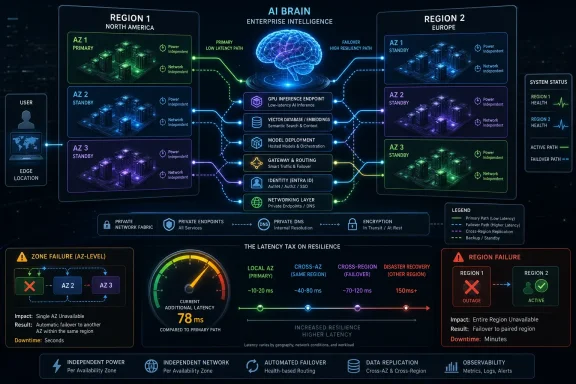 AI Has Turned Cloud Geography Into Application Logic
For years, cloud region selection was often a procurement or latency decision. You chose East US because the rest of the company was there, West Europe because compliance demanded it, or Southeast Asia because users were close enough that the ping time looked respectable. Availability Zones were something serious teams cared about, but many internal applications survived perfectly well with a single-region deployment and a backup plan that lived in a runbook nobody wanted to test.AI changes that calculus because an AI application is rarely one service. It is a front end, an inference endpoint, a model catalog, vector storage, feature pipelines, observability, secrets, network controls, prompt logging, abuse monitoring, and often some combination of batch and interactive workloads. A conventional web app can sometimes limp along when one tier slows down. A generative AI system tends to fail in more expensive and visible ways: inference latency spikes, queues back up, embeddings become unavailable, retrieval results degrade, and downstream business workflows stall.
That is why a guide focused on Azure Regions and Availability Zones lands at the right moment. It is not announcing a shiny new model or a breakthrough accelerator. It is pointing back to the unglamorous substrate that determines whether a production AI workload survives the first real bad day.
The phrase “resilient AI” can sound like marketing fog, but at the infrastructure level it has a precise meaning. It means the system can absorb localized failures, route around capacity constraints, keep data consistent enough for the business requirement, and recover inside a defined window when the cloud does what clouds inevitably do: degrade, throttle, isolate, or fail.
Regions Are Not Map Pins; They Are Failure Domains
Azure Regions are usually introduced as geographic locations where Microsoft operates datacenters. That is accurate, but too shallow for architecture. A region is also a boundary for latency, service availability, quota, compliance, price, and blast radius.For AI workloads, those boundaries matter in ways that are easy to underestimate during prototyping. A proof-of-concept chatbot can run happily wherever the service is available. A production assistant used by call-center agents, claims processors, developers, or security analysts has to answer harder questions. Where is the prompt processed? Where are embeddings stored? Which region has the model version the application requires? What happens if that region has capacity pressure at 10 a.m. on a Monday?
Microsoft’s own architecture guidance has increasingly pushed customers toward thinking in deployment patterns rather than isolated services. Zone-redundant deployments protect against datacenter-level failures inside a region. Multi-region deployments protect against the rarer but more consequential loss of a region. The tradeoff is the same one enterprise IT has always faced: more resilience usually means more cost, more operational work, and more complicated failure testing.
The Build5Nines framing is therefore best read as a reminder that AI does not exempt anyone from distributed systems physics. If anything, AI makes the physics more painful. Large model artifacts, GPU-backed capacity, provisioned throughput reservations, vector indexes, and data residency requirements all make casual failover harder than it looks on a whiteboard.
There is a subtle trap here for teams coming from traditional web architecture. In a standard stateless service, duplicating app instances across regions can be relatively straightforward. In AI, the “application” may depend on a specific model deployment, a specific quota allocation, a particular retrieval corpus, and a data pipeline whose state is not trivially portable. The region is not merely where the app runs. It is where the assumptions gather.
Availability Zones Are the Sensible Default, Not the Finish Line
Availability Zones are Azure’s answer to a common cloud failure mode: a datacenter or localized facility problem that should not bring down an application running in the broader region. Zones are physically separate locations within a region, designed with independent power, cooling, and networking. For a production workload, using multiple zones is the cloud equivalent of not putting every server in the same rack.That sounds obvious until one remembers how much cloud infrastructure is still deployed as if “managed service” means “automatically resilient in the way my workload needs.” It does not. A service may support zone redundancy, but the customer still has to choose the right tier, deployment mode, or topology. A database, storage account, app service, Kubernetes cluster, or API gateway can have very different behavior depending on whether it is zonal, zone-redundant, or merely present in a region that happens to offer zones.
For AI, zone redundancy is often the best first resilience move because it improves availability without forcing a multi-region data strategy on day one. If the application is constrained by data residency rules, keeping replicas inside a single region while spreading across zones is especially attractive. It can protect against localized failures while avoiding the compliance and latency complications of moving data elsewhere.
But zones are not magic. They do not protect against a full-region outage. They do not solve service-level capacity shortages. They do not guarantee that every Azure AI model, every deployment type, or every supporting service behaves identically across zones. They reduce one class of risk, and they do it well, but pretending they are a complete business continuity plan is how resilience theater begins.
The practical lesson is to treat zones as the minimum credible architecture for many production systems, then decide whether the business needs more. A customer-facing AI assistant that handles refunds, patient scheduling, or fraud triage may need cross-region continuity. A low-priority internal summarization tool may not. The discipline is in making that decision explicitly rather than inheriting it from the first developer who clicked “Create resource.”
The AI Stack Breaks in Layers, So Resilience Must Be Layered Too
One reason Azure region-and-zone guidance matters is that AI systems fail across layers. The inference endpoint can be healthy while the vector database is slow. The model can respond while the prompt orchestration layer is down. The front end can be available while the private endpoint, DNS path, managed identity, or logging workspace introduces a hidden dependency on a degraded region.That layered nature makes simplistic “deploy it in two regions” advice dangerous. A secondary region that lacks the same model deployment, quota, data access, secrets, policy configuration, or network route is not a failover target. It is an architectural aspiration with a monthly bill.
Model serving is the most visible layer. For Azure OpenAI and Azure AI Foundry-style deployments, Microsoft’s current guidance distinguishes between standard, data-zone, global, and provisioned models of capacity. That matters because the resilience strategy changes depending on whether Microsoft is routing across a broader capacity pool or the customer is managing regional endpoints more directly. A team that has provisioned throughput for predictable production latency cannot assume the same behavior as a team using standard deployments for bursty workloads.
The data layer is just as important and often more stubborn. Model artifacts, prompts, completions, embeddings, indexes, feature stores, and audit logs all have different tolerance for staleness. Some data can be replicated asynchronously with minor risk. Some cannot leave a geography. Some should not be logged at all, depending on sensitivity and policy. Resilient AI architecture is therefore inseparable from data classification.
Then there is the control plane. Infrastructure-as-code repositories, deployment pipelines, container registries, key vaults, monitoring systems, and API management layers need their own resilience posture. It is little comfort to have a clean secondary region if the pipeline used to deploy there depends on a service or secret that was stranded in the failed region.
This is where experienced Windows and Azure administrators will recognize the old disaster recovery lesson in new clothes. A backup is not a restore. A secondary deployment is not a failover. A diagram is not an operating procedure. The only architecture that matters is the one that has been rehearsed under conditions ugly enough to expose its assumptions.
Latency Is the Tax on Resilience
Multi-region AI sounds elegant until the latency bill arrives. Inference already has a response-time problem compared with conventional application logic. Add retrieval, policy checks, tool calls, content filtering, and cross-region data movement, and a user-facing assistant can go from impressive to irritating very quickly.Azure’s regional footprint gives architects choices, but choices are not free. Placing inference close to users can improve responsiveness. Placing data close to inference can reduce retrieval latency. Placing everything inside a single geography can simplify compliance. Placing redundant copies across regions can improve disaster recovery. The trouble is that not all of these goals align.
Synchronous replication across distance is the classic trap. It sounds safe because every write is confirmed in more than one place, but distance imposes delay. For many AI workloads, asynchronous replication is more realistic, accepting that a failover may lose or lag some recent state. That can be acceptable for cached embeddings or non-critical prompt telemetry. It may be unacceptable for regulated transaction records or operational decisions.
The real design work is deciding which parts of the system need strong consistency and which need graceful degradation. A support chatbot might continue with a slightly stale knowledge index if the alternative is total outage. A security copilot investigating active incidents might need fresher context or a clear warning that some data sources are unavailable. An AI code assistant may tolerate degraded personalization far better than a healthcare workflow tolerates missing patient context.
This is why region strategy belongs in product planning, not just infrastructure review. Latency, consistency, and failover behavior shape user experience. If the system silently falls back to a slower model or older index, users may continue working but lose trust. If it fails closed, the business may preserve correctness but lose availability. Neither decision should be left to a default timeout.
Microsoft’s Managed AI Story Still Leaves Customers Holding the Architecture
The cloud pitch has always mixed two promises: Microsoft will operate the platform, and customers can focus on the application. That remains mostly true, but AI exposes the boundary between platform responsibility and customer responsibility. Microsoft can provide regions, zones, managed services, global routing options, private networking, and model deployment choices. It cannot know every enterprise’s recovery objectives, data rules, latency thresholds, or acceptable degradation path.The Build5Nines guide appears to emphasize Azure’s infrastructure building blocks rather than introduce new Azure capabilities. That distinction matters. This is not a product launch story. It is a maturity story. The AI conversation is moving from “Can we build a demo?” to “Can we run this thing at 99-whatever percent availability while auditors, users, and executives all have opinions?”
Microsoft’s own documentation increasingly reflects that reality. For Azure OpenAI-style workloads, the recommended patterns include multiple resources in different regions, duplicated model deployments, gateway layers that can perform load balancing and circuit breaking, and careful consideration of standard versus provisioned capacity. In other words, the customer still has to design the topology.
That is not a criticism so much as a correction to a common misconception. Managed AI is not serverless magic. It is a managed platform sitting inside a distributed architecture. The more important the workload, the more the customer must understand what is regional, what is global, what is replicated, what is quota-bound, and what fails independently.
For IT pros, this is familiar territory. The new skill is mapping old resilience instincts onto new AI-specific dependencies. Instead of only asking whether SQL is geo-replicated, teams ask whether embeddings are rebuilt in the secondary region. Instead of only asking whether the web tier scales out, they ask whether the chosen model has capacity and version parity in the failover location. Instead of only asking whether backups exist, they ask whether the system can produce acceptable answers when the retrieval layer is partially stale.
Data Residency Turns Architecture Into Governance
The global accessibility story is compelling: deploy AI services near users, use Azure’s global network, and improve availability by spreading workloads. But global AI architecture collides quickly with data residency, sovereignty, and privacy obligations. The more useful an AI system becomes, the more likely it is to touch sensitive data.That creates a three-way negotiation between performance, resilience, and governance. A multi-region design may be excellent from an availability perspective but unacceptable if data crosses a boundary the organization has promised not to cross. A single-region, multi-zone design may satisfy residency requirements but leave the business exposed to a regional event. A data-zone deployment can provide a middle path in some scenarios, but only if the service, model, and geography match the requirement.
This is where architects need to resist generic diagrams. “Deploy to multiple regions” is not a policy. Which regions? Which data moves? Which data is stored? Which data is processed transiently? Which logs are retained? Which prompts are considered customer content? Which administrators can access the environment? The answers determine whether the architecture is resilient or merely distributed.
WindowsForum’s sysadmin audience knows that compliance failures rarely come from one dramatic mistake. They come from many small assumptions that nobody wrote down. AI multiplies those assumptions because prompt and response flows can contain data that users never intended to expose as application state. If that state is then replicated, logged, indexed, or shipped to a secondary region, resilience work can accidentally become data-governance risk.
The right response is not paralysis. It is documentation and design discipline. Treat AI data flows as production data flows. Give prompts, embeddings, fine-tuning data, telemetry, and model outputs explicit classifications. Then choose regions and zones based on those classifications rather than retrofitting governance after the architecture is already expensive.
Cost Is the Quiet Enemy of Beautiful Failover Diagrams
Every resilience conversation eventually becomes a cost conversation. Zone redundancy can require higher service tiers. Multi-region deployment can double infrastructure. Cross-region replication can add bandwidth and storage charges. Provisioned throughput can make sense for predictable AI demand but becomes painful if capacity is overestimated or duplicated casually.AI magnifies this because the expensive part is not only storage or virtual machines. It may be reserved model capacity, GPU-backed compute, premium networking, managed gateway infrastructure, observability volume, and the engineering time required to test failover properly. A highly available AI system can become the most expensive “simple chatbot” the company has ever built.
That does not mean teams should avoid resilience. It means they should match resilience to business value. Not every AI workload deserves active-active multi-region deployment. Some need zone redundancy and backups. Some need an active-passive region with manual failover. Some need a global front door, regional gateways, replicated data stores, and capacity planning that looks more like payments infrastructure than a productivity tool.
The uncomfortable part is that many organizations will not know which category they are in until the AI system becomes popular. Internal copilots that begin as experiments can become embedded in daily workflows. A model-backed triage tool can become the unofficial front door for operations. Once that happens, the architecture inherited from the pilot becomes business-critical infrastructure.
That is why the Build5Nines article’s emphasis on infrastructure primitives is well placed. The early design need not be maximalist, but it should be honest. If a workload is single-region, say so. If failover is manual, document it. If recovery requires rebuilding indexes or redeploying models, measure the time. The worst architecture is not the cheap one. It is the one that is expensive enough to create confidence but incomplete enough to fail when needed.
The Windows Admin’s Role Moves Up the Stack
For Windows administrators and Microsoft-oriented IT teams, Azure AI resilience is not just a developer concern. The operational surface area runs straight through familiar territory: Entra ID, private endpoints, DNS, ExpressRoute, VPN, Azure Policy, Key Vault, API Management, monitoring, backup, and incident response. AI may be the workload, but the control mechanisms are enterprise IT’s home field.That creates an opportunity for sysadmins who have sometimes been positioned as downstream operators of developer-led cloud projects. AI systems need grown-up operations earlier. They need identity boundaries, network segmentation, cost controls, logging strategy, regional policy, and patchwork integration with existing enterprise systems. Those are not finishing touches.
A resilient Azure AI deployment also needs good Windows and endpoint thinking. If a desktop workflow, Teams app, internal portal, or Power Platform process depends on an AI backend, client behavior during degradation matters. Does the app retry aggressively and make an outage worse? Does it show a useful error? Does it fall back to search? Does it cache anything locally? Does it create help-desk noise that obscures the real incident?
The best IT teams will treat AI resilience as an end-to-end service management problem. The model endpoint is only one component in the service map. The service includes the user, the identity provider, the network, the gateway, the model, the data plane, the monitoring stack, and the escalation path when something goes wrong at 3 a.m.
That operational view is less glamorous than prompt engineering, but it is where production success is decided. AI may write fluent paragraphs, generate code, and summarize meetings, but it still depends on routing tables, quotas, certificates, and DNS records behaving under pressure.
Azure’s AI Resilience Playbook Is Really a Discipline Test
The concrete lesson from this discussion is that resilient AI on Azure is not a single feature to enable. It is a sequence of decisions that must be made before the workload becomes indispensable.- Production AI workloads should normally start with a region-and-zone design conversation, not end with one after the first outage or capacity incident.
- Availability Zones are a strong baseline for many Azure services, but they do not replace a regional disaster recovery strategy.
- Multi-region AI architectures must duplicate more than application code; they need compatible model deployments, quota, data access, network paths, secrets, and operational runbooks.
- Data residency requirements can rule out otherwise attractive failover patterns, so AI data flows need classification before replication decisions are made.
- Provisioned capacity, gateway routing, and circuit-breaker behavior are central to serious Azure AI operations because model availability is only useful when applications can route to it cleanly.
- The right resilience target depends on business criticality, and teams should document when they are choosing lower cost and simpler operations over faster recovery.
The Build5Nines guide is notable because it points attention away from AI spectacle and toward the cloud geography that production systems actually inhabit. That is where the next phase of enterprise AI will be fought: not only over which model answers best, but over which architecture keeps answering when a zone fails, a region strains, a quota fills, or a compliance boundary narrows. For Microsoft customers, the path forward is clear enough and demanding enough: build AI like it is already critical infrastructure, because if users adopt it, it soon will be.
References
- Primary source: Let's Data Science
Published: Tue, 02 Jun 2026 11:09:00 GMT
Azure Uses Regions and Availability Zones for Resilient AI | Let's Data Science
Build5Nines published a practical guide on June 2, 2026, explaining how Microsoft Azure Regions and Availability Zones can be used to architect scalable, resilient, and globally accessible AI solutions. The article, authored by a Microsoft MVP and HashiCorp Ambassador, highlights Azure's... letsdatascience.com
