

A new wave of nostalgia hardware is on the way: RetroBox has announced a boxed “VHS Combo TV” that pairs a built‑in VCR with a modern flat panel and a broad selection of legacy inputs, promising to “Binge‑watch like it’s 1999.” The product sketches shown so far mix genuine retro functionality (a full videotape mechanism, composite/S‑Video/component/RF inputs and ATSC support) with modern conveniences (HDMI, digital input handling and a 4:3 display that “emulates” CRT behavior), but the available information raises as many questions as it answers—especially for retro gamers, preservationists, and anyone who needs authentic 15 kHz, low‑latency analog handling.
RetroBox markets the new machine as an all‑in‑one solution: a VCR, a display tuned to classic 4:3 content, and a hub of mixed I/O aimed at both tape playback and retro console/computer connectivity. The company’s promotional materials and early product pages list HDMI, Composite, S‑Video, RF, Component YPbPr, and ATSC inputs, and call out native support for classic video modes such as 240p and 480i in an NTSC 4:3 format. The product is being offered as a presale / “first drop coming soon,” with a retail figure floating around the $399 mark. That combination—mechanical VCR hardware plus modern digital handling and a panel that tries to mimic CRT artifacts—makes RetroBox interesting on paper. It’s obvious why retro gamers and collectors are talking about it: a single, familiar chassis handling original VHS tapes and consoles without multiple adapters would solve a common living‑room problem. But the implementation choices announced so far—above all, using an LCD/OLED (or other modern panel) with software/hardware CRT emulation rather than a real cathode‑ray tube—are the key to whether RetroBox is a clever mainstream nostalgia product or a technical compromise that leaves hobbyists unsatisfied.
Tom’s Hardware notes surprise that the company managed to source VHS components; RetroDodo’s coverage is similarly intrigued. But there has been no detailed technical disclosure about the VCR’s origins, the availability of spare parts, the mechanism’s duty cycle, or whether the unit provides features pros care about (cleaning functions, head demagnetization, or easily replaceable belts and rollers). For anyone intending to use the RetroBox as a tape‑preservation device or a daily VCR, those details matter a lot.
Until independent reviews arrive that quantify latency, deinterlacing quality, time‑base correction, and VCR reliability, buyers should treat RetroBox as an intriguing idea rather than a guaranteed solution for retro gaming fidelity or tape archiving. For those who need proven 240p/480i handling and low latency, established scalers such as the RetroTINK family remain the safest bet. For casual nostalgia hunters who want a colorful, single‑box VHS experience and are willing to accept a degree of compromise, RetroBox could be fun—provided buyers wait for measured reviews and transparent support information before spending on presale.
Source: Tom's Hardware VHS Combo TVs debut with screen, old and new I/O, and a full videotape recorder in one — ‘Binge-watch like it's 1999’ says RetroBox
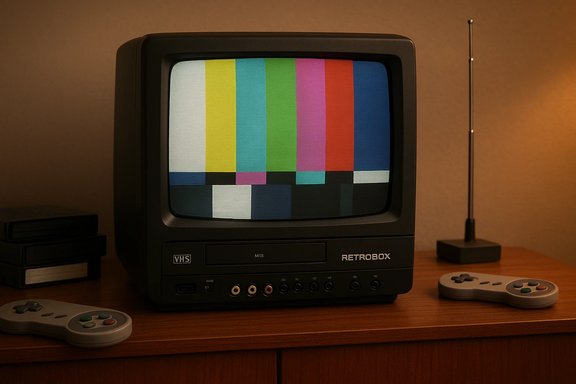 Background / Overview
RetroBox markets the new machine as an all‑in‑one solution: a VCR, a display tuned to classic 4:3 content, and a hub of mixed I/O aimed at both tape playback and retro console/computer connectivity. The company’s promotional materials and early product pages list HDMI, Composite, S‑Video, RF, Component YPbPr, and ATSC inputs, and call out native support for classic video modes such as 240p and 480i in an NTSC 4:3 format. The product is being offered as a presale / “first drop coming soon,” with a retail figure floating around the $399 mark. That combination—mechanical VCR hardware plus modern digital handling and a panel that tries to mimic CRT artifacts—makes RetroBox interesting on paper. It’s obvious why retro gamers and collectors are talking about it: a single, familiar chassis handling original VHS tapes and consoles without multiple adapters would solve a common living‑room problem. But the implementation choices announced so far—above all, using an LCD/OLED (or other modern panel) with software/hardware CRT emulation rather than a real cathode‑ray tube—are the key to whether RetroBox is a clever mainstream nostalgia product or a technical compromise that leaves hobbyists unsatisfied. Hardware and advertised specifications
Input and format coverage (what RetroBox says)
- HDMI input for modern sources (presumably HDMI passthrough and as an input for modern consoles or streaming boxes).
- Analog inputs: Composite (RCA), S‑Video, Component YPbPr, RF antenna connector.
- Digital OTA tuner: ATSC support listed.
- Native display modes: 240p and 480i (NTSC) with a 4:3 aspect ratio; the product pages also show references to 15 kHz horizontal scan format and a 60 Hz vertical rate.
- Built‑in VCR: the device claims a full videotape recorder that will play and record VHS tapes.
Price and availability
Advertised pricing in early coverage suggests a sell price around $399 USD. That positions the RetroBox in direct competition with higher‑end scalers and video processors on one side and with cheap retro‑nostalgia products on the other. For many retro‑enthusiasts, $399 buys a lot of specialized hardware (for example, a RetroTINK device plus quality cables, or a refurbished PVM/BVM professional monitor if you’re lucky), so the perceived value will come down to how accurately RetroBox handles analog sources and whether the VCR mechanism and emulated CRT deliver credible results.Emulated CRT vs real CRT: the technical tradeoffs
What RetroBox is promising
RetroBox has been explicit: the product will not use an actual cathode‑ray tube. The company explains the choice by pointing to CRTs’ weight, fragility, limited availability and environmental concerns associated with manufacturing and disposal of CRT glass and phosphors. Instead, RetroBox will use a modern display panel and attempt to mimic CRT characteristics in software and signal processing. The company describes itself as "CRT lovers" trying to reproduce the visual experience as closely as possible, but admits modern panels are more practical for production.Why purists worry
A real CRT provides several analog properties that are not straightforward to reproduce:- Phosphor persistence and motion blur: CRTs have a natural decay curve in phosphor glow that affects perceived motion blur. Emulating that convincingly requires frame‑accurate processing and carefully modeled temporal filtering.
- Scanline geometry and dot‑crawl characteristics: Soft edges, beam width, and field interleaving are analog phenomena; accurate reproduction on a pixel grid needs advanced shaders or temporal filtering that respects 15 kHz horizontal timing and integer scaling for 240p content.
- Overscan and analog coupling: Old consoles and computers rely on overscan and non‑square pixel behavior; precise pixel alignment and integer scaling are necessary to avoid shimmering and geometry errors.
- Latency: Many retro gamers choose CRTs because input latency is effectively zero; LCD/LED panels and processing chains introduce measurable lag. Any emulation layer that adds motion filtering, blending, or scanline application will add frames of latency unless explicitly engineered to avoid it.
What to look for in the final implementation
- Accurate 1:1 or integer scaling for 240p sources without interpolation artifacts.
- A low‑latency pipeline when CRT emulation filters are disabled, with explicit lag specs published (measured in milliseconds and frames).
- Proper field‑aware deinterlacing for interlaced sources (480i) and a TBC or genlock option to correct timebase jitter common with VHS and older consoles.
- Option to toggle emulation layers, scanline intensity, and chroma subsampling behavior so users can prioritize latency or visual nostalgia.
If RetroBox can publish measured specs and latency numbers and provide firmware updates, it will go a long way toward credibility with the retro community.
The VCR inside: real mechanical assurances, or marketing copy?
Integrating a mechanical VCR mechanism into new hardware in 2026 raises supply‑chain questions. Genuine, well‑serviced VCR movements (transport, capstan, head drum) are mechanical items with tolerances and lifespan issues. Sourcing functional heads and drive assemblies in volume—without relying on decades‑old surplus—poses manufacturing and serviceability challenges.Tom’s Hardware notes surprise that the company managed to source VHS components; RetroDodo’s coverage is similarly intrigued. But there has been no detailed technical disclosure about the VCR’s origins, the availability of spare parts, the mechanism’s duty cycle, or whether the unit provides features pros care about (cleaning functions, head demagnetization, or easily replaceable belts and rollers). For anyone intending to use the RetroBox as a tape‑preservation device or a daily VCR, those details matter a lot.
Tape preservation caveats
Tom’s Hardware rightly warns that playing degraded or hydrolyzed tapes can damage both the tape and the VCR heads. Owners who plan to watch family tapes should be aware that:- Tapes should ideally be stored in cool, low‑humidity conditions and transferred to digital formats for preservation.
- Some tapes may be fragile and require professional cleaning or baking before safe playback.
RetroBox acting as a consumer VCR is different from a professional archive deck; the company must be clear about recommended practices and risks to user tapes.
Retro gaming and retro computing: does RetroBox hit the right technical notes?
What retro gamers need
Serious retro gamers and retro computer users typically look for:- Native 15 kHz handling or an upscaler that cleanly supports 240p/480i switching without tearing or field order errors.
- RGB (SCART) support for the best color and sync options, especially for European (PAL/SECAM) hardware.
- Low, measurable input latency and the ability to bypass unnecessary processing.
- TBC/genlock or similar timing correction to stabilize VHS or noisy composite inputs and avoid field jitter.
RetroBox’s advertised features (240p/480i support, 15 kHz horizontal mention, and a broad input list) hit some checkboxes on paper, but the lack of confirmed SCART and explicit PAL/50 Hz support is a hard negative for many users outside NTSC regions.
How it compares to established tools
If you want proven, high‑quality analog handling today, the RetroTINK series remains a reference point. RetroTINK devices are built specifically as video processors and scalers for retro consoles, using FPGA processing, frequent firmware updates, and a hardware focus on 240p/480i handling and low latency. The RetroTINK family supports SCART/RGB (via adapters) and offers precise deinterlacing, scanline options and genlock modes on some models—functionality that serious hobbyists depend on. For those who are primarily interested in preserving low latency while connecting original consoles to HDMI displays, a RetroTINK + good cables is a proven solution.- RetroTINK 5X/4K (and similar high‑end units) advertise seamless handling of 240p/480i switching, configurable deinterlacers, and upscaling to 1080p/1440p/4K outputs with minimal lag. These products are designed for retro gaming fidelity rather than nostalgia aesthetics alone.
Critical analysis — strengths, risks, and unknowns
Strengths and upside
- One‑box simplicity: for casual users who want a nostalgic living‑room object that plays tapes and accepts modern HDMI devices, RetroBox’s all‑in‑one promise is compelling. The look and convenience of a single unit that reads VHS and accepts both retro and modern inputs has mass market appeal.
- Broad input list on paper: advertising composite, S‑Video, component, RF, ATSC and HDMI inputs addresses most casual use cases for tapes and consoles.
- Price point for casual buyers: at about $399, the product sits under some high‑end professional monitors and competitors while offering nostalgic styling that could attract impulse buyers.
Risks and red flags
- Emulated CRT limitations: the company’s decision to emulate a CRT rather than use a real tube is understandable from a manufacturing and safety standpoint, but it introduces subjective quality risks. Emulation can look good for playback but may not reproduce latency, scanline behavior, and analog quirks that serious retro users expect. Unless RetroBox publishes measured lag and supports a true 15 kHz signal path with optional bypasses, it risks disappointing the core retro audience.
- VCR serviceability and parts: integrating a mechanical VCR in 2026 is technically feasible, but the vendor must disclose parts lifetimes, repairability and warranty support. Users should ask for explicit RMA/repair paths for the tape transport before taking the plunge.
- Regional and format support: the absence of explicit PAL/SCART/50 Hz support in initial specs is a major gap for European retro gamers. Without these features, international adoption will be limited.
- Trust and provenance: the company’s public materials characterize the founders in personal terms (described in coverage as “college students and newly weds” trying to recreate childhood experiences), which appeals to nostalgia, but does not substitute for demonstrated manufacturing or consumer electronics experience. For a $399 presale product, many buyers will want to see independent reviews, measured specs and a clear support plan before spending money. Tom’s Hardware explicitly advises caution on presales pending reviews.
Unverifiable or soft claims
- Claims about “mimicking CRT qualities as close as possible” are intrinsically subjective and will only be testable with hands‑on review units and measurements (latency, colorimetric response, scanline accuracy). Until independent reviews measure those elements, treat the claim as aspirational.
- The source of the VCR components is not documented; the claim that the VCR will reliably play “every VHS tape in existence” is optimistic and should be tested specifically with degraded tapes and a variety of tape types.
Alternatives and practical recommendations
For retro gamers who prioritize authenticity
- Consider a dedicated scaler like the RetroTINK family. The RetroTINK lineup, from lower‑cost 2X devices to the 5X/4K scalers, focuses on accurate 240p/480i handling, low latency, and options such as genlock/TBC that preserve gameplay fidelity. If you require PAL/SCART support, choose a model or adapter explicitly designed for RGB SCART.
For collectors and tape‑preservation
- Use a professional or well‑maintained consumer VCR for archival transfers. If tapes are precious, consider professional digitization services or at least consult guidance on cleaning, baking and head maintenance before playback. A consumer VCR inside a novelty product is not the same as a calibrated archive deck. Tom’s Hardware highlights the risk of playing degraded tapes without proper preparation.
For casual nostalgia seekers
- RetroBox may be appealing as a lifestyle object: a colorful, single‑cabinet way to host VHS movie nights and retro aesthetics. If you are buying for looks and casual playback, the value proposition changes—though even casual buyers will benefit from waiting for reviews that test the VCR reliability and emulation quality.
Buying advice and presale caution
- Wait for independent reviews: don’t purchase on presale unless you are comfortable accepting a risk on build quality, long‑term serviceability, and the subjective look of the CRT emulation. Tom’s Hardware and other outlets advise waiting for hands‑on tests.
- Ask specific questions before buying: get concrete answers about PAL/SECAM support, SCART/RGB availability, published input latency figures (ms/frames), details on the VCR mechanism and replacement part availability, and the company’s repair/warranty policy. If these aren't answered in the product listing, consider it a red flag.
- Compare costs: for serious retro use, an equivalent investment in a dedicated scaler (RetroTINK 5X Pro or similar) plus quality cables and possibly a small professional monitor can offer better technical results. If you want tape playback too, you may end up paying extra to achieve both goals separately.
Conclusion
RetroBox’s VHS Combo TV is a concept that neatly packages a handful of nostalgic and practical desires: play those old tapes, stick retro consoles into the same chassis, and enjoy a visually familiar 4:3 presentation without the weight and fragility of a true CRT. On paper, the mix of legacy I/O and modern conveniences is attractive. In practice, the critical issues are technical fidelity and durability: how accurately can RetroBox emulate CRT behavior, how low will latency be for gamers, and how serviceable will the VCR component prove to be?Until independent reviews arrive that quantify latency, deinterlacing quality, time‑base correction, and VCR reliability, buyers should treat RetroBox as an intriguing idea rather than a guaranteed solution for retro gaming fidelity or tape archiving. For those who need proven 240p/480i handling and low latency, established scalers such as the RetroTINK family remain the safest bet. For casual nostalgia hunters who want a colorful, single‑box VHS experience and are willing to accept a degree of compromise, RetroBox could be fun—provided buyers wait for measured reviews and transparent support information before spending on presale.
Source: Tom's Hardware VHS Combo TVs debut with screen, old and new I/O, and a full videotape recorder in one — ‘Binge-watch like it's 1999’ says RetroBox
