

OLED Faces an RGB Arm Race: QD OLED, Micro RGB and RGB Stripe Monitors

  • Thread Author
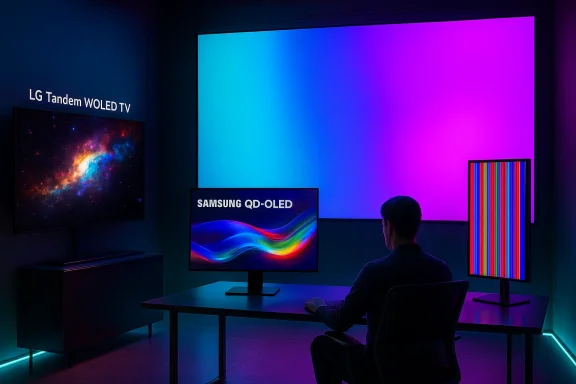
Dim showroom scene with LG WOLED and Samsung QD-OLED displays showing vibrant colors.
OLED’s long run as the undisputed premium-TV champion is being challenged not by a single rival but by a multi-front RGB arms race that stretches from micro‑LED and Micro RGB backlights to new RGB‑stripe OLED panels for gaming monitors — and that contest is rewriting what “best” means for buyers, creators and gamers.

Background: how we got here — OLED’s strengths and the pressure points​

For more than a decade, OLED (organic light‑emitting diode) TVs — particularly LG’s WRGB or WOLED implementations — set the premium standard with per‑pixel emissive blacks, superb contrast and ultra‑thin panels. The basic tradeoff has been familiar: OLED delivers perfect black and fantastic viewing angles, but traditionally lagged behind the brightest LCD variants in sustained peak luminance.
Two technical threads emerged as counters to that tradeoff:
  • QD‑OLED (Quantum‑Dot OLED): uses blue OLED emitters plus a quantum‑dot color conversion layer to produce purer red and green, lifting color volume and HDR highlights versus classic WOLED architectures. Samsung pioneered QD‑OLED at scale for larger TVs and monitors.
  • Brighter, denser LCD backlights and new architectures: Mini‑LED and Neo QLED drove sustained brightness gains; now we’re seeing Micro RGB and MicroLED hybrids that embed microscopic red, green and blue emitters in the illumination plane to deliver finer per‑subpixel color control and extreme peak luminance.
Those developments converged at recent industry events — most visibly at CES 2026 — where manufacturers escalated both emissive (OLED/QD‑OLED) and backlit (Micro RGB / Mini‑LED) strategies, and where a subplot emerged: moving subpixel design back to vertical RGB stripes to fix text clarity and desktop‑use complaints on OLED monitors.

The players and the new playbook​

LG Display: Tandem WOLED / Primary RGB Tandem 2.0 — OLED gets brighter and more reflective‑resistant​

LG Display announced an evolution of its OLED stack — variously branded as Primary RGB Tandem 2.0 and bundled under the “Tandem WOLED” family — designed to push sustained and peak brightness dramatically higher while lowering reflectance and retaining OLED’s black‑level advantage. The company’s headline claim for TV panels is up to 4,500 nits peak (lab window measurements) and an industry‑low 0.3% reflectance figure for some panels. Early implementation notes show stacked emissive layers (separate R/G/B stacks and multiple blue layers in some tandems) that spread electrical and optical load to reduce emitter stress and increase usable brightness.
What this practically means:
  • Bright, punchy HDR highlights on OLED are now feasible without relying solely on local dimming or white‑subpixel trickery.
  • LG’s approach retains a white (W) element in many large‑panel implementations (hence WOLED branding for TVs), which still gives advantages in reproducing bright whites and some highlight detail.
Caveat: vendor peak nits are commonly measured on small window sizes (3–10% APL windows) in lab conditions, which may not reflect sustained real‑scene performance in a living room. Independent lab validation is the necessary follow‑up to marketing figures.

Samsung Display: QD‑OLED advances and Micro RGB showstoppers​

Samsung continued to refine its QD‑OLED roadmap and simultaneously advanced Micro RGB for very large, gallery‑style sets. Two connected moves matter.
  1. Samsung’s QD‑OLED panels moved beyond triangular Pentile subpixel arrangements by introducing a V‑Stripe (vertical RGB stripe) layout for some high‑refresh‑rate monitor panels (notably a 34‑inch, 360Hz panel) — a change that directly addresses text fringing and font rendering issues that plagued earlier OLED monitor designs. The new 34‑inch V‑Stripe panels are reported to reach peak brightness in the neighborhood of 1,300 nits for monitor use and have already been supplied to multiple vendors (ASUS, MSI, Gigabyte).
  2. For living‑room scale, Samsung used CES to show a 130‑inch Micro RGB flagship (R95H family) that embeds sub‑100 µm RGB emitters in the backlight to achieve extreme color volume and claimed near‑total BT.2020 coverage in marketing materials, with VDE certification cited in vendor briefs. Micro RGB is still an LCD stack functionally, but it acts like an emissive array at the backlight plane and narrows the gap between LCD and emissive technologies on color and HDR highlights.
Both moves — V‑Stripe for monitors and Micro RGB for giant TVs — reflect a strategic bifurcation: make OLED friendlier for desktop and gaming use, and make LCD‑derived architectures mimic emissive color and contrast at very high brightnesses.

Monitor makers move fast: RGB stripe OLED monitors for productivity and gaming​

PC‑centric panel wins followed quickly. At CES 2026, LG Display and Samsung Display both showcased RGB‑stripe OLED panels targeted at gaming and creator monitors: examples include a 27‑inch 4K/240Hz RGB‑stripe panel from LG and multiple 34‑inch 360Hz designs from Samsung’s V‑Stripe production run. Manufacturers such as ASUS used these panels for new ROG and Strix families, touting sharper text, higher sustained brightness for HDR gaming, and competitive refresh‑rate credentials. That makes OLED compelling not just for movies and TV shows but for desktop productivity and high‑end gaming — a notable expansion of the addressable market for OLED.

Why RGB matters now: technical reasons and user‑visible benefits​

  • Color purity and gamut expansion: RGB subpixels (or micro‑RGB emitters in backlights) can produce spectrally purer primaries than an architecture that begins with white light and filters it down. That translates into wider color gamuts and greater color volume at high brightness. QD‑OLEDs and Micro RGB sets both lean into that advantage.
  • Text clarity for desktop use: Vertical RGB stripe subpixel layouts align with font rendering engines (subpixel anti‑aliasing), reducing the green/magenta fringing and edge softness associated with pentile/triangular layouts. That’s why monitor makers are adopting stripe arrangements for OLED monitors.
  • HDR highlight fidelity: Micro RGB and the newer tandem OLED stacks both aim to increase peak nit output without washing out colors — allowing HDR highlights that pop without losing saturation. This is a real, practical shift for HDR‑oriented content.
  • Design and use‑case diversification: Micro RGB enables gallery‑scale, high‑luminance installations previously reserved for LED walls; RGB‑stripe OLED monitors convert OLED’s cinematic strengths into a daily‑driver display for gamers and creatives. The market implications are broad: more choices, but also more complexity at the point of sale.

Strengths and clear wins in this new cycle​

  • Higher peak brightness on emissive panels: OLEDs are no longer confined to dimmer rooms; Tandem OLED and QD‑OLED generations are pushing peak figures toward and beyond 2,000–4,500 nits in lab conditions, closing a long‑standing gap with LCD variants.
  • Better color fidelity at high brightness: QD‑OLED and Micro RGB both improve color volume into HDR highlights, which matters for cinematic HDR and color‑critical workflows.
  • Improved monitor usability: Vertical RGB stripe QD‑OLED and RGB‑stripe OLED monitors reduce text artifacts and widen OLED’s appeal for productivity tasks — a practical win for creators and PC users.
  • Platform integration and AI value add: Vendors are coupling display hardware with on‑device AI engines and ecosystem features (upscaling, dynamic tone mapping, assistant integration), which can materially improve perceived image quality and user experience. The hardware is only part of the competitive equation now.

Risks, tradeoffs and unknowns — what buyers should worry about​

  • Marketing vs. real‑world brightness: The 4,500‑nit and similar peak numbers are almost always measured under small‑window test conditions. Those figures often don’t translate to sustained scene brightness across real content. Independent lab reviews that publish multi‑APL and full‑screen measurements are essential for verification. Treat headline nits as conditional until labs confirm them.
  • Burn‑in and long‑term durability: OLED remains a self‑emissive technology with inherent risks of differential wear. QD‑OLED mitigates some issues by relying on blue emitters and conversion layers, and tandem stacks distribute load, but burn‑in precautions and firmware‑level safeguards still matter for heavy static‑UI use (game HUDs, news tickers, channel logos). Monitor usage that involves static toolbars or UI must be considered carefully.
  • Price and availability: Micro RGB giant sets (e.g., 130‑inch Samsung displays) and early tandem OLED flagships are halo products with premium MSRPs and limited initial availability. Expect long lead times and regional SKU fragmentation.
  • HDR format fragmentation and ecosystem friction: Some manufacturers lean into HDR10+ Advanced while others emphasize Dolby Vision. HDR format splits can produce inconsistent results across content sources — another variable buyers need to validate.
  • Complexity at purchase time: With multiple panel types, subpixel layouts, HDR implementations, and AI feature sets, the average buyer faces a steep technical decision tree. Model numbers, panel source (LG Display vs Samsung Display), and SKU‑level features matter and are not always communicated clearly at retail.
  • Privacy and AI concerns: On‑device assistants and LLM integrations bring convenience but also data‑handling risks. Buyers should review privacy controls and whether sensitive processing happens locally or in the cloud.

How to choose in the RGB era — practical buyer checks​

  1. Confirm the exact panel type and pixel architecture at the SKU level: QD‑OLED vs WOLED/Tandem vs Micro RGB. Different panel sources produce different results even under the same brand.
  2. Don’t accept single‑window peak nits as the whole story; ask reviewers for multi‑APL and sustained brightness tests. If a manufacturer claims 4,500 nits, ask under what window size and test conditions that figure was measured.
  3. For monitor purchases, prefer vertical RGB‑stripe panels if you do heavy text or creative work. They resolve subpixel‑rendering artifacts that affected earlier OLED panels.
  4. Check HDR format support and whether firmware updates add or remove features like HDR10+ Advanced or Dolby Vision support. This affects streaming compatibility.
  5. Consider usage profile: if you keep static UI elements visible for long stretches, evaluate burn‑in mitigation policies, warranties, and whether the set has robust pixel‑refresh and panel‑care features.
  6. Factor in calibration and installation costs for very large sets, and confirm local service and warranty coverage for premium models.

The strategic implications for the TV and monitor market​

  • The premium display market has become a multi‑architecture battleground rather than a two‑horse race. OLED remains a top choice for contrast and form‑factor, but Micro RGB and advanced Mini‑LED variants now compete aggressively on brightness and color volume. That means differentiation will increasingly come from software — AI upscaling, tone mapping and platform services — rather than raw panel characteristics alone.
  • For content creators and professionals, true RGB approaches and improved monitor designs solve practical usability problems (font clarity, color accuracy), making OLED closer to a daily creative tool, not just a cinema display.
  • For mainstream buyers, the sheer choice explosion increases purchase risk: two TVs with similar advertised specs might use fundamentally different panels and therefore behave very differently in your living room. Retail communication and independent lab testing will be decisive.

Short technical primer: terms that matter​

  • WOLED / WRGB: LG’s white‑based OLED stack that includes a white subpixel to boost brightness and efficiency in certain modes.
  • QD‑OLED: Uses blue OLED emitters with quantum‑dot color conversion to create red and green, enabling purer color primaries.
  • Micro RGB / MicroLED hybrid: A backlight or emissive plane with microscopic R/G/B emitters, enabling near‑subpixel control of light and color at high brightness.
  • V‑Stripe / RGB‑stripe: Vertical alignment of R, G and B subpixels to improve text rendering and reduce visible subpixel fringing on close‑distance desktop use.
  • APL (Average Picture Level): The percentage of the screen that is bright; manufacturers often quote peak nit numbers on small‑window APLs which exaggerates single‑scene brightness. Independent tests should report multiple APL conditions.

Final analysis: is OLED dethroned?​

Not yet. The meaningful conclusion is that OLED is no longer the single answer for “best picture” across all use cases. The 2026 product cycle shows OLED fighting back on brightness and practical usability while LCD‑derived technologies — especially Micro RGB — are becoming serious contenders in color volume and HDR highlight performance.
For buyers, the choice is now use‑case driven:
  • Choose modern Tandem OLED / QD‑OLED when you value picture‑theatre contrast, very thin form factors and cinematic color rendering, especially in controlled lighting. Confirm the model’s sustained HDR behavior with independent lab tests.
  • Choose Micro RGB / high‑end Mini‑LED when you need exceptionally bright highlights, gallery installations, or worry about burn‑in on static high‑APL content — and when extreme color gamut at high luminance is a priority.
  • Choose RGB‑stripe OLED monitors if you do mixed productivity and gaming on a single screen and want the best of OLED contrast and crisp text rendering.
The headline is simple: the display market has entered an RGB arms race that benefits buyers with more capability and more nuance, but it also demands more technical literacy at purchase. As the vendors iterate on panel chemistry, pixel layout and AI image pipelines, the definitive lab measurements and long‑term reviews will be the most valuable tools for anyone planning a high‑end TV or monitor purchase this year.

OLED’s era as the unquestioned premium champion has ended — not with a single coup but with healthy, evolutionary competition that will raise the bar for brightness, color and everyday usability. The winner for any individual buyer will be the option that matches real‑world viewing habits to verified performance, not the one with the flashiest headline nit number.

Source: The Australian https://www.theaustralian.com.au/bu.../news-story/35145f32c40f000366e997b20f82188b/
 

OLED’s decandde of unchallenged dominance over the high‑end living‑room TV market is giving way to a far broader and more aggressive race centered on RGB control — and that shift is already changing what “best picture” means for buyers, creators and gamers.

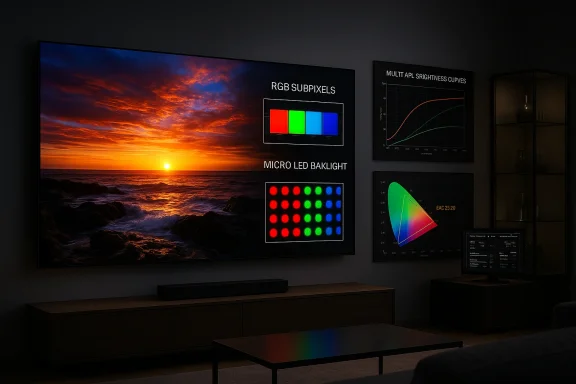
A dark, modern living room with a large screen displaying a sunset over the sea and RGB subpixels.Background​

For years, OLED (organic light‑emitting diode) panels — especially LG’s white‑subpixel variants (WOLED/WRGB) — were the shorthand for cinematic contrast, inky blacks and ultra‑thin designs. Those advantages made OLED the default recommendation for dark‑room movie viewing and premium hardware lists. But OLED’s historical weakness — sustained peak brightness and extreme highlight luminance versus the brightest LCDs — has become a commercial and technical sore point as content, living‑room setups and buyer expectations evolve.
Into that opening has stepped an “RGB arms race”: vendors are pursuing multiple technical paths that put red/green/blue control back into the center of the display conversation. The contenders include QD‑OLED refinements, denser Mini‑LED implementations, Micro RGB backlights and emergent MicroLED hybrids — plus a subtler but important pixel‑layout battle to return to vertical RGB‑stripe subpixels for monitors. These moves are reshaping what premium buyers should expect and how reviewers must verify vendor claims.

Why RGB matters now: the technical case​

Color primaries, color volume and HDR highlights​

Direct RGB emitters (whether as micro emitters in a backlight or as RGB subpixels in emissive panels) produce spectrally purer primaries than architectures that begin with a white or blue source then filter light down. That improves color volume — the ability to hold saturated colors at very high luminance — which is critical to HDR that “pops” without desaturating. Vendors tout 100% coverage of wide gamuts (BT.2020, DCI‑P3, Adobe RGB) for new RGB approaches; some claims carry third‑party test flags. Still, those headlines require careful scrutiny on measurement conditions.

Brightness without washed color​

Historically, LCD‑derived approaches won brightness by dumping energy into white light and using quantum‑dot filters; the result was punchy nits but limited color fidelity in the brightest highlights. Micro RGB — arrays of microscopic R/G/B LEDs in the backlight plane — promises a different trade: high sustained peak luminance while retaining saturated primaries because each micro‑emitter is tuned to a primary color. LG and Samsung used CES‑era launches to position Micro RGB as a route to gallery‑scale brightness without the typical color wash of white‑backlight HDR.

Text clarity and the monitor problem​

OLEDs originally used PenTile/triangular subpixel arrangements that produced excellent perceived resolution for video but caused text fringing and subpixel anti‑aliasing artifacts at desktop viewing distances. The industry response is a return to vertical RGB‑stripe subpixel layouts for OLED monitors — an architectural pivot that preserves OLED’s contrast while restoring sharp font rendering and improved UI fidelity for creators and gamers. That pivot is already rolling into high‑refresh monitor panels.

What manufacturers actually announced and claimed​

Samsung: the 130‑inch Micro RGB showcase​

At CES 2026 Samsung unveiled a gallery‑scale 130‑inch Micro RGB flagship (R95H family) that underscores the company’s strategy: make ultra‑large panels irresistible with extreme color volume, high peak luminance and integrated on‑device AI. Samsung’s materials claim sub‑100‑µm emitter pitch, near‑total BT.2020 coverage and VDE certification for color accuracy, plus HDR10+ ADVANCED support and tight software integration with the company’s Vision AI Companion. These are bold engineering claims framed as showroom showstoppers rather than mass‑market SKUs.
Caveat: marketing nit figures and certification badges are meaningful but not definitive — the measurement window, APL (Average Picture Level) conditions and tone‑mapping behaviors all matter to real‑world HDR fidelity. Independent lab measurements will be decisive.

LG: Micro RGB evo and Tandem WOLED evolutions​

LG answered with two fronts: an evolved WOLED/Tandem OLED stack promising much higher sustained brightness, and a Micro RGB evo family (MRGB95) that targets 75‑, 86‑ and 100‑inch sizes for living‑room and pro‑viewer use. LG’s Micro RGB evo materials claim Intertek verification for extremely wide gamut coverage and a CES Innovation Award on the 100‑inch model. The company emphasizes OLED‑grade control logic, dual‑AI processors and micro‑dimming systems to make LCD-derived Micro RGB feel closer to emissive panels in behavior.
Again, vendor claims such as “100% BT.2020” or “4,500 nits peak” must be read against how those peaks were measured (3% window vs full‑screen APL) and whether sustained HDR scenes hold color and contrast without clipping or tone mapping artifacts.

QD‑OLED and RGB‑stripe OLED monitors​

Samsung Display’s QD‑OLED roadmap has pursued two separate improvements: quantum‑dot color conversion to boost color primaries, and V‑Stripe/vertical RGB subpixel layouts to cure earlier text‑rendering issues on OLED monitors. LG and panel partners have likewise introduced stripe OLED panels targeted at 27‑ to 34‑inch monitors with high refresh rates for gaming and content creation. The net effect: OLED is becoming more useful outside the dark‑room TV niche.

What’s new for buyers: practical implications​

  • More capability, more nuance. Buyers now choose between true emissive (OLED, QD‑OLED), hybrid emissive/backlit (Micro RGB, MicroLED hybrids) and high‑density local‑dimming LCDs (Mini‑LED/Neo QLED). Each has unique performance envelopes for black level, peak highlights, and color volume.
  • Lab tests matter more than ever. Headline nits and gamut percentages are conditional. Insist on independent lab tests that report multi‑APL measurements, Delta‑E color accuracy across APL windows, and verified tone‑mapping behavior.
  • Use‑case optimization beats spec chasing. If you watch in a bright room or want gallery‑scale HDR, high‑nit Micro RGB / Mini‑LED systems may serve better. If you want black‑level perfection and thin form factor, OLED still wins. If you mix productivity and gaming, look for RGB‑stripe OLED monitors.
  • Installation, warranty and software matter. Ultra‑large Micro RGB sets may carry AV‑grade installation and electrical requirements. AI features and assistant integrations add value — but also raise privacy questions and update/compatibility risks. Confirm warranty terms and local service availability.

Technical caveats and the verification checklist​

Manufacturers commonly publish the following metrics. Here’s how to interrogate them:
  • Peak brightness (nits): Ask under what window size (3%, 10%, full‑screen) this was measured. Small‑window peaks often don’t reflect sustained scene behavior.
  • Color gamut claims: Check whether a claim of “100% DCI‑P3 / BT.2020” comes with independent lab verification (Intertek, VDE) and whether the test conditions are disclosed.
  • APL performance: Prefer multi‑APL charts showing 3%, 10%, 25% and 100% behavior; those reveal how tone mapping and thermal limits impact real content.
  • Burn‑in and longevity: For self‑emissive panels, review manufacturer mitigation features (pixel refresh, brightness zoning) and warranty language regarding image retention.
  • HDR format support: Note whether the TV favors Dolby Vision, HDR10+ Advanced, or HDR10, and whether firmware updates can change supported formats. Format fragmentation still affects HDR grading fidelity.

Strengths of the RGB era​

  • Expanded capability envelope. The additive effect of Micro RGB and advanced OLED stacks closes long‑standing gaps — OLED recaptures meaningful brightness; RGB‑backlit LCDs deliver saturated highlights at extreme nits. That raises the bar for HDR experiences.
  • Better tools for creators. RGB‑primary systems arend validated wide gamuts bring consumer hardware closer to studio workflows, making living‑room panels more viable as reference displays for prosumers.
  • Diversified product fit. There’s now a clearer mapping from use case to architecture: ambient bright‑room viewing, gallery installations, content creation, or competitive gaming can each be matched to a targeted panel type.

Risks, unknowns and consumer pitfalls​

  • Marketing vs. measurement. Many headline claims (4,000–4,500 nits, 100% BT.2020) are presented without the fuller measurement context. Buyers who accept these numbers at face value may be disappointed by sustained real‑world performance. Independent labs and reviewers will be the arbiter.
  • Format fragmentation and firmware risk. The HDR ecosystem splits (Dolby Vision vs HDR10+ Advanced) and feature‑toggle firmware updates mean a TV’s capabilities can change over its life. Confirm upgrade policies and the likelihood of new HDR features being gated behind region or SKU differences.
  • Burn‑in and long‑term durability. Emissive OLED variants remain susceptible to differential wear; while QD‑OLED and engineering fixes reduce risk, static UI use (news tickers, game HUDs, desktop toolbars) still demands caution and warranty diligence. Micro RGB/LCD variants sidestep burn‑in but introduce potential bloom and haloing tradeoffs.
  • Price, availability and regional SKU fragmentation. The first wave of Micro RGB and tandem OLED flagships will be premium, limited SKUs with long lead times. Buyers must factor in installation costs, calibration and local support.
  • AI and privacy. On‑device assistants and LLM integrations can materially improve imaging and user workflows, but they also bring data‑handling and hallucination concerns that vary by vendor. Review privacy settings carefully and prefer on‑device processing where available.

How to buy in the RGB era: a practical step‑by‑step guide​

  • Define your primary use case: dark‑room cinema, bright‑room sports, gallery installation, creative work, or mixed desktop/gaming. This determines the architecture that best fits your needs.
  • Confirm the exact SKU and panel source (LG Display vs Samsung Display). Two TVs with the same brand name may use different panels and behave very differently.
  • Demand multi‑APL and independent lab data, not just small‑window peak nits. Look for Intertek, VDE or respected measurement labs reporting Delta‑E and APL performance.
  • For monitors, prefer vertical RGB‑stripe OLED for heavy text and creative work; insist on measured metrics for refresh rate, color depth and chroma subsampling at the modes you plan to use.
  • Factor in calibration costs, wall mounting and electrical requirements for very large sets; confirm warranty coverage for burn‑in or panel defects.
  • Evaluate AI features and privacy: check whether assistant processing is on device, what data is sent to cloud services, and whether voice/assistant functionality can be disabled.

The market strategic picture​

The premium display market has shifted from a narrow duel (OLED vs LCD) into a multi‑front contest where panel chemistry, subpixel layout, micro‑emitter design and software pipelines compete in combination. That fragmentation benefits buyers with more optimized choices but also raises the bar for pre‑purchase technical literacy. As vendors converge on better brightness, richer color volume and more useful AI processing, the decisive differentiator will be verified, repeatable lab performance and long‑term reliability rather than marketing copy.
For AV integrators and professionals, the era demands new checklist disciplines: ask for spectral power distributions, APL curves, validated color‑management presets and on‑site calibration options. For mainstream buyers, the advice is simpler: match the display to your room and viewing habits, and wait for trusted lab reviews if the model is a new architectural experiment rather than an incremental update.

Conclusion​

OLED is not dead — far from it. Its hallmark contrast and thin form factor still make it the right answer for many viewers. But the display crown is no longer a single, uncontested prize: Micro RGB, advanced Mini‑LED, QD‑OLED refinements and RGB‑stripe OLED monitors have all moved the performance frontier in ways that close OLED’s traditional gaps and open new choices for buyers. The net effect is healthier competition that will push brightness, color fidelity and day‑to‑day usability forward — provided independent labs translate vendor claims into repeatable, real‑world measurements.
In short: the era of one‑size‑fits‑all premium recommendations is over. The smartest purchases in 2026 and beyond will come from buyers who pair careful technical verification with clear use‑case thinking, and who treat vendor headline numbers as starting points for deeper scrutiny rather than final answers.

Source: The Weekly Times https://www.weeklytimesnow.com.au/a.../news-story/35145f32c40f000366e997b20f82188b/
 

Back
Top