

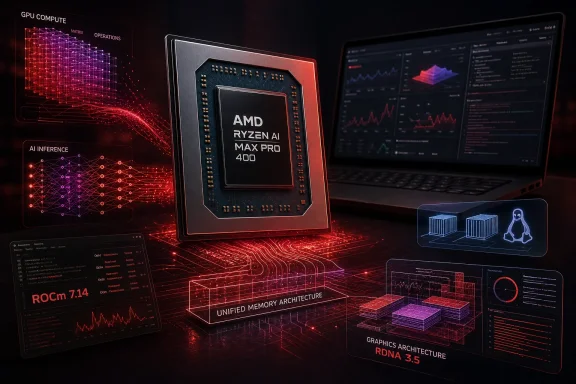
AMD’s ROCm 7.14 release adds software support for the Ryzen AI Max PRO 400 series, giving developers access to AMD’s GPU-compute stack before systems using the chips reach OEM channels later this quarter.
The update supports three Gorgon Halo processors: the 16-core Ryzen AI Max+ PRO 495 with Radeon 8065S graphics, the 12-core Ryzen AI Max PRO 490, and the eight-core Ryzen AI Max PRO 485. AMD’s ROCm release notes list all three as RDNA 3.5-based gfx1151 devices.
This is not, as some early coverage suggested, an unannounced CPU family surfacing in code. AMD formally introduced the Ryzen AI Max PRO 400 line on May 20 and said systems from partners including HP and Lenovo are due in the third quarter of 2026. ROCm 7.14 is instead the expected software enablement step ahead of wider hardware availability.
The Max PRO 400 parts sit above AMD’s regular Ryzen AI PRO notebook chips, targeting mobile workstations, compact desktops and developer systems that need substantial local AI and graphics capability without a discrete GPU.
AMD says the top-end 495 combines 16 Zen 5 CPU cores, 40 RDNA 3.5 graphics compute units, and an XDNA 2 NPU. The platform supports up to 192GB of unified LPDDR5X memory, with up to 160GB assignable to graphics. The 490 cuts the CPU allocation to 12 cores and graphics to 32 compute units; the 485 uses eight cores with the same 32-CU Radeon 8050S graphics configuration. All three are configurable from 45W to 120W.
Those specifications matter chiefly for local inference and graphics-heavy professional workloads, where the unusually large shared-memory pool can be more useful than a thin-and-light laptop’s NPU score alone.
AMD also positions ROCm 7.14 as a production release after the 7.9 through 7.13 preview sequence. Its release notes highlight updated AI framework and inference support, telemetry, profiling workflows, and mathematical libraries.
For Windows users, this does not mean an existing PC receives a new consumer AI feature through Windows Update or AMD Software: Adrenalin Edition. The practical change is for developers and IT teams planning Linux-based ROCm deployments, containers, or workstation software around the upcoming hardware.
Buyers waiting for a Ryzen AI Max PRO 400 system will need to wait for OEM product announcements and availability in the third quarter of 2026.
The update supports three Gorgon Halo processors: the 16-core Ryzen AI Max+ PRO 495 with Radeon 8065S graphics, the 12-core Ryzen AI Max PRO 490, and the eight-core Ryzen AI Max PRO 485. AMD’s ROCm release notes list all three as RDNA 3.5-based gfx1151 devices.
This is not, as some early coverage suggested, an unannounced CPU family surfacing in code. AMD formally introduced the Ryzen AI Max PRO 400 line on May 20 and said systems from partners including HP and Lenovo are due in the third quarter of 2026. ROCm 7.14 is instead the expected software enablement step ahead of wider hardware availability.
 A workstation-focused Halo refresh
The Max PRO 400 parts sit above AMD’s regular Ryzen AI PRO notebook chips, targeting mobile workstations, compact desktops and developer systems that need substantial local AI and graphics capability without a discrete GPU.AMD says the top-end 495 combines 16 Zen 5 CPU cores, 40 RDNA 3.5 graphics compute units, and an XDNA 2 NPU. The platform supports up to 192GB of unified LPDDR5X memory, with up to 160GB assignable to graphics. The 490 cuts the CPU allocation to 12 cores and graphics to 32 compute units; the 485 uses eight cores with the same 32-CU Radeon 8050S graphics configuration. All three are configurable from 45W to 120W.
Those specifications matter chiefly for local inference and graphics-heavy professional workloads, where the unusually large shared-memory pool can be more useful than a thin-and-light laptop’s NPU score alone.
ROCm support arrives first
ROCm is AMD’s developer platform for GPU computing, AI frameworks and HPC applications rather than a conventional Radeon display driver. Per AMD’s 7.14 release notes, the update also expands profiler coverage: ROCm Systems Profiler now supports the Max PRO platform, while ROCm Compute Profiler adds compatibility for the newer Ryzen AI Max PRO chips as well as Strix Halo and Strix Point systems.AMD also positions ROCm 7.14 as a production release after the 7.9 through 7.13 preview sequence. Its release notes highlight updated AI framework and inference support, telemetry, profiling workflows, and mathematical libraries.
For Windows users, this does not mean an existing PC receives a new consumer AI feature through Windows Update or AMD Software: Adrenalin Edition. The practical change is for developers and IT teams planning Linux-based ROCm deployments, containers, or workstation software around the upcoming hardware.
Buyers waiting for a Ryzen AI Max PRO 400 system will need to wait for OEM product announcements and availability in the third quarter of 2026.
References
- Primary source: www.guru3d.com
Published: 2026-07-17T16:21:00+00:00
AMD Adds Ryzen AI MAX PRO 400 Series Support to ROCm Ahead of Launch
AMD appears to be preparing the release of its Ryzen AI MAX PRO 400 series processors, as support for the new lineup has surfaced inside the company's latest ROCm 7.www.guru3d.com - Independent coverage: Wccftech
Published: 2026-07-16T13:01:25+00:00
AMD Prepares For Ryzen AI MAX PRO 400 Launch With ROCm 7.14 Support
AMD's ROCm 7.14 adds support for Ryzen AI Max PRO 400 series, enabling AI developers to optimize applications ahead of the Gorgon Halo launchwccftech.com
- Independent coverage: videocardz.com
Published: 2026-07-16T10:53:07+00:00
- Related coverage: rocm.docs.amd.com