

Rokid’s CES reveal is a clear, ambitious bid to reshape the smart‑glasses market: the company introduced the Rokid Ai Glasses Style — a display‑free, voice‑centric pair of glasses that it bills as the “world’s first open AI ecosystem” for eyewear, combining a featherweight frame, a dual‑chip architecture, broad language support, and prescription‑grade optics at an aggressively low headline price. The product launch mixes practical engineering choices (prioritizing comfort, battery life and lens compatibility) with an overt ecosystem play: Rokid says Style will connect to multiple AI engines — ChatGPT, Qwen, DeepSeek and others — while opening an “AI Agent Store” for third‑party agents to run natively on the glasses. This launch signals an inflection point in the category where wearability, accessibility and ecosystem openness are now being sold as the differentiators that finally make AI glasses useful for everyday users.
Rokid is not a newcomer to the smart‑glasses game; the company has spent years building AR and AI eyewear and cultivating a developer community around its platform. Prior demos and field trials — including high‑profile demonstrations in China where Rokid showcased gesture and ring‑based interaction — helped the company refine hardware and interaction patterns that prioritize hands‑free, voice‑first workflows. Those early demos generated social buzz and framed Rokid’s push into consumer wearables as an evolution from enterprise AR toward mainstream, everyday AI eyewear.
At CES 2026 Rokid presented Style as an answer to what it calls the industry’s “impossible triangle”: delivering comfort and wearability, meaningful AI functionality, and long battery life without breaking the bank. Rather than building a glasses product with micro‑displays or a bulky temple array, Rokid’s Style opts for a compact, display‑free design that routes responses to the wearer via open‑ear audio and voice, plus multimodal camera input for context‑aware tasks. The company positions that tradeoff as purposeful: remove the screen, make the glasses feel like sunglasses or prescription eyewear, and move AI to the edge where it can be useful without being obtrusive.
Source: TechPowerUp Rokid Launches the World's First Open AI Ecosystem Smart Glasses at CES
 Background / Overview
Rokid is not a newcomer to the smart‑glasses game; the company has spent years building AR and AI eyewear and cultivating a developer community around its platform. Prior demos and field trials — including high‑profile demonstrations in China where Rokid showcased gesture and ring‑based interaction — helped the company refine hardware and interaction patterns that prioritize hands‑free, voice‑first workflows. Those early demos generated social buzz and framed Rokid’s push into consumer wearables as an evolution from enterprise AR toward mainstream, everyday AI eyewear.At CES 2026 Rokid presented Style as an answer to what it calls the industry’s “impossible triangle”: delivering comfort and wearability, meaningful AI functionality, and long battery life without breaking the bank. Rather than building a glasses product with micro‑displays or a bulky temple array, Rokid’s Style opts for a compact, display‑free design that routes responses to the wearer via open‑ear audio and voice, plus multimodal camera input for context‑aware tasks. The company positions that tradeoff as purposeful: remove the screen, make the glasses feel like sunglasses or prescription eyewear, and move AI to the edge where it can be useful without being obtrusive.
What Rokid announced at CES: the headline claims
- Product name: Rokid Ai Glasses Style (short: Style).
- Design thesis: display‑free, prescription‑first frames that weigh 38.5 grams, built for all‑day wear.
- Chips / architecture: a dual‑chip design combining an NXP RT600 for low‑power always‑on tasks and a Qualcomm AR1‑class processor for AI and imaging workloads. Rokid calls this a “world’s first” dual‑chip architecture for AI glasses.
- Imaging and capture: a 12MP Sony sensor, 4K capture capability and a claimed continuous video recording window up to 10 minutes (vs. typical 1–3 minute limits on other consumer glasses). Triple‑format capture is supported (3:4, 4:3, 9:16) for creator‑ready footage.
- Battery & runtime: Rokid quotes up to 12 hours of typical daily use and more than 24 hours standby on a single charge; marketing claims emphasize long real‑world sessions thanks to the display‑free approach.
- Languages & translation: voice interaction in 12 languages, translation in 89 languages (Rokid’s press material).
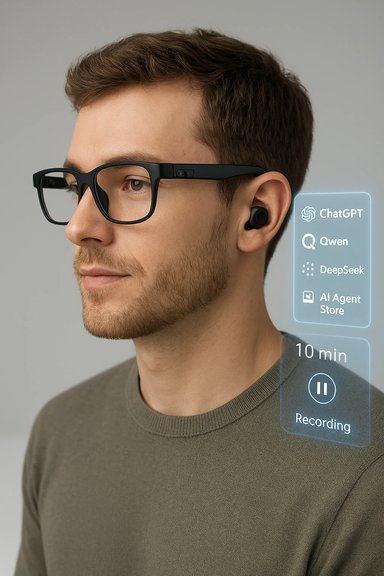
- Ecosystem & openness: on‑device support for multiple AI engines (ChatGPT, Qwen, DeepSeek) and an AI Agent Store for third‑party agents and services. Rokid frames this as an antidote to single‑vendor lock‑in.
- Price & availability: headline price $299 (global retail, excluding tax). Reservations began at CES with a $1 deposit and an announced global launch window for January 19, 2026. Rokid is also offering a “Golden Bundle” that includes prescription lenses and photochromic functionality for a higher bundle price.
Technical deep dive: architecture and what it practically means
Dual‑chip approach: why two chips?
Rokid’s Style uses a split architecture:- NXP RT600 (low‑power microcontroller role): handles always‑on wake words, sensor fusion, gesture detection and low‑latency controls with minimal energy draw. This keeps the glasses responsive without draining the main compute core for trivial events.
- Qualcomm AR1‑class processor (imaging and local AI): performs image processing, real‑time computer vision and runs small language models (SLMs) or offloads heavy reasoning to paired phones/cloud when needed. Qualcomm’s AR1 platform and AR1+ iterations were explicitly created to bring local inference to glasses, enabling the sort of on‑device assistant Rokid describes.
Imaging and creator features
Style’s 12MP Sony sensor and Rokid’s imaging pipeline are pitched at creators: automatic vertical capture, multi‑format output, and longer continuous recording (Rokid says up to 10 minutes). The longer recording claim is notable in the context of competitor defaults — many consumer smart glasses historically limited clips to 60 seconds and only more recently increased to 3 minutes via firmware updates on products like Meta’s Ray‑Ban series. Rokid’s 10‑minute window, if realized in retail units, would be significant for casual vlogging and hands‑free content capture.Prescription readiness and optics
Rokid positions prescription support as a core product attribute rather than an afterthought. The Style frames are offered with a wide correction range and specialized lens bundles, and Rokid promises global online prescription fulfillment (upload your script, receive custom lenses in 7–10 days). For mainstream adoption, solving prescription compatibility is essential; Rokid is betting the buyer friction is a bigger adoption blocker than whether the glasses have a small green HUD.How Style compares with the current competitive set
- Weight & wearability: Rokid quotes 38.5 g. That’s lighter than most current camera‑equipped smart glasses from major players — Meta’s Ray‑Ban family typically falls in the ~48–52 g range depending on frame and variant. Lighter devices increase the likelihood of full‑day wear.
- Display strategy: Rokid chose no display (voice + audio + camera) while some competitors (including Meta’s display models) are shipping display variants. Removing the display simplifies optics, reduces battery draw and enables a more conventional eyewear look. This design choice trades immediacy of visual overlay for comfort and battery.
- Recording duration: Rokid’s 10‑minute claim exceeds the typical 1–3 minute clip limits that have been common. Meta’s Ray‑Ban updated firmware to allow up to 3 minutes. If Rokid’s 10‑minute limit is accurate in the shipping product, it would materially extend creator use cases.
- Open AI ecosystem: Rokid’s claim to support multiple AI engines (ChatGPT, Qwen, DeepSeek) and a developer agent store is a direct counter to closed stacks. The competitive landscape is mixed: some vendors tightly integrate a single assistant, others support multiple backends. Rokid’s openness is an attempt to avoid lock‑in and accelerate third‑party innovations.
Strengths: where Rokid’s approach makes sense
- Wearability & design realism: Prioritizing lightweight frames and seamless prescription support acknowledges a major adoption barrier for mainstream users. The 38.5 g claim is market‑relevant and consistent with the device’s positioning as “eyewear first.”
- Battery parity via tradeoffs: By choosing no display and offloading heavy tasks, Rokid can realistically target multi‑hour daily use — a major practical advantage over display‑heavy designs.
- Developer‑centric ecosystem: An AI Agent Store and multi‑model support lower the bar for third‑party agents and specialized vertical services (language, travel, medical triage helpers). For developers, openness coupled with an SDK can speed feature creation and localization.
- Accessibility focus: Rokid’s programs for subsidized purchases for visually impaired users and the emphasis on audio‑first AI suggest a concrete social benefit strategy that could drive real‑world value for certain user groups.
- Competitive pricing: A $299 launch price is aggressive for an AI‑enabled pair of glasses with prescription options; the low price point could spur adoption among curious early adopters who would otherwise be priced out of the category.
Risks and unresolved questions
While the product is compelling on paper, several technical, privacy and business risks deserve careful scrutiny.1) Marketing superlatives vs. verifiable firsts
Rokid uses terms like “world’s first open AI ecosystem” and “world’s first dual‑chip AI glasses architecture.” Those are marketing claims and require careful parsing. The underlying technical claims (dual‑chip approach, AR1 silicon, language support) are plausible and consistent with industry trends, but “first” labels are commonly disputed in fast‑moving categories where design variants and integration choices often create overlapping “firsts.” Treat absolute claims as promotional until validated by independent testing.2) Privacy, data flows and jurisdictional complexity
The openness to multiple AI engines is a double‑edge sword. Supporting third‑party agents and cloud models raises three sensitive governance questions:- Which data leaves the glasses? Multimodal sensors (camera, microphone, location) generate highly personal data. Consumers and enterprises must know what is processed locally, what is sent to partner model endpoints, how long data is retained, and where it is stored geographically. Rokid’s materials emphasize on‑device capabilities but also promise cloud augmentation; the precise default behaviors need transparent disclosure.
- Model provenance and security: Allowing third‑party agents to run natively raises authentication, sandboxing and privacy‑policy enforcement issues. An “AI Agent Store” must implement robust vetting, runtime isolation, and telemetry controls to prevent a malicious or poorly implemented agent from exfiltrating data or performing unwanted actions.
- Regulatory cross‑border concerns: Rokid is a global company with a large installed base in Asia. Data residency, export controls, and governmental access differ by country; enterprises and privacy‑sensitive users will want contractual guarantees about where their data is processed and stored.
3) On‑device AI limitations
Qualcomm’s AR1 and similarly compact NPUs can run small language models but are not substitutes for large‑context LLMs. That means Rokid’s promise of instantaneous local AI may be limited to smaller agent tasks (translations, short Q&A, image tagging) while more complex reasoning will still require cloud augmentation — which reintroduces latency and privacy tradeoffs. Expect a hybrid model in practice.4) Real‑world battery and recording behavior
Rokid’s battery numbers and 10‑minute continuous recording claim are optimistic; real‑world usage (continuous video + AI processing + audio) often shortens quoted runtimes. Independent, hands‑on testing will be needed to confirm device longevity under typical creator workflows. Earlier smart‑glasses products routinely underperformed marketing runtimes in field tests.5) Software maturity, update cadence and support
Rokid’s platform success depends on ongoing firmware updates, developer tools, and robust privacy controls. Questions include: how often will models and agent frameworks be updated? What guarantees exist for security patches and long‑term support? For an always‑on wearable that sees and hears, a transparent software lifecycle is a baseline requirement.What independent outlets corroborated (and where to be cautious)
Multiple independent outlets covering CES repeated Rokid’s core specs: the light weight (~38.5 g), Qualcomm AR1 integration, 12MP camera, and an emphasis on voice‑first interaction were consistently reported. Rokid’s own press distribution (PR Newswire) provides the canonical spec sheet and availability details, and CES press coverage from independent technology outlets echoed the major design decisions and pricing. This constitutes reasonable corroboration for the product headline claims. That said, aspects that are inherently experience‑dependent — real battery life under mixed workloads, real network/privacy behavior when connecting to multiple AI engines, and the developer experience of the AI Agent Store — remain to be validated by hands‑on reviews, lab tests and developer feedback. Labeling those items “world’s first” should be treated skeptically until independent labs and reviewers confirm the specific technical or ecosystem milestones.Practical advice for buyers and IT teams
- If you care about privacy, ask Rokid: which features run always on locally, which ones route to cloud services, and where is the cloud data stored? Get contractual or documented answers for enterprise deployments.
- For creators: test actual recording limits and thermal behavior. Continuous 4K capture, combined with AI-assisted postprocessing, can cause heat and battery drain. Don’t assume lab numbers translate to full‑day vlogging.
- For accessibility buyers: verify any subsidies and program details that Rokid announced for visually impaired users. Confirm local availability and eligibility rules before purchasing.
- Developers: evaluate the SDK and the agent vetting process. If Rokid’s AI Agent Store is to scale, it requires clear runtime sandboxes, privacy APIs and monetization rules. Sign up early for developer resources and test edge cases for data access.
- Wait for independent reviews: check for lab tests on battery, audio privacy (is open‑ear audio leaking sensitive speech?, microphone quality, and camera consistency under varied light. These are the load‑bearing claims that determine real‑world value.
Broader market implications
Rokid’s launch exemplifies a pattern visible across CES and the wider industry: vendors are converging on on‑device AI silicon (Qualcomm AR1 families, vendor NPUs), hybrid local/cloud architectures, and ecosystem strategies that emphasize openness and partnerships rather than closed, single‑assistant stacks. That trend lowers technical barriers for smaller players and increases choice for consumers, but it also complicates governance and privacy oversight: more agents + more endpoints = more surfaces that require rules and transparency. If Rokid’s price and prescription approach prove durable in retail, the company could accelerate mainstream interest in audio‑first smart glasses. However, for the category to scale beyond enthusiasts and early adopters, vendors must deliver clear privacy models, long‑term software support and a straightforward path to fitment for prescription users — exactly the problems Rokid says Style is engineered to solve. The market will judge the company not by launch claims but by execution over the next 12–24 months: shipments, developer uptake, app/agent quality, and independent reports on battery, privacy and durability.Conclusion
Rokid’s Style is one of the most pragmatic takes on AI eyewear to appear at CES: rather than chasing a full‑color heads‑up display, the company prioritized lightness, prescription compatibility and an interoperable AI ecosystem at a compelling price. The hardware choices — a dual‑chip split between always‑on control and AR‑class compute, a 12MP camera tuned for creator formats, and a prescription‑centric lens program — reflect hard engineering tradeoffs aimed at making AI glasses genuinely wearable for everyday life. The launch also raises nontrivial questions about privacy, data governance and the practical limitations of on‑device AI. Rokid’s open ecosystem approach is attractive on paper, but openness demands rigorous runtime isolation, transparent data‑flow policies, and strong vetting for third‑party agents if the company wants to avoid misuse and regulatory headaches. Independent testing will be essential to confirm runtime figures and to validate claims about recording duration, language‑translation fidelity and battery life. For buyers and IT leaders, the sensible path is cautious optimism: Rokid’s Style addresses major usability hurdles that have stymied smart‑glasses adoption — weight, prescription fit, and price — but the actual user experience will determine if this is a milestone device or an incremental step. The next weeks of hands‑on reviews, teardown analyses and developer feedback will show whether Rokid’s “open AI ecosystem” is primarily marketing or the start of a genuinely interoperable, user‑centered platform.Source: TechPowerUp Rokid Launches the World's First Open AI Ecosystem Smart Glasses at CES
