

Roper Technologies reported fiscal first-quarter 2026 results on April 23, 2026, beating adjusted earnings expectations with $5.16 in adjusted diluted EPS, while its DAT Freight & Analytics unit later launched AI-enabled Load Recommendations for carriers using the DAT One mobile app. The timing matters because the market is being asked to value Roper less like a sleepy industrial compounder and more like a portfolio of specialized software companies with AI-assisted workflows embedded at the edge. That is an attractive story, but it is not yet a self-proving one. The bull case now rests on whether small, vertical AI features can become durable usage habits rather than press-release garnish.
The Simply Wall St framing captures the new tension around Roper Technologies: analysts were already moderately positive, earnings growth was expected to remain steady rather than spectacular, and a portfolio company’s AI feature offered a fresh reason to revisit the growth narrative. But the more important point is that Roper is not trying to sell investors a single moonshot platform. It is selling the idea that many niche software businesses can quietly become more useful, more embedded, and more defensible over time.
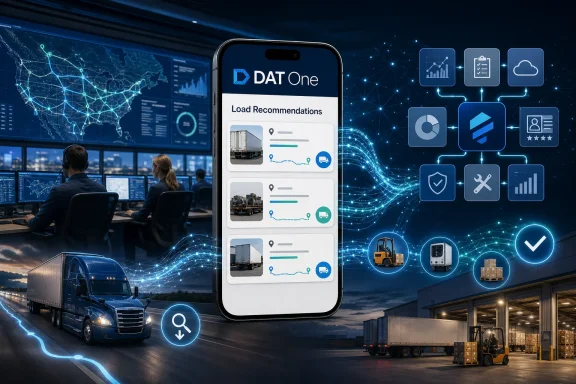
That is why the DAT announcement is more interesting than it first appears. Load Recommendations in DAT One is not “AI” in the grandiose, trillion-parameter sense that dominates consumer tech headlines. It is a practical workflow feature: show carriers freight that better matches their equipment, preferred lanes, and operating patterns, then reduce the search friction that keeps users bouncing between listings, calls, and competing tools.
For a vertical software owner, that kind of feature can matter more than a chatbot demo. If the recommendation layer makes the app a daily starting point rather than a searchable database, DAT gains more engagement data, customers get more habit-forming utility, and the platform becomes harder to replace. The upside is not that AI magically expands freight volumes; it is that software can capture more of the decision loop around available freight.
Roper’s broader model depends on that same mechanism. Its portfolio companies serve specific industries where software is often mission-critical but not glamorous. The businesses win not by being universal platforms, but by knowing the peculiar details of their markets better than general-purpose software vendors do.
That does not invalidate the investment question. If anything, it sharpens it. Before earnings, the market was weighing whether single-digit profit growth and a moderately positive analyst stance left enough room for upside. After earnings, the issue becomes whether the company’s growth profile deserves a higher multiple when management is also using buybacks, acquisitions, and product-level AI investment to reinforce the compounding story.
Roper also raised full-year adjusted diluted EPS guidance after the quarter. That matters because the bull case cannot live on product announcements alone. Investors may tolerate a rich valuation for a diversified software compounder, but only if execution keeps turning niche leadership into cash flow.
The Q1 numbers suggest Roper remains firmly in that compounder lane. They do not suggest an explosive AI rerating is inevitable. The distinction is crucial: Roper’s quarter supports the base case; DAT’s AI launch adds optionality.
The feature announced for DAT One aims to display a curated set of loads most likely to fit a carrier’s truck, routes, and preferences. That is a classic vertical AI use case: not replacing the operator, but narrowing the decision space. The less time a carrier spends scanning irrelevant freight, the more valuable the app becomes.
This is also where Roper’s ownership model can pay off. A company like DAT has industry-specific data, established workflows, and an existing customer base. Those are the ingredients that make applied AI useful. Without domain data and user context, AI features risk becoming generic overlays; with them, they can become invisible infrastructure.
The freight market also offers a useful reality check. Logistics customers tend to care less about whether a feature is branded as AI and more about whether it saves time, improves yield, or reduces operational uncertainty. If Load Recommendations does that consistently, the feature can deepen retention. If it merely rearranges listings with a shinier label, customers will treat it as decoration.
The strongest version of the bull case is that AI tools make Roper’s software businesses more deeply embedded in their customers’ daily routines. In vertical software, the most valuable products are often the ones that become hard to separate from the work itself. A freight app that recommends loads, an education platform that automates administrative flows, a healthcare software product that reduces manual documentation, or a network tool that predicts failures all point toward the same pattern: recurring revenue becomes more durable when software is used continuously, not periodically.
That is why investors should pay more attention to product behavior than AI vocabulary. The market has spent years rewarding companies that can attach AI to a story. The next phase will be less forgiving. Investors will want evidence that AI features improve retention, expand seats, raise pricing power, or create measurable operating leverage.
Roper is well positioned for that test because its companies already operate in specialized markets where customers pay for utility rather than fashion. But that advantage cuts both ways. Vertical customers are pragmatic. They are unlikely to pay meaningfully more for AI unless the benefit is concrete.
Roper’s challenge is that investors already recognize its quality. A portfolio of recurring software and technology-enabled businesses with high free cash flow conversion is not a hidden asset class. The market generally prices that durability well, especially when the company has a long record of acquisitions and capital discipline.
For the bull case to expand from here, Roper probably needs more than “steady execution.” It needs evidence that its vertical software assets can sustain organic growth while acquisitions add value without diluting quality. AI features like DAT’s Load Recommendations help if they reinforce both sides of that equation: organic product improvement and a stronger moat around acquired platforms.
The bear case is less dramatic but still meaningful. If AI adoption is slower, if freight remains cyclical, if acquired platforms prove harder to integrate, or if customers resist price increases, Roper can still be a good company while the stock becomes a mediocre investment. Quality does not eliminate valuation risk; it merely changes the shape of it.
AI can make those assets more attractive, but it cannot solve the hardest part of the model: choosing the right assets at the right price. If every vertical software company now claims an AI roadmap, acquisition discipline becomes more important, not less. The risk is not that Roper suddenly forgets how to allocate capital; it is that the market environment makes attractive assets more expensive.
That is especially relevant in software. Many private vertical software companies have sticky customers and high margins, but growth can vary widely. Paying too much for a slow-growth asset can weigh on returns even if the business remains operationally sound.
Roper’s Q1 share repurchases also deserve attention in this context. Buybacks can be highly effective when management believes the stock is undervalued relative to future cash flows. They can also signal that attractive acquisitions are not always available at rational prices. The best outcome is flexibility: buy back stock when the opportunity is compelling, acquire when the fit and price are right, and invest internally when product improvements can generate stronger retention.
This makes the DAT One feature more measurable than many enterprise AI announcements. Engagement, conversion, booking feedback, repeat use, and retention can all indicate whether recommendations are improving the marketplace. The most valuable signal may not be immediate monetization, but whether users increasingly let DAT shape the first pass of their freight search.
There is also a network effect angle. If better recommendations improve carrier engagement, DAT can learn more about preferences and outcomes. Better data can improve recommendations, which can improve engagement again. That loop is powerful if it works, but fragile if the recommendations are weak or if users do not trust them.
For Roper investors, the DAT example should be seen as a small but meaningful datapoint. It is not enough to revalue the company by itself. It is enough to show how Roper’s portfolio companies can deploy AI in ways that fit their vertical markets rather than chasing generic enterprise software trends.
AI changes the conversation by adding a new route to product differentiation. It does not remove the obligation to show earnings growth. In fact, it raises expectations because investors now have a fresh reason to ask whether software assets can accelerate.
That is the core tension in the Simply Wall St narrative. The upside case depends on Roper’s software holdings becoming more valuable as AI tools deepen customer integration. The downside risk is that AI features become table stakes across vertical software, eroding differentiation rather than expanding it.
The truth will likely emerge unevenly across the portfolio. Some businesses will find obvious AI use cases that customers adopt quickly. Others may discover that their markets are slower, more regulated, or less willing to change workflows. Roper’s diversification helps absorb that unevenness, but it also makes the AI story harder to quantify from the outside.
But investors should resist the temptation to treat every AI launch as a valuation reset. The more durable question is whether these tools change customer behavior. If DAT One becomes more central to how carriers find freight, the feature matters. If it becomes one more button in an already crowded app, the impact will be modest.
The same standard should apply across Roper’s portfolio. AI should be judged by retention, pricing power, user engagement, and workflow depth. A company with Roper’s profile does not need AI to become a different business. It needs AI to make its existing businesses harder to dislodge.
That is a less glamorous story than the market usually wants from artificial intelligence. It may also be the more investable one.
 Roper’s AI Story Is Really a Portfolio Discipline Story
The Simply Wall St framing captures the new tension around Roper Technologies: analysts were already moderately positive, earnings growth was expected to remain steady rather than spectacular, and a portfolio company’s AI feature offered a fresh reason to revisit the growth narrative. But the more important point is that Roper is not trying to sell investors a single moonshot platform. It is selling the idea that many niche software businesses can quietly become more useful, more embedded, and more defensible over time.That is why the DAT announcement is more interesting than it first appears. Load Recommendations in DAT One is not “AI” in the grandiose, trillion-parameter sense that dominates consumer tech headlines. It is a practical workflow feature: show carriers freight that better matches their equipment, preferred lanes, and operating patterns, then reduce the search friction that keeps users bouncing between listings, calls, and competing tools.
For a vertical software owner, that kind of feature can matter more than a chatbot demo. If the recommendation layer makes the app a daily starting point rather than a searchable database, DAT gains more engagement data, customers get more habit-forming utility, and the platform becomes harder to replace. The upside is not that AI magically expands freight volumes; it is that software can capture more of the decision loop around available freight.
Roper’s broader model depends on that same mechanism. Its portfolio companies serve specific industries where software is often mission-critical but not glamorous. The businesses win not by being universal platforms, but by knowing the peculiar details of their markets better than general-purpose software vendors do.
The Earnings Beat Made the Preview Obsolete, but Not Irrelevant
One wrinkle in the Simply Wall St article is chronological. It described Roper as preparing to report Q1 2026 results and cited expectations for adjusted EPS growth, but the company had already reported by late April. The actual report was better than a plain preview would imply: Roper posted 11% total revenue growth, 6% organic revenue growth, 11% free cash flow growth, and adjusted diluted EPS of $5.16.That does not invalidate the investment question. If anything, it sharpens it. Before earnings, the market was weighing whether single-digit profit growth and a moderately positive analyst stance left enough room for upside. After earnings, the issue becomes whether the company’s growth profile deserves a higher multiple when management is also using buybacks, acquisitions, and product-level AI investment to reinforce the compounding story.
Roper also raised full-year adjusted diluted EPS guidance after the quarter. That matters because the bull case cannot live on product announcements alone. Investors may tolerate a rich valuation for a diversified software compounder, but only if execution keeps turning niche leadership into cash flow.
The Q1 numbers suggest Roper remains firmly in that compounder lane. They do not suggest an explosive AI rerating is inevitable. The distinction is crucial: Roper’s quarter supports the base case; DAT’s AI launch adds optionality.
DAT Shows Why Boring AI May Be the Most Bankable AI
DAT Freight & Analytics sits in a market where inefficiency is not an abstraction. Truckers and carriers spend time matching trucks to loads, judging rates, calling brokers, checking lanes, weighing deadhead miles, and trying to avoid wasted time. A recommendation engine that cuts through some of that search burden has an obvious economic rationale.The feature announced for DAT One aims to display a curated set of loads most likely to fit a carrier’s truck, routes, and preferences. That is a classic vertical AI use case: not replacing the operator, but narrowing the decision space. The less time a carrier spends scanning irrelevant freight, the more valuable the app becomes.
This is also where Roper’s ownership model can pay off. A company like DAT has industry-specific data, established workflows, and an existing customer base. Those are the ingredients that make applied AI useful. Without domain data and user context, AI features risk becoming generic overlays; with them, they can become invisible infrastructure.
The freight market also offers a useful reality check. Logistics customers tend to care less about whether a feature is branded as AI and more about whether it saves time, improves yield, or reduces operational uncertainty. If Load Recommendations does that consistently, the feature can deepen retention. If it merely rearranges listings with a shinier label, customers will treat it as decoration.
The Real Catalyst Is Recurring Usage, Not AI Itself
Roper’s investment narrative has long centered on recurring revenue, strong margins, and disciplined capital allocation. AI does not replace that narrative. It either strengthens it or exposes its limits.The strongest version of the bull case is that AI tools make Roper’s software businesses more deeply embedded in their customers’ daily routines. In vertical software, the most valuable products are often the ones that become hard to separate from the work itself. A freight app that recommends loads, an education platform that automates administrative flows, a healthcare software product that reduces manual documentation, or a network tool that predicts failures all point toward the same pattern: recurring revenue becomes more durable when software is used continuously, not periodically.
That is why investors should pay more attention to product behavior than AI vocabulary. The market has spent years rewarding companies that can attach AI to a story. The next phase will be less forgiving. Investors will want evidence that AI features improve retention, expand seats, raise pricing power, or create measurable operating leverage.
Roper is well positioned for that test because its companies already operate in specialized markets where customers pay for utility rather than fashion. But that advantage cuts both ways. Vertical customers are pragmatic. They are unlikely to pay meaningfully more for AI unless the benefit is concrete.
The Valuation Argument Still Has to Survive the Math
Simply Wall St’s narrative projection pointed to roughly $10.4 billion in revenue and $2.1 billion in earnings by 2029, implying annual revenue growth around 8.5% and an earnings increase from about $1.7 billion today. It also suggested meaningful upside to the current price under that model. That is a plausible compounder story, but it is not a low-bar story.Roper’s challenge is that investors already recognize its quality. A portfolio of recurring software and technology-enabled businesses with high free cash flow conversion is not a hidden asset class. The market generally prices that durability well, especially when the company has a long record of acquisitions and capital discipline.
For the bull case to expand from here, Roper probably needs more than “steady execution.” It needs evidence that its vertical software assets can sustain organic growth while acquisitions add value without diluting quality. AI features like DAT’s Load Recommendations help if they reinforce both sides of that equation: organic product improvement and a stronger moat around acquired platforms.
The bear case is less dramatic but still meaningful. If AI adoption is slower, if freight remains cyclical, if acquired platforms prove harder to integrate, or if customers resist price increases, Roper can still be a good company while the stock becomes a mediocre investment. Quality does not eliminate valuation risk; it merely changes the shape of it.
Acquisition Discipline Is the Part AI Cannot Automate
Roper’s identity has evolved over time from a diversified industrial company into a more software-heavy operator and acquirer. That transition has been central to the stock’s long-term appeal. The company buys niche businesses, gives them room to operate, and expects cash flow to compound.AI can make those assets more attractive, but it cannot solve the hardest part of the model: choosing the right assets at the right price. If every vertical software company now claims an AI roadmap, acquisition discipline becomes more important, not less. The risk is not that Roper suddenly forgets how to allocate capital; it is that the market environment makes attractive assets more expensive.
That is especially relevant in software. Many private vertical software companies have sticky customers and high margins, but growth can vary widely. Paying too much for a slow-growth asset can weigh on returns even if the business remains operationally sound.
Roper’s Q1 share repurchases also deserve attention in this context. Buybacks can be highly effective when management believes the stock is undervalued relative to future cash flows. They can also signal that attractive acquisitions are not always available at rational prices. The best outcome is flexibility: buy back stock when the opportunity is compelling, acquire when the fit and price are right, and invest internally when product improvements can generate stronger retention.
Freight Is a Useful Test Case Because It Refuses to Be Abstract
DAT’s AI launch is a helpful case study because freight does not allow vague productivity claims to survive for long. Carriers either find better loads faster, or they do not. Brokers either receive better-matched calls, or they do not. The platform either becomes more useful in the daily workflow, or it remains one tool among many.This makes the DAT One feature more measurable than many enterprise AI announcements. Engagement, conversion, booking feedback, repeat use, and retention can all indicate whether recommendations are improving the marketplace. The most valuable signal may not be immediate monetization, but whether users increasingly let DAT shape the first pass of their freight search.
There is also a network effect angle. If better recommendations improve carrier engagement, DAT can learn more about preferences and outcomes. Better data can improve recommendations, which can improve engagement again. That loop is powerful if it works, but fragile if the recommendations are weak or if users do not trust them.
For Roper investors, the DAT example should be seen as a small but meaningful datapoint. It is not enough to revalue the company by itself. It is enough to show how Roper’s portfolio companies can deploy AI in ways that fit their vertical markets rather than chasing generic enterprise software trends.
The Cautious Analyst View Is Not Bearish; It Is a Demand for Proof
The phrase “moderately positive” may sound underwhelming in an AI market, but it is probably the right posture. Roper has the characteristics investors like: recurring revenue, strong free cash flow, niche leadership, and a management team known for capital allocation. It also has the constraints investors should respect: valuation, acquisition execution, and the need to keep organic growth from slipping.AI changes the conversation by adding a new route to product differentiation. It does not remove the obligation to show earnings growth. In fact, it raises expectations because investors now have a fresh reason to ask whether software assets can accelerate.
That is the core tension in the Simply Wall St narrative. The upside case depends on Roper’s software holdings becoming more valuable as AI tools deepen customer integration. The downside risk is that AI features become table stakes across vertical software, eroding differentiation rather than expanding it.
The truth will likely emerge unevenly across the portfolio. Some businesses will find obvious AI use cases that customers adopt quickly. Others may discover that their markets are slower, more regulated, or less willing to change workflows. Roper’s diversification helps absorb that unevenness, but it also makes the AI story harder to quantify from the outside.
The Stock Story Now Runs Through Usefulness, Not Hype
Roper’s near-term narrative is stronger after Q1 than it was before Q1. The company beat expectations, raised guidance, and continued to show the free cash flow profile that underpins its long-term appeal. DAT’s Load Recommendations then added a timely example of how Roper’s software units can introduce AI features that are practical rather than theatrical.But investors should resist the temptation to treat every AI launch as a valuation reset. The more durable question is whether these tools change customer behavior. If DAT One becomes more central to how carriers find freight, the feature matters. If it becomes one more button in an already crowded app, the impact will be modest.
The same standard should apply across Roper’s portfolio. AI should be judged by retention, pricing power, user engagement, and workflow depth. A company with Roper’s profile does not need AI to become a different business. It needs AI to make its existing businesses harder to dislodge.
That is a less glamorous story than the market usually wants from artificial intelligence. It may also be the more investable one.
The DAT Signal Gives Roper Bulls a Better Argument, Not a Free Pass
The practical read on Roper is narrower than the hype cycle and more interesting than a simple earnings preview. Investors do not need to believe DAT’s new feature transforms the company overnight. They need to decide whether it is evidence of a repeatable pattern across Roper’s vertical software holdings.- Roper’s Q1 2026 results already moved the story beyond pre-earnings expectations, with adjusted diluted EPS of $5.16 and stronger guidance supporting the base case.
- DAT’s Load Recommendations feature is a credible vertical AI use case because it targets a specific workflow pain point in freight matching.
- The investment upside depends less on AI branding and more on whether features like this increase engagement, retention, and pricing power.
- Acquisition integration remains a central risk because Roper’s model still depends on buying and scaling specialized businesses without overpaying.
- The stock can be a high-quality compounder and still face valuation risk if AI-driven growth proves incremental rather than material.
References
- Primary source: simplywall.st
Published: Sat, 27 Jun 2026 22:28:51 GMT
The Bull Case For Roper Technologies (ROP) Could Change Following New AI Tools And Q1 EPS Expectations - Simply Wall St News
Roper Technologies recently prepared to report its fiscal Q1 2026 results, with analysts expecting adjusted EPS to rise by 8.6% and projecting single-digit earnings growth, while maintaining a moderately positive rating on the company. At the same time, portfolio company DAT Freight &...simplywall.st - Related coverage: globenewswire.com
Roper Technologies announces first quarter financial
Increases full year DEPS guidance and expands share repurchase program...www.globenewswire.com - Related coverage: dat.com
DAT brings new business tools, expertise to MATS 2026 - DAT
Find loads and trucks fast with full access to the trusted DAT Network. Freight matching designed for shippers, brokers and carriers.www.dat.com - Related coverage: stockanalysis.com
Roper Technologies (ROP) Stock Price & Overview
A detailed overview of Roper Technologies, Inc. (ROP) stock, including real-time price, chart, key statistics, news, and more.stockanalysis.com - Related coverage: investing.com
Roper Q1 2026 slides: double-digit growth, AI momentum accelerates By Investing.com
Roper Q1 2026 slides: double-digit growth, AI momentum accelerateswww.investing.com - Related coverage: marketbeat.com
Roper Technologies (ROP) Earnings Date and Reports 2026
When is Roper Technologies' next earnings announcement? View the latest ROP earnings date, analysts forecasts, earnings history, and conference call transcripts.www.marketbeat.com
