

Indie studio BamBit gave ROUTE its first public look on July 8, 2026, with a YouTube reveal teaser and simultaneous Steam wishlist launch, pitching a first-person co-op zombie survival game where up to four players live out of a school bus in permanent darkness. The elevator pitch sounds almost too clean: Left 4 Dead panic welded to survival-crafting logistics, except the safe room has wheels and a finite trunk. But ROUTE’s more interesting bet is not that it has zombies, crafting, or co-op; it is that the game turns the base itself into the thing players must risk. In a Steam market where co-op survival remains one of the few indie genres with a visible commercial path, BamBit is trying to win through specificity rather than scale.
That specificity matters because zombie survival is no longer a novelty category. Since DayZ helped turn survival into a mainstream PC genre in 2012, the field has filled with scavenging loops, base-building fantasies, Early Access experiments, and multiplayer horror variants. ROUTE arrives after years of player fatigue and expectation-setting, which means its reveal has to answer a harsher question than “can you survive zombies with friends?” It has to answer why this bus, this darkness, and this progression structure are worth another wishlist click.
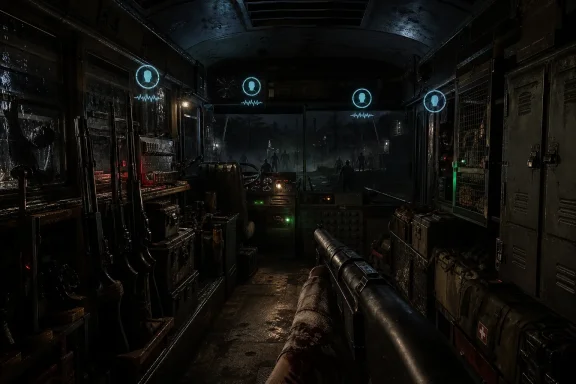
As reported by Tech Times, ROUTE puts up to four players inside a school bus that must be driven, fortified, supplied, and kept moving through a zombie-overrun world locked in permanent darkness. BamBit’s own framing is blunt: the bus is “home, storage, armory, and your only way out.” That line is more than marketing copy. It defines the game’s core pressure system.
Most survival games treat a base as a place where danger is managed. Players leave, loot, return, deposit resources, craft upgrades, and gradually convert the base into a monument to control. ROUTE appears to invert that rhythm by refusing to separate the sanctuary from the journey. The school bus is not a safe village, a menu hub, or a static camp protected by walls; it is the fragile container for everything players own, and it has to roll directly into the next bad decision.
That changes the emotional weight of upgrades. Reinforcing the bus walls is not just home improvement. Repairing the engine is not just maintenance. Mounting scavenged weapons to the exterior and building out a roof deck are not cosmetic expressions of progress. They are the difference between a crew that can push through another dark zone and a crew that becomes stranded with its inventory, tools, and escape plan all sitting in the same compromised vehicle.
The choice of a school bus also gives ROUTE a sharper identity than another generic apocalypse truck might have offered. A school bus is familiar, vulnerable, and faintly absurd in a horror context, which is exactly why it works. It carries cultural baggage: children, routines, suburbia, safety, public infrastructure. Put that object in a world where the sun never rises and the roads are choked with the dead, and the vehicle becomes an argument about corrupted normalcy.
That is the reveal’s strongest design signal. ROUTE does not appear to be chasing novelty through a never-before-seen mechanic. It is assembling recognizable parts into a coherent mood: a bus that should have carried students now carries ammunition, food, tools, and frightened adults whispering through proximity chat in the dark.
That split says something about what kind of survival game BamBit appears to be building. Public matchmaking works best when a game can tolerate churn, role confusion, and strangers treating the session like disposable content. ROUTE’s bus premise works against that. If the vehicle is home, storage, armory, and only escape route, then another player is not merely another gun. They are someone with access to the group’s future.
Friends-only co-op narrows the audience but may strengthen the design. A four-player bus crew depends on trust, not just aim. Someone needs to scavenge. Someone needs to guard. Someone needs to decide when the group has enough resources to risk the next gate. Someone will inevitably wander too far, overcommit, or demand that the squad go back for one more item. Those tensions are much more legible among friends than among anonymous players who may never join again.
Proximity voice chat reinforces that philosophy. Rather than treating voice as a detached party line, ROUTE links players spatially in the world. Communication changes depending on whether the group is together on the bus, split around a ruined street, or searching different corners of a zone on foot. The audio model turns distance into risk. The farther a player moves from the group, the more coordination becomes an in-world problem rather than a Discord overlay.
The lack of random matchmaking will disappoint some players, especially those who rely on public queues to sample co-op games. But it also prevents ROUTE from pretending to be something it is not. A bus full of strangers can be funny once. A bus full of friends making bad survival decisions under permanent night is the repeatable premise.
The conventional loop is familiar. Daylight means scavenging, building, expanding, and planning. Night means retreat, defense, fear, and punishment for players who mismanaged the day. It is effective because the clock is legible. The setting itself becomes a scheduler.
ROUTE removes that scheduler. There is no sunrise to work toward and no dusk to fear because the game is already there. The emotional structure shifts from “prepare before night comes” to “survive because night never leaves.” That may sound like a purely atmospheric decision, but it changes how players evaluate risk. If there is no safe daylight window, the game needs another way to pace pressure and progress.
BamBit’s answer appears to be zone-gated advancement. ROUTE unfolds across abandoned suburbs, ruined cities, clogged highways, farms, and forest backroads, and the crew cannot simply drive forward forever. To reach the next zone, players must find the resources and items that open the gate to it. Some zones can be driven through; others force the crew to park the bus and continue on foot.
That turns progression into a logistics puzzle. The bus is safe to return to, but safety alone does not move the game forward. Players have to leave the vehicle, enter hostile spaces, scavenge under pressure, and bring back the specific resources needed to unlock the next route. The replacement for the survival clock is not a timer. It is dependency.
This is where ROUTE’s premise starts to distinguish itself from a typical zombie road trip. A road game normally promises momentum: keep moving, keep escaping, keep watching the scenery change. ROUTE seems more interested in interrupted momentum. The bus can move only after the crew has earned the right to move it, and each gate turns the road into a problem to be solved rather than a backdrop to be consumed.
Raft built a large audience around a floating platform drifting through an endless ocean. Voidtrain, which launched on PC and Xbox in November 2025 and is scheduled to hit PlayStation 5 on July 30, 2026, centers survival play around a train moving through dimensional portals. Survival Machine, a four-player co-op zombie game from Grapes Pickers and publisher Games Operators, launched its full 1.0 version on Steam in June 2026 with a massive movable fortress as its base.
That context makes ROUTE less of a novelty pitch and more of a positioning exercise. BamBit is entering a field where the broad fantasy is already understood. A moving base is no longer enough. The question is whether ROUTE’s execution creates a different feel from the raft, the train, and the fortress.
The comparison shows why ROUTE’s school bus matters. A raft implies improvisation and exposure. A train implies track-bound movement and industrial momentum. A fortress implies power. A school bus implies compromise. It is big enough to hold a team, small enough to feel inadequate, and ordinary enough to make the apocalypse feel like it has invaded a familiar world.
Survival Machine is the most direct pressure point because it shares the four-player zombie co-op lane and the mobile-base premise. But the two games appear to be aiming at different fantasies. Survival Machine’s massive movable fortress suggests construction, scale, and siege energy. ROUTE’s first-person school bus suggests claustrophobia, improvisation, and the unpleasant intimacy of being trapped with everyone’s supplies.
That difference could be commercially important. Players do not usually need two versions of the same survival loop at the same time, but they will often make room for a game with a distinct enough texture. ROUTE’s reveal makes the correct move by emphasizing not “we also have a mobile base,” but “our mobile base is a specific object in a specific kind of night.”
The gate system is the connective tissue. BamBit’s Steam description says reaching the next zone requires finding the resources and items that open the gate to it. That is a plain progression rule, but it carries design consequences. The game can force the squad to engage with each zone before leaving, rather than letting players speedrun past danger in the bus.
This is a common survival design problem. Vehicles can make worlds feel large and exciting, but they can also trivialize encounter design if players can simply drive away from most threats. ROUTE’s answer, at least as described, is to make the bus necessary but insufficient. It gets the crew through the world, but it does not automatically solve the world.
That structure can create good co-op friction. One player may want to push deeper for gate resources. Another may want to return to the bus because ammunition is low. Someone may argue that the group should spend time upgrading before advancing. Someone else may insist that the current zone is only getting worse. The resource gate gives those arguments mechanical weight.
The danger is repetition. If every zone resolves into “park, search, return, unlock,” ROUTE could become a checklist in a horror costume. The reveal’s promise of zones with different layouts, threats, and puzzles is therefore not decorative. It is central to whether the game can sustain interest beyond the initial bus fantasy.
The strongest version of ROUTE would make each zone ask a different question of the bus. Can it fit? Can it withstand a swarm? Can it be defended while half the crew searches a building? Is it better to leave it running or conserve resources? Does the roof deck matter more on highways than in suburbs? The reveal does not yet answer those questions, but it points toward a design space where vehicle upgrades and zone layouts can meaningfully collide.
Those requirements place ROUTE in a practical middle tier. This is not a retro-styled survival game that can run on almost anything, but it is also not advertising itself as a hardware-crushing ray-tracing showcase. DirectX 12 is mandatory, and the recommended GPU tier suggests BamBit expects a reasonably modern 1080p survival audience rather than only high-end rigs.
The SSD recommendation is the more interesting line item. BamBit flags an SSD for zone loading, while the storage requirement itself is only 10 GB. That combination implies a game that is not massive by install size but may depend on storage responsiveness as players transition through zones. For a mobile-base game, load pacing matters. If every major forward push is interrupted by sluggish streaming or long waits, the road-trip fantasy starts to crack.
The Windows 10 and Windows 11 requirement also keeps the audience broad. As of the reveal context on July 8, 2026, ROUTE is not being presented as a Windows 11-only title. That matters for a survival game chasing co-op groups, because the practical platform is not an individual player’s best PC but the weakest machine in the friend group. A four-player invite-only model lives or dies by whether the whole crew can run it.
Language support points in the same direction. ROUTE supports 11 languages, with full voice audio in English only. French, Italian, German, Spanish, Japanese, Polish, Portuguese (Brazil), Russian, Simplified Chinese, and Turkish receive interface and subtitle support. For a small indie reveal, that is a meaningful international signal, though English-only voice audio may limit how broadly the proximity-chat atmosphere translates for players outside English-speaking groups.
No Mac version and no console version have been announced in the provided material. That absence should not be overread, but it does keep the story firmly in PC territory for now. ROUTE is a Steam-first pitch: wishlist now, wait for BamBit to define the release path later.
The upside is obvious. BamBit can begin accumulating wishlists while keeping schedule pressure low. Survival games are systems-heavy, and co-op survival games multiply every systems problem by latency, synchronization, griefing risk, inventory edge cases, AI behavior, and player expectation. Announcing too early a date can create a public countdown to disappointment.
The downside is that players have learned to treat “wishlist now” as a low-commitment parking lot. Steam wishlists are valuable, but they are not belief. A striking reveal can generate attention; a release window converts that attention into a more concrete plan. ROUTE currently has the first half of that equation.
The absence of an Early Access window is particularly notable because survival-crafting has long been one of Early Access’s natural habitats. Players in this genre are accustomed to buying into incomplete systems, watching roadmaps evolve, and helping shape balance over time. Not announcing Early Access does not mean BamBit will avoid it. It simply means the studio is not ready to promise that path.
That caution may be wise. Early Access can save a survival game by creating a community before the game is finished, but it can also freeze a game’s reputation around its roughest build. ROUTE’s premise depends heavily on feel: the bus must be satisfying to inhabit, driving must feel dangerous but not tedious, the darkness must create dread without visual exhaustion, and the co-op loop must reward coordination without becoming chores. If any of those elements are undercooked at launch, the concept could be judged before the design matures.
For now, the Steam wishlist launch is the practical event. BamBit has moved ROUTE from unseen project to public candidate. The next communication beat needs to show whether the bus is a cinematic hook or a deep system.
By 2025 — Market analysis documents that the median indie release on Steam earned under $300 in a quarter, underscoring how harsh the platform’s economics had become even in durable genres.
November 2025 — Voidtrain launches on PC and Xbox, strengthening the mobile-base survival context around trains, portals, and traveling home bases.
Q1 2026 — Games-Stats data characterizes co-op horror and survival titles as “the most consistent path to success” for indie games, while the broader market remains sharply concentrated.
June 2026 — Survival Machine, a four-player co-op zombie game from Grapes Pickers and published by Games Operators, launches its full 1.0 version on Steam.
July 8, 2026 — BamBit gives ROUTE its first public look with a YouTube reveal teaser and opens the Steam wishlist page simultaneously.
July 30, 2026 — Voidtrain is scheduled to arrive on PlayStation 5, expanding another mobile-base survival game beyond its earlier PC and Xbox release.
But the same context points to a harsher reality. By 2025, market analysis documented that the median indie release on Steam earned under $300 in a quarter. The lesson is not that survival games are easy money. The lesson is that the genre can still produce winners, but the median outcome for indie games remains punishingly low.
This is why ROUTE’s reveal needs to be judged less by feature count than by market legibility. “Co-op zombie survival crafting” is a crowded phrase. “First-person co-op survival where your fortified school bus is the home, armory, storage, and only way out in a world where daylight never comes” is a sharper one. In an overcrowded Steam feed, specificity is not just artistic identity. It is discoverability.
The danger is that every strong hook creates expectations. Permanent darkness must be more than a color grade. The school bus must be more than a reskinned RV. Friends-only co-op must feel intentionally intimate rather than under-supported. Zone gates must create meaningful expeditions rather than arbitrary locks.
Indie survival games often fail not because their ideas are bad, but because their systems do not reinforce one another. ROUTE’s reveal is promising precisely because the pieces seem mutually supportive. The bus encourages shared ownership. Friends-only invite co-op supports that shared ownership. Proximity chat makes distance matter. Permanent darkness removes the genre’s default clock. Zone-gated progression replaces it with scavenging pressure. The idea is coherent.
Coherence is not execution, though. It is the starting line.
The second thing to watch is how the game handles solo play. Offline single-player is confirmed, which is good news for players who do not always have a squad available. But a design built around a four-person crew can become lonely or overloaded in solo mode if tasks are not rebalanced carefully. A school bus survival game may be atmospheric alone, but the mechanics must still respect the player’s time.
The third issue is matchmaking, or rather the intentional lack of it. No random matchmaking means ROUTE is asking players to bring their own group. That can strengthen the experience, but it also narrows the funnel. BamBit will need to make the value proposition clear enough that one interested player can persuade three friends to wishlist, buy, and schedule sessions together.
The fourth issue is readability in darkness. Permanent night is a strong identity choice, but horror games live and die by visual information. If players cannot parse threats, routes, loot, and bus status clearly, darkness becomes irritation rather than dread. ROUTE needs to make night oppressive without making the interface and world illegible.
Finally, Windows performance deserves attention. The requirements are not extreme, but co-op survival games can be CPU-sensitive and network-sensitive in practice, especially when AI, physics, inventory, vehicles, and construction systems overlap. The recommended SSD for zone loading is a useful early warning: storage may not be large, but pacing may depend on fast transitions.
In many survival games, loss is distributed. You lose a backpack, a chest, a wall, a crafting station, a vehicle, a spawn point. ROUTE’s premise suggests a more focused anxiety. If the bus is compromised, the whole run feels compromised. The vehicle is not just where progress is stored; it is what progress looks like.
That could make even small decisions feel consequential. Do players spend scarce resources on armor, weapons, repairs, or tools for the next gate? Do they keep the bus near danger for a faster retreat, or park farther away to reduce immediate risk? Do they split up to search faster, knowing proximity chat and rescue options may degrade with distance? These are familiar survival questions, but the bus gives them a shared reference point.
It also creates an unusually strong social object. Co-op games thrive when players can tell stories afterward: the time the engine failed, the time someone got trapped off-bus, the time the roof deck saved the squad, the time the group had to choose between resources and escape. ROUTE’s reveal suggests a framework built for those anecdotes.
The permanent darkness deepens that social potential. Day-night cycles often create predictable story beats. Permanent night can create a more oppressive continuity, where players never feel fully reset. If BamBit uses that well, ROUTE could avoid the rhythm that makes some survival sessions feel like repeating work shifts: gather by day, defend by night, repeat. Its world is already night. The question is always what the crew is willing to risk next.
The game is not promising to be every survival fantasy at once. It is promising a bus, four friends at most, a world that never gets light, and a sequence of zones that must be unlocked through scavenging. That restraint gives the premise a better chance of surviving contact with reality. The more a small studio promises, the more likely its core loop gets buried under obligations.
The risk is that narrowness can be mistaken for thinness. Players will want to know how crafting works, how zombies behave, whether zones are handcrafted or procedural, how bus damage is modeled, whether progression persists cleanly, and how offline single-player scales. None of those answers are in the current material. For now, the reveal establishes identity, not depth.
That is acceptable for a first public look, but only temporarily. A strong premise buys attention; systems earn trust. BamBit’s next challenge is to show ROUTE functioning as a game with repeatable decisions, not just a trailer-ready concept.
The harder part is proving that the summary contains enough game. Co-op survival players have been trained by years of Early Access hits, abandoned projects, surprise breakouts, and janky experiments. They can be enthusiastic, but they are not naïve. A memorable vehicle and mood will not compensate for weak combat, shallow scavenging, poor pacing, or unreliable co-op.
Still, ROUTE has the shape of a game that understands its lane. It is not chasing massive servers. It is not leaning on public matchmaking chaos. It is not trying to outscale the genre’s biggest incumbents. It is betting that four players, one vulnerable bus, and an endless night can generate enough pressure to matter.
That specificity matters because zombie survival is no longer a novelty category. Since DayZ helped turn survival into a mainstream PC genre in 2012, the field has filled with scavenging loops, base-building fantasies, Early Access experiments, and multiplayer horror variants. ROUTE arrives after years of player fatigue and expectation-setting, which means its reveal has to answer a harsher question than “can you survive zombies with friends?” It has to answer why this bus, this darkness, and this progression structure are worth another wishlist click.
 BamBit’s Bus Is Not a Hub; It Is the Argument
As reported by Tech Times, ROUTE puts up to four players inside a school bus that must be driven, fortified, supplied, and kept moving through a zombie-overrun world locked in permanent darkness. BamBit’s own framing is blunt: the bus is “home, storage, armory, and your only way out.” That line is more than marketing copy. It defines the game’s core pressure system.Most survival games treat a base as a place where danger is managed. Players leave, loot, return, deposit resources, craft upgrades, and gradually convert the base into a monument to control. ROUTE appears to invert that rhythm by refusing to separate the sanctuary from the journey. The school bus is not a safe village, a menu hub, or a static camp protected by walls; it is the fragile container for everything players own, and it has to roll directly into the next bad decision.
That changes the emotional weight of upgrades. Reinforcing the bus walls is not just home improvement. Repairing the engine is not just maintenance. Mounting scavenged weapons to the exterior and building out a roof deck are not cosmetic expressions of progress. They are the difference between a crew that can push through another dark zone and a crew that becomes stranded with its inventory, tools, and escape plan all sitting in the same compromised vehicle.
The choice of a school bus also gives ROUTE a sharper identity than another generic apocalypse truck might have offered. A school bus is familiar, vulnerable, and faintly absurd in a horror context, which is exactly why it works. It carries cultural baggage: children, routines, suburbia, safety, public infrastructure. Put that object in a world where the sun never rises and the roads are choked with the dead, and the vehicle becomes an argument about corrupted normalcy.
That is the reveal’s strongest design signal. ROUTE does not appear to be chasing novelty through a never-before-seen mechanic. It is assembling recognizable parts into a coherent mood: a bus that should have carried students now carries ammunition, food, tools, and frightened adults whispering through proximity chat in the dark.
Friends-Only Co-Op Is a Design Choice, Not a Missing Feature
ROUTE’s multiplayer model is unusually clear for a reveal-stage survival game. Multiplayer is friends-only, with a squad of up to four players joining via Steam invite. There is no random matchmaking. Solo players are not locked out, either: BamBit’s Steam page confirms online co-op and offline single-player.That split says something about what kind of survival game BamBit appears to be building. Public matchmaking works best when a game can tolerate churn, role confusion, and strangers treating the session like disposable content. ROUTE’s bus premise works against that. If the vehicle is home, storage, armory, and only escape route, then another player is not merely another gun. They are someone with access to the group’s future.
Friends-only co-op narrows the audience but may strengthen the design. A four-player bus crew depends on trust, not just aim. Someone needs to scavenge. Someone needs to guard. Someone needs to decide when the group has enough resources to risk the next gate. Someone will inevitably wander too far, overcommit, or demand that the squad go back for one more item. Those tensions are much more legible among friends than among anonymous players who may never join again.
Proximity voice chat reinforces that philosophy. Rather than treating voice as a detached party line, ROUTE links players spatially in the world. Communication changes depending on whether the group is together on the bus, split around a ruined street, or searching different corners of a zone on foot. The audio model turns distance into risk. The farther a player moves from the group, the more coordination becomes an in-world problem rather than a Discord overlay.
The lack of random matchmaking will disappoint some players, especially those who rely on public queues to sample co-op games. But it also prevents ROUTE from pretending to be something it is not. A bus full of strangers can be funny once. A bus full of friends making bad survival decisions under permanent night is the repeatable premise.
Permanent Darkness Replaces the Genre’s Favorite Clock
The most important sentence in the reveal may be the least flashy one: ROUTE has no day-night cycle. Darkness is a permanent condition, not a timer. That is a consequential design choice because survival games have leaned on the day-night cycle for more than a decade as a cheap, reliable tension machine.The conventional loop is familiar. Daylight means scavenging, building, expanding, and planning. Night means retreat, defense, fear, and punishment for players who mismanaged the day. It is effective because the clock is legible. The setting itself becomes a scheduler.
ROUTE removes that scheduler. There is no sunrise to work toward and no dusk to fear because the game is already there. The emotional structure shifts from “prepare before night comes” to “survive because night never leaves.” That may sound like a purely atmospheric decision, but it changes how players evaluate risk. If there is no safe daylight window, the game needs another way to pace pressure and progress.
BamBit’s answer appears to be zone-gated advancement. ROUTE unfolds across abandoned suburbs, ruined cities, clogged highways, farms, and forest backroads, and the crew cannot simply drive forward forever. To reach the next zone, players must find the resources and items that open the gate to it. Some zones can be driven through; others force the crew to park the bus and continue on foot.
That turns progression into a logistics puzzle. The bus is safe to return to, but safety alone does not move the game forward. Players have to leave the vehicle, enter hostile spaces, scavenge under pressure, and bring back the specific resources needed to unlock the next route. The replacement for the survival clock is not a timer. It is dependency.
This is where ROUTE’s premise starts to distinguish itself from a typical zombie road trip. A road game normally promises momentum: keep moving, keep escaping, keep watching the scenery change. ROUTE seems more interested in interrupted momentum. The bus can move only after the crew has earned the right to move it, and each gate turns the road into a problem to be solved rather than a backdrop to be consumed.
The Mobile-Base Subgenre Has Already Become Crowded
ROUTE is not arriving in an empty lane. Tech Times correctly situates it among mobile-base survival games, a category whose appeal is easy to understand: players like building a home, but they also like not being stuck in one place. The mobile base offers continuity without stagnation. Your structure travels with you, so progress remains visible even as the world changes.Raft built a large audience around a floating platform drifting through an endless ocean. Voidtrain, which launched on PC and Xbox in November 2025 and is scheduled to hit PlayStation 5 on July 30, 2026, centers survival play around a train moving through dimensional portals. Survival Machine, a four-player co-op zombie game from Grapes Pickers and publisher Games Operators, launched its full 1.0 version on Steam in June 2026 with a massive movable fortress as its base.
That context makes ROUTE less of a novelty pitch and more of a positioning exercise. BamBit is entering a field where the broad fantasy is already understood. A moving base is no longer enough. The question is whether ROUTE’s execution creates a different feel from the raft, the train, and the fortress.
| Game | Developer / publisher detail | Mobile base | Player framing | Status or timing | Distinctive angle from source material |
|---|---|---|---|---|---|
| ROUTE | BamBit | School bus | Up to four players; friends-only Steam invite co-op; offline single-player | Revealed and wishlisted on July 8, 2026; no release date or Early Access window | First-person zombie survival in permanent darkness with resource-gated zones |
| Survival Machine | Grapes Pickers; published by Games Operators | Massive movable fortress | 4-player co-op zombie game | Full 1.0 Steam launch in June 2026 | Closest direct competitor in zombie mobile-base survival |
| Voidtrain | Not specified in the source material | Train moving through dimensional portals | Not specified in the source material | PC and Xbox launch in November 2025; PlayStation 5 on July 30, 2026 | Mobile survival built around portal-train traversal |
| Raft | Not specified in the source material | Floating platform | Not specified in the source material | Not specified in the source material | Drifting ocean base as the survival anchor |
Survival Machine is the most direct pressure point because it shares the four-player zombie co-op lane and the mobile-base premise. But the two games appear to be aiming at different fantasies. Survival Machine’s massive movable fortress suggests construction, scale, and siege energy. ROUTE’s first-person school bus suggests claustrophobia, improvisation, and the unpleasant intimacy of being trapped with everyone’s supplies.
That difference could be commercially important. Players do not usually need two versions of the same survival loop at the same time, but they will often make room for a game with a distinct enough texture. ROUTE’s reveal makes the correct move by emphasizing not “we also have a mobile base,” but “our mobile base is a specific object in a specific kind of night.”
The Zone Gate Is ROUTE’s Real Progression Bet
The reveal material describes ROUTE’s world as a sequence of distinct zones: abandoned suburbs, ruined cities, clogged highways, farms, and forest backroads. That list matters because it gives BamBit room to vary pace without changing the core premise. A bus rolling through a clogged highway should create different problems from a bus parked near a farm or threading forest backroads.The gate system is the connective tissue. BamBit’s Steam description says reaching the next zone requires finding the resources and items that open the gate to it. That is a plain progression rule, but it carries design consequences. The game can force the squad to engage with each zone before leaving, rather than letting players speedrun past danger in the bus.
This is a common survival design problem. Vehicles can make worlds feel large and exciting, but they can also trivialize encounter design if players can simply drive away from most threats. ROUTE’s answer, at least as described, is to make the bus necessary but insufficient. It gets the crew through the world, but it does not automatically solve the world.
That structure can create good co-op friction. One player may want to push deeper for gate resources. Another may want to return to the bus because ammunition is low. Someone may argue that the group should spend time upgrading before advancing. Someone else may insist that the current zone is only getting worse. The resource gate gives those arguments mechanical weight.
The danger is repetition. If every zone resolves into “park, search, return, unlock,” ROUTE could become a checklist in a horror costume. The reveal’s promise of zones with different layouts, threats, and puzzles is therefore not decorative. It is central to whether the game can sustain interest beyond the initial bus fantasy.
The strongest version of ROUTE would make each zone ask a different question of the bus. Can it fit? Can it withstand a swarm? Can it be defended while half the crew searches a building? Is it better to leave it running or conserve resources? Does the roof deck matter more on highways than in suburbs? The reveal does not yet answer those questions, but it points toward a design space where vehicle upgrades and zone layouts can meaningfully collide.
The Windows Requirements Say “Modern Indie,” Not “Punishing Showcase”
For WindowsForum readers, ROUTE’s PC requirements are refreshingly concrete even though the release date is not. The Steam page lists Windows 10 or Windows 11, 64-bit, as required, with DirectX 12 mandatory. Minimum hardware calls for an Intel Core i5-7600K or AMD Ryzen 5 1600, 8 GB of RAM, and an Nvidia GeForce GTX 1660 or AMD Radeon RX 590. Recommended specs step up to a Ryzen 5 3600X or Core i5-10600KF, 16 GB of RAM, and an RTX 2060 or RX 5600XT.Those requirements place ROUTE in a practical middle tier. This is not a retro-styled survival game that can run on almost anything, but it is also not advertising itself as a hardware-crushing ray-tracing showcase. DirectX 12 is mandatory, and the recommended GPU tier suggests BamBit expects a reasonably modern 1080p survival audience rather than only high-end rigs.
The SSD recommendation is the more interesting line item. BamBit flags an SSD for zone loading, while the storage requirement itself is only 10 GB. That combination implies a game that is not massive by install size but may depend on storage responsiveness as players transition through zones. For a mobile-base game, load pacing matters. If every major forward push is interrupted by sluggish streaming or long waits, the road-trip fantasy starts to crack.
The Windows 10 and Windows 11 requirement also keeps the audience broad. As of the reveal context on July 8, 2026, ROUTE is not being presented as a Windows 11-only title. That matters for a survival game chasing co-op groups, because the practical platform is not an individual player’s best PC but the weakest machine in the friend group. A four-player invite-only model lives or dies by whether the whole crew can run it.
Language support points in the same direction. ROUTE supports 11 languages, with full voice audio in English only. French, Italian, German, Spanish, Japanese, Polish, Portuguese (Brazil), Russian, Simplified Chinese, and Turkish receive interface and subtitle support. For a small indie reveal, that is a meaningful international signal, though English-only voice audio may limit how broadly the proximity-chat atmosphere translates for players outside English-speaking groups.
No Mac version and no console version have been announced in the provided material. That absence should not be overread, but it does keep the story firmly in PC territory for now. ROUTE is a Steam-first pitch: wishlist now, wait for BamBit to define the release path later.
The Missing Release Window Is Both Honest and Costly
BamBit has not announced a release date or Early Access window. That is a small sentence with large implications. In 2026, especially on Steam, a reveal without a date is not unusual. It is also not neutral.The upside is obvious. BamBit can begin accumulating wishlists while keeping schedule pressure low. Survival games are systems-heavy, and co-op survival games multiply every systems problem by latency, synchronization, griefing risk, inventory edge cases, AI behavior, and player expectation. Announcing too early a date can create a public countdown to disappointment.
The downside is that players have learned to treat “wishlist now” as a low-commitment parking lot. Steam wishlists are valuable, but they are not belief. A striking reveal can generate attention; a release window converts that attention into a more concrete plan. ROUTE currently has the first half of that equation.
The absence of an Early Access window is particularly notable because survival-crafting has long been one of Early Access’s natural habitats. Players in this genre are accustomed to buying into incomplete systems, watching roadmaps evolve, and helping shape balance over time. Not announcing Early Access does not mean BamBit will avoid it. It simply means the studio is not ready to promise that path.
That caution may be wise. Early Access can save a survival game by creating a community before the game is finished, but it can also freeze a game’s reputation around its roughest build. ROUTE’s premise depends heavily on feel: the bus must be satisfying to inhabit, driving must feel dangerous but not tedious, the darkness must create dread without visual exhaustion, and the co-op loop must reward coordination without becoming chores. If any of those elements are undercooked at launch, the concept could be judged before the design matures.
For now, the Steam wishlist launch is the practical event. BamBit has moved ROUTE from unseen project to public candidate. The next communication beat needs to show whether the bus is a cinematic hook or a deep system.
Timeline
2012 — DayZ turns the survival game into a mainstream category, establishing the commercial and design backdrop ROUTE now enters.By 2025 — Market analysis documents that the median indie release on Steam earned under $300 in a quarter, underscoring how harsh the platform’s economics had become even in durable genres.
November 2025 — Voidtrain launches on PC and Xbox, strengthening the mobile-base survival context around trains, portals, and traveling home bases.
Q1 2026 — Games-Stats data characterizes co-op horror and survival titles as “the most consistent path to success” for indie games, while the broader market remains sharply concentrated.
June 2026 — Survival Machine, a four-player co-op zombie game from Grapes Pickers and published by Games Operators, launches its full 1.0 version on Steam.
July 8, 2026 — BamBit gives ROUTE its first public look with a YouTube reveal teaser and opens the Steam wishlist page simultaneously.
July 30, 2026 — Voidtrain is scheduled to arrive on PlayStation 5, expanding another mobile-base survival game beyond its earlier PC and Xbox release.
Steam’s Co-Op Survival Opportunity Comes With a Brutal Catch
The business context around ROUTE is both encouraging and grim. According to the source material, co-op horror and survival titles remained “the most consistent path to success” for indie games in Games-Stats data from Q1 2026. That sounds like good news for BamBit. It means ROUTE is not swimming against the market.But the same context points to a harsher reality. By 2025, market analysis documented that the median indie release on Steam earned under $300 in a quarter. The lesson is not that survival games are easy money. The lesson is that the genre can still produce winners, but the median outcome for indie games remains punishingly low.
This is why ROUTE’s reveal needs to be judged less by feature count than by market legibility. “Co-op zombie survival crafting” is a crowded phrase. “First-person co-op survival where your fortified school bus is the home, armory, storage, and only way out in a world where daylight never comes” is a sharper one. In an overcrowded Steam feed, specificity is not just artistic identity. It is discoverability.
The danger is that every strong hook creates expectations. Permanent darkness must be more than a color grade. The school bus must be more than a reskinned RV. Friends-only co-op must feel intentionally intimate rather than under-supported. Zone gates must create meaningful expeditions rather than arbitrary locks.
Indie survival games often fail not because their ideas are bad, but because their systems do not reinforce one another. ROUTE’s reveal is promising precisely because the pieces seem mutually supportive. The bus encourages shared ownership. Friends-only invite co-op supports that shared ownership. Proximity chat makes distance matter. Permanent darkness removes the genre’s default clock. Zone-gated progression replaces it with scavenging pressure. The idea is coherent.
Coherence is not execution, though. It is the starting line.
What Windows Players Should Actually Watch Next
The first thing Windows players should watch is how BamBit shows the bus in unedited play. A reveal teaser can sell mood, silhouettes, and premise. It cannot prove that driving, repairing, upgrading, defending, and returning to the bus remain interesting after hour five. ROUTE’s future trailers or demos need to show the base as a system, not merely an image.The second thing to watch is how the game handles solo play. Offline single-player is confirmed, which is good news for players who do not always have a squad available. But a design built around a four-person crew can become lonely or overloaded in solo mode if tasks are not rebalanced carefully. A school bus survival game may be atmospheric alone, but the mechanics must still respect the player’s time.
The third issue is matchmaking, or rather the intentional lack of it. No random matchmaking means ROUTE is asking players to bring their own group. That can strengthen the experience, but it also narrows the funnel. BamBit will need to make the value proposition clear enough that one interested player can persuade three friends to wishlist, buy, and schedule sessions together.
The fourth issue is readability in darkness. Permanent night is a strong identity choice, but horror games live and die by visual information. If players cannot parse threats, routes, loot, and bus status clearly, darkness becomes irritation rather than dread. ROUTE needs to make night oppressive without making the interface and world illegible.
Finally, Windows performance deserves attention. The requirements are not extreme, but co-op survival games can be CPU-sensitive and network-sensitive in practice, especially when AI, physics, inventory, vehicles, and construction systems overlap. The recommended SSD for zone loading is a useful early warning: storage may not be large, but pacing may depend on fast transitions.
The Bus Works Because It Makes Survival Personal
ROUTE’s best idea is that it collapses several survival-game abstractions into one object. Inventory, home, escape route, upgrade tree, defensive position, and group identity all become the bus. That kind of compression is powerful because it gives players a single thing to care about.In many survival games, loss is distributed. You lose a backpack, a chest, a wall, a crafting station, a vehicle, a spawn point. ROUTE’s premise suggests a more focused anxiety. If the bus is compromised, the whole run feels compromised. The vehicle is not just where progress is stored; it is what progress looks like.
That could make even small decisions feel consequential. Do players spend scarce resources on armor, weapons, repairs, or tools for the next gate? Do they keep the bus near danger for a faster retreat, or park farther away to reduce immediate risk? Do they split up to search faster, knowing proximity chat and rescue options may degrade with distance? These are familiar survival questions, but the bus gives them a shared reference point.
It also creates an unusually strong social object. Co-op games thrive when players can tell stories afterward: the time the engine failed, the time someone got trapped off-bus, the time the roof deck saved the squad, the time the group had to choose between resources and escape. ROUTE’s reveal suggests a framework built for those anecdotes.
The permanent darkness deepens that social potential. Day-night cycles often create predictable story beats. Permanent night can create a more oppressive continuity, where players never feel fully reset. If BamBit uses that well, ROUTE could avoid the rhythm that makes some survival sessions feel like repeating work shifts: gather by day, defend by night, repeat. Its world is already night. The question is always what the crew is willing to risk next.
The Reveal’s Most Important Promise Is Restraint
There is a quiet confidence in what BamBit has not announced. No release date. No Early Access window. No console expansion. No claim of massive player counts. No random matchmaking. No sprawling feature manifesto in the provided material. ROUTE’s reveal is narrow, which in this case is a strength.The game is not promising to be every survival fantasy at once. It is promising a bus, four friends at most, a world that never gets light, and a sequence of zones that must be unlocked through scavenging. That restraint gives the premise a better chance of surviving contact with reality. The more a small studio promises, the more likely its core loop gets buried under obligations.
The risk is that narrowness can be mistaken for thinness. Players will want to know how crafting works, how zombies behave, whether zones are handcrafted or procedural, how bus damage is modeled, whether progression persists cleanly, and how offline single-player scales. None of those answers are in the current material. For now, the reveal establishes identity, not depth.
That is acceptable for a first public look, but only temporarily. A strong premise buys attention; systems earn trust. BamBit’s next challenge is to show ROUTE functioning as a game with repeatable decisions, not just a trailer-ready concept.
The Road Ahead Is Narrow, Dark, and Commercially Plausible
ROUTE’s early pitch is unusually easy to summarize, which is an underrated advantage in the Steam economy. Players do not need a design document to understand “four players survive in a fortified school bus through permanent zombie darkness.” The concept travels quickly.The harder part is proving that the summary contains enough game. Co-op survival players have been trained by years of Early Access hits, abandoned projects, surprise breakouts, and janky experiments. They can be enthusiastic, but they are not naïve. A memorable vehicle and mood will not compensate for weak combat, shallow scavenging, poor pacing, or unreliable co-op.
Still, ROUTE has the shape of a game that understands its lane. It is not chasing massive servers. It is not leaning on public matchmaking chaos. It is not trying to outscale the genre’s biggest incumbents. It is betting that four players, one vulnerable bus, and an endless night can generate enough pressure to matter.
Why This Reveal Deserves More Than a Wishlist Glance
ROUTE is still an unreleased game with no announced date, so skepticism is healthy. But the July 8 reveal gives Windows players and survival fans enough concrete information to identify the actual bet BamBit is making.- ROUTE is available to wishlist on Steam now, but BamBit has not announced a release date or Early Access window.
- The core loop centers on a school bus that functions as home, storage, armory, and escape route.
- Co-op is capped at up to four players, uses Steam invite, and has no random matchmaking.
- Offline single-player is supported alongside online co-op.
- The world has no day-night cycle; permanent darkness is the baseline condition.
- Windows 10 or Windows 11 64-bit, DirectX 12, 10 GB of storage, and midrange modern hardware define the current PC target.
References
- Primary source: Tech Times
Published: 2026-07-08T14:20:08.375280
Loading…
www.techtimes.com