

RSA’s new RSA ID Plus for Microsoft lineup — anchored by the RSA ID Plus M1 SKU now generally available on the Microsoft Azure Marketplace — is a deliberate attempt to layer phishing‑resistant, passwordless identity controls and operational resilience on top of Microsoft Entra ID, with a particular focus on hybrid, legacy and regulated environments.
Microsoft Entra ID has become the identity control plane for countless enterprises, but many organizations still run heterogeneous estates: on‑prem Active Directory, RADIUS, VPN and legacy web apps, industrial OT systems, mainframes, and air‑gapped endpoints. RSA’s pitch with RSA ID Plus for Microsoft is simple: provide an enterprise-grade identity security layer that fills the operational and coverage gaps Entra ID (as a cloud‑first service) can’t always reach. The vendor announced general availability of the RSA ID Plus M1 product on November 13, 2025 and lists the solution on its product pages and data sheets. RSA emphasizes four headline capabilities in the announcement and product collateral:
RSA’s announcement (GA availability on Azure Marketplace and the RSA ID Plus M1 SKU) is supported by RSA’s press materials and BusinessWire’s syndication, and additional product documentation (datasheets and solution briefs) supplies the architectural detail enterprises need to evaluate fit. For Microsoft‑centered organizations with hybrid constraints, RSA ID Plus M1 is worth a structured pilot — but only after the risks and operational commitments described here have been fully validated.
Conclusion
RSA ID Plus for Microsoft M1 is a targeted response to a real market need: protecting identity‑centric operations that span cloud, on‑prem, and legacy systems while hardening human processes that attackers increasingly exploit. The product’s Hybrid HA architecture and Help Desk Live Verify represent pragmatic investments in availability and social‑engineering resistance, but neither removes the imperative for disciplined policy design, independent testing, and mature operational controls. Organizations considering RSA ID Plus M1 should run measured pilots against their highest‑risk scenarios, verify interoperability with Microsoft Entra policies, and demand empirical proof that advertised protections perform as intended in their environment.
Source: medianet.com.au RSA Announces New Solution to Enhance Security for Microsoft Entra ID - News Hub
 Background / Overview
Microsoft Entra ID has become the identity control plane for countless enterprises, but many organizations still run heterogeneous estates: on‑prem Active Directory, RADIUS, VPN and legacy web apps, industrial OT systems, mainframes, and air‑gapped endpoints. RSA’s pitch with RSA ID Plus for Microsoft is simple: provide an enterprise-grade identity security layer that fills the operational and coverage gaps Entra ID (as a cloud‑first service) can’t always reach. The vendor announced general availability of the RSA ID Plus M1 product on November 13, 2025 and lists the solution on its product pages and data sheets. RSA emphasizes four headline capabilities in the announcement and product collateral:- Broader coverage across Microsoft and non‑Microsoft environments, including older OS versions, AD‑joined devices, macOS, mainframes and OT assets.
- Operational continuity through a Hybrid High‑Availability (Hybrid HA) and offline authentication architecture that provides failover when cloud services are unavailable.
- Help‑desk protection with a patent‑pending RSA Help Desk Live Verify feature that enforces bi‑directional, passwordless verification during support workflows.
- Seamless interoperability with Microsoft Entra ID Plan 1 and Plan 2 to avoid ripping out existing investments.
What RSA ID Plus M1 actually brings to an Entra‑centric environment
1. Coverage beyond cloud‑only identity
RSA positions ID Plus M1 as a way to deliver modern MFA and passwordless across systems that Entra ID alone may not reach. RSA’s materials call out explicit support scenarios such as:- Windows and macOS desktop logons (including older OS versions),
- AD‑joined servers and Entra‑joined PCs,
- RADIUS/VPN integrations,
- Datacenter and mainframe access flows,
- OT and industrial control endpoints.
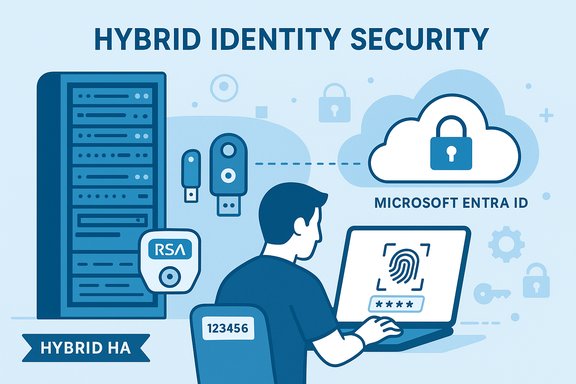
2. Hybrid HA and offline failover: resilience when connectivity fails
The Hybrid HA / Hybrid Failover capability is central to RSA’s operational pitch: by integrating RSA Cloud Authentication Service with an on‑premises Authentication Manager, RSA can continue to validate OTPs and allow authentication decisions locally if the cloud control plane is unreachable. The solution brief explains failover to OTP mode for critical on‑prem resources and local verification for disconnected endpoints. This is not a theoretical feature — RSA documents the architecture and failover behavior in solution briefs and data sheets. Why this matters: a cloud outage or a targeted availability attack against a cloud vendor can render cloud‑only auth unusable; Hybrid HA aims to ensure that critical systems remain accessible under a guarded, forced‑down mode rather than failing open.3. Help Desk Live Verify: reducing social‑engineering risk
RSA highlights Help Desk Live Verify as a patent‑pending, bi‑directional, passwordless verification flow that ensures both the end user and help‑desk agent can cryptographically prove identity during support activities. RSA’s own demonstrations frame this as a mitigation for attacks where adversaries manipulate IT support to bypass MFA or trigger account recovery. RSA published demos and feature pages that describe the bi‑directional verification and real‑time assurance mechanics. Caveat: “stops attacks that bypass MFA” is vendor language and an aspirational security claim. It describes the feature’s intent and design, but its real‑world effectiveness depends on deployment details, policy configuration, and attacker sophistication — independent testing (red teams, controlled pilots) is required to validate that it materially reduces help‑desk social engineering in a given environment.4. Phishing‑resistant passwordless and FIDO support
RSA’s materials emphasize support for modern, phishing‑resistant authenticators: FIDO2, passkeys, hardware authenticators (with FIPS‑140‑3 Level 3 examples cited for some hardware), QR flows and platform biometrics. This aligns with industry guidance urging migration to phishing‑resistant authentication methods, particularly for high‑value and privileged accounts. RSA’s datasheet and product pages list FIDO and hardware authenticator options as part of the ID Plus M1 offering.How RSA ID Plus integrates with Microsoft Entra ID (and why that matters)
RSA frames ID Plus M1 as a complement rather than a replacement for Entra ID. Key interoperability points according to RSA:- RSA ID Plus can be procured via the Microsoft Azure Marketplace for easier procurement alignment.
- It is designed to work with Entra ID Plan 1 and Plan 2, letting organizations keep conditional access, token protections, and other tenant‑level policy while adding RSA’s coverage where needed.
- The integration model focuses on making RSA an enforcing or assisting identity plane for workloads Entra doesn’t natively handle (legacy systems, on‑prem tokens, offline logons).
Who benefits most — and why RSA is targeting regulated industries
RSA’s messaging calls out financial services, healthcare, energy, government and other high‑security industries as the primary beneficiaries. That’s a credible market fit: these sectors commonly have:- Long‑lived legacy systems and critical OT,
- Regulatory demands for certified hardware and auditable authentication,
- Strong operational continuity requirements where downtime is unacceptable.
Deployment guidance and realistic expectations
Practical rollout steps
- Catalog the identity estate — inventory Entra, AD, RADIUS, VPN, OT, and legacy web apps to determine coverage gaps.
- Select pilot scenarios — protect 2–3 high‑value flows (help‑desk recovery, offline laptop logon, legacy RADIUS) to validate integration behaviors and measure MTTR changes.
- Interoperability testing — run controlled tests against Entra conditional access policies to avoid policy conflicts and ensure one authoritative decision source.
- Red‑team help‑desk flows — simulate social‑engineering and enrollment bypass attempts to validate Help Desk Live Verify and recovery UX.
- Failover exercises — test Hybrid HA failover for planned outages and network partitions, confirming credential escrow and emergency unlock processes.
Licensing and procurement considerations
RSA ID Plus M1 is offered via Azure Marketplace and RSA’s subscription pages; enterprises should confirm pricing model (per‑user, per‑authenticator or tiered) and how entitlements interplay with existing Entra Plan 1/2 licenses to avoid double‑paying for overlapping capabilities. Confirm support SLAs and hardware token procurement channels for FIPS devices before committing to large deployments.Strengths — where RSA’s offering aligns with real operational needs
- Resilience for critical systems: Hybrid HA and offline authentication answer a concrete problem for field devices, remote engineers and OT environments that must remain operational during cloud disruptions.
- Help‑desk hardening: Given attacker trends that target support channels, a dedicated, bi‑directional verification flow addresses a well‑documented attack path. RSA’s design intent is consistent with industry calls to secure human processes as well as technical controls.
- Heterogeneous coverage: Support across macOS, older Windows builds, AD‑joined servers, and RADIUS means organizations can extend passwordless and phishing‑resistant methods more broadly than a cloud‑only plan alone allows.
- Marketplace procurement: Availability on the Azure Marketplace simplifies procurement and billing for Azure‑centric organizations and typically eases proof‑of‑concept paths for Microsoft platform customers.
Risks, tradeoffs and things to validate before buying
- Vendor claims vs. operational reality: Statements like “stops attacks that bypass MFA” should be treated as product intent rather than proven immunity. Real‑world efficacy depends on policy design, operator training, and adversary tactics; customers must perform independent testing and red‑team validation.
- Overlap and policy complexity: RSA and Microsoft offer overlapping capabilities (passwordless, conditional decisions, risk‑based access). Without a clear single source of truth for enforcement, organizations risk inconsistent decisions and debugging complexity.
- Operational surface introduced by hybrid components: Hybrid HA introduces on‑prem components and local processing points that require patching, backup/restore plans, secure key handling, and lifecycle management. These must be integrated into existing ITSM and patching workflows.
- Supply‑chain and hardware lifecycle: If relying on FIPS‑certified hardware tokens, confirm procurement channels, firmware update policies, revocation and replacement processes, and how RSA handles compromised authenticators.
- Interoperability edge cases: RSA’s documentation lists supported connectors, but customers should run a compatibility matrix against actual estate elements — older server builds, custom web apps, and OT controllers often reveal unexpected exceptions.
Recommendations for Windows and Entra administrators
- Treat RSA ID Plus M1 as a complementary layer: map each authentication decision to one authoritative control plane (Entra or RSA) to avoid conflicting conditional access logic.
- Start with targeted pilots for the highest‑value scenarios (help‑desk, offline laptop login, legacy RADIUS) before broad rollouts.
- Require independent verification: contract for red‑team testing of help‑desk flows and failover exercises; validate the claimed protections under realistic attack simulations.
- Document operational runbooks for Hybrid HA: disaster recovery, patch cycles, key escrow and emergency admin processes must be concrete and tested.
- Verify licensing and integration costs early: check Azure Marketplace terms, expected per‑user fees, and how RSA support SLAs align with your recovery objectives.
The broader market context and what this launch signals
RSA’s move is emblematic of a broader industry dynamic: identity has become the primary attack vector and vendors are racing to provide continuous, phishing‑resistant authentication across hybrid estates. The market increasingly demands solutions that:- Extend phishing‑resistant passwordless beyond modern endpoints,
- Harden human processes (help desks, recovery flows),
- Ensure access continuity across cloud outages.
Final assessment
RSA ID Plus M1 is a credible, pragmatic product for organizations that cannot, or should not, rely exclusively on cloud‑only identity controls. Its strengths are practical: operational continuity, help‑desk hardening, and broad authenticator support that reach into non‑cloud systems. These are real problems with demonstrable business impact, especially in regulated and critical‑infrastructure sectors. However, prospective buyers should be rigorous: vendor statements are design claims and should be validated in production‑like pilots. Pay careful attention to policy rationalization with Entra conditional access, operational runbooks for Hybrid HA, and the lifecycle management of hardware authenticators and local components. Independent red‑teaming and interoperability testing are essential steps before widescale deployment.RSA’s announcement (GA availability on Azure Marketplace and the RSA ID Plus M1 SKU) is supported by RSA’s press materials and BusinessWire’s syndication, and additional product documentation (datasheets and solution briefs) supplies the architectural detail enterprises need to evaluate fit. For Microsoft‑centered organizations with hybrid constraints, RSA ID Plus M1 is worth a structured pilot — but only after the risks and operational commitments described here have been fully validated.
Conclusion
RSA ID Plus for Microsoft M1 is a targeted response to a real market need: protecting identity‑centric operations that span cloud, on‑prem, and legacy systems while hardening human processes that attackers increasingly exploit. The product’s Hybrid HA architecture and Help Desk Live Verify represent pragmatic investments in availability and social‑engineering resistance, but neither removes the imperative for disciplined policy design, independent testing, and mature operational controls. Organizations considering RSA ID Plus M1 should run measured pilots against their highest‑risk scenarios, verify interoperability with Microsoft Entra policies, and demand empirical proof that advertised protections perform as intended in their environment.
Source: medianet.com.au RSA Announces New Solution to Enhance Security for Microsoft Entra ID - News Hub
