

RSA’s new RSA ID Plus for Microsoft lineup goes beyond a simple integration — it’s a strategic push to layer enterprise-grade, phishing‑resistant identity controls on top of Microsoft Entra ID while promising operational resilience for environments that still rely on legacy, on‑premises, and operational‑technology assets.
In a press announcement published November 13, 2025, RSA launched RSA ID Plus for Microsoft, with the first SKU labeled RSA ID Plus M1 now generally available through the Microsoft Azure Marketplace. The product line is framed as a purpose-built identity security layer intended to fill gaps that enterprise Entra ID deployments alone may leave — notably legacy authentication, offline/off‑network scenarios, and help‑desk attack surfaces. RSA’s messaging emphasizes four headline capabilities:
RSA positions ID Plus for Microsoft as a pragmatic complement to Entra ID:
Microsoft’s own guidance and Secure Future Initiative patterns emphasize tenant hygiene, stronger app security, and centralized logs; RSA’s approach maps to those priorities by attempting to add remediation and resilience where Entra’s cloud model may not fully meet every enterprise operating constraint.
Source: STT Info RSA Announces New Solution to Enhance Security for Microsoft Entra ID | Business Wire
Source: Markets Financial Content https://markets.financialcontent.co...n-to-enhance-security-for-microsoft-entra-id/
 Background / Overview
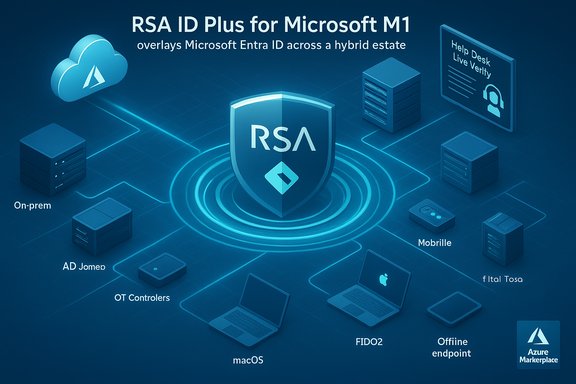
In a press announcement published November 13, 2025, RSA launched RSA ID Plus for Microsoft, with the first SKU labeled RSA ID Plus M1 now generally available through the Microsoft Azure Marketplace. The product line is framed as a purpose-built identity security layer intended to fill gaps that enterprise Entra ID deployments alone may leave — notably legacy authentication, offline/off‑network scenarios, and help‑desk attack surfaces. RSA’s messaging emphasizes four headline capabilities:- Broad coverage across Microsoft and non‑Microsoft environments, including mainframes, macOS, AD‑joined and Entra‑joined devices, OT systems, and other critical systems Entra alone may not reach.
- Operational resilience via a Hybrid HA and offline authentication architecture that allows mission‑critical assets to authenticate even when cloud services are unavailable.
- New anti‑social‑engineering defenses for help desk workflows — RSA Help Desk Live Verify (patent‑pending) — aimed at stopping attacks that bypass MFA by manipulating support staff or enrollment flows.
- Tight interoperability with Microsoft Entra ID Plan 1 and Plan 2 while exposing RSA’s Identity Security Posture Management and passwordless capabilities.
Why this matters: identity, legacy, and continuity
Microsoft Entra ID has matured into the backbone of identity for countless organizations, but the enterprise identity landscape remains heterogeneous. Many organizations still rely on mixed estates that include legacy AD, RADIUS, mainframes, OT controllers, and offline endpoints. Pure cloud‑only identity controls often struggle to address availability and compatibility needs of those environments.RSA positions ID Plus for Microsoft as a pragmatic complement to Entra ID:
- Compatibility: RSA says ID Plus integrates with Entra ID Plan 1/Plan 2 and can be consumed through Azure Marketplace to simplify procurement and provisioning.
- Coverage: The product family is marketed to protect assets beyond what Entra controls by default — for example, AD‑joined servers, older OS versions, and industrial systems. This is a deliberate appeal to regulated industries and critical infrastructure.
- Resilience: The Hybrid HA/offline capabilities are being highlighted as a differentiator for operations that cannot tolerate cloud outages or where network connectivity is intermittent. This caters to sectors with stringent uptime or deterministic control requirements.
What’s new in RSA ID Plus for Microsoft (technical highlights)
RSA Help Desk Live Verify — addressing social engineering at scale
RSA describes Help Desk Live Verify as a patent‑pending, passwordless, bi‑directional identity assurance capability designed to stop help‑desk social engineering attacks and MFA bypass attempts. According to RSA, the feature forces an identity confirmation flow for help‑desk‑initiated actions, which reduces risk where attackers first compromise support channels rather than endpoints. RSA also calls out the feature as targeted at recent high‑profile help‑desk‑targeted incidents. These are vendor claims; customers should validate effectiveness in their own operational contexts.Hybrid HA and offline failover — operational continuity
RSA’s Hybrid HA architecture intends to provide authentication continuity when cloud services are degraded or unreachable. Key architectural promises include:- Offline MFA and credential validation for disconnected endpoints.
- Local or hybrid processing points that handle authentication in the absence of cloud connectivity.
- Built‑in failover designed for mission‑critical operations in regulated industries.
Passwordless and multi‑protocol support
RSA continues to expand its passwordless playbook: mobile passkeys, QR code‑based flows, hardware authenticators, FIDO2, and PIV support are explicitly referenced. RSA also highlights FIPS‑140‑3 Level 3 certification for certain hardware (RSA iShield Key 2 Series) as a compliance and assurance signal for regulated customers. These features are consistent with broader industry pushes toward phishing‑resistant authentication.Identity Security Posture Management (ISPM)
RSA is packaging posture analytics and governance dashboards under an ISPM umbrella — continuous evaluation of entitlements, risk signals, and anomalous identity behavior. RSA’s ISPM messaging is intended to give security teams visibility and prescriptive remediation guidance beyond static IGA controls. This dovetails with industry moves to make identity governance more continuous and risk‑aware.Independent verification and cross‑checks
The core product announcement appears in RSA’s press channels and in syndicated press (BusinessWire and financial news providers). Key claims (GA availability on Azure Marketplace, RSA ID Plus M1 SKU, Hybrid HA, Help Desk Live Verify, FIDO/FIPS support, and integration with Entra ID Plan 1/2) are documented on RSA’s product pages and the press release. Those two independent references — RSA’s official product pages and BusinessWire syndication — corroborate the headline capabilities and availability. Additional industry context — such as Microsoft’s broader hardening guidance for Entra and identity posture patterns — is available in public guidance and community analyses and helps explain the market need this product is targeting. Readers should treat vendor security claims (e.g., “stops attacks that bypass MFA”) as assertions that require validation in production environments; no vendor product can be assumed to be a silver bullet without pilot testing and comparatives.Strengths: where RSA’s pitch aligns with real enterprise needs
- Operational continuity is real need: Organizations that operate critical infrastructure, factories, or field devices frequently require authentication that survives intermittent or absent cloud connectivity. RSA’s Hybrid HA and offline modes directly address this operational demand.
- Phishing‑resistant passwordless for heterogeneous estates: RSA’s support for a wide variety of authenticators, including FIDO2, mobile passkeys, hardware tokens, and enterprise tokens with high FIPS levels, makes it easier to roll out phishing‑resistant auth across mixed environments where not every endpoint can run the same modern client stack.
- Help‑desk targeted protections: Help‑desk social engineering and enrollment flows are a known attack vector; a well‑designed live verification workflow that contracts identity proofs at the point of help‑desk activity can materially reduce that class of risk — if implemented correctly with operational guardrails.
- Marketplace distribution and Microsoft interoperability: Publication on the Azure Marketplace and explicit support for Entra Plan 1/2 simplify procurement and align RSA’s support model with Microsoft licensing and control planes, easing enterprise adoption risk.
- Identity posture analytics: ISPM fills an increasing operational gap: organizations want automated, continuous signals about identity hygiene rather than periodic certification exercises. RSA’s dashboards and automated remediation can accelerate risk reduction when integrated with workflows.
Risks, gaps, and what to validate before deployment
- Vendor claims vs. operational reality: Statements like “stops attacks that bypass MFA” are meaningful marketing language but require empirical validation. Attack mitigation depends on integration discipline, playbook fidelity, and operator training. Independent testing and red‑team exercises should validate the specific protections RSA offers in the customer’s environment.
- Complexity and overlap with Microsoft controls: Enterprises familiar with Entra conditional access, token protection, and Microsoft Security stack should map use cases carefully. RSA adds capabilities that overlap with Microsoft’s feature set in some areas (e.g., passwordless, conditional decisions). Overlapping controls can increase operational complexity if not rationalized. Adopt a single source of truth for policy enforcement to reduce inconsistent decisions.
- Operational overhead for hybrid failover: Hybrid HA and offline modes are powerful, but they introduce their own operational surface: local processing points, secure key handling, and disaster recovery procedures. Validate backup/restore, patching, and lifecycle processes for any on‑prem components RSA deploys.
- Supply‑chain and hardware assurance: RSA touts certified hardware (FIPS‑140‑3 L3) for high‑assurance use cases. If relying on hardware tokens for compliance, confirm procurement, storage, tamper evidence, and revocation processes meet your regulatory requirements. Also confirm how firmware updates and endpoint attestation are managed.
- Interoperability testing matrix: RSA’s cross‑platform support sounds comprehensive, but customers should run a compatibility matrix against their estate—AD‑joined servers, older Windows Server versions, macOS builds, industrial controllers, and custom web apps—to find edge cases before mass rollout. RSA documentation lists supported connectors and processes, but real‑world integration uncovers the exceptions.
Deployment guidance: pragmatic steps for Windows and Entra operators
1. Inventory identity and authentication estate.- Catalog Entra, AD, RADIUS, legacy web apps, OT controllers, and any systems that require uninterrupted access. This reveals where Hybrid HA and offline auth matter most.
- Choose 2–3 critical use cases (help‑desk admin recovery, Entra‑joined laptop offline login, and legacy RADIUS portal) to validate RSA mechanics and measure mean time to authenticate and incident response changes.
- Ensure RSA’s controls don’t unintentionally bypass or conflict with conditional access, device health gates, or token protection policies. Harmonize policy decisioning (which system is authoritative for each scenario).
- Simulate real help‑desk social engineering and escalations to test the live verification flows, timeouts, and recovery options. Validate usability as much as security.
- Test failover scenarios for both planned maintenance and network partitions. Confirm offline auth paths, credential escrow, and emergency unlock methods meet recovery time objectives.
- Validate that ISPM insights map into identity lifecycle and entitlement review processes. Embed remediation into IAM workflows and ticketing automation.
Pricing, licensing, and procurement signals
RSA ID Plus for Microsoft M1 is available through the Azure Marketplace, which typically streamlines procurement and aligns metering with Azure subscriptions. Enterprises should:- Confirm whether RSA’s ID Plus licensing is subscription‑based, per‑user, or per‑authenticator for the specific SKU they plan to adopt.
- Validate license interplay with Entra Plan 1/Plan 2 entitlements to avoid double‑paying for equivalent capabilities.
- Factor in hardware token lifecycle and replacement costs where FIPS‑certified authenticators are required.
Broader market implications
RSA’s announcement is notable for two reasons. First, it signals continued vendor consolidation around identity as the central signal for enterprise security — vendors want to layer strong authentication, posture checks, and identity analytics into the Microsoft ecosystem where many enterprise customers already live. Second, the emphasis on hybrid resilience and help‑desk protection is a realistic recognition that attackers increasingly target human processes and service desks, not just technology stacks.Microsoft’s own guidance and Secure Future Initiative patterns emphasize tenant hygiene, stronger app security, and centralized logs; RSA’s approach maps to those priorities by attempting to add remediation and resilience where Entra’s cloud model may not fully meet every enterprise operating constraint.
Final assessment — who should consider RSA ID Plus for Microsoft?
- Organizations with mixed estates (cloud + AD + RADIUS + OT) that need phishing‑resistant, continuous authentication and cannot rely exclusively on cloud availability.
- Regulated sectors (finance, healthcare, energy, government) that require certified hardware and deterministic authentication continuity for compliance and life‑safety operations.
- Teams that need to reduce social‑engineering risk around help‑desk processes and want a vendorized, out‑of‑the‑box workflow to harden those interactions.
Conclusion
RSA ID Plus for Microsoft is a meaningful, pragmatic play: it positions RSA as an overlay that extends Entra ID’s reach into legacy, offline, and high‑assurance environments while promising help‑desk protections and identity posture insights. The offering is now available via the Azure Marketplace and is backed by RSA’s long history in high‑security identity services. The product’s strengths are aligned with real enterprise pain points — network partitions, legacy systems, and human‑targeted attacks — but the vendor claims should be validated through pilots, red‑team exercises, and interoperability testing to confirm real‑world resilience and to avoid policy overlap with existing Microsoft controls. Practical adoption will require careful planning around lifecycle operations, token management, and governance to realize the layered security benefits RSA promises.Source: STT Info RSA Announces New Solution to Enhance Security for Microsoft Entra ID | Business Wire
Source: Markets Financial Content https://markets.financialcontent.co...n-to-enhance-security-for-microsoft-entra-id/
