

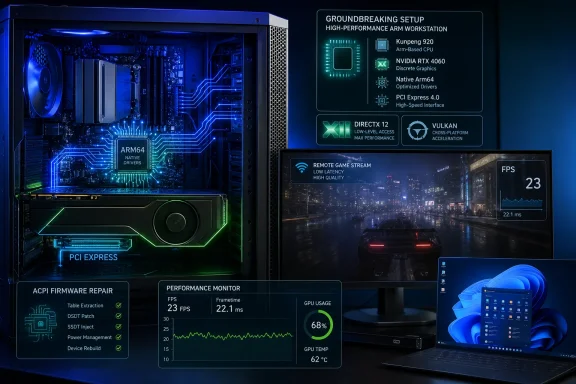
A developer has crossed a boundary that has long limited Windows 11 on Arm: getting a conventional Nvidia GeForce desktop graphics card to operate with an Arm processor. By pairing an RTX 4060 with a Huawei Qingyun W510 workstation powered by the Arm-based Kunpeng 920, adapting the system firmware, and installing a native Arm64 Nvidia driver extracted from the new RTX Spark software stack, the experiment reportedly enabled DirectX 12, Vulkan, and GPU acceleration. The result is far from a practical gaming PC—there is no direct monitor output, performance hovers around 20 to 25 frames per second in several tests, and compatibility remains inconsistent—but it demonstrates that the architectural wall separating Windows on Arm from discrete GeForce graphics is not as immovable as it once appeared.
Windows on Arm has spent years trying to escape the reputation that it is Windows with an asterisk. Microsoft’s operating system can now translate many conventional x86 and x64 applications for Arm processors, while a growing selection of browsers, productivity tools, creative applications, and developer utilities runs natively. Hardware support, however, remains much less forgiving than application compatibility.
The central problem is that Windows can translate an ordinary user-mode application, but it cannot simply translate a kernel-level hardware driver and safely load it into the operating system. A graphics driver must be compiled specifically for Arm64, understand the hardware platform, interact with the Windows graphics kernel, manage memory, and communicate reliably with the GPU.
Adding a desktop GeForce card changes the equation. The operating system needs a native Arm64 display driver, the motherboard must expose compatible PCI Express resources, firmware tables must describe those resources correctly, and the platform must support interrupt delivery, memory mapping, power management, and display initialization.
Nvidia had not offered a general-purpose public GeForce driver for Windows on Arm. Without that foundational component, inserting an RTX card into an Arm workstation could not produce a functional Windows graphics device, regardless of the theoretical compatibility of PCI Express.
RTX Spark is not a downloadable GeForce upgrade for existing Arm computers. It is a complete platform intended for purpose-built systems, with firmware, silicon, drivers, Windows components, and applications developed around a known configuration.
Even so, the existence of RTX Spark means Nvidia has done something experimenters previously lacked: built a modern Windows Arm64 driver capable of controlling RTX-class graphics hardware. The developer’s breakthrough appears to come from adapting that driver to recognize and initialize a conventional RTX 4060.
The reported configuration includes 32GB of DDR4 memory and an RTX 4060 with 8GB of graphics memory. The graphics card was connected over a PCI Express 4.0 interface operating with eight lanes, which is the normal physical link width for an RTX 4060.
That does not make it equivalent to a current consumer desktop processor. The workload demonstrated here depends heavily on per-core performance, instruction translation, Windows optimization, and gaming-specific scheduling behavior—areas in which the Kunpeng platform was not designed to compete with recent Intel Core, AMD Ryzen, or high-performance Snapdragon PC chips.
The processor also predates the current surge of Windows-focused Arm silicon. Its ecosystem was built primarily around Linux distributions, server software, enterprise deployment, and Huawei’s own platform requirements.
The card supports modern Nvidia features, including DirectX 12 Ultimate capabilities, hardware ray tracing, Tensor cores, DLSS, and contemporary video encoding. Proving that Windows on Arm can initialize this GPU therefore tests far more than basic framebuffer output.
The experiment reportedly exposed hardware acceleration, DirectX 12, and Vulkan. Those results suggest that meaningful portions of Nvidia’s user-mode and kernel-mode driver stack were operating, even though display output and some advanced features remained incomplete.
The Huawei workstation was not designed as a Windows PC. Its firmware and hardware description therefore did not necessarily present the interfaces Windows expects to find.
Windows depends heavily on correctly structured ACPI information. If tables contain unsupported assumptions, Linux-oriented definitions, missing devices, or incompatible methods, Windows may fail during boot or be unable to control critical hardware.
According to the reported demonstration, the developer used an open-source patch to correct the ACPI tables. That modification allowed Windows 11 on Arm to understand enough of the Kunpeng platform to boot.
That distinction matters because errors at this level can produce unstable behavior that is difficult to diagnose. A machine may boot while still lacking correct power management, interrupt routing, hot-plug handling, or device initialization.
The absence of direct video output may be related partly to this incomplete platform support rather than solely to the Nvidia driver. The motherboard, integrated display hardware, PCI Express topology, and Windows display stack all need to cooperate before a monitor connected to the RTX 4060 can show an image.
Windows Update cannot be expected to maintain such a system reliably. A cumulative update, graphics driver revision, firmware change, or security-policy adjustment could break the configuration without warning.
The value lies in the technical proof, not in the immediate usability of the machine.
Application translation does not solve this problem. Graphics drivers operate within security-sensitive and timing-sensitive parts of the operating system where architecture-native code is mandatory.
This implies that the driver’s internal support was broad enough to initialize the RTX 4060, or that the required device identification information could be adapted without rewriting the core driver. Nvidia often shares substantial code across related product families, even when individual installation packages expose only selected devices.
The fact that the driver reportedly passed Windows driver checks is notable. It suggests the files retained valid signing or packaging properties accepted by the test environment, although that does not make the resulting configuration officially supported.
A modern graphics package contains far more than a generic GPU driver. It includes architecture-specific microcode, memory-management logic, power profiles, display components, video engines, feature tables, application profiles, and device identifiers.
Different RTX generations can also depend on different firmware, security behavior, and Windows Display Driver Model capabilities. A driver that initializes one RTX 4060 may fail with another card family or provide only partial functionality.
A complete validation program would need to test:
One additional demonstration could not enable ray tracing, apparently because of a compatibility or GPU-detection problem. These figures should not be compared directly with ordinary RTX 4060 reviews because the surrounding platform is radically different.
Most Windows PC games are distributed as x64 binaries. Windows 11 on Arm must translate those instructions into Arm64 code while preserving expected Windows behavior.
Translation performance has improved substantially through Microsoft’s Prism technology, but it cannot turn an older, non-Windows-optimized Arm server processor into a current gaming CPU. Weak single-threaded performance is particularly damaging because many games still depend on one or a few heavily loaded threads.
A useful follow-up test would record:
That is a much narrower result, but technically more consequential. Performance tuning usually begins only after the complete software stack can initialize and run.
That workaround converts the GPU’s rendered frames into a compressed video stream, sends them to a client, and decodes them remotely. It proves the GPU can render frames, but it does not prove that the entire physical display pipeline works.
Physical display output requires additional components. The driver must initialize display controllers, enumerate connectors, read monitor information, select timing modes, configure link training, and integrate with the motherboard’s boot and display behavior.
The RTX Spark driver may have been designed around a different display topology. Alternatively, missing Huawei platform drivers may prevent Windows from completing the required routing and initialization.
If hardware video encoding operated correctly, the RTX 4060 may have handled much of that workload. Even then, capture and synchronization can affect frame pacing and latency.
The setup is therefore suitable for demonstration and remote compute use, but not as evidence of a normal desktop experience. A practical GeForce-on-Arm implementation must produce reliable local display output from boot through the Windows desktop and demanding applications.
Arm-based Windows PCs have generally offered a more appliance-like model. Buyers receive an integrated system whose graphics capabilities are fixed by the system-on-chip and whose hardware support depends on a narrower set of vendor-qualified drivers.
Potential configurations could include:
That flexibility could also put pressure on Intel, AMD, and Qualcomm. Intel and AMD would face stronger competition in the processor market, while Qualcomm would no longer be the default center of gravity for premium Windows on Arm systems.
Nvidia, meanwhile, could extend its software ecosystem across x64 and Arm Windows devices. CUDA, RTX rendering, AI acceleration, and gaming technologies could become architecture-independent reasons to remain within the company’s platform.
Any one of those components can block execution. Kernel-level anti-cheat is especially problematic because it requires a native Arm64 driver.
An x64 game might start successfully but fail when one dependency attempts to load unsupported low-level code. It might also run while suffering bugs caused by assumptions about processor behavior, memory ordering, or instruction support.
The RTX 4060 experiment therefore validates the graphics side only partially. The wider Windows gaming ecosystem still needs native Arm64 components or carefully tested translation paths.
Future RTX Spark systems are expected to benefit from game developers targeting Arm directly, optimizing existing x64 releases for Prism, or adopting hybrid approaches. Microsoft’s Arm64EC technology can also allow developers to migrate selected application components while retaining compatibility with existing code.
The breakthrough’s poor frame rates should therefore not be projected automatically onto future Nvidia-powered Arm PCs. Those systems will use purpose-built processors, validated firmware, optimized drivers, and a software ecosystem that has had time to adapt.
The demonstrated configuration could be conceptually useful for a headless workstation, although its unofficial driver and platform modifications make it unsuitable for production deployment.
However, graphics acceleration does not automatically confirm complete CUDA functionality. The runtime, development tools, libraries, debuggers, and framework dependencies must all support Windows on Arm.
Nvidia’s RTX Spark strategy suggests the company wants its full software stack to participate in the Arm Windows market. The developer’s experiment hints that parts of that stack may already be more portable across RTX hardware than officially exposed.
Organizations would also demand:
That could reduce one obstacle to native Arm ports. Developers may be more willing to invest in Arm64 binaries if they know the resulting applications can access high-performance Nvidia graphics rather than only integrated mobile-class GPUs.
That model resembles the integration that has helped Apple control performance and efficiency across its Mac lineup, but Nvidia would be operating inside the broader Windows hardware ecosystem.
RTX Spark introduces a different value proposition centered on Nvidia’s graphics and AI ecosystem. If the platform delivers stronger gaming, CUDA access, creator performance, and application support, Qualcomm may need to improve both its integrated graphics and its relationships with discrete GPU vendors.
A public GeForce Arm64 driver would be particularly disruptive because it could allow future Snapdragon desktops to use Nvidia cards, provided their firmware and PCI Express implementations support them. Whether Nvidia would enable that degree of openness remains uncertain.
Nvidia’s strength lies in software gravity. CUDA, DLSS, OptiX, RTX acceleration, and AI tooling can make the GPU ecosystem more important than the CPU architecture beneath it.
If Windows users can retain Nvidia applications and gaming features while moving to Arm, processor competition becomes less constrained by legacy assumptions. Intel and AMD would still hold enormous compatibility advantages, but Arm vendors would gain a more credible route into performance desktops.
Windows benefits most when multiple graphics vendors compete on a common architecture. A single-vendor Arm graphics ecosystem could reproduce the limitations users already associate with tightly integrated platforms.
Their drivers, device lists, installation packages, and software capabilities will reveal how tightly Nvidia intends to restrict the platform.
On the other hand, the PC market values openness. A general GeForce Arm64 driver could make Nvidia the default graphics partner for an emerging category of Arm desktops and workstations.
The company’s eventual choice will indicate whether RTX Spark is intended as a controlled, integrated platform or the foundation of a wider Nvidia graphics ecosystem for Windows on Arm.
The RTX 4060 running on a Kunpeng 920 workstation is not yet a practical gaming machine, but practicality is not what makes the demonstration important. The developer bridged incompatible firmware assumptions, an unsupported Windows platform, a processor architecture transition, and a graphics driver never intended for that desktop card, ultimately reaching functional DirectX 12 and Vulkan acceleration. If Nvidia converts that accidental compatibility into deliberate product support, Windows on Arm could evolve from a market of sealed, integrated laptops into a genuinely modular PC platform—one where choosing an Arm processor no longer means giving up the power, software ecosystem, and upgrade freedom of a discrete GeForce GPU.
 Background
Windows on Arm has spent years trying to escape the reputation that it is Windows with an asterisk. Microsoft’s operating system can now translate many conventional x86 and x64 applications for Arm processors, while a growing selection of browsers, productivity tools, creative applications, and developer utilities runs natively. Hardware support, however, remains much less forgiving than application compatibility.The central problem is that Windows can translate an ordinary user-mode application, but it cannot simply translate a kernel-level hardware driver and safely load it into the operating system. A graphics driver must be compiled specifically for Arm64, understand the hardware platform, interact with the Windows graphics kernel, manage memory, and communicate reliably with the GPU.
Why discrete graphics remained missing
Qualcomm-powered Windows laptops have historically relied on integrated Adreno graphics. Those GPUs are part of a tightly controlled system-on-chip platform, allowing Qualcomm, Microsoft, and PC manufacturers to qualify the complete hardware and driver stack together.Adding a desktop GeForce card changes the equation. The operating system needs a native Arm64 display driver, the motherboard must expose compatible PCI Express resources, firmware tables must describe those resources correctly, and the platform must support interrupt delivery, memory mapping, power management, and display initialization.
Nvidia had not offered a general-purpose public GeForce driver for Windows on Arm. Without that foundational component, inserting an RTX card into an Arm workstation could not produce a functional Windows graphics device, regardless of the theoretical compatibility of PCI Express.
The significance of RTX Spark
Nvidia’s RTX Spark initiative changes the software landscape because it brings the company’s Windows graphics and compute stack to a new generation of Arm-based PCs. The platform is intended to combine Nvidia graphics technology with a custom Arm processor design developed with MediaTek.RTX Spark is not a downloadable GeForce upgrade for existing Arm computers. It is a complete platform intended for purpose-built systems, with firmware, silicon, drivers, Windows components, and applications developed around a known configuration.
Even so, the existence of RTX Spark means Nvidia has done something experimenters previously lacked: built a modern Windows Arm64 driver capable of controlling RTX-class graphics hardware. The developer’s breakthrough appears to come from adapting that driver to recognize and initialize a conventional RTX 4060.
The Hardware Behind the Experiment
The machine at the center of the demonstration is reportedly a Huawei Qingyun W510 desktop using the Kunpeng 920 processor. This is not a Snapdragon laptop or a Microsoft development kit, but an enterprise-oriented Arm workstation from an ecosystem primarily associated with Linux.The reported configuration includes 32GB of DDR4 memory and an RTX 4060 with 8GB of graphics memory. The graphics card was connected over a PCI Express 4.0 interface operating with eight lanes, which is the normal physical link width for an RTX 4060.
Understanding the Kunpeng 920
Huawei’s Kunpeng 920 belongs to the Arm server and infrastructure family rather than the low-power mobile class. Depending on its implementation, the processor can provide multiple cores, DDR4 memory support, and substantial PCI Express connectivity.That does not make it equivalent to a current consumer desktop processor. The workload demonstrated here depends heavily on per-core performance, instruction translation, Windows optimization, and gaming-specific scheduling behavior—areas in which the Kunpeng platform was not designed to compete with recent Intel Core, AMD Ryzen, or high-performance Snapdragon PC chips.
The processor also predates the current surge of Windows-focused Arm silicon. Its ecosystem was built primarily around Linux distributions, server software, enterprise deployment, and Huawei’s own platform requirements.
Why the RTX 4060 was a sensible choice
The RTX 4060 is an interesting test candidate because it is a relatively efficient Ada Lovelace card that does not demand the power delivery or cooling infrastructure of a high-end RTX model. Its PCIe 4.0 x8 interface also fits naturally into the available workstation configuration.The card supports modern Nvidia features, including DirectX 12 Ultimate capabilities, hardware ray tracing, Tensor cores, DLSS, and contemporary video encoding. Proving that Windows on Arm can initialize this GPU therefore tests far more than basic framebuffer output.
The experiment reportedly exposed hardware acceleration, DirectX 12, and Vulkan. Those results suggest that meaningful portions of Nvidia’s user-mode and kernel-mode driver stack were operating, even though display output and some advanced features remained incomplete.
Booting Windows Was the First Major Obstacle
Installing Windows 11 on an unsupported Arm workstation is fundamentally different from installing it on a standard x64 desktop. Microsoft publishes Arm64 installation media, but installation media alone does not provide every driver or firmware adaptation required by an arbitrary Arm machine.The Huawei workstation was not designed as a Windows PC. Its firmware and hardware description therefore did not necessarily present the interfaces Windows expects to find.
The role of ACPI
The Advanced Configuration and Power Interface, better known as ACPI, allows an operating system to discover hardware and manage platform resources. ACPI tables describe processors, memory regions, interrupt routing, power states, PCI Express devices, thermal behavior, and other essential characteristics.Windows depends heavily on correctly structured ACPI information. If tables contain unsupported assumptions, Linux-oriented definitions, missing devices, or incompatible methods, Windows may fail during boot or be unable to control critical hardware.
According to the reported demonstration, the developer used an open-source patch to correct the ACPI tables. That modification allowed Windows 11 on Arm to understand enough of the Kunpeng platform to boot.
Why an ACPI patch is not a normal driver fix
A conventional device driver operates after the firmware has successfully described the platform. An ACPI patch changes the platform description itself, effectively translating or repairing the contract between the firmware and Windows.That distinction matters because errors at this level can produce unstable behavior that is difficult to diagnose. A machine may boot while still lacking correct power management, interrupt routing, hot-plug handling, or device initialization.
The absence of direct video output may be related partly to this incomplete platform support rather than solely to the Nvidia driver. The motherboard, integrated display hardware, PCI Express topology, and Windows display stack all need to cooperate before a monitor connected to the RTX 4060 can show an image.
An unsupported Windows installation
This should not be mistaken for an alternative installation procedure suitable for everyday users. The developer was working on an unsupported combination of processor, firmware, motherboard, operating system, and graphics card.Windows Update cannot be expected to maintain such a system reliably. A cumulative update, graphics driver revision, firmware change, or security-policy adjustment could break the configuration without warning.
The value lies in the technical proof, not in the immediate usability of the machine.
How the Nvidia Driver Barrier Was Crossed
Once Windows was running, the developer still faced the decisive limitation: standard Nvidia GeForce drivers are compiled for x64 Windows. Windows 11 on Arm cannot load those binaries as native kernel drivers.Application translation does not solve this problem. Graphics drivers operate within security-sensitive and timing-sensitive parts of the operating system where architecture-native code is mandatory.
Extracting the RTX Spark driver
The developer reportedly extracted a native Windows Arm64 Nvidia driver from RTX Spark software and installed it for the desktop RTX 4060. Windows then identified the graphics card and enabled multiple acceleration interfaces.This implies that the driver’s internal support was broad enough to initialize the RTX 4060, or that the required device identification information could be adapted without rewriting the core driver. Nvidia often shares substantial code across related product families, even when individual installation packages expose only selected devices.
The fact that the driver reportedly passed Windows driver checks is notable. It suggests the files retained valid signing or packaging properties accepted by the test environment, although that does not make the resulting configuration officially supported.
Unified architecture does not guarantee universal support
The developer reportedly believes the shared Nvidia architecture could allow cards from the RTX 20, 30, 40, and 50 families to operate. That is plausible as a technical hypothesis, but it should not be treated as confirmed compatibility.A modern graphics package contains far more than a generic GPU driver. It includes architecture-specific microcode, memory-management logic, power profiles, display components, video engines, feature tables, application profiles, and device identifiers.
Different RTX generations can also depend on different firmware, security behavior, and Windows Display Driver Model capabilities. A driver that initializes one RTX 4060 may fail with another card family or provide only partial functionality.
Why passing driver checks is only the beginning
Windows accepting a driver means that the operating system permits it to load under the applicable security rules. It does not certify every function of the card on that platform.A complete validation program would need to test:
- The GPU’s behavior under sustained graphics and compute loads.
- Recovery after a driver timeout or application crash.
- Sleep, resume, restart, and shutdown reliability.
- Video decoding and encoding across supported codecs.
- Hardware-accelerated browser and desktop composition.
- Multiple monitors, refresh rates, and high-dynamic-range output.
- DirectX 11, DirectX 12, Vulkan, OpenGL, CUDA, and OpenCL workloads.
- Memory pressure, PCI Express error handling, and power-state transitions.
What the Benchmark Results Really Show
The reported frame rates are understandably modest. Genshin Impact averaged around 20 frames per second at 1080p, while the Black Myth: Wukong benchmark reached roughly 20 to 25 frames per second. A Star Wars Reflections demonstration reportedly operated at approximately 23 to 25 frames per second.One additional demonstration could not enable ray tracing, apparently because of a compatibility or GPU-detection problem. These figures should not be compared directly with ordinary RTX 4060 reviews because the surrounding platform is radically different.
The CPU is the primary bottleneck
The RTX 4060 itself is capable of far higher frame rates in a conventional Windows gaming PC. Here, the Kunpeng 920 must execute—or translate—the game’s CPU code, submit work to the graphics driver, handle operating-system activity, and keep the GPU supplied with commands.Most Windows PC games are distributed as x64 binaries. Windows 11 on Arm must translate those instructions into Arm64 code while preserving expected Windows behavior.
Translation performance has improved substantially through Microsoft’s Prism technology, but it cannot turn an older, non-Windows-optimized Arm server processor into a current gaming CPU. Weak single-threaded performance is particularly damaging because many games still depend on one or a few heavily loaded threads.
Why GPU utilization matters more than raw frame rate
If the CPU cannot prepare frames quickly enough, the RTX 4060 spends time waiting. That condition produces low GPU utilization and makes the graphics card appear much slower than it actually is.A useful follow-up test would record:
- Per-core CPU utilization and clock behavior.
- GPU utilization, power consumption, and effective clock speed.
- Graphics memory usage and PCI Express link activity.
- Frame-time consistency rather than only average frame rate.
- The overhead of streaming the display to another device.
- Performance differences between native Arm64 and translated workloads.
The benchmarks are proof-of-function tests
The appropriate interpretation is not that an RTX 4060 delivers only 20 frames per second on Windows on Arm. It is that a desktop Nvidia GPU can execute demanding DirectX workloads on an unsupported Arm workstation through a transplanted native driver.That is a much narrower result, but technically more consequential. Performance tuning usually begins only after the complete software stack can initialize and run.
The Missing Monitor Output
The most visible limitation is that the RTX 4060 reportedly cannot send a usable signal directly to a monitor. The developer instead used Sunshine on the test system and Moonlight on another device to stream the Windows desktop and games over a network.That workaround converts the GPU’s rendered frames into a compressed video stream, sends them to a client, and decodes them remotely. It proves the GPU can render frames, but it does not prove that the entire physical display pipeline works.
Rendering and display output are separate functions
A discrete GPU can accelerate an application without functioning as the system’s active display adapter. Windows may allocate DirectX resources and execute shaders even if another device handles presentation or if the completed frames are captured for remote delivery.Physical display output requires additional components. The driver must initialize display controllers, enumerate connectors, read monitor information, select timing modes, configure link training, and integrate with the motherboard’s boot and display behavior.
The RTX Spark driver may have been designed around a different display topology. Alternatively, missing Huawei platform drivers may prevent Windows from completing the required routing and initialization.
Streaming adds another performance variable
Sunshine and Moonlight are efficient, but remote streaming is not free. The host must capture rendered frames, encode them, transfer them across the network, and synchronize presentation with the client.If hardware video encoding operated correctly, the RTX 4060 may have handled much of that workload. Even then, capture and synchronization can affect frame pacing and latency.
The setup is therefore suitable for demonstration and remote compute use, but not as evidence of a normal desktop experience. A practical GeForce-on-Arm implementation must produce reliable local display output from boot through the Windows desktop and demanding applications.
Why This Matters for Windows on Arm
The experiment addresses one of the most persistent structural weaknesses in the Windows on Arm ecosystem: limited graphics choice. Windows users expect to combine processors, motherboards, GPUs, monitors, storage devices, and peripherals with considerable freedom.Arm-based Windows PCs have generally offered a more appliance-like model. Buyers receive an integrated system whose graphics capabilities are fixed by the system-on-chip and whose hardware support depends on a narrower set of vendor-qualified drivers.
A path toward modular Arm desktops
If Nvidia eventually releases a general Windows Arm64 GeForce driver, system builders could create Arm desktops and workstations with replaceable graphics cards. Such support would broaden the platform beyond thin-and-light laptops and integrated Copilot+ PCs.Potential configurations could include:
- Compact Arm workstations with high-end RTX cards for rendering and AI.
- Efficient development systems that combine native Arm software with CUDA.
- Gaming desktops built around future high-performance Arm processors.
- Enterprise terminals with discrete graphics for visualization and simulation.
- Arm servers equipped with Windows-supported GPUs for specialized workloads.
Windows gains leverage from hardware diversity
Microsoft benefits when Windows can span multiple processor architectures without forcing users to abandon familiar hardware and software. Broad Nvidia support would reduce the perception that choosing Arm means accepting permanently integrated graphics.That flexibility could also put pressure on Intel, AMD, and Qualcomm. Intel and AMD would face stronger competition in the processor market, while Qualcomm would no longer be the default center of gravity for premium Windows on Arm systems.
Nvidia, meanwhile, could extend its software ecosystem across x64 and Arm Windows devices. CUDA, RTX rendering, AI acceleration, and gaming technologies could become architecture-independent reasons to remain within the company’s platform.
Gaming Compatibility Remains the Hardest Test
Launching a few games does not mean Windows on Arm has solved PC gaming. Games combine performance-sensitive CPU code, graphics APIs, launchers, copy protection, anti-cheat systems, overlays, input software, and sometimes legacy middleware.Any one of those components can block execution. Kernel-level anti-cheat is especially problematic because it requires a native Arm64 driver.
Translation is only one compatibility layer
Microsoft’s Prism emulator translates x86 and x64 application code, but games often rely on more than the primary executable. A title can load third-party libraries, runtime components, graphics injectors, audio middleware, controller drivers, and security modules.An x64 game might start successfully but fail when one dependency attempts to load unsupported low-level code. It might also run while suffering bugs caused by assumptions about processor behavior, memory ordering, or instruction support.
The RTX 4060 experiment therefore validates the graphics side only partially. The wider Windows gaming ecosystem still needs native Arm64 components or carefully tested translation paths.
Native Arm games would transform the result
A native Arm64 game would remove much of the CPU translation overhead and provide a fairer test of the Kunpeng processor and Nvidia driver. An Arm-native benchmark could reveal whether the graphics stack itself imposes a substantial penalty.Future RTX Spark systems are expected to benefit from game developers targeting Arm directly, optimizing existing x64 releases for Prism, or adopting hybrid approaches. Microsoft’s Arm64EC technology can also allow developers to migrate selected application components while retaining compatibility with existing code.
The breakthrough’s poor frame rates should therefore not be projected automatically onto future Nvidia-powered Arm PCs. Those systems will use purpose-built processors, validated firmware, optimized drivers, and a software ecosystem that has had time to adapt.
Enterprise and Developer Implications
Gaming attracts attention, but the more immediate value of discrete Nvidia graphics on Windows on Arm may lie in professional computing. Many enterprise workloads care more about CUDA, AI inference, video processing, visualization, or remote rendering than direct monitor output.The demonstrated configuration could be conceptually useful for a headless workstation, although its unofficial driver and platform modifications make it unsuitable for production deployment.
CUDA could be the larger prize
If the extracted driver includes functional CUDA support, developers may eventually be able to combine native Arm64 Windows applications with Nvidia’s compute ecosystem. That would create new options for local AI development, scientific computing, media processing, and engineering software.However, graphics acceleration does not automatically confirm complete CUDA functionality. The runtime, development tools, libraries, debuggers, and framework dependencies must all support Windows on Arm.
Nvidia’s RTX Spark strategy suggests the company wants its full software stack to participate in the Arm Windows market. The developer’s experiment hints that parts of that stack may already be more portable across RTX hardware than officially exposed.
Enterprises require support, not merely functionality
A business cannot standardize on a driver extracted from another platform and installed through unofficial modifications. Enterprise adoption requires documented compatibility, predictable updates, security servicing, lifecycle commitments, and a vendor willing to investigate failures.Organizations would also demand:
- Signed and publicly distributed production drivers.
- Windows Hardware Compatibility Program validation.
- Stable firmware and ACPI implementations.
- Management support through standard enterprise tools.
- Reliable virtualization and remote-desktop behavior.
- Long-term servicing for graphics and compute components.
- Clear licensing for deployment and redistribution.
Developers now have a concrete target
For software developers, the demonstration makes discrete RTX graphics on Arm Windows less theoretical. Teams building graphics engines, plugins, renderers, and AI applications can begin considering a future in which the CPU architecture is Arm64 while the GPU programming model remains familiar.That could reduce one obstacle to native Arm ports. Developers may be more willing to invest in Arm64 binaries if they know the resulting applications can access high-performance Nvidia graphics rather than only integrated mobile-class GPUs.
Competitive Implications
Nvidia’s entrance into the Windows on Arm ecosystem could alter several overlapping markets. The company is not simply providing graphics technology; RTX Spark positions Nvidia as a platform supplier combining CPU, GPU, AI acceleration, drivers, and developer tools.That model resembles the integration that has helped Apple control performance and efficiency across its Mac lineup, but Nvidia would be operating inside the broader Windows hardware ecosystem.
Pressure on Qualcomm
Qualcomm helped establish the modern Windows on Arm market through Snapdragon processors and close collaboration with Microsoft. Its systems emphasize battery life, integrated connectivity, neural processing, and thin designs.RTX Spark introduces a different value proposition centered on Nvidia’s graphics and AI ecosystem. If the platform delivers stronger gaming, CUDA access, creator performance, and application support, Qualcomm may need to improve both its integrated graphics and its relationships with discrete GPU vendors.
A public GeForce Arm64 driver would be particularly disruptive because it could allow future Snapdragon desktops to use Nvidia cards, provided their firmware and PCI Express implementations support them. Whether Nvidia would enable that degree of openness remains uncertain.
Pressure on AMD and Intel
AMD already combines x86 processors and Radeon graphics, while Intel offers x86 CPUs, integrated GPUs, and Arc discrete cards. Both companies can provide complete Windows platforms without crossing an instruction-set boundary.Nvidia’s strength lies in software gravity. CUDA, DLSS, OptiX, RTX acceleration, and AI tooling can make the GPU ecosystem more important than the CPU architecture beneath it.
If Windows users can retain Nvidia applications and gaming features while moving to Arm, processor competition becomes less constrained by legacy assumptions. Intel and AMD would still hold enormous compatibility advantages, but Arm vendors would gain a more credible route into performance desktops.
A new test for AMD’s graphics strategy
The experiment also raises an obvious question about Radeon. If Nvidia brings RTX drivers to Arm Windows, AMD will need to decide whether its discrete GPUs should support the same market.Windows benefits most when multiple graphics vendors compete on a common architecture. A single-vendor Arm graphics ecosystem could reproduce the limitations users already associate with tightly integrated platforms.
Strengths and Opportunities
This achievement is valuable because it exposes what is already technically possible, even before vendors package that capability for mainstream customers.- It proves a desktop RTX card can be initialized by a native Windows Arm64 Nvidia stack. That is the foundational requirement for any future GeForce-on-Arm product.
- It demonstrates modern graphics APIs rather than only basic device detection. DirectX 12 and Vulkan operation show that the driver progressed beyond a placeholder or generic display state.
- It gives the Windows community a practical research platform. Developers can investigate compatibility boundaries that were previously blocked by the absence of any usable Nvidia driver.
- It strengthens the case for modular Arm desktops. Replaceable GPUs would make Windows on Arm more attractive to enthusiasts, creators, engineers, and AI developers.
- It suggests Nvidia’s unified driver work may span more hardware than RTX Spark devices alone. Broader support may be technically achievable even if it is not yet commercially authorized.
- It highlights remote and headless use cases. Rendering, encoding, inference, and compute do not always require a monitor attached directly to the GPU.
- It gives Microsoft another reason to improve Prism and native Arm development tools. Better CPU-side compatibility would allow powerful GPUs to operate closer to their potential.
- It could accelerate native Arm64 game development. Developers now have evidence that high-performance RTX graphics can exist on the other side of an Arm CPU.
Risks and Concerns
The same experiment carries significant limitations that prevent it from serving as a buying guide or installation recommendation.- The driver was not released for this GeForce configuration. Its successful installation does not grant official compatibility, redistribution rights, or support.
- There is no confirmed direct display output. A graphics card that requires remote streaming cannot replace a normal desktop display adapter.
- Performance is severely constrained. CPU limitations, translation overhead, platform inefficiency, and streaming may all contribute to the low frame rates.
- Game compatibility remains inconsistent. Anti-cheat, DRM, launchers, middleware, and processor-specific code can fail independently of the GPU.
- Driver updates could close the workaround. Nvidia may change signatures, device checks, packaging, or installation logic before RTX Spark reaches consumers.
- Firmware modifications can create security and reliability problems. Incorrect ACPI changes can affect power management, interrupts, device resources, and system stability.
- Feature detection is incomplete. The reported ray-tracing failure shows that initialization does not guarantee every RTX function works.
- There is no evidence of long-term stability. Sustained loads, sleep transitions, Windows updates, application crashes, and GPU recovery still require testing.
- Users could misinterpret the result as product support. Nvidia has not publicly turned existing Arm workstations into supported GeForce gaming PCs.
What to Watch Next
The next stage will determine whether this remains an ingenious one-off experiment or becomes an early glimpse of a broader Windows hardware transition. Official RTX Spark products will provide the first fully supported reference point for Nvidia graphics on Windows 11 Arm.Their drivers, device lists, installation packages, and software capabilities will reveal how tightly Nvidia intends to restrict the platform.
Key technical milestones
Several developments would materially advance the story:- Direct display output must work. Local monitors should function during boot, sign-in, desktop use, gaming, and recovery.
- Native Arm64 benchmarks should be tested. This would separate GPU-driver performance from Prism translation overhead.
- GPU utilization and frame-time data should be published. Detailed telemetry would identify the true bottlenecks.
- CUDA and creator applications should be validated. Compute support may prove more important than early gaming results.
- Additional GeForce generations should be tested. RTX 20, 30, 40, and 50 compatibility remains theoretical beyond the RTX 4060 demonstration.
- Sleep, resume, and driver recovery need verification. These are essential for daily use and often expose platform-level problems.
- Nvidia must clarify its support policy. The crucial question is whether Arm64 drivers will remain exclusive to RTX Spark or expand to conventional GeForce cards.
- Microsoft and OEMs must define modular Arm hardware standards. Firmware consistency and PCI Express qualification will matter as much as the driver itself.
The official driver question
Nvidia may have technical and commercial reasons to limit Arm64 drivers to certified RTX Spark systems. Supporting arbitrary combinations of Arm processors, firmware, chipsets, and GeForce cards would expand testing requirements dramatically.On the other hand, the PC market values openness. A general GeForce Arm64 driver could make Nvidia the default graphics partner for an emerging category of Arm desktops and workstations.
The company’s eventual choice will indicate whether RTX Spark is intended as a controlled, integrated platform or the foundation of a wider Nvidia graphics ecosystem for Windows on Arm.
The RTX 4060 running on a Kunpeng 920 workstation is not yet a practical gaming machine, but practicality is not what makes the demonstration important. The developer bridged incompatible firmware assumptions, an unsupported Windows platform, a processor architecture transition, and a graphics driver never intended for that desktop card, ultimately reaching functional DirectX 12 and Vulkan acceleration. If Nvidia converts that accidental compatibility into deliberate product support, Windows on Arm could evolve from a market of sealed, integrated laptops into a genuinely modular PC platform—one where choosing an Arm processor no longer means giving up the power, software ecosystem, and upgrade freedom of a discrete GeForce GPU.
References
- Primary source: Windows Latest
Published: 2026-07-21T11:28:49+00:00
Developer gets Nvidia RTX 4060 working on Windows 11 ARM
Until now, Windows on ARM PCs have not supported Nvidia’s desktop GPUs, largely because the company had not released a public Windows ARM64 driver. Nvidia now has an ARM64 driver through its RTX Spark project, but it is intended for RTX Spark systems, not existing desktop GeForce GPUs... www.windowslatest.com
- Related coverage: nvidianews.nvidia.com
NVIDIA and Microsoft Reinvent Windows PCs for the Age of Personal AI | NVIDIA Newsroom
NVIDIA today unveiled NVIDIA RTX Spark™, a new superchip that reinvents Windows PCs for the era of personal AI agents — offering a new class of computer that moves from tool to teammate.nvidianews.nvidia.com - Official source: developer.microsoft.com
Windows Apps on Arm | Microsoft Developer
Windows PCs with Arm chip processors offer stronger battery life, cellular connectivity, and new AI-focused devices.developer.microsoft.com - Official source: blogs.windows.com
Introducing a powerful new chapter for Windows PCs, accelerated by NVIDIA RTX Spark
Today at NVIDIA GTC, Microsoft and NVIDIA announced the world’s most powerful and efficient thin-and-light Windows PCs ever. Accelerated by NVIDIA RTX Sparkblogs.windows.com - Related coverage: tomshardware.com
Nvidia says RTX Spark chip will support all major anti-cheat and DRM technologies — Fortnite, Valorant, Denuvo, and more to work natively with Windows on Arm | Tom's Hardware
Solving one of the biggest hurdles of a non-x86 platform.www.tomshardware.com - Related coverage: windowscentral.com
NVIDIA CEO Jensen Huang promises new 'RTX Spark' Windows on Arm chips will run every Windows app ever made | Windows Central
In an attempt to quell people's concerns around app compatibility with Windows on Arm, NVIDIA's CEO says that its new RTX Spark chips won't have any app compatibility problems.www.windowscentral.com