

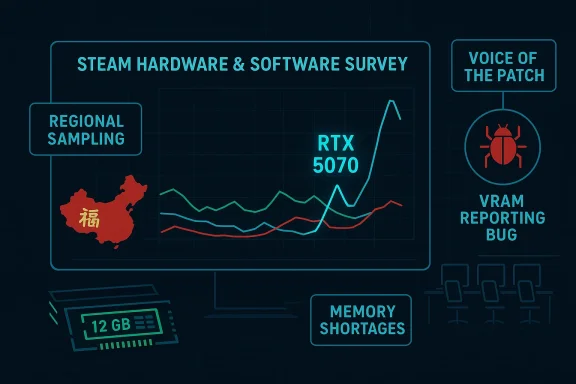
Nvidia’s GeForce RTX 5070 appearing as Steam’s most popular GPU in February 2026 is a headline-grabbing result — but a close read of the numbers, Valve’s recent client patch notes, and the market context shows this “victory” is far from a straightforward product-success story. Behind the banner statistic lie seasonal usage swings in China, known reporting problems in Steam’s survey tooling, and an unusual memory-market environment that has reshaped NVIDIA’s supply calculus — all of which complicate any simple interpretation of Steam’s snapshot. (tomshardware.com)
The Steam Hardware & Software Survey is a monthly, opt-in snapshot of the hardware and software that active Steam clients report. Developers, hardware makers, and analysts use it as a rough barometer for what millions of gamers are running, but the survey is not a census: it samples whoever runs the client and opts in that month, and it has known blind spots. Valve itself quietly shipped a Steam Client Beta update late in February that fixes VRAM misreporting on some systems and changes which adapter is selected for reporting when multiple display devices are present — a fix that could materially alter several survey categories going forward.
Tom’s Hardware reporting of conversations with partners (including Gigabyte’s leadership commentary at trade events) suggests GPU allocation during shortages is shaped by profit per gigabyte considerations: higher-margin SKUs that generate more revenue for each scarce gigabyte of GDDR7 have a better chance of being pushed into production. Gigabyte’s CEO explained that Nvidia and board partners may prioritize SKUs where the gross revenue per GB is higher, which could help explain why some mid‑high SKUs remain available while others are constrained. That dynamic can create regional price and availability variations that in turn influence buying patterns.
In practical terms, expect the following in the months ahead:
Source: Tom's Hardware Nvidia’s RTX 5070 seemingly crushes memory shortages to reign supreme as Steam’s number one GPU — but there are questions about why
 Background
The Steam Hardware & Software Survey is a monthly, opt-in snapshot of the hardware and software that active Steam clients report. Developers, hardware makers, and analysts use it as a rough barometer for what millions of gamers are running, but the survey is not a census: it samples whoever runs the client and opts in that month, and it has known blind spots. Valve itself quietly shipped a Steam Client Beta update late in February that fixes VRAM misreporting on some systems and changes which adapter is selected for reporting when multiple display devices are present — a fix that could materially alter several survey categories going forward.Why the February 2026 results grabbed attention
- Steam’s February snapshot showed an unusually large month-over-month move in GPU share for the RTX 5070, with Tom’s Hardware reporting the card jumped to ~9.42% share and a 6.55-percentage-point monthly increase — a massive swing for a single month on a platform with more than 36 million concurrent users. That scale means even a one-point swing represents hundreds of thousands of individual sessions. (tomshardware.com)
- At the same time, Valve’s survey registered a dramatic jump in users reporting Simplified Chinese as their client language and a big rise in systems reporting 32GB of system RAM, even while the industry is suffering from a severe memory shortage. The co-occurrence of these anomalies raised immediate flags among analysts and community observers.
What the Steam numbers actually say — look at the raw categories first
Steam’s public UI layers and charts make it easy to spot big monthly moves. The most load‑bearing figures from February that sparked coverage and debate included:- A large increase in the percentage share attributed to the GeForce RTX 5070 (reported as the top discrete gaming GPU in that month’s survey). (tomshardware.com)
- A jump in Simplified Chinese language users to roughly 54.6% of the sample — a ~30.7-percentage-point increase — and a marked bump coinciding with the Lunar New Year period.
- A reported 18.91% increase in systems showing 32GB of system RAM in the February report, at a time when DRAM and GDDR pricing is under extreme pressure globally.
- A notable decline in Windows 11 share in Steam’s sample for February and a commensurate increase in Windows 10 — surprising, because Microsoft officially ended mainstream support for Windows 10 in October 2025.
Why the RTX 5070’s leap is suspicious (and why skepticism is healthy)
1) Seasonal and regional skews: the Chinese New Year effect
Every year, Steam’s sample shifts during the Lunar New Year because many Chinese players log in more often during the holiday week. February 2026’s report lines up with that cycle: Simplified Chinese declarations spiked and drove a larger proportion of the active-sample toward Chinese gamers, who now represent a very large slice of Steam’s active base in that month. That shift alone will change relative shares for GPUs, operating systems, and RAM configurations if the Chinese sample differs in hardware mix from other regions. Community analysts and Steam forum posts pointed to the same pattern — the country-level surge can move the needle dramatically in a single month.- Why this matters: if a region with a distinct hardware profile (for example, more RTX 5070-equipped internet cafés or deep prebuilt adoption of a particular SKU) becomes a larger slice of the survey, that region’s preferred hardware will look disproportionately popular in the overall numbers.
2) Internet cafés and multi-user terminals amplify duplicates
Chinese internet cafés remain a huge part of local PC gaming culture. Those venues often contain banks of identical high-end systems, and hundreds of distinct players may log into Steam from the same machine over days and weeks. If Steam’s survey counts client instances rather than unique humans, a handful of well-provisioned cafés can multiply a particular GPU’s presence in the dataset. Reports and industry observers have repeatedly warned that such concentration biases can distort Steam’s “popularity” rankings. Valve’s public documentation is not explicit about duplicate mitigation for café versus home usage, so the risk of over-counting remains. Industry discussions and community posts flagged this as a major factor in February’s spike.3) Valve’s VRAM reporting bug and multi-adapter selection logic
Perhaps the single most consequential technical detail is that Valve patched a VRAM reporting bug in late February: Steam’s client sometimes recorded the wrong video-memory figure or picked the wrong adapter (often an integrated GPU) to report. Valve’s fix makes Steam prefer the display adapter with the most VRAM when multiple adapters are present — a sensible change, but one that can retroactively explain oddities in the data (for example, discrete cards being hidden behind an integrated GPU label). Given the fix’s timing — just before the March reporting window — the February dataset may contain distortions in both VRAM distribution and discrete-GPU identification. Valve made the change public in the Steam Client Beta notes; outlets like PC Gamer and multiple community trackers ran the news because the implications are material.- Why this matters: a misreported VRAM value or an integrated-GPU label can make a discrete card appear rarer or more common than it truly is. When you pair that with a sudden regional surge, apparent “tripling” of card share becomes much more plausible as an artifact than as pure market movement.
The market context: memory shortages, GDDR7, and supply strategy
The RTX 5070 sits on a generation that relies on GDDR7 for its video memory. In 2025–26 the industry has experienced acute memory constraints driven by AI hyperscaler demand for DRAM, HBM, and high‑speed GDDR parts. Analysts and trade outlets have documented dramatic DRAM price inflation and constrained contract availability; the memory crisis is not hypothetical — firms like TrendForce and market outlets reported double-digit and occasionally triple-digit price hikes across categories. That shortage reshapes how GPU vendors allocate scarce memory and which SKUs they prioritize.Tom’s Hardware reporting of conversations with partners (including Gigabyte’s leadership commentary at trade events) suggests GPU allocation during shortages is shaped by profit per gigabyte considerations: higher-margin SKUs that generate more revenue for each scarce gigabyte of GDDR7 have a better chance of being pushed into production. Gigabyte’s CEO explained that Nvidia and board partners may prioritize SKUs where the gross revenue per GB is higher, which could help explain why some mid‑high SKUs remain available while others are constrained. That dynamic can create regional price and availability variations that in turn influence buying patterns.
- Why this matters: if the RTX 5070 was easier to source (relative to other models) in a major market like China or became a preferred configuration for café operators or OEMs, its install base could have increased independently of a broad consumer buying frenzy.
Technical reality check: what the RTX 5070 actually is
To avoid conflating marketing spin with technical fact, here are the consistent, verifiable specs for the GeForce RTX 5070 as reported by independent hardware databases and tech outlets:- Architecture: NVIDIA Blackwell (GeForce RTX 50-series).
- Memory: 12 GB GDDR7 (typical card configuration) with ~672 GB/s bandwidth (varies by source and exact model).
- Launch MSRP: $549 (street prices and regional retail have varied, and Tom’s Hardware noted MSRP-based comparisons during launch).
Cross-referencing the claims: the independent-evidence approach
Responsible reporting requires triangulating major claims across independent sources. For the February anomaly:- The Steam charts and data (Valve’s survey page) show the raw shifts in language, OS, RAM, and GPU categories. That’s the primary dataset.
- Valve’s own client patch notes confirm a VRAM reporting correction in late February; that change likely affects how cards were attributed in the survey data. Outlets like PC Gamer and community trackers documented the same change.
- Community discussions and archival comparisons to past Lunar New Year windows show a recurring pattern: China’s usage spikes periodically, pushing local hardware preferences into the global sample for one month. Analysts and community threads highlighted this correlation for February 2026.
Possible scenarios that produce the observed outcome
- Scenario A — Genuine surge: RTX 5070 sales/installs surged regionally (OEM systems, prebuilt sales, café upgrades), producing hundreds of thousands of additional active sessions. Memory shortages and pricing dynamics made the 5070 an attractive relative buy in some markets. This would be a real market shift, albeit regionally concentrated.
- Scenario B — Sampling + bug artifact: Chinese New Year increased the share of Chinese sessions, cafés amplified identical-system logins, and Steam’s VRAM/adaptor-selection bug misattributed some GPUs or VRAM totals. The net effect is an inflated headline number for the 5070 that will normalize in subsequent months. Valve’s February client patch supports this scenario.
- Scenario C — Hybrid: A combination of A and B. The RTX 5070 did gain real traction in some markets, but the recorded magnitude in Steam’s global figures is exaggerated by the sampling and reporting issues described above. This is the most plausible reading given the available evidence.
What this means for different stakeholders
For gamers
- Treat single-month Steam survey headlines as interesting signals, not definitive sales figures. Hardware choice decisions should be based on performance, price, and local availability rather than a single Steam chart. If you’re upgrading, check local retail pricing and availability, and consider whether 12 GB of GDDR7 (the most common RTX 5070 fitment) meets your long-term needs for high-res textures and ray tracing.
For reviewers and journalists
- Always triangulate Steam’s monthly changes with other sources (retailer sell-through, OEM announcements, and regional pricing data). When Valve changes client reporting logic — as it did in late February — incorporate that as an explanatory factor in any interpretation.
For NVIDIA and partners
- The memory shortage dynamic favors a nuanced allocation strategy; prioritizing SKUs with better revenue-per-GB can maximize returns, but it also introduces regional availability variance that can feed perception issues (e.g., “this GPU is everywhere” vs. “this GPU is in select markets”). Public explanation from partners about allocation rationale may help reduce confusion.
For Valve/Steam
- The February episode illustrates why transparency about sampling methodology, duplicate mitigation (e.g., internet-café sessions), and how multi-adapter systems are represented matters. Valve’s quick fix for VRAM reporting was the right move, but better public methodology notes and optional filtering (region, venue type) would improve interpretability.
How to read Steam survey numbers responsibly — a short guide
- Look at trendlines, not single months. Month-to-month volatility can be misleading; sustained multi-month changes are far more trustworthy.
- Check for coincident events (holiday periods, regional promotions, price cuts, or client updates) that can change who’s active on Steam.
- Compare Steam’s numbers with retailer/marketplace data and OEM or distributor commentary when claiming “best-selling” or “most popular” in absolute market terms.
- When Valve updates the client or survey logic, treat that as a structural break; results before and after are not strictly comparable without adjustment.
Final analysis and verdict
The headline that the GeForce RTX 5070 “crushed memory shortages to become Steam’s number‑one GPU” is an over-simplification. The card’s specs and price positioning make it a compelling purchase in certain circumstances, and Nvidia/board partners may have prioritized some 50‑series SKUs during tight GDDR7 supply windows — both of which create plausible reasons for localized growth. At the same time, Valve’s own admission about VRAM reporting inaccuracies, a massive regional surge in Chinese Steam activity during Lunar New Year, and the amplifying effect of internet-café usage together provide a strong alternative explanation: the February spike was substantially shaped by sampling and reporting artifacts.In practical terms, expect the following in the months ahead:
- Steam’s March and April reports will be the more instructive comparators; if the RTX 5070 remains near the top without the Chinese New Year bump, that supports a genuine market shift. If it reverts toward previous levels, that suggests the February result was a transient artifact.
- Memory-price and availability trends will continue to drive OEM and board-level allocation decisions; follow contract-price trackers and vendor statements for hard signals of supply normalization.
Takeaway
The Steam snapshot for February 2026 gave a headline that was hard to resist: a $549‑MSRP Blackwell card rising to the top on the world’s largest PC-gaming platform. But the honest story is more complex and more instructive: data without context misleads. The RTX 5070’s moment in the sun is part product strength, part market dynamics, and part instrument noise — and it underlines why analysts, journalists, and gamers should read Steam numbers with caution, corroborate with independent datasets, and pay attention to changes in how the data are collected. Until the next few months of survey data arrive and Valve’s client-wide fixes propagate to the whole user base, the safest conclusion is this: the RTX 5070’s February crown is notable — and not yet definitive. (tomshardware.com)Source: Tom's Hardware Nvidia’s RTX 5070 seemingly crushes memory shortages to reign supreme as Steam’s number one GPU — but there are questions about why
