

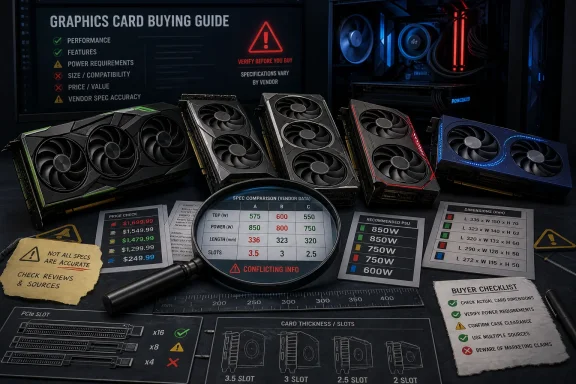
A GPU buying guide published by Propel RC on July 17 mixes valid product specifications with several claims that do not survive a basic check against vendor documentation, including incorrect power requirements, questionable dimensions, and launch-price figures presented as current buying advice.
The guide calls MSI’s RTX 5090 Gaming Trio OC a near-$4,000 card that “requires” a 1,200W PSU. NVIDIA launched the RTX 5090 at $1,999, while MSI’s own specifications for this particular Gaming Trio OC list 575W board power and a recommended 1,000W power supply. Retail pricing can of course vary wildly, especially for flagship cards, but a single inflated figure should not be treated as a universal price or a hardware requirement.
The same issue appears with the RTX 5080 Founders Edition. Propel RC describes it as “expensive at $1700,” despite NVIDIA’s stated $999 starting price. That does not mean buyers will always find one at MSRP, but it is a material distinction for a guide that repeatedly frames its selections around value.
AMD’s RX 9070 XT is correctly identified as a 16GB RDNA 4 card, but its placement and recommendations are still built around broad, unqualified claims rather than comparable test data. AMD lists the reference RX 9070 XT at 304W with a $599 suggested price; board-partner coolers, clock speeds, dimensions and street prices differ substantially.
The guide also claims some motherboards may need a BIOS update to “properly recognize” the card’s PCIe 5.0 interface. PCIe is backward-compatible; a PCIe 5.0 GPU works in a PCIe 4.0 or PCIe 3.0 slot. A board firmware update may be useful for general platform compatibility, but it is not a normal prerequisite for recognizing the graphics card.
That matters because several recommendations turn on precise claims: 4K frame rates, memory temperatures, fan behavior, Linux compute support, connector reliability and game-driver compatibility. Those are not attributes that can be responsibly generalized across every board partner, BIOS revision, operating system build and game patch.
Intel’s Arc B570, for example, is accurately described by Intel as a 10GB GDDR6, 150W card with AV1 encode/decode support, but its real-world game performance depends heavily on the title, driver release and system configuration. The same is true of Resizable BAR, which is important for Arc performance but does not justify treating every older system as unsuitable without qualification.
Windows PC builders should treat the Propel RC list as an affiliate shopping page, not a validated hardware review, and verify the exact model’s dimensions, PSU recommendation, connector requirements and current price before ordering.
 Major specification and pricing problems
The guide calls MSI’s RTX 5090 Gaming Trio OC a near-$4,000 card that “requires” a 1,200W PSU. NVIDIA launched the RTX 5090 at $1,999, while MSI’s own specifications for this particular Gaming Trio OC list 575W board power and a recommended 1,000W power supply. Retail pricing can of course vary wildly, especially for flagship cards, but a single inflated figure should not be treated as a universal price or a hardware requirement.The same issue appears with the RTX 5080 Founders Edition. Propel RC describes it as “expensive at $1700,” despite NVIDIA’s stated $999 starting price. That does not mean buyers will always find one at MSRP, but it is a material distinction for a guide that repeatedly frames its selections around value.
AMD’s RX 9070 XT is correctly identified as a 16GB RDNA 4 card, but its placement and recommendations are still built around broad, unqualified claims rather than comparable test data. AMD lists the reference RX 9070 XT at 304W with a $599 suggested price; board-partner coolers, clock speeds, dimensions and street prices differ substantially.
The “ITX-friendly” claim does not add up
The MSI RTX 5070 Ti Ventus 3X PZ OC entry is the clearest red flag. Propel RC calls the card a compact, ITX-friendly model and says it is “just 15 inches long.” MSI lists it at 11.93 inches long, 4.76 inches wide and 1.93 inches thick. It is an SFF-Ready Enthusiast GeForce card, but that label means prospective buyers must check a compatible case list—not that it will fit a typical Mini-ITX enclosure.The guide also claims some motherboards may need a BIOS update to “properly recognize” the card’s PCIe 5.0 interface. PCIe is backward-compatible; a PCIe 5.0 GPU works in a PCIe 4.0 or PCIe 3.0 slot. A board firmware update may be useful for general platform compatibility, but it is not a normal prerequisite for recognizing the graphics card.
Why the roundup is a poor purchase guide
Propel RC says its team tested 12 cards, yet the article provides no reproducible benchmark suite, game settings, driver versions, test-system configuration, noise measurements, power methodology, or thermal methodology. Instead, it leans heavily on generic verdict language, retailer ratings, affiliate purchase links, and anecdotes about unnamed “users.”That matters because several recommendations turn on precise claims: 4K frame rates, memory temperatures, fan behavior, Linux compute support, connector reliability and game-driver compatibility. Those are not attributes that can be responsibly generalized across every board partner, BIOS revision, operating system build and game patch.
Intel’s Arc B570, for example, is accurately described by Intel as a 10GB GDDR6, 150W card with AV1 encode/decode support, but its real-world game performance depends heavily on the title, driver release and system configuration. The same is true of Resizable BAR, which is important for Arc performance but does not justify treating every older system as unsuitable without qualification.
Windows PC builders should treat the Propel RC list as an affiliate shopping page, not a validated hardware review, and verify the exact model’s dimensions, PSU recommendation, connector requirements and current price before ordering.
References
- Primary source: Propel RC
Published: 2026-07-17T17:52:39+00:00
12 Best Computer Graphics Cards 2026: Complete GPU Guide
Discover the best computer graphics cards with our 2026 guide. We tested 12 GPUs from RTX 5090 to budget Arc B570 for gaming, AI workloads, and value.www.propelrc.com - Related coverage: nvidia.com
NVIDIA GeForce RTX 5090 Graphics Cards
The most powerful GeForce GPU ever made, bringing game-changing capabilities to gamers and creators, powered by the NVIDIA Blackwell architecture.www.nvidia.com - Related coverage: marketplace.nvidia.com
- Related coverage: intel.com
- Related coverage: us-store.msi.com
- Related coverage: investor.nvidia.com
NVIDIA Corporation - NVIDIA Blackwell GeForce RTX 50 Series Opens New World of AI Computer Graphics
Next Generation of GeForce RTX GPUs Deliver Stunning Visual Realism and 2x Performance Increase, Made Possible by AI, Neural Shaders and DLSS 4 LAS VEGAS, Jan. 06, 2025 (GLOBE NEWSWIRE) - CES - NVIDIA today unveiled the most advanced consumer GPUs for gamers, creators and developers — the...investor.nvidia.com