

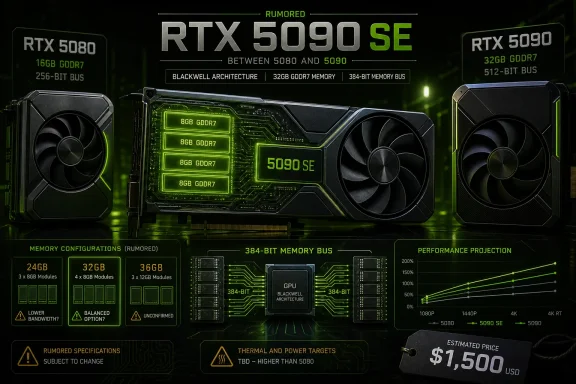
Nvidia is reportedly developing a GeForce RTX 5090 SE built from a cut-down GB202 GPU, with 14,080 CUDA cores, 32GB of GDDR7, a 384-bit memory bus, and 500W board power, positioning it between the RTX 5080 and RTX 5090 at a rumored $1,500 retail price. The product idea is entirely believable: Nvidia has an enormous performance and pricing gulf between its two fastest consumer cards, and a partially disabled flagship processor is an obvious way to fill it. The problem is that the leaked memory configuration does not fit neatly with the physical organization of Blackwell, making the memory specification the credibility test for the entire rumor.
PCMag treats the RTX 5090 SE as a plausible new enthusiast card whose real-world price would probably exceed $2,000. HotHardware reaches a much harsher conclusion, arguing that the proposed combination of 32GB and a 384-bit bus is so awkward that the card, at least as described, is unlikely to exist. Both readings expose something important about Nvidia’s current high-end market: there is ample space for another product, but almost no reason to believe that product would arrive with every attractive number in the rumor intact.
The strongest evidence for an RTX 5090 SE is not the leaked name, CUDA-core count, or purported price. It is the unusually large distance between the RTX 5080 and RTX 5090, a gap wide enough to make an intermediate model commercially logical even before GameGPU’s report appeared.
According to PCMag, the RTX 5090 has been the fastest graphics card on the market since its early-2025 launch. It is around 50 percent faster than the RTX 5080 and carries twice the VRAM, making the two products feel less like neighboring steps in the same family and more like separate classes of hardware.
Their launch prices reflected that separation. The RTX 5080 arrived at $1,000, while the RTX 5090 launched at $2,000. On paper, Nvidia therefore left a clean four-figure interval in which it could place a faster, more capacious card without formally displacing either model.
The actual retail market has made that opening even more conspicuous. PCMag observed RTX 5080 cards selling for roughly $1,400 to $2,000, while RTX 5090 cards were rarely available below $4,000 at the time of its report. That means the nominal $1,000 launch-price difference has become an unpredictable real-world gulf shaped by supply, board-partner premiums, and demand for the fastest available GPU.
GameGPU’s claimed positioning exploits that gulf almost too perfectly. Its RTX 5090 SE would reportedly replace the role that might otherwise have been occupied by a hypothetical RTX 5080 Ti, while delivering more performance than the also-rumored RTX 5080 Super. In other words, the name says “discount flagship,” but the market role says “premium bridge product.”
That distinction matters because Nvidia’s model names are less important than the silicon segmentation behind them. A card based on GB202 but substantially cut down could credibly sit above the RTX 5080 without approaching the full RTX 5090. Calling it a 5090 SE would emphasize its flagship-derived memory capacity and processor lineage; calling the same general concept a 5080 Ti would emphasize its reduced core count and lower performance tier.
From Nvidia’s perspective, either label could turn partially functional GB202 processors into high-value consumer products. Large flagship dies do not need to emerge from manufacturing with every unit enabled to remain commercially useful. A processor with too many inactive regions for a full RTX 5090 may still offer considerably more resources than the GPU used by an RTX 5080.
None of that confirms the rumor. It merely explains why the premise survives first contact with economic reality: Nvidia has a performance gap, a pricing gap, and a flagship processor that can theoretically be segmented into more than one consumer product.
Those numbers describe a card that would be meaningfully faster than the RTX 5080 without threatening the RTX 5090’s compute advantage. It would not be a lightly trimmed flagship. It would be a heavily segmented GB202 product whose value came from combining a large processor, more active resources than an RTX 5080, and a flagship-sized memory allocation.
The GB202 connection itself is plausible. The processor family is already associated with the RTX 5090, the professional RTX Pro 6000, and China-focused products such as the 5090D. Using the same broad silicon foundation for another model would therefore be consistent with Nvidia’s ability to tailor one large design for different markets and constraints.
Power figures in the rumor also fall into a believable range. GameGPU reportedly assigns the RTX 5090 SE a 500W total board power and recommends a 1,000W power supply. That would place the card below the RTX 5090’s rated 575W while still making it one of the most demanding components that could be installed in a conventional desktop PC.
A 75W reduction from the RTX 5090 would broadly match the idea of a processor with substantially fewer active CUDA cores and reduced memory bandwidth. It would not make the card efficient in an ordinary sense, but it could reduce the cooling and electrical burden relative to the flagship.
The recommended 1,000W supply is consequently not an incidental line in the leak. A 500W graphics card leaves only half of that nominal PSU capacity for the processor, motherboard, storage, cooling, transient behavior, and conversion losses. Anyone considering such a system would need to evaluate the quality and connector provisions of the power supply, not simply the number printed on its box.
PCMag also notes that some high-power RTX 5090 designs have been engineered to draw more than 1,000W. Those extreme implementations are not the appropriate baseline for an ordinary workstation or gaming PC, but they illustrate how far board makers can push the platform when power and cooling restrictions are loosened.
The rumored RTX 5090 SE is therefore not undermined by its processor or power figures. A 14,080-core GB202 card operating at 500W is conceptually straightforward. It is the proposed route to 32GB that turns a credible segmentation exercise into a hardware puzzle.
The RTX 5090 uses 32GB of GDDR7 on a 512-bit memory bus, delivering 1.79 TB/s of memory bandwidth. Blackwell’s memory interface is organized around 32-bit channels, so a 512-bit bus provides 16 channels and supports 16 memory chips.
Nvidia reaches the RTX 5090’s 32GB total by using 16 GDDR7 chips, each with a capacity of 16Gb, or 2GB. The arithmetic is clean: 16 channels multiplied by 2GB per chip produces 32GB.
A 384-bit bus changes the available topology. Dividing 384 bits into 32-bit channels yields 12 channels, meaning the proposed RTX 5090 SE would support 12 corresponding GDDR7 chips under the configuration described by HotHardware.
With 2GB chips, 12 channels provide 24GB. With the available 24Gb, or 3GB, chips cited by HotHardware, the same 12-channel interface provides 36GB. Neither uniform arrangement produces the rumored 32GB.
To hit exactly 32GB, Nvidia would have to mix chip densities. HotHardware offers one example: four 2GB chips and eight 3GB chips. That totals 32GB, but it would distribute unequal memory capacities across otherwise parallel channels.
This is not a small bookkeeping discrepancy that can be waved away as an imprecise early leak. The VRAM total, chip density, channel width, and bus width are physically linked. If the 384-bit bus is correct and the card follows the memory organization described in the report, then a uniform-density design points to 24GB or 36GB, not 32GB.
That leaves several possibilities. The product may not exist. The 32GB capacity may be wrong. The 384-bit bus may be wrong. The report may have combined details from different prospective configurations. Or Nvidia may be pursuing an unusual implementation whose complexity has not been captured by the leak.
Only the last possibility preserves every rumored specification simultaneously, and it is also the one HotHardware considers least realistic. The fact that a configuration can be made to add up mathematically does not mean it can be engineered, validated, manufactured, and sold sensibly.
It nevertheless establishes the direction of Nvidia’s engineering priorities. The reasons attributed to the company include consistent performance, price optimization, and engineering simplicity. A mixed-density board would work against all three.
Memory channels are expected to operate in a balanced, predictable fashion. When some channels provide more capacity than others, the GPU must manage address mapping across unequal resources while preserving useful bandwidth and avoiding abrupt performance changes as workloads move into differently arranged regions.
The challenge extends beyond firmware or driver logic. HotHardware points to signal integrity, timing, bandwidth symmetry, printed-circuit-board complexity, and validation. Each is manageable in isolation under the right circumstances, but together they create cost and risk for a consumer card supposedly intended to make flagship-class capacity more accessible.
Validation would be particularly important because the proposed RTX 5090 SE is not merely a gaming device. A 32GB GeForce card would attract local-AI users, 3D artists, video professionals, researchers, and developers whose workloads can fill large amounts of VRAM and remain there for extended periods. Those buyers would be unusually likely to discover edge cases involving memory allocation and sustained bandwidth.
A gaming benchmark could also conceal some of those complications. If a game’s working set stayed within the fastest or most symmetrical region, performance might appear normal. Larger professional or AI workloads could exercise the entire memory pool, making any asymmetry more visible and more consequential.
That would leave Nvidia selling a product whose headline feature—32GB of relatively affordable GDDR7—was also its greatest source of architectural complexity. The company would have to explain how the memory behaves, ensure that software sees and uses it predictably, and prevent the card from developing a reputation for having “good” and “less good” sections of VRAM.
This is why 32GB on a 384-bit bus cannot be treated as an isolated typo-sized detail. It defines the board layout, memory population, bandwidth characteristics, validation burden, and ultimately the credibility of the product’s value proposition.
The resulting backlash was not just about a benchmark number. Buyers believed the stated capacity implied a more uniform resource than they had received. The dispute eventually led to a class-action lawsuit alleging that the specifications were misleading.
The alleged RTX 5090 SE configuration would not automatically reproduce the GTX 970’s exact architecture or behavior. It would be irresponsible to claim otherwise without hardware, documentation, or confirmation from Nvidia. HotHardware’s comparison is best understood as a warning about perception and disclosure rather than proof of identical engineering.
Even so, that history gives Nvidia little incentive to create a consumer card that requires lengthy explanations about why all 32GB is present but not arranged conventionally. At the premium end of the market, technical nuance does not stay confined to architecture diagrams. It becomes a purchasing controversy.
The risk would be amplified by the rumored price. A card at $1,500 would already sit well above mainstream gaming budgets, while PCMag expects the practical price to land north of $2,000 if it launches. Customers spending that much are unlikely to tolerate ambiguity about the organization of the product’s signature feature.
For Nvidia, 24GB would be easier to explain on a 384-bit interface. So would 36GB. The former would clearly distinguish the card from the 32GB RTX 5090, while the latter would give it more capacity than the flagship but lower bandwidth and fewer compute resources. Either choice would create marketing complications, but neither would require mixed-density arithmetic to land on an aesthetically convenient number.
That does not mean Nvidia would choose one of those capacities. It means the leaked 32GB figure may reflect a product-positioning wish—matching the RTX 5090’s capacity—rather than a finalized engineering configuration.
The market described by PCMag is nothing like that spreadsheet. The RTX 5080, despite launching at $1,000, was typically selling between $1,400 and $2,000. The RTX 5090, despite its $2,000 launch price, was rarely found below $4,000.
A $1,500 RTX 5090 SE would therefore collide directly with the prevailing price of the RTX 5080. It would offer around 31 percent more CUDA cores, twice the RTX 5080’s VRAM, a flagship-derived GB202 processor, and a higher performance target for the same money as many existing RTX 5080 listings.
That would be extremely attractive to buyers and deeply disruptive to Nvidia’s own product stack. It could make sense as a nominal starting price designed to create a clean lineup, but availability would determine whether the figure had practical meaning.
PCMag’s expectation of a price north of $2,000 is consequently more grounded in observed retail conditions. Even at that level, the card could look compelling next to RTX 5090 listings near twice the price, particularly for workloads that need 32GB but do not need the flagship’s full compute throughput or 1.79 TB/s of bandwidth.
The rumored card would appeal to two overlapping audiences. Enthusiast gamers would see a route toward performance above the RTX 5080 without paying the market price of an RTX 5090. AI and content-creation users would focus on the possibility of getting 32GB of VRAM in a less expensive package.
That second audience could exert substantial pressure on availability. Capacity often matters more than peak gaming performance when a workload must fit in GPU memory. A slower 32GB card can be more useful than a faster 16GB card if the latter cannot hold the required model, scene, dataset, or media pipeline without compromises.
This is why the RTX 5090 SE rumor is so effective. It combines the compute uplift enthusiasts want, the memory capacity professionals want, and the price relief both groups want. Each element makes commercial sense separately; their simultaneous appearance at $1,500 is what makes the package look engineered for attention rather than retail reality.
A recommended 1,000W power supply should be treated as a starting specification rather than a blanket guarantee. PSU quality, available connectors, sustained output, transient handling, and the demands of the rest of the workstation all matter. A high-end CPU, multiple storage devices, extensive cooling, and peripheral expansion reduce available headroom.
Thermal planning is equally important. Even if the RTX 5090 SE consumes 75W less than the rated RTX 5090, 500W remains an extraordinary amount of heat to remove from a desktop enclosure. A case that performs adequately with an RTX 5080 may not maintain the same component temperatures, acoustics, or fan behavior after such an upgrade.
The 32GB capacity would also change how the card is evaluated. Gaming performance would remain important, but buyers should expect tests covering local AI, rendering, video production, large textures, and other memory-intensive workloads. The narrower bus means the RTX 5090 SE would have lower bandwidth than the RTX 5090 even if both cards genuinely carried 32GB.
Capacity and bandwidth answer different questions. Capacity determines whether a workload fits; bandwidth helps determine how quickly the processor can move data once it is there. Matching the RTX 5090’s VRAM total would not make the SE equivalent to the flagship for memory-heavy work.
Windows driver behavior would deserve scrutiny as well if Nvidia used any unconventional memory arrangement. Reviewers would need to test full-memory utilization rather than relying solely on applications that occupy only part of the advertised capacity. System builders and IT departments should also avoid assuming that a product name guarantees identical software behavior to the RTX 5090.
In short, the card could be valuable precisely because it is not a normal gaming upgrade. But that also means conventional launch-day frame-rate charts would be insufficient to validate it.
Their disagreement concerns how much weight to place on internal coherence. PCMag emphasizes the obvious market opportunity and treats the report as a plausible indication that Nvidia is preparing another high-end card, while warning that its likely street price would exceed the rumored $1,500.
HotHardware treats the memory arithmetic as disqualifying. If one prominent specification conflicts with the straightforward chip configurations available on a 384-bit bus, the outlet argues, the safer conclusion is that the reported card will not happen.
The most defensible interpretation lies between those positions. There is no official Nvidia confirmation in the supplied reporting, so the RTX 5090 SE remains a rumor. HotHardware has identified a concrete technical reason to distrust the specification set, but that does not prove Nvidia has no intermediate GB202 product under consideration.
Leaks routinely capture plans in motion. A model name may survive while its memory capacity changes. A bus width may belong to a different prototype. A price may be an internal target rather than an achievable retail figure. Multiple configurations may be discussed before one is selected—or before the product is canceled.
The better conclusion is therefore narrower than “the RTX 5090 SE is real” and more nuanced than “Nvidia will never release such a card.” Nvidia has a compelling reason to introduce something between the RTX 5080 and RTX 5090. The specific 32GB, 384-bit, $1,500 configuration is the part that should not be accepted without much stronger evidence.
That distinction protects buyers from two common failures of rumor coverage. The first is treating a plausible product category as confirmation of a specific product. The second is treating a flawed specification leak as proof that the underlying market idea cannot exist in another form.
The company would then need to resolve the memory question. A different capacity, a different bus width, or an otherwise revised memory subsystem would eliminate the central objection raised by HotHardware. Any such change could materially affect the card’s appeal to AI and professional users, even if gaming performance remained strong.
Pricing could change just as dramatically. A launch figure near $1,500 would make sense as a lineup marker but appears difficult to reconcile with the retail observations in PCMag’s report. A price above $2,000 would be less sensational yet still leave considerable room below scarce RTX 5090 cards selling near $4,000.
The name is similarly uncertain in practical terms. GameGPU describes the product as replacing the role of a hypothetical RTX 5080 Ti, but Nvidia could choose whichever branding best protects its existing products. “RTX 5090 SE” signals access to the flagship family; “RTX 5080 Ti” would set more conservative expectations about performance and memory.
For buyers, the label should be the least important part. What matters is how much GB202 compute remains enabled, how the VRAM is physically arranged, what sustained bandwidth is available, how much power the board consumes, and whether the street price reflects the advertised tier.
The current rumor gives precise answers to all of those questions, but precision is not the same as reliability. In this case, one of the most precise claims is also the one that creates the strongest reason for doubt.
PCMag treats the RTX 5090 SE as a plausible new enthusiast card whose real-world price would probably exceed $2,000. HotHardware reaches a much harsher conclusion, arguing that the proposed combination of 32GB and a 384-bit bus is so awkward that the card, at least as described, is unlikely to exist. Both readings expose something important about Nvidia’s current high-end market: there is ample space for another product, but almost no reason to believe that product would arrive with every attractive number in the rumor intact.
 Nvidia Has Left a Product-Sized Hole Below the RTX 5090
The strongest evidence for an RTX 5090 SE is not the leaked name, CUDA-core count, or purported price. It is the unusually large distance between the RTX 5080 and RTX 5090, a gap wide enough to make an intermediate model commercially logical even before GameGPU’s report appeared.According to PCMag, the RTX 5090 has been the fastest graphics card on the market since its early-2025 launch. It is around 50 percent faster than the RTX 5080 and carries twice the VRAM, making the two products feel less like neighboring steps in the same family and more like separate classes of hardware.
Their launch prices reflected that separation. The RTX 5080 arrived at $1,000, while the RTX 5090 launched at $2,000. On paper, Nvidia therefore left a clean four-figure interval in which it could place a faster, more capacious card without formally displacing either model.
The actual retail market has made that opening even more conspicuous. PCMag observed RTX 5080 cards selling for roughly $1,400 to $2,000, while RTX 5090 cards were rarely available below $4,000 at the time of its report. That means the nominal $1,000 launch-price difference has become an unpredictable real-world gulf shaped by supply, board-partner premiums, and demand for the fastest available GPU.
GameGPU’s claimed positioning exploits that gulf almost too perfectly. Its RTX 5090 SE would reportedly replace the role that might otherwise have been occupied by a hypothetical RTX 5080 Ti, while delivering more performance than the also-rumored RTX 5080 Super. In other words, the name says “discount flagship,” but the market role says “premium bridge product.”
That distinction matters because Nvidia’s model names are less important than the silicon segmentation behind them. A card based on GB202 but substantially cut down could credibly sit above the RTX 5080 without approaching the full RTX 5090. Calling it a 5090 SE would emphasize its flagship-derived memory capacity and processor lineage; calling the same general concept a 5080 Ti would emphasize its reduced core count and lower performance tier.
From Nvidia’s perspective, either label could turn partially functional GB202 processors into high-value consumer products. Large flagship dies do not need to emerge from manufacturing with every unit enabled to remain commercially useful. A processor with too many inactive regions for a full RTX 5090 may still offer considerably more resources than the GPU used by an RTX 5080.
None of that confirms the rumor. It merely explains why the premise survives first contact with economic reality: Nvidia has a performance gap, a pricing gap, and a flagship processor that can theoretically be segmented into more than one consumer product.
The Rumored Core Configuration Is Aggressive but Coherent
The alleged RTX 5090 SE would reportedly use a partially deactivated GB202 processor with 14,080 CUDA cores. That is around 31 percent more than the RTX 5080, according to PCMag’s comparison, but approximately one-third fewer than the full RTX 5090’s 21,760 CUDA cores.Those numbers describe a card that would be meaningfully faster than the RTX 5080 without threatening the RTX 5090’s compute advantage. It would not be a lightly trimmed flagship. It would be a heavily segmented GB202 product whose value came from combining a large processor, more active resources than an RTX 5080, and a flagship-sized memory allocation.
The GB202 connection itself is plausible. The processor family is already associated with the RTX 5090, the professional RTX Pro 6000, and China-focused products such as the 5090D. Using the same broad silicon foundation for another model would therefore be consistent with Nvidia’s ability to tailor one large design for different markets and constraints.
Power figures in the rumor also fall into a believable range. GameGPU reportedly assigns the RTX 5090 SE a 500W total board power and recommends a 1,000W power supply. That would place the card below the RTX 5090’s rated 575W while still making it one of the most demanding components that could be installed in a conventional desktop PC.
A 75W reduction from the RTX 5090 would broadly match the idea of a processor with substantially fewer active CUDA cores and reduced memory bandwidth. It would not make the card efficient in an ordinary sense, but it could reduce the cooling and electrical burden relative to the flagship.
The recommended 1,000W supply is consequently not an incidental line in the leak. A 500W graphics card leaves only half of that nominal PSU capacity for the processor, motherboard, storage, cooling, transient behavior, and conversion losses. Anyone considering such a system would need to evaluate the quality and connector provisions of the power supply, not simply the number printed on its box.
PCMag also notes that some high-power RTX 5090 designs have been engineered to draw more than 1,000W. Those extreme implementations are not the appropriate baseline for an ordinary workstation or gaming PC, but they illustrate how far board makers can push the platform when power and cooling restrictions are loosened.
The rumored RTX 5090 SE is therefore not undermined by its processor or power figures. A 14,080-core GB202 card operating at 500W is conceptually straightforward. It is the proposed route to 32GB that turns a credible segmentation exercise into a hardware puzzle.
| Specification | RTX 5080 | Rumored RTX 5090 SE | RTX 5090 |
|---|---|---|---|
| Market position | Existing upper-tier card | Between RTX 5080 and RTX 5090 | Existing flagship |
| CUDA-core relationship | Baseline | Around 31% more than RTX 5080 | 21,760; roughly one-third more than the rumored SE |
| GDDR7 capacity | Half the RTX 5090 capacity | 32GB | 32GB |
| Memory bus | Not specified in the reports | 384-bit | 512-bit |
| Power and price | $1,000 launch price | 500W; rumored $1,500 | 575W; $2,000 launch price |
Thirty-Two Gigabytes Is Where the Arithmetic Breaks
HotHardware’s rejection of the rumor rests on the physical relationship between memory channels, chip capacities, and total VRAM. Its conclusion is blunt: “But it’s not happening, folks.” The outlet acknowledges the danger of speaking in absolutes, but argues that the leaked configuration is implausible enough to justify doing so.The RTX 5090 uses 32GB of GDDR7 on a 512-bit memory bus, delivering 1.79 TB/s of memory bandwidth. Blackwell’s memory interface is organized around 32-bit channels, so a 512-bit bus provides 16 channels and supports 16 memory chips.
Nvidia reaches the RTX 5090’s 32GB total by using 16 GDDR7 chips, each with a capacity of 16Gb, or 2GB. The arithmetic is clean: 16 channels multiplied by 2GB per chip produces 32GB.
A 384-bit bus changes the available topology. Dividing 384 bits into 32-bit channels yields 12 channels, meaning the proposed RTX 5090 SE would support 12 corresponding GDDR7 chips under the configuration described by HotHardware.
With 2GB chips, 12 channels provide 24GB. With the available 24Gb, or 3GB, chips cited by HotHardware, the same 12-channel interface provides 36GB. Neither uniform arrangement produces the rumored 32GB.
To hit exactly 32GB, Nvidia would have to mix chip densities. HotHardware offers one example: four 2GB chips and eight 3GB chips. That totals 32GB, but it would distribute unequal memory capacities across otherwise parallel channels.
This is not a small bookkeeping discrepancy that can be waved away as an imprecise early leak. The VRAM total, chip density, channel width, and bus width are physically linked. If the 384-bit bus is correct and the card follows the memory organization described in the report, then a uniform-density design points to 24GB or 36GB, not 32GB.
That leaves several possibilities. The product may not exist. The 32GB capacity may be wrong. The 384-bit bus may be wrong. The report may have combined details from different prospective configurations. Or Nvidia may be pursuing an unusual implementation whose complexity has not been captured by the leak.
Only the last possibility preserves every rumored specification simultaneously, and it is also the one HotHardware considers least realistic. The fact that a configuration can be made to add up mathematically does not mean it can be engineered, validated, manufactured, and sold sensibly.
Mixed-Density Memory Would Create More Problems Than It Solves
HotHardware says Nvidia has previously stated that mixing memory densities is not possible in its designs, although that statement concerned the GeForce RTX 40 series rather than Blackwell. The generational qualification is essential: a design constraint or policy discussed for one architecture does not automatically prove what can or cannot be built with its successor.It nevertheless establishes the direction of Nvidia’s engineering priorities. The reasons attributed to the company include consistent performance, price optimization, and engineering simplicity. A mixed-density board would work against all three.
Memory channels are expected to operate in a balanced, predictable fashion. When some channels provide more capacity than others, the GPU must manage address mapping across unequal resources while preserving useful bandwidth and avoiding abrupt performance changes as workloads move into differently arranged regions.
The challenge extends beyond firmware or driver logic. HotHardware points to signal integrity, timing, bandwidth symmetry, printed-circuit-board complexity, and validation. Each is manageable in isolation under the right circumstances, but together they create cost and risk for a consumer card supposedly intended to make flagship-class capacity more accessible.
Validation would be particularly important because the proposed RTX 5090 SE is not merely a gaming device. A 32GB GeForce card would attract local-AI users, 3D artists, video professionals, researchers, and developers whose workloads can fill large amounts of VRAM and remain there for extended periods. Those buyers would be unusually likely to discover edge cases involving memory allocation and sustained bandwidth.
A gaming benchmark could also conceal some of those complications. If a game’s working set stayed within the fastest or most symmetrical region, performance might appear normal. Larger professional or AI workloads could exercise the entire memory pool, making any asymmetry more visible and more consequential.
That would leave Nvidia selling a product whose headline feature—32GB of relatively affordable GDDR7—was also its greatest source of architectural complexity. The company would have to explain how the memory behaves, ensure that software sees and uses it predictably, and prevent the card from developing a reputation for having “good” and “less good” sections of VRAM.
This is why 32GB on a 384-bit bus cannot be treated as an isolated typo-sized detail. It defines the board layout, memory population, bandwidth characteristics, validation burden, and ultimately the credibility of the product’s value proposition.
The GTX 970 Still Shadows Any Uneven Memory Design
HotHardware invokes the GeForce GTX 970 because Nvidia has already experienced the reputational cost of selling a graphics card whose advertised memory capacity concealed materially different behavior within the pool. Released in 2014, the GTX 970 divided its memory into a fast 3.5GB region and a slower 0.5GB spillover segment.The resulting backlash was not just about a benchmark number. Buyers believed the stated capacity implied a more uniform resource than they had received. The dispute eventually led to a class-action lawsuit alleging that the specifications were misleading.
The alleged RTX 5090 SE configuration would not automatically reproduce the GTX 970’s exact architecture or behavior. It would be irresponsible to claim otherwise without hardware, documentation, or confirmation from Nvidia. HotHardware’s comparison is best understood as a warning about perception and disclosure rather than proof of identical engineering.
Even so, that history gives Nvidia little incentive to create a consumer card that requires lengthy explanations about why all 32GB is present but not arranged conventionally. At the premium end of the market, technical nuance does not stay confined to architecture diagrams. It becomes a purchasing controversy.
The risk would be amplified by the rumored price. A card at $1,500 would already sit well above mainstream gaming budgets, while PCMag expects the practical price to land north of $2,000 if it launches. Customers spending that much are unlikely to tolerate ambiguity about the organization of the product’s signature feature.
For Nvidia, 24GB would be easier to explain on a 384-bit interface. So would 36GB. The former would clearly distinguish the card from the 32GB RTX 5090, while the latter would give it more capacity than the flagship but lower bandwidth and fewer compute resources. Either choice would create marketing complications, but neither would require mixed-density arithmetic to land on an aesthetically convenient number.
That does not mean Nvidia would choose one of those capacities. It means the leaked 32GB figure may reflect a product-positioning wish—matching the RTX 5090’s capacity—rather than a finalized engineering configuration.
The Alleged $1,500 Price Is the Least Believable Number After the VRAM
GameGPU reportedly assigns the RTX 5090 SE a $1,500 retail price. In a launch-price spreadsheet, that is beautifully symmetrical: $500 above the RTX 5080 and $500 below the RTX 5090.The market described by PCMag is nothing like that spreadsheet. The RTX 5080, despite launching at $1,000, was typically selling between $1,400 and $2,000. The RTX 5090, despite its $2,000 launch price, was rarely found below $4,000.
A $1,500 RTX 5090 SE would therefore collide directly with the prevailing price of the RTX 5080. It would offer around 31 percent more CUDA cores, twice the RTX 5080’s VRAM, a flagship-derived GB202 processor, and a higher performance target for the same money as many existing RTX 5080 listings.
That would be extremely attractive to buyers and deeply disruptive to Nvidia’s own product stack. It could make sense as a nominal starting price designed to create a clean lineup, but availability would determine whether the figure had practical meaning.
PCMag’s expectation of a price north of $2,000 is consequently more grounded in observed retail conditions. Even at that level, the card could look compelling next to RTX 5090 listings near twice the price, particularly for workloads that need 32GB but do not need the flagship’s full compute throughput or 1.79 TB/s of bandwidth.
The rumored card would appeal to two overlapping audiences. Enthusiast gamers would see a route toward performance above the RTX 5080 without paying the market price of an RTX 5090. AI and content-creation users would focus on the possibility of getting 32GB of VRAM in a less expensive package.
That second audience could exert substantial pressure on availability. Capacity often matters more than peak gaming performance when a workload must fit in GPU memory. A slower 32GB card can be more useful than a faster 16GB card if the latter cannot hold the required model, scene, dataset, or media pipeline without compromises.
This is why the RTX 5090 SE rumor is so effective. It combines the compute uplift enthusiasts want, the memory capacity professionals want, and the price relief both groups want. Each element makes commercial sense separately; their simultaneous appearance at $1,500 is what makes the package look engineered for attention rather than retail reality.
Windows Users Would Be Buying a Platform, Not Just a GPU
For Windows users, a 500W graphics card is a system-level purchase. The card would affect power provisioning, case airflow, cooling, physical clearance, cabling, motherboard layout, and potentially the selection of the processor and chassis around it.A recommended 1,000W power supply should be treated as a starting specification rather than a blanket guarantee. PSU quality, available connectors, sustained output, transient handling, and the demands of the rest of the workstation all matter. A high-end CPU, multiple storage devices, extensive cooling, and peripheral expansion reduce available headroom.
Thermal planning is equally important. Even if the RTX 5090 SE consumes 75W less than the rated RTX 5090, 500W remains an extraordinary amount of heat to remove from a desktop enclosure. A case that performs adequately with an RTX 5080 may not maintain the same component temperatures, acoustics, or fan behavior after such an upgrade.
The 32GB capacity would also change how the card is evaluated. Gaming performance would remain important, but buyers should expect tests covering local AI, rendering, video production, large textures, and other memory-intensive workloads. The narrower bus means the RTX 5090 SE would have lower bandwidth than the RTX 5090 even if both cards genuinely carried 32GB.
Capacity and bandwidth answer different questions. Capacity determines whether a workload fits; bandwidth helps determine how quickly the processor can move data once it is there. Matching the RTX 5090’s VRAM total would not make the SE equivalent to the flagship for memory-heavy work.
Windows driver behavior would deserve scrutiny as well if Nvidia used any unconventional memory arrangement. Reviewers would need to test full-memory utilization rather than relying solely on applications that occupy only part of the advertised capacity. System builders and IT departments should also avoid assuming that a product name guarantees identical software behavior to the RTX 5090.
In short, the card could be valuable precisely because it is not a normal gaming upgrade. But that also means conventional launch-day frame-rate charts would be insufficient to validate it.
Action checklist for admins
- Do not write the RTX 5090 SE into procurement plans until Nvidia publishes an official product page and complete specifications.
- Verify the final VRAM capacity, memory-bus width, and bandwidth rather than relying on the reported model name.
- Require independent testing that allocates and exercises the full memory pool.
- Audit PSU capacity, connector support, case clearance, cooling, and circuit requirements before approving workstation upgrades.
- Compare workload fit and sustained application performance, not only gaming benchmarks or CUDA-core counts.
- Treat any $1,500 price as provisional until cards are available through normal retail or authorized system channels.
The Disagreement Is Really About Which Part of the Leak to Trust
PCMag and HotHardware are not working from fundamentally different descriptions of the rumored product. Both trace the core claim to GameGPU: a cut-down GB202 card with 14,080 CUDA cores, 32GB of GDDR7, a 384-bit bus, and a position between the RTX 5080 and RTX 5090.Their disagreement concerns how much weight to place on internal coherence. PCMag emphasizes the obvious market opportunity and treats the report as a plausible indication that Nvidia is preparing another high-end card, while warning that its likely street price would exceed the rumored $1,500.
HotHardware treats the memory arithmetic as disqualifying. If one prominent specification conflicts with the straightforward chip configurations available on a 384-bit bus, the outlet argues, the safer conclusion is that the reported card will not happen.
The most defensible interpretation lies between those positions. There is no official Nvidia confirmation in the supplied reporting, so the RTX 5090 SE remains a rumor. HotHardware has identified a concrete technical reason to distrust the specification set, but that does not prove Nvidia has no intermediate GB202 product under consideration.
Leaks routinely capture plans in motion. A model name may survive while its memory capacity changes. A bus width may belong to a different prototype. A price may be an internal target rather than an achievable retail figure. Multiple configurations may be discussed before one is selected—or before the product is canceled.
The better conclusion is therefore narrower than “the RTX 5090 SE is real” and more nuanced than “Nvidia will never release such a card.” Nvidia has a compelling reason to introduce something between the RTX 5080 and RTX 5090. The specific 32GB, 384-bit, $1,500 configuration is the part that should not be accepted without much stronger evidence.
That distinction protects buyers from two common failures of rumor coverage. The first is treating a plausible product category as confirmation of a specific product. The second is treating a flawed specification leak as proof that the underlying market idea cannot exist in another form.
A Real Intermediate Card May Look Less Generous
If Nvidia does release an intermediate GB202 model, the final product may preserve the least controversial parts of the rumor: the cut-down processor, 14,080 activated CUDA cores, a power target below the RTX 5090, and performance above the RTX 5080.The company would then need to resolve the memory question. A different capacity, a different bus width, or an otherwise revised memory subsystem would eliminate the central objection raised by HotHardware. Any such change could materially affect the card’s appeal to AI and professional users, even if gaming performance remained strong.
Pricing could change just as dramatically. A launch figure near $1,500 would make sense as a lineup marker but appears difficult to reconcile with the retail observations in PCMag’s report. A price above $2,000 would be less sensational yet still leave considerable room below scarce RTX 5090 cards selling near $4,000.
The name is similarly uncertain in practical terms. GameGPU describes the product as replacing the role of a hypothetical RTX 5080 Ti, but Nvidia could choose whichever branding best protects its existing products. “RTX 5090 SE” signals access to the flagship family; “RTX 5080 Ti” would set more conservative expectations about performance and memory.
For buyers, the label should be the least important part. What matters is how much GB202 compute remains enabled, how the VRAM is physically arranged, what sustained bandwidth is available, how much power the board consumes, and whether the street price reflects the advertised tier.
The current rumor gives precise answers to all of those questions, but precision is not the same as reliability. In this case, one of the most precise claims is also the one that creates the strongest reason for doubt.
What to Believe Before the Benchmarks Arrive
The RTX 5090 SE story is best treated as evidence of pressure within Nvidia’s lineup, not evidence that a finished retail card has been fully described. The market wants a product in this space, and Nvidia has plausible silicon with which to build one, but the reported memory topology remains unresolved.- A cut-down GB202 card between the RTX 5080 and RTX 5090 is commercially plausible.
- The rumored 14,080 CUDA cores would place it around 31 percent above the RTX 5080 but well below the RTX 5090.
- A 500W board-power target and 1,000W PSU recommendation are believable for that class of hardware.
- A uniform 384-bit configuration naturally produces 24GB with 2GB chips or 36GB with 3GB chips—not 32GB.
- The rumored $1,500 price conflicts with a market where RTX 5080 cards were already selling in that territory.
- Buyers and IT departments should not plan around this card until Nvidia confirms the memory design, price, and availability.
References
- Primary source: PCMag
Published: Fri, 10 Jul 2026 15:19:07 GMT
Nvidia Reportedly Prepping RTX 5090 SE Graphics Card That's Better Than a 5080 | PCMag
Nvidia may see some value in bridging the gap between the RTX 5090 and 5080.www.pcmag.com - Independent coverage: HotHardware
Published: Fri, 10 Jul 2026 14:38:00 GMT
Is NVIDIA Releasing A Cheaper GeForce RTX 5090 SE? Don't Get Your Hopes Up | HotHardware
Reports of a GeForce RTX 5090 SE with 32GB of VRAM and a 384-bit bus are circulating, but the math doesn't work. Here is why the rumor is almost certainly false.hothardware.com
- Related coverage: nvidia.com
NVIDIA GeForce RTX 5090 Graphics Cards
The most powerful GeForce GPU ever made, bringing game-changing capabilities to gamers and creators, powered by the NVIDIA Blackwell architecture.www.nvidia.com - Related coverage: marketplace.nvidia.com
- Related coverage: en.gamegpu.com
Future NVIDIA models: GPU RTX 50XX series will retain the same memory capacities
Recent rumors from insider Kopite7kimi indicate that the upcoming NVIDIA GeForce RTX 50XX series graphics cards, according toen.gamegpu.com
- Related coverage: images.nvidia.com
</rdf:Alt> </dc:title> <dc:description> <rdf:Alt> <rdf:li xml:lang="x-default"/> </rdf:Alt> </dc:description> <dc:creator> <rdf:Seq> <rdf:li>Nick St
</rdf:Alt> </dc:description> <dc:creator> <rdf:Seq> <rdf:li>Nick Stamimages.nvidia.com
- Related coverage: tech4gamers.com
NVIDIA GeForce RTX 5090 SE: A Middle Ground Between RTX 5080 And RTX 5090
NVIDIA is preparing to launch GeForce RTX 5090 SE to sit between the GeForce RTX 5080 and the flagship GeForce RTX 5090. tech4gamers.com
- Related coverage: blogs.nvidia.com
New NVIDIA Broadcast AI Features Now Streaming | NVIDIA Blog
GeForce RTX 5090 and 5080 GPUs are out now, DaVinci Resolve and Wondershare Filmora add 50 Series features, plus download the January Studio Driver.blogs.nvidia.com - Related coverage: pcgamer.com
I really hope you weren't considering a GPU upgrade this year, as Nvidia may raise the price of the already pricey RTX 5090 by as much as $300 | PC Gamer
Memory is proving an expensive problem.www.pcgamer.com - Related coverage: tomshardware.com
Nvidia RTX 5090D V2 limits AI performance even more with 25% less VRAM and bandwidth — downgraded gaming flagship keeps same $2,299 MSRP in China | Tom's Hardware
When version 2 isn't better than the originalwww.tomshardware.com - Related coverage: windowscentral.com
RTX 5090 vanishes from U.S. stores | Windows Central
It feels like the original RTX 5090 launch all over again.www.windowscentral.com - Related coverage: tomsguide.com
Nvidia RTX 50 SUPER GPU rumors: Everything we know so far | Tom's Guide
Nvidia GeForce RTX 50 SUPER GPUs are expected to be in the works, bringing more video memory to the latest graphics cards, including the RTX 5080, RTX 5070 Ti and RTX 5070. Here's what we know.www.tomsguide.com - Related coverage: techpowerup.com
Making sure you're not a bot!
Well, damn: Seems like I'm missing a few as well. Are we sure it's not a bug? I mean my scores in 3dmark seem to be in line, now it's OCed so its even better. Maybe the spec in the database is wrong? Oh well that would explain it. I went and checked the reviews on the...www.techpowerup.com - Related coverage: fr.gamegpu.com
GeForce RTX 5090
La sortie prévue de la nouvelle architecture Blackwell de NVIDIA en 2024 place le fleuron potentiel d'une nouvelle plate-forme au premier plan.fr.gamegpu.com