

Rubrik’s new Agent Cloud integration with Microsoft Copilot Studio marks a pragmatic extension of resilience-first security into the fast-growing world of AI agents, pairing discovery, governance and selective rollback for agent-driven actions with Microsoft’s enterprise agent platform — a move that tightens control over the new operational surface created by Copilot Studio while underscoring Rubrik’s positioning at the intersection of data protection, cyber resilience and enterprise AI.
AI agents — autonomous or semi-autonomous software components that can read, decide and act across systems — have moved from research curiosities to enterprise tools with real write-back capabilities in weeks rather than years. Microsoft’s Copilot Studio is a central pillar in that shift: it provides a low-code/full-code authoring surface, model-routing and runtime controls that let organizations build agents that connect to SharePoint, OneDrive, Dataverse and third‑party systems, and to assign agents first‑class identities in Entra for lifecycle governance.
Rubrik’s announcement expands its Agent Cloud to interoperate with Copilot Studio, offering three core capabilities — Agent Monitor, Agent Govern and Agent Remediate — intended to discover agents across tenant surfaces, enforce runtime and access controls, and selectively roll back agent-driven changes when they are undesired or harmful. The vendor positions the combination as “beyond observability,” enabling organizations to undo agent actions without downtime. Rubrik’s product materials emphasize discovery across leading agent builders including Microsoft Copilot Studio, OpenAI and Amazon Bedrock. This feature arrives against a backdrop of rapid analyst attention and investor interest in Rubrik: the company has posted strong top-line expansion and healthy gross margins yet remains unprofitable on a GAAP basis, a mix that invites both bullish growth narratives and valuation scrutiny. Financial trackers show ~47.7% revenue growth year‑over‑year and gross margins near 78% on a trailing‑twelve‑month basis; liquidity metrics such as a current ratio around 1.82 and an LTM net loss near $444 million frame a company that is scaling ARR while still investing heavily. The market is watching closely as Rubrik prepares to report earnings after the close on December 4, 2025.
Source: Investing.com Rubrik to integrate agent cloud with Microsoft Copilot Studio By Investing.com
 Background / Overview
AI agents — autonomous or semi-autonomous software components that can read, decide and act across systems — have moved from research curiosities to enterprise tools with real write-back capabilities in weeks rather than years. Microsoft’s Copilot Studio is a central pillar in that shift: it provides a low-code/full-code authoring surface, model-routing and runtime controls that let organizations build agents that connect to SharePoint, OneDrive, Dataverse and third‑party systems, and to assign agents first‑class identities in Entra for lifecycle governance.Rubrik’s announcement expands its Agent Cloud to interoperate with Copilot Studio, offering three core capabilities — Agent Monitor, Agent Govern and Agent Remediate — intended to discover agents across tenant surfaces, enforce runtime and access controls, and selectively roll back agent-driven changes when they are undesired or harmful. The vendor positions the combination as “beyond observability,” enabling organizations to undo agent actions without downtime. Rubrik’s product materials emphasize discovery across leading agent builders including Microsoft Copilot Studio, OpenAI and Amazon Bedrock. This feature arrives against a backdrop of rapid analyst attention and investor interest in Rubrik: the company has posted strong top-line expansion and healthy gross margins yet remains unprofitable on a GAAP basis, a mix that invites both bullish growth narratives and valuation scrutiny. Financial trackers show ~47.7% revenue growth year‑over‑year and gross margins near 78% on a trailing‑twelve‑month basis; liquidity metrics such as a current ratio around 1.82 and an LTM net loss near $444 million frame a company that is scaling ARR while still investing heavily. The market is watching closely as Rubrik prepares to report earnings after the close on December 4, 2025.
What Rubrik announced: the integration, capabilities and availability
The core value proposition
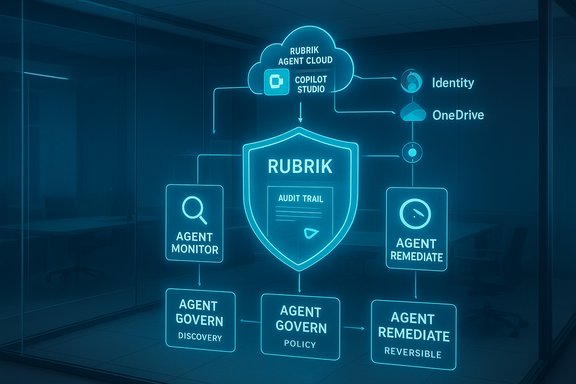
Rubrik presented the integration as a way to let enterprises treat AI agents as first‑class operational assets — discoverable, auditable, policy‑governed and, crucially, reversible when an agent makes a mistake or acts maliciously. The three named capabilities are:- Agent Monitor — auto‑discovery and continuous monitoring of agents across clouds and SaaS surfaces, maintaining immutable audit trails that combine data, identity and application context.
- Agent Govern — real‑time enforcement of agent behavior and access policies, tying agents into identity systems for least‑privilege and lifecycle controls.
- Agent Remediate — precise, selective rollback (Rubrik brands parts of this work as Agent Rewind or Agent Remediate) that integrates with Rubrik Security Cloud to reverse unwanted changes without system downtime or data loss. Rubrik notes this capability was first announced as a concept earlier in 2025 and is being folded into the Agent Cloud story.
Integration specifics with Microsoft Copilot Studio
Rubrik says the integration will automatically discover agents built or published through Microsoft Copilot Studio and across Microsoft 365 artifacts such as SharePoint and OneDrive, and that it will surface agent activity and data access in an aggregated control plane. This interoperability is designed to work with the agent identity constructs Microsoft has introduced (Entra Agent IDs, agent catalogs and Agent 365 governance constructs), which makes Rubrik’s job — mapping agent actions to users, identities and data footprints — technically tractable. Rubrik’s messaging emphasizes context: rollback decisions are not blind snapshots but are informed by identity and application context so that selective rollback can avoid collateral damage. The vendor also warns that not all features are immediately available and that the product is initially in limited early access. That “limited availability” note is material: enterprises evaluating the integration must verify feature parity, support and SLAs for their particular tenant scenarios before operationalizing rollback at scale.Availability and product maturity
The Agent Cloud for Microsoft Copilot Studio is being offered as limited early access to select customers, and Rubrik’s press material includes the standard safe‑harbor caveat that unreleased features and timelines may change. In practice this means immediate adopters should expect staged rollouts, early limitations and the need for careful pilot engineering. Rubrik is showcasing the integration at Microsoft Ignite 2025, signaling a public product debut and partner‑driven co‑selling push.Why this matters for enterprises running Copilot Studio
Agent proliferation is already a governance problem
Microsoft’s Copilot Studio and the wider agent ecosystem (Azure AI Foundry, Agent Service, Model Context Protocol) explicitly make it easier for business units and citizen makers to create agents that read tenant data, call APIs and perform write operations — generating “agent sprawl” risk. Microsoft’s own product direction moves agent management toward tenant‑level identity and registry constructs that make governance possible, but a complementary control plane that includes recovery is still rare. Rubrik’s pitch is to fill that gap by combining discovery + policies + immutable recovery.Practical benefits
- Rapid discovery of existing and shadow agents reduces the blind spots that allow a misconfigured agent to exfiltrate or corrupt data.
- Real‑time enforcement of least‑privilege policies helps prevent agents from accumulating excessive permissions over time.
- Selective rollback (when it works as advertised) converts a high‑impact, high‑velocity event (an agent error or abuse) into a contained remediation exercise rather than a multi‑day crisis.
Technical and operational analysis
How discovery and mapping will likely work
Rubrik’s Agent Monitor claims to map agent activity by correlating:- Agent identities and registrations from Entra / Copilot Studio,
- Data and object accesses in Microsoft 365 (SharePoint, OneDrive, mailboxes),
- Tool and service calls to model runtimes and external connectors.
The rollback challenge: selective vs. total rewind
There are two technical models to rollback:- Full snapshot rewind — revert a machine, mailbox or drive to a point‑in‑time snapshot. This is reliable but heavy: it typically causes downtime or data loss for other actors.
- Selective, context‑aware rollback — surgically undo the specific files, list items or identity changes made by the agent while preserving unrelated activity.
- Recovering object‑level changes across multi‑tenant SaaS stores (like SharePoint lists, Dataverse rows, or Teams messages) requires precise change tracking and a robust mapping from agent‑action logs to data deltas.
- Interleaved human and agent activity in the same object increases the risk of collateral inconsistency if rollbacks are applied without proper conflict resolution.
- The latency between detection and rollback matters; the longer an unwanted change remains live, the higher the probability of downstream processes depending on that changed state.
Integrations and standards: MCP, Agent IDs and telemetry
Microsoft’s Model Context Protocol (MCP) and the Agent 365 governance constructs make third‑party integration more straightforward than older, ad‑hoc agent ecosystems. Rubrik’s integration relies on these emerging standards and Microsoft identity primitives to map agents to actions. That reduces brittle connector code but also ties Rubrik’s agent visibility to Microsoft’s telemetry platform and the maturity of that telemetry. In short: this is an integration that benefits from Microsoft’s control plane coherence but inherits its limitations.Business implications and market context
Rubrik’s strategic posture: security plus AI operations
Rubrik has been repositioning from backup vendor toward a “Security and AI Operations” company, investing heavily in cyber resilience, identity recovery and agentic AI capabilities. The Agent Cloud is consistent with that frame — it’s both a defensive product (reducing agent risk) and an operational offering for teams scaling agent fleets. The company’s recent strategic collaboration with AWS to integrate its Preemptive Recovery Engine into AWS environments is another sign of cross‑cloud positioning.Financial signals and analyst sentiment
Market and sell‑side activity has been notable: multiple analyst firms have initiated or adjusted coverage in recent weeks, with price targets spread into the $97–$130 range and fresh Buy/Outperform initiations from firms including Berenberg and Mizuho; Oppenheimer started coverage with a Perform view. Meanwhile, leading data aggregators show Rubrik delivering ~47.7% revenue growth on a trailing basis and a strong gross margin (~78%), alongside an LTM net loss of roughly $444M and a current ratio near 1.82. Those figures support a growth‑at‑scale story but also underline ongoing investment intensity and the company’s path to profitability being still a multi‑quarter task.What investors and customers should watch
- Product availability and SLAs: early‑access status means enterprises should require clear timelines and proof points before relying on the rollback capabilities in production.
- Integration fidelity: confirm that the Rubrik integration can map agent actions across the specific Microsoft 365 artifacts in use (e.g., Dataverse, SharePoint Online, Teams) and test conflict scenarios.
- Performance and scale: test rollback speed and correctness under real workloads; “selective rollback” claims should be validated with concurrency and data‑integrity tests.
- Licensing and cost: determine whether the new capability is bundled with existing security or backup contracts or sold as a separate premium SKU; agent monitoring and remediation at scale has potential FinOps implications.
Strengths and notable positive points
- Operational completeness: Rubrik is addressing the full agent lifecycle — discovery, governance and remediation — rather than stopping at observability alone. That end‑to‑end scope appeals to IT and security teams that need actionable controls.
- Resilience‑first angle: pairing rollback with immutable backups and identity context minimizes the typical dilemma of “detect vs. recover” by providing an integrated recovery mechanism.
- Platform interoperability: supporting Copilot Studio, OpenAI builders and Amazon Bedrock positions Rubrik to be useful in multi‑model, multi‑cloud enterprise stacks rather than being Microsoft‑exclusive.
- Market momentum: strong ARR growth and high gross margins give Rubrik both the credibility and the cash runway to invest in product expansion and partnership programs.
Risks, caveats and open questions
- Early access, not GA: many features are labeled limited or early access; customers should not assume full functionality or general availability timelines. Rubrik’s safe‑harbor language expressly warns that unreleased services may change.
- Complex rollback semantics: selective undo across SaaS objects, distributed apps and interleaved human/agent workflows is technically difficult; incomplete rollback semantics risk introducing data inconsistency. Independent validation and integration testing are essential.
- Dependence on platform telemetry: the integration’s depth and accuracy depend on Microsoft’s agent telemetry, identity plumbing and audit signals; any gaps in Microsoft telemetry will constrain Rubrik’s coverage.
- Cost and licensing ambiguity: agent consumption and data protection both have cost vectors — Copilot credits on Microsoft’s side and protective service SKUs on Rubrik’s side — which may complicate TCO and chargeback models for finance teams.
- Valuation sensitivity: the company’s strong growth metrics coexist with unprofitability; analyst views vary and the stock is sensitive to execution beats or misses around ARR and margin improvement. Investors must reconcile growth expectations with the path to positive operating leverage.
Practical guidance for IT, security and procurement teams
- Start with a focused pilot: choose two or three high‑value, low‑risk agent use cases (document triage, email routing, HR automation in non‑production) to validate discovery, monitoring and rollback workflows.
- Verify identity and policy mapping: require proof that agents are surfaced as directory objects and that access reviews and conditional access flows can be applied programmatically to agent IDs.
- Test rollback end‑to‑end: simulate agent misbehavior and measure RTO, data consistency, and user impact. Validate rollback across SharePoint/OneDrive items, Dataverse rows and any target SaaS APIs.
- FinOps & licensing review: obtain a clear price and consumption model for both Rubrik Agent Cloud features and any Microsoft Copilot/Credits implications; model costs under expected agent run rates.
- Add agents to standard incident playbooks: agents must be included in security incident response, tabletop exercises and runbooks; designate agent owners and lifecycle stewards.
How this fits into a broader vendor and platform landscape
Microsoft’s agent strategy — Copilot Studio, Azure AI Foundry, Agent 365 governance constructs and the Model Context Protocol — is designed to scale agent adoption while making governance tractable. The emergence of third‑party products like Rubrik’s Agent Cloud and security vendors offering inline prevention or telemetry enrichment reflects a common pattern: platform vendors create the surface and primitives; ecosystem vendors provide hardened controls, recovery and deep compliance features that enterprises demand. The result is an increasingly composable stack where enterprises must validate both platform primitives and third‑party assurances before trusting agent-enabled automation with mission‑critical tasks.Conclusion
Rubrik’s integration of Agent Cloud with Microsoft Copilot Studio is a timely and strategically coherent response to the operational risks of agentic AI. By combining discovery, real‑time governance and the promise of selective rollback, Rubrik addresses a real pain point in enterprise deployments: how to get the productivity benefits of agents without accepting a proportionate increase in blast radius or recovery complexity. The technical and operational value depends on execution — particularly the maturity of selective rollback and the fidelity of cross‑platform telemetry — and enterprises should treat the offering as a compelling pilot candidate rather than a turnkey cure until general availability and independent validation are achieved. From a market perspective, Rubrik’s product moves sit squarely in the sweet spot of current buyer priorities: data resilience, identity protection and safe AI adoption. The company’s recent AWS collaboration and favorable analyst attention reinforce that narrative, yet the financial profile — rapid ARR growth and strong gross margins coupled with continuing GAAP losses — means stakeholders must balance optimism about product leadership with realism about execution risk and valuation. Enterprises piloting Copilot Studio should factor visibility, policy enforcement and rollback into their agent readiness playbooks today; Rubrik’s Agent Cloud offers one pragmatic path to meeting those requirements, but careful, stage‑gated validation will determine whether the product delivers on the high operational promise it lays out.Source: Investing.com Rubrik to integrate agent cloud with Microsoft Copilot Studio By Investing.com
