

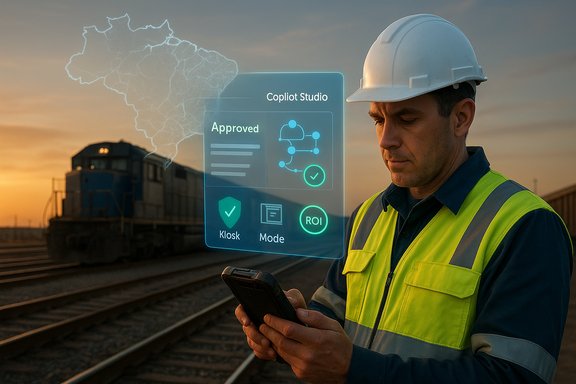
Microsoft and Rumo say a new Copilot-powered mobile app has slashed the average time it takes a Brazilian train driver to find an operational procedure from roughly four minutes to just three seconds—saving weight in operators’ backpacks, eliminating millions of printed pages, and delivering what Microsoft frames as measurable ROI in under two months.
For decades, frontline transport crews have relied on paper procedures and radio calls to resolve operational questions—an approach that is slow, brittle, and hard to govern. Rumo, Brazil’s largest freight rail operator, manages an extensive network that spans roughly 13,000–14,000 kilometers of track and runs thousands of locomotives and freight cars across multiple states. Independent industry reporting and regulatory filings confirm the scale of Rumo’s freight network and asset base, making this an operationally large and complex environment. Rumo’s customer-story brief from Microsoft describes a focused modernization effort: an AI agent named RUTI Maquinista built with Microsoft Copilot Studio, grounded on SharePoint content and Azure-hosted models, and secured using Microsoft Entra ID, kiosk access, two-factor authentication, and containerized knowledge boundaries. Microsoft reports outcomes that include a response-time reduction from four minutes to three seconds, elimination of about 4 kg of printed manuals per driver, 1.3 million pages saved annually, 7,644 hours freed per year, and ROI within two months. This article dissects that announcement for WindowsForum readers: what Rumo actually built, what technical ingredients make it possible, why the numbers matter, where independent corroboration exists (and where it doesn’t), and the operational and governance risks every IT leader should evaluate before trying to replicate the approach.
Source: Microsoft Microsoft AI cuts Rumo’s frontline response time from 4 minutes to just 3 seconds | Microsoft Customer Stories
 Background
For decades, frontline transport crews have relied on paper procedures and radio calls to resolve operational questions—an approach that is slow, brittle, and hard to govern. Rumo, Brazil’s largest freight rail operator, manages an extensive network that spans roughly 13,000–14,000 kilometers of track and runs thousands of locomotives and freight cars across multiple states. Independent industry reporting and regulatory filings confirm the scale of Rumo’s freight network and asset base, making this an operationally large and complex environment. Rumo’s customer-story brief from Microsoft describes a focused modernization effort: an AI agent named RUTI Maquinista built with Microsoft Copilot Studio, grounded on SharePoint content and Azure-hosted models, and secured using Microsoft Entra ID, kiosk access, two-factor authentication, and containerized knowledge boundaries. Microsoft reports outcomes that include a response-time reduction from four minutes to three seconds, elimination of about 4 kg of printed manuals per driver, 1.3 million pages saved annually, 7,644 hours freed per year, and ROI within two months. This article dissects that announcement for WindowsForum readers: what Rumo actually built, what technical ingredients make it possible, why the numbers matter, where independent corroboration exists (and where it doesn’t), and the operational and governance risks every IT leader should evaluate before trying to replicate the approach.Overview of the RUTI Maquinista deployment
What Rumo says they built
- An AI-powered frontline assistant (RUTI Maquinista) available on company mobile devices that answers procedural questions in natural language.
- A knowledge base hosted in SharePoint and curated by Rumo’s regulatory team so that the agent only answers from approved, auditable content.
- Model hosting and inference using Azure OpenAI (Foundry models in Microsoft parlance) with Copilot Studio used to assemble and publish the agent.
- Role-based access via Microsoft Entra ID, a locked kiosk experience on devices, two-factor authentication, and a containerized knowledge scope to prevent exposure of unrelated corporate data.
Why those choices matter
- Using SharePoint as the authoritative document store gives the team a single content control point and supports existing Microsoft 365 governance and retention policies.
- Enforcing identity via Entra ID and kiosk mode reduces the attack surface for device-level compromise.
- Using Copilot Studio as the agent orchestration layer simplifies the no-code/low-code composition of intent handlers and connectors for frontline scenarios.
The numbers: what’s claimed and what’s verifiable
Rumo and Microsoft’s customer story carries several headline metrics:- Response-time drop: from ~4 minutes to ~3 seconds when operators query procedures.
- Paper reduction: ~4 kg of printed manuals eliminated per driver; 1.3 million pages saved annually.
- Productivity impact: 7,644 hours recovered per year and over 50% adoption during the initial phase.
- ROI: Achieved in under two months, per the Microsoft case write-up.
Why the response-time claim matters operationally
When a train must stop or slow because of a procedural doubt, the operational impact cascades: schedule disruption, cascading delays across long-distance services, resource reallocation, and safety trade-offs. Reducing the time it takes for a driver to get a validated answer can therefore produce outsized benefits:- Safety: faster access to the latest procedure mitigates the risk of incorrect manual actions during critical windows.
- Throughput: fewer unscheduled stops and quicker problem resolution improve network utilization.
- Human factors: lighter physical loads and immediate answers reduce fatigue and decision latency.
Technical anatomy: how this is likely implemented
Rumo’s public description names Copilot Studio, SharePoint, Azure OpenAI (Foundry models), and Entra ID. A practical implementation will typically include:- Content ingestion pipeline:
- Curated documents and procedures published into SharePoint.
- Metadata and versioning to ensure the agent always references the latest regulatory text.
- Retrieval and grounding:
- A vector indexing layer (embedding store) created from SharePoint content for retrieval-augmented generation (RAG).
- Relevance thresholds and citation plumbing so the agent returns a precise excerpt or pointer rather than hallucinated summaries.
- Model hosting and orchestration:
- Azure OpenAI models running in a managed environment, invoked through Copilot Studio agent definitions.
- Confidence scoring and provenance attachments to responses.
- Security and device controls:
- Microsoft Entra ID for device and user authentication.
- Kiosk mode, device management (MDM), and app containers to limit lateral data movement and offline caching.
- Audit logging of agent interactions and versioned snapshots of the knowledge base.
- Operational governance:
- A regulatory team that curates and approves knowledge updates.
- Human-in-the-loop review processes for responses used in critical decisions.
Strengths and notable achievements
- Rapid frontline access to validated knowledge. The Microsoft case describes a near-instant retrieval experience that clearly reduces cognitive and operational friction for drivers. High initial adoption suggests the UX and device choice matched operator needs.
- Tangible sustainability gains. Replacing paper manuals with a digital, single-source knowledge base naturally reduces printing logistics and environmental footprint—1.3 million pages saved annually is plausible at Rumo’s scale.
- Strong identity and device controls. Using Entra ID, kiosk mode, and two-factor authentication reflects an appropriate defense-in-depth posture for an enforcement-limited frontline device.
- Fast business case. The claim of ROI in under two months indicates low per-user implementation cost relative to the scale of printed-material savings and time-saved metrics; rapid ROI is common in targeted document-retrieval use cases when printing, logistics, and operator time are considered. Comparative studies of Copilot pilots show similar short-term wins on routine administrative tasks.
Risks, caveats, and governance blind spots
The promise of AI‑assisted frontline decisioning is compelling, but there are concrete risks to consider before adopting a similar approach:- Hallucination and incorrect outputs. Large language models can confidently present incorrect or ambiguous answers. In a rail-safety context, even low-frequency hallucinations require robust mitigation: conservative confidence thresholds, automatic routing to human supervisors for ambiguous queries, and prominent provenance on every response. The Microsoft case emphasizes grounding on SharePoint, but the presence of rigorous confidence gating and fallback flows is not specified publicly.
- Measurement and attribution. Vendor-reported metrics (response time, hours saved, ROI) are useful but should be validated by independent measurement. IT teams should instrument pre/post baselines (same route, same time windows) and produce matched samples to avoid optimistic attribution. Industry commentary on Copilot pilots repeatedly urges disciplined measurement frameworks.
- Connectivity and offline resilience. Trains often traverse low- or zero‑connectivity regions. A cloud-dependent agent must have clearly defined offline modes, cached authoritative excerpts for critical procedures, and a safe fallback behavior when connectivity is absent or intermittent. The case study doesn’t fully describe offline strategies; this is a material operational requirement.
- Data residency, logging, and auditability. Regulators and insurers may demand auditable trails proving which version of a procedure was cited at decision time, who approved the update, and whether the operator saw the same content. Implementations must maintain immutable logs and retention policies that satisfy legal and safety audits.
- Scope creep and over-automation. What starts as a document-retrieval assistant can creep toward prescriptive automation (e.g., recommending speed changes or triggering control actions). Any step beyond informational assistance raises certification, liability, and insurance questions—and requires formal safety engineering processes akin to those used in OT (operational technology) control systems. Industry guidance recommends human-in-the-loop (HITL) gates for any action with physical consequences.
- Vendor concentration. A full Microsoft-first stack simplifies integration but concentrates supply‑chain, compliance, and business risks with one vendor. Organisations should plan for exportability of knowledge bases and contingency migration paths.
Practical checklist for WindowsForum readers and IT leaders
If your organisation is considering a similar frontline Copilot deployment, use this checklist as a pragmatic starting point:- Define the scope narrowly: begin with read-only procedural lookups and administrative tasks before moving to advisory or prescriptive scenarios.
- Establish a single, auditable content source (SharePoint or equivalent), with versioning and a named regulatory owner for each document.
- Design for offline: ensure critical procedure excerpts are cached securely on-device with tamper detection and expiration windows when connectivity is absent.
- Implement provenance and confidence UI elements: always show the source document and a confidence score; allow one‑click escalation to a human supervisor.
- Require multi-factor authentication and MDM-enforced kiosk mode on frontline devices.
- Instrument pre/post metrics for time-to-answer, stop/delay minutes, and adverse events; use matched sampling.
- Build a robust logging and retention policy for regulatory auditability.
- Run a staged pilot with HITL gating and safety sign-off before moving to large‑scale rollout.
- Negotiate contractual audit and explainability rights with the platform provider.
- Train operators on when not to rely solely on the assistant—preserve core skills and decision-making discipline.
Cost and ROI realities
The Microsoft case indicates fast payback driven by print-logistics savings and recovered operator time. For most organisations evaluating similar projects, the financial model should include:- One-time costs: development/configuration in Copilot Studio, Azure OpenAI model usage, MDM configuration, device provisioning, and content migration.
- Recurring costs: model inference (Azure tokens), Copilot/Copilot Studio licensing, device connectivity, and content governance staffing.
- Hard benefits: printing/logistics savings, measurable reduction in unscheduled stops, and operator time recovered.
- Soft benefits: improved operator confidence, reduced error-risk, and sustainability wins.
Security and compliance: hardened recommendations
- Use private endpoints and VNet integration for any on-premises connectors; avoid sending sensitive PII to public endpoints without contractual and technical protections.
- Enforce least-privilege connector access and an MCP (Model Context Protocol) registry or equivalent to control back-end endpoints callable by agents.
- Maintain immutable audit trails for each agent invocation (inputs, model responses, cited documents, timestamps, and user overrides).
- Retain snapshots of the knowledge base at the time of each interaction for post‑hoc verification.
- Conduct threat modeling with OT and ICS teams where any agent output can influence operations.
- Produce an AI safety case for any use case that touches safety or physical control, and obtain appropriate sign-offs from safety engineering and legal teams.
What to watch next
- Product evolution: Copilot Studio and related Microsoft agent tooling are evolving quickly; new governance, observability, and offline capabilities can materially affect adoption calculus.
- Regulatory scrutiny: transport regulators and insurers will increasingly demand auditable behavior and safety justification for AI-assisted operational decisions.
- Independent verification: as vendors publish success stories, independent audits or neutral third‑party benchmarks will provide better clarity on replicability of headline numbers.
- Edge resilience: solutions that combine local inference for critical procedures with cloud-based enrichment for non-critical lookups will become best practice for low-connectivity frontline scenarios.
Conclusion
Rumo’s Copilot-powered RUTI Maquinista is a clear example of how modern AI agents can transform frontline operations—reducing the friction of information access, cutting tangible paper waste, and delivering faster decision support to crews across a large national rail network. The Microsoft customer story provides a detailed, optimistic picture of both the technical architecture and the operational benefits. At the same time, the most consequential claims—especially the dramatic four‑minute-to‑three‑second improvement—are currently documented primarily in the vendor/case study narrative and should be interpreted alongside disciplined, independent measurement. Core risks—model hallucination, offline resilience, regulatory auditability, and scope creep into operational control—are real and require mature governance, engineering rigor, and human‑in‑the‑loop safeguards before the technology touches higher‑risk actions. For IT leaders in transport and other frontline industries, Rumo’s story is both inspiration and a checklist: the opportunity to accelerate decisions at the edge is real, but doing it safely calls for careful content curation, strong identity and device controls, measurable pilots, and a relentless focus on auditability and offline behavior. The technology can deliver very fast answers—what matters now is ensuring those answers are always the right ones.Source: Microsoft Microsoft AI cuts Rumo’s frontline response time from 4 minutes to just 3 seconds | Microsoft Customer Stories
