

AMD’s Ryzen 7 7700X3D has arrived as the lowest-cost eight-core X3D processor on AM5, pairing 96MB of L3 cache with Zen 4 at a suggested U.S. price of $329. The practical appeal is straightforward: it delivers nearly the gaming performance of the Ryzen 7 7800X3D while running at lower clocks, potentially leaving more of a new-build budget for a graphics card, DDR5 memory, and storage.
The catch is that this is a value proposition dictated almost entirely by street pricing. Reviews published alongside the July 16 launch agree that the Ryzen 7 7700X3D is effectively a lower-clocked 7800X3D, but they disagree on whether its launch price creates enough separation from existing AM5 alternatives. For Windows gamers building a PC rather than upgrading an existing AM4 machine, that distinction matters more than AMD’s product positioning.
Digital Foundry’s testing calls the 7700X3D a new default AM5 gaming choice at $329, while Tom’s Hardware argues that the nearby pricing of the faster 7800X3D and cheaper six-core 7600X3D makes the new chip awkward at its recommended price. Both conclusions can be true: this is a capable processor, but it needs the right discount to become the obvious purchase.
AMD lists the Ryzen 7 7700X3D as an eight-core, 16-thread Ryzen 7000-series processor for Socket AM5. It carries the same 96MB of L3 cache as the Ryzen 7 7800X3D, plus 8MB of L2 cache, and retains a 120W TDP. It also supports the same broad AM5 chipset range, from entry-level A620 through B650, B850, X670 and X870 boards.
The differences are clock speeds. The 7700X3D has a 4.0GHz base clock and boost frequency of up to 4.5GHz, versus 4.2GHz and 5.0GHz for the 7800X3D. AMD has not created a new gaming architecture here; it has introduced a lower-bin version of a familiar Zen 4 X3D design.
That makes its performance behavior unusually predictable. Digital Foundry, using Windows 11 25H2 and an RTX 4090 test system, found the 7700X3D generally delivered 95 to 98 percent of the 7800X3D’s gaming result across its CPU-bound test suite. In content-creation benchmarks, where cache is less able to compensate for reduced clocks, the chip landed closer to 92 to 94 percent of the 7800X3D.
For a gaming-only desktop, those are modest losses. At 1440p or 4K, where even powerful GPUs increasingly become the limiting factor, the gap may be smaller still. At 1080p with a high-end GPU, simulation-heavy games, esports titles, or a high-refresh-rate monitor, the lost clock speed will be more visible.
Digital Foundry judged the U.S. pricing reasonable when the 7800X3D sits at roughly $349. Under that condition, buyers must decide whether a small premium is worth a few percentage points of additional performance. The publication’s conclusion was simple: pay up to around five percent more for the 7800X3D; otherwise, the 7700X3D is the sensible alternative.
Tom’s Hardware took a harsher view, noting that the Ryzen 5 7600X3D can offer closely comparable average gaming performance for much less, while the 7800X3D remains close enough in price to justify stepping up. Its recommendation was that the 7700X3D becomes compelling only around $250 to $280, a range that better reflects its role as a cut-down part arriving three years after the 7800X3D.
That disagreement is not about benchmarks. It is about a component market where a CPU should never be evaluated in isolation. A $30 saving is not trivial, but on a new AM5 platform it can disappear immediately if the buyer has to pay more for DDR5 memory, a motherboard, or a cooler.
The chip also launched amid confusing retailer conditions. Neowin reported that Newegg held an exclusive arrangement for sales in the U.S. and Canada, although AMD’s own product page lists the processor’s regional availability as global. That does not necessarily mean the processor will remain locked to a single retailer, but it reinforces the need to compare complete bundles and real checkout prices rather than rely on a launch-day MSRP.
Digital Foundry’s Cinebench and HandBrake figures place it below the 7800X3D and well behind processors designed for sustained productivity throughput. TweakTown reached the same conclusion after testing Blender, HandBrake, compression, and gaming workloads: the 7700X3D’s standout trait is efficiency, not workstation output.
That efficiency is meaningful for compact Windows gaming systems. TweakTown measured about 77W under a Cinebench loop and a peak temperature of 73 degrees Celsius in its test environment, suggesting the chip does not require an expensive 360mm liquid cooler or a premium motherboard VRM design. It should be at home in a well-configured B650 or B850 build with a competent air cooler.
That combination—strong gaming performance, modest cooling demands, and AM5 compatibility—may matter most to system builders assembling a quiet small-form-factor PC. Digital Foundry has already placed the chip in a compact SteamOS gaming machine alongside a Radeon RX 9070 XT, but the same hardware profile makes sense for a Windows 11 living-room system or a conventional desktop that spends most of its time in games.
The Linux angle is not a warning sign, either. Phoronix reported no compatibility issues in its Linux testing on Ubuntu 26.04 LTS and Linux 7.0, which is unsurprising for a mature Zen 4 and AM5 design. For Windows users, the more important point is that there is no new platform complexity: this is standard AM5 hardware, subject to the usual BIOS update and chipset-driver housekeeping.
That is the familiar X3D upgrade dilemma. The older AM4 flagship remains highly capable, especially when paired with a GPU appropriate to the monitor resolution. Moving to the 7700X3D is not simply a CPU replacement; it normally means a new motherboard and DDR5 memory as well. The platform cost makes more sense for a fresh system than for a functioning 5800X3D gaming PC.
For owners of older six-core Ryzen systems or early Intel platforms, the calculation changes. The 7700X3D offers a clean route into AM5, PCIe 5.0-capable boards, DDR5, and an upgrade path that AMD continues to support across current chipset generations. But buyers should not mistake that platform longevity for a reason to accept a poor CPU price.
The Ryzen 7 7700X3D is a good gaming processor waiting for a better market position. If it remains meaningfully cheaper than the 7800X3D, it is an easy recommendation for a gaming-led AM5 build. If the faster chip is only $20 to $30 more, or if a 7600X3D bundle saves substantially more, AMD’s newest X3D part becomes the option to watch rather than the one to buy immediately.
The catch is that this is a value proposition dictated almost entirely by street pricing. Reviews published alongside the July 16 launch agree that the Ryzen 7 7700X3D is effectively a lower-clocked 7800X3D, but they disagree on whether its launch price creates enough separation from existing AM5 alternatives. For Windows gamers building a PC rather than upgrading an existing AM4 machine, that distinction matters more than AMD’s product positioning.
Digital Foundry’s testing calls the 7700X3D a new default AM5 gaming choice at $329, while Tom’s Hardware argues that the nearby pricing of the faster 7800X3D and cheaper six-core 7600X3D makes the new chip awkward at its recommended price. Both conclusions can be true: this is a capable processor, but it needs the right discount to become the obvious purchase.
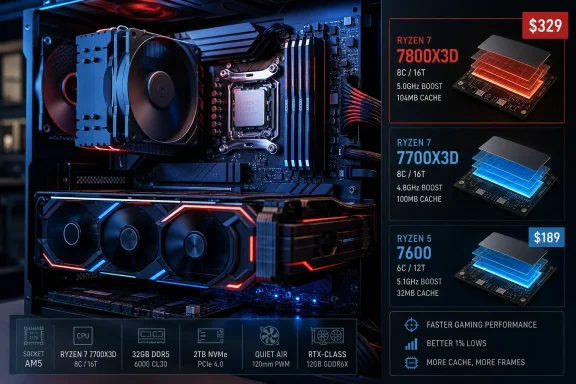 A 7800X3D With Its Clocks Turned Down
AMD lists the Ryzen 7 7700X3D as an eight-core, 16-thread Ryzen 7000-series processor for Socket AM5. It carries the same 96MB of L3 cache as the Ryzen 7 7800X3D, plus 8MB of L2 cache, and retains a 120W TDP. It also supports the same broad AM5 chipset range, from entry-level A620 through B650, B850, X670 and X870 boards.The differences are clock speeds. The 7700X3D has a 4.0GHz base clock and boost frequency of up to 4.5GHz, versus 4.2GHz and 5.0GHz for the 7800X3D. AMD has not created a new gaming architecture here; it has introduced a lower-bin version of a familiar Zen 4 X3D design.
That makes its performance behavior unusually predictable. Digital Foundry, using Windows 11 25H2 and an RTX 4090 test system, found the 7700X3D generally delivered 95 to 98 percent of the 7800X3D’s gaming result across its CPU-bound test suite. In content-creation benchmarks, where cache is less able to compensate for reduced clocks, the chip landed closer to 92 to 94 percent of the 7800X3D.
For a gaming-only desktop, those are modest losses. At 1440p or 4K, where even powerful GPUs increasingly become the limiting factor, the gap may be smaller still. At 1080p with a high-end GPU, simulation-heavy games, esports titles, or a high-refresh-rate monitor, the lost clock speed will be more visible.
The Price Is the Product Story
The Ryzen 7 7700X3D’s recommended price is $329, compared with the 7800X3D’s original $449 launch price. But original MSRP is not the comparison that matters in a mature platform. The 7800X3D has been available for far less than its launch price, and its real-world cost fluctuates enough to undermine AMD’s carefully placed $20 suggested-price gap.Digital Foundry judged the U.S. pricing reasonable when the 7800X3D sits at roughly $349. Under that condition, buyers must decide whether a small premium is worth a few percentage points of additional performance. The publication’s conclusion was simple: pay up to around five percent more for the 7800X3D; otherwise, the 7700X3D is the sensible alternative.
Tom’s Hardware took a harsher view, noting that the Ryzen 5 7600X3D can offer closely comparable average gaming performance for much less, while the 7800X3D remains close enough in price to justify stepping up. Its recommendation was that the 7700X3D becomes compelling only around $250 to $280, a range that better reflects its role as a cut-down part arriving three years after the 7800X3D.
That disagreement is not about benchmarks. It is about a component market where a CPU should never be evaluated in isolation. A $30 saving is not trivial, but on a new AM5 platform it can disappear immediately if the buyer has to pay more for DDR5 memory, a motherboard, or a cooler.
The chip also launched amid confusing retailer conditions. Neowin reported that Newegg held an exclusive arrangement for sales in the U.S. and Canada, although AMD’s own product page lists the processor’s regional availability as global. That does not necessarily mean the processor will remain locked to a single retailer, but it reinforces the need to compare complete bundles and real checkout prices rather than rely on a launch-day MSRP.
Gaming First, Productivity Second
The Ryzen 7 7700X3D is not intended to be a universal-purpose CPU. Its relatively low boost clock puts it behind newer Zen 5 processors and competing higher-core-count Intel parts in heavily threaded work such as rendering, video encoding, compilation, and demanding multitasking.Digital Foundry’s Cinebench and HandBrake figures place it below the 7800X3D and well behind processors designed for sustained productivity throughput. TweakTown reached the same conclusion after testing Blender, HandBrake, compression, and gaming workloads: the 7700X3D’s standout trait is efficiency, not workstation output.
That efficiency is meaningful for compact Windows gaming systems. TweakTown measured about 77W under a Cinebench loop and a peak temperature of 73 degrees Celsius in its test environment, suggesting the chip does not require an expensive 360mm liquid cooler or a premium motherboard VRM design. It should be at home in a well-configured B650 or B850 build with a competent air cooler.
That combination—strong gaming performance, modest cooling demands, and AM5 compatibility—may matter most to system builders assembling a quiet small-form-factor PC. Digital Foundry has already placed the chip in a compact SteamOS gaming machine alongside a Radeon RX 9070 XT, but the same hardware profile makes sense for a Windows 11 living-room system or a conventional desktop that spends most of its time in games.
The Linux angle is not a warning sign, either. Phoronix reported no compatibility issues in its Linux testing on Ubuntu 26.04 LTS and Linux 7.0, which is unsurprising for a mature Zen 4 and AM5 design. For Windows users, the more important point is that there is no new platform complexity: this is standard AM5 hardware, subject to the usual BIOS update and chipset-driver housekeeping.
AM4 Owners Should Not Rush
The Ryzen 7 7700X3D is a more complicated decision for owners of the Ryzen 7 5800X3D. Digital Foundry found substantial gains in several demanding titles, including Baldur’s Gate 3, Hitman: World of Assassination, and Crimson Desert. Yet it also found near-parity in games such as Counter-Strike 2, Microsoft Flight Simulator 2020, and F1 24.That is the familiar X3D upgrade dilemma. The older AM4 flagship remains highly capable, especially when paired with a GPU appropriate to the monitor resolution. Moving to the 7700X3D is not simply a CPU replacement; it normally means a new motherboard and DDR5 memory as well. The platform cost makes more sense for a fresh system than for a functioning 5800X3D gaming PC.
For owners of older six-core Ryzen systems or early Intel platforms, the calculation changes. The 7700X3D offers a clean route into AM5, PCIe 5.0-capable boards, DDR5, and an upgrade path that AMD continues to support across current chipset generations. But buyers should not mistake that platform longevity for a reason to accept a poor CPU price.
The Ryzen 7 7700X3D is a good gaming processor waiting for a better market position. If it remains meaningfully cheaper than the 7800X3D, it is an easy recommendation for a gaming-led AM5 build. If the faster chip is only $20 to $30 more, or if a 7600X3D bundle saves substantially more, AMD’s newest X3D part becomes the option to watch rather than the one to buy immediately.
References
- Primary source: Digital Foundry
Published: 2026-07-16T13:00:00+00:00
- Independent coverage: Newswav
Published: 2026-07-17T03:44:45+00:00
AMD Ryzen 7 7700X3D now available, officially the cheapest X3D chip on AM5 - Newswav
It’s been a month and a half now since AMD announced their brand new Ryzen 7 7700X3D processor at Computex 2026, and it’s now finally available for purchase, winewswav.com
- Independent coverage: Neowin
Published: 2026-07-16T13:54:01+00:00
Popular AMD Ryzen 7800X3D just got a not-so-cheaper, and highly exclusive substitute - Neowin
AMD's popular Ryzen 7800X3D now has a slightly slower, but not significantly cheaper, alternative with the newly launched Ryzen 7700X3D. www.neowin.net
- Independent coverage: TweakTown
Published: 2026-07-16T18:57:03+00:00
AMD Ryzen 7 7700X3D Review - Days of Future Past
AMD's Ryzen 7 7700X3D processor offers excellent power efficiency, making it a great choice for those looking to build a cool and quiet budget gaming PC. www.tweaktown.com
- Independent coverage: TechPowerUp
Published: Thu, 16 Jul 2026 14:10:52 GMT
AMD Ryzen 7 7700X3D Review | TechPowerUp
The AMD Ryzen 7 7700X3D delivers fantastic gaming performance thanks to 3D V-Cache. Priced at $330, it offers more FPS than the Intel Core Ultra 7 270K Plus, at a similar price point. Energy efficiency is impressive with low temperatures, making it an strong choice for gamers wanting high-tier...www.techpowerup.com - Related coverage: tomshardware.com
AMD Ryzen 7 7700X3D review: A slower 7800X3D, but not necessarily a cheaper one | Tom's Hardware
$330 is too expensive when the 7800X3D is already approaching that price.www.tomshardware.com