

A Reddit user reported on June 20, 2026, that a Ryzen 9 9900X processor in an MSI MAG X870E Tomahawk WiFi system failed with a Code 00 POST error and showed a visible bump on the underside of the AM5 package. The claim is still a single-user failure report, not a proven defect pattern. But it lands in an uncomfortable place for AMD: after years of AM5 voltage sensitivity, motherboard firmware drama, and warranty ambiguity, another physically deformed Ryzen chip is exactly the kind of anecdote that refuses to stay anecdotal.
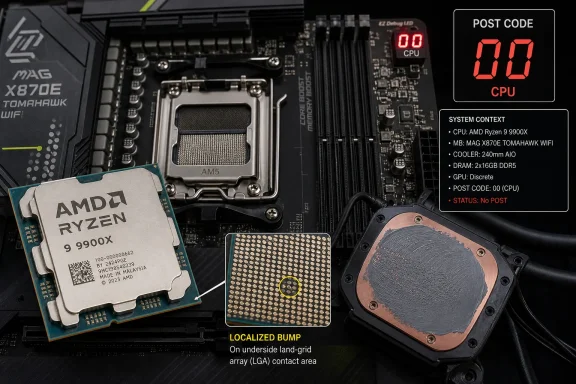
The reported failure is not another vague “my PC won’t boot” forum post. The owner described a system that abruptly stopped working, presented the dreaded Code 00 diagnostic readout, and lit the red CPU debug LED on an MSI MAG X870E Tomahawk WiFi motherboard. Code 00 is not a diagnosis by itself, but in enthusiast troubleshooting it is the kind of early-POST dead end that often sends builders straight to CPU, socket, or board-level fault isolation.
The more interesting detail came after the cooler and chip were removed. According to the report, the underside of the Ryzen 9 9900X showed a localized bump near the middle of the land-grid contact area, while the integrated heat spreader looked normal and the thermal paste pattern did not suggest an obvious mounting catastrophe. In other words, the visible evidence was not on the top of the CPU, where users usually look for cooler pressure problems, but on the substrate side where the electrical and mechanical consequences are harder to interpret.
The owner says the system was less than a year old, used a Corsair RM1000x power supply, and was cooled by a 240mm DeepCool AIO. The PSU was reportedly tested in another machine without issue, and the owner said there had been no manual voltage tuning. Precision Boost Overdrive, however, was enabled.
That last detail matters because it is simultaneously normal and not normal. PBO is a familiar AMD feature exposed in motherboard firmware and often marketed as a simple performance toggle. It is also, in AMD’s own warranty framing, operation outside stock specifications. The failure therefore sits in the gray zone that modern enthusiast hardware has created for itself: a chip can be “not manually overclocked” in the builder’s mind while still not being “stock” in the vendor’s legal vocabulary.
The most notorious chapter came with early Ryzen 7000X3D burnout cases, where damaged processors and motherboards pushed AMD and its partners into BIOS updates that tightened voltage limits, particularly around SoC voltage. Those incidents were not identical to the newly reported 9900X swelling case, and it would be irresponsible to pretend they prove a shared root cause. But they established the broader pattern: AM5 failures become public arguments not merely because a component died, but because the platform’s performance model delegates so much behavior to firmware, automatic boosting, and motherboard interpretation.
That is the uncomfortable part for AMD. Enthusiast CPUs no longer behave like fixed-frequency components that either run within a simple table or do not. They opportunistically boost, negotiate thermal and electrical headroom, apply board-defined limits, respond to memory profiles, and expose one-click options that many buyers understand as “supported tuning” rather than warranty-risking overclocking. When something fails physically, the average user is left trying to reconstruct a forensic timeline from BIOS versions, debug LEDs, and Reddit comments.
The Ryzen 9 9900X is also not an obscure budget part being pushed far beyond its intended use. It is a mainstream high-end Zen 5 desktop CPU on AMD’s current AM5 platform. A failure involving a recent board and an early-2026 BIOS does not fit neatly into the “old launch firmware” bucket, which is why the report is likely to attract more attention than its sample size deserves.
AMD’s legal language is less romantic. PBO allows operation outside factory settings, and AMD has long warned that this can invalidate processor warranty coverage. The company’s position is understandable from an engineering and liability standpoint: once a chip is run beyond published limits, the vendor does not want to guarantee every resulting failure. But that framing clashes with how PBO is presented across the ecosystem.
Motherboard BIOS screens expose PBO as a normal option. Reviewers benchmark it. Enthusiast guides recommend it. Users who would never type in a manual voltage happily enable it because it comes from AMD’s own platform vocabulary. The result is a feature that is official enough to be mainstream but unofficial enough to become a problem when an RMA agent sees the word “overclock.”
This is not just semantic hair-splitting. If the 9900X owner pursues warranty service, AMD will have to decide whether PBO is a meaningful factor, an incidental configuration detail, or an escape hatch. A strict reading of warranty exclusions could make the answer simple. A customer-relations reading is much harder, especially if there is no evidence that the user abused voltage settings or cooling.
The industry has trained users to trust automated performance features. It cannot then act surprised when those same users treat automated performance features as part of normal ownership.
Still, “swollen substrate” is a description, not a root cause. The substrate is a layered structure carrying signals and power between the silicon die package and the motherboard contact array. A bump could point toward internal delamination, localized thermal stress, mechanical pressure, electrical damage, manufacturing defect, or some combination that cannot be diagnosed from photos alone.
That distinction matters because enthusiast forums tend to collapse symptoms into verdicts. A bump becomes “the CPU exploded.” Code 00 becomes “the board killed it.” PBO becomes “AMD voided the warranty.” Each of those may be directionally plausible, but none is proven by the public evidence so far.
The reported normal thermal paste spread is useful, but it does not eliminate mounting pressure as a possible contributor. The lack of visible damage on the integrated heat spreader is useful, but it does not eliminate internal package stress. A tested power supply is useful, but it does not eliminate a transient event, board-side fault, or CPU-side weakness. Consumer troubleshooting can rule out the obvious; it rarely proves the invisible.
That is why AMD’s eventual response matters more than Reddit’s immediate diagnosis. The company has the ability to inspect the part, compare it with known failure signatures, and decide whether this is a random package defect, a board interaction, a warranty-excluded tuning casualty, or something that deserves wider attention. The public does not need AMD to litigate one user’s RMA in real time. It does need AMD to avoid looking as though it only takes physical-package failures seriously when they go viral.
Warranty disputes are normally private and boring. A user submits a claim, a vendor reviews it, and the result disappears into an email thread. But when the alleged damage is unusual, visible, and plausibly not user-caused, a denial can become a reputational event. The public does not see the lab report; it sees the photo and the refusal.
That is dangerous terrain for any hardware vendor. A company must protect itself from abuse, delidding mishaps, liquid metal accidents, cracked substrates, bent contacts, and outright fraud. But it also has to recognize that “physical damage” is not always synonymous with “customer damage.” A physically deformed CPU can be the outcome of an internal failure rather than the cause of the failure.
The 7950X3D reversal therefore created an expectation. If AMD replaced that chip after scrutiny, then similar-looking cases will be judged against the same standard. Even if the 9900X case turns out to be unrelated, the burden of explanation has shifted. A quiet denial will look harsher than it might have looked before.
This is how scattered hardware incidents become narratives. The first report is a curiosity. The second is a pattern. The third becomes a platform story, even if the statistical reality remains unknown. AMD is not there yet, but it is close enough that silence would be unwise.
The reported board in this case, MSI’s MAG X870E Tomahawk WiFi, is a current-generation AM5 motherboard rather than an early X670 launch board. The owner reportedly used a BIOS from early 2026, which weakens the easy explanation that this was simply an old unsafe firmware profile from AM5’s first year. But “newer BIOS” does not automatically mean every board setting is conservative, every auto rule is ideal, or every transient condition is impossible.
This is where the enthusiast PC market’s incentives become messy. Motherboard vendors compete on performance charts, memory compatibility, boosting behavior, and the promise that their boards will extract the most from expensive silicon. CPU vendors publish limits and issue firmware guidance, but board vendors implement the user-facing defaults. Reviewers and buyers reward the board that boosts harder, until the day a failure makes everyone rediscover the word “specification.”
The user’s PBO setting complicates the motherboard question further. PBO is not a single universal behavior so much as a framework of limits and algorithms that can vary by board implementation and configuration. Two AM5 systems can both have “PBO enabled” and still behave differently under load, depending on power limits, thermal limits, scalar behavior, curve optimizer settings, and vendor defaults.
That does not mean MSI caused this failure. It means the investigation cannot credibly stop at “the CPU had a bump.” AM5 is an ecosystem, and ecosystem failures demand ecosystem accountability.
That can make these incidents maddening for sysadmins and power users. The usual diagnostic muscle memory—check Reliability Monitor, inspect minidumps, roll back a driver, test memory, update firmware—does not apply when the platform never completes POST. At that point, the work becomes hardware isolation: reseat memory, inspect socket contacts, clear CMOS, swap PSU, test board, test CPU, and document every step for a possible warranty claim.
The documentation part is not optional anymore. If a CPU or motherboard may be headed for RMA, users should preserve photos of the CPU underside, socket, cooler mount, thermal paste spread, BIOS version, debug code, and system configuration. The goal is not to win an argument on Reddit. It is to give the vendor fewer reasons to classify the case as mishandling.
Windows enthusiasts also need to be honest about firmware toggles. EXPO, XMP, PBO, curve optimizer, “enhanced boost,” and vendor performance presets are not all the same thing, but they all change the warranty and stability conversation. A system can be everyday-stable for months and still be running outside the strict baseline the vendor will invoke when a claim gets complicated.
This is not a call to stop tuning PCs. Tuning is part of the enthusiast bargain. But the bargain has changed. The performance knobs are easier to use, the consequences are harder to see, and the paper trail matters more than it used to.
The danger is that the failure aligns with existing user fears. AM5 already has a history of voltage-related controversy. Ryzen X3D parts already made headlines for physical damage. AMD’s warranty language around PBO and overclocking is already stricter than many users intuitively expect. Put those together, and a small bump on a CPU substrate becomes a credibility test.
AMD has spent years rebuilding desktop CPU trust by offering strong performance, long-lived sockets, and meaningful competition against Intel. AM5 is central to that pitch. Users bought into the platform not only for Zen 4 and Zen 5, but for the promise that the socket would carry them forward. That promise depends on confidence that the platform’s automated behavior will not become a warranty trap.
The company does not need to declare a platform-wide defect to respond well. It can acknowledge the report, inspect the part, coordinate with MSI if necessary, and state whether it sees any broader signal. Even a limited statement would be better than letting the story be written entirely by screenshots, speculation, and RMA rumors.
Trust is not maintained by pretending edge cases do not exist. It is maintained by showing that edge cases are investigated before they are dismissed.
That creates a mismatch between marketing and support. Marketing wants performance uplift with one click. Support wants clean boundaries between stock and modified operation. Engineering wants guardrails, but board vendors want differentiation. Users want speed, stability, and a warranty if the hardware dies doing what the BIOS appeared to invite them to do.
The Ryzen 9 9900X case exposes that mismatch because the owner’s configuration sounds ordinary by enthusiast standards. No manual voltage. A reputable PSU. A mainstream AIO. A recent AM5 board. PBO enabled. That is not an exotic benchmarking rig under liquid nitrogen; it is close to the kind of system many power users would build without thinking they were living dangerously.
If vendors want to treat PBO as warranty-relevant overclocking, they should make that consequence impossible to miss at the point of activation. If they want users to view it as a safe mainstream feature, they should stand behind failures unless there is evidence of abuse. The current middle ground is good for benchmark slides and bad for customer confidence.
The same applies to motherboard defaults. A BIOS should not ship with “auto” behavior that quietly behaves like an aggressive tuning profile while leaving users to believe they are stock. If a setting changes electrical limits, it should say so plainly. Enthusiasts can handle warnings. What they cannot handle is ambiguity that appears only after hardware dies.
The report has several features that justify closer attention. The processor was relatively new. The visible deformation was localized and unusual. The system reportedly did not use manual voltage settings. The PSU was tested elsewhere. The BIOS was not from AM5’s troubled launch window. And there is a recent similar-looking warranty controversy involving another AM5 Ryzen 9 chip.
None of that proves causation. It does, however, raise the cost of a dismissive response. If AMD denies the claim solely as physical damage without explaining whether the deformation appears user-induced or failure-induced, the company risks repeating the 7950X3D optics. If it approves the RMA quietly, the immediate user problem may go away, but the broader question remains.
A better response would separate the individual warranty decision from the platform question. AMD can replace a chip without admitting a systemic flaw. It can investigate a swollen substrate without implying that all AM5 owners should panic. It can remind users that PBO is outside stock while still recognizing that an unexplained package deformation deserves more than boilerplate.
The worst outcome would be selective seriousness: deny when nobody is watching, reverse when a YouTube channel or major outlet amplifies the case, and never explain what changed. That pattern trains customers to litigate RMAs in public and makes every hardware failure a media campaign.
Start with firmware. If you are running an old AM5 BIOS, update to a current stable release from the motherboard vendor, especially on Ryzen 7000X3D or Ryzen 9000 systems. Read the notes, not because they always explain everything, but because AGESA updates often contain the platform behavior changes that matter most when voltage limits are involved.
Then look at tuning settings with legalistic honesty. If PBO is enabled, your system is not strictly stock. If EXPO or XMP is enabled, your memory subsystem is not running at baseline JEDEC settings. If your board has vendor “enhancement” or “performance boost” presets, assume they may alter power or voltage behavior until proven otherwise.
Also keep evidence. Save screenshots of BIOS versions and settings after a stable build is complete. Photograph the socket and CPU if you ever disassemble after a failure. Keep purchase records for the CPU, board, PSU, and cooler. A good RMA file is created before the argument begins.
This may sound tedious for a home gaming PC, but the enthusiast desktop has become a semi-professional platform. The parts are expensive, the firmware is complex, and the warranty line is narrower than the marketing language suggests.
 The New Failure Is Small, Specific, and Hard to Dismiss
The reported failure is not another vague “my PC won’t boot” forum post. The owner described a system that abruptly stopped working, presented the dreaded Code 00 diagnostic readout, and lit the red CPU debug LED on an MSI MAG X870E Tomahawk WiFi motherboard. Code 00 is not a diagnosis by itself, but in enthusiast troubleshooting it is the kind of early-POST dead end that often sends builders straight to CPU, socket, or board-level fault isolation.The more interesting detail came after the cooler and chip were removed. According to the report, the underside of the Ryzen 9 9900X showed a localized bump near the middle of the land-grid contact area, while the integrated heat spreader looked normal and the thermal paste pattern did not suggest an obvious mounting catastrophe. In other words, the visible evidence was not on the top of the CPU, where users usually look for cooler pressure problems, but on the substrate side where the electrical and mechanical consequences are harder to interpret.
The owner says the system was less than a year old, used a Corsair RM1000x power supply, and was cooled by a 240mm DeepCool AIO. The PSU was reportedly tested in another machine without issue, and the owner said there had been no manual voltage tuning. Precision Boost Overdrive, however, was enabled.
That last detail matters because it is simultaneously normal and not normal. PBO is a familiar AMD feature exposed in motherboard firmware and often marketed as a simple performance toggle. It is also, in AMD’s own warranty framing, operation outside stock specifications. The failure therefore sits in the gray zone that modern enthusiast hardware has created for itself: a chip can be “not manually overclocked” in the builder’s mind while still not being “stock” in the vendor’s legal vocabulary.
AM5’s Reputation Was Already Living on a Voltage Knife Edge
The Ryzen 9 9900X report would be easier to file away if AM5 had a spotless history. It does not. Since the Ryzen 7000 launch era, AMD’s socket has carried a low-level anxiety around voltage behavior, motherboard defaults, EXPO memory profiles, and the sometimes blurry line between sanctioned boosting and board-vendor opportunism.The most notorious chapter came with early Ryzen 7000X3D burnout cases, where damaged processors and motherboards pushed AMD and its partners into BIOS updates that tightened voltage limits, particularly around SoC voltage. Those incidents were not identical to the newly reported 9900X swelling case, and it would be irresponsible to pretend they prove a shared root cause. But they established the broader pattern: AM5 failures become public arguments not merely because a component died, but because the platform’s performance model delegates so much behavior to firmware, automatic boosting, and motherboard interpretation.
That is the uncomfortable part for AMD. Enthusiast CPUs no longer behave like fixed-frequency components that either run within a simple table or do not. They opportunistically boost, negotiate thermal and electrical headroom, apply board-defined limits, respond to memory profiles, and expose one-click options that many buyers understand as “supported tuning” rather than warranty-risking overclocking. When something fails physically, the average user is left trying to reconstruct a forensic timeline from BIOS versions, debug LEDs, and Reddit comments.
The Ryzen 9 9900X is also not an obscure budget part being pushed far beyond its intended use. It is a mainstream high-end Zen 5 desktop CPU on AMD’s current AM5 platform. A failure involving a recent board and an early-2026 BIOS does not fit neatly into the “old launch firmware” bucket, which is why the report is likely to attract more attention than its sample size deserves.
PBO Is the Toggle That Makes Everyone Uncomfortable
Precision Boost Overdrive is one of AMD’s most successful and most awkward enthusiast features. It gives users a way to let Ryzen chips push harder under favorable thermal and power conditions without the old-school ritual of fixed multipliers and manual voltage. For many builders, enabling PBO feels less like overclocking than letting the CPU behave the way it wanted to behave anyway.AMD’s legal language is less romantic. PBO allows operation outside factory settings, and AMD has long warned that this can invalidate processor warranty coverage. The company’s position is understandable from an engineering and liability standpoint: once a chip is run beyond published limits, the vendor does not want to guarantee every resulting failure. But that framing clashes with how PBO is presented across the ecosystem.
Motherboard BIOS screens expose PBO as a normal option. Reviewers benchmark it. Enthusiast guides recommend it. Users who would never type in a manual voltage happily enable it because it comes from AMD’s own platform vocabulary. The result is a feature that is official enough to be mainstream but unofficial enough to become a problem when an RMA agent sees the word “overclock.”
This is not just semantic hair-splitting. If the 9900X owner pursues warranty service, AMD will have to decide whether PBO is a meaningful factor, an incidental configuration detail, or an escape hatch. A strict reading of warranty exclusions could make the answer simple. A customer-relations reading is much harder, especially if there is no evidence that the user abused voltage settings or cooling.
The industry has trained users to trust automated performance features. It cannot then act surprised when those same users treat automated performance features as part of normal ownership.
A Swollen Substrate Is Not the Same as a Burned Socket
The visible bump on the underside of the CPU is the detail that makes this story feel different from ordinary silicon failure. CPUs can die silently. Motherboards can fail in ways that implicate the CPU. Pins, pads, sockets, VRMs, and firmware can all turn a once-stable machine into a debugging exercise. A physical deformation in the CPU package narrows the imagination.Still, “swollen substrate” is a description, not a root cause. The substrate is a layered structure carrying signals and power between the silicon die package and the motherboard contact array. A bump could point toward internal delamination, localized thermal stress, mechanical pressure, electrical damage, manufacturing defect, or some combination that cannot be diagnosed from photos alone.
That distinction matters because enthusiast forums tend to collapse symptoms into verdicts. A bump becomes “the CPU exploded.” Code 00 becomes “the board killed it.” PBO becomes “AMD voided the warranty.” Each of those may be directionally plausible, but none is proven by the public evidence so far.
The reported normal thermal paste spread is useful, but it does not eliminate mounting pressure as a possible contributor. The lack of visible damage on the integrated heat spreader is useful, but it does not eliminate internal package stress. A tested power supply is useful, but it does not eliminate a transient event, board-side fault, or CPU-side weakness. Consumer troubleshooting can rule out the obvious; it rarely proves the invisible.
That is why AMD’s eventual response matters more than Reddit’s immediate diagnosis. The company has the ability to inspect the part, compare it with known failure signatures, and decide whether this is a random package defect, a board interaction, a warranty-excluded tuning casualty, or something that deserves wider attention. The public does not need AMD to litigate one user’s RMA in real time. It does need AMD to avoid looking as though it only takes physical-package failures seriously when they go viral.
The 7950X3D Precedent Changed the Warranty Politics
The 9900X report follows a separate recent case involving a Ryzen 9 7950X3D that reportedly developed visible substrate swelling after a sudden failure. In that earlier case, AMD was said to have initially rejected the warranty claim on the basis of physical damage before reversing course after public attention and commentary from Hardware Unboxed. That reversal is now part of the context whether AMD likes it or not.Warranty disputes are normally private and boring. A user submits a claim, a vendor reviews it, and the result disappears into an email thread. But when the alleged damage is unusual, visible, and plausibly not user-caused, a denial can become a reputational event. The public does not see the lab report; it sees the photo and the refusal.
That is dangerous terrain for any hardware vendor. A company must protect itself from abuse, delidding mishaps, liquid metal accidents, cracked substrates, bent contacts, and outright fraud. But it also has to recognize that “physical damage” is not always synonymous with “customer damage.” A physically deformed CPU can be the outcome of an internal failure rather than the cause of the failure.
The 7950X3D reversal therefore created an expectation. If AMD replaced that chip after scrutiny, then similar-looking cases will be judged against the same standard. Even if the 9900X case turns out to be unrelated, the burden of explanation has shifted. A quiet denial will look harsher than it might have looked before.
This is how scattered hardware incidents become narratives. The first report is a curiosity. The second is a pattern. The third becomes a platform story, even if the statistical reality remains unknown. AMD is not there yet, but it is close enough that silence would be unwise.
Motherboard Makers Are Still the Unnamed Co-Authors
No modern desktop CPU story belongs only to the CPU vendor. AM5 behavior is shaped by AGESA firmware, motherboard BIOS settings, vendor defaults, power delivery design, memory profiles, and the user’s cooling environment. When a high-end Ryzen part fails, the motherboard is not a background prop; it is a co-author of the system’s electrical behavior.The reported board in this case, MSI’s MAG X870E Tomahawk WiFi, is a current-generation AM5 motherboard rather than an early X670 launch board. The owner reportedly used a BIOS from early 2026, which weakens the easy explanation that this was simply an old unsafe firmware profile from AM5’s first year. But “newer BIOS” does not automatically mean every board setting is conservative, every auto rule is ideal, or every transient condition is impossible.
This is where the enthusiast PC market’s incentives become messy. Motherboard vendors compete on performance charts, memory compatibility, boosting behavior, and the promise that their boards will extract the most from expensive silicon. CPU vendors publish limits and issue firmware guidance, but board vendors implement the user-facing defaults. Reviewers and buyers reward the board that boosts harder, until the day a failure makes everyone rediscover the word “specification.”
The user’s PBO setting complicates the motherboard question further. PBO is not a single universal behavior so much as a framework of limits and algorithms that can vary by board implementation and configuration. Two AM5 systems can both have “PBO enabled” and still behave differently under load, depending on power limits, thermal limits, scalar behavior, curve optimizer settings, and vendor defaults.
That does not mean MSI caused this failure. It means the investigation cannot credibly stop at “the CPU had a bump.” AM5 is an ecosystem, and ecosystem failures demand ecosystem accountability.
Windows Users Meet the Hardware Layer the Hard Way
For WindowsForum readers, the practical lesson is not that every Ryzen system is suspect. It is that modern Windows stability still begins below Windows. A machine that suddenly stops at Code 00 never reaches the operating system’s event logs, crash dumps, driver stack, or recovery environment. It fails before Windows has a chance to be useful.That can make these incidents maddening for sysadmins and power users. The usual diagnostic muscle memory—check Reliability Monitor, inspect minidumps, roll back a driver, test memory, update firmware—does not apply when the platform never completes POST. At that point, the work becomes hardware isolation: reseat memory, inspect socket contacts, clear CMOS, swap PSU, test board, test CPU, and document every step for a possible warranty claim.
The documentation part is not optional anymore. If a CPU or motherboard may be headed for RMA, users should preserve photos of the CPU underside, socket, cooler mount, thermal paste spread, BIOS version, debug code, and system configuration. The goal is not to win an argument on Reddit. It is to give the vendor fewer reasons to classify the case as mishandling.
Windows enthusiasts also need to be honest about firmware toggles. EXPO, XMP, PBO, curve optimizer, “enhanced boost,” and vendor performance presets are not all the same thing, but they all change the warranty and stability conversation. A system can be everyday-stable for months and still be running outside the strict baseline the vendor will invoke when a claim gets complicated.
This is not a call to stop tuning PCs. Tuning is part of the enthusiast bargain. But the bargain has changed. The performance knobs are easier to use, the consequences are harder to see, and the paper trail matters more than it used to.
AMD’s Problem Is Trust, Not Thermals Alone
The danger for AMD is not that one Ryzen 9 9900X reportedly failed. Every hardware line has failures. A global CPU business ships enough parts that strange, ugly, one-in-a-million defects will surface somewhere, and social media will make sure they travel further than the quiet majority of functioning systems.The danger is that the failure aligns with existing user fears. AM5 already has a history of voltage-related controversy. Ryzen X3D parts already made headlines for physical damage. AMD’s warranty language around PBO and overclocking is already stricter than many users intuitively expect. Put those together, and a small bump on a CPU substrate becomes a credibility test.
AMD has spent years rebuilding desktop CPU trust by offering strong performance, long-lived sockets, and meaningful competition against Intel. AM5 is central to that pitch. Users bought into the platform not only for Zen 4 and Zen 5, but for the promise that the socket would carry them forward. That promise depends on confidence that the platform’s automated behavior will not become a warranty trap.
The company does not need to declare a platform-wide defect to respond well. It can acknowledge the report, inspect the part, coordinate with MSI if necessary, and state whether it sees any broader signal. Even a limited statement would be better than letting the story be written entirely by screenshots, speculation, and RMA rumors.
Trust is not maintained by pretending edge cases do not exist. It is maintained by showing that edge cases are investigated before they are dismissed.
The Enthusiast Market Built This Ambiguity
There is a larger industry lesson here, and it is not uniquely AMD’s. CPU and motherboard vendors have spent years turning overclocking from a niche manual craft into a set of productized presets. The language changed from “void your warranty for a few more megahertz” to “enable performance mode,” “AI overclocking,” “PBO enhancement,” and “memory profile.” The risk did not disappear. It was simply hidden behind friendlier UI.That creates a mismatch between marketing and support. Marketing wants performance uplift with one click. Support wants clean boundaries between stock and modified operation. Engineering wants guardrails, but board vendors want differentiation. Users want speed, stability, and a warranty if the hardware dies doing what the BIOS appeared to invite them to do.
The Ryzen 9 9900X case exposes that mismatch because the owner’s configuration sounds ordinary by enthusiast standards. No manual voltage. A reputable PSU. A mainstream AIO. A recent AM5 board. PBO enabled. That is not an exotic benchmarking rig under liquid nitrogen; it is close to the kind of system many power users would build without thinking they were living dangerously.
If vendors want to treat PBO as warranty-relevant overclocking, they should make that consequence impossible to miss at the point of activation. If they want users to view it as a safe mainstream feature, they should stand behind failures unless there is evidence of abuse. The current middle ground is good for benchmark slides and bad for customer confidence.
The same applies to motherboard defaults. A BIOS should not ship with “auto” behavior that quietly behaves like an aggressive tuning profile while leaving users to believe they are stock. If a setting changes electrical limits, it should say so plainly. Enthusiasts can handle warnings. What they cannot handle is ambiguity that appears only after hardware dies.
The 9900X Case Leaves AMD With Few Easy Answers
The most defensible position today is caution. There is not enough public evidence to say the Ryzen 9 9900X has a swelling problem, that Zen 5 packaging is defective, or that MSI’s board caused the failure. There is also enough public evidence to say AMD should not treat this as just another dead CPU claim.The report has several features that justify closer attention. The processor was relatively new. The visible deformation was localized and unusual. The system reportedly did not use manual voltage settings. The PSU was tested elsewhere. The BIOS was not from AM5’s troubled launch window. And there is a recent similar-looking warranty controversy involving another AM5 Ryzen 9 chip.
None of that proves causation. It does, however, raise the cost of a dismissive response. If AMD denies the claim solely as physical damage without explaining whether the deformation appears user-induced or failure-induced, the company risks repeating the 7950X3D optics. If it approves the RMA quietly, the immediate user problem may go away, but the broader question remains.
A better response would separate the individual warranty decision from the platform question. AMD can replace a chip without admitting a systemic flaw. It can investigate a swollen substrate without implying that all AM5 owners should panic. It can remind users that PBO is outside stock while still recognizing that an unexplained package deformation deserves more than boilerplate.
The worst outcome would be selective seriousness: deny when nobody is watching, reverse when a YouTube channel or major outlet amplifies the case, and never explain what changed. That pattern trains customers to litigate RMAs in public and makes every hardware failure a media campaign.
The Practical Advice Is Boring Because Boring Is What Saves RMAs
For AM5 owners, the immediate response should not be panic-buying a new motherboard or disabling every performance feature out of fear. It should be a sober audit of what the system is actually doing. Modern BIOS menus make it too easy to forget which “auto” choices are conservative and which are performance bets.Start with firmware. If you are running an old AM5 BIOS, update to a current stable release from the motherboard vendor, especially on Ryzen 7000X3D or Ryzen 9000 systems. Read the notes, not because they always explain everything, but because AGESA updates often contain the platform behavior changes that matter most when voltage limits are involved.
Then look at tuning settings with legalistic honesty. If PBO is enabled, your system is not strictly stock. If EXPO or XMP is enabled, your memory subsystem is not running at baseline JEDEC settings. If your board has vendor “enhancement” or “performance boost” presets, assume they may alter power or voltage behavior until proven otherwise.
Also keep evidence. Save screenshots of BIOS versions and settings after a stable build is complete. Photograph the socket and CPU if you ever disassemble after a failure. Keep purchase records for the CPU, board, PSU, and cooler. A good RMA file is created before the argument begins.
This may sound tedious for a home gaming PC, but the enthusiast desktop has become a semi-professional platform. The parts are expensive, the firmware is complex, and the warranty line is narrower than the marketing language suggests.
The Small Bump That Could Become a Platform Story
This is where the story stands for now:- A Ryzen 9 9900X owner reported a sudden no-POST failure with Code 00 and a red CPU debug LED on an MSI MAG X870E Tomahawk WiFi motherboard.
- The user reported a visible localized bump on the underside of the CPU substrate, while the heat spreader and thermal paste pattern appeared normal.
- The system was reportedly less than a year old and used PBO, but no manual voltage tuning.
- A recent Ryzen 9 7950X3D swelling case already put AMD’s warranty handling under scrutiny after an initial rejection was reportedly reversed.
- The public evidence does not establish a systemic AM5 defect, but it does justify a careful vendor investigation rather than a reflexive “physical damage” denial.
- AM5 owners should keep BIOS current, understand which settings move the system outside stock behavior, and document failures thoroughly before filing warranty claims.
References
- Primary source: TweakTown
Published: Mon, 22 Jun 2026 03:33:06 GMT
Another AMD AM5 CPU has reportedly swelled and died, this time a Ryzen 9 9900X less than a year old
The Ryzen 9 9900X was less than a year old, running only PBO with no manual voltages, yet it developed a visible physical deformation on its substrate. www.tweaktown.com
- Related coverage: hothardware.com
Bulging Ryzen 9 7950X3D Puts AMD's Warranty Policy In The Spotlight | HotHardware
Taken at face value, the denied claim seems questionable, but we probably don't have all the details.hothardware.com
- Related coverage: pausehardware.com
Ryzen 9 7950X3D : AMD Refuse La Garantie Après Gonflement
Ryzen 9 7950X3D : un CPU monté en mai 2023 tombe en panne le 28 avril 2026, avec substrat gonflé. AMD refuse la garantie pour dommage physique.pausehardware.com - Related coverage: xanxogaming.com
AMD rechaza la garantía del Ryzen 9 7950X3D tras detectar hinchazón en el sustrato
AMD ha rechazado una garantía para un procesador Ryzen 9 7950X3D tras detectar hinchazón en el sustrato del chip, clasificando el fallo como daño físico xanxogaming.com
- Related coverage: wccftech.com
AMD Denies Warranty On Dead Ryzen 9 7950X3D, Blaming Substrate Swelling After GIGABYTE Cleared The Motherboard Of Any Faults
AMD denies RMA for Ryzen 9 7950X3D due to swollen substrate, while GIGABYTE cites BIOS corruption; user confusion over warranty coverage persists.wccftech.com - Related coverage: pcnews.ru
У пользователя «вздулся» процессор Ryzen 9 7950X3D — AMD отказала в гарантии, даже не ознакомившись с CPU - PCNEWS.RU
Все компьютерные новости на PCNews.ru. Вся новая информация, о компьютерах и информационных технологиях. Синдикация новостей, статей, пресс-релизов со всех сайтов компьютерной (ИТ или IT) тематики.pcnews.ru
- Related coverage: elchapuzasinformatico.com
AMD finalmente dará garantía al Ryzen 9 7950X3D hinchado
AMD ha decidido dar marcha atrás en el polémico caso del Ryzen 9 7950X3D hinchado respetando el uso de garantía al usuario afectado. elchapuzasinformatico.com
- Related coverage: tomshardware.com
Thermal Grizzly pops the top on Ryzen 7 9850X3Ds for you, charges eyewatering premium for delidded chips — almost double the cost of a regular model, comes with its own warranty | Tom's Hardware
They don't come cheap, but TG is picking up warranty service, so it's a more sensible option than it looks.www.tomshardware.com - Related coverage: amd.com
- Related coverage: howtogeek.com
Overclocking Your Ryzen Threadripper 7000 Blows a Hidden Fuse, Says AMD
The blown fuse won't hurt your CPU, but it proves you've enabled overclocking. www.howtogeek.com
- Related coverage: na.ingrammicro.com
