

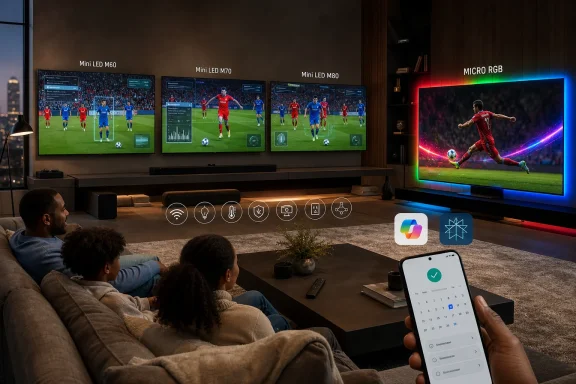
Samsung launched its 2026 television range in Kenya on July 11, outlining Mini LED M60, M70, and M80 models, a higher-end Micro RGB introduction planned for later in 2026, seven years of Tizen OS upgrades for its latest premium televisions, and integrations spanning Microsoft Copilot, Perplexity AI, and SmartThings. The company also highlighted the Watu Africa Easy Installment Plan, but it announced no Kenyan retail prices and did not disclose the programme’s complete payment, eligibility, device-management, or settlement terms.
That platform thesis is the clearest WindowsForum angle, but it should be understood as analysis rather than a statement of Samsung’s reported intent. A television that depends on operating-system support, external AI providers, smart-home integrations, user accounts, and finance-related security management must be judged on more than picture quality.
Samsung Vision AI shifts more attention toward software-assisted viewing. At the Kenya event, Samsung demonstrated named football features including AI Soccer Mode, Motion Accelerator, AI-assisted brightness adjustment, match recognition, and contextual overlays. Object Tracking Sound was also presented as part of the viewing experience.
Those are more specific and supportable claims than saying Vision AI universally analyzes all on-screen content and adjusts both picture and audio in real time. The launch facts establish particular viewing and football-related functions, not an unlimited description of how every programme, input, or sound source is processed.
The software distinction matters because televisions have unusually long replacement cycles. A phone may be changed after several years, but a premium television can remain in a living room long after its original applications, authentication methods, and streaming arrangements have aged.
Samsung’s seven-year Tizen OS upgrade commitment for its latest premium televisions is therefore one of the most consequential parts of the announcement. It acknowledges that panel longevity is no longer enough if the television’s operating system, applications, account services, or connected features become obsolete first.
For Kenyan buyers, that commitment may be especially relevant when a television is expected to remain in use for many years. A buyer should consider not only the image displayed in the showroom but also the likely software life of the model, the availability of applications, and the practical process for receiving updates.
The launch facts do not, however, establish that every 2026 Samsung television qualifies. Buyers need model-specific confirmation rather than assuming that “latest premium televisions” includes every Mini LED, OLED, or Micro RGB configuration sold in Kenya.
AI Soccer Mode, Motion Accelerator, and AI-assisted brightness adjustments are intended to address practical viewing concerns. Fast movement must remain clear, the picture must cope with the room’s lighting conditions, and the display must preserve visible detail during a match.
Object Tracking Sound applies a similar idea to audio positioning by making sound appear to follow movement across the display. Whether that produces a meaningful improvement will depend on the model, source material, room, and audio configuration, but it is a feature buyers can assess directly during a demonstration.
Vision AI Companion was also shown recognizing players during matches, presenting contextual information, and adding tactical overlays without requiring the viewer to leave the broadcast. The verified launch information supports those match-recognition and overlay functions. It does not establish broader claims about unrestricted conversational interaction or personalized recommendations.
This is still a potentially useful direction. Many viewers already use a phone to identify a player, check match context, or search for related information. Bringing selected information to the television could reduce that second-screen behavior.
It also creates a product-design challenge. Contextual information is helpful when requested and easy to dismiss. It becomes an interruption when overlays obscure the broadcast, appear too frequently, or prioritize promotion over the match.
For consumers, the test is straightforward: ask for a demonstration using an ordinary broadcast rather than relying solely on a prepared promotional clip. Check whether motion remains clear, whether overlays can be disabled, whether the feature requires an account or internet connection, and whether it works with the channels and source devices used at home.
Mini LED’s role is to provide an upgrade path for customers who want better backlight control without immediately moving to Samsung’s OLED tier. Using many smaller LEDs can allow the backlight to control smaller areas of an image than a less granular conventional system.
The final result still depends on the panel, number and behavior of dimming zones, processing, source quality, viewing environment, and the exact model. “Mini LED” should therefore be treated as a technology category rather than a guarantee that every model carrying the label will perform identically.
Samsung plans to introduce the technology through the M60, M70, and M80 series. That creates a ladder within the Mini LED category, but the launch facts do not provide enough model-level specifications or prices to determine which series will offer the best value.
Micro RGB sits at the top of the announced hierarchy. Samsung described it as combining AI processing with self-emitting RGB lighting technology. Claims that go beyond that description—such as the exact physical scale of the light sources or a quantified color-control advantage—require product-specific evidence that was not included in the supplied launch facts.
The expected price position is nevertheless significant. Samsung indicated that Micro RGB would carry a roughly 5% to 10% premium over comparable OLED models, depending on screen size.
That percentage cannot yet support a buying decision. Samsung did not announce the underlying Kenyan OLED prices, Micro RGB screen sizes, final Micro RGB prices, or financing costs. Until those figures are published, Micro RGB is a roadmap with a relative premium, not a complete retail proposition.
The launch facts confirm the presence of Copilot and Perplexity, but they do not fully define which features will be available on every model, which languages or regions will be supported, whether accounts will be required, or whether the experience will match the versions available on phones and computers.
The television also changes the social context of AI use. Phones and laptops are generally personal screens, while a television is often shared. A question entered or spoken in a living room may be visible to several people, and the resulting information may become part of a household discussion.
That could be useful for group searches, learning, or exploring information connected to a programme or live event. It also creates privacy and profile-management questions that are less prominent on a personal device.
Buyers should determine whether Copilot and Perplexity interactions are associated with a Samsung account, a third-party account, a television profile, or the device as a whole. They should also check whether histories can be viewed and deleted, whether voice input can be disabled, and whether separate household profiles are supported.
The presence of several connected systems makes disclosure important. An AI request may involve the television’s input method, Tizen, a Samsung account, network services, and an external provider. Customers should not assume that every function has the same privacy settings or data-retention behavior.
The television is well suited to certain smart-home tasks because it has a large screen, is usually connected to power and a network, and often occupies a central room. Camera feeds, appliance status, or alerts can be easier to see on a television than on a phone.
It is not a universal controller. The TV may be turned off, used by another household member, or unavailable when the owner is away. Because it is shared, a notification displayed on screen may also reveal information to everyone in the room.
For home users, the practical issue is dependency. SmartThings functions rely on compatible devices, accounts, network access, software support, and continued service availability. Buyers should confirm compatibility with their existing equipment rather than assuming that any connected device will work with the television.
Businesses, hospitality operators, and communal residences should apply stricter controls. A consumer SmartThings interface is not automatically a substitute for network segmentation, formal access management, building-management software, or documented procedures for transferring and resetting devices.
The concise implication is that a television capable of controlling other devices must itself be treated as a managed network device. Owners should install updates, secure accounts, review permissions, and perform a complete reset before resale, reassignment, or disposal.
The facts also do not establish feature parity over the seven-year period. An operating-system upgrade commitment does not necessarily mean that every future AI feature will reach every supported television, particularly where newer functions may depend on different hardware.
Nor does the announcement define the cadence of security patches, guarantee the continued availability of third-party applications, or promise that external services will remain unchanged. Streaming companies, AI providers, and connected-device manufacturers control their own products and regional availability.
These limitations do not make the seven-year commitment unimportant. A defined support window is preferable to an undefined software life, and it gives buyers a concrete issue to confirm before purchase.
Consumers should ask the retailer to identify the exact model number and confirm in writing whether it qualifies. They should also ask when the seven-year period begins, whether updates are automatic, whether release notes are available, and what support remains after the upgrade period ends.
Business and institutional buyers should additionally determine whether update status can be audited across multiple displays. A long support period is useful only if administrators can identify which televisions are current and which have failed to receive or install updates.
The practical ownership implication is simple: panel specifications are no longer enough. The useful life of a premium television increasingly depends on both the physical display and the software environment that supplies applications, accounts, connected-home controls, and AI integrations.
Samsung projects that financing could account for approximately 40% of its television sales in Kenya as the company works toward expanding overall sales. That indicates that financing is being treated as a significant distribution channel rather than a minor checkout option.
The supplied facts do not establish who is eligible, whether every customer must pay a deposit, how many installments are offered, or how the remaining balance is structured. The name “Easy Installment Plan” alone is not enough to infer those mechanics.
The facts also do not establish that the partnership is based on Watu’s smartphone-financing experience. Any comparison with another financing category would require separate confirmation.
Financing can reduce the immediate barrier associated with a large cash purchase, but a smaller recurring payment does not automatically mean a lower or affordable total cost. Buyers need the complete financial picture before comparing the plan with a cash purchase or another source of credit.
Samsung also identified KnoxGuard as the security-management product associated with financed televisions. That is the limit of what the supplied facts establish. They do not explain whether KnoxGuard can restrict a television after missed payments, how any such action would work, what information is collected, when management ends, or how the device is released after final payment.
Those unanswered points are material contractual questions. They should not be filled with assumptions about locking, collection, ownership transfer, customer data, or the duration of management.
The omission is particularly important because affordability is central to the launch. Financing can change the timing of payments, but it does not by itself establish whether the television is competitively priced or whether the financed total represents good value.
The M60, M70, and M80 series may provide a meaningful upgrade path from Crystal UHD, but their relative positions cannot be converted into a recommendation until Samsung or its retailers publish screen sizes, complete specifications, cash prices, and availability.
The same limitation applies to Micro RGB. A 5% to 10% premium sounds relatively narrow, but the real amount could be substantial on a flagship television. Buyers must know the comparable OLED model, its Kenyan cash price, the Micro RGB cash price, and any difference in financed total.
Samsung’s 2026 Kenya launch establishes a credible technology roadmap, but not yet a complete purchasing proposition. The named football features provide the clearest Vision AI use case. SmartThings, Copilot, and Perplexity widen the television’s role beyond conventional viewing. The seven-year Tizen commitment could materially improve long-term value for qualifying premium models.
The unresolved issues are equally important: no retail prices, no model-by-model support list, no complete Watu terms, and no detailed explanation of how KnoxGuard behaves on a financed television. Those are not peripheral details. They determine the real cost, practical ownership experience, and long-term value of the product.
Do not choose Micro RGB over OLED—or OLED over Micro RGB—until Kenyan cash prices, exact model specifications, and the complete Watu financing terms are published. A percentage premium is not a substitute for a price list, and an advertised installment is not a substitute for the total amount payable.
Buyers who value long software support should confirm in writing that their exact premium model qualifies for Samsung’s seven-year Tizen OS upgrade commitment. Anyone considering financing should also obtain written answers about the cash price, deposit, installment schedule, total cost, late-payment consequences, early settlement, warranty handling, KnoxGuard behavior, and post-final-payment release process before signing.
The important shift is not merely from one display technology to another. Samsung is presenting the television as a long-lived software platform, an AI-enabled viewing device, a SmartThings control surface, and—when purchased through financing—a product connected to both a software lifecycle and a financial agreement.What Kenyan buyers should do now
Samsung’s 2026 Kenya lineup is official, with Mini LED M60, M70, and M80 televisions planned and Micro RGB due later in 2026 at a premium above OLED. However, Samsung has not announced retail prices.
Do not sign a financing agreement based only on the advertised installment amount. First obtain the television’s cash price, deposit requirement, number of installments, total amount payable, late-payment consequences, early-settlement policy, warranty and repair procedure, KnoxGuard behavior, and the process for releasing the television from finance-related management after final payment.
These are questions buyers must ask the retailer and Watu, because the supplied launch facts do not answer them.
That platform thesis is the clearest WindowsForum angle, but it should be understood as analysis rather than a statement of Samsung’s reported intent. A television that depends on operating-system support, external AI providers, smart-home integrations, user accounts, and finance-related security management must be judged on more than picture quality.
 Launch Facts at a Glance
| Item | Confirmed launch information |
|---|---|
| Launch date | July 11 |
| Lineup positioning | Crystal UHD is the mainstream tier, followed by Mini LED, OLED, and flagship Micro RGB |
| Mini LED series | M60, M70, and M80 are planned |
| Micro RGB timing | Expected later in 2026 |
| Micro RGB price position | Expected to carry a roughly 5% to 10% premium over comparable OLED models, depending on screen size |
| Tizen support | Seven years of Tizen OS upgrades for Samsung’s latest premium televisions |
| AI and connected services | Microsoft Copilot, Perplexity AI, and SmartThings integration |
| Financing | Watu Africa Easy Installment Plan |
| Financing volume | More than 1,000 Samsung televisions financed since the programme began |
| Financing projection | Samsung projects that financing could account for approximately 40% of its Kenyan television sales |
| Retail pricing | No Kenyan retail prices were announced |
Samsung Is Selling a Platform, Not Just a Better Picture
For most of television’s history, the central promise was straightforward: a larger, sharper, or brighter image. Smart-TV software complicated that proposition by adding streaming services, advertising, app stores, voice interfaces, user accounts, and connected-home controls, but the screen remained the obvious reason for the purchase.Samsung Vision AI shifts more attention toward software-assisted viewing. At the Kenya event, Samsung demonstrated named football features including AI Soccer Mode, Motion Accelerator, AI-assisted brightness adjustment, match recognition, and contextual overlays. Object Tracking Sound was also presented as part of the viewing experience.
Those are more specific and supportable claims than saying Vision AI universally analyzes all on-screen content and adjusts both picture and audio in real time. The launch facts establish particular viewing and football-related functions, not an unlimited description of how every programme, input, or sound source is processed.
The software distinction matters because televisions have unusually long replacement cycles. A phone may be changed after several years, but a premium television can remain in a living room long after its original applications, authentication methods, and streaming arrangements have aged.
Samsung’s seven-year Tizen OS upgrade commitment for its latest premium televisions is therefore one of the most consequential parts of the announcement. It acknowledges that panel longevity is no longer enough if the television’s operating system, applications, account services, or connected features become obsolete first.
For Kenyan buyers, that commitment may be especially relevant when a television is expected to remain in use for many years. A buyer should consider not only the image displayed in the showroom but also the likely software life of the model, the availability of applications, and the practical process for receiving updates.
The launch facts do not, however, establish that every 2026 Samsung television qualifies. Buyers need model-specific confirmation rather than assuming that “latest premium televisions” includes every Mini LED, OLED, or Micro RGB configuration sold in Kenya.
Football Gives Vision AI Its Most Persuasive Demonstration
AI is now an almost unavoidable label in consumer electronics, often applied to features that might previously have been described as automatic processing. Samsung’s strongest Kenya demonstration was not a general claim that the television can understand everything on screen. It was a recognizable use case: watching live football.AI Soccer Mode, Motion Accelerator, and AI-assisted brightness adjustments are intended to address practical viewing concerns. Fast movement must remain clear, the picture must cope with the room’s lighting conditions, and the display must preserve visible detail during a match.
Object Tracking Sound applies a similar idea to audio positioning by making sound appear to follow movement across the display. Whether that produces a meaningful improvement will depend on the model, source material, room, and audio configuration, but it is a feature buyers can assess directly during a demonstration.
Vision AI Companion was also shown recognizing players during matches, presenting contextual information, and adding tactical overlays without requiring the viewer to leave the broadcast. The verified launch information supports those match-recognition and overlay functions. It does not establish broader claims about unrestricted conversational interaction or personalized recommendations.
This is still a potentially useful direction. Many viewers already use a phone to identify a player, check match context, or search for related information. Bringing selected information to the television could reduce that second-screen behavior.
It also creates a product-design challenge. Contextual information is helpful when requested and easy to dismiss. It becomes an interruption when overlays obscure the broadcast, appear too frequently, or prioritize promotion over the match.
For consumers, the test is straightforward: ask for a demonstration using an ordinary broadcast rather than relying solely on a prepared promotional clip. Check whether motion remains clear, whether overlays can be disabled, whether the feature requires an account or internet connection, and whether it works with the channels and source devices used at home.
The Screen Hierarchy Now Has Four Distinct Rungs
Samsung used the launch to explain the progression through its television portfolio. George Kebaso, Mobile Product & Marketing Manager, described Crystal UHD as the mainstream option, Mini LED as the next premium step, OLED above Mini LED, and Micro RGB as the flagship platform.| Platform | Position in Samsung’s portfolio | Display or lighting approach | Kenya roadmap |
|---|---|---|---|
| Crystal UHD | Mainstream offering | Conventional LCD television platform | Established entry point |
| Mini LED | Next premium step | Thousands of smaller LEDs replace conventional backlights | M60, M70, and M80 planned |
| OLED | Above Mini LED | Premium OLED display platform | Positioned below Micro RGB |
| Micro RGB | Flagship platform | AI processing combined with self-emitting RGB lighting technology | Expected later in 2026 |
The final result still depends on the panel, number and behavior of dimming zones, processing, source quality, viewing environment, and the exact model. “Mini LED” should therefore be treated as a technology category rather than a guarantee that every model carrying the label will perform identically.
Samsung plans to introduce the technology through the M60, M70, and M80 series. That creates a ladder within the Mini LED category, but the launch facts do not provide enough model-level specifications or prices to determine which series will offer the best value.
Micro RGB sits at the top of the announced hierarchy. Samsung described it as combining AI processing with self-emitting RGB lighting technology. Claims that go beyond that description—such as the exact physical scale of the light sources or a quantified color-control advantage—require product-specific evidence that was not included in the supplied launch facts.
The expected price position is nevertheless significant. Samsung indicated that Micro RGB would carry a roughly 5% to 10% premium over comparable OLED models, depending on screen size.
That percentage cannot yet support a buying decision. Samsung did not announce the underlying Kenyan OLED prices, Micro RGB screen sizes, final Micro RGB prices, or financing costs. Until those figures are published, Micro RGB is a roadmap with a relative premium, not a complete retail proposition.
Copilot and Perplexity Turn the TV Into a Shared AI Terminal
The inclusion of Microsoft Copilot and Perplexity AI shows that Samsung’s television platform will connect with established external AI services rather than relying exclusively on Samsung-developed functions.The launch facts confirm the presence of Copilot and Perplexity, but they do not fully define which features will be available on every model, which languages or regions will be supported, whether accounts will be required, or whether the experience will match the versions available on phones and computers.
The television also changes the social context of AI use. Phones and laptops are generally personal screens, while a television is often shared. A question entered or spoken in a living room may be visible to several people, and the resulting information may become part of a household discussion.
That could be useful for group searches, learning, or exploring information connected to a programme or live event. It also creates privacy and profile-management questions that are less prominent on a personal device.
Buyers should determine whether Copilot and Perplexity interactions are associated with a Samsung account, a third-party account, a television profile, or the device as a whole. They should also check whether histories can be viewed and deleted, whether voice input can be disabled, and whether separate household profiles are supported.
The presence of several connected systems makes disclosure important. An AI request may involve the television’s input method, Tizen, a Samsung account, network services, and an external provider. Customers should not assume that every function has the same privacy settings or data-retention behavior.
SmartThings Makes the Television a Home-Control Surface
SmartThings integration allows the television to operate as a visible dashboard for compatible connected devices. Depending on the available devices and supported functions, the TV can surface status information, notifications, and controls, including features connected to Samsung’s wider Galaxy and appliance ecosystem.The television is well suited to certain smart-home tasks because it has a large screen, is usually connected to power and a network, and often occupies a central room. Camera feeds, appliance status, or alerts can be easier to see on a television than on a phone.
It is not a universal controller. The TV may be turned off, used by another household member, or unavailable when the owner is away. Because it is shared, a notification displayed on screen may also reveal information to everyone in the room.
For home users, the practical issue is dependency. SmartThings functions rely on compatible devices, accounts, network access, software support, and continued service availability. Buyers should confirm compatibility with their existing equipment rather than assuming that any connected device will work with the television.
Businesses, hospitality operators, and communal residences should apply stricter controls. A consumer SmartThings interface is not automatically a substitute for network segmentation, formal access management, building-management software, or documented procedures for transferring and resetting devices.
The concise implication is that a television capable of controlling other devices must itself be treated as a managed network device. Owners should install updates, secure accounts, review permissions, and perform a complete reset before resale, reassignment, or disposal.
Seven Years of Tizen Updates Rewrites the Ownership Calculation
Samsung’s commitment applies to its latest premium televisions. That wording is important: the launch facts do not establish model-by-model eligibility across the entire 2026 Kenyan range.The facts also do not establish feature parity over the seven-year period. An operating-system upgrade commitment does not necessarily mean that every future AI feature will reach every supported television, particularly where newer functions may depend on different hardware.
Nor does the announcement define the cadence of security patches, guarantee the continued availability of third-party applications, or promise that external services will remain unchanged. Streaming companies, AI providers, and connected-device manufacturers control their own products and regional availability.
These limitations do not make the seven-year commitment unimportant. A defined support window is preferable to an undefined software life, and it gives buyers a concrete issue to confirm before purchase.
Consumers should ask the retailer to identify the exact model number and confirm in writing whether it qualifies. They should also ask when the seven-year period begins, whether updates are automatic, whether release notes are available, and what support remains after the upgrade period ends.
Business and institutional buyers should additionally determine whether update status can be audited across multiple displays. A long support period is useful only if administrators can identify which televisions are current and which have failed to receive or install updates.
The practical ownership implication is simple: panel specifications are no longer enough. The useful life of a premium television increasingly depends on both the physical display and the software environment that supplies applications, accounts, connected-home controls, and AI integrations.
Financing Is the Launch’s Real Market-Making Technology
The Watu Africa Easy Installment Plan may ultimately affect Samsung’s Kenyan reach more than any individual display feature. According to the launch information, more than 1,000 Samsung televisions have been financed since the programme began.Samsung projects that financing could account for approximately 40% of its television sales in Kenya as the company works toward expanding overall sales. That indicates that financing is being treated as a significant distribution channel rather than a minor checkout option.
The supplied facts do not establish who is eligible, whether every customer must pay a deposit, how many installments are offered, or how the remaining balance is structured. The name “Easy Installment Plan” alone is not enough to infer those mechanics.
The facts also do not establish that the partnership is based on Watu’s smartphone-financing experience. Any comparison with another financing category would require separate confirmation.
Financing can reduce the immediate barrier associated with a large cash purchase, but a smaller recurring payment does not automatically mean a lower or affordable total cost. Buyers need the complete financial picture before comparing the plan with a cash purchase or another source of credit.
Samsung also identified KnoxGuard as the security-management product associated with financed televisions. That is the limit of what the supplied facts establish. They do not explain whether KnoxGuard can restrict a television after missed payments, how any such action would work, what information is collected, when management ends, or how the device is released after final payment.
Those unanswered points are material contractual questions. They should not be filled with assumptions about locking, collection, ownership transfer, customer data, or the duration of management.
Questions to Ask the Retailer and Watu Before Signing
The launch facts do not answer the questions below. Buyers should obtain clear written responses and keep copies with the sales and financing documents.- What is the television’s cash price?
The cash price is the baseline needed to measure the actual cost of financing. - Is a deposit required, and if so, how much is it?
Ask whether the deposit forms part of the advertised total or is charged separately. - How many installments are required?
Confirm the amount, frequency, due dates, and complete repayment period. - What is the total amount payable?
Request one figure that includes the deposit, all installments, fees, insurance, administrative charges, and any other mandatory costs. - What happens after a late or missed payment?
Ask about grace periods, penalties, account reporting, collection procedures, and any effect on the television. - What is the early-settlement policy?
Determine whether the balance can be cleared early, whether fees apply, and whether an early payoff reduces the total cost. - How do warranty claims and repairs work during financing?
Confirm who arranges transport, whether payments continue while the television is being repaired, and what happens if the unit must be replaced. - What exactly does KnoxGuard do on the financed television?
Request a plain-language explanation of every management capability, the circumstances in which it can be used, and the information processed. - What happens after the final payment?
Ask how finance-related management is removed, how long release takes, and what written confirmation proves that the account and device are fully cleared. - Can the television be sold, gifted, moved, or transferred before settlement?
Do not assume that ordinary ownership-transfer rules apply while a finance agreement remains active. - What is the return and cancellation policy?
Confirm whether there is a cooling-off period and how cancellation affects amounts already paid. - Who handles disputes?
Identify whether the first contact is the retailer, Samsung, Watu, or another party, and obtain the relevant escalation process.
The Missing Price List Leaves the Strategy Unfinished
Samsung explained how Crystal UHD, Mini LED, OLED, and Micro RGB relate to one another, but Kenyan buyers still cannot judge the value of those tiers without local cash prices.The omission is particularly important because affordability is central to the launch. Financing can change the timing of payments, but it does not by itself establish whether the television is competitively priced or whether the financed total represents good value.
The M60, M70, and M80 series may provide a meaningful upgrade path from Crystal UHD, but their relative positions cannot be converted into a recommendation until Samsung or its retailers publish screen sizes, complete specifications, cash prices, and availability.
The same limitation applies to Micro RGB. A 5% to 10% premium sounds relatively narrow, but the real amount could be substantial on a flagship television. Buyers must know the comparable OLED model, its Kenyan cash price, the Micro RGB cash price, and any difference in financed total.
Practical Buying Recommendation by Buyer Type
| Buyer | Best action before prices and terms are published |
|---|---|
| Mainstream buyer replacing an older TV | Compare current Crystal UHD options with the eventual M60 cash price; do not assume Mini LED will fit the same budget |
| Buyer prioritizing brightness and backlight control | Wait for M60, M70, and M80 specifications, sizes, and demonstrations before choosing a tier |
| OLED buyer | Compare exact model numbers and local cash prices rather than relying on the portfolio hierarchy |
| Early adopter considering Micro RGB | Wait for Kenyan pricing, screen sizes, warranty details, and side-by-side demonstrations with comparable OLED models |
| Buyer considering Watu financing | Obtain the complete written financing schedule and KnoxGuard explanation before signing |
| Buyer prioritizing software longevity | Confirm that the exact model qualifies for seven years of Tizen OS upgrades |
The unresolved issues are equally important: no retail prices, no model-by-model support list, no complete Watu terms, and no detailed explanation of how KnoxGuard behaves on a financed television. Those are not peripheral details. They determine the real cost, practical ownership experience, and long-term value of the product.
Verdict
Samsung has given Kenyan buyers a clear picture of where its 2026 television lineup is heading, but not enough information to make the most expensive decisions yet.Do not choose Micro RGB over OLED—or OLED over Micro RGB—until Kenyan cash prices, exact model specifications, and the complete Watu financing terms are published. A percentage premium is not a substitute for a price list, and an advertised installment is not a substitute for the total amount payable.
Buyers who value long software support should confirm in writing that their exact premium model qualifies for Samsung’s seven-year Tizen OS upgrade commitment. Anyone considering financing should also obtain written answers about the cash price, deposit, installment schedule, total cost, late-payment consequences, early settlement, warranty handling, KnoxGuard behavior, and post-final-payment release process before signing.
References
- Primary source: TechTrendsKE
Published: 2026-07-11T08:50:08.189001
Loading…
techtrendske.co.ke - Related coverage: news.samsung.com
Loading…
news.samsung.com - Related coverage: samsung.com
Loading…
www.samsung.com - Related coverage: africa.mkt.samsung.com
Loading…
africa.mkt.samsung.com - Related coverage: images.samsung.com
Loading…
images.samsung.com