

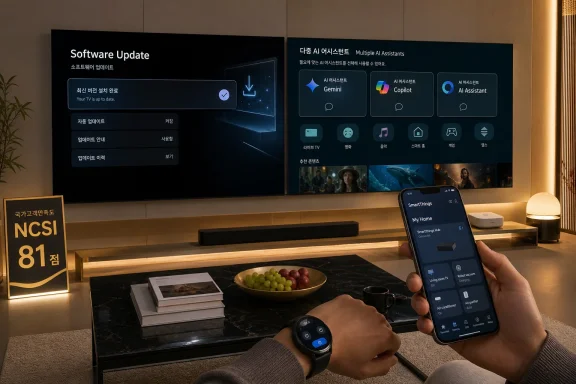
Samsung Electronics and LG Electronics tied for first place in the 2026 National Customer Satisfaction Index survey for South Korea’s TV sector on July 6, with both companies scoring 81 points and sharing the top ranking for a third consecutive year. The result, reported by The Chosun Daily, is not just another trophy in the long-running Samsung-versus-LG living-room rivalry. It is a snapshot of where premium television has gone in 2026: away from panel specs alone and toward software, AI assistants, operating-system promises, and ecosystem lock-in.
The remarkable part is not that Samsung and LG are both good at making televisions. That has been true for years. The remarkable part is that customer satisfaction is now being won at the messy intersection of display hardware, voice interfaces, smart-home control, content discovery, and long-term software support — precisely the same terrain that Windows users and IT professionals already know can turn a good device into either a durable platform or an expensive annoyance.
For decades, TV competition was easy to understand. Plasma fought LCD, LED backlighting refined LCD, OLED became the aspirational benchmark, and resolution numbers marched from 720p to 1080p to 4K and beyond. The consumer question was usually blunt: which set has the best picture for the money?
That question still matters, but it no longer explains the market by itself. The Chosun report frames the 2026 NCSI tie around AI-based image and sound optimization, wireless connectivity, personalized viewing, smart-home integration, and extended operating-system support. In other words, the set on the wall is now as much a software endpoint as a display appliance.
That shift should sound familiar to anyone who manages PCs, phones, tablets, or conference-room gear. Once a device becomes software-defined, the vendor’s long-term behavior matters as much as the launch-day hardware. Updates, account requirements, privacy posture, assistant integrations, app compatibility, and support lifecycles all become part of the customer experience.
Samsung and LG tying at 81 points suggests that consumers are rewarding both companies for making that transition without completely breaking trust. But the tie also masks two different strategies. LG is leaning into OLED heritage and a widening multi-assistant experience, while Samsung is leaning into AI companion features, SmartThings connectivity, and the promise that a TV’s operating system will not fossilize after a couple of years.
But the 2026 story is not only about OLED panels. LG’s “The Next OLED” lineup, as described in the Chosun report, emphasizes AI-based picture and sound optimization, wireless connectivity, and “Multi AI” functions that bring in Google Gemini and Microsoft Copilot. That is a very different kind of sales pitch from “perfect blacks” or “infinite contrast.”
LG appears to be treating the television as a conversational surface. The value proposition is that the TV can recommend content, understand voice requests, optimize the screen for what is being watched, and reduce friction between user intent and viewing result. The OLED panel remains the prestige hardware, but the daily experience increasingly comes from the intelligence layered on top of it.
This is a risky evolution. Enthusiasts buy OLEDs for image quality and can be skeptical of processing that touches the signal too aggressively. The same buyer who wants AI upscaling for low-quality streaming video may also want every enhancement disabled when watching a calibrated 4K Blu-ray. LG’s challenge is to make AI feel like assistance rather than interference.
The Copilot and Gemini angle is also notable for WindowsForum readers. Microsoft’s Copilot is no longer confined to Windows taskbars, Office documents, or enterprise productivity suites. It is becoming a branded service surface inside televisions, browsers, phones, cars, and appliances. That ubiquity may help Microsoft, but it also raises a question consumers are only beginning to ask: how many places do we really want AI assistants embedded?
That strategy plays to Samsung’s strengths. The company sells phones, tablets, appliances, monitors, soundbars, watches, and TVs. SmartThings gives it a unifying layer across many of those devices. If the TV becomes the largest and most visible screen in that network, it can anchor a broader Samsung household.
Vision AI Companion is the key branding move. The phrase suggests the TV should know what is on screen, respond contextually, and help the viewer without requiring a traditional app search or remote-control hunt. Samsung has promoted integrations with Bixby, Perplexity, and Microsoft Copilot, giving users multiple paths into AI-assisted interaction rather than betting everything on a single assistant.
The more consequential promise may be Samsung’s offer of up to seven years of free operating-system upgrades for supported TVs. In the PC world, that would be called lifecycle policy. In the TV world, it is a competitive weapon.
A premium television is often expected to last longer than a phone, yet smart-TV software has historically aged badly. Apps slow down, streaming services drop support, interfaces become cluttered, security updates become ambiguous, and a perfectly good panel becomes dependent on an external streaming box. If Samsung can make seven years of Tizen upgrades feel real rather than cosmetic, it changes the ownership equation.
That includes whether the remote is comprehensible. It includes whether the home screen is full of ads. It includes whether voice control works reliably enough to become habit. It includes whether account sign-ins are required for features that used to be local. It includes whether an update improves the product or simply inserts a new layer of vendor ambition.
The National Customer Satisfaction Index result captures the whole bundle. A score of 81 does not mean every buyer loves every feature. It means that, in aggregate, Samsung and LG are delivering enough perceived value to overcome the annoyances that smart TVs inevitably create.
This is where the TV market starts to resemble the Windows PC market. A laptop can have excellent silicon and still frustrate users with bloatware, update instability, telemetry anxiety, driver conflicts, or poor support. A TV can have a stunning panel and still feel worse after six months if the software becomes noisier, slower, or more intrusive.
Samsung and LG understand this. Their 2026 messaging is not only “look at our display technology.” It is “trust our software layer.” That is a much harder promise to keep.
That does not mean AI is useless on televisions. Quite the opposite. AI upscaling, dialogue enhancement, scene-aware audio, personalized recommendations, accessibility tools, and natural-language search can make a TV easier to use. A modern household may have dozens of streaming apps, multiple HDMI devices, several user profiles, and inconsistent content quality. Intelligence applied carefully can reduce that complexity.
The problem is that “AI” is also a convenient marketing wrapper for features that may not need generative AI at all. A TV that recommends a crime drama after you watch three crime dramas is not necessarily a revolution. A voice assistant that opens an app is useful, but not new. A screen that adjusts brightness based on room lighting may be helpful, but consumers have seen versions of that idea for years.
What is different now is the arrival of big-name AI services inside the TV interface. Google Gemini, Microsoft Copilot, Perplexity, and Samsung’s Bixby create the impression that the living-room screen is joining the same assistant race playing out on PCs and smartphones. That can be powerful, but it can also be confusing.
Consumers may reasonably ask which assistant is listening, which account it uses, what data leaves the device, whether responses are grounded in the content on screen, and whether features remain free. The more assistants appear on a TV, the more the interface risks becoming a directory of corporate partnerships rather than a coherent user experience.
On one hand, Copilot on a TV could be genuinely useful. It might help explain what is happening in a documentary, search across streaming catalogs, summarize a sports schedule, answer setup questions, or help a user tune accessibility settings by voice. For households already using Microsoft accounts, Windows PCs, Edge, Microsoft 365, or Xbox, the TV could become another endpoint in a familiar cloud identity system.
On the other hand, Copilot’s expansion reinforces a broader industry pattern: consumer devices are filling with assistants before the market has settled on norms for consent, persistence, data retention, and monetization. A Windows user who already finds Copilot’s placement in the OS contentious may not be thrilled to see the same brand surface on a TV home screen. The question is not whether Copilot can be useful. The question is whether users feel they are choosing it.
LG has already faced scrutiny around how Copilot appears in webOS contexts, with reporting from PC hardware outlets noting that some implementations are closer to shortcuts than deeply embedded native apps. That distinction matters. A shortcut can be ignored or removed more easily; a system-level assistant can become part of the device’s identity.
Samsung’s approach, by contrast, folds Copilot into a broader assistant constellation that includes Bixby and Perplexity. That may give users flexibility, but it may also create overlapping features. If three assistants can answer a question, the experience is only elegant if the TV knows which one should handle it — and if the user understands why.
The TV industry badly needs this. Many users keep televisions for seven to ten years. During that time, streaming services evolve, codecs change, app frameworks shift, security expectations rise, and smart-home standards mature. A TV abandoned after three years of software attention can become a liability, even if the panel itself remains excellent.
For IT professionals, the support-window issue is obvious. You would not buy business hardware without asking how long it receives firmware updates, security fixes, management support, and compatibility maintenance. Consumers have not always applied that discipline to TVs, partly because TVs used to be simpler. Smart TVs ended that era.
Samsung’s policy also puts pressure on LG, Sony, TCL, Hisense, and other TV makers to define their own commitments more clearly. Vague language about “future updates” is no longer enough at the premium end. If a TV is a software platform, buyers deserve a support lifecycle.
The caveat is implementation. “Up to seven years” is not the same as seven years of identical feature support across every model. Hardware limits, regional differences, licensing issues, and app-provider decisions can all narrow what users actually receive. Samsung will need to make the promise legible at purchase time and credible five years later.
That is the dream, at least. The danger is that smart-home systems can become brittle quickly. Devices fall offline, account linking breaks, firmware updates change behavior, and household members have different tolerance levels for automation. The TV, because it sits in the center of family life, magnifies both success and failure.
Samsung’s advantage is breadth. It can connect more of its own products under one brand story than most competitors can. A Samsung phone, Samsung TV, Samsung refrigerator, Samsung washer, and Samsung soundbar can all be made to feel like pieces of a single environment. Apple has used a similar logic in personal devices; Samsung is applying it across the home.
LG is not absent from the smart-home race, but its TV satisfaction story remains more tightly tied to display quality and webOS experience. Samsung’s ecosystem play may therefore appeal to users who see the TV as part of a connected household rather than a standalone display.
For buyers, the practical question is whether ecosystem convenience outweighs lock-in. SmartThings can be a compelling benefit if you already own Samsung hardware. It is less decisive if your home is a patchwork of Apple, Google, Amazon, Matter-compatible devices, game consoles, and third-party streaming boxes.
Both asks are reasonable. Both are risky.
LG’s risk is that AI and assistant partnerships could dilute the clarity of its OLED brand. Enthusiasts know why they buy LG OLEDs. If the software becomes too promotional or too eager to intervene, LG could annoy the very customers who care most about picture fidelity. The company must keep AI subordinate to the viewing experience.
Samsung’s risk is that platform ambition can feel heavy-handed. SmartThings, Vision AI Companion, Bixby, Perplexity, Copilot, Tizen upgrades, account services, and content layers can add up to a powerful system. They can also add up to a TV that feels like it has too many stakeholders.
The NCSI tie suggests that neither company has crossed the line for most customers. But satisfaction scores are lagging indicators. They reflect how users feel after living with products and services, not just what companies announce at CES. If AI features become more intrusive, if ads expand, if updates slow older sets, or if premium features move behind subscriptions, satisfaction can move quickly.
A brilliant screen can become frustrating if the OS gets slow. A useful assistant can become irritating if it constantly pushes services. A smart-home dashboard can become dead weight if it depends on devices you do not own. A seven-year update promise can be meaningful, but only if the model you buy is included and the vendor’s definition of “upgrade” is substantial.
This is especially relevant for Windows users who often use TVs as PC displays, gaming screens, media endpoints, or meeting-room panels. Input latency, HDMI behavior, variable refresh rate support, color handling, firmware stability, and privacy controls all matter. So does whether the TV can be used comfortably without signing into every vendor ecosystem under the sun.
The 2026 NCSI result gives Samsung and LG bragging rights, but it should also encourage sharper consumer scrutiny. Satisfaction is not a mystical brand aura. It is the accumulated effect of many small decisions: how fast the TV wakes, whether the remote makes sense, whether settings stay put, whether updates break anything, whether the app you need still works, and whether the vendor respects the fact that the device is in your home.
The remarkable part is not that Samsung and LG are both good at making televisions. That has been true for years. The remarkable part is that customer satisfaction is now being won at the messy intersection of display hardware, voice interfaces, smart-home control, content discovery, and long-term software support — precisely the same terrain that Windows users and IT professionals already know can turn a good device into either a durable platform or an expensive annoyance.
 The TV War Has Moved Beyond the Panel
For decades, TV competition was easy to understand. Plasma fought LCD, LED backlighting refined LCD, OLED became the aspirational benchmark, and resolution numbers marched from 720p to 1080p to 4K and beyond. The consumer question was usually blunt: which set has the best picture for the money?That question still matters, but it no longer explains the market by itself. The Chosun report frames the 2026 NCSI tie around AI-based image and sound optimization, wireless connectivity, personalized viewing, smart-home integration, and extended operating-system support. In other words, the set on the wall is now as much a software endpoint as a display appliance.
That shift should sound familiar to anyone who manages PCs, phones, tablets, or conference-room gear. Once a device becomes software-defined, the vendor’s long-term behavior matters as much as the launch-day hardware. Updates, account requirements, privacy posture, assistant integrations, app compatibility, and support lifecycles all become part of the customer experience.
Samsung and LG tying at 81 points suggests that consumers are rewarding both companies for making that transition without completely breaking trust. But the tie also masks two different strategies. LG is leaning into OLED heritage and a widening multi-assistant experience, while Samsung is leaning into AI companion features, SmartThings connectivity, and the promise that a TV’s operating system will not fossilize after a couple of years.
LG’s OLED Advantage Is Becoming a Software Story
LG’s position in this survey has a long tail. According to The Chosun Daily, LG has held the top spot for nine consecutive years, including the period before Samsung joined it in first place. That matters because LG’s TV brand has been built on a simple consumer association: if you want OLED, LG is usually in the conversation.But the 2026 story is not only about OLED panels. LG’s “The Next OLED” lineup, as described in the Chosun report, emphasizes AI-based picture and sound optimization, wireless connectivity, and “Multi AI” functions that bring in Google Gemini and Microsoft Copilot. That is a very different kind of sales pitch from “perfect blacks” or “infinite contrast.”
LG appears to be treating the television as a conversational surface. The value proposition is that the TV can recommend content, understand voice requests, optimize the screen for what is being watched, and reduce friction between user intent and viewing result. The OLED panel remains the prestige hardware, but the daily experience increasingly comes from the intelligence layered on top of it.
This is a risky evolution. Enthusiasts buy OLEDs for image quality and can be skeptical of processing that touches the signal too aggressively. The same buyer who wants AI upscaling for low-quality streaming video may also want every enhancement disabled when watching a calibrated 4K Blu-ray. LG’s challenge is to make AI feel like assistance rather than interference.
The Copilot and Gemini angle is also notable for WindowsForum readers. Microsoft’s Copilot is no longer confined to Windows taskbars, Office documents, or enterprise productivity suites. It is becoming a branded service surface inside televisions, browsers, phones, cars, and appliances. That ubiquity may help Microsoft, but it also raises a question consumers are only beginning to ask: how many places do we really want AI assistants embedded?
Samsung Is Selling the TV as a Smart-Home Hub
Samsung’s 2026 pitch, as reported by The Chosun Daily and echoed in Samsung’s own CES-era announcements, is more ecosystem-driven. Its 2026 AI TV lineup strengthens AI functions and smart-home connectivity through Vision AI Companion, Bixby, Perplexity, Microsoft Copilot, and SmartThings. Samsung is not merely trying to make a television that displays content well; it is trying to make the television a control plane for the home.That strategy plays to Samsung’s strengths. The company sells phones, tablets, appliances, monitors, soundbars, watches, and TVs. SmartThings gives it a unifying layer across many of those devices. If the TV becomes the largest and most visible screen in that network, it can anchor a broader Samsung household.
Vision AI Companion is the key branding move. The phrase suggests the TV should know what is on screen, respond contextually, and help the viewer without requiring a traditional app search or remote-control hunt. Samsung has promoted integrations with Bixby, Perplexity, and Microsoft Copilot, giving users multiple paths into AI-assisted interaction rather than betting everything on a single assistant.
The more consequential promise may be Samsung’s offer of up to seven years of free operating-system upgrades for supported TVs. In the PC world, that would be called lifecycle policy. In the TV world, it is a competitive weapon.
A premium television is often expected to last longer than a phone, yet smart-TV software has historically aged badly. Apps slow down, streaming services drop support, interfaces become cluttered, security updates become ambiguous, and a perfectly good panel becomes dependent on an external streaming box. If Samsung can make seven years of Tizen upgrades feel real rather than cosmetic, it changes the ownership equation.
Customer Satisfaction Is Now a Platform Metric
The 81-point tie is easy to treat as a consumer-electronics headline, but it is more interesting as a platform signal. Customers are no longer judging TVs only by brightness, color, motion handling, and industrial design. They are judging whether the software respects them.That includes whether the remote is comprehensible. It includes whether the home screen is full of ads. It includes whether voice control works reliably enough to become habit. It includes whether account sign-ins are required for features that used to be local. It includes whether an update improves the product or simply inserts a new layer of vendor ambition.
The National Customer Satisfaction Index result captures the whole bundle. A score of 81 does not mean every buyer loves every feature. It means that, in aggregate, Samsung and LG are delivering enough perceived value to overcome the annoyances that smart TVs inevitably create.
This is where the TV market starts to resemble the Windows PC market. A laptop can have excellent silicon and still frustrate users with bloatware, update instability, telemetry anxiety, driver conflicts, or poor support. A TV can have a stunning panel and still feel worse after six months if the software becomes noisier, slower, or more intrusive.
Samsung and LG understand this. Their 2026 messaging is not only “look at our display technology.” It is “trust our software layer.” That is a much harder promise to keep.
AI Is the New Motion Smoothing
Every TV generation has its feature that sounds better in a showroom than it feels in a living room. Motion smoothing was one. Overzealous noise reduction was another. Auto-brightness and eco modes have had their moments of user rebellion. In 2026, AI risks becoming the next feature that vendors love more than customers do.That does not mean AI is useless on televisions. Quite the opposite. AI upscaling, dialogue enhancement, scene-aware audio, personalized recommendations, accessibility tools, and natural-language search can make a TV easier to use. A modern household may have dozens of streaming apps, multiple HDMI devices, several user profiles, and inconsistent content quality. Intelligence applied carefully can reduce that complexity.
The problem is that “AI” is also a convenient marketing wrapper for features that may not need generative AI at all. A TV that recommends a crime drama after you watch three crime dramas is not necessarily a revolution. A voice assistant that opens an app is useful, but not new. A screen that adjusts brightness based on room lighting may be helpful, but consumers have seen versions of that idea for years.
What is different now is the arrival of big-name AI services inside the TV interface. Google Gemini, Microsoft Copilot, Perplexity, and Samsung’s Bixby create the impression that the living-room screen is joining the same assistant race playing out on PCs and smartphones. That can be powerful, but it can also be confusing.
Consumers may reasonably ask which assistant is listening, which account it uses, what data leaves the device, whether responses are grounded in the content on screen, and whether features remain free. The more assistants appear on a TV, the more the interface risks becoming a directory of corporate partnerships rather than a coherent user experience.
Microsoft’s Copilot Is Quietly Entering the Living Room
The Microsoft angle deserves particular attention. Copilot appearing in both LG’s and Samsung’s 2026 TV narratives shows how aggressively Microsoft’s assistant brand has moved beyond Windows. For Windows users, that broadening cuts both ways.On one hand, Copilot on a TV could be genuinely useful. It might help explain what is happening in a documentary, search across streaming catalogs, summarize a sports schedule, answer setup questions, or help a user tune accessibility settings by voice. For households already using Microsoft accounts, Windows PCs, Edge, Microsoft 365, or Xbox, the TV could become another endpoint in a familiar cloud identity system.
On the other hand, Copilot’s expansion reinforces a broader industry pattern: consumer devices are filling with assistants before the market has settled on norms for consent, persistence, data retention, and monetization. A Windows user who already finds Copilot’s placement in the OS contentious may not be thrilled to see the same brand surface on a TV home screen. The question is not whether Copilot can be useful. The question is whether users feel they are choosing it.
LG has already faced scrutiny around how Copilot appears in webOS contexts, with reporting from PC hardware outlets noting that some implementations are closer to shortcuts than deeply embedded native apps. That distinction matters. A shortcut can be ignored or removed more easily; a system-level assistant can become part of the device’s identity.
Samsung’s approach, by contrast, folds Copilot into a broader assistant constellation that includes Bixby and Perplexity. That may give users flexibility, but it may also create overlapping features. If three assistants can answer a question, the experience is only elegant if the TV knows which one should handle it — and if the user understands why.
Seven Years of TV Updates Changes the Buying Math
Samsung’s seven-year OS upgrade promise is one of the most important details in the Chosun report, even if it sounds less glamorous than AI. Long support windows are a form of customer satisfaction that vendors can actually engineer. They turn a premium purchase into a longer-term platform commitment.The TV industry badly needs this. Many users keep televisions for seven to ten years. During that time, streaming services evolve, codecs change, app frameworks shift, security expectations rise, and smart-home standards mature. A TV abandoned after three years of software attention can become a liability, even if the panel itself remains excellent.
For IT professionals, the support-window issue is obvious. You would not buy business hardware without asking how long it receives firmware updates, security fixes, management support, and compatibility maintenance. Consumers have not always applied that discipline to TVs, partly because TVs used to be simpler. Smart TVs ended that era.
Samsung’s policy also puts pressure on LG, Sony, TCL, Hisense, and other TV makers to define their own commitments more clearly. Vague language about “future updates” is no longer enough at the premium end. If a TV is a software platform, buyers deserve a support lifecycle.
The caveat is implementation. “Up to seven years” is not the same as seven years of identical feature support across every model. Hardware limits, regional differences, licensing issues, and app-provider decisions can all narrow what users actually receive. Samsung will need to make the promise legible at purchase time and credible five years later.
SmartThings Gives Samsung a Household Advantage LG Cannot Ignore
Samsung’s SmartThings integration is another satisfaction driver that looks mundane until you consider the modern home. A television is often the one shared screen everyone understands. If it can show camera feeds, control lights, surface appliance alerts, and coordinate with phones or soundbars, it becomes more than entertainment hardware.That is the dream, at least. The danger is that smart-home systems can become brittle quickly. Devices fall offline, account linking breaks, firmware updates change behavior, and household members have different tolerance levels for automation. The TV, because it sits in the center of family life, magnifies both success and failure.
Samsung’s advantage is breadth. It can connect more of its own products under one brand story than most competitors can. A Samsung phone, Samsung TV, Samsung refrigerator, Samsung washer, and Samsung soundbar can all be made to feel like pieces of a single environment. Apple has used a similar logic in personal devices; Samsung is applying it across the home.
LG is not absent from the smart-home race, but its TV satisfaction story remains more tightly tied to display quality and webOS experience. Samsung’s ecosystem play may therefore appeal to users who see the TV as part of a connected household rather than a standalone display.
For buyers, the practical question is whether ecosystem convenience outweighs lock-in. SmartThings can be a compelling benefit if you already own Samsung hardware. It is less decisive if your home is a patchwork of Apple, Google, Amazon, Matter-compatible devices, game consoles, and third-party streaming boxes.
The Satisfaction Tie Hides Different Kinds of Trust
Samsung and LG both scored 81, but they are not asking customers for the same kind of trust. LG is asking users to trust that its premium display expertise can evolve into a more intelligent, more connected OLED experience. Samsung is asking users to trust that a sprawling AI-and-smart-home ecosystem will make the TV more useful over time rather than more cluttered.Both asks are reasonable. Both are risky.
LG’s risk is that AI and assistant partnerships could dilute the clarity of its OLED brand. Enthusiasts know why they buy LG OLEDs. If the software becomes too promotional or too eager to intervene, LG could annoy the very customers who care most about picture fidelity. The company must keep AI subordinate to the viewing experience.
Samsung’s risk is that platform ambition can feel heavy-handed. SmartThings, Vision AI Companion, Bixby, Perplexity, Copilot, Tizen upgrades, account services, and content layers can add up to a powerful system. They can also add up to a TV that feels like it has too many stakeholders.
The NCSI tie suggests that neither company has crossed the line for most customers. But satisfaction scores are lagging indicators. They reflect how users feel after living with products and services, not just what companies announce at CES. If AI features become more intrusive, if ads expand, if updates slow older sets, or if premium features move behind subscriptions, satisfaction can move quickly.
The Best TV May Be the One That Ages Gracefully
The most important buying advice from this result is not “buy Samsung” or “buy LG.” It is that buyers should evaluate televisions the way they evaluate long-lived computing devices. Hardware quality still matters, but software behavior over time matters more than it used to.A brilliant screen can become frustrating if the OS gets slow. A useful assistant can become irritating if it constantly pushes services. A smart-home dashboard can become dead weight if it depends on devices you do not own. A seven-year update promise can be meaningful, but only if the model you buy is included and the vendor’s definition of “upgrade” is substantial.
This is especially relevant for Windows users who often use TVs as PC displays, gaming screens, media endpoints, or meeting-room panels. Input latency, HDMI behavior, variable refresh rate support, color handling, firmware stability, and privacy controls all matter. So does whether the TV can be used comfortably without signing into every vendor ecosystem under the sun.
The 2026 NCSI result gives Samsung and LG bragging rights, but it should also encourage sharper consumer scrutiny. Satisfaction is not a mystical brand aura. It is the accumulated effect of many small decisions: how fast the TV wakes, whether the remote makes sense, whether settings stay put, whether updates break anything, whether the app you need still works, and whether the vendor respects the fact that the device is in your home.
The Living-Room Scorecard Has Changed
The 81-point tie says less about a photo finish and more about the new rules of the category. Samsung and LG are both succeeding because they have recognized that the television is now a platform, not a panel with apps bolted on. For buyers trying to decode the marketing, the concrete lessons are straightforward.- Samsung and LG jointly led the 2026 NCSI TV sector with 81 points, extending their shared first-place run to three consecutive years.
- LG’s satisfaction story rests on a long OLED reputation now being reinforced by AI picture and sound optimization, wireless connectivity, and Multi AI features involving Google Gemini and Microsoft Copilot.
- Samsung’s satisfaction story rests on Vision AI Companion, SmartThings connectivity, multiple AI service integrations, and a promise of up to seven years of free operating-system upgrades.
- Microsoft Copilot’s presence in both companies’ TV strategies shows that AI assistants are moving from PCs and phones into shared household screens.
- The next meaningful TV comparison is not only OLED versus QLED or brightness versus contrast, but support lifecycle, software restraint, privacy posture, and whether the interface improves with age.
References
- Primary source: 조선일보
Published: 2026-07-05T17:50:13.233237
Loading…
www.chosun.com - Related coverage: macrumors.com
Loading…
www.macrumors.com - Related coverage: news.samsung.com
Loading…
news.samsung.com - Related coverage: mactech.com
Loading…
www.mactech.com - Related coverage: en.sedaily.com
Loading…
en.sedaily.com - Related coverage: sammobile.com
Loading…
www.sammobile.com
- Related coverage: iclarified.com
Loading…
www.iclarified.com - Related coverage: theacsi.com
Loading…
theacsi.com - Related coverage: samsung.com
Loading…
www.samsung.com - Related coverage: gadgets360.com
Loading…
www.gadgets360.com - Related coverage: lg.com
Loading…
www.lg.com - Related coverage: androidcentral.com
Loading…
www.androidcentral.com - Related coverage: techradar.com
Samsung revives its Bixby assistant with an AI brain transplant from Perplexity | TechRadar
With One UI 8.5, Bixby gets real context, live answers, and maybe a second chancewww.techradar.com - Related coverage: tomsguide.com
Loading…
www.tomsguide.com - Related coverage: whathifi.com
Loading…
www.whathifi.com - Related coverage: images.samsung.com