

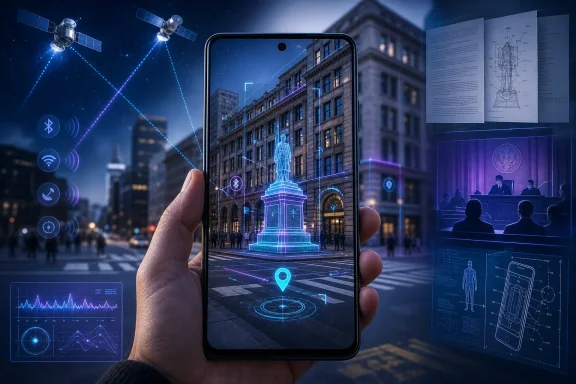
Samsung faces a new patent fight over technology that sits at the intersection of smartphone cameras, wireless positioning, and augmented reality. In a complaint filed on July 17, 2026, Gravity Jack Inc. alleges that Samsung Electronics and Samsung Electronics America infringed two US patents through Galaxy smartphones after years of business discussions failed to produce an agreement. The lawsuit does not establish infringement, but its combination of early AR patents, alleged pre-suit knowledge, and one of the world’s largest mobile-device portfolios could turn a dispute between two companies into a wider test of who controls foundational methods for anchoring digital information to the physical world.
Gravity Jack filed the case in the US District Court for the Eastern District of Texas under case number 2:26-cv-00593. The defendants are South Korea-based Samsung Electronics Co. and its US subsidiary, Samsung Electronics America Inc., while the asserted intellectual property consists of US Patent Nos. 8,502,659 and 8,519,844.
Both patents are titled “Augmented reality and location determination methods and apparatus.” They trace their priority to July 30, 2010, when mobile augmented reality was still an emerging field rather than a standard capability built into mainstream smartphones.
The intervening years transformed that landscape. Today, camera-based visual search, measurement tools, live navigation overlays, face filters, object placement, spatial mapping, and location-aware recommendations appear across consumer and enterprise applications.
Gravity Jack’s patents therefore come from an important period in AR history. They were filed before Apple’s ARKit, Google’s ARCore, Microsoft’s commercial HoloLens platform, and many of the mobile experiences that taught consumers to point a camera at the world and expect software to understand what it sees.
The complaint’s business-discussion narrative may support an argument that Samsung had direct knowledge of Gravity Jack’s work rather than encountering the patents only after litigation began. Samsung has not yet had the opportunity to develop its full response in court, and the existence of discussions alone does not prove that Samsung copied technology or infringed a valid claim.
In simplified terms, the patent addresses a persistent AR problem: ordinary location data may not be precise enough to place digital content convincingly in the real world. A GPS estimate that is wrong by several meters might be adequate for showing a user on a road map, yet unsuitable for attaching a virtual marker to a particular doorway, machine, display, or person.
The disclosed approaches include combinations of:
That structure connects positioning with content delivery. A device does not merely calculate where it is; it uses location to decide what digital information should appear and how that information should relate to physical-world objects.
The patent describes scenarios involving both static and moving targets. Augmented content might be associated with a building, marker, nearby device, or person, while a server or management device could coordinate information across multiple participants.
Potentially relevant components could include:
Samsung may argue that an accused feature comes from Google software, an independent application developer, or an optional user configuration. Gravity Jack may counter that Samsung manufactures, configures, markets, tests, and sells devices designed to perform the patented operations.
This distinction matters especially for method claims. Direct infringement generally requires proof that all claimed steps are performed by or attributable to a single responsible party, while indirect-infringement theories add further requirements involving knowledge and intent.
Gravity Jack may therefore need evidence showing that relevant Galaxy features were actually used in the United States during the damages period. Such evidence could involve internal testing, product demonstrations, telemetry, usage data, technical documentation, or customer instructions.
Samsung may answer that the discussions concerned different technology, that the patents were not identified with sufficient specificity, or that its engineers independently developed the accused features. It may also argue that knowledge of a patent does not establish knowledge that a particular product infringes it.
The legal question is not merely whether Samsung knew Gravity Jack existed. It is whether Samsung knew about the asserted patent rights and continued conduct that it knew, or should have known under the applicable standard, constituted infringement.
However, enhanced damages are discretionary and usually reserved for conduct beyond ordinary infringement. A company can know about a patent while maintaining a good-faith belief that the patent is invalid, inapplicable, exhausted, licensed, or not infringed.
The content of the discussions will matter more than their duration. Seven years sounds dramatic, but dozens of routine sales contacts would carry a different implication from a detailed technical evaluation followed by internal adoption.
Protective orders are common in patent litigation, especially where source code, product road maps, engineering documents, and licensing proposals are involved. WindowsForum readers should therefore expect important technical details to remain sealed even if the litigation advances.
Samsung will likely press for narrower definitions that separate its products from the claimed methods. Gravity Jack will favor constructions broad enough to cover modern smartphone implementations while remaining anchored to the patents’ language and specification.
Claim construction can decide a case before trial. If the court interprets a required element in a way that the accused Galaxy system does not perform, Gravity Jack’s infringement theory could collapse.
AR and wireless positioning did not begin in 2010. Earlier systems used GPS, radio measurements, visual markers, object recognition, head-mounted displays, and location-linked content, giving Samsung a substantial body of prior art to investigate.
The key question will be whether earlier publications, patents, products, or demonstrations disclosed the particular combinations recited by Gravity Jack’s claims. An invention can consist of a novel combination of known elements, but that combination must still be non-obvious to a skilled person at the relevant time.
A likely sequence would be:
Gravity Jack may seek a reasonable royalty based on licensing negotiations, comparable agreements, device sales, feature usage, or the commercial importance of accurate AR positioning. Samsung will attempt to reduce the royalty base to the smallest relevant component or software function.
Samsung may challenge venue or seek transfer to another district. It could argue that witnesses, engineers, documents, and product decisions are concentrated elsewhere, potentially in California, New Jersey, or South Korea.
Gravity Jack will likely emphasize Samsung’s US operations and the sale or use of accused products within the district. The court will examine concrete facts rather than relying solely on the convenience preferences of either side.
Samsung has both won and lost significant patent cases in the district. Past verdicts involving other patent owners do not prove anything about Gravity Jack’s claims, although they help explain why both sides will treat early discovery and claim construction as high-stakes events.
A scheduled trial date can create pressure on both sides. Gravity Jack must fund a lengthy enforcement effort, while Samsung must weigh defense costs and commercial uncertainty against the danger of encouraging additional claims through an early settlement.
Courts must interpret patent language as understood in its technical context, not rewrite old claims to match current marketing vocabulary. The result can be a difficult question: Is a modern feature merely a faster implementation of an old patented method, or does it operate through a materially different architecture?
This creates several business problems:
As AI assistants become more visually aware, the boundary between augmented reality and ordinary camera intelligence will blur. A phone that recognizes a storefront and displays contextual directions may perform many of the same technical operations as an application explicitly marketed as AR.
Software-based redesigns are often possible, but they can introduce performance or compatibility costs. A workaround that avoids one patent limitation might consume more power, require additional network access, reduce positioning accuracy, or break compatibility with existing applications.
Google could become relevant if the allegations target Android location services or AR frameworks, although its involvement should not be assumed merely because Galaxy phones run Android. Samsung also supplies distinctive applications, user-interface layers, sensors, and system integrations that differ from those on other Android devices.
Other patent owners will monitor the case for claim-construction rulings, validity decisions, damages methodologies, and public technical disclosures. One successful enforcement action can make a patent portfolio more attractive for licensing, while an invalidity ruling can sharply reduce its value.
A patent claim spanning device positioning, server coordination, and augmented-data delivery can potentially implicate more than the handheld endpoint. Whether it does so depends on who performs each step and how the claims are written.
Developers should not assume that using a standard operating-system API eliminates patent exposure. Platform APIs simplify engineering, but they do not guarantee freedom to practice every underlying method.
Reliable systems must combine:
Enterprise teams should instead ensure that procurement agreements address intellectual-property indemnification, update obligations, application support, and the consequences of a forced software redesign. Organizations building proprietary AR systems should also document which party supplies each technical layer.
A sensible review should cover:
Even when a patent owner ultimately succeeds, consumer-facing outcomes frequently involve financial compensation or a license rather than the removal of an entire product line. Courts also consider whether an injunction is justified rather than granting one automatically.
Such a change could arrive through an ordinary firmware or application update without prominent reference to the lawsuit. Users might notice that a camera mode, measurement tool, navigation overlay, or location-aware feature behaves differently, although there is currently no evidence that Samsung plans such action.
A system that improves position by combining GPS, nearby devices, wireless signals, images, and cloud services may create a richer record of the user’s environment. Patent litigation focuses on ownership of technical methods, but product designers and regulators must also consider whether those methods minimize data collection and protect bystanders.
Claim charts will be especially important. They should map each element of an asserted claim to evidence involving device hardware, software, servers, or documented user operations.
A review petition would also affect scheduling. The district judge would need to decide whether the case should proceed alongside Patent Office review or pause while patent validity is examined.
The dates of specific patent notices will matter. A general awareness of Gravity Jack’s AR business is less powerful than evidence that identifies the asserted patents, explains their relevance, and connects them to later accused functionality.
Claim construction can also affect validity. A broad interpretation may capture more Samsung functionality but expose the claims to more prior art, while a narrow interpretation may preserve validity yet make infringement harder to prove.
Alternatively, Gravity Jack could file additional cases if it believes other companies use comparable technology. Any expansion would clarify whether Samsung is the target because of a unique implementation, its alleged negotiation history, its enormous sales volume, or a combination of all three.
The Gravity Jack lawsuit arrives as augmented reality is being absorbed into a broader generation of spatial computing, AI-powered cameras, wearable displays, indoor navigation, and context-aware software. Its outcome will depend on highly specific claim language and technical evidence, not on who first popularized AR or which company has the larger brand. Yet the case highlights an enduring reality for Samsung, Microsoft, Google, and every developer connecting digital content to physical space: the infrastructure beneath a seemingly simple camera overlay may carry legal obligations formed long before today’s devices made the technology feel ordinary.
 Background
Gravity Jack filed the case in the US District Court for the Eastern District of Texas under case number 2:26-cv-00593. The defendants are South Korea-based Samsung Electronics Co. and its US subsidiary, Samsung Electronics America Inc., while the asserted intellectual property consists of US Patent Nos. 8,502,659 and 8,519,844.Both patents are titled “Augmented reality and location determination methods and apparatus.” They trace their priority to July 30, 2010, when mobile augmented reality was still an emerging field rather than a standard capability built into mainstream smartphones.
From experimental AR to a standard mobile feature
In 2010, phones were gaining cameras, GPS receivers, accelerometers, digital compasses, faster processors, and increasingly capable cellular data connections. Developers could see the ingredients of practical augmented reality coming together, but the software platforms, computer-vision frameworks, and hardware performance required for reliable mass-market experiences remained immature.The intervening years transformed that landscape. Today, camera-based visual search, measurement tools, live navigation overlays, face filters, object placement, spatial mapping, and location-aware recommendations appear across consumer and enterprise applications.
Gravity Jack’s patents therefore come from an important period in AR history. They were filed before Apple’s ARKit, Google’s ARCore, Microsoft’s commercial HoloLens platform, and many of the mobile experiences that taught consumers to point a camera at the world and expect software to understand what it sees.
A seven-year business history
According to Gravity Jack, discussions with Samsung began in 2013 and continued over a seven-year period. That allegation matters because patent damages can depend not only on whether a product practices a patent claim, but also on when the accused company allegedly learned of the patent and how it behaved afterward.The complaint’s business-discussion narrative may support an argument that Samsung had direct knowledge of Gravity Jack’s work rather than encountering the patents only after litigation began. Samsung has not yet had the opportunity to develop its full response in court, and the existence of discussions alone does not prove that Samsung copied technology or infringed a valid claim.
What the Two Patents Actually Cover
The patent titles may sound broad, but patent litigation does not turn on titles, abstracts, or general similarities. It turns on the wording of individual claims and whether every required limitation can be found in an accused product or process.The ’659 patent and refined positioning
US Patent No. 8,502,659 was issued on August 6, 2013. Its specification describes techniques in which a user-interaction device begins with initial location information and then uses communications involving nearby wireless devices to determine more accurate location information.In simplified terms, the patent addresses a persistent AR problem: ordinary location data may not be precise enough to place digital content convincingly in the real world. A GPS estimate that is wrong by several meters might be adequate for showing a user on a road map, yet unsuitable for attaching a virtual marker to a particular doorway, machine, display, or person.
The disclosed approaches include combinations of:
- Initial location data, potentially derived from GPS or assisted GPS.
- Nearby wireless devices identified through a management system.
- Signals exchanged among devices using technologies such as Bluetooth or other local communications.
- Timing or signal information used to improve the estimated location.
- Refined location data applied to augmented-reality operations.
The ’844 patent and delivery of augmented data
US Patent No. 8,519,844 was issued on August 27, 2013. It similarly describes starting with initial device location information, generating more accurate location information, and communicating augmented data used to create an AR representation.That structure connects positioning with content delivery. A device does not merely calculate where it is; it uses location to decide what digital information should appear and how that information should relate to physical-world objects.
The patent describes scenarios involving both static and moving targets. Augmented content might be associated with a building, marker, nearby device, or person, while a server or management device could coordinate information across multiple participants.
Why precision matters
An AR application must estimate several variables correctly:- It must determine the approximate location of the user and device.
- It must estimate the device’s orientation and movement.
- It must identify the relevant physical object or surface.
- It must obtain the correct digital content.
- It must render that content in a stable and believable position.
The Allegations Against Galaxy Smartphones
The complaint reportedly identifies Samsung Galaxy smartphones as infringing products. That is commercially significant because Galaxy is not a single device but a long-running family covering premium foldables, flagship handsets, mainstream models, rugged enterprise devices, and lower-cost phones sold across many markets.Product names are only the beginning
A viable infringement case will require Gravity Jack to move beyond a general reference to Galaxy phones. It will need to identify specific models, software versions, services, and technical operations that allegedly satisfy the asserted patent claims.Potentially relevant components could include:
- Camera and computer-vision functions.
- GPS, Wi-Fi, Bluetooth, ultra-wideband, or cellular positioning.
- Motion sensors and sensor-fusion software.
- Samsung-developed camera or location applications.
- Android services supplied by Google.
- Cloud systems used to retrieve or coordinate AR content.
- Third-party applications distributed through Samsung’s ecosystem.
The Android supply-chain complication
Modern Galaxy devices combine Samsung hardware, Samsung firmware, Google’s Android platform, chipset-vendor components, licensed communications stacks, and third-party applications. That layered architecture can make it difficult to determine who performs a patented method and which company controls the relevant functionality.Samsung may argue that an accused feature comes from Google software, an independent application developer, or an optional user configuration. Gravity Jack may counter that Samsung manufactures, configures, markets, tests, and sells devices designed to perform the patented operations.
This distinction matters especially for method claims. Direct infringement generally requires proof that all claimed steps are performed by or attributable to a single responsible party, while indirect-infringement theories add further requirements involving knowledge and intent.
Built-in capability versus actual use
A hardware claim can sometimes be implicated by how a device is configured when sold. A method claim, by contrast, generally requires the claimed process to be performed.Gravity Jack may therefore need evidence showing that relevant Galaxy features were actually used in the United States during the damages period. Such evidence could involve internal testing, product demonstrations, telemetry, usage data, technical documentation, or customer instructions.
Why the 2013–2020 Discussions Could Be Pivotal
The alleged seven-year history between Gravity Jack and Samsung may become one of the lawsuit’s most contested factual areas. It could influence knowledge, damages, credibility, discovery, and the story eventually presented to a jury.Notice is not the same as infringement
Gravity Jack will likely seek communications, presentations, technical demonstrations, patent notices, meeting records, and internal Samsung analyses. If Samsung received detailed information about the patents and later deployed a substantially similar implementation, Gravity Jack could use that chronology to support a claim of knowing infringement.Samsung may answer that the discussions concerned different technology, that the patents were not identified with sufficient specificity, or that its engineers independently developed the accused features. It may also argue that knowledge of a patent does not establish knowledge that a particular product infringes it.
The legal question is not merely whether Samsung knew Gravity Jack existed. It is whether Samsung knew about the asserted patent rights and continued conduct that it knew, or should have known under the applicable standard, constituted infringement.
Enhanced damages are possible but far from automatic
US patent law permits courts to increase damages in cases involving egregious infringement behavior. Plaintiffs often invoke failed licensing discussions to argue that a defendant deliberately used patented technology without permission.However, enhanced damages are discretionary and usually reserved for conduct beyond ordinary infringement. A company can know about a patent while maintaining a good-faith belief that the patent is invalid, inapplicable, exhausted, licensed, or not infringed.
The content of the discussions will matter more than their duration. Seven years sounds dramatic, but dozens of routine sales contacts would carry a different implication from a detailed technical evaluation followed by internal adoption.
Confidentiality may limit the public record
Business negotiations often operate under nondisclosure agreements. Samsung could seek to restrict the use or public disclosure of sensitive material, while Gravity Jack may argue that particular records are essential to proving notice and intent.Protective orders are common in patent litigation, especially where source code, product road maps, engineering documents, and licensing proposals are involved. WindowsForum readers should therefore expect important technical details to remain sealed even if the litigation advances.
Samsung’s Likely Defense Strategy
Samsung has extensive experience defending complex patent cases and is unlikely to rely on a single argument. Its response can be expected to attack infringement, patent validity, damages, and potentially the suitability of the Eastern District of Texas as the forum.Non-infringement and claim construction
The first major dispute will concern what the patent claims mean. Terms involving initial location information, increased accuracy, wireless devices, management systems, augmented data, and AR representations may receive competing interpretations.Samsung will likely press for narrower definitions that separate its products from the claimed methods. Gravity Jack will favor constructions broad enough to cover modern smartphone implementations while remaining anchored to the patents’ language and specification.
Claim construction can decide a case before trial. If the court interprets a required element in a way that the accused Galaxy system does not perform, Gravity Jack’s infringement theory could collapse.
Invalidity based on earlier work
Samsung can also argue that the asserted claims should never have been granted. Possible grounds include anticipation by a single earlier reference, obviousness based on a combination of references, inadequate written description, lack of enablement, or patent-ineligible subject matter.AR and wireless positioning did not begin in 2010. Earlier systems used GPS, radio measurements, visual markers, object recognition, head-mounted displays, and location-linked content, giving Samsung a substantial body of prior art to investigate.
The key question will be whether earlier publications, patents, products, or demonstrations disclosed the particular combinations recited by Gravity Jack’s claims. An invention can consist of a novel combination of known elements, but that combination must still be non-obvious to a skilled person at the relevant time.
Challenges at the Patent Trial and Appeal Board
Samsung may petition the Patent Trial and Appeal Board for inter partes review. That process allows a challenger to attack patent claims using prior patents and printed publications.A likely sequence would be:
- Samsung identifies the specific patent claims Gravity Jack intends to assert.
- It searches for prior art predating the July 2010 priority date.
- It files one or more review petitions within the statutory deadline.
- The Patent Trial and Appeal Board decides whether to institute review.
- Samsung asks the Texas court to pause some or all of the litigation.
Damages and the value of a component
Even if infringement and validity survive, Gravity Jack must connect its requested compensation to the economic value of the patented technology. Samsung will argue that a smartphone’s price reflects thousands of unrelated features, including its display, modem, processor, camera sensors, memory, industrial design, battery, operating system, and applications.Gravity Jack may seek a reasonable royalty based on licensing negotiations, comparable agreements, device sales, feature usage, or the commercial importance of accurate AR positioning. Samsung will attempt to reduce the royalty base to the smallest relevant component or software function.
Why the Eastern District of Texas Matters
The Eastern District of Texas remains a major venue for US patent disputes. Its judges and local procedures are familiar with technical claim construction, source-code discovery, global corporate defendants, and Patent Trial and Appeal Board challenges.Venue and Samsung’s Texas presence
A patent plaintiff must establish that venue is proper for each defendant. Samsung Electronics America has substantial operations in Texas, while the analysis for the Korean parent may involve corporate structure, places of business, agency, sales activity, and alleged acts of infringement.Samsung may challenge venue or seek transfer to another district. It could argue that witnesses, engineers, documents, and product decisions are concentrated elsewhere, potentially in California, New Jersey, or South Korea.
Gravity Jack will likely emphasize Samsung’s US operations and the sale or use of accused products within the district. The court will examine concrete facts rather than relying solely on the convenience preferences of either side.
A forum comfortable with patent trials
East Texas juries have handled disputes involving semiconductors, networking, wireless communications, memory, mobile devices, and software. That experience can accelerate procedural scheduling, but it does not predetermine the result.Samsung has both won and lost significant patent cases in the district. Past verdicts involving other patent owners do not prove anything about Gravity Jack’s claims, although they help explain why both sides will treat early discovery and claim construction as high-stakes events.
The timetable can create settlement pressure
Patent cases are expensive before they ever reach a jury. The parties may need to process years of communications, inspect source code, hire technical experts, conduct depositions across countries, and build complex damages models.A scheduled trial date can create pressure on both sides. Gravity Jack must fund a lengthy enforcement effort, while Samsung must weigh defense costs and commercial uncertainty against the danger of encouraging additional claims through an early settlement.
The Broader Augmented Reality Patent Landscape
AR is not a single technology. It is a stack involving cameras, displays, graphics engines, mapping, localization, networking, computer vision, artificial intelligence, user interfaces, and content-management systems.Foundational patents can reach modern implementations
A patent filed before today’s AR frameworks may use older terminology while still claiming functions found in newer products. For example, a 2010 document might describe a management device and wireless interaction devices where a current engineer would speak of cloud services, smartphones, edge processing, or spatial anchors.Courts must interpret patent language as understood in its technical context, not rewrite old claims to match current marketing vocabulary. The result can be a difficult question: Is a modern feature merely a faster implementation of an old patented method, or does it operate through a materially different architecture?
Platform vendors face overlapping rights
Samsung devices can expose AR capabilities through Samsung software, Google services, Android APIs, chipset features, and third-party apps. Each layer may be covered by different patents owned by operating companies, research institutions, individual inventors, or licensing entities.This creates several business problems:
- A device maker may obtain a license for one layer without clearing another.
- An application developer may rely on a platform API while remaining exposed to method claims.
- A cloud provider may perform some claimed steps while the user’s phone performs others.
- A customer may trigger a patented process without understanding the underlying implementation.
- A patent owner may target the device seller because it offers the largest recoverable sales base.
AI is making the overlap more complicated
Modern camera systems increasingly use machine learning to identify objects, estimate depth, segment scenes, recognize text, and generate contextual information. These AI functions can improve AR without replacing its dependence on location, orientation, and content delivery.As AI assistants become more visually aware, the boundary between augmented reality and ordinary camera intelligence will blur. A phone that recognizes a storefront and displays contextual directions may perform many of the same technical operations as an application explicitly marketed as AR.
Implications for Samsung and the Android Ecosystem
Samsung’s immediate exposure depends on the complaint’s detailed claim charts and the models included in the damages period. The strategic implications, however, extend beyond a single generation of Galaxy hardware.Pressure on Galaxy software architecture
If Gravity Jack establishes that a standard Galaxy workflow infringes, Samsung could pursue several remedies short of discontinuing devices. It might modify software, disable a particular function, replace a positioning technique, shift processing between device and server, obtain a license, or challenge the patents through appeal and Patent Office review.Software-based redesigns are often possible, but they can introduce performance or compatibility costs. A workaround that avoids one patent limitation might consume more power, require additional network access, reduce positioning accuracy, or break compatibility with existing applications.
Google and supplier involvement
Samsung may seek indemnification or technical assistance from software and component suppliers if their technology contributes to the accused functionality. Contractual responsibility will depend on licensing agreements that are unlikely to become fully public.Google could become relevant if the allegations target Android location services or AR frameworks, although its involvement should not be assumed merely because Galaxy phones run Android. Samsung also supplies distinctive applications, user-interface layers, sensors, and system integrations that differ from those on other Android devices.
A roadmap for additional defendants
If Gravity Jack’s theory applies to common Android components rather than Samsung-specific software, other handset makers could face similar allegations. Conversely, a theory tied to a unique Galaxy implementation may limit the dispute’s reach.Other patent owners will monitor the case for claim-construction rulings, validity decisions, damages methodologies, and public technical disclosures. One successful enforcement action can make a patent portfolio more attractive for licensing, while an invalidity ruling can sharply reduce its value.
What It Means for Windows and Enterprise Technology
The named products are Galaxy smartphones, not Windows PCs or Microsoft devices. Nevertheless, the case is relevant to WindowsForum readers because Microsoft’s ecosystem increasingly overlaps with mobile cameras, spatial computing, connected-device workflows, and enterprise AR.Windows-based spatial applications
Windows PCs commonly serve as development workstations, management consoles, content-authoring systems, and cloud-connected back ends for AR applications. Enterprises may create an experience on Windows, distribute it to Android hardware, and manage its location data through Azure or another cloud platform.A patent claim spanning device positioning, server coordination, and augmented-data delivery can potentially implicate more than the handheld endpoint. Whether it does so depends on who performs each step and how the claims are written.
Developers should not assume that using a standard operating-system API eliminates patent exposure. Platform APIs simplify engineering, but they do not guarantee freedom to practice every underlying method.
Lessons from Microsoft’s mixed-reality history
Microsoft invested heavily in HoloLens, Windows Mixed Reality, spatial mapping, cloud anchors, and enterprise visualization. The company’s experience showed that compelling AR requires far more than rendering a three-dimensional object.Reliable systems must combine:
- Low-latency tracking and rendering.
- Accurate mapping of physical spaces.
- Stable persistence of digital objects.
- Identity and access controls.
- Device management and update policies.
- Privacy protections for camera and location data.
- Compatibility across hardware generations.
Enterprise procurement concerns
Businesses deploying Galaxy devices alongside Windows endpoints may wonder whether the lawsuit creates an immediate operational risk. At this early stage, it does not justify disabling AR features or changing device fleets.Enterprise teams should instead ensure that procurement agreements address intellectual-property indemnification, update obligations, application support, and the consequences of a forced software redesign. Organizations building proprietary AR systems should also document which party supplies each technical layer.
A sensible review should cover:
- The mobile hardware and operating system.
- Location, mapping, and computer-vision services.
- Cloud processing and data storage.
- Content-authoring software.
- Third-party libraries and development kits.
- Contractual responsibility if a feature is challenged.
Consumer Impact
Patent lawsuits rarely cause an immediate change for smartphone owners. Galaxy devices will continue to operate while Samsung contests the allegations, and a case filed in July 2026 may take years to reach a final resolution.No immediate reason for users to act
Consumers do not need to uninstall applications, disable location services, or avoid Galaxy phones because of the filing. A complaint states one party’s allegations; it is not a judicial determination that Samsung infringed valid patents.Even when a patent owner ultimately succeeds, consumer-facing outcomes frequently involve financial compensation or a license rather than the removal of an entire product line. Courts also consider whether an injunction is justified rather than granting one automatically.
Updates could alter individual features
The more realistic consumer risk is a future software change. Samsung might redesign an accused process during litigation or after an adverse decision, potentially altering accuracy, availability, battery use, or compatibility.Such a change could arrive through an ordinary firmware or application update without prominent reference to the lawsuit. Users might notice that a camera mode, measurement tool, navigation overlay, or location-aware feature behaves differently, although there is currently no evidence that Samsung plans such action.
Privacy remains an underlying issue
The same capabilities that make AR useful can collect sensitive information. Cameras observe homes, offices, screens, faces, and possessions, while location systems reveal movement and proximity.A system that improves position by combining GPS, nearby devices, wireless signals, images, and cloud services may create a richer record of the user’s environment. Patent litigation focuses on ownership of technical methods, but product designers and regulators must also consider whether those methods minimize data collection and protect bystanders.
Strengths and Opportunities
Gravity Jack’s complaint presents several potential strengths, although each remains subject to proof and Samsung’s defenses.- The patents have early priority dates. A July 2010 priority date predates the mass adoption of mobile AR and could help Gravity Jack distinguish its work from later commercial platforms.
- The alleged discussions may support notice. If records show that Samsung received detailed information about the patents and relevant implementation, Gravity Jack may have a stronger knowledge and damages narrative.
- The patents describe concrete technical mechanisms. The specifications discuss wireless communications, timing, GPS refinement, image recognition, sensors, servers, and camera-based augmentation rather than relying only on an abstract desire to display information.
- Galaxy sales provide substantial commercial stakes. Even a narrowly calculated royalty could become significant if Gravity Jack proves infringement across large numbers of US device sales.
- The case may create licensing leverage beyond Samsung. Favorable claim construction or a validity victory could increase the portfolio’s relevance to other mobile, wearable, navigation, and spatial-computing vendors.
- A negotiated resolution could preserve business flexibility. Licensing may allow Samsung to retain features without disruptive redesigns while giving Gravity Jack a return on its development work.
Risks and Concerns
The lawsuit also presents substantial challenges for Gravity Jack and wider concerns for the technology industry.- The claims may face strong prior-art attacks. GPS refinement, radio-based positioning, visual markers, and mobile AR all existed in some form before July 2010.
- Modern Galaxy implementations may differ materially. Current devices can use visual-inertial odometry, machine-learning models, depth sensors, satellite corrections, Wi-Fi databases, and other techniques that may not satisfy the asserted claim language.
- Divided infringement could complicate the case. If Samsung, Google, application developers, cloud providers, and users perform different steps, Gravity Jack may struggle to attribute the entire claimed method to Samsung.
- Damages may be difficult to apportion. AR positioning is only one function within a multipurpose smartphone containing numerous patented and unpatented technologies.
- Broad enforcement could chill smaller developers. Uncertainty over foundational AR patents may discourage startups from building camera- and location-aware applications, even where their implementations are legally distinct.
- A forced redesign could degrade user experience. Avoiding a claim limitation may result in lower accuracy, increased latency, additional power consumption, or reduced interoperability.
- Long litigation may outlast product relevance. The accused phone models could be obsolete before appeals conclude, leaving the case focused primarily on historical damages.
What to Watch Next
The initial complaint opens the dispute, but the most informative events are still ahead. Samsung’s formal response will reveal whether it attacks venue, moves to dismiss particular allegations, denies infringement broadly, or introduces counterclaims.The accused products and claims
Gravity Jack will eventually need to identify the specific patent claims and Galaxy implementations at issue. That disclosure will show whether the case targets a narrow Samsung application, a system-level positioning service, or a more general Android workflow.Claim charts will be especially important. They should map each element of an asserted claim to evidence involving device hardware, software, servers, or documented user operations.
Samsung’s prior-art campaign
Samsung’s invalidity contentions and any Patent Trial and Appeal Board petitions will identify the earlier technologies it believes undermine Gravity Jack’s patents. Those documents may provide the clearest technical account of how mobile positioning and AR developed before 2010.A review petition would also affect scheduling. The district judge would need to decide whether the case should proceed alongside Patent Office review or pause while patent validity is examined.
Discovery into the business discussions
The seven-year communication history could generate some of the case’s most consequential evidence. Watch for disputes over email preservation, presentation materials, nondisclosure agreements, technical demonstrations, licensing proposals, and access by Samsung engineers.The dates of specific patent notices will matter. A general awareness of Gravity Jack’s AR business is less powerful than evidence that identifies the asserted patents, explains their relevance, and connects them to later accused functionality.
Claim construction
The court’s interpretation of disputed terms will provide an early indication of each side’s prospects. Definitions involving “increased accuracy,” “management device,” “augmented data,” and communications among nearby devices may determine whether modern Galaxy architectures fall within the claims.Claim construction can also affect validity. A broad interpretation may capture more Samsung functionality but expose the claims to more prior art, while a narrow interpretation may preserve validity yet make infringement harder to prove.
Settlement or expansion
The parties could settle at any stage, particularly after initial technical discovery or a Patent Trial and Appeal Board institution decision. A settlement may remain confidential and reveal little about the strength of the patents.Alternatively, Gravity Jack could file additional cases if it believes other companies use comparable technology. Any expansion would clarify whether Samsung is the target because of a unique implementation, its alleged negotiation history, its enormous sales volume, or a combination of all three.
The Gravity Jack lawsuit arrives as augmented reality is being absorbed into a broader generation of spatial computing, AI-powered cameras, wearable displays, indoor navigation, and context-aware software. Its outcome will depend on highly specific claim language and technical evidence, not on who first popularized AR or which company has the larger brand. Yet the case highlights an enduring reality for Samsung, Microsoft, Google, and every developer connecting digital content to physical space: the infrastructure beneath a seemingly simple camera overlay may carry legal obligations formed long before today’s devices made the technology feel ordinary.