

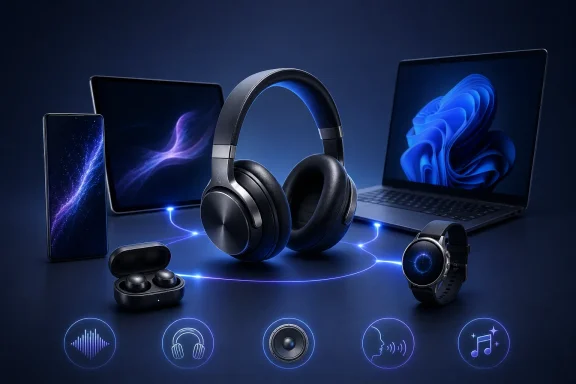
SoundGuys is arguing that Samsung should add premium over-ear headphones to the Galaxy ecosystem, giving users who already rely on Galaxy phones, tablets, watches, laptops, and earbuds a direct alternative to Apple’s AirPods Max 2 and established models such as Sony’s WH-1000XM6. The case is stronger than a simple request for another audio product. Samsung has assembled nearly every ingredient required for a credible flagship headset, yet it still leaves its most committed customers to buy the most immersive personal-audio device from somebody else.
That absence matters because over-ear headphones solve problems that better earbuds cannot. They serve listeners who cannot tolerate an in-ear fit, provide more physical room for acoustic hardware, and remain better suited to long workdays, flights, concentrated listening, and desktop use. Samsung’s failure to address that category is becoming less understandable as its device ecosystem grows more ambitious.
The SoundGuys argument begins with the perspective of a committed customer rather than a dissatisfied outsider. The author says they have owned Samsung earbuds from the original Galaxy Buds through the Galaxy Buds 4 Pro, and they continue to wear the Galaxy Buds 4 Pro for hours every day. Sound, comfort, and integration with Samsung devices have kept the Galaxy Buds line at the center of that listening routine.
That history gives the criticism weight. This is not a complaint that Samsung makes inadequate earbuds; it is an argument that earbuds, however accomplished, cannot cover every listening situation. A customer can be satisfied with Galaxy Buds and still need a different physical form factor.
Samsung already encourages users to think of Galaxy devices as parts of a coordinated system. Phones, tablets, watches, laptops, and earbuds exchange information, share accounts, and reduce the friction involved in moving from one screen to another. Galaxy Buds reinforce that strategy through features such as automatic device switching and controls that become more valuable when several Samsung products are in use.
But when that same customer wants full-size headphones, the ecosystem abruptly ends. The buyer must choose a specialist manufacturer such as Sony or consider Apple’s AirPods Max 2, even though Apple’s deepest integration naturally targets its own hardware. Samsung has done the difficult work of creating customer loyalty and then declined to sell a product to the loyal customer standing at the checkout.
The missed opportunity is not merely financial. Every third-party headset introduced into a Galaxy household weakens Samsung’s claim that its ecosystem can rival Apple’s in completeness. A Sony headset may function perfectly well with a Galaxy phone, but it becomes another app, another device-management layer, another set of controls, and another product relationship outside Samsung’s orbit.
Apple understands that an ecosystem does not have to contain the objectively best product in every category. It needs to provide a sufficiently polished first-party option that makes leaving the ecosystem feel unnecessary. Samsung has achieved that with earbuds but not with over-ear listening, where the company effectively tells customers to shop around.
The SoundGuys author reports wearing Galaxy Buds 4 Pro for hours every day but still experiencing soreness toward the end of long sessions. With over-ear headphones, that discomfort reportedly does not occur. The distinction is important because it shows that even a user who considers Samsung’s earbuds comfortable can encounter the limits of an in-ear design.
For other people, the problem is more severe. The author says the Galaxy Buds Live came closest to being comfortable for their wife, yet she could tolerate them for only an hour or less. Small ears, differently shaped ears, sensitivity to pressure, and difficulty obtaining a stable seal can turn otherwise excellent earbuds into products that are physically unusable.
Over-ear headphones do not guarantee comfort. Clamp force, weight, heat, headband pressure, glasses, ear-cup depth, and material choices all matter. Yet they shift the engineering problem away from placing hardware inside the ear canal and toward distributing it around the head and outer ear, opening the category to listeners whom Galaxy Buds cannot adequately serve.
That distinction also changes how a product is used. Earbuds excel when portability is the priority: commuting, exercise, short calls, walking, and situations in which a charging case needs to disappear into a pocket. Over-ear headphones make more sense when the listening session itself is the priority, especially at a desk, on a long trip, or during uninterrupted work.
This is why a Samsung headset would not simply cannibalize Galaxy Buds. Many customers use both formats because they perform different jobs. Earbuds are the everyday carry device; headphones are the extended-session device. Asking one format to replace the other misses the way personal audio is actually used.
Noise cancellation adds another comfort dimension. In-ear models frequently depend on a tight seal, which can create the plugged-up sensation the SoundGuys author describes. Over-ear cups can provide passive isolation by surrounding the ear, allowing the physical structure and active processing to work together without requiring an object to remain pressed into the ear canal.
Samsung can continue refining the ergonomic design of its earbuds, but it cannot engineer its way around the basic fact that some customers do not want—or cannot tolerate—an in-ear product. An over-ear model would expand the addressable Galaxy audience, not merely offer existing Galaxy Buds buyers a more expensive version of the same experience.
Samsung has already demonstrated that it takes audio seriously in the Galaxy Buds line. The author praises the sound of Samsung’s earbuds and specifically calls out the Samsung Seamless Codec, or SSC, as a strong component of the experience when used with compatible Samsung phones and tablets. The proprietary nature of SSC limits its appeal outside the ecosystem, but inside that ecosystem it becomes one of Samsung’s clearest technical advantages.
A premium headset could turn that limitation into a sales strategy. Samsung could offer a broadly functional Bluetooth product for ordinary devices while reserving its most tightly integrated audio path for compatible Galaxy hardware. Apple has long made ecosystem advantages part of the value proposition rather than treating platform dependence as an embarrassment.
Samsung would need to resist the temptation to make codec support the entire pitch. Audio specifications are useful for marketing, but customers experience a headset through the complete chain: fit, seal, tuning, noise cancellation, microphone quality, controls, connection reliability, battery behavior, and the way software responds when several devices are nearby. A premium product that sounds impressive but behaves unpredictably would undermine the ecosystem argument.
The opportunity is to take what already works in Galaxy Buds and remove the spatial constraints imposed by earbuds. More internal volume could reportedly give Samsung greater freedom with drivers, microphones, batteries, and acoustic chambers, while the larger external surface could accommodate controls that are easier to use without dislodging the product.
The four models cited by SoundGuys play different roles in this argument:
The comparison exposes the strategic gap. Samsung participates in the first two rows and leaves the second two to rivals. Its customers can choose a compact Galaxy product or abandon the Galaxy brand when they need full-size headphones.
The author highlights voice commands introduced with the Galaxy Buds 3 and Galaxy Buds 3 Pro. Hands-free control of playback and volume has become part of their daily routine because it eliminates the need to reach for either the phone or earbuds. A Galaxy headset should preserve that behavior rather than replace it with a disconnected control scheme.
Automatic device switching would be equally central. The value of an ecosystem headset becomes obvious when a user moves from music on a phone to a meeting on a laptop, a video on a tablet, or a call arriving elsewhere. Bluetooth pairing is no longer the impressive part; deciding which device should own the connection and making that transition reliably is where first-party integration earns its keep.
This is particularly relevant to Windows users. Samsung sells laptops and already treats the PC as part of the wider Galaxy environment. A headset that could move predictably between a Galaxy phone and a Windows laptop would provide a practical advantage during work rather than merely a brand-consistency benefit.
The difficult part is that ecosystem features are judged by their worst moments. A feature that switches correctly most of the time can become infuriating if it repeatedly steals audio from the wrong device, interrupts meetings, or refuses to release a connection. Samsung would have to make the rules visible and configurable rather than assuming that automation is always desirable.
A credible implementation would therefore require more than a checkbox labeled Auto Switch. Users should be able to understand connection priority, disable individual devices, prevent interruptions during calls, and manually reclaim a source without navigating several menus. The headset should behave like a mature endpoint in a multi-device system, not like an earbud implementation enlarged to fit an ear cup.
The same principle applies to voice controls. Commands must work in noisy rooms and should not trigger accidentally during conversation. They also need to coexist with physical controls, because users wearing gloves, working in an office, or sitting in a meeting may not want to speak aloud to change volume.
Samsung’s advantage is that these are not abstract capabilities it would be inventing from nothing. The company already deploys related features through Galaxy Buds. The task would be to refine and extend them for a product likely to remain on a user’s head for longer sessions and to spend more time connected to laptops, tablets, and televisions.
Samsung would have to answer both. A headset built entirely around Galaxy-exclusive features might appeal to the most committed customers but struggle when paired with other Android phones, Windows PCs outside Samsung’s lineup, work computers, game systems, and shared household devices. A platform-neutral headset, meanwhile, could lose the very integration that justifies placing the Galaxy name on it.
The balance should resemble a layered product rather than a locked one. Core listening, controls, calling, noise cancellation, and ordinary Bluetooth behavior should function broadly. Galaxy owners should then receive additional convenience through SSC, automatic switching, account-linked setup, device finding, synchronized settings, and deeper integration with Samsung software.
That approach would let Samsung compete with Sony on baseline competence and Apple on ecosystem value. It would also avoid making the headset feel disposable if the owner later changes phone brands. Customers are more willing to invest in premium audio hardware when they expect it to outlast a single phone-upgrade cycle.
Samsung must also recognize that AirPods Max 2 and the Sony WH-1000XM6 are not interchangeable targets. Buyers considering Apple may be drawn to materials, industrial design, integration, and status as much as sound. Buyers considering Sony may prioritize noise cancellation, comfort, portability, controls, tuning, or device flexibility.
Trying to defeat both with a specification checklist would produce a confused product. Samsung needs a coherent reason for the headset to exist: it should be the default full-size personal-audio device for Galaxy users while remaining a respectable headphone everywhere else.
That means the company cannot rely solely on brand attachment. Galaxy customers may prefer first-party accessories, but the SoundGuys article makes clear that they already have credible alternatives. The author has been tempted by the Sony WH-1000XM6 many times and will eventually need to look elsewhere if Samsung continues to offer nothing.
The competitive danger is not that Galaxy users will suddenly abandon Samsung phones. It is that they will discover another audio brand, install its software, grow comfortable with its controls, and stop waiting for Samsung to fill the gap. Ecosystem loyalty can be eroded one peripheral at a time.
That corporate structure may also help explain the hesitation. A Galaxy headset could overlap with products sold elsewhere in the portfolio, creating internal arguments over pricing, positioning, distribution, and technology. What appears from the outside to be an obvious missing product may look internally like a cannibalization problem.
Yet portfolio overlap is not automatically a reason to surrender the category. Samsung already uses the Galaxy brand to express a particular relationship between hardware and software. A HARMAN-associated headphone and a Galaxy headset could serve different buyers even if they shared selected research, components, or acoustic expertise.
The distinguishing feature would not need to be that Samsung suddenly knows more about audio than its subsidiaries. It would be that the Galaxy division can connect headphones to Samsung accounts, devices, services, and interface conventions in ways that a more independent audio brand may not prioritize.
Samsung could even use its audio holdings as an advantage without turning the product into a badge-engineering exercise. Acoustic expertise, testing resources, and established supply relationships could reduce some of the risks involved in entering a mature premium category. Galaxy software and industrial design could then provide the customer-facing identity.
What Samsung should not do is take an existing headset, change the logo, add SSC, and declare the ecosystem complete. Customers spending premium money will notice if the physical design, control logic, microphone system, and carrying experience were not conceived as one product. Integration cannot rescue mediocre hardware any more than excellent hardware can fully compensate for unreliable software.
The longer Samsung waits, the higher the expected standard becomes. A first-generation Galaxy headset would no longer arrive in an immature category. It would be compared immediately against products refined over multiple generations and against Apple’s ability to make first-party integration part of the purchasing decision.
Weight distribution would matter as much as total weight. Ear cups would need enough depth to avoid pressing against a wide variety of ears, while the headband would need to distribute force over long sessions. Replaceable cushions would be preferable for hygiene, longevity, and fit, especially if the product is meant to survive several phone generations.
Heat management would deserve similar attention. Over-ear headphones isolate partly by enclosing the ear, but that enclosure can become uncomfortable during long work sessions. Samsung would need to balance passive isolation against ventilation without undermining noise cancellation or causing excessive sound leakage.
Physical controls should remain usable by touch. The Galaxy Buds approach is optimized for tiny surfaces and highly portable products; a headset offers room for distinct buttons, dials, touch areas, or other mechanisms. Samsung should use that space to reduce ambiguity rather than turning the ear cup into an invisible gesture puzzle.
The product should also acknowledge that over-ear headphones are used differently from earbuds. They are more likely to be set on a desk, carried in a bag, worn on flights, connected to computers for hours, or used while charging. Durability around hinges, headband adjustment, cushions, and charging ports would shape long-term satisfaction more than an impressive launch demonstration.
Microphone quality would be another test. Laptop meetings and phone calls are central use cases for a Galaxy ecosystem headset, particularly if Samsung wants Windows integration to be meaningful. The microphone system must handle ordinary office noise and movement without making the wearer sound remote or aggressively processed.
Battery behavior should be predictable rather than theatrical. Users need clear status reporting across connected devices, sensible low-power modes, and charging behavior that does not make the headset unavailable whenever the battery is depleted. A premium headset is often expected to function as work equipment, and work equipment cannot behave like a temperamental fashion accessory.
Samsung should also avoid pushing every interaction through a phone. Settings may live in Galaxy software, but essential controls should remain available on the headset, and Windows users should not have to reach for a mobile device every time they need to change a listening mode. The ecosystem should remove friction, not redistribute it.
That calculus, however, undervalues the customers Samsung would not need to acquire. The SoundGuys author already owns the phones, tablets, watches, laptops, and earbuds that would make a Galaxy headset more useful. Samsung would not need to explain the ecosystem from the beginning; it would need only to extend an existing relationship.
This is the same reason the product should not be evaluated purely as a standalone profit center. A compelling headset could reinforce the attractiveness of Galaxy phones and laptops, increase attachment to Samsung accounts and software, and make the entire collection feel more complete. Accessories can defend the value of the core platform even when they are not its largest business.
Conversely, the absence imposes a small but recurring ecosystem tax. Every time a Galaxy customer researches Sony, Apple, Bose, Sennheiser, or another headphone maker, Samsung loses control of the purchase journey. The customer learns that leaving the ecosystem for one category is survivable and perhaps beneficial.
Samsung should not assume that Galaxy loyalty guarantees an instant hit. The poll attached to the SoundGuys article asks, “Would you buy Samsung headphones?” and shows Yes at 100% and No at 0%, but it contains only two votes. That is an anecdote, not market validation.
Still, the poll is useful in a narrower sense. It captures the intensity of demand among the small number of people who responded, while the author’s purchasing history demonstrates the type of customer Samsung would be targeting. The strategic question is not whether two voters constitute a market; they plainly do not. It is whether they represent a larger group of Galaxy owners whose needs are currently invisible in Samsung’s product range.
Samsung has better ways to answer that question than outside observers do. It can examine accessory attachment, device combinations, customer searches, trade-in behavior, support requests, and how often Galaxy users connect third-party headphones. If a meaningful share of its most committed customers already owns premium over-ear models from competitors, the market may be sitting inside Samsung’s existing user base.
A headset can pair with a Windows PC and still create daily frustration. Users may encounter uncertainty over which microphone is active, whether a phone call will interrupt a meeting, which device controls the equalizer, and where battery status or firmware settings can be found. These are not glamorous problems, but solving them is exactly how an ecosystem earns loyalty.
Samsung already has a reason to care about this boundary because Galaxy laptops coexist with its phones, tablets, watches, and earbuds. An over-ear model could make the PC a first-class part of the audio handoff instead of treating Windows as a generic Bluetooth destination.
For business users, the ideal product would transition between focused listening and communications without requiring constant reconfiguration. It would remember sensible preferences for different devices, preserve microphone reliability, and avoid automatically moving audio at inappropriate moments. Administrators might not centrally manage such a consumer-oriented headset, but they would still feel the support consequences if employees brought unreliable devices into meetings.
Samsung should therefore consider the Windows experience during product design, not after launch. A companion application, firmware-update path, diagnostic information, and transparent connection controls would matter. So would compatibility with ordinary Windows systems, rather than limiting the best desktop experience so tightly that only a narrow subset of Galaxy-branded PCs receives it.
There is an opportunity here that Apple cannot address in the same way. Samsung’s mobile ecosystem is built on Android, but many of its customers work on Windows. A headset designed explicitly around that combination could become more useful to those buyers than an accessory optimized primarily for Apple hardware.
Sony and other headphone specialists already offer broad compatibility, so Samsung cannot win merely by supporting Windows. It must make Windows and Galaxy devices behave like parts of one user environment while preserving enough standard functionality to work on a corporate PC, a home desktop, or another manufacturer’s laptop.
That would turn the product from an AirPods Max imitator into something more strategically interesting: a premium headset built for people whose personal and professional computing lives cross platform boundaries every day.
Samsung may also believe that third-party compatibility is good enough. From a customer-service perspective, Galaxy owners can already buy the Sony WH-1000XM6 or another established headset and connect it to their devices. Samsung does not need to manufacture every product that works with a Galaxy phone.
But that argument contradicts the logic of ecosystem competition. If generic Bluetooth compatibility were enough, Apple would have had little reason to build premium over-ear headphones. The value lies in controlling both the ordinary audio experience and the interactions that occur around it.
Waiting also allows competitors to define customer expectations. Every year without a Galaxy headset gives established manufacturers more time to refine comfort, noise cancellation, apps, controls, and multi-device behavior. It gives Apple more time to make AirPods Max 2 synonymous with premium first-party over-ear audio.
Samsung does not need to rush an unfinished product to market. It does need to decide whether the Galaxy ecosystem is intended to cover the complete personal-computing experience or only the categories that map most directly to a smartphone launch. If the ambition is the former, the current gap is difficult to defend.
The strongest version of Samsung’s strategy would treat earbuds and headphones as complementary endpoints. Galaxy Buds would remain the portable default for commuting, exercise, and everyday carry. The over-ear model would serve travel, work, entertainment, and long listening sessions while sharing the same account, connection logic, voice controls, and audio technologies.
That would give customers a reason to own both rather than forcing Samsung to choose between them. It would also allow features and settings to feel familiar across form factors without pretending that the two products should be operated or worn in exactly the same way.
The essentials are now clear:
The demand reflected in two poll votes cannot prove that the business case works, but the underlying argument does not depend on that tiny sample. As Galaxy expands across more screens and more parts of a user’s day, the absence of a first-party over-ear headset becomes more conspicuous. Samsung can continue letting Sony, Apple, and other audio companies finish the Galaxy customer’s setup, or it can recognize that the next important Galaxy audio product may not belong inside the ear at all.
That absence matters because over-ear headphones solve problems that better earbuds cannot. They serve listeners who cannot tolerate an in-ear fit, provide more physical room for acoustic hardware, and remain better suited to long workdays, flights, concentrated listening, and desktop use. Samsung’s failure to address that category is becoming less understandable as its device ecosystem grows more ambitious.
 Samsung Has Built an Ecosystem With a Headphone-Shaped Hole
The SoundGuys argument begins with the perspective of a committed customer rather than a dissatisfied outsider. The author says they have owned Samsung earbuds from the original Galaxy Buds through the Galaxy Buds 4 Pro, and they continue to wear the Galaxy Buds 4 Pro for hours every day. Sound, comfort, and integration with Samsung devices have kept the Galaxy Buds line at the center of that listening routine.That history gives the criticism weight. This is not a complaint that Samsung makes inadequate earbuds; it is an argument that earbuds, however accomplished, cannot cover every listening situation. A customer can be satisfied with Galaxy Buds and still need a different physical form factor.
Samsung already encourages users to think of Galaxy devices as parts of a coordinated system. Phones, tablets, watches, laptops, and earbuds exchange information, share accounts, and reduce the friction involved in moving from one screen to another. Galaxy Buds reinforce that strategy through features such as automatic device switching and controls that become more valuable when several Samsung products are in use.
But when that same customer wants full-size headphones, the ecosystem abruptly ends. The buyer must choose a specialist manufacturer such as Sony or consider Apple’s AirPods Max 2, even though Apple’s deepest integration naturally targets its own hardware. Samsung has done the difficult work of creating customer loyalty and then declined to sell a product to the loyal customer standing at the checkout.
The missed opportunity is not merely financial. Every third-party headset introduced into a Galaxy household weakens Samsung’s claim that its ecosystem can rival Apple’s in completeness. A Sony headset may function perfectly well with a Galaxy phone, but it becomes another app, another device-management layer, another set of controls, and another product relationship outside Samsung’s orbit.
Apple understands that an ecosystem does not have to contain the objectively best product in every category. It needs to provide a sufficiently polished first-party option that makes leaving the ecosystem feel unnecessary. Samsung has achieved that with earbuds but not with over-ear listening, where the company effectively tells customers to shop around.
Comfort Is the Argument Earbud Specifications Cannot Defeat
The most persuasive case for Samsung headphones is not a codec, a driver configuration, or a noise-cancellation benchmark. It is anatomy. Earbuds must fit inside or against an unusually variable part of the human body, and no amount of software can guarantee that one design will remain comfortable for every listener.The SoundGuys author reports wearing Galaxy Buds 4 Pro for hours every day but still experiencing soreness toward the end of long sessions. With over-ear headphones, that discomfort reportedly does not occur. The distinction is important because it shows that even a user who considers Samsung’s earbuds comfortable can encounter the limits of an in-ear design.
For other people, the problem is more severe. The author says the Galaxy Buds Live came closest to being comfortable for their wife, yet she could tolerate them for only an hour or less. Small ears, differently shaped ears, sensitivity to pressure, and difficulty obtaining a stable seal can turn otherwise excellent earbuds into products that are physically unusable.
Over-ear headphones do not guarantee comfort. Clamp force, weight, heat, headband pressure, glasses, ear-cup depth, and material choices all matter. Yet they shift the engineering problem away from placing hardware inside the ear canal and toward distributing it around the head and outer ear, opening the category to listeners whom Galaxy Buds cannot adequately serve.
That distinction also changes how a product is used. Earbuds excel when portability is the priority: commuting, exercise, short calls, walking, and situations in which a charging case needs to disappear into a pocket. Over-ear headphones make more sense when the listening session itself is the priority, especially at a desk, on a long trip, or during uninterrupted work.
This is why a Samsung headset would not simply cannibalize Galaxy Buds. Many customers use both formats because they perform different jobs. Earbuds are the everyday carry device; headphones are the extended-session device. Asking one format to replace the other misses the way personal audio is actually used.
Noise cancellation adds another comfort dimension. In-ear models frequently depend on a tight seal, which can create the plugged-up sensation the SoundGuys author describes. Over-ear cups can provide passive isolation by surrounding the ear, allowing the physical structure and active processing to work together without requiring an object to remain pressed into the ear canal.
Samsung can continue refining the ergonomic design of its earbuds, but it cannot engineer its way around the basic fact that some customers do not want—or cannot tolerate—an in-ear product. An over-ear model would expand the addressable Galaxy audience, not merely offer existing Galaxy Buds buyers a more expensive version of the same experience.
A Larger Chassis Would Give Samsung’s Sound Room to Grow
SoundGuys also makes the intuitive argument that full-size headphones can accommodate larger drivers and more substantial hardware. Bigger does not automatically mean better; tuning, enclosure design, amplification, processing, and distortion control remain decisive. Still, an over-ear chassis gives engineers a different set of acoustic and electrical constraints than a tiny battery-powered earbud.Samsung has already demonstrated that it takes audio seriously in the Galaxy Buds line. The author praises the sound of Samsung’s earbuds and specifically calls out the Samsung Seamless Codec, or SSC, as a strong component of the experience when used with compatible Samsung phones and tablets. The proprietary nature of SSC limits its appeal outside the ecosystem, but inside that ecosystem it becomes one of Samsung’s clearest technical advantages.
A premium headset could turn that limitation into a sales strategy. Samsung could offer a broadly functional Bluetooth product for ordinary devices while reserving its most tightly integrated audio path for compatible Galaxy hardware. Apple has long made ecosystem advantages part of the value proposition rather than treating platform dependence as an embarrassment.
Samsung would need to resist the temptation to make codec support the entire pitch. Audio specifications are useful for marketing, but customers experience a headset through the complete chain: fit, seal, tuning, noise cancellation, microphone quality, controls, connection reliability, battery behavior, and the way software responds when several devices are nearby. A premium product that sounds impressive but behaves unpredictably would undermine the ecosystem argument.
The opportunity is to take what already works in Galaxy Buds and remove the spatial constraints imposed by earbuds. More internal volume could reportedly give Samsung greater freedom with drivers, microphones, batteries, and acoustic chambers, while the larger external surface could accommodate controls that are easier to use without dislodging the product.
The four models cited by SoundGuys play different roles in this argument:
| Model | Form factor | Role in the case | Reported user context |
|---|---|---|---|
| Galaxy Buds 4 Pro | In-ear earbuds | Samsung’s current enthusiast reference point | Worn by the author for hours every day |
| Galaxy Buds Live | Earbuds with an unconventional fit | Closest Samsung option to fitting the author’s wife comfortably | Tolerated for an hour or less |
| AirPods Max 2 | Over-ear headphones | The first-party ecosystem model Samsung is being urged to challenge | Apple’s premium reference point |
| Sony WH-1000XM6 | Over-ear headphones | The established third-party alternative | A model that has repeatedly tempted the author |
The Real Product Would Be Continuity, Not Just Better Audio
Samsung does not need another pair of generic Bluetooth headphones. The market already offers accomplished models, and SoundGuys explicitly points to the Sony WH-1000XM6 as a tempting option. A Samsung headset would justify its existence by transferring the Galaxy experience into a form factor that Samsung does not currently serve.The author highlights voice commands introduced with the Galaxy Buds 3 and Galaxy Buds 3 Pro. Hands-free control of playback and volume has become part of their daily routine because it eliminates the need to reach for either the phone or earbuds. A Galaxy headset should preserve that behavior rather than replace it with a disconnected control scheme.
Automatic device switching would be equally central. The value of an ecosystem headset becomes obvious when a user moves from music on a phone to a meeting on a laptop, a video on a tablet, or a call arriving elsewhere. Bluetooth pairing is no longer the impressive part; deciding which device should own the connection and making that transition reliably is where first-party integration earns its keep.
This is particularly relevant to Windows users. Samsung sells laptops and already treats the PC as part of the wider Galaxy environment. A headset that could move predictably between a Galaxy phone and a Windows laptop would provide a practical advantage during work rather than merely a brand-consistency benefit.
The difficult part is that ecosystem features are judged by their worst moments. A feature that switches correctly most of the time can become infuriating if it repeatedly steals audio from the wrong device, interrupts meetings, or refuses to release a connection. Samsung would have to make the rules visible and configurable rather than assuming that automation is always desirable.
A credible implementation would therefore require more than a checkbox labeled Auto Switch. Users should be able to understand connection priority, disable individual devices, prevent interruptions during calls, and manually reclaim a source without navigating several menus. The headset should behave like a mature endpoint in a multi-device system, not like an earbud implementation enlarged to fit an ear cup.
The same principle applies to voice controls. Commands must work in noisy rooms and should not trigger accidentally during conversation. They also need to coexist with physical controls, because users wearing gloves, working in an office, or sitting in a meeting may not want to speak aloud to change volume.
Samsung’s advantage is that these are not abstract capabilities it would be inventing from nothing. The company already deploys related features through Galaxy Buds. The task would be to refine and extend them for a product likely to remain on a user’s head for longer sessions and to spend more time connected to laptops, tablets, and televisions.
Apple and Sony Represent Two Different Competitive Threats
Calling the proposed device an AirPods Max 2 competitor captures the headline but not the whole battlefield. Apple represents the ecosystem threat: a premium first-party headset designed to become more valuable as the owner acquires more products from the same company. Sony represents the category threat: an established headphone maker that can win Samsung customers without needing to reproduce the Galaxy ecosystem.Samsung would have to answer both. A headset built entirely around Galaxy-exclusive features might appeal to the most committed customers but struggle when paired with other Android phones, Windows PCs outside Samsung’s lineup, work computers, game systems, and shared household devices. A platform-neutral headset, meanwhile, could lose the very integration that justifies placing the Galaxy name on it.
The balance should resemble a layered product rather than a locked one. Core listening, controls, calling, noise cancellation, and ordinary Bluetooth behavior should function broadly. Galaxy owners should then receive additional convenience through SSC, automatic switching, account-linked setup, device finding, synchronized settings, and deeper integration with Samsung software.
That approach would let Samsung compete with Sony on baseline competence and Apple on ecosystem value. It would also avoid making the headset feel disposable if the owner later changes phone brands. Customers are more willing to invest in premium audio hardware when they expect it to outlast a single phone-upgrade cycle.
Samsung must also recognize that AirPods Max 2 and the Sony WH-1000XM6 are not interchangeable targets. Buyers considering Apple may be drawn to materials, industrial design, integration, and status as much as sound. Buyers considering Sony may prioritize noise cancellation, comfort, portability, controls, tuning, or device flexibility.
Trying to defeat both with a specification checklist would produce a confused product. Samsung needs a coherent reason for the headset to exist: it should be the default full-size personal-audio device for Galaxy users while remaining a respectable headphone everywhere else.
That means the company cannot rely solely on brand attachment. Galaxy customers may prefer first-party accessories, but the SoundGuys article makes clear that they already have credible alternatives. The author has been tempted by the Sony WH-1000XM6 many times and will eventually need to look elsewhere if Samsung continues to offer nothing.
The competitive danger is not that Galaxy users will suddenly abandon Samsung phones. It is that they will discover another audio brand, install its software, grow comfortable with its controls, and stop waiting for Samsung to fill the gap. Ecosystem loyalty can be eroded one peripheral at a time.
HARMAN Makes Samsung’s Absence Harder to Explain
Samsung’s ownership of HARMAN makes the lack of a Galaxy-branded over-ear flagship especially conspicuous. Through HARMAN, Samsung sits above an extensive collection of audio expertise and brands. The question is therefore less whether the broader organization knows how to build headphones and more whether Samsung believes a Galaxy model would add enough value without interfering with existing businesses.That corporate structure may also help explain the hesitation. A Galaxy headset could overlap with products sold elsewhere in the portfolio, creating internal arguments over pricing, positioning, distribution, and technology. What appears from the outside to be an obvious missing product may look internally like a cannibalization problem.
Yet portfolio overlap is not automatically a reason to surrender the category. Samsung already uses the Galaxy brand to express a particular relationship between hardware and software. A HARMAN-associated headphone and a Galaxy headset could serve different buyers even if they shared selected research, components, or acoustic expertise.
The distinguishing feature would not need to be that Samsung suddenly knows more about audio than its subsidiaries. It would be that the Galaxy division can connect headphones to Samsung accounts, devices, services, and interface conventions in ways that a more independent audio brand may not prioritize.
Samsung could even use its audio holdings as an advantage without turning the product into a badge-engineering exercise. Acoustic expertise, testing resources, and established supply relationships could reduce some of the risks involved in entering a mature premium category. Galaxy software and industrial design could then provide the customer-facing identity.
What Samsung should not do is take an existing headset, change the logo, add SSC, and declare the ecosystem complete. Customers spending premium money will notice if the physical design, control logic, microphone system, and carrying experience were not conceived as one product. Integration cannot rescue mediocre hardware any more than excellent hardware can fully compensate for unreliable software.
The longer Samsung waits, the higher the expected standard becomes. A first-generation Galaxy headset would no longer arrive in an immature category. It would be compared immediately against products refined over multiple generations and against Apple’s ability to make first-party integration part of the purchasing decision.
A Galaxy Headset Must Be Designed Around Long Sessions
The SoundGuys case starts with comfort, and Samsung should treat that as the product brief rather than as one marketing bullet among many. A headset meant for people who cannot comfortably use earbuds must not introduce a different collection of pressure problems.Weight distribution would matter as much as total weight. Ear cups would need enough depth to avoid pressing against a wide variety of ears, while the headband would need to distribute force over long sessions. Replaceable cushions would be preferable for hygiene, longevity, and fit, especially if the product is meant to survive several phone generations.
Heat management would deserve similar attention. Over-ear headphones isolate partly by enclosing the ear, but that enclosure can become uncomfortable during long work sessions. Samsung would need to balance passive isolation against ventilation without undermining noise cancellation or causing excessive sound leakage.
Physical controls should remain usable by touch. The Galaxy Buds approach is optimized for tiny surfaces and highly portable products; a headset offers room for distinct buttons, dials, touch areas, or other mechanisms. Samsung should use that space to reduce ambiguity rather than turning the ear cup into an invisible gesture puzzle.
The product should also acknowledge that over-ear headphones are used differently from earbuds. They are more likely to be set on a desk, carried in a bag, worn on flights, connected to computers for hours, or used while charging. Durability around hinges, headband adjustment, cushions, and charging ports would shape long-term satisfaction more than an impressive launch demonstration.
Microphone quality would be another test. Laptop meetings and phone calls are central use cases for a Galaxy ecosystem headset, particularly if Samsung wants Windows integration to be meaningful. The microphone system must handle ordinary office noise and movement without making the wearer sound remote or aggressively processed.
Battery behavior should be predictable rather than theatrical. Users need clear status reporting across connected devices, sensible low-power modes, and charging behavior that does not make the headset unavailable whenever the battery is depleted. A premium headset is often expected to function as work equipment, and work equipment cannot behave like a temperamental fashion accessory.
Samsung should also avoid pushing every interaction through a phone. Settings may live in Galaxy software, but essential controls should remain available on the headset, and Windows users should not have to reach for a mobile device every time they need to change a listening mode. The ecosystem should remove friction, not redistribute it.
Samsung’s Best Advantage Is the Customer It Already Has
Entering a mature headphone market is expensive. Industrial design, acoustic engineering, certification, manufacturing, retail placement, support, and replacement parts all add complexity. Samsung may reasonably believe that premium over-ear headphones would sell in lower volumes than earbuds while competing against entrenched products.That calculus, however, undervalues the customers Samsung would not need to acquire. The SoundGuys author already owns the phones, tablets, watches, laptops, and earbuds that would make a Galaxy headset more useful. Samsung would not need to explain the ecosystem from the beginning; it would need only to extend an existing relationship.
This is the same reason the product should not be evaluated purely as a standalone profit center. A compelling headset could reinforce the attractiveness of Galaxy phones and laptops, increase attachment to Samsung accounts and software, and make the entire collection feel more complete. Accessories can defend the value of the core platform even when they are not its largest business.
Conversely, the absence imposes a small but recurring ecosystem tax. Every time a Galaxy customer researches Sony, Apple, Bose, Sennheiser, or another headphone maker, Samsung loses control of the purchase journey. The customer learns that leaving the ecosystem for one category is survivable and perhaps beneficial.
Samsung should not assume that Galaxy loyalty guarantees an instant hit. The poll attached to the SoundGuys article asks, “Would you buy Samsung headphones?” and shows Yes at 100% and No at 0%, but it contains only two votes. That is an anecdote, not market validation.
Still, the poll is useful in a narrower sense. It captures the intensity of demand among the small number of people who responded, while the author’s purchasing history demonstrates the type of customer Samsung would be targeting. The strategic question is not whether two voters constitute a market; they plainly do not. It is whether they represent a larger group of Galaxy owners whose needs are currently invisible in Samsung’s product range.
Samsung has better ways to answer that question than outside observers do. It can examine accessory attachment, device combinations, customer searches, trade-in behavior, support requests, and how often Galaxy users connect third-party headphones. If a meaningful share of its most committed customers already owns premium over-ear models from competitors, the market may be sitting inside Samsung’s existing user base.
Windows Is Where the Ecosystem Claim Would Be Tested
A Galaxy headset could become especially relevant at the boundary between mobile devices and Windows PCs. That is where many wireless-audio products expose the difference between being technically compatible and being genuinely integrated.A headset can pair with a Windows PC and still create daily frustration. Users may encounter uncertainty over which microphone is active, whether a phone call will interrupt a meeting, which device controls the equalizer, and where battery status or firmware settings can be found. These are not glamorous problems, but solving them is exactly how an ecosystem earns loyalty.
Samsung already has a reason to care about this boundary because Galaxy laptops coexist with its phones, tablets, watches, and earbuds. An over-ear model could make the PC a first-class part of the audio handoff instead of treating Windows as a generic Bluetooth destination.
For business users, the ideal product would transition between focused listening and communications without requiring constant reconfiguration. It would remember sensible preferences for different devices, preserve microphone reliability, and avoid automatically moving audio at inappropriate moments. Administrators might not centrally manage such a consumer-oriented headset, but they would still feel the support consequences if employees brought unreliable devices into meetings.
Samsung should therefore consider the Windows experience during product design, not after launch. A companion application, firmware-update path, diagnostic information, and transparent connection controls would matter. So would compatibility with ordinary Windows systems, rather than limiting the best desktop experience so tightly that only a narrow subset of Galaxy-branded PCs receives it.
There is an opportunity here that Apple cannot address in the same way. Samsung’s mobile ecosystem is built on Android, but many of its customers work on Windows. A headset designed explicitly around that combination could become more useful to those buyers than an accessory optimized primarily for Apple hardware.
Sony and other headphone specialists already offer broad compatibility, so Samsung cannot win merely by supporting Windows. It must make Windows and Galaxy devices behave like parts of one user environment while preserving enough standard functionality to work on a corporate PC, a home desktop, or another manufacturer’s laptop.
That would turn the product from an AirPods Max imitator into something more strategically interesting: a premium headset built for people whose personal and professional computing lives cross platform boundaries every day.
Waiting Is Safe Until It Becomes a Surrender
There are rational reasons for Samsung to wait. Premium over-ear headphones require significant investment, the market is crowded, and a poorly received first generation could damage the Galaxy audio brand. Earbuds are smaller, more portable, closely associated with smartphones, and easier to position as an expected phone companion.Samsung may also believe that third-party compatibility is good enough. From a customer-service perspective, Galaxy owners can already buy the Sony WH-1000XM6 or another established headset and connect it to their devices. Samsung does not need to manufacture every product that works with a Galaxy phone.
But that argument contradicts the logic of ecosystem competition. If generic Bluetooth compatibility were enough, Apple would have had little reason to build premium over-ear headphones. The value lies in controlling both the ordinary audio experience and the interactions that occur around it.
Waiting also allows competitors to define customer expectations. Every year without a Galaxy headset gives established manufacturers more time to refine comfort, noise cancellation, apps, controls, and multi-device behavior. It gives Apple more time to make AirPods Max 2 synonymous with premium first-party over-ear audio.
Samsung does not need to rush an unfinished product to market. It does need to decide whether the Galaxy ecosystem is intended to cover the complete personal-computing experience or only the categories that map most directly to a smartphone launch. If the ambition is the former, the current gap is difficult to defend.
The strongest version of Samsung’s strategy would treat earbuds and headphones as complementary endpoints. Galaxy Buds would remain the portable default for commuting, exercise, and everyday carry. The over-ear model would serve travel, work, entertainment, and long listening sessions while sharing the same account, connection logic, voice controls, and audio technologies.
That would give customers a reason to own both rather than forcing Samsung to choose between them. It would also allow features and settings to feel familiar across form factors without pretending that the two products should be operated or worn in exactly the same way.
What Samsung Must Get Right Before Asking Galaxy Users to Wait Again
The case for a Samsung over-ear product is compelling, but enthusiasm should not become an excuse for an underdeveloped first attempt. SoundGuys is effectively asking Samsung to translate years of Galaxy Buds experience into a different class of hardware, not simply to stretch the Buds brand over a headband.The essentials are now clear:
- Comfort must be the defining requirement, especially for people who cannot tolerate earbuds.
- Core functions must work broadly, while Galaxy devices receive meaningful first-party advantages.
- Samsung Seamless Codec support should complement, not substitute for, excellent acoustic tuning.
- Voice commands and automatic switching should carry over without becoming unpredictable.
- Windows integration should be designed as a primary use case rather than generic Bluetooth compatibility.
- The headset must compete with AirPods Max 2 on ecosystem value and the Sony WH-1000XM6 on everyday headphone competence.
The demand reflected in two poll votes cannot prove that the business case works, but the underlying argument does not depend on that tiny sample. As Galaxy expands across more screens and more parts of a user’s day, the absence of a first-party over-ear headset becomes more conspicuous. Samsung can continue letting Sony, Apple, and other audio companies finish the Galaxy customer’s setup, or it can recognize that the next important Galaxy audio product may not belong inside the ear at all.
References
- Primary source: SoundGuys
Published: Fri, 10 Jul 2026 09:00:00 GMT
Loading…
www.soundguys.com - Related coverage: tomsguide.com
Loading…
www.tomsguide.com - Related coverage: techradar.com
Loading…
www.techradar.com - Related coverage: whathifi.com
Loading…
www.whathifi.com - Related coverage: samsung.com
Loading…
www.samsung.com - Related coverage: news.samsung.com
Loading…
news.samsung.com
- Related coverage: sony.com
Loading…
www.sony.com - Official source: apple.com
Loading…
www.apple.com - Related coverage: macworld.com
Loading…
www.macworld.com - Related coverage: electronics.sony.com
Loading…
electronics.sony.com - Related coverage: image-us.samsung.com
Loading…
image-us.samsung.com - Related coverage: daringfireball.net
Loading…
daringfireball.net - Related coverage: revuze.it
Loading…
www.revuze.it - Related coverage: creativebloq.com
Loading…
www.creativebloq.com - Related coverage: t3.com
Loading…
www.t3.com - Related coverage: images.samsung.com
Loading…
images.samsung.com