

Samsung Health is reportedly presenting some users with a stark choice: permit their health information to be used for AI training and modelling, or lose Samsung account synchronization and have already-synced data deleted. The new consent screen was first reported by How-To Geek on July 10 and has since appeared in additional reporting, although Samsung has not publicly detailed the rollout’s scope or whether every region will receive identical terms.
The prompt is titled “Consent to the Use of Health Data for AI Training and Modelling.” According to the warning shown in the app, withdrawing or refusing consent stops Samsung Health from syncing health data with the user’s Samsung account and triggers deletion of the affected account-stored data unless Samsung must retain it under applicable law.
That distinction matters. Current reporting supports the deletion of data synchronized to Samsung’s account infrastructure, not necessarily every locally stored record on the phone at the moment a user declines. Even so, losing cloud synchronization can effectively break the continuity users expect when replacing a phone, reinstalling the app, resetting a device, or moving between Galaxy products.
Most consumer AI controls are framed around access to a specific feature: accept the processing terms and receive an AI-generated summary, or decline and continue using the underlying service without it. Samsung’s reported approach links AI-model consent to one of Samsung Health’s foundational functions instead.
Users can technically turn the toggle off, but the consequence makes it considerably more than an optional personalization setting. Without account synchronization, years of steps, workouts, sleep measurements, body-composition readings and other records may no longer be recoverable from Samsung’s servers after a device failure or migration.
The prompt reportedly states that Samsung may also use human review while training and modelling its systems. Samsung describes the purpose as improving health analysis and other AI-driven functions, but it has not publicly answered several practical questions raised by the rollout, including whether the training data is anonymized or pseudonymized before use and whether previously trained models can retain information derived from data after consent is withdrawn.
There is also uncertainty over availability. Reports say some Samsung Health users are receiving the notice, rather than establishing a universal global deployment. Consent language and deletion behavior may differ by jurisdiction because privacy laws impose different requirements on health information, withdrawal rights and data retention.
Depending on the devices and features a person uses, the affected categories may include:
Samsung’s US Consumer Health Data Privacy Statement, last updated in July 2025, already describes consumer health data broadly. It covers vital signs, reproductive or sexual-health information, medical records, diagnoses, testing, treatments and prescribed medications, as well as inferred information produced through algorithms or machine learning.
That policy says users have rights to access and request deletion of consumer health data, and to withdraw consent where applicable law requires it. The controversy is not simply whether Samsung offers an opt-out, but whether withdrawing from AI training should also remove the cloud service used to preserve and move a user’s health history.
Samsung’s current support instructions direct users to open Samsung Health, select the three-dot menu, open Settings and choose “Download personal data.” The resulting files are placed in a Samsung Health folder accessible through the device’s file manager. Users can then copy that export to an encrypted PC folder, external drive or another storage location they control.
This is particularly important for people preparing to reject or withdraw consent, replace a phone, clear application data or uninstall Samsung Health. A cloud deletion cannot be treated like a reversible synchronization error, and Samsung’s support documentation warns that intentionally erased Samsung Health data cannot be restored.
An export may not recreate the polished charts, trends and coaching views available inside the app. It does, however, preserve the underlying history for reference or potential import into another service. Windows users can transfer the folder over USB and store it in an encrypted BitLocker-protected volume, provided they also maintain a properly secured recovery key.
Health Connect may provide another copy of certain Android health records when the user has already granted compatible apps access, but it should not be assumed to be a complete Samsung Health backup. Coverage varies by data type, application and permission, and Samsung-specific insights may not transfer.
Users should also distinguish the new AI setting from Samsung Health’s general processing consent. Recent reports from Samsung community users indicate that app updates have exposed multiple privacy toggles, and disabling the wrong one may interrupt ordinary syncing before a user has determined what data is affected.
Those products require large and varied datasets to develop useful models. The business and engineering rationale is clear: more health histories can help Samsung test algorithms against different ages, routines and physiological patterns.
The user relationship is less straightforward. Health information is among the most sensitive data a consumer platform can collect, and meaningful consent requires a choice that is understandable and reasonably free of pressure. Tying refusal to the removal of cloud synchronization risks turning consent into a prerequisite for preserving functionality users may have relied on for years.
Samsung also needs to clarify what “AI training and modelling” means in operational terms. Users have not yet been given a widely published explanation of model types, retention periods, human-review safeguards, de-identification methods, access controls or whether the information could be shared with contractors involved in model development.
Until those details are available, the safest interpretation is the narrow one supported by the displayed warning: refusing the AI consent can stop Samsung account sync and delete the health data stored through that sync, subject to legal retention obligations. Claims that the app immediately wipes every measurement from every connected device go beyond the evidence currently available.
The immediate action is therefore simple but consequential: export first, decide second. Samsung’s next move must be to explain why declining AI training cannot leave ordinary encrypted health synchronization intact—and exactly what happens to years of records when a user says no.
The prompt is titled “Consent to the Use of Health Data for AI Training and Modelling.” According to the warning shown in the app, withdrawing or refusing consent stops Samsung Health from syncing health data with the user’s Samsung account and triggers deletion of the affected account-stored data unless Samsung must retain it under applicable law.
That distinction matters. Current reporting supports the deletion of data synchronized to Samsung’s account infrastructure, not necessarily every locally stored record on the phone at the moment a user declines. Even so, losing cloud synchronization can effectively break the continuity users expect when replacing a phone, reinstalling the app, resetting a device, or moving between Galaxy products.
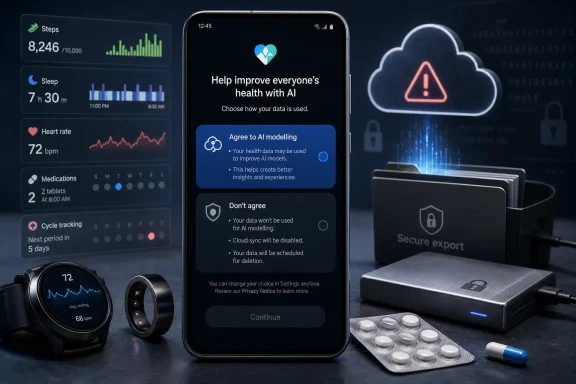 AI Consent Becomes a Condition of Cloud Sync
Most consumer AI controls are framed around access to a specific feature: accept the processing terms and receive an AI-generated summary, or decline and continue using the underlying service without it. Samsung’s reported approach links AI-model consent to one of Samsung Health’s foundational functions instead.Users can technically turn the toggle off, but the consequence makes it considerably more than an optional personalization setting. Without account synchronization, years of steps, workouts, sleep measurements, body-composition readings and other records may no longer be recoverable from Samsung’s servers after a device failure or migration.
The prompt reportedly states that Samsung may also use human review while training and modelling its systems. Samsung describes the purpose as improving health analysis and other AI-driven functions, but it has not publicly answered several practical questions raised by the rollout, including whether the training data is anonymized or pseudonymized before use and whether previously trained models can retain information derived from data after consent is withdrawn.
There is also uncertainty over availability. Reports say some Samsung Health users are receiving the notice, rather than establishing a universal global deployment. Consent language and deletion behavior may differ by jurisdiction because privacy laws impose different requirements on health information, withdrawal rights and data retention.
The Data Goes Far Beyond Step Counts
Samsung Health is no longer just a pedometer. Samsung’s own product and support documentation shows that the platform can hold an unusually broad collection of fitness, physiological and medical information.Depending on the devices and features a person uses, the affected categories may include:
- Samsung Health can store activity, exercise, step, nutrition, weight, body-composition and sleep records.
- Connected Galaxy watches and rings can contribute heart rate, blood oxygen, skin temperature, stress and other physiological measurements.
- Users can enter medications, dosage schedules and information taken from prescription labels.
- Health Records can include conditions, immunizations, allergies, diagnoses and test information imported from participating providers.
- Cycle Tracking can contain period dates, symptoms, moods, fertility estimates and temperature-derived predictions.
Samsung’s US Consumer Health Data Privacy Statement, last updated in July 2025, already describes consumer health data broadly. It covers vital signs, reproductive or sexual-health information, medical records, diagnoses, testing, treatments and prescribed medications, as well as inferred information produced through algorithms or machine learning.
That policy says users have rights to access and request deletion of consumer health data, and to withdraw consent where applicable law requires it. The controversy is not simply whether Samsung offers an opt-out, but whether withdrawing from AI training should also remove the cloud service used to preserve and move a user’s health history.
Export Before Touching the Toggle
Anyone who sees the prompt should avoid making a quick selection before preserving a copy of important records. Samsung provides a built-in download function under Samsung Health’s settings, although the exact menu names may vary by app version and region.Samsung’s current support instructions direct users to open Samsung Health, select the three-dot menu, open Settings and choose “Download personal data.” The resulting files are placed in a Samsung Health folder accessible through the device’s file manager. Users can then copy that export to an encrypted PC folder, external drive or another storage location they control.
This is particularly important for people preparing to reject or withdraw consent, replace a phone, clear application data or uninstall Samsung Health. A cloud deletion cannot be treated like a reversible synchronization error, and Samsung’s support documentation warns that intentionally erased Samsung Health data cannot be restored.
An export may not recreate the polished charts, trends and coaching views available inside the app. It does, however, preserve the underlying history for reference or potential import into another service. Windows users can transfer the folder over USB and store it in an encrypted BitLocker-protected volume, provided they also maintain a properly secured recovery key.
Health Connect may provide another copy of certain Android health records when the user has already granted compatible apps access, but it should not be assumed to be a complete Samsung Health backup. Coverage varies by data type, application and permission, and Samsung-specific insights may not transfer.
Users should also distinguish the new AI setting from Samsung Health’s general processing consent. Recent reports from Samsung community users indicate that app updates have exposed multiple privacy toggles, and disabling the wrong one may interrupt ordinary syncing before a user has determined what data is affected.
Samsung’s AI Health Push Meets a Trust Problem
The consent screen arrives as Samsung expands AI-based health analysis across Galaxy watches, rings and phones. In June, Samsung announced additional Samsung Health capabilities designed to combine wearable measurements with proactive insights, including cardiovascular-load analysis, fitness comparisons and recommendations based on accumulated activity data.Those products require large and varied datasets to develop useful models. The business and engineering rationale is clear: more health histories can help Samsung test algorithms against different ages, routines and physiological patterns.
The user relationship is less straightforward. Health information is among the most sensitive data a consumer platform can collect, and meaningful consent requires a choice that is understandable and reasonably free of pressure. Tying refusal to the removal of cloud synchronization risks turning consent into a prerequisite for preserving functionality users may have relied on for years.
Samsung also needs to clarify what “AI training and modelling” means in operational terms. Users have not yet been given a widely published explanation of model types, retention periods, human-review safeguards, de-identification methods, access controls or whether the information could be shared with contractors involved in model development.
Until those details are available, the safest interpretation is the narrow one supported by the displayed warning: refusing the AI consent can stop Samsung account sync and delete the health data stored through that sync, subject to legal retention obligations. Claims that the app immediately wipes every measurement from every connected device go beyond the evidence currently available.
The immediate action is therefore simple but consequential: export first, decide second. Samsung’s next move must be to explain why declining AI training cannot leave ordinary encrypted health synchronization intact—and exactly what happens to years of records when a user says no.
References
- Primary source: The News International
Published: 2026-07-13T08:10:37+00:00
Samsung Health may delete your data if you reject AI training
Samsung Health users are running into an ultimatum they didn't ask for: hand over health data for AI training, or lose it entirely. A new in-app notice, first reported by How-To Geek, is prompting...www.thenews.com.pk - Related coverage: androidauthority.com
Samsung will kill your health data if you don't consent to AI training
Samsung is reportedly holding your health data hostage if you don't let the company train its AI with your data.www.androidauthority.com - Related coverage: mediosick.com
SAMSUNG HEALTH FORCES USERS TO CONSENT TO AI TRAINING OR LOSE DATA
Samsung Health is asking users to consent to AI training on their health data or risk losing sync access and having their data deleted. Here's what to know.www.mediosick.com - Related coverage: samsung.com
SAMSUNG CONSUMER HEALTH DATA PRIVACY STATEMENT | Samsung US
SAMSUNG CONSUMER HEALTH DATA PRIVACY STATEMENTwww.samsung.com - Related coverage: androidpure.com
Samsung Health Asks: Consent to AI Training or Lose Your Synced Data – AndroidPure
Samsung Health's new AI training consent screen means declining stops health-data sync and deletes already-synced data. Here's how to check and manage it.www.androidpure.com - Related coverage: developer.samsung.com