

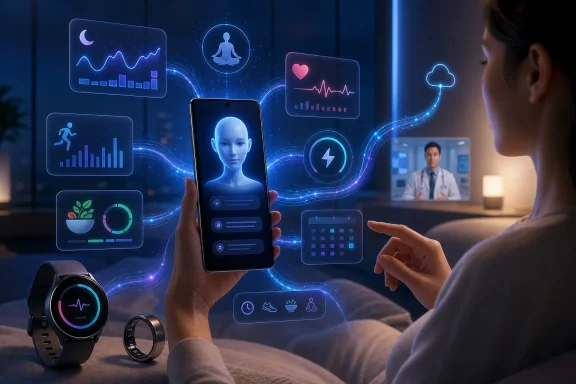
Samsung has launched Health Assistant, a beta AI-powered companion built directly into Samsung Health for eligible users in the United States, marking a significant shift from recording wellness data to interpreting it through an ongoing conversation. The assistant combines sleep, activity, nutrition, mindfulness, and vital-sign information to explain patterns, answer health-related questions, and generate personalized recommendations, while Samsung insists that the beta is a wellness service rather than a source of medical diagnosis or treatment. More importantly, the July 21, 2026 launch reveals Samsung’s wider ambition: to make Galaxy phones, watches, rings, services, and eventually clinical partnerships parts of a connected health platform that follows users throughout the day.
Samsung Health has spent years evolving from a relatively conventional fitness tracker into the central repository for health information collected across the Galaxy ecosystem. Earlier versions emphasized steps, workouts, calories, weight, and manually entered records, but the expansion of Galaxy Watch sensors and the arrival of Galaxy Ring created a much richer stream of continuous data.
That growth produced a familiar digital-health problem. Users could see more measurements than ever, yet they still had to decide what the numbers meant, whether two trends were related, and which behavioral change might actually improve the situation.
Health Assistant attempts to place an interpretive layer above those measurements. Instead of expecting someone to compare multiple screens, the service can potentially explain that poor sleep, unusual stress indicators, and reduced activity may be connected rather than isolated events.
Health Assistant makes that score conversational and contextual. A number alone can tell a user that today differs from yesterday; an assistant can attempt to explain why it changed and what action might be realistic given the user’s circumstances.
It has also attached a critical limitation: Health Assistant does not provide medical advice, diagnoses, or treatment recommendations. That distinction is essential because the more authoritative and personalized an AI sounds, the easier it becomes for consumers to mistake wellness guidance for clinical judgment.
This approach is technically more ambitious than attaching a generic chatbot to a fitness app. To deliver useful responses, the system must retrieve the correct user data, understand the context of the question, select medically responsible explanatory material, and avoid claiming certainty that the underlying sensors cannot support.
A well-designed assistant could support questions such as:
That does not mean every generated response has been individually written or approved by a clinician. It more likely indicates that the knowledge, guidance frameworks, and response policies were developed under professional review, while the AI assembles an answer appropriate to the user’s question and available context.
If Health Assistant can reliably distinguish persistent trends from normal fluctuations, it could help users focus on behaviors that matter. If it cannot, the result may be a stream of plausible but low-value observations that increase anxiety without improving health.
The model also gives Samsung a framework for expanding Health Assistant without redefining the product every time a new sensor or service appears.
The difficulty is communicating uncertainty. Consumer wearables estimate sleep rather than performing a clinical sleep study, and even accurate-looking graphs should not be treated as definitive diagnoses of sleep disorders.
Samsung must avoid reducing every recommendation to “move more.” Valuable coaching requires adapting guidance to the person’s baseline, limitations, schedule, and recent behavior.
Nutrition also introduces substantial data-quality challenges. Food logs are often incomplete, portion estimates are imprecise, and users may stop recording meals when the process becomes burdensome. The assistant must recognize missing information rather than presenting an incomplete diary as a comprehensive account.
However, mental wellness is a sensitive domain. General stress-management suggestions are different from assessing a psychiatric condition, and Health Assistant will need clear escalation and safety behavior when a question falls outside ordinary wellness guidance.
Samsung therefore needs to explain whether a response is based on a direct measurement, an estimate, an inferred relationship, or general educational knowledge. The distinction between sensing and diagnosis must remain visible.
The assistant is designed to turn that number into an explanation and, potentially, an action plan.
These conditions underline an important reality. Although Health Assistant lives inside an application, its usefulness increases when a consumer owns and consistently wears additional Samsung hardware.
Health Assistant has an opportunity to counter that tendency by emphasizing long-term patterns and personal experience. A responsible response should explain that one day’s score is not a medical verdict and that wearable information should complement, not replace, attention to symptoms.
This is where Samsung’s health strategy begins to merge with its broader Galaxy AI architecture. The assistant would not merely know that a user slept poorly; it could potentially recognize that an early meeting, travel schedule, or established routine makes a particular recommendation impractical.
Contextual guidance could instead propose a shorter workout on an unusually busy day, recommend an earlier wind-down before a scheduled morning commitment, or avoid suggesting a behavior the user repeatedly rejects. That shifts the product from information delivery toward adaptive coaching.
Users will need controls that explain exactly which sources Health Assistant can access. Consent should be granular enough that someone can use wearable-based recommendations without automatically exposing unrelated personal information.
A strong implementation would minimize data transmission, separate identity from model-improvement pipelines where possible, retain only what is necessary, and make processing choices understandable in ordinary language. Security cannot be treated as a background feature when the product’s value depends on assembling an intimate picture of daily life.
The company’s acquisition of Xealth gives this ambition considerably more weight.
Samsung agreed to acquire Xealth in July 2025 and completed the transaction in October 2025. At the time of the original announcement, the companies described a footprint of more than 500 U.S. hospitals and more than 70 digital-health solution partners.
Combining those environments—with informed user consent—could create a more continuous view of health. A care team might eventually receive relevant summaries or monitor a prescribed digital program without requiring the patient to manually transfer screenshots and spreadsheets.
Xealth’s orchestration experience may help Samsung filter and route information appropriately. The challenge is to deliver a small number of clinically relevant signals instead of turning consumer telemetry into another overflowing inbox.
It also makes the Galaxy ecosystem more cohesive. A Watch or Ring becomes more than a sensor when the phone can explain its observations and adapt recommendations over time.
It could also make Samsung Health more approachable for users who open the application only occasionally. Conversational questions provide a lower barrier than navigating through layers of historical charts.
Samsung’s non-medical disclaimer is necessary, but disclaimers alone do not control behavior. The product must recognize red-flag language, avoid dismissing symptoms, and encourage appropriate professional care without pretending to triage conditions it is not designed to diagnose.
Yet AI-generated wording can also hide complexity. Users should be able to inspect the measurements and reasoning behind an explanation instead of receiving an unchallengeable answer from a seemingly confident system.
If Samsung combines that reach with Xealth’s hospital integrations, it could become a major infrastructure provider for remote monitoring and care-at-home programs.
A vertically integrated platform could reduce the friction of asking patients to install several unrelated applications. It could also improve adherence if clinical tasks appear inside software the patient already uses every day.
Samsung’s success will therefore depend on openness. A connected-care system that becomes a Galaxy-only island would reproduce the fragmentation the company says it wants to solve.
Health systems will also demand audit logs, validation evidence, incident-response procedures, model-change controls, and clear contractual responsibility. Consumer-grade convenience cannot replace the governance expected in a clinical environment.
The competition is shifting from who collects the most metrics to who can explain them safely and persuasively.
A connected home could contribute information about routines, sleep environments, food storage, exercise, and daily schedules. The opportunity is substantial, although using household data for health personalization would require exceptionally clear consent.
This creates a familiar strategic tension. Samsung benefits from Android interoperability while trying to ensure that Galaxy-specific services provide enough value to keep users loyal to Samsung hardware.
Whichever company convinces users that its assistant is helpful without becoming intrusive will gain an advantage that cannot be measured solely through sensor specifications.
Samsung’s challenge is breadth without superficiality. An assistant covering five wellness pillars must still provide insights precise enough to compete with specialist platforms.
Samsung has kept the initial Health Assistant description firmly on the wellness side of that line.
However, function matters alongside wording. If a future version evaluates symptoms, predicts disease, recommends treatment changes, or directs urgent care decisions, regulators may examine the actual behavior rather than relying on a wellness label.
A consumer service can encourage a user to notice persistent changes or discuss concerning trends with a professional. It should not claim that a wearable-derived pattern identifies a disease unless that specific function has undergone appropriate validation and regulatory review.
Samsung will need rigorous testing across demographic groups, health conditions, languages, sensor combinations, and adversarial questions. A recommendation that is safe for a healthy adult may be inappropriate for someone who is pregnant, recovering from surgery, taking medication, or managing a chronic condition.
The launch therefore arrives with a higher trust requirement than an ordinary AI feature for writing messages or editing photographs.
Recent user concern over health-data permissions and AI-training choices shows how quickly trust can erode when synchronization, retention, and model development appear bundled together. Even where the legal language permits an arrangement, the product design must pass a simpler test: would a reasonable user consider the choice fair?
This makes secondary use especially consequential. Samsung must prevent health information from silently migrating into unrelated profiling systems or being retained beyond the period necessary for the service.
Users also need practical protections, including strong account authentication, device access controls, clear session history, data deletion, export options, and notification of unusual access. A compromised health account could expose years of intimate behavioral information.
That timing suggests Health Assistant is the software centerpiece of a wider wearable strategy rather than a standalone beta.
A limited beta can generate useful feedback, but overly narrow eligibility could make the “fully integrated” claim feel more aspirational than practical.
A health assistant should not operate as an opaque oracle. Traceability is a core safety feature.
Clear, separate toggles would reduce confusion. Bundled permissions would invite criticism regardless of the assistant’s technical quality.
Samsung will also need to show that user consent can be revoked cleanly and that clinical sharing does not become a permanent, invisible background process.
A subscription would not necessarily be unreasonable, but Samsung should define the boundary between basic interpretation and premium coaching before users become dependent on the feature.
The key measure is not how many questions users ask. It is whether the answers lead to safe, sustainable, and appropriately modest changes in behavior.
Samsung Health Assistant represents a logical but consequential next step for wearable computing: the transition from passive measurement to personalized interpretation. Samsung has the devices, data infrastructure, AI ambitions, and newly acquired clinical-integration expertise to build a service that genuinely helps users understand their daily wellness, but those same advantages create unusually high obligations around consent, transparency, security, and medical boundaries. If the beta proves that conversational guidance can remain useful without becoming intrusive or falsely authoritative, Health Assistant could turn Samsung Health into the connective tissue of the Galaxy ecosystem—and provide an early model for how consumer AI may support healthier decisions without pretending to replace professional care.
Samsung also says Personal Data Engine analysis can be disabled through the Personal Data Intelligence setting, which deletes analyzed data when switched off. Supported personalization workloads use Knox Enhanced Encrypted Protection, and the engine is currently limited to Samsung’s native applications. Samsung Health reportedly serves more than 77 million monthly active users.

 www.gsmarena.com
 Background
Samsung Health has spent years evolving from a relatively conventional fitness tracker into the central repository for health information collected across the Galaxy ecosystem. Earlier versions emphasized steps, workouts, calories, weight, and manually entered records, but the expansion of Galaxy Watch sensors and the arrival of Galaxy Ring created a much richer stream of continuous data.That growth produced a familiar digital-health problem. Users could see more measurements than ever, yet they still had to decide what the numbers meant, whether two trends were related, and which behavioral change might actually improve the situation.
From dashboards to interpretation
Traditional health applications generally organize information into cards, charts, daily totals, and historical graphs. Those interfaces are useful for motivated enthusiasts, but they often assume that the user already understands concepts such as resting heart rate, heart-rate variability, sleep regularity, training load, and recovery.Health Assistant attempts to place an interpretive layer above those measurements. Instead of expecting someone to compare multiple screens, the service can potentially explain that poor sleep, unusual stress indicators, and reduced activity may be connected rather than isolated events.
The foundation laid by Energy Score
Samsung introduced Energy Score as a way to convert several measurements into a more understandable assessment of daily readiness. The score draws on recent activity, sleep, and sleeping heart-rate data synchronized from compatible Samsung wearables.Health Assistant makes that score conversational and contextual. A number alone can tell a user that today differs from yesterday; an assistant can attempt to explain why it changed and what action might be realistic given the user’s circumstances.
A beta with important boundaries
Samsung is initially limiting Health Assistant to eligible U.S. users, and availability may depend on account status, software versions, language, region, connected hardware, and participation in the beta. The company has not presented the launch as an immediate worldwide release.It has also attached a critical limitation: Health Assistant does not provide medical advice, diagnoses, or treatment recommendations. That distinction is essential because the more authoritative and personalized an AI sounds, the easier it becomes for consumers to mistake wellness guidance for clinical judgment.
How Samsung Health Assistant Works
The assistant’s central proposition is that health information becomes more valuable when it is evaluated as a connected system. Samsung describes five core wellness pillars—sleep, activity, nutrition, mindfulness, and vitals—that can be examined together rather than in separate application silos.This approach is technically more ambitious than attaching a generic chatbot to a fitness app. To deliver useful responses, the system must retrieve the correct user data, understand the context of the question, select medically responsible explanatory material, and avoid claiming certainty that the underlying sensors cannot support.
A conversational interface over personal data
Users can ask questions about their wellness and receive answers informed by information already stored in Samsung Health. The practical advantage is accessibility: asking why an Energy Score declined is easier than manually comparing several nights of sleep with exercise and heart-rate charts.A well-designed assistant could support questions such as:
- It could explain which measurements contributed most strongly to a change in Energy Score.
- It could identify a recurring relationship between late exercise, sleep timing, and morning readiness.
- It could suggest manageable lifestyle adjustments rather than merely displaying an unfavorable trend.
- It could summarize a week of activity and recovery in language that does not require specialist knowledge.
- It could distinguish between a single unusual measurement and a pattern that has persisted over time.
A health-specific knowledge base
Samsung says Health Assistant is supported by a dedicated Samsung Health knowledge base. Recommendations have reportedly been reviewed or validated by physicians and certified health coaches, which should give the system a more controlled foundation than an unrestricted general-purpose language model.That does not mean every generated response has been individually written or approved by a clinician. It more likely indicates that the knowledge, guidance frameworks, and response policies were developed under professional review, while the AI assembles an answer appropriate to the user’s question and available context.
Pattern detection is the real value
The assistant’s strongest use case may not be answering isolated questions, but finding patterns that are difficult to notice in daily charts. Human behavior varies, wearable measurements contain uncertainty, and meaningful changes often emerge only after several days or weeks.If Health Assistant can reliably distinguish persistent trends from normal fluctuations, it could help users focus on behaviors that matter. If it cannot, the result may be a stream of plausible but low-value observations that increase anxiety without improving health.
The Five-Pillar Health Model
Samsung’s five-pillar model is intended to produce a more holistic interpretation than a fitness service focused primarily on workouts. Each pillar contributes different context, and the relationships between them may be more informative than any single measurement.The model also gives Samsung a framework for expanding Health Assistant without redefining the product every time a new sensor or service appears.
Sleep and recovery
Sleep is already one of Samsung Health’s most developed categories, with supported devices tracking duration, stages, consistency, heart rate, and other overnight signals. Health Assistant can use those records to explain how sleep timing and quality may affect energy, activity, and perceived readiness.The difficulty is communicating uncertainty. Consumer wearables estimate sleep rather than performing a clinical sleep study, and even accurate-looking graphs should not be treated as definitive diagnoses of sleep disorders.
Activity and training behavior
Activity information includes steps, structured workouts, movement patterns, duration, intensity, and recovery context. An assistant could help someone understand whether a demanding day followed poor sleep, whether weekly movement has declined, or whether an aggressive exercise goal is producing inconsistent adherence.Samsung must avoid reducing every recommendation to “move more.” Valuable coaching requires adapting guidance to the person’s baseline, limitations, schedule, and recent behavior.
Nutrition and weight management
Nutrition is a strategically important pillar because it connects daily decisions with longer-term goals. Samsung says future Health Assistant capabilities will explore services such as weight management and behavior-change coaching.Nutrition also introduces substantial data-quality challenges. Food logs are often incomplete, portion estimates are imprecise, and users may stop recording meals when the process becomes burdensome. The assistant must recognize missing information rather than presenting an incomplete diary as a comprehensive account.
Mindfulness and behavioral context
Mindfulness gives Samsung a pathway beyond physical measurements. Breathing exercises, stress-management activities, routines, and self-reported information can help explain why the same recommendation may be appropriate one week and unrealistic the next.However, mental wellness is a sensitive domain. General stress-management suggestions are different from assessing a psychiatric condition, and Health Assistant will need clear escalation and safety behavior when a question falls outside ordinary wellness guidance.
Vitals and physiological signals
Vitals can include measurements such as heart rate and other sensor-derived indicators supported by the user’s devices and region. These signals may make recommendations feel especially authoritative because they resemble information encountered in clinical care.Samsung therefore needs to explain whether a response is based on a direct measurement, an estimate, an inferred relationship, or general educational knowledge. The distinction between sensing and diagnosis must remain visible.
Energy Score Becomes More Useful
Energy Score is an obvious entry point for Health Assistant because it condenses several inputs into a single daily result. On its own, however, a composite score can become a black box: users know that the number changed but not what to do about it.The assistant is designed to turn that number into an explanation and, potentially, an action plan.
Hardware and software requirements
Energy Score requires a compatible Android phone running Android 11 or later, a supported Samsung Health release, a Samsung account, and synchronized data from a Galaxy Watch or Galaxy Ring. Samsung also requires sufficient recent activity, sleep, and sleeping heart-rate information to calculate the score.These conditions underline an important reality. Although Health Assistant lives inside an application, its usefulness increases when a consumer owns and consistently wears additional Samsung hardware.
From score chasing to behavior change
Readiness metrics can motivate healthier behavior, but they can also encourage users to chase the number. Someone may become concerned by a lower score even when they feel fine, or may interpret a high score as permission to ignore discomfort.Health Assistant has an opportunity to counter that tendency by emphasizing long-term patterns and personal experience. A responsible response should explain that one day’s score is not a medical verdict and that wearable information should complement, not replace, attention to symptoms.
A practical daily workflow
For users who receive access to the beta, the intended interaction can be understood as a simple sequence:- Wear a supported Galaxy Watch or Galaxy Ring consistently, particularly during sleep.
- Synchronize the wearable with Samsung Health so the application receives the required activity, sleep, and heart-rate information.
- Review the current Energy Score and contributing factors rather than judging the number in isolation.
- Ask Health Assistant a focused question, such as what changed or which factor deserves attention.
- Evaluate the suggestion against personal circumstances, including illness, medication, travel, injury, and subjective wellbeing.
- Track the result over several days before concluding that a particular change caused an improvement.
Personalization Through the Personal Data Engine
Samsung plans to use its Personal Data Engine, or PDE, to give future Health Assistant responses more context. The company’s example is straightforward: recommendations could account for calendar events, recurring habits, schedules, and user preferences.This is where Samsung’s health strategy begins to merge with its broader Galaxy AI architecture. The assistant would not merely know that a user slept poorly; it could potentially recognize that an early meeting, travel schedule, or established routine makes a particular recommendation impractical.
Context can make guidance actionable
Generic advice is one of the largest weaknesses in current wellness apps. Telling a user to sleep longer, prepare healthier meals, or exercise at a consistent time may be scientifically reasonable but operationally useless.Contextual guidance could instead propose a shorter workout on an unusually busy day, recommend an earlier wind-down before a scheduled morning commitment, or avoid suggesting a behavior the user repeatedly rejects. That shifts the product from information delivery toward adaptive coaching.
The data boundary becomes broader
The same context that improves personalization also expands the sensitivity of the system. Calendar entries, routines, health records, sleep patterns, medication information, reproductive-health data, and location-related habits can collectively reveal far more than any single category.Users will need controls that explain exactly which sources Health Assistant can access. Consent should be granular enough that someone can use wearable-based recommendations without automatically exposing unrelated personal information.
On-device intelligence versus cloud processing
Samsung has increasingly emphasized private, personalized intelligence across Galaxy products, but the Health Assistant announcement does not fully explain which stages of every interaction occur locally and which require cloud processing. That architectural detail matters because health questions may contain highly sensitive information even when the underlying wearable data remains protected.A strong implementation would minimize data transmission, separate identity from model-improvement pipelines where possible, retain only what is necessary, and make processing choices understandable in ordinary language. Security cannot be treated as a background feature when the product’s value depends on assembling an intimate picture of daily life.
Samsung’s Connected Care Strategy
Health Assistant is not an isolated chatbot experiment. It sits inside Samsung’s broader “Connected Care” strategy, which aims to bridge everyday wellness measurements with professional healthcare workflows where users consent to that connection.The company’s acquisition of Xealth gives this ambition considerably more weight.
Why Xealth matters
Xealth developed an orchestration platform that allows healthcare organizations to deploy, prescribe, and monitor digital-health tools through established clinical systems. It originated within the Providence health system before becoming an independent company and building relationships across a large U.S. hospital network.Samsung agreed to acquire Xealth in July 2025 and completed the transaction in October 2025. At the time of the original announcement, the companies described a footprint of more than 500 U.S. hospitals and more than 70 digital-health solution partners.
Connecting home data to care teams
Wearables observe users during the hundreds of hours they spend outside a clinic. Medical records, by contrast, contain diagnoses, test results, medications, procedures, and professional assessments that a consumer device cannot independently infer.Combining those environments—with informed user consent—could create a more continuous view of health. A care team might eventually receive relevant summaries or monitor a prescribed digital program without requiring the patient to manually transfer screenshots and spreadsheets.
More data is not automatically better care
Clinicians already face heavy documentation and alert burdens. Sending every step count, nightly sleep estimate, and transient heart-rate change into a medical workflow could create noise rather than insight.Xealth’s orchestration experience may help Samsung filter and route information appropriately. The challenge is to deliver a small number of clinically relevant signals instead of turning consumer telemetry into another overflowing inbox.
Consumer Impact
For consumers, Health Assistant could solve the usability gap between collecting health data and understanding it. The service may be particularly helpful for people who are interested in wellness but do not want to learn the technical language behind every chart.It also makes the Galaxy ecosystem more cohesive. A Watch or Ring becomes more than a sensor when the phone can explain its observations and adapt recommendations over time.
Benefits for everyday users
The most immediate improvements are likely to involve comprehension and motivation. Health Assistant can translate several categories of information into a single explanation, reducing the effort required to locate trends.It could also make Samsung Health more approachable for users who open the application only occasionally. Conversational questions provide a lower barrier than navigating through layers of historical charts.
The danger of false reassurance
A polished response may reassure a user that a trend reflects poor sleep or reduced activity when the true explanation is unknown. Conversely, the assistant may warn about an innocuous fluctuation and cause unnecessary concern.Samsung’s non-medical disclaimer is necessary, but disclaimers alone do not control behavior. The product must recognize red-flag language, avoid dismissing symptoms, and encourage appropriate professional care without pretending to triage conditions it is not designed to diagnose.
Accessibility and digital literacy
Conversational health interfaces can improve accessibility for people who find complex dashboards difficult. Clear summaries, adjustable detail, voice interaction, and plain-language explanations could make wearable information useful to a wider audience.Yet AI-generated wording can also hide complexity. Users should be able to inspect the measurements and reasoning behind an explanation instead of receiving an unchallengeable answer from a seemingly confident system.
Enterprise and Healthcare Impact
Health Assistant’s first beta is consumer-facing, but the longer-term enterprise implications may be more consequential. Samsung sells phones, tablets, wearables, displays, and connected appliances at a scale few dedicated health-technology companies can match.If Samsung combines that reach with Xealth’s hospital integrations, it could become a major infrastructure provider for remote monitoring and care-at-home programs.
Opportunities for health systems
Healthcare organizations could use Samsung devices as accessible endpoints for patient engagement. Prescribed programs might include reminders, educational content, symptom collection, activity goals, and compatible home-monitoring devices.A vertically integrated platform could reduce the friction of asking patients to install several unrelated applications. It could also improve adherence if clinical tasks appear inside software the patient already uses every day.
Interoperability will determine adoption
Hospitals will not adopt a platform merely because it works well with Galaxy products. They need integration with electronic health records, identity systems, consent frameworks, clinical workflows, security controls, and devices from multiple vendors.Samsung’s success will therefore depend on openness. A connected-care system that becomes a Galaxy-only island would reproduce the fragmentation the company says it wants to solve.
Governance and liability
Enterprise deployments introduce difficult questions about accountability. If an AI-generated recommendation conflicts with a clinician’s plan, users need to know which instruction takes priority and how the discrepancy will be resolved.Health systems will also demand audit logs, validation evidence, incident-response procedures, model-change controls, and clear contractual responsibility. Consumer-grade convenience cannot replace the governance expected in a clinical environment.
Competitive Implications
Samsung’s announcement places additional pressure on Apple, Google, Fitbit, Garmin, Oura, Whoop, and a growing field of AI wellness platforms. Most major wearable ecosystems already generate scores, summaries, or coaching prompts, but Samsung is emphasizing direct integration across multiple health categories and a future bridge into clinical care.The competition is shifting from who collects the most metrics to who can explain them safely and persuasively.
Samsung’s ecosystem advantage
Samsung controls a broad range of hardware, including smartphones, watches, rings, tablets, televisions, and home appliances. That breadth could eventually provide contextual signals that smaller wearable manufacturers cannot easily reproduce.A connected home could contribute information about routines, sleep environments, food storage, exercise, and daily schedules. The opportunity is substantial, although using household data for health personalization would require exceptionally clear consent.
Google is both partner and rival
Samsung’s mobile health products operate within the Android and Wear OS ecosystems, where Google remains a critical platform partner. At the same time, Google’s Fitbit technology and AI capabilities make it a direct competitor in personalized health interpretation.This creates a familiar strategic tension. Samsung benefits from Android interoperability while trying to ensure that Galaxy-specific services provide enough value to keep users loyal to Samsung hardware.
Apple’s privacy and integration benchmark
Apple has historically emphasized controlled hardware-software integration and privacy messaging in its health ecosystem. Samsung can compete through device variety, Android reach, Galaxy Ring integration, and healthcare partnerships, but consumers will compare not only features but also trust.Whichever company convinces users that its assistant is helpful without becoming intrusive will gain an advantage that cannot be measured solely through sensor specifications.
Specialists still have room to compete
Garmin, Oura, and Whoop have cultivated audiences around training, recovery, sleep, or performance. Their narrower focus can produce deeper domain experiences and stronger loyalty among athletes or highly engaged users.Samsung’s challenge is breadth without superficiality. An assistant covering five wellness pillars must still provide insights precise enough to compete with specialist platforms.
Regulation and the Medical Boundary
AI health products occupy a complicated boundary between general wellness software and regulated medical functionality. In the United States, intended use matters: software that supports low-risk healthy-lifestyle behavior is treated differently from software intended to diagnose, treat, prevent, or make patient-specific clinical decisions.Samsung has kept the initial Health Assistant description firmly on the wellness side of that line.
Why the disclaimer matters
The explicit statement that Health Assistant does not provide medical advice, diagnosis, or treatment recommendations limits user expectations and helps define the product’s intended purpose. It also shapes the types of questions the assistant should answer and the language it should use.However, function matters alongside wording. If a future version evaluates symptoms, predicts disease, recommends treatment changes, or directs urgent care decisions, regulators may examine the actual behavior rather than relying on a wellness label.
Early detection requires careful language
Samsung says its connected-care vision can increase opportunities for early detection. That is a compelling goal, but it is also a phrase that approaches medical territory.A consumer service can encourage a user to notice persistent changes or discuss concerning trends with a professional. It should not claim that a wearable-derived pattern identifies a disease unless that specific function has undergone appropriate validation and regulatory review.
Continuous AI updates complicate validation
Traditional medical software can be assessed as a defined version with known behavior. Generative AI systems may change through new models, knowledge updates, response policies, and personalization logic.Samsung will need rigorous testing across demographic groups, health conditions, languages, sensor combinations, and adversarial questions. A recommendation that is safe for a healthy adult may be inappropriate for someone who is pregnant, recovering from surgery, taking medication, or managing a chronic condition.
Privacy, Consent, and Security
Health Assistant’s personalization depends on information that users reasonably regard as among their most private. Samsung’s U.S. consumer health privacy materials cover categories including vital signs, reproductive health, medication, diagnoses, tests, treatments, and inferred health information.The launch therefore arrives with a higher trust requirement than an ordinary AI feature for writing messages or editing photographs.
Consent must be meaningful
Consent is not meaningful if the user cannot understand what is being authorized or if refusing an optional use disables an unrelated core function. Samsung should clearly separate processing required to provide Health Assistant from processing used to train models, improve algorithms, personalize advertising, or support other services.Recent user concern over health-data permissions and AI-training choices shows how quickly trust can erode when synchronization, retention, and model development appear bundled together. Even where the legal language permits an arrangement, the product design must pass a simpler test: would a reasonable user consider the choice fair?
Health data can reveal more than expected
A long-term record of sleep, heart rate, exercise, medications, cycle tracking, and calendar context can reveal travel, work patterns, pregnancy, illness, stress, religious routines, and relationships. Inferences may become sensitive even when the original data points appear mundane.This makes secondary use especially consequential. Samsung must prevent health information from silently migrating into unrelated profiling systems or being retained beyond the period necessary for the service.
Security needs multiple layers
Protecting Health Assistant requires more than encrypting a database. Samsung must secure the wearable, phone, account, synchronization process, AI infrastructure, partner integrations, and any pathways into healthcare systems.Users also need practical protections, including strong account authentication, device access controls, clear session history, data deletion, export options, and notification of unusual access. A compromised health account could expose years of intimate behavioral information.
Strengths and Opportunities
Health Assistant enters beta with several structural advantages that could make it one of Samsung Health’s most important additions.- The assistant is integrated into an existing health platform. Users do not have to export their information into a generic chatbot or explain their history from scratch.
- Samsung owns a broad sensor ecosystem. Galaxy Watch and Galaxy Ring can provide continuous information that makes recommendations more relevant than answers based only on manually entered questions.
- The five-pillar model encourages holistic interpretation. Sleep, movement, nutrition, mindfulness, and vitals can be discussed as connected influences rather than independent scores.
- Energy Score provides a familiar starting point. Health Assistant can add explanation and action to a metric that existing Galaxy users may already check every morning.
- Professional review can improve safety. Physician and certified health-coach involvement offers a path toward more responsible guidance than an unrestricted language model could provide.
- Xealth creates a bridge to healthcare organizations. Samsung now has access to expertise in clinical integration, digital prescribing, and provider workflows rather than having to build that capability entirely from the consumer side.
- The Personal Data Engine could make advice more realistic. Calendar-aware and habit-aware responses may fit daily life better than repetitive generic recommendations.
- Beta deployment allows Samsung to test behavior before scaling. The company can study misunderstood answers, refusal performance, engagement, and sensor-data limitations before wider availability.
Risks and Concerns
The same integration that makes Health Assistant useful also creates significant technical, ethical, and commercial risks.- AI responses may sound more certain than the evidence supports. Consumer sensors, incomplete logs, and inferred relationships cannot justify definitive conclusions.
- Users may confuse wellness guidance with medical advice. A disclaimer can be overlooked when the assistant speaks in a personalized and authoritative voice.
- False reassurance could delay care. The system must never explain away serious symptoms simply because recent wearable data appears normal.
- Excessive warnings could create anxiety. Highlighting every fluctuation may encourage compulsive checking or unnecessary medical consultations.
- Consent design could undermine trust. Optional AI training, cloud synchronization, feature access, and data retention should not be combined in ways that pressure users into broader sharing.
- Clinical integration could overwhelm providers. Raw wearable streams need filtering, prioritization, and workflow controls before they become useful in healthcare.
- Bias may affect recommendation quality. Models and wearable sensors must be evaluated across age groups, skin tones, body types, disabilities, health conditions, and patterns of device use.
- Ecosystem lock-in could restrict consumer choice. Users should be able to move, export, and selectively share their health histories without remaining dependent on one hardware brand.
- Commercial incentives may conflict with health goals. Samsung must resist turning personalized wellness observations into opportunities to sell devices, subscriptions, food services, or other products without clear separation.
- Future feature expansion may cross regulatory boundaries. Weight management, early detection, mental wellness, and clinical decision support each introduce additional oversight and safety obligations.
What to Watch Next
Samsung’s July 21 announcement comes immediately before its July 22, 2026 Galaxy Unpacked event, where the company plans to reveal the next evolution of Galaxy Watch. Samsung has already signaled improved internal components, longer battery life, greater tracking accuracy, and more real-time AI-driven health insights.That timing suggests Health Assistant is the software centerpiece of a wider wearable strategy rather than a standalone beta.
Beta eligibility and rollout pace
Samsung has not yet provided a comprehensive public roadmap covering every compatible device, account type, language, or U.S. rollout wave. The first question is therefore how many existing Samsung Health users actually receive access and whether participation requires newer Galaxy hardware.A limited beta can generate useful feedback, but overly narrow eligibility could make the “fully integrated” claim feel more aspirational than practical.
Transparency inside responses
Users should watch for explanations showing which measurements influenced an answer, how recent those measurements are, and whether the assistant is expressing a known relationship or a tentative inference. Confidence indicators and links back to underlying Samsung Health charts would make the system easier to verify.A health assistant should not operate as an opaque oracle. Traceability is a core safety feature.
Data controls and AI training choices
Samsung’s handling of consent may become one of the defining stories around the service. Users need to know whether they can access ordinary synchronization and storage without contributing health information to model training, and whether deleting assistant history also deletes the underlying health record.Clear, separate toggles would reduce confusion. Bundled permissions would invite criticism regardless of the assistant’s technical quality.
Integration with Xealth
The next major milestone will be evidence that Xealth is producing useful, carefully governed connections between Galaxy-generated wellness data and care teams. Pilot programs should demonstrate reduced friction and better engagement without flooding clinicians with low-value alerts.Samsung will also need to show that user consent can be revoked cleanly and that clinical sharing does not become a permanent, invisible background process.
Pricing and long-term availability
Samsung has not established whether advanced Health Assistant capabilities will remain free, become tied to premium hardware, or eventually form part of a subscription. Behavior coaching and weight-management services could be costly to operate, particularly if they involve extensive cloud AI processing or human oversight.A subscription would not necessarily be unreasonable, but Samsung should define the boundary between basic interpretation and premium coaching before users become dependent on the feature.
Evidence of real-world benefit
Engagement statistics will not be enough. Samsung should eventually publish evidence showing whether the assistant improves comprehension, adherence, sleep regularity, activity consistency, or other meaningful outcomes.The key measure is not how many questions users ask. It is whether the answers lead to safe, sustainable, and appropriately modest changes in behavior.
Samsung Health Assistant represents a logical but consequential next step for wearable computing: the transition from passive measurement to personalized interpretation. Samsung has the devices, data infrastructure, AI ambitions, and newly acquired clinical-integration expertise to build a service that genuinely helps users understand their daily wellness, but those same advantages create unusually high obligations around consent, transparency, security, and medical boundaries. If the beta proves that conversational guidance can remain useful without becoming intrusive or falsely authoritative, Health Assistant could turn Samsung Health into the connective tissue of the Galaxy ecosystem—and provide an early model for how consumer AI may support healthier decisions without pretending to replace professional care.
Update: Additional details (July 22, 2026)
GSMArena reports that the Health Assistant beta requires Samsung Health version 6.27 or later and a Galaxy phone or tablet running Android 10 or newer. Eligible users may find the feature through a message near the top of Samsung Health or through the Health Assist entry in Galaxy AI settings. Energy Score retains stricter requirements, including Android 11 or later and at least the previous day’s activity, sleep, and sleeping heart-rate data.Samsung also says Personal Data Engine analysis can be disabled through the Personal Data Intelligence setting, which deletes analyzed data when switched off. Supported personalization workloads use Knox Enhanced Encrypted Protection, and the engine is currently limited to Samsung’s native applications. Samsung Health reportedly serves more than 77 million monthly active users.
Samsung unveils AI-powered Health Assistant - GSMArena.com news
It's currently available in beta in the US. Today Samsung has announced the Health Assistant, which it bills as the "first fully integrated AI-powered...
References
- Primary source: Samsung Mobile Press
Published: 2026-07-21T22:00:00+00:00
Samsung Launches Health Assistant Beta — First Fully Integrated AI-Powered Personal Health Assistant | Samsung Mobile Press
Meet Samsung Health Assistant, an AI-powered personal health assistant now in beta. It connects core wellness data into meaningful, actionable insights and personalized health recommendations.www.samsungmobilepress.com - Related coverage: samsung.com
SAMSUNG CONSUMER HEALTH DATA PRIVACY STATEMENT | Samsung US
SAMSUNG CONSUMER HEALTH DATA PRIVACY STATEMENTwww.samsung.com - Related coverage: androidcentral.com
Want Samsung Health cloud sync? You may have to agree to AI training first | Android Central
Samsung Health's latest AI push comes with a catch: Say no, and your cloud health data may disappear.www.androidcentral.com
Last edited:
