

Samsung has moved its long-rumored AI smart glasses from concept to a defined product strategy, unveiling Intelligent Eyewear developed with Google and designed alongside Gentle Monster and Warby Parker. The launch places Samsung directly in the fast-growing market popularized by Ray-Ban Meta, but its approach is notably different: these are Android XR-powered, audio-first glasses designed to make Google Gemini a constant, hands-free companion for Galaxy users.
The announcement clarifies several details that had been obscured by early rumors. Samsung’s glasses use Qualcomm’s Snapdragon AR1 Gen 1 platform, include an onboard camera, support touch and voice input, and promise up to nine hours of battery life per charge. A charging case is said to provide up to seven additional full charges. They are expected to launch in select markets this fall, although Samsung has not yet confirmed U.S. pricing, exact availability, prescription-lens policies, weight, storage capacity, or a formal retail product name such as “Galaxy Glasses.”
That lack of commercial detail matters. Samsung has revealed a compelling platform and a clear hardware direction, but it has not yet fully revealed the consumer product buyers will be able to order. Still, the significance is clear: the AI glasses race is no longer a contest centered on Meta’s Ray-Ban partnership. It is becoming an ecosystem battle between Meta AI and social-first wearables on one side, and Android XR, Gemini, Galaxy devices, and Google services on the other.
The core idea behind Samsung Intelligent Eyewear is straightforward: AI should be available without requiring users to constantly reach for a smartphone, look down at a smartwatch, or wear a bulky headset. The glasses are intended to provide assistance while users remain aware of their environment, whether walking through a city, commuting, handling messages, joining a call, or recording a first-person video.
Samsung is positioning the device as an extension of the Galaxy ecosystem, not as a replacement for a Galaxy phone. That distinction is important. The glasses are designed as a companion device, relying on a connected phone and supported services for many of their most ambitious capabilities.
This gives Samsung some immediate advantages. Galaxy users already have access to a tightly connected family of devices that includes phones, tablets, watches, earbuds, PCs, smart TVs, and SmartThings-connected home products. Intelligent Eyewear adds a new interaction layer: one that sits on the face, listens through microphones, responds through speakers, and can use a camera to provide visual context to Gemini.
The product’s goals include:
That is a powerful vision. It is also one that will depend heavily on reliability, privacy protections, battery performance, regional service availability, and the quality of Gemini’s responses in real-world situations.
For Samsung’s first Intelligent Eyewear collection, the emphasis is on the latter. These are not full augmented reality glasses with a persistent visual overlay floating in front of the wearer’s eyes. The first models are audio glasses: they use speakers, microphones, voice control, touch controls, and a camera to deliver assistance without requiring a heads-up display.
That makes them far more practical than a bulky mixed-reality headset for all-day use. It also keeps expectations grounded. A user should not expect holographic desktop windows, floating app panels, or turn-by-turn directions projected onto the street. Navigation, translation, notifications, and Gemini responses will largely be delivered through audio and, where necessary, through the connected smartphone.
Samsung and Google have described several practical scenarios:
For Windows users who already rely on Android phones and Microsoft services, that could eventually become particularly relevant. A hands-free device that can receive Android notifications, participate in calls, manage calendar information, capture meeting notes, and work alongside Microsoft 365 mobile apps could be useful in hybrid work environments. However, Samsung has not yet detailed direct Windows integration, PC pairing features, or a dedicated Windows companion experience.
Google’s assistant is being positioned as a context-aware AI layer that can respond to voice requests and interpret visual information from the wearer’s environment. This matters because smart glasses are an unusually natural home for multimodal AI. They can hear what the wearer hears and, when explicitly prompted, see what the wearer sees.
A phone can also use a camera and microphone, of course. But glasses remove the friction of pulling out a device, unlocking it, opening an app, aiming the camera, and typing or speaking a question. The interaction can begin with a voice command or a touch on the frame.
For example, a user could ask for directions to a location, request a coffee shop along the route, receive a recommendation based on preferences, and then initiate a pickup order through a supported service. The user would still need to approve important actions, but the glasses could reduce the number of steps required.
This is a more ambitious model than traditional voice assistants, which often treated each command as a separate transaction. If it works consistently, it could make smart glasses feel genuinely useful rather than merely novel.
But this is also where practical limitations are likely to surface.
That choice is sensible. Smart glasses have little room for batteries, processors, cooling components, antennas, cameras, microphones, speakers, and prescription-compatible optics. Every part of the design must be optimized for heat, weight, balance, and power draw.
Samsung is promising a slim, lightweight frame engineered for everyday comfort. It has also said the glasses can last up to nine hours on a single charge, with a case that provides up to seven further full charges.
Samsung deserves credit for publishing a clear maximum-use figure rather than leaving battery life entirely vague. Yet the company still needs to explain the test conditions behind that number, along with charging speed, battery longevity, repairability, and how the product behaves when the battery declines over time.
That omission is notable because camera quality will be central to the product’s value. The camera is expected to serve at least three roles:
Smart glasses are worn on the face. That means they are not judged like a smartwatch, an earbud case, or a phone. They must look acceptable in public, feel comfortable for hours, accommodate different face shapes, work with prescription lenses, and suit different personal styles.
Samsung has introduced two initial styles:
Warby Parker brings mainstream optical retail experience, prescription expertise, and a broad consumer-facing style catalogue. Gentle Monster brings a more fashion-led, premium, culturally expressive approach. Together, those partnerships may help Samsung appeal to different types of buyer rather than forcing one hardware design on everyone.
However, Samsung has not yet disclosed several practical buying details:
Both products occupy the same broad category: camera-equipped smart glasses with microphones, open-ear audio, voice controls, AI assistance, and a focus on wearable fashion. Both are trying to make hands-free computing feel normal. Both will face questions about privacy, social acceptance, and whether users genuinely need AI on their faces.
But their strategic centers differ.
Meta enters the contest with a meaningful head start in public awareness, consumer familiarity, and creator usage. Ray-Ban Meta glasses have helped establish the idea that a camera and speakers can fit into ordinary-looking eyewear without turning the product into a conspicuous gadget.
Samsung, meanwhile, has an opportunity to make the category feel more useful for productivity, navigation, travel, communication, and Android-based daily workflows. That advantage will depend on whether Gemini proves more effective in these ambient, real-world contexts than Meta AI.
Samsung’s arrival could expand that market rather than simply split it. Competition may push both companies to improve:
Any product that places a camera, microphones, internet-connected AI, and contextual data collection on a person’s face raises obvious privacy concerns. People nearby may not know when they are being recorded, photographed, analyzed, or included in a live visual call.
Samsung says the glasses will include controls and safeguards intended to support responsible use. That is welcome, but broad assurances are not enough. The company will need to make its privacy model clear before launch.
Critical questions include:
Samsung will need simple, visible recording indicators and plain-language privacy controls. If those protections feel hidden or overly complicated, the company risks repeating the public skepticism that has followed earlier attempts at camera-equipped wearable technology.
That does not make the feature set less interesting. It simply means buyers should wait for final compatibility charts and retail specifications before assuming every demo scenario will be available on day one.
For Samsung, this strategy makes particular sense. The company already sells across nearly every major personal-device category. Smart glasses can become a connective layer between those products, giving Galaxy users a more immediate way to interact with AI and services while away from a screen.
For Google, Android XR is equally strategic. Android helped create a broad smartphone hardware ecosystem. Android XR could attempt the same in spatial and wearable computing, allowing multiple manufacturers and fashion brands to build devices around a shared software and AI foundation.
The first Samsung models are deliberately conservative in form factor. They do not attempt to solve the hard technical challenge of placing a rich, bright, lightweight display in ordinary glasses. By launching audio-first eyewear, Samsung and Google can test the value of Gemini-powered assistance in a design that is more likely to be worn all day.
That may be the right move. Smart glasses do not need to replace a phone screen to become useful. If they can reliably provide directions, translate a conversation, summarize an important message, capture a quick image, assist with a task, and keep a user connected without breaking eye contact with the real world, they could earn a place in everyday life.
Samsung’s Intelligent Eyewear is therefore not just a new Galaxy accessory. It is the opening move in a larger competition over who gets to define the personal AI interface of the next decade.
The announcement clarifies several details that had been obscured by early rumors. Samsung’s glasses use Qualcomm’s Snapdragon AR1 Gen 1 platform, include an onboard camera, support touch and voice input, and promise up to nine hours of battery life per charge. A charging case is said to provide up to seven additional full charges. They are expected to launch in select markets this fall, although Samsung has not yet confirmed U.S. pricing, exact availability, prescription-lens policies, weight, storage capacity, or a formal retail product name such as “Galaxy Glasses.”
That lack of commercial detail matters. Samsung has revealed a compelling platform and a clear hardware direction, but it has not yet fully revealed the consumer product buyers will be able to order. Still, the significance is clear: the AI glasses race is no longer a contest centered on Meta’s Ray-Ban partnership. It is becoming an ecosystem battle between Meta AI and social-first wearables on one side, and Android XR, Gemini, Galaxy devices, and Google services on the other.
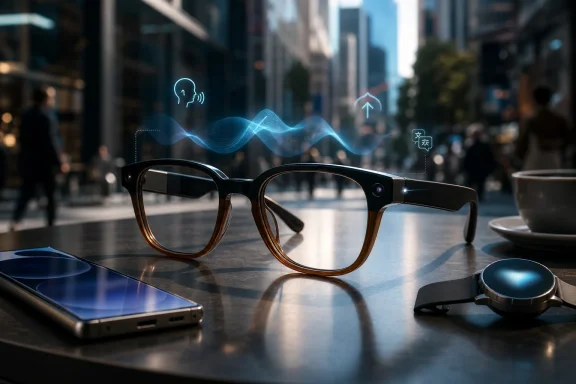 Samsung’s Intelligent Eyewear Is More Than a Camera Accessory
The core idea behind Samsung Intelligent Eyewear is straightforward: AI should be available without requiring users to constantly reach for a smartphone, look down at a smartwatch, or wear a bulky headset. The glasses are intended to provide assistance while users remain aware of their environment, whether walking through a city, commuting, handling messages, joining a call, or recording a first-person video.Samsung is positioning the device as an extension of the Galaxy ecosystem, not as a replacement for a Galaxy phone. That distinction is important. The glasses are designed as a companion device, relying on a connected phone and supported services for many of their most ambitious capabilities.
This gives Samsung some immediate advantages. Galaxy users already have access to a tightly connected family of devices that includes phones, tablets, watches, earbuds, PCs, smart TVs, and SmartThings-connected home products. Intelligent Eyewear adds a new interaction layer: one that sits on the face, listens through microphones, responds through speakers, and can use a camera to provide visual context to Gemini.
The product’s goals include:
- Voice-first access to Gemini
- Navigation and location-aware help
- Live translation of spoken language and visible text
- Summarized notifications and message readouts
- Photo and video capture
- Contextual assistance using what the wearer sees
- Hands-free calls, messaging, and media control
- Galaxy device integration, including gesture control through Galaxy Watch9
That is a powerful vision. It is also one that will depend heavily on reliability, privacy protections, battery performance, regional service availability, and the quality of Gemini’s responses in real-world situations.
Android XR Gives Samsung a Broader Platform
Samsung’s AI glasses are built on Android XR, Google’s extended-reality platform developed with Samsung and Qualcomm. Android XR is designed to support a range of form factors, from immersive headsets to display-equipped glasses and simpler audio-focused eyewear.For Samsung’s first Intelligent Eyewear collection, the emphasis is on the latter. These are not full augmented reality glasses with a persistent visual overlay floating in front of the wearer’s eyes. The first models are audio glasses: they use speakers, microphones, voice control, touch controls, and a camera to deliver assistance without requiring a heads-up display.
That makes them far more practical than a bulky mixed-reality headset for all-day use. It also keeps expectations grounded. A user should not expect holographic desktop windows, floating app panels, or turn-by-turn directions projected onto the street. Navigation, translation, notifications, and Gemini responses will largely be delivered through audio and, where necessary, through the connected smartphone.
Audio-First Does Not Mean Basic
The absence of a display does not make the glasses a simple pair of Bluetooth headphones with a camera. The glasses are intended to combine audio output with Gemini’s multimodal understanding. That means a wearer can potentially ask about a sign, a menu, a building, or an object in front of them and receive an answer based on what the camera captures.Samsung and Google have described several practical scenarios:
- Navigation assistance while walking, including route guidance and nearby recommendations.
- Live translation for conversations and visible text, such as signs or menus.
- Message triage, including reading or summarizing important notifications.
- Context capture, such as photographing a whiteboard or meeting discussion for organization in Samsung Notes.
- Visual sharing during calls, allowing another person to see what the wearer sees.
- AI-assisted task completion, potentially including services such as food orders and transportation requests through compatible mobile apps.
For Windows users who already rely on Android phones and Microsoft services, that could eventually become particularly relevant. A hands-free device that can receive Android notifications, participate in calls, manage calendar information, capture meeting notes, and work alongside Microsoft 365 mobile apps could be useful in hybrid work environments. However, Samsung has not yet detailed direct Windows integration, PC pairing features, or a dedicated Windows companion experience.
Gemini Is the Main Differentiator
The defining feature of Samsung Intelligent Eyewear is not the camera, the speaker system, or even Android XR. It is Gemini.Google’s assistant is being positioned as a context-aware AI layer that can respond to voice requests and interpret visual information from the wearer’s environment. This matters because smart glasses are an unusually natural home for multimodal AI. They can hear what the wearer hears and, when explicitly prompted, see what the wearer sees.
A phone can also use a camera and microphone, of course. But glasses remove the friction of pulling out a device, unlocking it, opening an app, aiming the camera, and typing or speaking a question. The interaction can begin with a voice command or a touch on the frame.
From Search Queries to Contextual Assistance
Samsung’s messaging focuses heavily on an agentic AI future, in which AI does more than answer isolated questions. In theory, the glasses can connect information across tasks and reduce repetitive instructions.For example, a user could ask for directions to a location, request a coffee shop along the route, receive a recommendation based on preferences, and then initiate a pickup order through a supported service. The user would still need to approve important actions, but the glasses could reduce the number of steps required.
This is a more ambitious model than traditional voice assistants, which often treated each command as a separate transaction. If it works consistently, it could make smart glasses feel genuinely useful rather than merely novel.
But this is also where practical limitations are likely to surface.
- AI-generated answers can be wrong, incomplete, or overly confident.
- Navigation and location services can fail in dense urban areas or weak-signal locations.
- Translation may struggle with accents, noisy environments, jargon, and overlapping speakers.
- Third-party app actions will depend on partnerships, region availability, account status, and service compatibility.
- The quality of visual AI assistance will depend on lighting, camera angle, image clarity, and whether the wearer asks a precise question.
The Hardware: Snapdragon AR1, Camera Context, and Battery Claims
Samsung has confirmed that Intelligent Eyewear uses the Snapdragon AR1 Gen 1 platform. This chipset was developed specifically for lightweight smart glasses and is designed to balance camera processing, audio functions, wireless connectivity, AI workloads, thermal control, and power efficiency in a compact wearable form factor.That choice is sensible. Smart glasses have little room for batteries, processors, cooling components, antennas, cameras, microphones, speakers, and prescription-compatible optics. Every part of the design must be optimized for heat, weight, balance, and power draw.
Samsung is promising a slim, lightweight frame engineered for everyday comfort. It has also said the glasses can last up to nine hours on a single charge, with a case that provides up to seven further full charges.
Battery Life Needs Real-World Scrutiny
Nine hours would be an impressive figure for AI-powered camera glasses, but buyers should view it as a best-case claim until independent testing is available. Battery life in this category can vary dramatically based on:- Camera use and video recording
- Live translation sessions
- Continuous Gemini interaction
- Calls and music playback
- Network conditions
- Notification volume
- Connected-phone activity
- Ambient temperature
- Speaker volume
- AI processing demands
Samsung deserves credit for publishing a clear maximum-use figure rather than leaving battery life entirely vague. Yet the company still needs to explain the test conditions behind that number, along with charging speed, battery longevity, repairability, and how the product behaves when the battery declines over time.
A Camera Is Confirmed, but Specifications Remain Limited
Samsung has confirmed a built-in camera, but it has not publicly provided full camera specifications. The company has not detailed the sensor resolution, field of view, video resolution, stabilization, storage limits, recording duration, or capture indicator behavior.That omission is notable because camera quality will be central to the product’s value. The camera is expected to serve at least three roles:
- Capturing photos and video
- Giving Gemini visual context
- Supporting live visual sharing during calls
Fashion Partnerships Solve a Crucial Smart Glasses Problem
Samsung’s collaboration with Gentle Monster and Warby Parker is not a side detail. It may be one of the most important parts of the entire launch.Smart glasses are worn on the face. That means they are not judged like a smartwatch, an earbud case, or a phone. They must look acceptable in public, feel comfortable for hours, accommodate different face shapes, work with prescription lenses, and suit different personal styles.
Samsung has introduced two initial styles:
- A Gentle Monster design with a slim black frame, a straight upper rim, and softly rounded lower edges.
- A Warby Parker design with a subtly upswept brow line and a rich brown finish intended for versatile daily wear.
Style Is a Functional Requirement
Meta’s partnership with Ray-Ban helped normalize smart glasses because the product looked recognizably like eyewear rather than a sci-fi headset. Samsung and Google are applying the same lesson, but with two fashion partners that offer different design identities.Warby Parker brings mainstream optical retail experience, prescription expertise, and a broad consumer-facing style catalogue. Gentle Monster brings a more fashion-led, premium, culturally expressive approach. Together, those partnerships may help Samsung appeal to different types of buyer rather than forcing one hardware design on everyone.
However, Samsung has not yet disclosed several practical buying details:
- Prescription lens availability and supported prescription ranges
- Lens type options, including clear, sun, polarized, and photochromic lenses
- Warranty and repair programs
- Retail fitting availability
- International service arrangements
- Weight and fit measurements
- Water and dust resistance ratings
Samsung vs. Ray-Ban Meta: A Different Kind of Rivalry
It is tempting to describe Samsung Intelligent Eyewear as a direct Ray-Ban Meta clone. That would be too simplistic.Both products occupy the same broad category: camera-equipped smart glasses with microphones, open-ear audio, voice controls, AI assistance, and a focus on wearable fashion. Both are trying to make hands-free computing feel normal. Both will face questions about privacy, social acceptance, and whether users genuinely need AI on their faces.
But their strategic centers differ.
| Category | Samsung Intelligent Eyewear | Ray-Ban Meta |
|---|---|---|
| Core AI platform | Google Gemini | Meta AI |
| Operating platform | Android XR | Meta’s wearable software ecosystem |
| Ecosystem focus | Galaxy, Android, Google services | Meta apps, social platforms, messaging |
| Initial approach | Audio-first AI assistance | Camera, audio, AI, content creation |
| Design partners | Gentle Monster and Warby Parker | Ray-Ban |
| Key differentiator | Gemini context and Galaxy integration | Established market presence and social capture tools |
Samsung, meanwhile, has an opportunity to make the category feel more useful for productivity, navigation, travel, communication, and Android-based daily workflows. That advantage will depend on whether Gemini proves more effective in these ambient, real-world contexts than Meta AI.
Meta’s Lead Is Real, but Not Unassailable
Ray-Ban Meta has built recognition through a recognizable fashion brand and its ability to capture point-of-view media, make calls, play audio, and connect with Meta’s broader services. It has turned camera glasses from an oddity into a product category consumers can understand.Samsung’s arrival could expand that market rather than simply split it. Competition may push both companies to improve:
- Battery life
- Camera quality
- Translation reliability
- Privacy indicators
- Prescription options
- App compatibility
- Voice recognition
- AI accuracy
- Retail support
- Accessibility features
Privacy Will Determine Whether AI Glasses Become Mainstream
The biggest risk facing Samsung Intelligent Eyewear is not processor speed or frame design. It is trust.Any product that places a camera, microphones, internet-connected AI, and contextual data collection on a person’s face raises obvious privacy concerns. People nearby may not know when they are being recorded, photographed, analyzed, or included in a live visual call.
Samsung says the glasses will include controls and safeguards intended to support responsible use. That is welcome, but broad assurances are not enough. The company will need to make its privacy model clear before launch.
Critical questions include:
- Is there a prominent physical recording indicator?
- Can the camera be disabled with a hardware control?
- What happens to images and video used for Gemini queries?
- Are visual inputs processed locally, in the cloud, or through a hybrid model?
- How long are recordings and AI interactions retained?
- Can users opt out of data use for model improvement?
- Are captured images encrypted in transit and at rest?
- How do users delete recordings and AI history?
- What policies govern third-party access and law-enforcement requests?
- How will the glasses behave in schools, workplaces, medical settings, and other sensitive environments?
Samsung will need simple, visible recording indicators and plain-language privacy controls. If those protections feel hidden or overly complicated, the company risks repeating the public skepticism that has followed earlier attempts at camera-equipped wearable technology.
What Samsung Still Needs to Reveal
Samsung’s July announcement is substantial, but it is not the final consumer launch. Several of the most important questions remain unanswered.The Missing Details
Before buyers can make an informed decision, Samsung needs to disclose:- Official product names
- U.S. price and international pricing
- Exact release date
- Launch markets
- Prescription lens support
- Lens options
- Frame sizes
- Product weight
- Full camera specifications
- Video recording limits
- Audio hardware details
- Water resistance rating
- Storage capacity
- Connectivity requirements
- Supported Galaxy phones and Android versions
- Whether iPhone compatibility will be available
- Which Gemini features require subscriptions
- Which capabilities work offline
- How long software support will last
That does not make the feature set less interesting. It simply means buyers should wait for final compatibility charts and retail specifications before assuming every demo scenario will be available on day one.
The Bigger Picture for Android, Galaxy, and Everyday Computing
Samsung Intelligent Eyewear represents a meaningful shift in how major technology companies view the next interface after the smartphone. The phone is not disappearing. Instead, it is becoming the computing hub behind a wider network of devices: watches for quick controls, earbuds for audio, tablets and PCs for focused work, headsets for immersive experiences, and now glasses for ambient assistance.For Samsung, this strategy makes particular sense. The company already sells across nearly every major personal-device category. Smart glasses can become a connective layer between those products, giving Galaxy users a more immediate way to interact with AI and services while away from a screen.
For Google, Android XR is equally strategic. Android helped create a broad smartphone hardware ecosystem. Android XR could attempt the same in spatial and wearable computing, allowing multiple manufacturers and fashion brands to build devices around a shared software and AI foundation.
The first Samsung models are deliberately conservative in form factor. They do not attempt to solve the hard technical challenge of placing a rich, bright, lightweight display in ordinary glasses. By launching audio-first eyewear, Samsung and Google can test the value of Gemini-powered assistance in a design that is more likely to be worn all day.
That may be the right move. Smart glasses do not need to replace a phone screen to become useful. If they can reliably provide directions, translate a conversation, summarize an important message, capture a quick image, assist with a task, and keep a user connected without breaking eye contact with the real world, they could earn a place in everyday life.
Samsung’s Intelligent Eyewear is therefore not just a new Galaxy accessory. It is the opening move in a larger competition over who gets to define the personal AI interface of the next decade.
References
- Primary source: Mashable India
Published: 2026-07-22T17:52:11.639551+00:00
Samsung AI Smart Glasses Unveiled To Rival Ray-Ban Meta With Android XR And Gemini
Samsung has entered the smart glasses race with Intelligent Eyewear powered by Android XR and Google Gemini AI. The new AI glasses aim to challenge Ray-Ban Meta smart glasses with hands-free assistance, real-time features and a stylish everyday design.in.mashable.com - Related coverage: tomsguide.com
Exclusive: Inside Google’s plan to win over your face with AI glasses — and avoid Meta's privacy missteps | Tom's Guide
I spoke with Google’s XR product chief Juston Payne about the new 'Intelligent Eyewear' launching this fall, the hard lessons of Google Glass, and how Google plans to navigate thorny privacy issues and take on Meta and Apple.www.tomsguide.com - Related coverage: androidcentral.com
Google knows AI glasses won't take off without trust — so it's building anti-tampering protections into Android XR from day one | Android Central
Google says privacy and trust are the biggest hurdles facing AI glasses.www.androidcentral.com - Related coverage: androidauthority.com
Samsung and Google just showed off Android XR smart glasses with Warby Parker and Gentle Monster
Samsung and Google just unveiled Android XR smart glasses with Warby Parker and Gentle Monster ahead of a fall launch.www.androidauthority.com - Related coverage: techxplore.com