

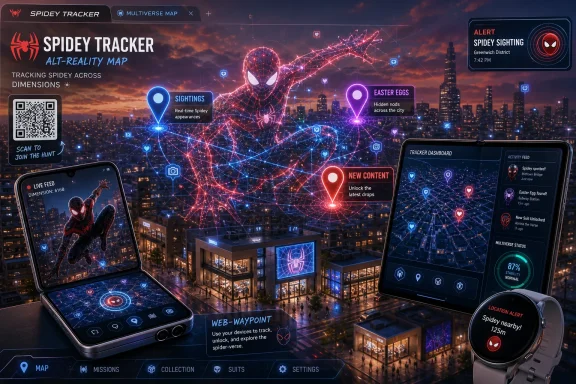
Samsung and Sony Pictures launched the Spidey Tracker on June 17, 2026, as a web-based promotional experience for Spider-Man: Brand New Day that lets fans follow fictional Spider-Man sightings, unlock campaign content, and see Samsung Galaxy devices woven into the film’s marketing. It is product placement dressed up as an alternate-reality toy, and that is exactly why it is interesting. The campaign says less about Spider-Man needing a foldable phone than it does about how hardware brands now buy their way into fandom infrastructure, not just movie scenes. For WindowsForum readers, the useful story is not celebrity branding; it is the continuing merger of devices, identity, entertainment, location play, and platform loyalty into one seamless commercial surface.
Product placement used to be a background art. A laptop logo in a newsroom, a phone held just long enough for the camera to notice, a watch face catching the light before the hero checks the time. Samsung’s Spider-Man: Brand New Day tie-in is operating at a more ambitious level: the Galaxy device is not merely in the movie, it is part of the story’s marketing grammar.
The premise is tidy. Ned Leeds, played by Jacob Batalon, uses Samsung devices in the film’s world to try to locate Spider-Man. Outside the theater, Samsung and Sony have turned that fiction into the Spidey Tracker, an interactive experience available through a dedicated site in Canada and dozens of other regions. Fans can follow sightings, watch cast interviews, view content drops, chase easter eggs, and submit their own sightings of the wall-crawler.
That makes the campaign more than a conventional “as seen in the movie” ad. It is an attempt to move the product from prop to portal. Samsung is not asking viewers to remember that Peter Parker had a Galaxy Z Flip; it is asking them to use a Spider-Man-themed experience that behaves like a branded layer over the real world.
This is the kind of marketing that works only when the brand is confident enough to become part of the fictional machinery. The Galaxy Z Flip, Galaxy Z Fold, and Galaxy Watch are being positioned as tools that belong in Spider-Man’s everyday orbit: portable, glanceable, flexible, connected. The commercial message is obvious, but the delivery is subtler than a spec sheet. Samsung is selling use cases by association.
For Sony, the calculation is equally clear. A major superhero release now needs a runway, not just a trailer. A static poster campaign cannot carry weeks of online conversation by itself, but a map, a tracker, content drops, and fan submissions can create recurring touchpoints. The movie arrives July 31, 2026; the campaign gives the marketing machine something to feed every day until then.
This is not new in principle. Film studios have used alternate-reality campaigns, hidden websites, fictional institutions, and scavenger hunts for decades. What is newer is the way the device brand sits at the center of the experience. Samsung is not sponsoring a contest on the edge of the campaign; Samsung is the technology that makes the fictional interaction plausible.
That is a powerful shift for a phone maker. Smartphones are mature products, and foldables still face the burden of explaining why their form factor matters beyond novelty. A Spider-Man campaign gives Samsung a way to skip the lecture. The Z Flip becomes the compact device a superhero might use in motion; the Z Fold becomes a multitasking screen for coordination; the Galaxy Watch becomes the always-on companion for alerts and location cues.
The danger, of course, is that audiences are not naïve. Fans know when they are being marketed to, and the online reaction to superhero product placement often swings between amusement and ridicule. Peter Parker using an expensive foldable phone is an easy joke, especially for a character historically coded as broke, stressed, and scraping by in New York. Samsung is betting that the fun of the bit outweighs the awkwardness of the economics.
That bet may be reasonable. Spider-Man has always survived contradictions. He is a street-level hero who gets pulled into cosmic battles, a teenager or young adult who somehow stands at the center of multibillion-dollar franchises, and a character whose relatable problems coexist with absurdly advanced technology. A Galaxy Z Flip in his hand is not the strangest thing that has happened to Peter Parker. But it does underline how far modern superhero realism bends when brand partnerships enter the room.
That does not mean Sony Mobile was “snubbed” in any formal sense. Large entertainment conglomerates are not single-minded organisms; divisions have different priorities, budgets, markets, and strategic incentives. Sony Pictures wants the biggest promotional partner and the loudest global device campaign it can get. Samsung can offer retail presence, marketing muscle, and a foldable lineup that visually reads better on screen than most rectangular slabs.
Still, the symbolism is hard to miss. Xperia once represented Sony’s ability to connect cameras, displays, entertainment, and mobile computing under one brand. In practice, the smartphone market consolidated around Apple and Samsung at the premium end, with Chinese manufacturers dominating much of the volume story elsewhere. A Spider-Man film choosing Galaxy as its visible tech ecosystem is a reminder that cultural reach often follows market reach.
This is where the campaign becomes a small case study in platform power. Sony owns the movie rights, Marvel owns the broader character universe, Disney sits adjacent through the MCU, and Samsung buys into the screen narrative as the device partner. The result is a layered commercial stack in which intellectual property, hardware, retail, and online engagement all borrow legitimacy from one another.
For consumers, the experience is playful. For the industry, it is evidence that the most valuable brands increasingly operate as ecosystems of attention. Samsung is not merely selling phones; Sony is not merely selling tickets. Both are trying to convert fandom into a habit loop.
That is why entertainment partnerships are useful. They create stories around form factors before consumers have fully formed practical arguments for them. A foldable in Spider-Man’s hand says the device is compact, fast, cinematic, and cool without requiring Samsung to explain hinge durability, crease improvements, battery compromises, or app continuity.
The Z Flip in particular benefits from this kind of placement. It is the more culturally legible foldable: a pocketable phone that snaps shut, opens with a gesture, and carries a bit of gadget theater. On camera, it reads as a prop with motion. That matters in a film world where a normal phone can disappear into visual noise.
The Z Fold has a different role. It represents productivity, coordination, and command-center multitasking. If Ned Leeds is the one trying to locate Spider-Man, a larger foldable screen makes narrative sense in the same way that wall-sized displays used to make sense in spy movies. It turns a phone into a dashboard.
The Galaxy Watch completes the triangle. Wearables are about immediacy: alerts, glances, proximity, activity, and the illusion of constant ambient intelligence. In a tracker-themed campaign, a watch is almost too obvious. It implies the user is connected to the action without needing to pull out a phone at all.
The important point is that Samsung is selling the shape of its ecosystem. Phone, foldable tablet-phone, watch, web experience, store activation, social sharing: each component reinforces the others. In a mature smartphone market, that may matter more than a marginal camera improvement or another incremental chipset gain.
For Samsung, a web campaign is slightly paradoxical. The company wants to sell Galaxy hardware, but the tracker itself must be accessible beyond Galaxy owners if it is to function as a broad film promotion. A locked-down Samsung-only app would flatter the installed base but shrink the audience. A website can still be “powered by Samsung Galaxy” in the branding while remaining open enough to serve Sony’s theatrical goals.
That balance is revealing. Modern device marketing often wants exclusivity and ubiquity at the same time. The brand wants fans to associate the experience with Galaxy devices, but it also wants the campaign to travel through iPhones, desktops, tablets, social posts, and search results. The web is still the easiest compromise.
There is also a privacy-adjacent lesson here. Anything that asks users to submit sightings, engage with location-themed content, or participate in a pseudo-tracking experience will inevitably brush against sensitivities around data and surveillance, even if the “tracking” is fictional and promotional. A browser-based campaign can be designed to limit permissions and avoid the optics of a persistent installed app. Whether users notice that distinction is another matter.
For Windows users and administrators, this is familiar territory. The browser has become the universal surface for work, entertainment, identity, payments, device setup, and now branded film play. The OS matters, but the campaign layer increasingly lives above it. That is one reason Microsoft has pushed Edge, Copilot, Microsoft account integration, and web-powered experiences so hard: whoever controls the browser-adjacent engagement surface controls an enormous amount of user attention.
This is now normal because audiences have been trained to expect ongoing engagement. Games run events. Streaming shows run social campaigns. Hardware launches come with countdown pages, influencer embargoes, preorder bonuses, and interactive demos. A superhero film, especially one as commercially important as Spider-Man: Brand New Day, cannot simply arrive. It must be fed into the internet as a sequence of moments.
Samsung fits neatly into that pattern because its own product cycle already works like event media. Galaxy Unpacked presentations are staged as global entertainment. Device leaks, hands-on videos, carrier promos, trade-in offers, and ecosystem announcements form a rolling narrative. Adding Spider-Man gives that machinery a more emotionally potent wrapper.
There is a deeper convergence here between consumer electronics and fandom. Both rely on identity. People do not merely own a phone; they signal preferences, budgets, ecosystems, aesthetics, and sometimes values through it. People do not merely watch Spider-Man; they participate in a long-running cultural argument about which version, which studio, which villain, which continuity, and which future matters.
The Spidey Tracker sits at the overlap. It lets Samsung borrow fandom’s emotional charge while letting Sony borrow Samsung’s device ecosystem and retail footprint. The actual utility of the tracker is secondary. Its job is to make the partnership feel participatory instead of transactional.
This matters because premium phones are still tactile purchases. Foldables especially benefit from hands-on demos. A user can read about a hinge or watch a video of a cover screen, but the device’s appeal often depends on the moment someone opens and closes it. If Spider-Man branding gives families, fans, and casual shoppers a reason to walk into a Samsung store, the campaign has done practical work.
Retail activations also solve a measurement problem. Online campaigns produce impressions, clicks, dwell time, and social engagement, but stores produce leads, demos, accessory sales, trade-in conversations, and carrier-plan discussions. A movie tie-in that creates foot traffic can justify itself in ways a billboard cannot.
There is a risk of gimmick fatigue. Consumers have seen enough branded pop-ups, limited-edition displays, and selfie stations to understand the trade. But Spider-Man is unusually suited to this kind of local activation because the character’s mythology is urban and communal. “Sightings” and “neighborhood” language feel native to the brand, which helps the retail component feel less bolted on.
For Samsung, the retail layer is also a way to compete with Apple’s physical-store advantage. Apple Stores are not just points of sale; they are trust infrastructure. Samsung Experience Stores have a harder job because the Android market is broader, messier, and often carrier-mediated. A high-profile entertainment event gives Samsung’s stores a reason to become destinations rather than showrooms.
Spider-Man is a particularly sensitive case because his appeal depends on relatability. He is the hero with rent problems, school problems, friendship problems, and moral exhaustion. When that hero uses a premium foldable phone, the placement can either feel aspirational or absurd, depending on the viewer’s tolerance for brand logic.
The MCU has spent years negotiating that tension. Peter Parker’s earlier connection to Stark technology gave the films a built-in explanation for advanced gadgets. After No Way Home, the character’s reset pushed him toward a more independent, stripped-down identity. That makes the visible use of a high-end Samsung device more noticeable, not less.
To be fair, movies are full of economic impossibilities. Characters in sitcoms live in apartments they could not afford; spies use prototype devices without procurement paperwork; superheroes repair costumes with impossible speed. The audience accepts these things if the story earns enough goodwill. Product placement becomes a problem only when it breaks the emotional contract.
Samsung and Sony appear to be trying to avoid that by routing the placement through Ned as much as Peter. Ned using a Z Fold and Galaxy Watch to track Spider-Man fits his established role as the friend, operator, and tech-adjacent helper. Peter with a Z Flip is flashier, but Ned with a foldable dashboard is easier to rationalize.
That distinction matters because the best product placement does not simply display a device; it assigns the device a job. If the Galaxy hardware helps characters do something the story already wants them to do, viewers may accept it. If the camera lingers too long on the hinge, the illusion collapses.
That global scale changes the nature of the campaign. A local promotion can be quirky; a 35-region rollout is operational. It requires localization, legal review, content scheduling, privacy considerations, device messaging, and regional retail coordination. The fun surface hides a serious marketing platform underneath.
This is where the campaign resembles enterprise software more than entertainment fluff. There is a central experience, distributed regional availability, content modules, user input, analytics, partner branding, and physical activation points. The object may be Spider-Man, but the machinery looks like any other global customer-engagement system.
For WindowsForum’s IT-minded audience, that should sound familiar. The same web infrastructure patterns that support product launches, customer portals, and SaaS onboarding now support superhero campaigns. Identity, localization, analytics, content management, and device targeting are not back-office concerns; they are the product experience.
That is why consumer marketing increasingly feels like software. The campaign is not a static ad but a service with uptime expectations, regional access rules, content cadence, and user flows. Even a fictional Spider-Man tracker has to behave like a reliable digital product if millions of fans are expected to touch it.
That does not make the campaign sinister. It does make it contemporary. The fantasy of knowing where Spider-Man is mirrors the everyday reality that our devices know where we are, where we shop, where we pause, and which notifications make us move. A playful sighting map works because the public is already fluent in location-based interaction.
The challenge for brands is tone. If the campaign asks for user-submitted sightings, it has to make participation feel voluntary, bounded, and fun. If it leans too heavily into surveillance aesthetics, it risks reminding users of the parts of modern tech they distrust. Spider-Man’s community ethos helps soften that edge, but it does not erase it.
Samsung has a particular interest in presenting device intelligence as helpful rather than invasive. Galaxy AI, wearables, SmartThings, health metrics, location features, and cross-device continuity all depend on users accepting a dense mesh of sensors and services. A Spider-Man campaign can make that mesh feel magical. Security professionals know magic is usually just abstraction with better lighting.
This is the tension at the heart of modern consumer technology. The most delightful experiences are often the ones that require the most invisible coordination. Users want seamlessness, but they also resent being profiled. They want personalization, but they do not want to feel watched. The Spidey Tracker is a toy version of that bargain.
Apple does not need Spider-Man in quite the same way Samsung does. The iPhone already owns enormous cultural default status in North America, especially among younger users and in social contexts where blue bubbles, AirDrop, FaceTime, and camera familiarity function as network effects. Samsung has to fight that with hardware variety, display leadership, promotions, and moments that make Android feel visible in premium culture.
Foldables are Samsung’s clearest differentiation. Apple has not released an iPhone foldable, and until it does, Samsung can use the category as proof that it is willing to ship designs Apple has not. A Spider-Man partnership makes that differentiation cinematic. It says the interesting phone is not just the one everyone owns; it is the one that flips open in a superhero trailer.
The irony is that web-based campaigns blur platform boundaries. An iPhone owner can visit the tracker, watch the clips, and participate in the hype. Samsung may still benefit if the experience makes Galaxy devices feel cooler, but it cannot fully control the environment. That is the tradeoff of cultural marketing: the broader the reach, the less exclusive the conversion path.
For Microsoft watchers, there is a familiar echo here. Windows remains massively important, but many of the experiences that shape consumer behavior now float above the operating system. The device still matters, but the emotional layer is cross-platform. Companies win not only by controlling hardware or software, but by placing themselves inside the stories users already care about.
The second screen is not secondary anymore. It is where anticipation is manufactured, measured, and monetized. A viewer may spend two hours watching the film, but they may spend weeks encountering its campaign through clips, maps, reposts, interviews, and notifications. That attention is valuable because it happens before purchase and continues after purchase.
Samsung’s presence in this loop is strategic. A phone brand wants to be associated with the device through which culture is consumed, discussed, and shared. If Spider-Man hype lives on smartphones, then Samsung wants Galaxy to appear not just as the tool inside the movie but as the tool around the movie.
This is why the campaign does not have to convert every fan into a Galaxy buyer to be useful. It reinforces mental availability. The next time a user thinks about foldables, watches, or premium Android phones, Samsung wants a little bit of Spider-Man’s energy attached to the thought. Advertising has always worked that way; interactive campaigns just make the attachment feel more personal.
There is also a defensive element. In a market where hardware upgrades are slowing and phones last longer, brands need reasons to stay emotionally present between purchase cycles. A user may not buy a phone this summer, but they may remember that Samsung was part of the movie everyone was talking about. That memory is not a sale, but it is not nothing.
Samsung gets a superhero-scale showcase for foldables and wearables. Sony gets a campaign that can stretch across regions and weeks without relying solely on trailers. Fans get a toy that makes the wait for July 31 feel participatory. And the rest of the tech industry gets another reminder that devices are no longer sold only by features, benchmarks, and price cuts; they are sold by the worlds they appear to unlock.
 Samsung Does Not Want a Cameo, It Wants a Role
Product placement used to be a background art. A laptop logo in a newsroom, a phone held just long enough for the camera to notice, a watch face catching the light before the hero checks the time. Samsung’s Spider-Man: Brand New Day tie-in is operating at a more ambitious level: the Galaxy device is not merely in the movie, it is part of the story’s marketing grammar.The premise is tidy. Ned Leeds, played by Jacob Batalon, uses Samsung devices in the film’s world to try to locate Spider-Man. Outside the theater, Samsung and Sony have turned that fiction into the Spidey Tracker, an interactive experience available through a dedicated site in Canada and dozens of other regions. Fans can follow sightings, watch cast interviews, view content drops, chase easter eggs, and submit their own sightings of the wall-crawler.
That makes the campaign more than a conventional “as seen in the movie” ad. It is an attempt to move the product from prop to portal. Samsung is not asking viewers to remember that Peter Parker had a Galaxy Z Flip; it is asking them to use a Spider-Man-themed experience that behaves like a branded layer over the real world.
This is the kind of marketing that works only when the brand is confident enough to become part of the fictional machinery. The Galaxy Z Flip, Galaxy Z Fold, and Galaxy Watch are being positioned as tools that belong in Spider-Man’s everyday orbit: portable, glanceable, flexible, connected. The commercial message is obvious, but the delivery is subtler than a spec sheet. Samsung is selling use cases by association.
For Sony, the calculation is equally clear. A major superhero release now needs a runway, not just a trailer. A static poster campaign cannot carry weeks of online conversation by itself, but a map, a tracker, content drops, and fan submissions can create recurring touchpoints. The movie arrives July 31, 2026; the campaign gives the marketing machine something to feed every day until then.
The Tracker Is Fictional, but the Marketing Logic Is Very Real
The Spidey Tracker is framed as if fans are participating in the same system used by Ned Leeds. That is clever because it turns ordinary engagement into something that feels diegetic, a word marketers love because it means the ad appears to live inside the story rather than outside it. The site does not just say “watch this clip”; it implies that watching, tracking, and submitting are all part of the Spider-Man universe.This is not new in principle. Film studios have used alternate-reality campaigns, hidden websites, fictional institutions, and scavenger hunts for decades. What is newer is the way the device brand sits at the center of the experience. Samsung is not sponsoring a contest on the edge of the campaign; Samsung is the technology that makes the fictional interaction plausible.
That is a powerful shift for a phone maker. Smartphones are mature products, and foldables still face the burden of explaining why their form factor matters beyond novelty. A Spider-Man campaign gives Samsung a way to skip the lecture. The Z Flip becomes the compact device a superhero might use in motion; the Z Fold becomes a multitasking screen for coordination; the Galaxy Watch becomes the always-on companion for alerts and location cues.
The danger, of course, is that audiences are not naïve. Fans know when they are being marketed to, and the online reaction to superhero product placement often swings between amusement and ridicule. Peter Parker using an expensive foldable phone is an easy joke, especially for a character historically coded as broke, stressed, and scraping by in New York. Samsung is betting that the fun of the bit outweighs the awkwardness of the economics.
That bet may be reasonable. Spider-Man has always survived contradictions. He is a street-level hero who gets pulled into cosmic battles, a teenager or young adult who somehow stands at the center of multibillion-dollar franchises, and a character whose relatable problems coexist with absurdly advanced technology. A Galaxy Z Flip in his hand is not the strangest thing that has happened to Peter Parker. But it does underline how far modern superhero realism bends when brand partnerships enter the room.
Sony’s Own Phone Absence Says the Quiet Part Loudly
The strangest part of the partnership is not that Samsung wants Spider-Man. It is that Sony Pictures is giving Samsung this much space in a film attached to one of Sony’s most valuable entertainment properties. Sony still makes Xperia phones, even if the brand has become niche in many markets. Spider-Man using a Samsung foldable instead of a Sony handset is the kind of detail that tech watchers notice immediately.That does not mean Sony Mobile was “snubbed” in any formal sense. Large entertainment conglomerates are not single-minded organisms; divisions have different priorities, budgets, markets, and strategic incentives. Sony Pictures wants the biggest promotional partner and the loudest global device campaign it can get. Samsung can offer retail presence, marketing muscle, and a foldable lineup that visually reads better on screen than most rectangular slabs.
Still, the symbolism is hard to miss. Xperia once represented Sony’s ability to connect cameras, displays, entertainment, and mobile computing under one brand. In practice, the smartphone market consolidated around Apple and Samsung at the premium end, with Chinese manufacturers dominating much of the volume story elsewhere. A Spider-Man film choosing Galaxy as its visible tech ecosystem is a reminder that cultural reach often follows market reach.
This is where the campaign becomes a small case study in platform power. Sony owns the movie rights, Marvel owns the broader character universe, Disney sits adjacent through the MCU, and Samsung buys into the screen narrative as the device partner. The result is a layered commercial stack in which intellectual property, hardware, retail, and online engagement all borrow legitimacy from one another.
For consumers, the experience is playful. For the industry, it is evidence that the most valuable brands increasingly operate as ecosystems of attention. Samsung is not merely selling phones; Sony is not merely selling tickets. Both are trying to convert fandom into a habit loop.
Foldables Need Stories More Than They Need Spec Sheets
Samsung’s foldable phones have always had a marketing problem that raw engineering cannot solve. The devices are impressive, expensive, and visibly different, but difference alone does not create necessity. A folding display can be a marvel in a store demo and still leave buyers asking why they should change their habits.That is why entertainment partnerships are useful. They create stories around form factors before consumers have fully formed practical arguments for them. A foldable in Spider-Man’s hand says the device is compact, fast, cinematic, and cool without requiring Samsung to explain hinge durability, crease improvements, battery compromises, or app continuity.
The Z Flip in particular benefits from this kind of placement. It is the more culturally legible foldable: a pocketable phone that snaps shut, opens with a gesture, and carries a bit of gadget theater. On camera, it reads as a prop with motion. That matters in a film world where a normal phone can disappear into visual noise.
The Z Fold has a different role. It represents productivity, coordination, and command-center multitasking. If Ned Leeds is the one trying to locate Spider-Man, a larger foldable screen makes narrative sense in the same way that wall-sized displays used to make sense in spy movies. It turns a phone into a dashboard.
The Galaxy Watch completes the triangle. Wearables are about immediacy: alerts, glances, proximity, activity, and the illusion of constant ambient intelligence. In a tracker-themed campaign, a watch is almost too obvious. It implies the user is connected to the action without needing to pull out a phone at all.
The important point is that Samsung is selling the shape of its ecosystem. Phone, foldable tablet-phone, watch, web experience, store activation, social sharing: each component reinforces the others. In a mature smartphone market, that may matter more than a marginal camera improvement or another incremental chipset gain.
The Experience Is a Website Because the App Store Is No Longer Neutral Ground
One underappreciated detail is that the Spidey Tracker is presented as a web-based experience rather than a conventional app download. That choice lowers friction, broadens access, and avoids turning the campaign into an App Store or Play Store approval story. It also makes the experience easier to launch across regions without asking fans to install yet another promotional app they will delete in August.For Samsung, a web campaign is slightly paradoxical. The company wants to sell Galaxy hardware, but the tracker itself must be accessible beyond Galaxy owners if it is to function as a broad film promotion. A locked-down Samsung-only app would flatter the installed base but shrink the audience. A website can still be “powered by Samsung Galaxy” in the branding while remaining open enough to serve Sony’s theatrical goals.
That balance is revealing. Modern device marketing often wants exclusivity and ubiquity at the same time. The brand wants fans to associate the experience with Galaxy devices, but it also wants the campaign to travel through iPhones, desktops, tablets, social posts, and search results. The web is still the easiest compromise.
There is also a privacy-adjacent lesson here. Anything that asks users to submit sightings, engage with location-themed content, or participate in a pseudo-tracking experience will inevitably brush against sensitivities around data and surveillance, even if the “tracking” is fictional and promotional. A browser-based campaign can be designed to limit permissions and avoid the optics of a persistent installed app. Whether users notice that distinction is another matter.
For Windows users and administrators, this is familiar territory. The browser has become the universal surface for work, entertainment, identity, payments, device setup, and now branded film play. The OS matters, but the campaign layer increasingly lives above it. That is one reason Microsoft has pushed Edge, Copilot, Microsoft account integration, and web-powered experiences so hard: whoever controls the browser-adjacent engagement surface controls an enormous amount of user attention.
A Spider-Man Campaign Shows How Consumer Tech Learned From Games
The Spidey Tracker has the texture of a live-service campaign. It promises content drops, activations, easter eggs, and user participation. That is the language of games, not traditional film advertising. The movie is a fixed product, but the marketing around it behaves like a season.This is now normal because audiences have been trained to expect ongoing engagement. Games run events. Streaming shows run social campaigns. Hardware launches come with countdown pages, influencer embargoes, preorder bonuses, and interactive demos. A superhero film, especially one as commercially important as Spider-Man: Brand New Day, cannot simply arrive. It must be fed into the internet as a sequence of moments.
Samsung fits neatly into that pattern because its own product cycle already works like event media. Galaxy Unpacked presentations are staged as global entertainment. Device leaks, hands-on videos, carrier promos, trade-in offers, and ecosystem announcements form a rolling narrative. Adding Spider-Man gives that machinery a more emotionally potent wrapper.
There is a deeper convergence here between consumer electronics and fandom. Both rely on identity. People do not merely own a phone; they signal preferences, budgets, ecosystems, aesthetics, and sometimes values through it. People do not merely watch Spider-Man; they participate in a long-running cultural argument about which version, which studio, which villain, which continuity, and which future matters.
The Spidey Tracker sits at the overlap. It lets Samsung borrow fandom’s emotional charge while letting Sony borrow Samsung’s device ecosystem and retail footprint. The actual utility of the tracker is secondary. Its job is to make the partnership feel participatory instead of transactional.
Store Activations Turn the Campaign Back Into Foot Traffic
Samsung has also teased the possibility of Spider-Man appearing at participating Samsung Experience Stores this summer. That is the old retail instinct hiding inside the new digital campaign. After all the talk of interactive websites and global fan submissions, the endgame still includes getting bodies into stores.This matters because premium phones are still tactile purchases. Foldables especially benefit from hands-on demos. A user can read about a hinge or watch a video of a cover screen, but the device’s appeal often depends on the moment someone opens and closes it. If Spider-Man branding gives families, fans, and casual shoppers a reason to walk into a Samsung store, the campaign has done practical work.
Retail activations also solve a measurement problem. Online campaigns produce impressions, clicks, dwell time, and social engagement, but stores produce leads, demos, accessory sales, trade-in conversations, and carrier-plan discussions. A movie tie-in that creates foot traffic can justify itself in ways a billboard cannot.
There is a risk of gimmick fatigue. Consumers have seen enough branded pop-ups, limited-edition displays, and selfie stations to understand the trade. But Spider-Man is unusually suited to this kind of local activation because the character’s mythology is urban and communal. “Sightings” and “neighborhood” language feel native to the brand, which helps the retail component feel less bolted on.
For Samsung, the retail layer is also a way to compete with Apple’s physical-store advantage. Apple Stores are not just points of sale; they are trust infrastructure. Samsung Experience Stores have a harder job because the Android market is broader, messier, and often carrier-mediated. A high-profile entertainment event gives Samsung’s stores a reason to become destinations rather than showrooms.
The MCU Is Becoming a Hardware Showroom With Better Dialogue
The Marvel Cinematic Universe has always been comfortable with technology as character language. Tony Stark’s glass interfaces, Wakandan labs, S.H.I.E.L.D. control rooms, and Peter Parker’s suits all turned devices into personality. What has changed is the increasing proximity between fictional tech and purchasable tech.Spider-Man is a particularly sensitive case because his appeal depends on relatability. He is the hero with rent problems, school problems, friendship problems, and moral exhaustion. When that hero uses a premium foldable phone, the placement can either feel aspirational or absurd, depending on the viewer’s tolerance for brand logic.
The MCU has spent years negotiating that tension. Peter Parker’s earlier connection to Stark technology gave the films a built-in explanation for advanced gadgets. After No Way Home, the character’s reset pushed him toward a more independent, stripped-down identity. That makes the visible use of a high-end Samsung device more noticeable, not less.
To be fair, movies are full of economic impossibilities. Characters in sitcoms live in apartments they could not afford; spies use prototype devices without procurement paperwork; superheroes repair costumes with impossible speed. The audience accepts these things if the story earns enough goodwill. Product placement becomes a problem only when it breaks the emotional contract.
Samsung and Sony appear to be trying to avoid that by routing the placement through Ned as much as Peter. Ned using a Z Fold and Galaxy Watch to track Spider-Man fits his established role as the friend, operator, and tech-adjacent helper. Peter with a Z Flip is flashier, but Ned with a foldable dashboard is easier to rationalize.
That distinction matters because the best product placement does not simply display a device; it assigns the device a job. If the Galaxy hardware helps characters do something the story already wants them to do, viewers may accept it. If the camera lingers too long on the hinge, the illusion collapses.
The Campaign’s Global Rollout Treats Fandom as Infrastructure
The Spidey Tracker is available in Canada and 34 other regions worldwide, which is an important detail because it shows the campaign was built as a global activation rather than a local stunt. Spider-Man is one of the few characters who can support that kind of simultaneous marketing. Samsung is one of the few hardware brands with enough global footprint to make the partnership credible.That global scale changes the nature of the campaign. A local promotion can be quirky; a 35-region rollout is operational. It requires localization, legal review, content scheduling, privacy considerations, device messaging, and regional retail coordination. The fun surface hides a serious marketing platform underneath.
This is where the campaign resembles enterprise software more than entertainment fluff. There is a central experience, distributed regional availability, content modules, user input, analytics, partner branding, and physical activation points. The object may be Spider-Man, but the machinery looks like any other global customer-engagement system.
For WindowsForum’s IT-minded audience, that should sound familiar. The same web infrastructure patterns that support product launches, customer portals, and SaaS onboarding now support superhero campaigns. Identity, localization, analytics, content management, and device targeting are not back-office concerns; they are the product experience.
That is why consumer marketing increasingly feels like software. The campaign is not a static ad but a service with uptime expectations, regional access rules, content cadence, and user flows. Even a fictional Spider-Man tracker has to behave like a reliable digital product if millions of fans are expected to touch it.
The Privacy Subtext Is Hiding in Plain Sight
A tracker-themed campaign arrives in a culture already saturated with location services, device telemetry, Bluetooth tags, family safety apps, and advertising identifiers. Samsung and Sony are obviously not asking fans to track a real superhero. But the language of tracking is no longer innocent in the way it might have been twenty years ago.That does not make the campaign sinister. It does make it contemporary. The fantasy of knowing where Spider-Man is mirrors the everyday reality that our devices know where we are, where we shop, where we pause, and which notifications make us move. A playful sighting map works because the public is already fluent in location-based interaction.
The challenge for brands is tone. If the campaign asks for user-submitted sightings, it has to make participation feel voluntary, bounded, and fun. If it leans too heavily into surveillance aesthetics, it risks reminding users of the parts of modern tech they distrust. Spider-Man’s community ethos helps soften that edge, but it does not erase it.
Samsung has a particular interest in presenting device intelligence as helpful rather than invasive. Galaxy AI, wearables, SmartThings, health metrics, location features, and cross-device continuity all depend on users accepting a dense mesh of sensors and services. A Spider-Man campaign can make that mesh feel magical. Security professionals know magic is usually just abstraction with better lighting.
This is the tension at the heart of modern consumer technology. The most delightful experiences are often the ones that require the most invisible coordination. Users want seamlessness, but they also resent being profiled. They want personalization, but they do not want to feel watched. The Spidey Tracker is a toy version of that bargain.
Apple Is Not in the Frame, but It Is Still in the Story
The source item comes from iPhone in Canada, which adds an amusing layer: an Apple-focused publication covering Samsung’s Spider-Man campaign because the cultural footprint is bigger than the platform boundary. That is exactly the point. The smartphone wars no longer happen only in carrier stores and spec comparisons; they happen inside movies, sports broadcasts, creator videos, and fandom rituals.Apple does not need Spider-Man in quite the same way Samsung does. The iPhone already owns enormous cultural default status in North America, especially among younger users and in social contexts where blue bubbles, AirDrop, FaceTime, and camera familiarity function as network effects. Samsung has to fight that with hardware variety, display leadership, promotions, and moments that make Android feel visible in premium culture.
Foldables are Samsung’s clearest differentiation. Apple has not released an iPhone foldable, and until it does, Samsung can use the category as proof that it is willing to ship designs Apple has not. A Spider-Man partnership makes that differentiation cinematic. It says the interesting phone is not just the one everyone owns; it is the one that flips open in a superhero trailer.
The irony is that web-based campaigns blur platform boundaries. An iPhone owner can visit the tracker, watch the clips, and participate in the hype. Samsung may still benefit if the experience makes Galaxy devices feel cooler, but it cannot fully control the environment. That is the tradeoff of cultural marketing: the broader the reach, the less exclusive the conversion path.
For Microsoft watchers, there is a familiar echo here. Windows remains massively important, but many of the experiences that shape consumer behavior now float above the operating system. The device still matters, but the emotional layer is cross-platform. Companies win not only by controlling hardware or software, but by placing themselves inside the stories users already care about.
The Real Contest Is for the Second Screen
Movie marketing is increasingly designed for the device in your hand while you are not yet in the theater. Trailers launch online, tickets are bought through apps, fan theories spread through social feeds, and branded experiences fill the gaps between official reveals. The Spidey Tracker is built for that second-screen economy.The second screen is not secondary anymore. It is where anticipation is manufactured, measured, and monetized. A viewer may spend two hours watching the film, but they may spend weeks encountering its campaign through clips, maps, reposts, interviews, and notifications. That attention is valuable because it happens before purchase and continues after purchase.
Samsung’s presence in this loop is strategic. A phone brand wants to be associated with the device through which culture is consumed, discussed, and shared. If Spider-Man hype lives on smartphones, then Samsung wants Galaxy to appear not just as the tool inside the movie but as the tool around the movie.
This is why the campaign does not have to convert every fan into a Galaxy buyer to be useful. It reinforces mental availability. The next time a user thinks about foldables, watches, or premium Android phones, Samsung wants a little bit of Spider-Man’s energy attached to the thought. Advertising has always worked that way; interactive campaigns just make the attachment feel more personal.
There is also a defensive element. In a market where hardware upgrades are slowing and phones last longer, brands need reasons to stay emotionally present between purchase cycles. A user may not buy a phone this summer, but they may remember that Samsung was part of the movie everyone was talking about. That memory is not a sale, but it is not nothing.
The Web-Slinger’s Gadget Bag Shows Where Marketing Is Going
The most concrete lesson from the Spidey Tracker is that large consumer campaigns now behave like small platforms. They have regions, content schedules, user input, retail tie-ins, device narratives, and social hooks. The movie is the anchor, but the campaign is the operating environment around it.- Samsung and Sony launched the Spidey Tracker as a global web experience tied to Spider-Man: Brand New Day, not as a simple one-off advertisement.
- The campaign gives Galaxy Z Flip, Galaxy Z Fold, and Galaxy Watch devices narrative jobs inside the film’s promotional universe.
- The choice of Samsung hardware is notable because Sony Pictures is partnering with a rival phone maker despite Sony’s own Xperia lineage.
- The web-based format lowers friction and lets the campaign reach iPhone, Android, desktop, and tablet users without forcing an app install.
- Store activations give Samsung a practical path from fandom engagement to hands-on foldable demos and possible sales conversations.
- The tracker concept is playful, but it also reflects a broader consumer-tech shift toward location-aware, identity-driven, always-on engagement.
Samsung gets a superhero-scale showcase for foldables and wearables. Sony gets a campaign that can stretch across regions and weeks without relying solely on trailers. Fans get a toy that makes the wait for July 31 feel participatory. And the rest of the tech industry gets another reminder that devices are no longer sold only by features, benchmarks, and price cuts; they are sold by the worlds they appear to unlock.
References
- Primary source: iPhone in Canada
Published: 2026-06-17T13:10:17.881100
Samsung Releases Spidey Tracker in Partnership With Spider-Man: Brand New Day | iPhone in Canada
Samsung has partnered with Sony Pictures, launching its own Spidey Tracker interactive experience ahead of Spider-Man: Brand New Day's theatrical release.www.iphoneincanada.ca - Related coverage: androidcentral.com
Brand New Day: Samsung's foldables swing with Spider-Man, but you'll need the Spidey Tracker | Android Central
*thwip*www.androidcentral.com - Related coverage: gamesradar.com
Spidey Tracker is a meta ARG featuring Ned Leeds, officially launches alongside second Spider-Man: Brand New Day trailer tomorrow | GamesRadar+
Follow Spider-Man around the world with the Spidey Trackerwww.gamesradar.com - Related coverage: news.samsung.com
Samsung Flips into Action for Sony Pictures’ Spider-Man™: Brand New Day
Keep an eye out for Spider-Man sightings throughout the summer with Spidey Tracker Powered by Samsung Galaxy Samsung Galaxy Z series foldables and Galaxy Watch to be featured in Sony Pictures’ Spider-Man: Brand New Day, exclusively in theaters July 31news.samsung.com
- Related coverage: sammobile.com
Spider-Man is using a Samsung phone in his next MCU adventure - SamMobile
The first Spider-Man: Brand New Day movie trailer is here, and it shows Spider-Man using a Samsung phone while hanging from a skyscraper. - SamMobilewww.sammobile.com - Related coverage: phonearena.com
Samsung and Sony make the Galaxy Z Fold and Z Flip Spider-Man's secret weapons - PhoneArena
A Galaxy Watch rounds out the lineup in the collab of the summer.www.phonearena.com
- Related coverage: mandatory.com
Samsung’s Latest Spider-Man Collaboration Lets Fans Track the Hero - Mandatory
Samsung partners with Sony Pictures and brings the world of Spider-Man: Brand New Day to life. Read for more details!www.mandatory.com - Official source: 9to5google.com
Spider-Man: Brand New Day will be full of Samsung phones
Ahead of a new trailer for Sony & Marvel’s Spider-Man: Brand New Day arriving tomorrow, Samsung has confirmed that its...9to5google.com - Related coverage: wdwnt.com
Samsung Launching Spidey Tracker as Part of 'Spider-Man: Brand New Day' Collaboration - WDW News Today
Samsung has teamed up with Sony to feature their products in Spider-Man: Brand New Day, plus bring the all-new Spidey Tracker to life.wdwnt.com - Related coverage: popline.id
Cara Pakai Spidey Tracker, Fitur Samsung Galaxy x Spider-Man: Brand New Day - Popline
Samsung menghadirkan Spidey Tracker untuk film Spider-Man: Brand New Day. Penggemar bisa mengikuti kemunculan Spider-Man dengan interaktif.www.popline.id - Related coverage: archynewsy.com
Samsung Teams Up with Spider-Man to Launch Interactive Spidey Tracker Campaign - Archynewsy
Samsung has partnered with Sony Pictures to integrate its Galaxy devices into the "Spider-Man: Brand New Day" film through an interactive campaign called the www.archynewsy.com
- Related coverage: as.com
- Related coverage: los40.com
'Spider-Man: Brand New Day' adelanta su estreno en cines | Cine | LOS40
La nueva película de Marvel y Sony da una pequeña alegría a los fanslos40.com - Related coverage: t3.com
Spider-Man uses a Samsung Galaxy Z Flip now? | T3
The new Spider-Man trailer reveals the web-head's favourite new phone is flexible like himwww.t3.com - Related coverage: cincodias.elpais.com
Samsung se hace con Spider-Man: el héroe utiliza este Galaxy en su nueva película | Smartphones | Smartlife | Cinco Días
En el primer tráiler de Un nuevo día, el conocido personaje de Marvel se pasa de Sony a un terminal de la firma coreana.cincodias.elpais.com
