

Samsung announced on June 23, 2026, that it has developed a Universal Flash Storage 5.0 chip for future mobile devices, claiming sequential read speeds up to 10.8GB/s, write speeds up to 9.5GB/s, and mass production beginning in the fourth quarter of 2026. The headline number is simple enough: phone storage is about to get roughly twice as fast as today’s best UFS 4.x implementations. The more interesting story is why Samsung is spending its announcement not on app launches or camera bursts, but on on-device AI. This is not just a faster flash chip; it is a wager that the next premium phone bottleneck will be local data movement, not cloud access.
As first detailed by Samsung’s own Global Newsroom and picked up by HardwareZone, TechRadar, Android Central, and other outlets, UFS 5.0 is being positioned as a memory upgrade for the AI-phone era rather than merely a storage refresh. That distinction matters. Smartphone storage has long been sold to users as capacity — 256GB, 512GB, 1TB — but Samsung is now selling it to device makers as infrastructure for local inference, multimodal models, high-resolution video, and increasingly PC-like workloads in pocket hardware.
For years, the storage conversation on phones has been strangely lopsided. Buyers understood that 128GB might feel cramped and 512GB might feel luxurious, but few people outside the enthusiast crowd cared whether their flagship used UFS 3.1, UFS 4.0, or UFS 4.1. The phone either felt fast or it did not, and most performance marketing went to the application processor, GPU, modem, or camera pipeline.
UFS 5.0 changes the framing because the advertised jump is too large to hide in a spec table. Samsung says its new solution reaches up to 10.8GB/s for sequential reads and 9.5GB/s for sequential writes, more than twice the class of throughput associated with many current high-end UFS 4.x chips. HardwareZone’s summary compares that with premium UFS 4.1 products commonly sitting around the 4.2GB/s to 4.6GB/s range, while Samsung’s own materials emphasize the generational leap over its previous storage.
That does not mean a 2027 phone will suddenly “feel twice as fast” in every daily task. Sequential throughput is the cleanest number to market and the least representative of the messy reality of launching apps, paging memory, indexing files, and moving small blocks under thermal constraints. But it does mean the ceiling is rising dramatically for workloads that actually can stream large amounts of data: model loading, local media processing, high-bitrate video capture, game assets, and future XR devices that need to juggle sensors, displays, and inference at once.
Samsung is also claiming up to 40 percent better power efficiency than its own UFS 4.1 solution, helped by techniques such as clock gating and multi-voltage design. That claim is just as important as the bandwidth claim, because mobile devices do not merely need faster storage; they need faster storage that does not become a tiny space heater next to the battery. In phones, performance that cannot be sustained is marketing theater with a benchmark attached.
But storage really does matter more when models move onto devices. A phone running local AI workloads is not just executing code; it is loading model weights, accessing embeddings, caching intermediate data, indexing personal content, and potentially moving large media files through AI-enhanced pipelines. DRAM remains the faster working area, but persistent storage becomes the staging ground for what can realistically live on the device.
This is where UFS 5.0 starts to look less like a luxury spec and more like plumbing. A multimodal assistant that can search photos, summarize local files, analyze video, and work offline will need to move data quickly without constantly reaching for the cloud. If vendors want to advertise privacy-preserving AI that runs locally, the phone needs a storage subsystem capable of feeding that stack without making the experience feel like an old laptop waking from hibernation.
There is also a Windows-adjacent angle here that should not be ignored. Microsoft, Qualcomm, Intel, AMD, and the wider PC industry have spent the past two years trying to define the “AI PC” as a device with local acceleration, local models, and a richer memory hierarchy. Phones are moving along the same axis, only with tighter power and thermal constraints. Samsung’s UFS 5.0 announcement is a reminder that the AI-device race is not only about neural processing units; it is about the boring parts of the system becoming less boring.
Still, the comparison can mislead. A phone’s UFS chip is not a desktop M.2 SSD with a heatsink, a roomy chassis, a larger controller, and access to much more sustained power. UFS is built for embedded mobile systems, not workstation scratch disks. The interface, controller behavior, queueing characteristics, endurance targets, thermals, and firmware assumptions are all different.
That does not make the achievement less meaningful. It just means the user impact will arrive unevenly. The phone that first ships with UFS 5.0 may not boot twice as fast, install apps twice as fast, or copy files twice as fast in every situation. The bigger difference may appear in the background: faster indexing after a restore, smoother loading of large games, quicker local AI model startup, faster movement of high-resolution video, and less time spent burning power during large transfers.
The irony is that the most important benefit may be the least visible one. If Samsung’s power-efficiency claim holds in shipping devices, UFS 5.0 could let phones complete heavy storage work quickly and return to idle sooner. That is the kind of improvement users notice only indirectly, as less warmth, less stutter, and a battery percentage that declines more slowly during demanding tasks.
Every millimeter inside a flagship phone is already contested by the battery, camera modules, vapor chamber, antennas, speakers, haptics, SIM hardware, mmWave components in some markets, and increasingly elaborate display assemblies. A storage chip that gets smaller while becoming faster and more efficient gives device makers a little more freedom in a design environment where freedom is scarce.
The same is true beyond phones. Samsung’s release explicitly gestures toward future mobile devices, and HardwareZone points to smart glasses and XR as potential beneficiaries of smaller embedded storage. That is not speculative fluff. XR devices need low-latency local storage, aggressive power management, and compact component footprints even more than phones do.
The promise of wearable computing has always been constrained by the physical indignities of putting a computer on someone’s face. Weight, heat, battery life, and board area are not secondary concerns; they are the product. If UFS 5.0 can deliver higher throughput with better efficiency in a smaller package, it becomes relevant not just to Galaxy flagships, but to the broader category of devices trying to escape the smartphone rectangle.
The first UFS 5.0 devices will almost certainly be premium. That is how these transitions work. Early supply is limited, validation takes time, and vendors prefer to attach expensive new components to expensive devices where margin can absorb them. Even if a flagship line adopts UFS 5.0, the base storage configuration may not necessarily get the same part as the 512GB or 1TB variant.
This matters because storage standards can become another quiet segmentation tool. We have already seen phones ship with different RAM types, different storage speeds, or different thermal behavior across capacity tiers while marketing treats the model family as a single product. UFS 5.0 gives manufacturers one more axis on which to differentiate the “real” flagship from the entry flagship.
Consumers should therefore be cautious when the first UFS 5.0 phones arrive. The meaningful question will not be whether a brand mentions UFS 5.0 somewhere on a launch slide. It will be which capacities use it, which regions receive it, how it performs under sustained load, and whether the software stack actually exploits the extra bandwidth.
Samsung says its UFS 5.0 solution follows the latest JEDEC standard for embedded storage, and earlier reporting around the standard pointed to the role of newer MIPI interface technologies in reaching the higher bandwidth ceiling. In plain English, this is not merely Samsung overclocking a storage chip and inventing a badge. It is part of the next negotiated step in the mobile memory stack.
That said, a standard is a starting line, not a finish line. The real work happens when SoC platforms support it properly, firmware matures, thermals are tuned, Android’s storage stack interacts with it efficiently, and OEMs decide how aggressively they want to spend power for performance. A theoretical ceiling can be impressive while early products remain conservative.
Windows users know this pattern well from the PC world. PCIe generations arrive, NVMe drives advertise dramatic sequential numbers, and then real-world benefits depend on workload, controller quality, cooling, firmware, and software. UFS 5.0 is entering a mobile version of the same story: the interface gets faster first, and the ecosystem spends the next cycle figuring out where that speed matters.
That is a shift from the cloud-first mobile era. For much of the last decade, the phone’s job was to capture data, render interfaces, and call remote services. Storage needed to be reliable and reasonably quick, but many of the heaviest workloads happened elsewhere. The AI-device pitch reverses some of that dependency by asking the phone to perform more work locally, sometimes for privacy, sometimes for latency, and sometimes because cloud inference is expensive at scale.
A faster UFS chip does not solve the hardest problems in that transition. It does not make small models smarter, fix hallucinations, guarantee privacy, or create useful AI features where vendors have shipped gimmicks. But it reduces one class of bottleneck, and that is how platform shifts tend to happen: not through one magical component, but through the gradual removal of excuses.
The PC analogy is again useful. SSDs did not merely make file copies faster; they changed what operating systems could assume about responsiveness. Once fast storage became common, sleep, resume, indexing, app launching, and update behavior could evolve. If UFS 5.0 becomes common in high-end phones, mobile operating systems and AI frameworks may start assuming that large local data movement is less painful than it used to be.
The phrase “up to” is doing real work. It usually means the best-case improvement under defined conditions, not a blanket guarantee that every storage operation uses 40 percent less power. Clock gating and multi-voltage techniques are plausible ways to reduce wasted energy, but the practical effect will vary depending on how often a phone hits peak bandwidth and how intelligently the controller scales itself.
That does not mean the claim should be dismissed. In mobile computing, completing a task faster can itself save energy, especially if the system can race to idle. But peak throughput can also tempt vendors into heavier workloads that consume the saved power elsewhere. A phone that uses UFS 5.0 to run larger local models, capture more demanding video, or perform more background indexing may feel more capable without necessarily lasting longer.
This is where reviewers will matter. Synthetic read and write benchmarks will tell only part of the story. The more useful tests will compare restore times, game loading, AI feature latency, video capture stability, thermal throttling, and battery drain during sustained local workloads. UFS 5.0’s best outcome is not a chart-topping number; it is a phone that does more without making users pay for it in heat and endurance.
Microsoft’s AI PC push has focused heavily on NPUs and Copilot-class experiences, but a local AI system is only as good as its memory architecture. Fast storage matters when models are too large to keep fully resident in memory, when user data needs to be indexed locally, and when applications stream assets or checkpoints. The mobile industry is attacking that problem under harsher constraints, and its solutions often migrate outward.
There is also a competitive lesson here. Apple’s tight integration of storage, memory, and silicon has long allowed it to optimize user-perceived performance beyond what individual specs suggest. Android and Windows ecosystems are more modular, which makes standards like UFS and NVMe crucial. Samsung’s UFS 5.0 is another attempt to raise the common floor for devices that cannot rely on a single vertically integrated design.
For Windows on Arm, handheld devices, and thin fanless machines, the relevance is obvious. The future client device is expected to be always-on, AI-capable, battery-conscious, and responsive under background workload pressure. Whether the storage badge says UFS or NVMe, the architectural demand is converging.
App launches depend on CPU scheduling, decompression, memory pressure, framework overhead, and the amount of data actually read from storage. AI features depend on model architecture, NPU throughput, memory bandwidth, software optimization, and user-interface latency. Camera performance depends on sensors, image signal processors, buffers, codecs, heat, and storage. UFS 5.0 helps some of those paths, but it is not the whole road.
The same caution applies to “AI-ready” storage. Faster flash can enable more ambitious local AI, but it cannot make those features useful by itself. A phone may have the bandwidth to load a model quickly and still ship with an assistant that misunderstands intent, summarizes poorly, or hides behind region restrictions. Hardware readiness is not product readiness.
The useful way to read Samsung’s announcement is as a signal of where the industry believes bottlenecks are moving. Premium phones already have fast CPUs, capable GPUs, specialized NPUs, abundant RAM, and excellent displays. Storage is now being pulled into the same arms race because the next layer of software wants to treat the phone less like a terminal and more like a local workstation.
The most credible benefits will likely appear in areas where storage is already a known pressure point. Large mobile games could load assets faster and reduce stalls. Full-device transfers and restores could become less painful. Local AI models could start faster or swap resources more gracefully. High-resolution video workflows could gain headroom, especially as capture formats become more demanding.
But the biggest question is whether operating systems and applications will adapt. Hardware transitions deliver their full value only when software starts assuming the new baseline. If developers continue to target older UFS generations, UFS 5.0 may initially behave like a wider road feeding the same old traffic light. If flagship platforms make it common enough, that assumption can change.
This is why Samsung’s mass-production timing matters. Q4 2026 production means UFS 5.0 is not a distant lab demo, but it also means the first broad consumer test belongs to 2027 hardware. The gap between announcement and device availability gives SoC vendors, OEMs, and software teams time to prepare — or time to turn a promising standard into another badge on an already crowded box.
Near-term, users should expect UFS 5.0 to appear first in expensive devices, likely in 2027, and not necessarily across every storage tier. The best early improvements will come in heavy workflows rather than ordinary messaging, browsing, and social media use. The benchmark charts will be dramatic; the everyday difference will depend on how ambitious the software becomes.
The announcement also reinforces a broader hardware truth that the AI boom tends to obscure. NPUs get the headlines, but AI devices need balanced systems. They need enough DRAM, fast persistent storage, efficient interconnects, capable thermal designs, and software that understands when to use local resources instead of cloud services. A faster UFS chip is one piece of that stack, but it is a necessary piece if the phone is going to become more than a cloud-connected screen.
As first detailed by Samsung’s own Global Newsroom and picked up by HardwareZone, TechRadar, Android Central, and other outlets, UFS 5.0 is being positioned as a memory upgrade for the AI-phone era rather than merely a storage refresh. That distinction matters. Smartphone storage has long been sold to users as capacity — 256GB, 512GB, 1TB — but Samsung is now selling it to device makers as infrastructure for local inference, multimodal models, high-resolution video, and increasingly PC-like workloads in pocket hardware.
 Samsung Moves the Storage Race From Capacity to Throughput
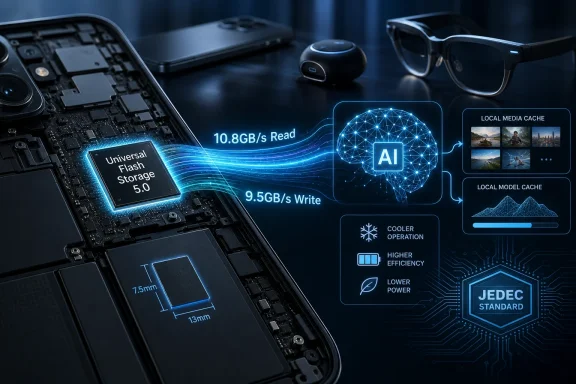
For years, the storage conversation on phones has been strangely lopsided. Buyers understood that 128GB might feel cramped and 512GB might feel luxurious, but few people outside the enthusiast crowd cared whether their flagship used UFS 3.1, UFS 4.0, or UFS 4.1. The phone either felt fast or it did not, and most performance marketing went to the application processor, GPU, modem, or camera pipeline.UFS 5.0 changes the framing because the advertised jump is too large to hide in a spec table. Samsung says its new solution reaches up to 10.8GB/s for sequential reads and 9.5GB/s for sequential writes, more than twice the class of throughput associated with many current high-end UFS 4.x chips. HardwareZone’s summary compares that with premium UFS 4.1 products commonly sitting around the 4.2GB/s to 4.6GB/s range, while Samsung’s own materials emphasize the generational leap over its previous storage.
That does not mean a 2027 phone will suddenly “feel twice as fast” in every daily task. Sequential throughput is the cleanest number to market and the least representative of the messy reality of launching apps, paging memory, indexing files, and moving small blocks under thermal constraints. But it does mean the ceiling is rising dramatically for workloads that actually can stream large amounts of data: model loading, local media processing, high-bitrate video capture, game assets, and future XR devices that need to juggle sensors, displays, and inference at once.
Samsung is also claiming up to 40 percent better power efficiency than its own UFS 4.1 solution, helped by techniques such as clock gating and multi-voltage design. That claim is just as important as the bandwidth claim, because mobile devices do not merely need faster storage; they need faster storage that does not become a tiny space heater next to the battery. In phones, performance that cannot be sustained is marketing theater with a benchmark attached.
The AI Phone Needs a Faster Local Memory Hierarchy
Samsung’s announcement is filled with the vocabulary of the current hardware cycle: on-device AI, efficient local processing, future mobile devices, and seamless AI services. It would be easy to dismiss that language as obligatory 2026 vendor boilerplate. Every chip now wants to be an AI chip, every subsystem now wants to be AI-optimized, and every press release seems one paragraph away from promising a personal assistant that finally understands your calendar.But storage really does matter more when models move onto devices. A phone running local AI workloads is not just executing code; it is loading model weights, accessing embeddings, caching intermediate data, indexing personal content, and potentially moving large media files through AI-enhanced pipelines. DRAM remains the faster working area, but persistent storage becomes the staging ground for what can realistically live on the device.
This is where UFS 5.0 starts to look less like a luxury spec and more like plumbing. A multimodal assistant that can search photos, summarize local files, analyze video, and work offline will need to move data quickly without constantly reaching for the cloud. If vendors want to advertise privacy-preserving AI that runs locally, the phone needs a storage subsystem capable of feeding that stack without making the experience feel like an old laptop waking from hibernation.
There is also a Windows-adjacent angle here that should not be ignored. Microsoft, Qualcomm, Intel, AMD, and the wider PC industry have spent the past two years trying to define the “AI PC” as a device with local acceleration, local models, and a richer memory hierarchy. Phones are moving along the same axis, only with tighter power and thermal constraints. Samsung’s UFS 5.0 announcement is a reminder that the AI-device race is not only about neural processing units; it is about the boring parts of the system becoming less boring.
The SSD Comparison Is Tempting, but It Needs Discipline
TechRadar and others have understandably leaned into the “SSD-class” comparison, because 10.8GB/s sounds like territory once reserved for desktop NVMe drives. On raw sequential bandwidth, UFS 5.0 does indeed start to overlap with numbers enthusiasts associate with modern PC storage. A flash package smaller than a fingernail reaching that kind of throughput is legitimately impressive.Still, the comparison can mislead. A phone’s UFS chip is not a desktop M.2 SSD with a heatsink, a roomy chassis, a larger controller, and access to much more sustained power. UFS is built for embedded mobile systems, not workstation scratch disks. The interface, controller behavior, queueing characteristics, endurance targets, thermals, and firmware assumptions are all different.
That does not make the achievement less meaningful. It just means the user impact will arrive unevenly. The phone that first ships with UFS 5.0 may not boot twice as fast, install apps twice as fast, or copy files twice as fast in every situation. The bigger difference may appear in the background: faster indexing after a restore, smoother loading of large games, quicker local AI model startup, faster movement of high-resolution video, and less time spent burning power during large transfers.
The irony is that the most important benefit may be the least visible one. If Samsung’s power-efficiency claim holds in shipping devices, UFS 5.0 could let phones complete heavy storage work quickly and return to idle sooner. That is the kind of improvement users notice only indirectly, as less warmth, less stutter, and a battery percentage that declines more slowly during demanding tasks.
Smaller Packages Matter Because Phones Are Already Out of Room
Samsung says its UFS 5.0 package measures 7.5mm by 13mm and is just 0.9mm thick, with HardwareZone noting that this is smaller than prior UFS 4.1 packaging. That kind of dimensional detail rarely excites anyone outside hardware design teams, but it is central to why this announcement matters. Modern phones are brutally crowded.Every millimeter inside a flagship phone is already contested by the battery, camera modules, vapor chamber, antennas, speakers, haptics, SIM hardware, mmWave components in some markets, and increasingly elaborate display assemblies. A storage chip that gets smaller while becoming faster and more efficient gives device makers a little more freedom in a design environment where freedom is scarce.
The same is true beyond phones. Samsung’s release explicitly gestures toward future mobile devices, and HardwareZone points to smart glasses and XR as potential beneficiaries of smaller embedded storage. That is not speculative fluff. XR devices need low-latency local storage, aggressive power management, and compact component footprints even more than phones do.
The promise of wearable computing has always been constrained by the physical indignities of putting a computer on someone’s face. Weight, heat, battery life, and board area are not secondary concerns; they are the product. If UFS 5.0 can deliver higher throughput with better efficiency in a smaller package, it becomes relevant not just to Galaxy flagships, but to the broader category of devices trying to escape the smartphone rectangle.
The First Wave Will Be Premium, Expensive, and Uneven
Samsung says mass production begins in the fourth quarter of 2026, with capacities up to 1TB. That timing points naturally toward 2027 devices, and several outlets have already speculated about possible Galaxy S27 adoption. That speculation is reasonable but not confirmed. Samsung’s memory division can announce a component before Samsung’s mobile division commits it to a particular phone, and device configurations often vary by model, region, and storage tier.The first UFS 5.0 devices will almost certainly be premium. That is how these transitions work. Early supply is limited, validation takes time, and vendors prefer to attach expensive new components to expensive devices where margin can absorb them. Even if a flagship line adopts UFS 5.0, the base storage configuration may not necessarily get the same part as the 512GB or 1TB variant.
This matters because storage standards can become another quiet segmentation tool. We have already seen phones ship with different RAM types, different storage speeds, or different thermal behavior across capacity tiers while marketing treats the model family as a single product. UFS 5.0 gives manufacturers one more axis on which to differentiate the “real” flagship from the entry flagship.
Consumers should therefore be cautious when the first UFS 5.0 phones arrive. The meaningful question will not be whether a brand mentions UFS 5.0 somewhere on a launch slide. It will be which capacities use it, which regions receive it, how it performs under sustained load, and whether the software stack actually exploits the extra bandwidth.
JEDEC Standardization Gives the Claim Weight, but Shipping Devices Will Decide the Value
One reason this announcement lands differently from a proprietary vendor flourish is that UFS 5.0 is tied to JEDEC’s standardization work. Standards matter in mobile storage because phone makers, SoC vendors, memory suppliers, and operating-system developers all need a shared target. Without that, faster flash risks becoming a compatibility science project.Samsung says its UFS 5.0 solution follows the latest JEDEC standard for embedded storage, and earlier reporting around the standard pointed to the role of newer MIPI interface technologies in reaching the higher bandwidth ceiling. In plain English, this is not merely Samsung overclocking a storage chip and inventing a badge. It is part of the next negotiated step in the mobile memory stack.
That said, a standard is a starting line, not a finish line. The real work happens when SoC platforms support it properly, firmware matures, thermals are tuned, Android’s storage stack interacts with it efficiently, and OEMs decide how aggressively they want to spend power for performance. A theoretical ceiling can be impressive while early products remain conservative.
Windows users know this pattern well from the PC world. PCIe generations arrive, NVMe drives advertise dramatic sequential numbers, and then real-world benefits depend on workload, controller quality, cooling, firmware, and software. UFS 5.0 is entering a mobile version of the same story: the interface gets faster first, and the ecosystem spends the next cycle figuring out where that speed matters.
The Smartphone Spec Sheet Is Becoming a Systems Argument
The most interesting thing about UFS 5.0 is not that it is fast. It is that Samsung is presenting storage as part of a broader systems argument about where computing happens. If AI inference, media processing, search, translation, summarization, and personalization move onto the device, then every part of the local system becomes more important.That is a shift from the cloud-first mobile era. For much of the last decade, the phone’s job was to capture data, render interfaces, and call remote services. Storage needed to be reliable and reasonably quick, but many of the heaviest workloads happened elsewhere. The AI-device pitch reverses some of that dependency by asking the phone to perform more work locally, sometimes for privacy, sometimes for latency, and sometimes because cloud inference is expensive at scale.
A faster UFS chip does not solve the hardest problems in that transition. It does not make small models smarter, fix hallucinations, guarantee privacy, or create useful AI features where vendors have shipped gimmicks. But it reduces one class of bottleneck, and that is how platform shifts tend to happen: not through one magical component, but through the gradual removal of excuses.
The PC analogy is again useful. SSDs did not merely make file copies faster; they changed what operating systems could assume about responsiveness. Once fast storage became common, sleep, resume, indexing, app launching, and update behavior could evolve. If UFS 5.0 becomes common in high-end phones, mobile operating systems and AI frameworks may start assuming that large local data movement is less painful than it used to be.
Battery Life Is the Claim That Deserves the Most Scrutiny
Samsung’s “up to 40 percent” power-efficiency claim is likely to be the most consequential and the hardest for buyers to verify. Performance numbers are relatively easy to benchmark. Efficiency claims depend on workload, temperature, device design, firmware, and the comparison point chosen by the vendor.The phrase “up to” is doing real work. It usually means the best-case improvement under defined conditions, not a blanket guarantee that every storage operation uses 40 percent less power. Clock gating and multi-voltage techniques are plausible ways to reduce wasted energy, but the practical effect will vary depending on how often a phone hits peak bandwidth and how intelligently the controller scales itself.
That does not mean the claim should be dismissed. In mobile computing, completing a task faster can itself save energy, especially if the system can race to idle. But peak throughput can also tempt vendors into heavier workloads that consume the saved power elsewhere. A phone that uses UFS 5.0 to run larger local models, capture more demanding video, or perform more background indexing may feel more capable without necessarily lasting longer.
This is where reviewers will matter. Synthetic read and write benchmarks will tell only part of the story. The more useful tests will compare restore times, game loading, AI feature latency, video capture stability, thermal throttling, and battery drain during sustained local workloads. UFS 5.0’s best outcome is not a chart-topping number; it is a phone that does more without making users pay for it in heat and endurance.
Android Gets the First Act, but Windows Should Pay Attention
UFS is primarily a mobile and embedded storage story, so the first consumer impact will almost certainly be Android flagships rather than Windows PCs. Still, WindowsForum readers should care because the boundary between phone, PC, and edge device continues to blur. The same pressures shaping UFS 5.0 — local AI, faster persistent storage, tighter energy budgets, smaller boards — are reshaping laptops, handheld gaming PCs, tablets, and compact edge hardware.Microsoft’s AI PC push has focused heavily on NPUs and Copilot-class experiences, but a local AI system is only as good as its memory architecture. Fast storage matters when models are too large to keep fully resident in memory, when user data needs to be indexed locally, and when applications stream assets or checkpoints. The mobile industry is attacking that problem under harsher constraints, and its solutions often migrate outward.
There is also a competitive lesson here. Apple’s tight integration of storage, memory, and silicon has long allowed it to optimize user-perceived performance beyond what individual specs suggest. Android and Windows ecosystems are more modular, which makes standards like UFS and NVMe crucial. Samsung’s UFS 5.0 is another attempt to raise the common floor for devices that cannot rely on a single vertically integrated design.
For Windows on Arm, handheld devices, and thin fanless machines, the relevance is obvious. The future client device is expected to be always-on, AI-capable, battery-conscious, and responsive under background workload pressure. Whether the storage badge says UFS or NVMe, the architectural demand is converging.
The Numbers Are Real, but the Marketing Will Get Ahead of the Experience
The danger with announcements like this is that a concrete engineering advance gets swallowed by marketing inflation. “Twice the speed” is true in the context Samsung is using, but it will be repeated in ways that imply every user interaction doubles in speed. That is not how storage works.App launches depend on CPU scheduling, decompression, memory pressure, framework overhead, and the amount of data actually read from storage. AI features depend on model architecture, NPU throughput, memory bandwidth, software optimization, and user-interface latency. Camera performance depends on sensors, image signal processors, buffers, codecs, heat, and storage. UFS 5.0 helps some of those paths, but it is not the whole road.
The same caution applies to “AI-ready” storage. Faster flash can enable more ambitious local AI, but it cannot make those features useful by itself. A phone may have the bandwidth to load a model quickly and still ship with an assistant that misunderstands intent, summarizes poorly, or hides behind region restrictions. Hardware readiness is not product readiness.
The useful way to read Samsung’s announcement is as a signal of where the industry believes bottlenecks are moving. Premium phones already have fast CPUs, capable GPUs, specialized NPUs, abundant RAM, and excellent displays. Storage is now being pulled into the same arms race because the next layer of software wants to treat the phone less like a terminal and more like a local workstation.
The 2027 Flagship Will Be Judged by What It Does With the Bandwidth
If UFS 5.0 enters phones in 2027, the first wave of launch events will almost certainly include sweeping claims about AI, gaming, photography, and productivity. Some of those claims will be justified. Others will be ordinary feature inflation riding on a real component upgrade.The most credible benefits will likely appear in areas where storage is already a known pressure point. Large mobile games could load assets faster and reduce stalls. Full-device transfers and restores could become less painful. Local AI models could start faster or swap resources more gracefully. High-resolution video workflows could gain headroom, especially as capture formats become more demanding.
But the biggest question is whether operating systems and applications will adapt. Hardware transitions deliver their full value only when software starts assuming the new baseline. If developers continue to target older UFS generations, UFS 5.0 may initially behave like a wider road feeding the same old traffic light. If flagship platforms make it common enough, that assumption can change.
This is why Samsung’s mass-production timing matters. Q4 2026 production means UFS 5.0 is not a distant lab demo, but it also means the first broad consumer test belongs to 2027 hardware. The gap between announcement and device availability gives SoC vendors, OEMs, and software teams time to prepare — or time to turn a promising standard into another badge on an already crowded box.
Samsung’s Tiny Flash Chip Carries a Large Platform Bet
The practical reading of Samsung’s announcement is straightforward, but the strategic reading is larger. UFS 5.0 gives device makers a faster, more efficient embedded storage option just as they are trying to move heavier workloads onto local devices. It is both a component launch and a vote on the direction of consumer computing.Near-term, users should expect UFS 5.0 to appear first in expensive devices, likely in 2027, and not necessarily across every storage tier. The best early improvements will come in heavy workflows rather than ordinary messaging, browsing, and social media use. The benchmark charts will be dramatic; the everyday difference will depend on how ambitious the software becomes.
The announcement also reinforces a broader hardware truth that the AI boom tends to obscure. NPUs get the headlines, but AI devices need balanced systems. They need enough DRAM, fast persistent storage, efficient interconnects, capable thermal designs, and software that understands when to use local resources instead of cloud services. A faster UFS chip is one piece of that stack, but it is a necessary piece if the phone is going to become more than a cloud-connected screen.
The Fine Print Behind the 10.8GB/s Headline
Before the first UFS 5.0 phone lands, the safest conclusions are the concrete ones.- Samsung has developed a UFS 5.0 storage solution that it says reaches up to 10.8GB/s sequential read speed and 9.5GB/s sequential write speed.
- Samsung says mass production is scheduled for the fourth quarter of 2026, with capacities planned up to 1TB.
- The first consumer devices using UFS 5.0 are most likely to appear in 2027, though specific Galaxy models remain unconfirmed.
- The biggest early benefits should come in storage-heavy workloads such as model loading, large game assets, high-resolution media handling, restores, and local indexing.
- Samsung’s claimed power-efficiency gain may matter as much as raw speed, but it will need independent testing in shipping devices.
- UFS 5.0 should be read as part of the wider move toward local AI computing, not as a guarantee that every phone interaction will become twice as fast.
References
- Primary source: HardwareZone
Published: 2026-07-06T04:30:16.956845
Loading…
www.hardwarezone.com.sg - Related coverage: techradar.com
Loading…
www.techradar.com - Related coverage: news.samsung.com
Loading…
news.samsung.com - Related coverage: androidcentral.com
Loading…
www.androidcentral.com - Related coverage: tweaktown.com
Loading…
www.tweaktown.com - Related coverage: smartprix.com
Samsung Announces UFS 5.0 Storage With Up to 10.8GB/s Speeds, Mass Production Set for Late 2026 - Smartprix
Samsung Electronics has officially announced its next-generation UFS 5.0 storage solution, bringing substantial improvements in performance and power efficiency as smartphone makers prepare for increasingly demanding on-device AI workloads. According to Samsung, the new storage standard delivers... www.smartprix.com
- Related coverage: notebookcheck.net
Loading…
www.notebookcheck.net - Related coverage: news.samsungsemiconductor.com
Samsung Unveils Industry’s Fastest UFS 5.0 Solution for Next-Gen On-Device AI Applications – Samsung Semiconductor Global Newsroom
Samsung’s UFS 5.0 solution achieves industry’s highest data transfer speed of 10.8GB/s, enabling faster storage and processing in mobile memory...news.samsungsemiconductor.com
- Related coverage: megamobilecontent.com
Loading…
www.megamobilecontent.com - Related coverage: abit.ee
Loading…
abit.ee - Related coverage: computerbase.de
Loading…
www.computerbase.de - Related coverage: sammobile.com
Loading…
www.sammobile.com - Related coverage: cincodias.elpais.com
Loading…
cincodias.elpais.com - Related coverage: image.samsungsds.com
Loading…
image.samsungsds.com - Related coverage: images.samsung.com
Loading…
images.samsung.com
