

Samsung’s Vision AI Companion lands as a major software-driven reinvention of the TV: a conversational, visual-first AI layer that upgrades Bixby, folds in third‑party agents such as Microsoft Copilot and Perplexity, and ships as a staged software update across Samsung’s 2025 Neo QLED, Micro RGB (Micro LED), OLED, step‑up QLED models and selected Smart Monitors.
Samsung introduced Vision AI Companion publicly during its 2025 product cycle and at IFA 2025, positioning it as the new, unified AI surface for displays. The company describes the Companion as an evolution of its existing on‑device vision and Bixby assistant work — one that combines local perceptual features (image recognition, Live Translate, AI upscaling and audio tuning) with cloud‑backed generative agents to provide conversational, screen‑aware answers without pulling users away from what they’re watching. This is a strategic shift: Samsung is treating televisions and large displays not simply as content players but as shared, ambient AI surfaces for discovery, translation, basic productivity and smart‑home orchestration. The Vision AI Companion is delivered primarily as a firmware/OS update for eligible 2025 models, with Samsung committing what it calls seven years of One UI Tizen OS upgrades for qualifying devices — a notable longevity promise in the TV market.
Execution will determine whether the Companion becomes an everyday utility or a novelty. The critical variables are privacy transparency, consistent regional availability, robustness of partner backends, and how clearly Samsung surfaces data and consent controls to end users. When those areas are handled well, the Companion promises true living‑room convenience: ask about who’s on screen and get rich, sourced answers; translate a foreign film on the fly; generate an ambient wallpaper; or pull up game tips without swapping devices.
However, the model choices and cloud dependencies introduce legitimate concerns. Households should expect to manage permissions explicitly, confirm what data is shared with Microsoft or Perplexity, and verify which features are available on their specific model and locale. Promotional offers and partnership add‑ons are valuable but transient; they shouldn’t be the only reason to invest in an otherwise compelling display.
At an industry level, Samsung’s multi‑agent orchestration is likely to drive wider adoption of pluralistic AI in consumer hardware — a design approach that emphasizes choice, orchestration and platform control rather than assistant lock‑in. If privacy, transparency and regional parity are treated as first‑class obligations, Vision AI Companion could set the template for how generative AI gets integrated into shared home surfaces. If those obligations are neglected, it risks becoming another device feature that raises more questions than answers.
Samsung’s rollout is already under way for 2025 models, and early adopters will determine the living‑room UX story in the months ahead. For now, Vision AI Companion is a major step forward in making TVs less passive and more helpful — but it’s not a finished product. Expect steady iteration, additional agent partnerships and incremental feature parity updates as the platform matures under One UI Tizen’s extended upgrade window.
Conclusion: Samsung’s Vision AI Companion reframes the television as an interactive, shared AI surface built to be conversational, visual and multi‑agent. The promise — helpful, on‑screen answers and coordinated audiovisual optimizations — is credible and grounded in a pragmatic hybrid architecture. The remaining questions are governance, regional parity and long‑term operational transparency; those will determine whether the Companion is a durable upgrade to the living room or simply a headline feature for early adopters.
Source: My Mobile India https://www.mymobileindia.com/samsu...nversational-ai-to-2025-tvs-and-monitors/amp/
 Background / Overview
Samsung introduced Vision AI Companion publicly during its 2025 product cycle and at IFA 2025, positioning it as the new, unified AI surface for displays. The company describes the Companion as an evolution of its existing on‑device vision and Bixby assistant work — one that combines local perceptual features (image recognition, Live Translate, AI upscaling and audio tuning) with cloud‑backed generative agents to provide conversational, screen‑aware answers without pulling users away from what they’re watching. This is a strategic shift: Samsung is treating televisions and large displays not simply as content players but as shared, ambient AI surfaces for discovery, translation, basic productivity and smart‑home orchestration. The Vision AI Companion is delivered primarily as a firmware/OS update for eligible 2025 models, with Samsung committing what it calls seven years of One UI Tizen OS upgrades for qualifying devices — a notable longevity promise in the TV market. What Vision AI Companion Is — The Product in Plain Terms
Conversational, visual‑first assistance
- The Companion is invoked by a dedicated AI button on supported Samsung remotes or via the Tizen home and Samsung Daily+ UI tiles. Spoken or typed prompts produce spoken answers paired with large, TV‑optimized visual cards that are designed to be legible from couch distance.
- Interactions are multi‑turn: follow‑ups preserve context so a household conversation can progress naturally (for example: identify an actor → ask which movie they’re from → show other films). The interface is built for shared use rather than private, phone‑style assistant sessions.
A multi‑agent architecture
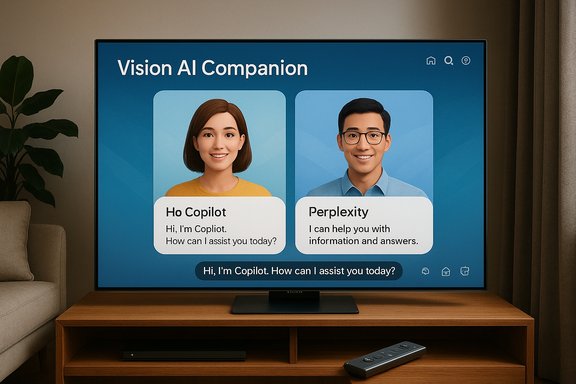
- Samsung’s Companion is intentionally pluralistic: rather than locking to a single LLM, it orchestrates multiple agents. At launch it surfaces Microsoft Copilot for conversational, discovery and “friendly” assistance and Perplexity as a retrieval‑focused, citation‑oriented agent. Samsung markets these as standalone agent apps within the Vision AI shell so users can pick the tool best suited to the task.
Built on One UI Tizen and upgraded Bixby
- Vision AI Companion is layered on Samsung’s One UI Tizen TV platform and represents a generative‑AI upgrade to Bixby rather than a wholesale replacement. Samsung describes the refreshed Bixby as having better contextual awareness and visual integration for screen‑aware answers.
Key Features — What You Can Actually Use
Below are the headline capabilities Samsung has announced and demonstrated. Each item includes how it’s meant to behave in living‑room use.- Conversational Q&A — Natural‑language queries about on‑screen content with follow‑up handling and screen awareness. Large visual cards and short spoken replies make answers glanceable.
- On‑screen visual intelligence — Actor identification, artwork recognition, place/product detection and the ability to surface related clips or facts directly on the TV. Results are meant to be visual and legible across the room.
- Microsoft Copilot integration — Copilot appears as an animated, lip‑synced persona that narrates answers and shows contextual cards. It supports content discovery, spoiler‑safe recaps, light productivity tasks and smart‑home actions (SmartThings). Microsoft and Samsung state Copilot is free on supported hardware, with optional sign‑in via QR code for personalization.
- Perplexity TV App — A web‑sourced, citation‑forward agent that returns research‑style answers as TV‑friendly cards. Samsung’s launch materials also announced a Perplexity Pro promotional offer for early users on 2025 TVs.
- Live Translate — Near‑real‑time on‑screen subtitle translation and transcribing of dialogue with local processing to reduce latency when possible. This is aimed at broadcast and streamed content where immediate translation matters.
- AI Picture / AI Upscaling Pro — Scene‑by‑scene perceptual tuning and upscaling to improve perceived picture quality on standard and low‑resolution sources. Samsung positions this as a content‑aware enhancement made more useful when coordinated by the Companion.
- Active Voice Amplifier (AVA) Pro — Adaptive audio adjustments to improve dialogue clarity in noisy rooms. This pairs with Live Translate and other audio features when an AI interaction triggers environment‑aware tuning.
- AI Gaming Mode — Automated switching to gaming‑optimized latency and audio profiles when a user asks for game tips or launches gameplay. The Companion can orchestrate picture and audio tuning in a single voice interaction.
- Generative Wallpaper — AI‑generated ambient images or dynamic backgrounds created from text prompts or user preferences to decorate the idle screen.
- Account & personalization flows — Optional QR code sign‑in to link a Microsoft Account (for Copilot) or other accounts and unlock memory, personalization and cross‑device continuity features. Basic functionality is available without sign‑in.
Availability — Which Models and When
Samsung says Vision AI Companion is rolling out as a staged software update across its 2025 lineup. The initial availability list and rollout cadence reported by Samsung and independent outlets include:- 2025 models: Neo QLED, Micro RGB (Micro LED), OLED, QLED step‑up models, The Frame / The Frame Pro, and selected Smart Monitors (M7, M8, M9). The Movingstyle series and some lifestyle/projector SKUs were also named in Samsung’s materials.
- Rollout timing: Samsung signalled a staged rollout beginning in late September 2025 in Korea, North America and selected European markets, then expanding to additional regions and eligible 2023/2024 models via later OS upgrades. Exact regional timing and per‑model feature parity may vary.
- Languages: Samsung advertises initial support for ten languages (including Korean, English, Spanish, French, German, Italian and Portuguese). Expect expansion over time.
- Update commitment: Samsung has publicly committed to seven years of One UI Tizen OS upgrades for supported models — a longer support window than many rivals. This is positioned as a way to keep the Companion, security patches and new AI features available over a longer useful lifespan. Samsung’s newsroom and product pages carry this pledge.
Architecture and How It Works — Edge, Cloud, and the Tradeoffs
Samsung describes Vision AI Companion as a hybrid edge + cloud architecture designed for real‑world, latency‑sensitive media use:- On‑device (edge) processing handles latency‑sensitive perceptual tasks such as Live Translate subtitling, scene/object recognition, AI upscaling, audio tuning and wake‑word processing. Keeping these local reduces interruptions while playback is underway.
- Cloud agents (Microsoft Copilot, Perplexity and others) perform large‑context generative reasoning, web retrieval and multi‑turn conversational synthesis. These agents supply broader knowledge, web‑backed answers, and retrieval that local SoCs cannot handle.
- Advantage: responsiveness and reduced playback interruption for audiovisual tasks.
- Disadvantage: full functionality depends on network connectivity and partner backends; different agents may have different privacy, latency and regional availability characteristics.
Strategic Context — Why Samsung Is Doing This
Samsung’s move toward a multi‑agent, display‑centric AI surface serves several company goals:- It converts a traditionally passive product (TV) into a platform that can keep users inside Samsung’s ecosystem for longer sessions — surfacing content discovery, smart‑home control, shopping and productivity features without switching devices.
- By integrating third‑party agents (Microsoft, Perplexity and others), Samsung hedges against locking into a single vendor, offering choice and a competitive position as an orchestrator of AI rather than a single‑model owner. This pluralistic approach also dovetails with Samsung’s broader Galaxy AI commitments across phones and appliances.
- The seven‑year OS upgrade promise is a clear commercial differentiator: it reduces buyer anxiety about obsolescence and supports the long‑tail value of cloud‑enabled features that improve over time.
Strengths — Why the Companion Could Succeed
- Immediate, living‑room utility. The Companion fulfills concrete pain points: identify who’s on screen, translate dialogue on the fly, learn trivia about what you’re watching, and get content suggestions without pausing playback. The visual‑first UI and large cards are designed for communal viewing contexts.
- Flexible agent model. By letting Microsoft Copilot and Perplexity operate as distinct agent experiences, Samsung gives users choice and the ability to use the best tool for different tasks (creative discovery vs. citation‑backed research).
- Hybrid design for latency. Local processing for perceptual tasks yields a more seamless experience during live playback, while cloud agents provide depth when needed — a balanced technical approach for TV use cases.
- Longer software support. Seven years of updates is a persuasive benefit for consumers who keep TVs for many years; it also gives Samsung leeway to improve AI features across a device’s lifespan.
Risks, Unknowns, and Practical Concerns
While Vision AI Companion is promising, multiple risks and caveats deserve attention.1) Privacy and data routing
The Companion’s hybrid model means local audio and visual analysis plus cloud routing of conversational queries. That raises questions about:- What audio and visual data are stored or transmitted to partner backends?
- How long are transcripts or images retained when routed to Copilot or Perplexity?
- What defaults are set for on‑device microphones and camera access, and how transparent are those settings to households?
2) Feature fragmentation by region and model
- Agent availability, feature parity and rollout timing vary by market. A model that receives Copilot in North America might get a delayed rollout or limited functionality in other regions. Samsung’s staged rollout and per‑model SKU differences mean buyers should check exact model support before relying on specific agents.
3) Cloud dependency and resilience
- Full conversational power depends on backend availability; network outages or agent downtime will affect the Companion’s usefulness. For households that prize offline reliability, the companion’s value is reduced unless local fallbacks are robust.
4) Account sign‑in tradeoffs
- Personalization and memory features require scanning a QR code and linking accounts. This adds convenience but also concentrates cross‑device personal data under Microsoft, Samsung or Perplexity accounts, depending on agent choice. Users should weigh convenience vs. centralized data storage.
5) Commercial offers and sustainability
- Promotional Perplexity Pro offers and bundled perks (12‑month trials) are attractive but may be promotional and time‑limited. Past experience with carrier or manufacturer bundle deals suggests these can be rescinded or modified; users should treat such promotions as temporary benefits rather than permanent entitlements.
6) Unverifiable or aspirational claims
- Some coverage referenced ambitious device targets or investment talks (for example, large device reach goals or potential Samsung investments in Perplexity). Those should be treated as corporate ambition statements unless confirmed by regulatory filings or independent confirmation. Flagged corporate ambitions should not be treated as hard performance guarantees.
How Vision AI Companion Compares to Rivals
- LG and webOS: LG’s webOS has its own generative features and a re:New update program; Samsung’s seven‑year update pledge and multi‑agent approach are a clear attempt to outflank LG on both longevity and agent choice. Samsung’s hybrid orchestration (Copilot + Perplexity + native AI) differentiates it from single‑agent strategies.
- Google and Android TV/Google TV: Google has invested heavily in Gemini and on‑device models; Samsung’s strategy deliberately leaves room for multiple partners (including Google on Galaxy devices) rather than tying TVs exclusively to one AI ecosystem. This pluralism can be an advantage where cross‑platform compatibility and choice matter.
- Amazon and Alexa/Fire OS: Amazon focuses on voice and commerce integration; Samsung’s Companion emphasizes visual cards, long‑form conversation and on‑screen visuals for shared viewing — an intentionally different UX prioritized for living‑room social contexts.
Practical Recommendations for Buyers and Administrators
- Check the official model list and regional rollout calendar for your specific SKU before purchase or before expecting a feature update; agent availability may vary by country.
- Review and configure privacy settings immediately after the update: disable microphone access or require explicit confirmation before cloud transmission if you prefer local‑first operation. Look for settings that control what is sent to third‑party agents.
- Use QR sign‑in mindfully: link accounts only to profiles you trust and understand the privacy tradeoffs for personalization and memory.
- Treat promotional agent subscriptions (Perplexity Pro, etc. as short‑term perks; verify the terms and the mechanism for redemption so you don’t rely on them for long‑term workflows.
- If you use a TV as a monitor for productivity, test Copilot’s productivity features on the target model (calendar previews, email summaries) to confirm the responsiveness and layout work for your workflow.
Final Analysis — Value, Execution, and the Road Ahead
Samsung’s Vision AI Companion is a bold and pragmatic attempt to put high‑value generative features where families already gather: on the largest screen in the home. The strengths are real: screen‑aware, multi‑turn conversation; hybrid edge/cloud architecture for low latency; choice through multi‑agent orchestration; and a long‑term One UI Tizen upgrade commitment that protects buyer value.Execution will determine whether the Companion becomes an everyday utility or a novelty. The critical variables are privacy transparency, consistent regional availability, robustness of partner backends, and how clearly Samsung surfaces data and consent controls to end users. When those areas are handled well, the Companion promises true living‑room convenience: ask about who’s on screen and get rich, sourced answers; translate a foreign film on the fly; generate an ambient wallpaper; or pull up game tips without swapping devices.
However, the model choices and cloud dependencies introduce legitimate concerns. Households should expect to manage permissions explicitly, confirm what data is shared with Microsoft or Perplexity, and verify which features are available on their specific model and locale. Promotional offers and partnership add‑ons are valuable but transient; they shouldn’t be the only reason to invest in an otherwise compelling display.
At an industry level, Samsung’s multi‑agent orchestration is likely to drive wider adoption of pluralistic AI in consumer hardware — a design approach that emphasizes choice, orchestration and platform control rather than assistant lock‑in. If privacy, transparency and regional parity are treated as first‑class obligations, Vision AI Companion could set the template for how generative AI gets integrated into shared home surfaces. If those obligations are neglected, it risks becoming another device feature that raises more questions than answers.
Samsung’s rollout is already under way for 2025 models, and early adopters will determine the living‑room UX story in the months ahead. For now, Vision AI Companion is a major step forward in making TVs less passive and more helpful — but it’s not a finished product. Expect steady iteration, additional agent partnerships and incremental feature parity updates as the platform matures under One UI Tizen’s extended upgrade window.
Conclusion: Samsung’s Vision AI Companion reframes the television as an interactive, shared AI surface built to be conversational, visual and multi‑agent. The promise — helpful, on‑screen answers and coordinated audiovisual optimizations — is credible and grounded in a pragmatic hybrid architecture. The remaining questions are governance, regional parity and long‑term operational transparency; those will determine whether the Companion is a durable upgrade to the living room or simply a headline feature for early adopters.
Source: My Mobile India https://www.mymobileindia.com/samsu...nversational-ai-to-2025-tvs-and-monitors/amp/
