

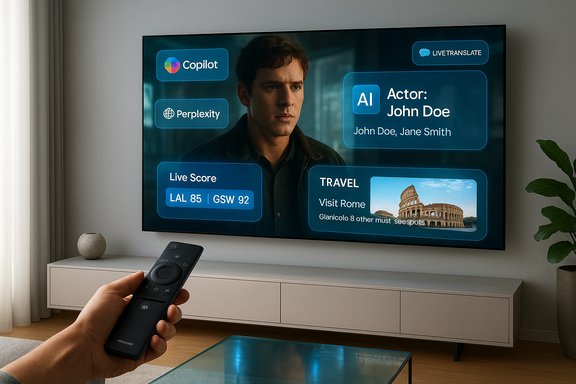
Samsung has begun rolling out Vision AI Companion, a generative‑AI upgrade to Bixby that brings a conversational, context‑aware assistant to its 2025 smart‑TV and monitor lineup — enabling viewers to ask about actors, scenes, live scores, recipes and travel suggestions, and receive visual answers overlaid on the screen without forcing playback to stop.
Background
Samsung unveiled Vision AI Companion at IFA 2025 as the next stage of its Vision AI strategy, folding multiple AI capabilities into a single, remote‑accessible assistant on One UI Tizen. The company pitches the feature as a way to make the TV the home’s central AI surface: a device that does more than stream video by offering contextual answers, multi‑step help, and integrations with other AI agents. Samsung’s newsroom materials and product briefings describe the Companion as an upgraded Bixby experience powered by generative models and connected AI services. Samsung’s launch materials promise a broad set of bundled features — Live Translate, Generative Wallpaper, AI Picture, AI Upscaling Pro, and other optimizations — and name external AI partners such as Microsoft Copilot and Perplexity as supplemental agent apps to extend functionality. The company also states the platform will receive extended OS support through One UI Tizen updates.What Vision AI Companion actually does
Core capabilities (what Samsung says it will do)
- Answer questions about what’s on screen — identify actors, artworks, locations, or explain a scene — with visualized responses that appear alongside playback.
- Provide real‑time information such as live sports results, facts, or short summaries without interrupting the show.
- Offer recommendations and lifestyle assistance: film and series suggestions, quick recipes, travel ideas and nearby restaurant options.
- Integrate other Samsung Vision AI features (picture and audio optimizations, live translation, generative wallpapers) so the assistant becomes a single hub for display‑level AI services.
How responses are delivered
Vision AI Companion returns both spoken and visual results: a brief voice reply combined with on‑screen cards, images, or short clips related to the query. The stated design goal is to keep playback intact while layering informational overlays, rather than forcing users to leave their content to view search results. This hybrid presentation is central to Samsung’s “companion” framing.Device coverage and rollout
Vision AI Companion is rolling out across Samsung’s 2025 lineup, including Neo QLED, Micro RGB, OLED, step‑up QLED models, Smart Monitors and lifestyle displays such as The Frame and The Movingstyle. Samsung’s press materials list broad hardware coverage and say the feature is integrated into One UI Tizen; the company has also emphasized seven years of OS upgrades for systems running the platform. A global rollout is being staged over the 2025 model year; availability by country, language support and the pace of feature activation will vary by model and region. Samsung lists support for 10 languages (including English, Korean and Spanish) out of the gate. Independent coverage confirms the Companion began appearing in retail and review units shortly after the IFA announcement.The technology stack and partnerships
Generative models, agent apps and third‑party integration
Samsung describes Vision AI Companion as a generative‑AI upgrade to Bixby that can call external AI agents when needed. The official materials and subsequent reporting specifically call out Microsoft Copilot and Perplexity as integrated agent apps, allowing the TV to access broader knowledge, retrieval and tasking capabilities beyond Samsung’s own models. These partnerships are positioned as a way to extend the assistant’s capabilities (for example, task support and web‑facing knowledge) while keeping the TV interface simple. It is important to note that corporate disclosures name the integrated partners, but they do not fully detail where inference runs (on‑device vs cloud), what data flows between Samsung and third‑party services, or how long dialogue history is retained. Those implementation details are not fully public and should be considered partially unverifiable without deeper technical documentation or regulatory filings. Flag: the degree of on‑device processing, telemetry, and partner access to user‑facing content requires further confirmation from Samsung technical documentation or privacy notices.Platform and OS
Vision AI Companion is built into One UI Tizen, Samsung’s TV operating environment. The integration leverages the OS’s update infrastructure; Samsung promises continued software upgrades for eligible models. This is an important point for buyers who consider long‑term feature support and security updates when purchasing a high‑end TV.Practical examples and user experience
In‑play queries and contextual follow‑ups
A typical use case demonstrated in Samsung materials and independent articles: while watching a movie, you press the AI button and ask “Who’s that actor?” or “Where was this scene filmed?” The Companion responds with a short spoken answer, shows the actor’s name and related credits, and presents clickable cards for more detail — all without pausing the film. Follow‑up queries like “What else has she been in?” remain in the same conversational context.Live events and sports
For live sports, Samsung says the assistant can surface scores and quick stats on demand. That capability depends on the same retrieval agents used for other queries; coverage of live data accuracy and latency will matter in practice, and independent testing will be required to judge reliability in fast‑moving events.Lifestyle and discovery
Beyond content recognition, Vision AI Companion aims to perform everyday tasks: suggesting quick recipes based on what’s on screen, proposing travel ideas when a travel documentary is playing, or locating nearby restaurants. These cross‑domain use cases are a strategic push to move the TV from a passive consumption device to an interactive hub.Strengths — where Vision AI Companion can genuinely add value
- Contextual, low‑friction information: The overlay approach keeps users watching while enabling immediate discovery — a clear UX improvement over forcing a switch to a separate search app.
- Unified AI feature set: By combining picture/audio optimization, translation and generative search into one assistant, Samsung simplifies access to capabilities that previously required multiple menus and apps.
- Large partner ecosystem: Integrations with Microsoft Copilot and Perplexity mean the Companion can leverage specialized agents for tasks like web retrieval, planning and knowledge summarization. That modularity may accelerate capability growth and reduce time‑to‑market for new features.
- Broad device and language coverage: Samsung’s stated support across flagship 2025 hardware and 10 languages is a strong commercial move to make the assistant viable in multiple regions.
Risks and unresolved technical questions
Data flows, privacy and model access
Samsung’s messaging mentions third‑party agents but leaves several technical and privacy questions open: where is user audio and video metadata processed; what parts of a conversation are stored; do partner models receive raw transcript or only redacted requests; how long is history kept; and what opt‑out controls are provided? These are material concerns when a device sits in the home and can access broadcast, streaming, and microphone input. Without detailed privacy engineering documentation, these aspects remain only partially verifiable. Caution is warranted until Samsung publishes full privacy and data‑processing disclosures.Accuracy and hallucination risk
Generative models can produce confident but incorrect answers (hallucinations). For identification tasks (who is that actor? or factual claims (match scores), accuracy is crucial. Samsung’s reliance on retrieval agents like Perplexity and Copilot suggests a retrieval‑augmented architecture, which reduces hallucination risk but does not eliminate it. Buyers should expect occasional mistakes, and critical use cases (medical advice, legal recommendations) remain inappropriate for TV companions.Commercial and ad implications
An AI layer that recommends content and local businesses raises monetization questions. Will suggestions be neutral or prioritized by commercial relationships? Samsung’s initial messaging focuses on user experience, but business models often follow: sponsored suggestions, affiliate links or promoted content could appear over time. This is not yet detailed in Samsung’s public briefing and merits watcher scrutiny.Latency and compute constraints
Real‑time, low‑latency responses depend on cloud infrastructure and local device performance. Samsung’s ambition to deliver visualized results while maintaining playback implies complex parallel processing. The capture, upload, retrieval, and rendering pipeline introduces points of failure: network outages, slow inference, or degraded UX on lower‑end models. These practical performance aspects will be revealed only through hands‑on reviews and long‑term use.How Vision AI Companion compares with rivals
The TV industry is rapidly moving toward generative assistants. Samsung’s Companion competes directly with:- Google’s Gemini on Google TV — Gemini adds conversational search and recommendations to the Google TV ecosystem and has rolled out to multiple OEMs and streamers.
- Amazon’s Alexa+ on Fire TV — Amazon has incorporated generative AI into Alexa and Fire TV to provide natural language search and recommendations.
- OEM‑specific moves from other vendors — companies such as LG have signaled plans to incorporate advanced assistants through third‑party partnerships and their own AI suites.
Practical tips for buyers and administrators
- Check the model: confirm that your specific 2025 model is listed as Vision AI Companion‑capable. Samsung’s newsroom lists model families; retailer listings and firmware release notes will reflect activation timing.
- Review privacy settings at setup: look for controls around voice data, conversation history, and third‑party data sharing. If you are privacy‑sensitive, investigate whether Samsung offers local processing modes or opt‑outs for partner agents. Flagged: full privacy detail may not yet be granular in public facing materials.
- Test live features: try live questions during sports and compare responses with authoritative sources. This will show practical latency and accuracy for time‑sensitive queries.
- Keep firmware current: Samsung’s promise of extended updates matters here because many AI capabilities will arrive as software improvements rather than hardware upgrades. Ensure you enroll in automatic updates where possible.
Regulatory and ethical considerations
The combination of large displays and generative assistants in living rooms raises fresh regulatory flags: consumer protection rules around AI‑provided information, advertising transparency, children’s data protection, and audio/video surveillance laws in various jurisdictions. Policymakers are increasingly focused on AI transparency and opt‑in consent for data use; manufacturers will need to publish clear notices and potentially implement more restrictive defaults to comply with regional rules. Samsung’s initial brief touches on language coverage and partner integrations, but not on compliance workflows or auditability, so this remains a policy area to watch.Hands‑on experience expectations and what reviewers will look for
Independent reviewers and technical auditors will focus on:- Context retention: How many turns of conversational context are preserved and how gracefully are follow‑ups handled?
- Accuracy: How often is the assistant correct on identity, facts and live scores?
- Latency: How fast are responses during streaming and live events?
- Privacy controls: Is data minimization implemented? Are logs editable/deletable? Is local processing offered?
- Localization: How well do the 10 supported languages perform, and are regional dialects and colloquialisms handled?
Business and market implications
Samsung’s move is strategically sensible: it elevates the TV as a permanent in‑home AI endpoint and leverages Samsung’s hardware leadership to anchor its AI ecosystem. For Microsoft and Perplexity, the integrations place their agents in front of living‑room audiences, expanding the reach of their services. For consumers, this could mean less time reaching for phones to look up information and more natural, multimodal interaction with media.However, the shift also nudges the TV market toward continuous software competition rather than periodic hardware only, changing how value is delivered and monetized over a TV’s lifetime. Samsung’s seven‑year update commitment is a commercial differentiator that can keep devices relevant while the companion improves via cloud and model updates.
Final analysis: pragmatic optimism with guarded caution
Vision AI Companion is a meaningful step in evolving the TV from a passive screen to an interactive, AI‑driven hub. Its strengths are obvious: contextual overlays that preserve playback, a unified access point for display AI, and a partner ecosystem that broadens capability quickly. Early reporting and Samsung’s official briefings show a considered product with real consumer use cases. At the same time, several material questions remain: the exact mechanics of data sharing with Copilot and Perplexity; the extent of on‑device versus cloud inference; the durability of privacy controls; and the commercial pathway for recommendations and advertising. These are not minor items — they determine whether the Companion will be seen as empowering or intrusive. Until Samsung publishes detailed technical and privacy documentation (or independent audits appear), these points should be treated as open.What to watch next
- Firmware rollouts and hands‑on reviews: independent tests will reveal latency, accuracy and robustness.
- Privacy documentation updates: look for detailed data‑flow diagrams and user‑control knobs from Samsung.
- Partner behavior: how Microsoft Copilot and Perplexity integrate (and whether they expose user data to partners) will be critical.
- Competitive moves: responses from Google (Gemini on Google TV), Amazon (Alexa+), and other OEMs will influence consumer choice and feature parity.
Source: newskarnataka.com https://newskarnataka.com/technolog...sion-ai-companion-on-2025-smart-tvs/13112025/
