

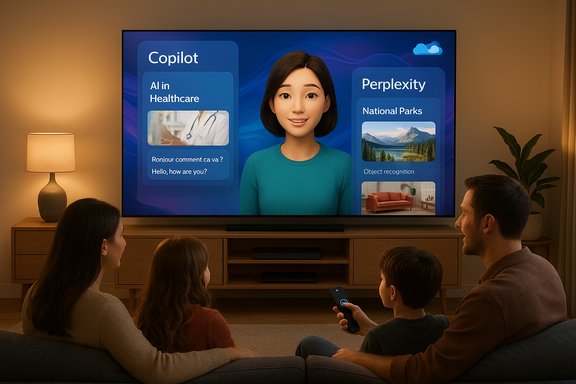
Samsung’s new Vision AI Companion turns the living‑room television from a passive display into a conversational, multi‑agent AI hub that arrives as an over‑the‑air upgrade across the company’s 2025 Neo QLED, Micro RGB, OLED, QLED step‑up models, selected Smart Monitors and lifestyle screens — and it stitches an upgraded, visual‑first Bixby together with cloud agents such as Microsoft Copilot and Perplexity to deliver on‑screen answers, real‑time translation, picture/audio tuning, generative wallpapers and more.
Samsung introduced Vision AI Companion at IFA 2025 as the centerpiece of a broader push to turn displays into screen‑aware assistants: devices that not only play content, but understand what’s on screen and respond to natural two‑way dialogue with visual, TV‑optimized answers. The company presents the Companion as an evolution of Bixby — layered on One UI Tizen — and as a hybrid, multi‑agent architecture that balances on‑device, low‑latency perception with cloud‑backed generative reasoning. This move is strategic: Samsung wants the TV to be the household’s shared AI surface rather than an accessory for phone‑centric assistants. The Vision AI Companion is designed for communal, glanceable interactions (large visual cards, spoken replies and quick actions) so multiple people can query the screen without everyone reaching for a phone.
Cross‑checking Samsung’s claims with independent reporting confirms the Copilot integration, the multi‑agent stance and the basic feature list — outlets including The Verge and Tom’s Guidedescribe the same core commitments and the visual, conversational experience Samsung demonstrated publicly.
Illustrative examples Samsung highlights:
Four broader implications are worth noting:
Who should consider buying now:
For buyers who want a smarter, more social TV and who accept the trade‑offs of cloud‑augmented generative AI, Vision AI Companion is a significant step forward. For privacy‑first households or those needing uniformly sourced answers, a cautious, informed rollout and careful account management remain prudent. Samsung’s approach sets a new standard for what a TV can do; the real test will be how well the company and its partners navigate the operational and ethical complexities of putting generative AI at the centre of the home.
Source: Sammy Fans Samsung Vision AI Companion brings smart and useful features
 Background and overview
Samsung introduced Vision AI Companion at IFA 2025 as the centerpiece of a broader push to turn displays into screen‑aware assistants: devices that not only play content, but understand what’s on screen and respond to natural two‑way dialogue with visual, TV‑optimized answers. The company presents the Companion as an evolution of Bixby — layered on One UI Tizen — and as a hybrid, multi‑agent architecture that balances on‑device, low‑latency perception with cloud‑backed generative reasoning. This move is strategic: Samsung wants the TV to be the household’s shared AI surface rather than an accessory for phone‑centric assistants. The Vision AI Companion is designed for communal, glanceable interactions (large visual cards, spoken replies and quick actions) so multiple people can query the screen without everyone reaching for a phone.What Vision AI Companion actually does
Headline capabilities (what you’ll notice first)
- Conversational Q&A: Press the AI/mic button on the remote and ask natural questions about on‑screen content; the Companion supports multi‑turn follow‑ups and preserves context across a dialogue.
- On‑screen visual intelligence: Identify actors, artworks, locations, products and other objects in a frame, then surface contextual clips, facts and related content as large cards optimized for couch viewing.
- Live Translate: Near‑real‑time subtitle and dialogue translation powered by local processing where possible to reduce latency.
- Multi‑agent generative AI: Route queries to specialized agents — notably Microsoft Copilot for conversational discovery and Perplexity for retrieval/citation‑focused answers — alongside Samsung’s upgraded Bixby.
- Picture and audio AI: AI Picture, AI Upscaling Pro, Active Voice Amplifier (AVA) Pro and AI Gaming Mode automatically tune visuals and sound to the content and room conditions.
- Generative Wallpaper: Create dynamic, personalized background imagery or idle‑screen art using generative models.
- Perplexity TV app: A dedicated Perplexity agent is available as a preinstalled TV app on 2025 models, offering citation‑aware answers and a promotional Perplexity Pro offer in some regions.
How the system is built — hybrid edge + cloud
Vision AI Companion explicitly separates duties between local (edge) processing and cloud agents:- Edge/On‑device handles wake‑word detection, low‑latency subtitling (Live Translate), quick visual recognition, AI upscaling and certain audio optimizations so that requests made during playback feel immediate.
- Cloud handles large‑context generative reasoning, web retrieval, citation‑aware summarization and personalization/memory when users sign in to partner services. Microsoft Copilot and Perplexity are two named cloud partners at launch.
Availability, languages and update commitments
Samsung has confirmed Vision AI Companion will roll out as a staged software update across its 2025 product lines — Neo QLED, Micro RGB (Micro LED), OLED, selected QLED step‑up models, The Frame (and Frame Pro), Smart Monitors (M7/M8/M9) and lifestyle/projector SKUs — with eligible 2023/2024 models slated to receive the feature via later Tizen OS updates. The rollout began in late September 2025 in Korea, North America and select European markets, with broader regional expansion to follow. Samsung advertises initial conversational support for 10 languages, including Korean, English, Spanish, French, German, Italian and Portuguese. The company pairs that language footprint with a notable commitment: up to seven years of One UI Tizen OS upgrades for supported models, which Samsung positions as a long‑term software and security promise for buyers.Cross‑checking Samsung’s claims with independent reporting confirms the Copilot integration, the multi‑agent stance and the basic feature list — outlets including The Verge and Tom’s Guidedescribe the same core commitments and the visual, conversational experience Samsung demonstrated publicly.
Deep dive: the multi‑agent strategy and what it means for users
Samsung’s most consequential architectural choice is to be an orchestration layer rather than a single‑model vendor: Vision AI Companion routes different tasks to the most appropriate agent. At launch, two named agents are prominent:- Microsoft Copilot — positioned as the conversational, discovery‑oriented assistant optimized for TV (friendly summaries, episode recaps, recommendations). Copilot is accessible via the Tizen home, Samsung Daily+ and the AI button, and can be personalized by scanning a QR code to link a Microsoft account.
- Perplexity — presented as a retrieval‑focused, citation‑aware agent with a dedicated TV app that returns research‑style answers as on‑screen cards; Samsung promoted a limited Perplexity Pro offer during launch.
- It gives users choice and lets Samsung route tasks to specialists: creative discovery to Copilot, citation‑focused queries to Perplexity, on‑device perceptual tasks to Samsung’s own models.
- It reduces single‑vendor lock‑in and enables a richer set of capabilities than one assistant could deliver alone.
- Inconsistent answers: Different agents may return conflicting information or vary in tone and depth. The UX must make agent selection and routing transparent to prevent confusion.
- Fragmented personalization: Memories and personalization live in partner clouds (Microsoft for Copilot, Perplexity for Perplexity). Cross‑agent continuity requires multiple account linkages, QR sign‑ins and clear privacy consent flows.
- Service dependence: Outages, rate limits or regional restrictions on partner services could degrade the Companion’s capabilities; local on‑device fallbacks are limited to perceptual tasks.
Practical use cases and real‑world UX
Samsung’s launch demos map directly to real household scenarios. The Companion aims to simplify typical cross‑device friction — asking the TV instead of reaching for a phone — and surfaces actions and media without breaking the viewing experience.Illustrative examples Samsung highlights:
- “What’s the best way to grill pork belly?” — Companion returns step‑by‑step recipe videos and related items.
- “Can you recommend a movie for Christmas?” — Copilot or the Companion surfaces holiday film suggestions and direct playback options.
- “Who is that actor?” — Visual recognition identifies the actor and offers filmography and clips.
- During a foreign‑language film, Live Translate provides near‑real‑time subtitles so viewers can follow along without second‑screen lookups.
Strengths: where Vision AI Companion truly moves the needle
- Screen‑first UX: The Companion is built around the TV’s strengths — distance reading and shared viewing — rather than shoehorning a phone or speaker assistant into a big screen. This makes the experience feel native and social.
- Practical hybrid architecture: Offloading perceptual, low‑latency tasks to the device while reserving generative reasoning for the cloud is sensible for current hardware constraints and keeps the experience responsive during playback.
- Choice via multi‑agent model: Letting users pick agents (Copilot, Perplexity, Samsung Bixby) addresses different query types and reduces reliance on one company’s model priors.
- Broad feature set: Combining Live Translate, AI upscaling, AVA Pro, AI Gaming Mode and generative wallpaper in a single interface adds practical, immediate value to TVs beyond novelty.
- Seven‑year update commitment: Offering up to seven years of One UI Tizen OS upgrades is a competitive differentiator in the TV market that promises feature longevity and security updates for buyers.
Risks, unresolved questions and criticisms
No generative feature of this scale is without tradeoffs. The following are the material risks and gaps users and buyers should weigh:- Privacy and data flows: Multi‑agent routing means conversational data may be shared with third parties (Microsoft, Perplexity). While Samsung’s materials mention QR sign‑in and consent flows, the precise telemetry, retention policies and scope of data shared (voice snippets, screenshots, viewing context) are not fully public in granular form — buyers should review account permissions and privacy settings when linking services. Flag: verify per‑region privacy controls at setup.
- Fragmented personalization: Personalization and memory are agent‑specific. Achieving a single, coherent profile across Copilot, Perplexity and Samsung features requires linking multiple accounts and consent choices, which increases friction and potential confusion about where your profile data lives.
- Answer consistency and sourcing: Different agents use different retrieval strategies. Perplexity emphasizes citation‑aware answers; Copilot may favor conversational summaries. Users seeking strict sourcing or reproducible facts should prefer Perplexity or explicitly request cited responses.
- Regional feature parity: Agent availability, Perplexity promotions, and even Copilot integration can vary by market. Some features may be delayed or restricted depending on local regulations and partner agreements.
- Network reliance and latency: Cloud‑backed features require reliable internet. While Live Translate and some recognition run locally, multi‑turn generative help and web retrieval will be limited or unavailable without connectivity.
- Safety and hallucinations: As with all generative systems, hallucination risk exists — especially for open‑ended queries. Samsung’s multi‑agent approach mitigates this partially by including a citation‑focused agent, but vendors must still make provenance and fallback behavior obvious.
How Vision AI Companion compares with alternatives
Samsung’s strategy contrasts with other vendor approaches in two ways:- Pluralistic agent orchestration vs. single assistant: Samsung intentionally surfaces multiple third‑party agents on the TV, while some competitors bundle a single assistant tightly into their ecosystem. The multi‑agent model offers flexibility but also complexity.
- Longer OS support: Samsung’s seven‑year One UI Tizen update commitment is relatively generous compared with many rivals and should extend the useful life of AI features on the hardware. This is a meaningful purchasing differentiator for consumers who value long software longevity.
Practical advice for buyers and early adopters
- If you value the TV as a shared, glanceable surface for discovery and translation, Vision AI Companion is a compelling upgrade on 2025 Samsung models. Prioritize models that Samsung explicitly lists (Neo QLED, Micro RGB, OLED, The Frame variants, M7/M8/M9 monitors) for best feature parity.
- When setting up Copilot or Perplexity on a shared TV, consider whether you want to link personal accounts. Use the QR sign‑in for convenience, but review the terms and privacy controls before granting long‑term access.
- For research‑grade answers or where sourcing matters, prefer the Perplexity agent and look for cited cards; for conversational discovery or recommendations, Copilot is likely to be more helpful.
- If you have intermittent internet, note that on‑device features (Live Translate, AI upscaling) will often remain usable while cloud agents will not — plan for an offline fallback for critical tasks.
- Keep firmware updated: Samsung’s staged rollout means feature availability can change over time. The seven‑year upgrade promise suggests Samsung intends to refine the Companion via updates, so installing OS patches promptly will improve both features and security.
The bigger picture: what Vision AI Companion signals about TVs and the AI home
Vision AI Companion represents a shift in how major consumer electronics vendors think about displays: not merely as content consumption devices but as ambient, multimodal AI surfaces that mediate household interactions, learning, translation and light productivity.Four broader implications are worth noting:
- The living room as an AI node: By centering AI on the TV, Samsung formalizes the idea that the big screen is a social AI endpoint — a shared place where household context and multi‑person conversations matter.
- Ecosystem orchestration: Samsung’s multi‑agent approach shows vendors can be orchestrators of external AI capabilities rather than exclusive model owners. This opens pathways for richer partner ecosystems but raises questions about consistency and governance.
- Software as a hardware differentiator: Long update windows and frequent feature rollouts are now major selling points in the TV market, which historically emphasized hardware features. Samsung’s seven‑year promise reframes buyer expectations around device longevity.
- Regulatory and privacy complexity: As TVs begin to process more sensitive information (voice, viewing context, account links), regulation and user consent will matter. Regionally variable agent availability underscores the need for transparent privacy controls and accountable data practices.
Final assessment — strengths, cautions, and who should consider buying
Vision AI Companion is one of the most substantial attempts yet to make a TV a genuinely useful, conversational hub for the home. Its strengths are clear: a thoughtful, screen‑first UX; a pragmatic hybrid architecture; a flexible, multi‑agent model that brings Copilot and Perplexity to the big screen; and an unusually long software support window that protects buyer investment. Early independent coverage corroborates Samsung’s claims and highlights the same functional benefits. However, the platform also brings complexity: multi‑agent routing, account fragmentation, privacy implications and regional feature parity are real concerns. Buyers should pay careful attention to account linkages, privacy settings and network reliability before relying on cloud‑backed features for critical use. Where factual sourcing matters, prefer citation‑aware agents and verify important claims independently.Who should consider buying now:
- Households that prize shared, conversational discovery and translation on a big screen.
- Buyers who want a forward‑looking TV with AI features and a long OS update commitment.
- Early adopters comfortable managing multiple account linkages and evaluating agent behavior.
- Privacy‑sensitive users who prefer minimal cloud sharing until detailed telemetry and retention policies are clearer.
- Regions where Copilot/Perplexity availability is delayed or restricted — check local rollout status before purchasing if agent access matters.
Conclusion
Samsung’s Vision AI Companion is more than a novelty: it is a deliberate rethinking of the television as a shared, contextual AI surface that combines on‑device perception with multi‑agent generative intelligence. The results are promising — instant, visual, conversational answers, real‑time translation and intelligent audiovisual tuning delivered in a TV‑friendly UX — and Samsung’s seven‑year One UI Tizen commitment gives the platform a rare longevity advantage. But the multi‑agent model also introduces new questions about data flows, answer consistency and regional parity that consumers should evaluate before fully delegating household queries to the TV.For buyers who want a smarter, more social TV and who accept the trade‑offs of cloud‑augmented generative AI, Vision AI Companion is a significant step forward. For privacy‑first households or those needing uniformly sourced answers, a cautious, informed rollout and careful account management remain prudent. Samsung’s approach sets a new standard for what a TV can do; the real test will be how well the company and its partners navigate the operational and ethical complexities of putting generative AI at the centre of the home.
Source: Sammy Fans Samsung Vision AI Companion brings smart and useful features
