

Samsung’s Vision AI Companion arrives on the TV to shift the device from a passive screen to an active, conversational household hub that answers questions, surfaces recommendations, and integrates multiple AI agents — all without the need to pick up a phone or toggle through menus.
Samsung unveiled Vision AI Companion (VAC) at IFA 2025 and has begun rolling the feature out across its 2025 TV and smart monitor lineup as a software update that stitches together an upgraded Bixby, third‑party AI agents, and Samsung’s own display and audio AI tools. The goal is explicit: make the TV a social AI surface built for shared viewing rather than a personal phone-style assistant. This is not a minor voice‑command update. Samsung frames VAC as an open, multi‑AI agent platform — a layer that can route questions to specialist models (Microsoft Copilot, Perplexity and others) and return compact, visually rich answers formatted for a living‑room “lean‑back” experience. That multi‑agent approach, combined with visual cards and context retention, is the main product differentiator Samsung is selling.
Vision AI Companion is a clear signal that the TV’s role is evolving: from a display that shows content to an active surface that helps households discover, plan, and learn together. The technical architecture — an open, multi‑AI agent platform — is promising, but the user experience will rest on execution: the speed, relevance, and privacy transparency of routing between Samsung and its AI partners. For now, the TV has graduated from corner‑of‑the‑room broadcaster to potential household co‑pilot; whether it becomes indispensable depends on how well Samsung and its partners turn that potential into reliable, fast, and trustworthy everyday experiences.
Source: gadgetbridge.com Samsung Vision AI Companion Launched: Turns the TV into a true home hub
 Overview: what Samsung just launched and why it matters
Samsung unveiled Vision AI Companion (VAC) at IFA 2025 and has begun rolling the feature out across its 2025 TV and smart monitor lineup as a software update that stitches together an upgraded Bixby, third‑party AI agents, and Samsung’s own display and audio AI tools. The goal is explicit: make the TV a social AI surface built for shared viewing rather than a personal phone-style assistant. This is not a minor voice‑command update. Samsung frames VAC as an open, multi‑AI agent platform — a layer that can route questions to specialist models (Microsoft Copilot, Perplexity and others) and return compact, visually rich answers formatted for a living‑room “lean‑back” experience. That multi‑agent approach, combined with visual cards and context retention, is the main product differentiator Samsung is selling. Background: the rise of AI on the big screen
From remote control to conversational co‑pilot
The TV has been the social anchor of the home for decades. Over the past five years, manufacturers have steadily pushed more intelligence into televisions — from content discovery and voice search to AI‑driven upscalers and sound tuning. Samsung’s Vision AI Companion is the latest iteration of that trend: an attempt to place a conversational, multimodal AI at the center of the living room experience. The offering builds on Samsung’s Vision AI concept first shown earlier in 2025 and was publicly formalized at IFA.Where this sits in Samsung’s product roadmap
Vision AI Companion is being deployed across the 2025 Samsung lineup — Neo QLED, Micro RGB, OLED, higher‑end QLEDs, selected Smart Monitors and Samsung’s lifestyle lines — and will ship on devices running One UI Tizen. Samsung also promises seven years of OS updates for supported devices, which positions VAC as a long‑running platform feature rather than a one‑time gimmick. Those updates are part of Samsung’s broader strategy to keep displays relevant and feature‑complete over several model years.What Vision AI Companion actually does
Built for the sofa, not the pocket
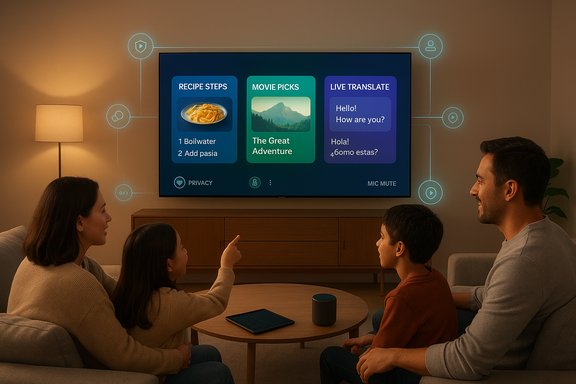
VAC is designed for group interactions. Instead of requiring strict commands, it supports natural, two‑way conversation that remembers context during follow‑ups (for example: “Who’s the actor in this scene?” → “What else has he been in?”). Answers are returned as visual cards — images, video suggestions, or quick step lists — so you can keep watching while you learn. That design choice emphasizes non‑intrusive assistance for shared viewing.A multi‑AI agent platform, not a single LLM
A central technical claim is that VAC doesn’t rely on a single large language model. Instead, it routes queries to the most appropriate agent: Samsung’s upgraded Bixby for immediate contextual replies, Microsoft Copilot for productivity and contextual summarization, Perplexity for deep factual answers and research‑style queries, and other specialized agents as they become available. The result should be answers that are faster, more accurate for the task, and visually formatted for TV. This “best‑tool” routing is what Samsung calls a multi‑AI agent approach.Key user flows (examples)
- Ask about a recipe and get step‑by‑step video cards and an on‑screen shopping checklist.
- Ask “Who painted that artwork?” and receive a short biography, images, and streaming or search options.
- Ask for a movie recommendation and get curated picks with synopses and related trailers.
- Get live translation of on‑screen dialogue for multilingual households without leaving the show.
Core features and how they work
Conversational and visual intelligence
VAC leverages generative AI to supply natural language responses and follow‑ups while presenting results as visual cards sized and designed for a TV. The assistant keeps playing the current show in the background so interactions feel like augmentations, not interruptions. This is intentionally different from phone‑centric assistants that expect you to read or scroll.Notable built‑in features
- Live Translate: Real‑time translation of on‑screen dialogue and conversations to support multilingual households. This is highlighted as a headline capability for cross‑language viewing.
- AI Gaming Mode: AI‑powered tuning for picture and sound aimed at reducing latency and optimizing visuals during gameplay.
- Generative Wallpaper: Dynamically generated wallpapers and ambient visuals that reflect mood and tastes — more than a static screensaver.
- AI Picture / AVA Pro / AI Upscaling Pro: Image and audio optimization that sharpens low‑res content and lifts dialogue clarity through AI processing.
Third‑party agents and apps
- Microsoft Copilot: Integrated as a first‑party agent on Samsung TVs for conversational assistance, summaries, and planning tasks — accessible via voice or home UI and optionally personalized when you sign in with a Microsoft account.
- Perplexity TV App: Launched as the first Perplexity TV app, this agent offers evidence‑oriented answers and deep research functionality, with a rollout to 2025 models and backward updates for eligible 2023–2024 TVs. Perplexity on TV presents results as large, glanceable cards and requires microphone permission for voice use.
Platforms, rollout, and language support
Where VAC will appear
Vision AI Companion ships across Samsung’s 2025 TV and smart monitor families, including Neo QLED, Micro RGB, OLED, The Frame Pro, The Frame, and select Smart Monitors (M7/M8/M9) according to Samsung and partner announcements. Availability may vary by country and model; in many cases VAC arrives as a software update.Language coverage and longevity
Samsung states VAC supports 10 languages — including Korean, English, Spanish, French, German, Italian, and Portuguese — giving it one of the broader language ranges for a TV assistant. Samsung also commits to seven years of OS updates for supported models through One UI Tizen, which is a meaningful promise for a feature that depends on continued AI model and security updates.Rollout timing and backward updates
Samsung planned a phased rollout beginning in late September (initially Korea, North America, select European markets), with continued expansion and optional OS upgrades to bring VAC to eligible 2023–2024 sets. Certain agent apps (Perplexity) were released later as standalone apps with incentives such as a free Perplexity Pro subscription for a limited period. Real‑world availability will vary by region and model year.The multi‑AI architecture: potential advantages
- Specialist routing: Routing queries to models optimized for particular tasks (e.g., Copilot for planning, Perplexity for research) can improve response quality and reliability.
- Context retention: Maintaining conversational context across follow‑ups makes interactions feel more natural than single‑shot voice commands.
- Visual design for TV: Designing answers as large visual cards rather than long text or phone‑style interfaces respects the “lean‑back” TV use case and reduces need for second‑screen lookups.
- Platform longevity: Seven years of updates and a modular agent approach mean Samsung can add new partners and models without rebuilding the whole assistant.
Privacy, data handling, and practical risks
What Samsung says about data — and what it doesn’t
Samsung’s materials indicate that VAC is a voice conversational AI service and that user inputs, viewing context and preferences are used to personalize responses. Some third‑party agents require account sign‑in (Microsoft) or microphone permission (Perplexity), which explicitly exposes data to external services as part of the experience. Samsung’s press materials and agent pages include standard footnotes clarifying that features and availability vary and that translation accuracy and other behaviors are not guaranteed.Key privacy considerations
- Third‑party processing: When VAC routes queries to Copilot or Perplexity, those agents process user inputs on their infrastructure. Users should expect telemetry and query data may be logged by those providers when their services are invoked.
- Microphone access: Voice features require the TV’s microphone and/or the remote’s mic to be active. Although many models include a physical mic‑mute option, households should confirm settings and permissions before enabling voice agents.
- Personalization and sign‑ins: Linking accounts (Samsung Account, Microsoft account) unlocks personalization but also increases data aggregation risk across devices and services. Assess tradeoffs between convenience and data exposure.
- Edge vs cloud: Samsung does not fully disclose which VAC functions run on‑device versus in the cloud. For low‑latency privacy‑sensitive use cases, this ambiguity matters because cloud processing implies data leaves the home network. Samsung’s statements about Copilot and Perplexity strongly suggest cloud processing is involved for third‑party agents.
Security and compliance questions
- The seven‑year OS update promise is positive for patching and long‑term security, but it does not extend to hardware vulnerabilities or guarantee data handling practices with partner AI services.
- Users in regulated environments (e.g., sensitive professions, family safety concerns) should carefully review privacy settings, permission prompts, and the terms for any agent they activate.
Competitors: where Samsung fits in the broader AI‑TV race
Samsung is not alone in bringing advanced conversational AI to the television.- Google (Gemini for TV) has rolled Gemini to Google TV devices (starting with TCL’s QM9K series) and emphasizes conversational, contextual search on the big screen. Gemini’s TV strategy also focuses on multi‑turn conversational assistance and deep YouTube integration. That competing offering underscores that the next wave of TV design prizes conversational value over raw display specs.
- LG and other TV makers continue to evolve voice assistants and AI‑based picture/sound features within their platforms (webOS/ThinQ), often integrating multiple voice services like Google Assistant and Alexa. Samsung’s VAC differentiator is the explicit multi‑agent model and heavy visual card design for communal interaction.
Practical considerations for buyers and families
Setup and daily usage (high‑level)
- Update your 2025 Samsung TV / monitor to the latest One UI Tizen build when VAC becomes available.
- Press the AI button on the remote to open Vision AI Companion or launch a standalone agent app (Copilot, Perplexity).
- Optionally sign in with a Samsung Account and/or Microsoft account for personalization.
- Grant microphone access if you want voice interactions; otherwise use on‑screen or USB keyboards.
Where VAC is likely to add real value
- Shared discovery: Choosing what to watch becomes a social, conversational session rather than scrolling through an app list.
- Cooking and planning: Recipe cards with video steps and checklists can make the TV an active kitchen helper.
- Multilingual households: Live Translate can reduce friction for families speaking different languages during shared viewing.
- Casual research and learning: Perplexity’s TV integration makes the big screen a useful place for quick research or deep dives during shared family moments.
Where VAC may fall short today
- Speed and relevance: For complex research or detailed fact checks, cloud routing introduces latency and occasional inaccuracy; follow‑up clarification flows help but are not perfect.
- Privacy tradeoffs: Families sensitive to voice data should weigh convenience against the possibility that queries are processed by external model providers.
- Accessibility: The visual card design is excellent for sighted users; Samsung and partners will need to ensure strong screen‑reader and captioning support for visually impaired viewers.
Critical analysis: strengths, weaknesses, and the path ahead
Strengths
- Platform thinking: VAC’s multi‑agent architecture gives Samsung flexibility to expand capabilities fast by adding new AI partners or specialized models without complete reengineering.
- Designed for shared interaction: The emphasis on visual cards and contextual follow‑ups is thoughtful for couch‑based usage and distinguishes VAC from phone‑first assistants.
- Deep partner integrations: Bringing Microsoft Copilot and Perplexity onto the TV brings recognized AI brands and capabilities to the platform, improving perceived usefulness and trust.
Weaknesses and risks
- Opaque data flows: Routing between vendors raises questions about how data is logged, used for model training, or retained. Samsung’s public materials mention personalization and permissions but leave some implementation details unspecified. Users need clear, accessible privacy controls.
- Potential fragmentation: A multi‑agent approach is only as good as the routing logic and the quality of each agent in a given locale. If partners have inconsistent language support or different accuracy profiles, the experience will feel uneven.
- Dependency on cloud and network: Many VAC functions depend on cloud processing. In environments with limited connectivity or strict privacy requirements, functionality and reliability will suffer.
What success will look like
- Rapid, low‑latency responses that feel natural in group settings.
- Transparent, user‑friendly privacy controls (per‑agent toggles, opt‑outs, clear data‑use summaries).
- Consistent language and regional support so VAC feels equally useful in non‑English markets.
Verdict: will talking to your TV finally feel natural?
Vision AI Companion is a significant and credible step toward a sociable, AI‑driven television. Samsung’s strengths — hardware reach, a major partner ecosystem (Microsoft, Perplexity), and a platform update cadence — give VAC real momentum. If Samsung follows through on responsiveness, maintains strong privacy controls, and expands reliable language support, this could be the moment conversational TV becomes a mainstream household habit rather than a novelty. However, the technical and privacy tradeoffs are real. The multi‑agent design exposes users to multiple data controllers, and the experience will depend heavily on how smoothly Samsung routes queries and how fast partner agents return answers. That means the initial months of rollout will be decisive: speed, accuracy, and clear privacy defaults will determine whether VAC is an elegant co‑pilot or another voice assistant silo.Practical takeaways for WindowsForum readers
- For early adopters with 2025 Samsung hardware, install the One UI Tizen update and test VAC with non‑sensitive queries to evaluate speed and accuracy.
- If privacy matters, review microphone and account permissions before enabling third‑party agents; use per‑agent sign‑in only when necessary.
- Compare features with competitor offerings (Gemini for Google TV, LG ThinQ’s AI features) to pick the TV ecosystem that matches your priorities for privacy, search accuracy, and language coverage.
Vision AI Companion is a clear signal that the TV’s role is evolving: from a display that shows content to an active surface that helps households discover, plan, and learn together. The technical architecture — an open, multi‑AI agent platform — is promising, but the user experience will rest on execution: the speed, relevance, and privacy transparency of routing between Samsung and its AI partners. For now, the TV has graduated from corner‑of‑the‑room broadcaster to potential household co‑pilot; whether it becomes indispensable depends on how well Samsung and its partners turn that potential into reliable, fast, and trustworthy everyday experiences.
Source: gadgetbridge.com Samsung Vision AI Companion Launched: Turns the TV into a true home hub
