

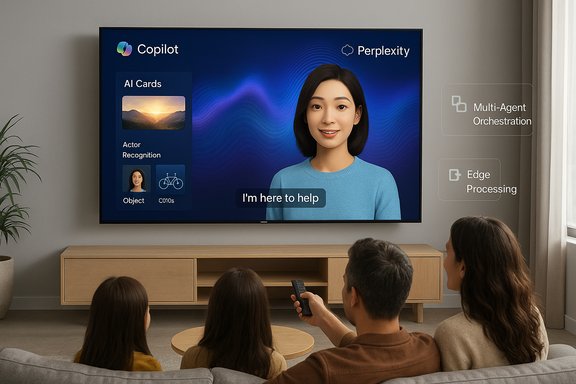
Samsung’s Vision AI Companion turns the living-room television from a passive display into an active, conversational hub—an evolution of Bixby that combines on-device visual intelligence with cloud-backed generative agents such as Microsoft Copilot and Perplexity to deliver context-aware answers, live translation, personalized recommendations and advanced picture/audio tuning on select 2025 Samsung TVs and smart monitors.
Samsung’s Vision AI Companion is the productization of several years of research and incremental feature launches: on-device vision features (actor and object recognition, AI upscaling, Live Translate), Bixby’s foundation as an in-house assistant, and partnerships with third-party AI providers. The initiative was formally showcased at IFA 2025 and rolled into Samsung’s 2025 One UI Tizen TV release, where it is being distributed as an over-the-air software update to qualifying 2025 models. At its core, Vision AI Companion is a multimodal, multi-agent layer:
Practically: upgrade-minded buyers should confirm model support, test Live Translate and Copilot/Perplexity behavior in their region, and carefully manage account sign-in on shared TVs. IT managers should pilot before mass deployment and insist on clear privacy and retention controls.
Vision AI Companion won’t be flawless at launch—expect iterative improvements—but it is a credible, strategic push by Samsung to make televisions into truly conversational companions. If Samsung and its partners maintain transparency on data practices, uphold reliability and refine multi-agent routing, this could set a de-facto standard for the next generation of AI-enabled home displays.
End of analysis.
Source: WebProNews Samsung’s Bixby AI Revolution: Turning 2025 TVs into Smart Conversational Companions
 Background / Overview
Samsung’s Vision AI Companion is the productization of several years of research and incremental feature launches: on-device vision features (actor and object recognition, AI upscaling, Live Translate), Bixby’s foundation as an in-house assistant, and partnerships with third-party AI providers. The initiative was formally showcased at IFA 2025 and rolled into Samsung’s 2025 One UI Tizen TV release, where it is being distributed as an over-the-air software update to qualifying 2025 models. At its core, Vision AI Companion is a multimodal, multi-agent layer:- Multimodal: the system accepts voice and visual context from what’s playing on-screen, returning spoken replies paired with large, TV-optimized visual cards.
- Multi-agent: it routes requests to specialized cloud agents (notably Microsoft Copilot for conversational discovery and Perplexity for citation-oriented answers), while keeping latency-sensitive perceptual tasks where possible on the device.
What the Vision AI Companion actually does
Vision AI Companion bundles a broad feature set tailored for the living room and shared viewing. The experience is purposely designed to be legible across a room, social in tone, and optimized for multi-turn dialogue.Headline capabilities
- Conversational Q&A: Ask natural-language questions about on-screen content (actors, plot points, locations) and receive spoken answers with large visual cards tailored for couch-distance reading. Follow-up questions retain context.
- On-screen Visual Intelligence: Actor identification, object/place recognition, and the ability to surface related clips or factual context for elements in the frame.
- Live Translate: Near real-time subtitle translation and transcription for foreign-language dialog, implemented with local processing when possible to reduce latency.
- Generative Wallpaper: AI-generated ambient imagery for idle or decorative screen states.
- AI Picture & Upscaling: Scene-by-scene perceptual tuning and algorithmic upscaling (AI Upscaling Pro) to improve perceived image quality.
- Adaptive Audio: Active Voice Amplifier Pro and audio tuning to improve dialog clarity in noisy rooms.
- AI Gaming Mode: Dynamic latency and responsiveness adjustments for gaming sessions.
- Third-party agents: Embedded, selectable agents—Microsoft Copilot and the Perplexity TV app—are available to handle different query types (discovery vs. citation-focused answers).
How users interact (practical flow)
- Press the AI or mic button on a supported Samsung remote or open Vision AI Companion through the Tizen OS home or Samsung Daily+.
- Speak naturally or type with the on-screen keyboard (or an attached USB keyboard). Optionally scan a QR code to link a Microsoft account or Perplexity account for personalization and memory features.
- Receive a spoken reply paired with TV-optimized visual cards. Follow-up questions preserve conversational context for multi-turn exchanges.
Technical backbone and partnerships
Samsung’s architecture is hybrid: on-device (edge) processing handles perceptual tasks requiring low latency while cloud agents perform generative reasoning, retrieval, and long-context dialogue.- Edge responsibilities: wake-word detection, local image analysis for actor/object recognition, Live Translate subtitling, AI upscaling and adaptive audio to avoid perceptible lag during playback.
- Cloud responsibilities: multi-turn conversation, web retrieval, synthesis of broad knowledge, and memory/personalization when a user links an external account. Microsoft Copilot and Perplexity are the lead cloud partners at launch.
Devices, availability and support commitments
Samsung’s initial rollout focuses on its flagship 2025 models and select smart monitors. At launch, supported devices include:- TVs: Micro RGB (Micro LED), Neo QLED, OLED, The Frame Pro, The Frame, and select QLED step-up models.
- Smart Monitors: M7, M8, M9.
User benefits: what’s compelling
- Less friction: Vision AI Companion removes the common “grab your phone to look that up” flow by surfacing answers directly on the TV in a glanceable format. The convenience of asking “Who’s that actor?” or “Give me a spoiler-safe recap” without leaving playback is a genuine UX upgrade.
- Shared experience: The design emphasizes communal usage—answers on the big screen make discovery a group activity rather than an isolated phone search. This matters for living rooms and family settings.
- Accessibility gains: Live Translate and improved auditory clarity (AVA Pro) expand access to foreign-language content and make dialog easier to follow in noisy environments.
- Longer device value: Samsung’s seven-year OS upgrade promise means the TVs could gain new AI capabilities and security updates for a longer ownership period—an attractive proposition for value-minded buyers.
Challenges, trade-offs and privacy considerations
The Vision AI Companion’s ambitions raise legitimate concerns that buyers and IT managers should evaluate before embracing an always-on household assistant.Privacy and data flow
- Hybrid processing reduces some exposure by keeping latency-sensitive tasks local, but the generative, web-backed portion of queries necessarily traverses cloud services. That means conversational transcripts, context and potentially on-screen visual metadata can be processed off-device by partners. Samsung has published high-level assurances about secure processing and optional local handling for simpler queries, but full telemetry and retention policies are not uniformly public and can vary by region. Users must review on-device privacy settings, account sign-in options and the terms of service for partner agents.
- Account linking (Microsoft/Perplexity) unlocks personalization and memory features but also ties interactions to an identity that may be subject to partner data policies. For shared, communal devices the typical phone-based “private account” model doesn’t map cleanly—households will need to manage who signs in, how memories are stored and how long conversation contexts are retained.
Accuracy, hallucination and sourcing
- Multi-agent routing is designed to pair creativity (Copilot) with citation-focused retrieval (Perplexity). However, generative systems still risk producing inaccurate or misleading content (“hallucinations”). Perplexity’s role as a citation-oriented agent helps, but users should treat open-ended or high-stakes answers with scrutiny and expect that not all on-screen claims will include reliable sourcing. Samsung and its partners emphasize visual cards and on-screen sourcing where feasible, but independent verification remains prudent.
Regulatory and compliance surface
- Deploying generative AI into a shared home context introduces additional regulatory scrutiny—particularly in markets with stringent data protection or consumer AI transparency rules. Enterprises deploying such displays in public spaces or workplaces should evaluate compliance requirements, enforce account policies and consider network restrictions. Samsung’s platform-level privacy controls will matter; vendors’ high-level commitments do not replace due diligence.
UX and reliability
- The real-world value of Vision AI Companion depends on latency, accuracy and consistent coverage across streaming apps and regions. Early hands-on reviews will be decisive; if the assistant interrupts playback, misidentifies actors, or struggles with fast-moving visual content, the novelty may wear off quickly. Samsung’s hybrid design mitigates some latency risks, but cloud dependencies remain a reliability vector.
Market and competitive implications
Samsung’s move accelerates a broader trend: televisions are becoming active nodes in the household AI fabric rather than passive consumers of streaming content. By integrating Microsoft Copilot and Perplexity, Samsung gains two strategic advantages:- Speed to capability—partnering with mature, cloud-powered agents avoids the need to build a full-fledged generative stack in-house.
- Choice and specialization—the multi-agent model lets Samsung offer different conversational styles (friendly discovery vs. citation-first answers) and avoid vendor lock-in with a single LLM supplier.
Deployment guidance for consumers and IT managers
For consumers considering an upgrade:- Verify model compatibility: ensure the specific 2025 model supports Vision AI Companion and check regional availability. Not every 2025 model has feature parity.
- Review account and privacy choices: decide whether to enable account linking (Microsoft/Perplexity) and examine retention/memory settings. For shared devices, consider a household policy around who signs in.
- Test Live Translate and AVA: verify translation quality for languages relevant to your household, and check dialog clarity in typical room noise conditions.
- Audit privacy and network flows: determine whether conversational telemetry is routed to third-party clouds and whether that complies with organizational policies.
- Consider account policies: deploy devices with controlled sign-in options or managed profiles to mitigate accidental linkage to personal accounts.
- Pilot before wide deployment: test for false positives, latency, or content errors in the specific operational environment and content types you handle.
What to watch next (short-term indicators)
- Independent hands-on reviews and long-form testing of Copilot/Perplexity performance on live streaming, broadcast TV and gaming will determine how useful the multi-agent approach is in practice. Early impressions have been positive on concept but cautious on execution.
- Regional roll-out pace and model coverage: Samsung has indicated phased availability, with expansion to eligible 2023/2024 models possible via firmware updates. Track firmware notes and regional press for concrete timelines.
- Privacy, regulatory updates and partner terms: watch for new disclosures from Samsung, Microsoft and Perplexity about retention, on-device processing thresholds, and data sharing. Any regulatory inquiries or new guidance could materially affect feature availability.
Critical analysis — strengths, risks and strategic fit
Strengths
- Practical UX innovation: Surfacing rich, TV-optimized answer cards and spoken replies addresses a real friction point—users frequently look up on-screen information on phones; Vision AI Companion keeps the interaction on the big screen.
- Balanced architecture: The hybrid edge + cloud split is sensible: perceptual tasks stay local for responsiveness, while cloud agents handle the heavy generative lifting. This reduces latency for immediate tasks and leverages partner strengths for broader knowledge.
- Ecosystem leverage: Partnering with Microsoft and Perplexity accelerates capability and provides clear specialization (conversation vs sourcing), lowering Samsung’s engineering and time-to-market costs.
- Business strategy: The seven-year software commitment and cross-device Vision AI narrative strengthen Samsung’s premium proposition and ecosystem lock-in for buyers who value ongoing feature updates.
Risks
- Privacy and transparency gaps: Vendor statements are high-level; granular telemetry, retention and cross-agent data sharing need clearer documentation. Without transparency, user trust and regulatory scrutiny could undermine adoption. Flag this as an active risk.
- Model accuracy and hallucinations: Generative answers without clear sourcing remain a potential liability. Perplexity’s citation model helps, but Copilot’s more creative answers may still mislead in the absence of explicit sourcing. Users must remain cautious with factual or consequential queries.
- Shared-device UX complexity: Account-based personalization vs. shared household usage creates friction. Memory features tied to a single account don’t map cleanly to family TVs; the result could be confusing experiences or inadvertent data leaks across household members.
- Dependence on cloud partners: If a partner service changes terms, pricing or availability, Samsung’s TV capabilities could be impacted. This vendor-dependence is a strategic trade-off for speed but introduces supply-side risk.
Final assessment and practical verdict
Samsung’s Vision AI Companion represents a significant step in redefining what a television can do: the company has combined local perceptual smarts with web-backed generative agents to create a social, multimodal assistant that answers questions about on-screen content without pulling viewers away from the show. The multi-agent architecture—pairing Microsoft Copilot’s conversational strengths with Perplexity’s citation-focused retrieval—offers a pragmatic balance between flair and factual rigor. For consumers, the feature offers real convenience and accessibility benefits, especially for households that value shared, living-room discovery and translation features. For organizations and privacy-conscious buyers, the hybrid model reduces some risk but does not eliminate the need for careful policy and configuration—account linking and cloud routing remain material privacy vectors.Practically: upgrade-minded buyers should confirm model support, test Live Translate and Copilot/Perplexity behavior in their region, and carefully manage account sign-in on shared TVs. IT managers should pilot before mass deployment and insist on clear privacy and retention controls.
Vision AI Companion won’t be flawless at launch—expect iterative improvements—but it is a credible, strategic push by Samsung to make televisions into truly conversational companions. If Samsung and its partners maintain transparency on data practices, uphold reliability and refine multi-agent routing, this could set a de-facto standard for the next generation of AI-enabled home displays.
End of analysis.
Source: WebProNews Samsung’s Bixby AI Revolution: Turning 2025 TVs into Smart Conversational Companions
