

Background
Samsung has spent several years repositioning its consumer electronics business around AI, connectivity, and human-centered design rather than isolated hardware specs. That shift has been visible in TVs, appliances, monitors, and even experimental housing concepts, all tied together by SmartThings-style orchestration and a design language that emphasizes practical automation. The Edison Awards recognition suggests those efforts are now being viewed externally as a coherent portfolio rather than a collection of disconnected experiments.
The company’s messaging at CES 2026 helps explain why this matters. At The First Look in January, Samsung introduced its “Companion to AI Living” vision and described AI as a foundation connecting product development, operations, and user experience. In other words, Samsung is not treating AI as a feature layered onto products; it is presenting AI as the operating logic of the home. That framing gives the Edison Awards result a strategic weight beyond a standard design award win.
The Edison Awards themselves are a useful benchmark because they are meant to recognize innovation across product, service, marketing, and human-centered design. The 2026 event took place in Fort Myers, Florida, on April 15–16, and Samsung’s four awardees were spread across categories that include residential living, TV software, laundry appliances, and commercial display. That breadth matters: it suggests Samsung’s design and engineering teams are aligning on a common platform story, not just chasing isolated category wins.
There is also a historical arc here. Samsung has previously earned design recognition for future-housing and AI-display concepts, and the company has used trade shows like CES and IFA to refine those ideas in public. The latest awards imply that the company’s long-running home-and-display narrative is gaining proof points. That is important because concept products often get dismissed as booth theater; repeated award recognition makes the “future home” story look more durable and more executable.
What Samsung Actually Won
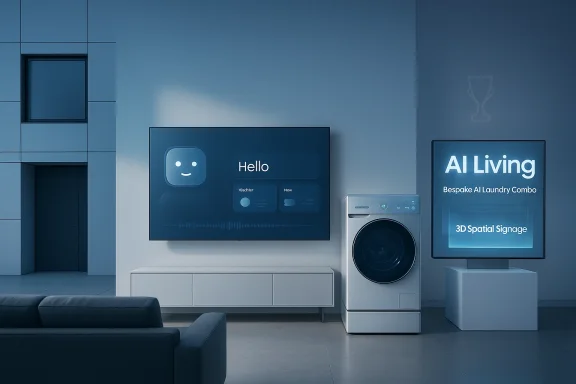
The headline is simple: Samsung took home two golds and two silvers. But the composition of those awards matters more than the tally itself. The gold winners were Smart Modular House and Vision AI Companion, while the silver winners were Spatial Signage and the Bespoke AI Laundry Combo. Together, they span the home, the screen, the laundry room, and the commercial environment, which is exactly where Samsung wants to frame its AI ecosystem.
Why the mix matters
These are not random products bundled for publicity. Each one answers a different consumer or commercial pain point, and each one depends on the same broad thesis: AI becomes more valuable when it reduces friction across the spaces people already use every day. That is a stronger narrative than the familiar “AI for AI’s sake” pitch, which has become increasingly easy to dismiss in the wake of overhyped smart-home launches.
Samsung’s own descriptions reinforce that point. Smart Modular House is about adaptive architecture; Vision AI Companion is about contextual screen interaction; Bespoke AI Laundry Combo is about automating a tedious household task; Spatial Signage is about helping businesses create deeper visual experiences without sacrificing content clarity. Each product implies a different segment, but the underlying promise is the same: fewer manual decisions, more ambient intelligence.
- Gold: Smart Modular House
- Gold: Vision AI Companion
- Silver: Bespoke AI Laundry Combo
- Silver: Spatial Signage
- Shared theme: AI integrated into living spaces, displays, and appliances
- Strategic signal: Samsung wants to be seen as a systems company, not just a device vendor
The award balance also suggests Samsung is doing something difficult: pairing technical novelty with commercial plausibility. Awards often favor either pure concept work or polished consumer products. Samsung managed both at once, which is a notable achievement in a market where many “AI” announcements still lack a believable path to adoption.
Smart Modular House and the Future of Living
Smart Modular House is perhaps the most ambitious of the four winners, because it reaches beyond gadgets and into the structure of the home itself. Samsung describes it as a future housing design project built around a prefabricated ADU-style approach, a 1.5-module system, and integrated IT and architectural standards. The concept is that the house can expand or reconfigure as life stages change, shifting from fixed dwelling to adaptable platform.
From building to platform
That is a meaningful conceptual shift. Traditional housing is static; Samsung’s idea is that housing should behave more like software, with modular flexibility and connected systems that can evolve over time. It is easy to see why awards juries respond to that idea, because it aligns with broader pressures around urban density, changing household composition, and the need for more efficient use of space.
Samsung is also trying to fuse appliances and architecture into one experience. Rather than treating the wall, the floor, and the device as separate layers, the design concept blends them into a connected environment that can track device status, energy usage, and indoor-outdoor conditions. That is a more mature vision than simply installing connected appliances in a house; it implies architectural intelligence as a design principle.
The broader implication is competitive as well as cultural. If Samsung can make its home-technology story feel credible in architecture, it may gain influence not just with consumers, but with developers, builders, and interior-design ecosystems. That could create a channel advantage that rivals in appliances or smart-home platforms may struggle to replicate quickly.
Why this matters beyond novelty
Samsung’s future-housing concept is important because it broadens the market for AI from devices to built environments. That opens the door to new partnerships, new procurement channels, and potentially new recurring services around energy management, device orchestration, and environmental control. It is not just a concept house if Samsung can keep translating it into modular products and scalable standards.
- Flexible room expansion based on life stage
- Prefabricated, modular construction logic
- Integrated management of energy and devices
- Potential appeal to developers and planners
- Strong crossover with sustainability narratives
The risk, of course, is that smart-housing concepts are notoriously difficult to commercialize at scale. Construction standards, local regulations, and cost sensitivity can easily slow innovation. Still, Samsung’s repeated design recognition suggests the company is building a long-term platform story rather than a one-off exhibition piece.
Vision AI Companion and the TV as Context Engine
Vision AI Companion is the clearest example of Samsung’s current display strategy. The company wants to transform the TV from a passive viewing surface into a contextual AI interface that can answer questions, surface information, and adapt to the content on screen. Samsung’s existing IFA 2025 messaging already framed Vision AI Companion as a single AI experience that integrates Bixby, Microsoft Copilot, and Perplexity, and the Edison recognition shows that the idea has moved from unveiling to validation.
Why Samsung’s TV strategy is changing
The old TV playbook was about panel quality, brightness, and refresh rates. Those specs still matter, but Samsung is now betting that the next battleground is interaction, not just image quality. By letting viewers ask about a film location, a cast member, or a sports record while watching content, Samsung is turning the TV into a live information layer.
That strategy also helps Samsung defend its premium TV business against commoditization. If many brands can sell a sharp 4K panel, fewer can sell a genuinely useful AI experience tied to content search, voice interaction, and cross-service integration. This is where Samsung’s platform depth becomes a strategic asset, especially when paired with the company’s broader hardware footprint.
The product also reflects a practical design philosophy. Samsung says the platform ties together picture and sound enhancement with AI Soccer Mode Pro, AI Sound Control Pro, and AI Upscaling Pro. That is important because users do not want a separate “AI app”; they want the TV to feel smarter in ways that are immediately visible and audible. That distinction matters more than marketing copy suggests.
The ecosystem angle
Samsung’s partnership-style approach is also notable. Bringing in Bixby, Perplexity, and Microsoft Copilot creates a more layered AI environment than a single-assistant model would allow. It also makes the TV more of a launchpad for external services, which could matter if Samsung wants the living room to become a productivity and discovery surface rather than just an entertainment endpoint.
- Voice-based contextual questions about on-screen content
- Integrated picture and sound optimization
- AI assistance that extends beyond entertainment
- More reasons to keep users inside Samsung’s ecosystem
- Better positioning against generic smart-TV interfaces
There is a catch, though. TV-based AI can become cluttered fast if it prioritizes novelty over speed. Samsung’s challenge will be to make the interaction feel instant and reliable, because a laggy voice assistant on a living-room screen will quickly lose credibility. For now, though, the Edison award suggests the market sees the idea as promising enough to reward.
Bespoke AI Laundry Combo and Practical Automation
If Smart Modular House is the visionary play and Vision AI Companion is the platform play, the Bespoke AI Laundry Combo is the pragmatic one. This product solves a real, repetitive household problem by combining washing and drying in a single machine, removing the need to transfer clothes between appliances. That may sound mundane compared with AI housing concepts, but in consumer electronics, mundane convenience often drives the fastest adoption.
What makes the combo stand out
Samsung highlighted a 25 kg wash and 20 kg dry capacity, and the product’s AI Wash Plus function is designed to detect load weight, fabric type, and soil level before automatically adjusting water, detergent, wash intensity, and drying parameters. That is the sort of automation consumers can understand immediately, which is one reason laundry has become one of Samsung’s strongest smart-appliance stories.
The company also cited a booster heat exchanger that improves dehumidification performance by up to 15%. That kind of engineering detail matters because it translates the “AI” label into actual appliance performance, not just cloud-connected gloss. In a skeptical market, better thermal efficiency and better cycle control can do more for product credibility than broad claims about intelligence.
Samsung has been steadily refining the laundry category with new combo variants and capacity updates, so this Edison win is less a surprise than a confirmation. The product sits at the intersection of convenience, energy management, and space saving, which makes it especially relevant in markets where compact living and multi-family housing are common. That is a stronger commercial argument than “smart laundry” as a novelty.
Why this category still matters
Laundry is one of those categories where small improvements can create big household value. Removing a transfer step, reducing guesswork, and automating optimization saves time in a way consumers can feel every week. That makes the Bespoke AI Combo a quietly important product in Samsung’s portfolio, even if it lacks the flash of a futuristic display or concept home.
- All-in-one wash and dry cycle
- AI-based load and fabric detection
- Adjustable water, detergent, and temperature settings
- High capacity for large households
- Strong fit for space-conscious homes
The broader market implication is that Samsung is using appliance intelligence to create brand stickiness. Once a household standardizes on a connected laundry product, it becomes easier to add a Samsung refrigerator, vacuum, or TV into the same ecosystem. That creates a flywheel effect that rivals will have to counter with either lower prices or equally convincing integration.
Spatial Signage and the Commercial Display Edge
Spatial Signage is the most obviously business-to-business of the four winners, but it may also be one of the most strategically interesting. Samsung says the glasses-free 3D display uses its proprietary 3D Plate technology to create a sense of depth behind the LCD panel while preserving 2D clarity. That matters because commercial display buyers often want spectacle without sacrificing readability.
Depth without glasses
Samsung’s pitch is not simply “3D.” It is 3D that remains usable in retail, exhibitions, and branded installations. The 85-inch model’s 52 mm ultra-slim profile, 4K UHD resolution, and 9:16 portrait format make it adaptable to product storytelling spaces where vertical digital signage is increasingly important. The idea is to make products appear as though they can rotate or occupy physical space, which can be powerful in premium retail.
The integration with Samsung VXT’s AI Studio is also significant. Turning still images into three-dimensional content with lower production friction lowers the barrier for content teams, which is often where commercial display projects stall. If Samsung can make premium 3D signage easier to deploy, it can raise the attractiveness of the whole category.
This is also where Samsung’s hardware and software integration gives it leverage. A vendor that sells the display, the content workflow, and the AI tools has more control over the customer experience than one that only sells panels. That can be a serious advantage in B2B markets, where simplicity and reliability often beat raw specifications.
Market relevance
Spatial Signage appeared repeatedly at major industry events, including ISE 2026, CES 2026, and IFA 2025. That repeated exposure suggests Samsung is building a category narrative around the product, not just launching it quietly into the channel. In display markets, that kind of public staging can matter because it helps buyers imagine how the technology fits into their own environments.
- Glasses-free 3D visual effect
- Designed for retail and exhibition use
- Slim form factor for premium installations
- Compatible with AI-assisted content creation
- Strong fit for experiential marketing
The risk is that commercial buyers may see 3D as a nice-to-have rather than a must-have unless Samsung proves measurable ROI. But if the company can show the technology drives dwell time, engagement, or conversion, Spatial Signage could become a differentiated revenue line in an otherwise crowded display market.
Design as Strategy, Not Decoration
One of the most important themes in Samsung’s Edison Awards success is that design is becoming a strategic engine rather than a cosmetic layer. Mauro Porcini’s comments make that clear: Samsung describes design as the intersection of business, technology, and humanity, and the company says it is trying to turn people’s needs, dreams, and emotions into meaningful experiences. That is classic product-story language, but in Samsung’s case it aligns with a visible investment pattern.
The role of human-centered design
The practical effect is that Samsung is trying to win on the experience layer, not merely the hardware layer. This matters because many consumer electronics categories have matured to the point where features alone do not differentiate strongly enough. Human-centered design, if executed well, makes products feel coherent across the home rather than fragmented across appliances and screens.
That coherence is especially important for enterprise buyers and retail partners. A display that is easy to install, a washer-dryer that reduces decision fatigue, or a housing concept that supports different family stages all speak to a design philosophy that values usability over feature bloat. In a market flooded with “smart” claims, that restraint can become a competitive advantage. It is the difference between intelligence and usability.
Samsung’s design story also helps explain why the company can compete across so many categories at once. Instead of building separate narratives for TVs, appliances, and spaces, it is building one umbrella story: AI that serves daily life. That broad framing gives Samsung room to stretch from consumer products into future housing and commercial visualization without seeming off-brand.
Why awards still matter
Awards are not just vanity trophies in this context. They validate a design philosophy in front of investors, partners, and consumers, and they help Samsung argue that its AI investments are producing recognizable innovation. In a sector where AI skepticism is rising, outside validation can be a useful counterweight to hype fatigue.
- Reinforces Samsung’s design-led product identity
- Helps unify home, display, and appliance messaging
- Supports premium positioning across categories
- Builds credibility for future housing concepts
- Reduces the perception of AI as mere marketing
Still, awards should not be mistaken for market adoption. The real test will be whether consumers and business customers continue using these features months after launch, not whether judges liked the concept. Samsung appears to understand that distinction, which is why the company keeps pushing the same “AI living” language across multiple launch stages.
Competitive Implications for Rivals
Samsung’s Edison Awards sweep has implications that go beyond the company itself. For rivals in TVs, appliances, and commercial displays, the message is that Samsung wants to own the narrative around AI-enabled living spaces, not just individual product categories. That is an ambitious move because it invites competitors to respond on ecosystem depth, not just panel quality or appliance efficiency.
TV rivals face a platform challenge
In TVs, the challenge to competitors is obvious. If Samsung can make Vision AI Companion feel like the default smart interface for entertainment and contextual search, then rivals will need more than better pictures. They will need software ecosystems, assistant integrations, and clear value propositions that justify choosing one brand’s TV platform over another’s.
Appliance rivals face a different problem. Samsung’s laundry combo, fridge, and other Bespoke AI devices are being positioned as part of a lifestyle system that reduces work across the house. That means competitors have to answer not just with efficiency numbers, but with coordinated convenience. The brand that owns the “less work at home” narrative gains a durable edge.
Display rivals, meanwhile, need to watch the commercial-signage angle carefully. Samsung is blending hardware design, content tools, and AI workflows in a way that can appeal to retailers and venue operators. If that stack becomes sticky, it may force other display vendors to invest more heavily in software and content creation than they previously expected.
The ecosystem race
The larger competitive issue is ecosystem lock-in. Samsung’s strategy encourages users to buy a TV, then appliances, then connected devices, then possibly commercial or architectural solutions, all under one design umbrella. That is a powerful commercial model, but only if the AI experience remains trustworthy and easy to understand.
- Rivals must compete on software, not just hardware
- Platform integration may become more valuable than specs
- Customer loyalty could deepen across product categories
- B2B opportunities extend the story beyond the living room
- Award recognition strengthens Samsung’s brand authority
This is why the Edison Awards matter strategically. They give Samsung external validation at a moment when it is trying to present a single connected story across multiple markets. That does not guarantee victory, but it helps shape the terms of competition.
Strengths and Opportunities
Samsung’s four Edison Awards highlight a portfolio that is unusually broad and unusually coherent. The company is showing that it can pair consumer convenience, enterprise utility, and future-facing design in ways that reinforce one another rather than compete for attention. That is a strong position in a market where many rivals are still trying to figure out whether AI should live in software, hardware, or both.
- Portfolio breadth across housing, TV, laundry, and signage
- Clear AI narrative that spans consumer and commercial use cases
- Human-centered design language that resonates beyond spec sheets
- Cross-selling potential across Samsung’s ecosystem
- Commercial credibility for products that solve real problems
- Future-housing thought leadership that few rivals can match
- Strong award momentum that supports premium brand positioning
Samsung also benefits from having several products that already feel close to market reality. The Bespoke AI Laundry Combo and Vision AI Companion are easier for consumers to understand than futuristic housing models, and that makes them useful anchors for the broader narrative. Meanwhile, Smart Modular House and Spatial Signage keep the company positioned as an innovator that still thinks beyond the next quarterly product cycle.
Risks and Concerns
The same breadth that makes Samsung’s strategy attractive also makes it vulnerable. The more categories it ties together under the AI living umbrella, the more it risks overpromising on integration, reliability, and long-term support. If one part of the ecosystem feels gimmicky or cumbersome, it can color perceptions of the whole stack.
- AI fatigue among consumers skeptical of unnecessary features
- Execution risk if voice and contextual systems feel slow or inconsistent
- Privacy concerns around always-on home and display intelligence
- Commercialization challenges for future-housing concepts
- Installation and standards hurdles in construction-linked products
- ROI pressure in the commercial display market
- Fragmentation risk if services and assistants do not stay unified
There is also a reputational risk in the broader market climate. Consumer advocates and tech critics have increasingly mocked AI-enabled products that feel invasive, redundant, or fragile, and Samsung will need to prove that its AI is actually useful, not just flashy. That is especially true for devices that live in private spaces like kitchens, living rooms, and laundry rooms.
Another concern is that future-housing innovation depends on external forces Samsung cannot fully control. Building codes, housing economics, local adoption, and developer appetite all influence whether a modular concept can move from showcase to deployment. In other words, Samsung can design the vision, but it cannot single-handedly design the market. That is a subtle but crucial limitation.
What to Watch Next
The key question is whether Samsung turns this Edison recognition into a broader product cycle and not just a headline. The company has already set the stage through CES 2026 and IFA 2025, so the next test is execution: firmware updates, regional rollouts, retail adoption, and whether these AI experiences feel polished enough to sustain demand.
A second thing to watch is how Samsung balances openness with control. Its use of Bixby alongside Perplexity and Microsoft Copilot suggests a willingness to integrate external intelligence, but those partnerships have to remain seamless if Samsung wants the TV and home ecosystem to feel unified. If the experience fragments, the company’s “companion” story weakens.
The third issue is whether Samsung can translate design awards into measurable business outcomes. Awards are helpful, but eventually the company will need sales growth, higher attach rates, stronger software engagement, or enterprise adoption to prove the strategy is more than conceptual theater. That evidence will matter most in the categories where the consumer value proposition is still being educated.
- Regional rollout pace for Vision AI Companion
- Consumer adoption of Bespoke AI laundry features
- Commercial deployments of Spatial Signage
- Additional housing partnerships or pilot projects
- Software updates that deepen AI usefulness over time
Samsung is in a strong position, but the company now has to protect the narrative with consistency. If it can do that, the Edison Awards may look like an early marker in a larger transition from device maker to environment designer. If it cannot, the awards will still matter, but mostly as proof that the idea was better than the execution.
Samsung’s four Edison Awards show a company that is not merely sprinkling AI onto products, but trying to reorganize the relationship between people, devices, and space. That is an ambitious and potentially durable strategy, and it fits the company’s broader push from CES and IFA to define the next era of connected living. The opportunity is real because the products address real pain points, but the same breadth that makes the vision compelling will demand discipline, patience, and flawless execution.