

Microsoft and Lockheed Martin have announced a close collaboration to build Sanctum, a cloud-enabled, AI-driven counter‑uncrewed aerial system (C‑UAS) that fuses Lockheed Martin’s C‑UAS operational know‑how with Microsoft Azure’s cloud, analytics and agent tooling to deliver real‑time detection, multi‑sensor tracking and operator‑facing defeat options—promising rapid updates, model retraining in the cloud, and a single console for defenders in both connected and disconnected edge environments.
Sanctum is being delivered as a modular, scalable software and systems architecture that is intended to sit across sensor inputs, effectors and command‑and‑control. Lockheed Martin positions the product as a software‑first layer that can ingest RF, electro‑optical/IR, radar and other sensor feeds, fuse those signals with AI‑based classification, and orchestrate non‑kinetic and kinetic effectors through a unified operator display. The official Lockheed Martin announcement emphasizes Azure as Sanctum’s digital backbone—naming Azure services such as Azure IoT Hub, Azure Synapse Analytics and Azure AI Foundry as platform components that support telemetry ingestion, large‑scale analytics and the lifecycle management of AI models. Independent defense outlets and trade coverage that previewed Sanctum at industry events corroborate the overall architecture: an open‑architecture C‑UAS stack that emphasizes sensor fusion, rapid AI retraining after engagements, and the option to mix third‑party sensors and effectors to fit existing base or site inventories. That positional corroboration is visible in multiple news reports published after Lockheed Martin’s release.
Sanctum’s advertised capabilities, including the vendor‑reported live exercise, are promising indicators but remain vendor demonstrations until independently validated under operationally realistic test conditions. Procurement teams and operators should treat the announcement as the start of a rigorous verification process: confirm offline resilience, demand model governance, insist on documented portability and security baselines, and ensure ethical and legal compliance for the intended deployment context. For IT and security architects, the technical building blocks are familiar—Azure IoT Hub for telemetry and device lifecycle, Azure Synapse for data warehousing and analytics, and Microsoft Foundry for model and agent lifecycle—yet turning those components into a field‑grade, high‑assurance C‑UAS will require precise engineering, robust red‑teaming and clear contractual commitments on portability and security. The partnership is an important step toward cloud‑native C‑UAS; the real test will be how Sanctum performs in sustained, contested, and constrained operational environments where the difference between detection and defeat is measured in seconds.
Source: Unmanned airspace Microsoft teams up with Lockheed Martin to develop C-UAS with cloud capabilities – Unmanned airspace
 Background / Overview
Sanctum is being delivered as a modular, scalable software and systems architecture that is intended to sit across sensor inputs, effectors and command‑and‑control. Lockheed Martin positions the product as a software‑first layer that can ingest RF, electro‑optical/IR, radar and other sensor feeds, fuse those signals with AI‑based classification, and orchestrate non‑kinetic and kinetic effectors through a unified operator display. The official Lockheed Martin announcement emphasizes Azure as Sanctum’s digital backbone—naming Azure services such as Azure IoT Hub, Azure Synapse Analytics and Azure AI Foundry as platform components that support telemetry ingestion, large‑scale analytics and the lifecycle management of AI models. Independent defense outlets and trade coverage that previewed Sanctum at industry events corroborate the overall architecture: an open‑architecture C‑UAS stack that emphasizes sensor fusion, rapid AI retraining after engagements, and the option to mix third‑party sensors and effectors to fit existing base or site inventories. That positional corroboration is visible in multiple news reports published after Lockheed Martin’s release. What's being claimed — the core capabilities
- Multi‑sensor fusion and tracking: Sanctum aggregates RF, EO/IR and other signatures to form fused tracks and to improve discrimination of small, low‑observable UAS in cluttered environments.
- AI‑assisted classification: Model‑based classifiers rank threats (e.g., friend/foe/unknown, payload type, swarm vs single) and surface time‑critical cues to operators. Lockheed Martin states that AI helps cut cognitive load and speed operator decisions.
- Cloud‑backed model lifecycle: Azure supports centralized model retraining and analytics for continuous improvement, with updates pushed to edge sites where needed—enabling a DevSecOps pipeline and over‑the‑air updates in connected deployments.
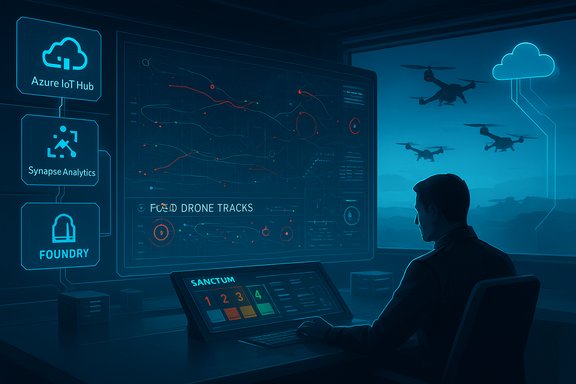
- Operator‑centric UI: A single unified console shows tracks and suggested actions; Lockheed Martin describes a live exercise where a single operator detected and neutralized multiple hostile drones within seconds after AI classification and interface cues. This demonstration is a vendor‑reported field exercise claim.
- Open, modular architecture: The system is marketed to integrate with existing C2 networks and third‑party sensors/effectors so customers can adopt Sanctum without wholesale infrastructure replacement.
Technical anatomy: how Azure fits into a C‑UAS stack
The press materials explicitly name Azure building blocks that map naturally to C‑UAS functional needs:- Azure IoT Hub — device and sensor ingress, device management, and over‑the‑air update delivery to edge gateways and sensors (useful for distributed sensor fleets and secure telemetry channels). Azure IoT Hub supports two‑way communication and Device Update capabilities that are relevant to fielded sensor and gateway refreshes.
- Azure Synapse Analytics — large‑scale analytics and data warehousing for long‑range trend analysis, post‑mission forensics, and building the training datasets needed for improved detection/classification. Synapse combines SQL, Spark and integrated data orchestration suitable for ingesting and curating sensor streams.
- Microsoft Foundry (Azure AI Foundry) — model cataloging, agent and application lifecycle, multi‑model routing and safety controls. Foundry provides a production‑ready toolchain for building, testing and governing models and agents used in real‑time classification and decision support—and is explicitly cited in the announcement as the place for AI model hosting and observability. Microsoft’s Foundry documentation lays out model fine‑tuning, agent orchestration and observability features that fit Sanctum’s continuous update claims.
- Observability & Ops — Azure Monitor, logging, and DevSecOps pipelines are referenced as mechanisms to keep deployments auditable, updated and observable across distributed sites—requirements that are important when systems transition from trials to operational use.
Why the partnership matters — strengths and practical benefits
- Scale and rapid iteration — Combining Lockheed Martin’s operational systems integration with Azure’s cloud scale gives an established path to continuous improvement: ingest telemetry from multiple sites, retrain models with new adversary signatures, and distribute updates to edge nodes. This can shorten the time between detection of a new threat type and fitted defenses being deployed at scale.
- Interoperability without wholesale replacement — An open, modular approach reduces integration friction and allows existing sensors and effectors to remain in service while new AI and orchestration layers are added. That lowers the barrier for sites that cannot afford large rip‑and‑replace programs.
- Operator ergonomics and decision support — A single console, coupled with ranked AI suggestions, can reduce cognitive load and speed reaction windows—important where seconds matter and operators face multiple simultaneous tracks. Vendor demonstrations show the potential for faster engagement cycles.
- Cloud‑native analytics for forensics and planning — Centralized data stores and analytics pipelines enable after‑action reviews, model validation, and the creation of richer training corpora. For defense customers, that can mean better deterrence and more informed basing decisions over time.
Risks, open questions and governance considerations
The fusion of commercial cloud platforms and military C‑UAS raises several engineering, operational and ethical risks that operators and procuring authorities must address.1) Vendor lock‑in and portability
Deep integration with Azure services (Foundry, Synapse, IoT Hub, Azure Monitor) increases efficiency but raises switching costs. Customers that require multi‑cloud posture or want to avoid single‑vendor dependencies will need contractual, architectural and data‑egress controls to preserve portability. Expect procurement teams to demand exit plans and data export guarantees.2) Cloud dependence, connectivity and edge resilience
While Azure enables continuous retraining and central analytics, operational C‑UAS often must function in disconnected, contested or air‑gapped environments. The announcement claims support for connected and disconnected edge scenarios, but buyers should insist on clear technical proofs: how models are cached at the edge, how over‑the‑air updates are staged for intermittent links, and what fallbacks exist if cloud connectivity is denied. Vendor exercise claims are valuable but must be validated under degraded, denied and intermittent connectivity (D3) conditions.3) Supply‑chain and attack surface
Pushing model training, telemetry aggregation and orchestration into the cloud expands the attack surface. Adversaries may attempt to poison training data, tamper with telemetry, or exploit management planes for lateral movement. Defensive architectures must include end‑to‑end encryption, signed model artifacts, immutable audit trails and zero‑trust supply‑chain controls. Public Microsoft and Lockheed Martin materials reference DevSecOps and monitoring but do not publish detailed implementation hardening for classified or sensitive workloads in the public announcement—these will require classified engineering and third‑party verification for high‑assurance customers.4) Dual‑use and ethical governance
C‑UAS are inherently dual‑use technologies: the same detection and defeat capabilities that protect critical infrastructure can be adapted to offensive or surveillance roles. The involvement of commercial cloud and AI providers in military systems raises ethical and governance questions about civilian oversight, export controls, red‑team testing and human‑in‑the‑loop (HITL) safeguards. Policy frameworks and legal reviews are necessary to ensure deployment conforms with domestic law, international humanitarian law where applicable, and organizational ethics.5) Verifiability of field claims
Lockheed Martin’s account of a live exercise—where a single operator neutralized multiple hostile drones within seconds—is a compelling capability narrative, but it is a vendor‑reported demonstration. Independent verification, after‑action data and third‑party testing under representative operational conditions are required to move from demonstration claims to fielded performance baselines. Treat such claims as early indicators rather than final performance assurances until documented test reports and independent trials are available.Procurement checklist — what customers should demand
When evaluating Sanctum or any cloud‑backed C‑UAS, procurement teams and program offices should insist on:- Clear security & compliance artifacts:
- Certifications (FedRAMP/DoD IL levels where applicable), supply‑chain attestations and third‑party penetration test results.
- Data residency and export guarantees:
- Explicit controls on where raw sensor data and model training data are stored and processed.
- Portability and interoperability:
- IaC (infrastructure as code) templates, exportable model weights, and documented APIs that avoid proprietary lock‑in.
- Edge assurance:
- Documentation of offline operation modes, model rollback mechanisms, and device update security for disconnected sites.
- Human‑in‑the‑loop and safety controls:
- Operator override policies, engagement authorization flows, and robust logging for forensic review.
- Third‑party testing:
- Independent red‑team evaluations, inter‑operability tests with customer sensors/effectors, and scenario‑based operational assessments.
Technical trade‑offs and engineering realities
- Latency vs accuracy: Real‑time track fusion and classification for small UAS demands tight latency budgets. Cloud‑centered inference can be powerful for retraining and historical analytics, but real‑time classification frequently needs to run at the edge. Expect architectures that route heavy training and batch analytics to Azure Synapse/Foundry while deploying optimized, compressed inference models on local accelerators or edge gateways.
- Model governance and explainability: For operational trust, defenders need traceable classification decisions and confidence metrics. Foundry and Azure observability tools provide telemetry, but customers must implement evaluation suites to quantify false positives/negatives and maintain model provenance for auditing.
- Cost and operational TCO: Cloud‑backed model retraining and large‑scale telemetry storage have recurring costs. Program offices should budget for egress, long‑term storage, and continuous integration pipelines—not just one‑time acquisition fees. Cost modeling should include pilot workloads that reflect real sensor volumes to avoid underprovisioning.
Geopolitical and regulatory context
The collaboration fits into a wider pattern: hyperscalers and defense primes increasingly partner to deliver AI‑enabled defense solutions. Microsoft has multiple prior engagements with Lockheed Martin—ranging from 5G.MIL work to classified cloud initiatives—and the sec‑to‑cloud timeline for national security workloads has been accelerating over the past several years. This partnership is an extension of that trajectory and reflects government appetite for commercial cloud scale when engineered to meet defense assurance needs. National procurement authorities and export control bodies will scrutinize deployments where cloud infrastructure, AI, and C‑UAS intersect. Program offices must coordinate legal review, classification handling, and international export licensing to avoid regulatory bottlenecks—especially if the system is marketed for allied or coalition use.Operational scenarios and use cases
Sanctum frames itself for a variety of mission sets:- Fixed‑site protection (bases, ports, critical infrastructure) using layered sensors and effectors.
- Event security (stadiums, major public gatherings) where temporary sensor grids and managed effectors are needed.
- Tiered force protection for deployed units, with options for connected cloud refinement when secure links are available.
- Law enforcement and domestic security use cases—though these are the most contentious from privacy and civil‑liberties perspectives and will demand strict policy guardrails.
What to watch next — verification and adoption signals
- Independent trials: Look for DoD/agency/coalition or trusted third‑party test reports that quantify detection range, classification accuracy, false alarm rates and operator reaction times.
- Contract awards and delivery timelines: Actual procurement decisions and fielded contracts will show how the market receives an Azure‑centric C‑UAS offering and whether customers accept the cloud dependency.
- Security documentation and compliance filings: FedRAMP/DoD IL, SOC2, and other attestations specific to deployed configurations will indicate whether Sanctum’s architecture meets high‑assurance requirements.
- Interoperability demonstrations with customer sensors, existing C2 systems and third‑party effectors: These are the practical milestones that determine how easily Sanctum can be integrated into an operator’s current baseline.
Conclusion — cautious optimism, conditionally useful
The Lockheed Martin–Microsoft Sanctum collaboration represents a clear example of the direction C‑UAS development is taking: moving from isolated sensors and point‑effectors to an integrated, AI‑assisted, cloud‑backed orchestration layer. The advantages are tangible—faster model iteration, unified operator interfaces, and centralized analytics—but they come with material trade‑offs in terms of vendor dependency, cloud‑surface attack area and governance complexity.Sanctum’s advertised capabilities, including the vendor‑reported live exercise, are promising indicators but remain vendor demonstrations until independently validated under operationally realistic test conditions. Procurement teams and operators should treat the announcement as the start of a rigorous verification process: confirm offline resilience, demand model governance, insist on documented portability and security baselines, and ensure ethical and legal compliance for the intended deployment context. For IT and security architects, the technical building blocks are familiar—Azure IoT Hub for telemetry and device lifecycle, Azure Synapse for data warehousing and analytics, and Microsoft Foundry for model and agent lifecycle—yet turning those components into a field‑grade, high‑assurance C‑UAS will require precise engineering, robust red‑teaming and clear contractual commitments on portability and security. The partnership is an important step toward cloud‑native C‑UAS; the real test will be how Sanctum performs in sustained, contested, and constrained operational environments where the difference between detection and defeat is measured in seconds.
Source: Unmanned airspace Microsoft teams up with Lockheed Martin to develop C-UAS with cloud capabilities – Unmanned airspace
