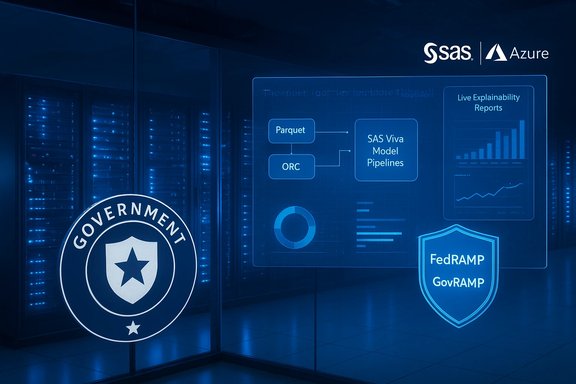
SAS Viya is now offered as a managed, U.S.-sovereign analytics platform inside Microsoft Azure Government—giving federal, state and local agencies (and their systems integrators) a turnkey path to deploy advanced analytics, ModelOps, and explainable AI inside physically isolated datacenters with FedRAMP, GovRAMP and StateRAMP coverage.
SAS announced in mid-January 2026 that SAS Viya can be deployed to U.S. public-sector customers and their partners via SAS Managed Cloud Services on Microsoft Azure Government, positioning the offering as a managed SaaS delivery of Viya inside Azure’s government-only cloud environment. The vendor frames the move as a way to combine SAS’s analytics and governance tooling with Azure Government’s physically isolated infrastructure and compliance posture, targeting regulated workloads such as Criminal Justice Information (CJIS) and Federal Tax Information (FTI). This announcement builds on SAS’s FedRAMP and GovRAMP progress from 2024–2025: SAS lists SAS AI and Analytics for Government as FedRAMP-authorized at the Moderate level and as GovRAMP/StateRAMP-authorized for state and local procurement routes, which is the foundational authorization that enables the managed service to be offered for many government use cases. Those authorizations and listings are visible in SAS materials and in independent product lists.
Key practical benefits cited by the vendors and validated by public documentation:
SAS Viya on Microsoft Azure Government represents a pragmatic and well-engineered option for U.S. public-sector analytics: the technical building blocks and compliance envelopes are demonstrably in place, but the realized security and governance outcomes will depend on rigorous procurement, contract enforcement, and operational validation. Agencies and partners should treat the vendor announcements as the start of a verification process—require ATO packages, test exports, measurable pilot data, and a binding SLA before entrusting mission‑critical decisioning to the managed stack.
SAS Viya’s availability on Microsoft Azure Government is an important step for agencies that need enterprise analytics inside a U.S.-only, compliance-oriented environment. The combination of vendor-managed Viya and Azure Government’s isolation reduces many operational barriers—but it does not replace the hard work of procurement, security engineering, pilot validation, and contractual clarity needed to run regulated analytics at scale. Agencies that require explainable, auditable AI and who insist on the verification items above will find a practical route to production; those who accept marketing claims without demanding evidence risk surprises when the platform meets real mission demands.
Source: HPCwire SAS Viya Now Available to US Public Sector and Partners on Microsoft Azure Government - BigDATAwire
 Background / Overview
SAS announced in mid-January 2026 that SAS Viya can be deployed to U.S. public-sector customers and their partners via SAS Managed Cloud Services on Microsoft Azure Government, positioning the offering as a managed SaaS delivery of Viya inside Azure’s government-only cloud environment. The vendor frames the move as a way to combine SAS’s analytics and governance tooling with Azure Government’s physically isolated infrastructure and compliance posture, targeting regulated workloads such as Criminal Justice Information (CJIS) and Federal Tax Information (FTI). This announcement builds on SAS’s FedRAMP and GovRAMP progress from 2024–2025: SAS lists SAS AI and Analytics for Government as FedRAMP-authorized at the Moderate level and as GovRAMP/StateRAMP-authorized for state and local procurement routes, which is the foundational authorization that enables the managed service to be offered for many government use cases. Those authorizations and listings are visible in SAS materials and in independent product lists. What the offering actually includes
Core components
- SAS Viya platform (cloud-native): data preparation, in-memory compute (CAS), model development, ModelOps, monitoring, and explainability capabilities used across statistical, machine learning and responsible-AI workflows.
- SAS Managed Cloud Services: SAS operates, patches and manages the Viya stack on behalf of agencies within an Azure Government tenancy, under a managed‑services contract and service-level terms.
- Azure Government tenancy: physically isolated datacenters and US-only networks with contractual controls intended to support CJIS, IRS Publication 1075 (FTI), DoD Impact Levels and FedRAMP compliance. Microsoft describes Azure Government as an environment with additional isolation and screening commitments compared with commercial Azure.
Integration and data interoperability
SAS emphasizes integrations with Azure services (identity, key management, storage) and the ability to keep data in non‑proprietary formats such as Apache Parquet in ADLS Gen2, enabling cross-platform data portability and lowering the risk of format lock‑in for agencies and contractors. SAS Viya’s CAS layer supports reading and writing Parquet and ORC files to cloud object stores, and the vendor and community documentation contain worked examples for ADLS Gen2.Compliance-centric operational model
SAS presents this product as a managed, compliance-focused route to get Viya into production quickly: SAS handles the platform engineering and operations while Azure Government supplies the isolation and contractual mechanics agencies rely on for regulated data. The offering is marketed with promises around explainable AI, bias detection, ModelOps and auditability to meet oversight requirements typical of justice, tax and benefits systems.Why this matters for U.S. public-sector analytics
The proposition is straightforward: agencies constrained by data‑sovereignty, personnel‑screening and auditability requirements can now adopt an enterprise analytics stack without building and operating the full platform themselves.Key practical benefits cited by the vendors and validated by public documentation:
- A faster on‑ramp to production. Pre‑engineered managed deployments shorten procurement-to-production timelines by removing the need to design and operate the Viya control plane internally.
- A compliance anchor. FedRAMP Moderate and GovRAMP/StateRAMP artifacts are in the vendor’s possession and listed for procurement, providing the baseline authorizations many agencies require.
- Sovereignty and CJIS/FTI readiness. Azure Government’s environment is designed for U.S. government data, offering contractual mechanisms and region isolation consistent with CJIS and IRS 1075 program needs. Microsoft’s compliance pages make those capabilities explicit.
- Open-data interoperability. Support for Parquet/ORC and ADLS Gen2 means datasets can be shared with other bureaus or contractors without forcing agencies into a proprietary store. This is an important practical advantage for multi‑vendor ecosystems.
Technical verification — what is verifiable and where to be cautious
The vendor claims are concrete where they reference authorizations and technical integration; independent verification is available for the most important assertions:- SAS confirms FedRAMP Moderate authorization for SAS AI and Analytics for Government and lists GovRAMP/StateRAMP achievements on its government pages. Those statements line up with public vendor press releases.
- Azure Government’s isolation, CJIS support, and IRS 1075 guidance are documented on Microsoft Learn and related compliance pages; Microsoft describes contractual amendments and managed‑access controls for these regulated programs. Agencies can request FedRAMP/Azure Government System Security Plans and IRS Safeguards documents under NDA through Microsoft.
- SAS Viya’s support for open formats (Parquet, ORC) and CAS load/save routines is documented in platform and community resources; administrators routinely use CAS to read/write Parquet to ADLS Gen2 in production examples.
- When marketing references “the highest” U.S. regulatory standards or unspecified cost savings, those are promotional claims that require contract-level substantiation (exact SLA, scope, pricing schedules, TCO scenarios). Agencies should treat such statements as assertions until matched with binding documents.
- The presence of FedRAMP or CJIS‑ready infrastructure does not automatically make a specific agency deployment compliant; agency implementation choices—key management, identity configuration, network segmentation and personnel screening—are critical to meeting CJIS and IRS 1075 controls. Microsoft’s compliance pages are explicit that agencies must take these steps and, in many cases, sign contractual amendments.
- SLA and availability promises vary between SAS materials (some marketing materials reference a 99% uptime baseline for managed cloud services, while packaged “Viya Essentials” materials reference 99.5% in other contexts). Procurement teams must insist on the contractually committed SLA annex that spells out covered components, exclusions, RTO/RPO, remedies and measurement windows.
Risks, operational responsibilities and LLM/AI-specific concerns
Deploying advanced analytics and generative workflows in regulated operations brings specific technical and governance risks—many of which are independent of the vendor pairing.- Shared‑responsibility misunderstandings. Managed services reduce operational load but do not shift all responsibilities. Identity and access management (Entra/Azure AD), key ownership, encryption configuration, data governance, and logging/monitoring remain largely customer responsibilities unless explicitly contracted otherwise. Agencies must receive a detailed shared-responsibility matrix.
- Data exfiltration and egress costs. Cloud-managed deployments introduce renewed emphasis on egress governance, billing controls and auditability of data export paths. Agencies should validate tested exit and export runbooks before production runs.
- Model governance for LLMs and generative components. If agencies plan to use generative AI components (LLMs, Copilot-style assistants integrated into Viya), add test harnesses that measure hallucination, drift and fairness; require human-in-the-loop gates and explicit lineage and provenance artifacts for decisions driven or assisted by LLMs. Vendor claims of “trustworthy AI” need empirical validation through pilots that simulate production data and governance reviews.
- Personnel and background-check constraints. For CJIS and some IRS FTI workflows, Azure Government offers screened US-personnel options, but agencies must confirm the exact screening level and contractual commitments applicable to their tenancy and SAS-managed support personnel. This is a jurisdictional, contractual detail that agencies must verify with Microsoft and SAS.
- Operational transparency and auditability. Agencies will expect artifacts—model “nutrition labels,” lineage, ModelOps logs, monitoring dashboards and continuous monitoring evidence—to satisfy internal audit and external oversight. Confirm these outputs and the SLAs for log retention and availability in the managed service agreement.
A practical verification checklist for procurement teams
Before committing mission‑critical workloads, procurement and engineering teams should require and validate the following artifacts and tests:- Request the formal FedRAMP/GovRAMP ATO package and verify the precise components, versions and Azure services included in the authorization boundary. Confirm whether the FedRAMP package references Azure Government or Azure Commercial and what controls are inherited.
- Obtain the full managed‑services contract annex: SLA (explicit measurement and exclusions), RTO/RPO, support hours, escalation paths, contact SLAs, penalties and uptime calculations. Resolve any marketing-to-contract inconsistencies (e.g., 99% vs. 99.5%).
- Secure a shared‑responsibility matrix that maps each NIST/FedRAMP/CJIS control to SAS, Microsoft and the agency, and have legal and security teams review the assignment.
- Confirm CJIS Management Agreement status for your state (if processing CJI). Work with Microsoft and SAS to obtain written evidence that the required state-level agreements and personnel screening measures are in place.
- Insist on customer‑managed keys (CMK) or clear key-ownership definitions for FTI/CJI to align with IRS 1075 controls; document where HSMs and CMKs are used and who has administrative access.
- Run a scoped pilot using representative production-like data: measure latency, concurrency, model lifecycles, billing behavior, and the ModelOps pipeline (training→deployment→monitoring→audit). Collect real billing and performance telemetry.
- Test data portability and exit: execute a sample export of production-scale datasets and model artifacts into agreed open formats (Parquet, CSV) and validate usability on alternative analytics platforms.
- Validate observability and SIEM integration: connect logs and metrics to your agency’s SIEM (for example, Azure Sentinel) and confirm retention, searchability and tamper-evidence for audit purposes.
How partners and systems integrators should position themselves
Systems integrators (SIs) and consulting partners with Azure Government expertise can leverage this offering—but only when they add governance, telemetry, and cost management value. Recommended partner playbooks:- Deliver tested CJIS/FTI readiness packages that show how your installation maps controls and proof-points for state/regional CJIS agreements.
- Provide ModelOps-for‑government templates: audit trails, drift detection, model-card generation, and human‑in‑the‑loop workflows that plug SAS outputs into agency compliance processes.
- Offer cost-optimization and tagging runbooks to prevent surprise hyperscaler bills; include reserved-instance, burst, and autoscaling strategies that conform to an agency’s budget cadence.
- Build exit and migration runbooks that demonstrate how to export data, models and metadata to neutral formats and reconstitute pipelines elsewhere.
Strengths, realistic expectations and the bottom line
Strengths- A credible, compliance-first path to run enterprise analytics in an isolated U.S. government cloud with vendor‑managed operations and FedRAMP/GovRAMP/StateRAMP artifacts in place.
- Open-format interoperability reduces practical lock‑in and enables data sharing across bureaus and contractor ecosystems.
- Embedded governance tooling (ModelOps, explainability, bias detection) that aligns with the transparency needs of regulated decision-making.
- The offering simplifies operations but does not obviate the need for disciplined procurement, a tested pilot project, and contract-level enforcement of SLAs and security responsibilities.
- Agencies must still take ownership of key identity, key-management and logging choices that materially affect compliance posture. Microsoft and SAS provide the environment and controls, but the agency configures the final security envelope.
SAS Viya on Microsoft Azure Government represents a pragmatic and well-engineered option for U.S. public-sector analytics: the technical building blocks and compliance envelopes are demonstrably in place, but the realized security and governance outcomes will depend on rigorous procurement, contract enforcement, and operational validation. Agencies and partners should treat the vendor announcements as the start of a verification process—require ATO packages, test exports, measurable pilot data, and a binding SLA before entrusting mission‑critical decisioning to the managed stack.
Quick reference — What to ask SAS and Microsoft now
- Which specific FedRAMP/GovRAMP artifacts (SSP, POA&M, SAR) cover our intended service scope, and can we review them under NDA?
- Precisely which Viya components are in-scope for the managed service, and what is the shared‑responsibility matrix for each NIST/FedRAMP control?
- What SLA and remedies apply to data-plane, control-plane, storage and managed‑service operations (incidents, RTO, RPO)? Request annexed examples.
- For CJIS/FTI workloads: provide documentation of personnel screening, CJIS Management Agreements, and key-management arrangements that meet the applicable state/IRS constraints.
- Can you provide a pilot runbook (sample datasets, expected billing, data‑export timings and a test of model‑export processes in Parquet or other open formats)?
SAS Viya’s availability on Microsoft Azure Government is an important step for agencies that need enterprise analytics inside a U.S.-only, compliance-oriented environment. The combination of vendor-managed Viya and Azure Government’s isolation reduces many operational barriers—but it does not replace the hard work of procurement, security engineering, pilot validation, and contractual clarity needed to run regulated analytics at scale. Agencies that require explainable, auditable AI and who insist on the verification items above will find a practical route to production; those who accept marketing claims without demanding evidence risk surprises when the platform meets real mission demands.
Source: HPCwire SAS Viya Now Available to US Public Sector and Partners on Microsoft Azure Government - BigDATAwire