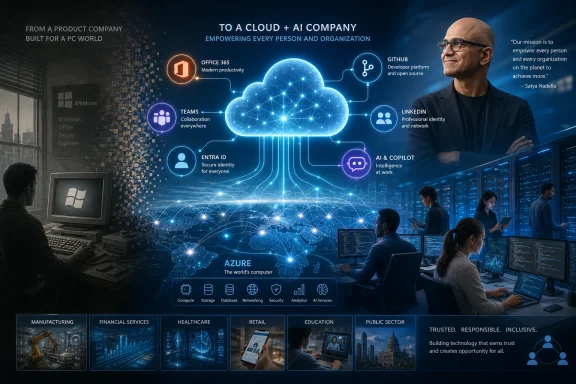
Satya Nadella became Microsoft’s chief executive on February 4, 2014, inheriting a company still dominant in Windows and Office but increasingly peripheral to the industry’s fastest-moving conversations around mobile, cloud, developers, and consumer platforms. Twelve years later, Microsoft is again one of tech’s central companies. The reset was not a single masterstroke; it was a long re-ranking of priorities. Nadella made Microsoft less obsessed with defending Windows, more willing to meet customers where they already were, and far more aggressive about cloud and AI infrastructure.
The Microsoft of early 2014 was not a failing company. That point matters, because the mythology of corporate turnarounds often begins by pretending the old business was already burning down. Windows still mattered, Office still minted money, and enterprise IT departments still treated Microsoft as a default supplier.
The problem was subtler and more dangerous. Microsoft was rich, profitable, and increasingly uncool in the places where the next decade of computing was being designed. Apple had turned the smartphone into the center of personal technology. Google had captured search, mobile software, and developer imagination. Amazon Web Services had made infrastructure feel like a programmable utility.
Microsoft, by comparison, looked like a company defending a castle while the roads around it were being rebuilt. Windows Phone struggled to become a third mobile ecosystem. Developers who once treated Microsoft as unavoidable were building for iOS, Android, Linux, and the web. The company still had leverage, but it was no longer setting the terms of the future.
That is the context in which Nadella’s leadership mattered. He did not rescue Microsoft by making Windows more important. He rescued Microsoft by making Windows less sacred.
Nadella’s first great act was not rhetorical. It was strategic surrender where surrender was rational. Microsoft Office arrived more seriously on iPad and Android. Microsoft services became first-class citizens on rival platforms. The company began behaving as if its customers’ workflows mattered more than its own platform purity.
That move sounds obvious now, but it was culturally radical. Old Microsoft was famous for treating platform rivals as existential threats. Nadella’s Microsoft increasingly treated them as surfaces on which Microsoft software should run. The goal was no longer to force the world back into Windows; it was to make Microsoft indispensable even when Windows was not the user’s front door.
This is why the transformation cannot be reduced to personality. Nadella’s calm style helped, but the deeper change was architectural. Microsoft stopped confusing control with relevance.
Azure was not simply another product line. It was Microsoft’s route back into the strategic center of enterprise computing. If Windows had once been the base layer for business software, cloud infrastructure was becoming the base layer for modern business operations, analytics, software development, identity, security, and eventually AI.
Amazon had the early lead and the cleaner cloud-native reputation. Microsoft had something different: decades of enterprise relationships, Active Directory and identity gravity, Windows Server and SQL Server estates, Office 365 momentum, and a sales organization that already knew how to talk to CIOs. Nadella’s Microsoft turned those legacy advantages into cloud migration paths.
This was the crucial pivot. Instead of treating the cloud as a threat to licensing revenue, Microsoft made the cloud the new licensing engine. Office became Microsoft 365. Server products became hybrid bridges. Developer tools became on-ramps to Azure. Security, identity, endpoint management, collaboration, and analytics were increasingly bundled into a broader cloud operating model.
Azure did not need to defeat AWS outright to change Microsoft’s trajectory. It needed to make Microsoft unavoidable in the boardroom again. On that measure, it succeeded.
The old caricature of Microsoft was a company of internal fiefdoms: Windows against Office, server against client, product groups fighting for political advantage, and teams rewarded for protecting territory. Whether exaggerated or not, the reputation had consequences. A company organized around internal competition struggles to respond when the external world changes faster than the internal hierarchy.
Nadella’s emphasis on learning was a direct attack on that posture. The point was not to make Microsoft softer. It was to make the company less brittle. A know-it-all organization defends past success; a learn-it-all organization can admit when the market has moved.
That cultural change showed up in product behavior. Microsoft became more willing to ship on competing platforms, support Linux in Azure, embrace open-source tooling, and court developers who had long distrusted Redmond. The GitHub acquisition in 2018 would have been almost unimaginable in Microsoft’s earlier era, not because Microsoft lacked the money, but because the symbolism would have been toxic.
Under Nadella, the symbolism became the point. Microsoft wanted developers to believe that it had stopped seeing open source as a disease and started seeing it as infrastructure.
LinkedIn gave Microsoft a professional graph: people, jobs, skills, sales relationships, recruiting workflows, and business identity. It strengthened the company’s position in the workplace beyond documents and email. It also gave Microsoft a data-rich platform that could connect to Dynamics, Microsoft 365, advertising, and professional learning.
GitHub was even more symbolically loaded. Developers had not forgotten the old Microsoft. Many remembered the company’s hostility toward Linux and open-source software. Buying GitHub could have triggered a developer revolt if it had been handled as a classic Microsoft absorption.
Instead, Microsoft largely let GitHub remain GitHub while connecting it to the broader developer platform. That restraint was part of the strategy. The acquisition worked because Microsoft understood that GitHub’s value came from trust, habit, and network effects. Smothering it in corporate branding would have destroyed what Microsoft had bought.
The larger pattern was clear. Nadella’s Microsoft was not just selling software licenses. It was buying and building networks: professional networks, developer networks, cloud networks, security networks, and productivity networks. Windows remained important, but the company’s power increasingly came from the layers around Windows rather than Windows alone.
This is where Nadella’s earlier cloud strategy paid off. Generative AI is not just a model story; it is an infrastructure story. It requires vast compute capacity, specialized chips, data-center scale, developer platforms, enterprise controls, identity systems, compliance tools, and distribution into everyday software. Microsoft had spent the previous decade assembling exactly those pieces.
The Copilot brand has since become Microsoft’s preferred wrapper for this ambition. In some products, Copilot is genuinely useful. In others, it still feels like a feature looking for a workflow. That unevenness is normal in a platform shift, but it also points to the risk: Microsoft is trying to make AI feel inevitable across its product estate before users have fully decided where it is valuable.
Still, the strategic logic is coherent. Microsoft does not need every AI feature to be revolutionary. It needs AI to make Microsoft 365 stickier, Azure more attractive, GitHub more productive, Windows more modern, and enterprise customers more dependent on its stack. That is classic Microsoft platform behavior, updated for the cloud era.
The irony is hard to miss. The company that once used Windows as the gravity well now wants AI to become the connective tissue across everything it sells.
Microsoft under Nadella has been extremely aggressive. It has pursued massive acquisitions, bundled products tightly, expanded security and compliance offerings, fought for cloud workloads, entered the AI race with enormous capital commitments, and defended its enterprise turf with disciplined execution. The company’s tone changed, but its ambition did not shrink.
This is one reason the reset worked. Nadella did not try to turn Microsoft into a boutique innovation lab or a consumer-cool hardware company. He modernized the old Microsoft machine. He made it more open where openness served distribution, more collaborative where collaboration improved execution, and more platform-neutral where neutrality expanded the addressable market.
The result is a company that can appear humble in language and ruthless in strategy. That combination has served Microsoft well. Customers hear partnership; competitors feel pressure.
That has practical consequences. Windows is now integrated into a broader Microsoft cloud and identity model. Microsoft accounts, Entra ID, Intune, Defender, OneDrive, Teams, Edge, Microsoft 365, and Copilot all shape the Windows experience. The operating system is less a standalone product and more a managed endpoint in a cloud-connected estate.
For administrators, this has been both useful and exhausting. The modern Microsoft stack offers powerful management, security, and compliance capabilities. It also creates licensing complexity, portal sprawl, policy overlap, and a constant sense that the local PC is being pulled deeper into cloud governance.
For enthusiasts, the trade-off is equally visible. Windows has gained tighter integration with cloud storage, AI features, security controls, and cross-device services. It has also become more opinionated about accounts, telemetry, defaults, search surfaces, and Microsoft service promotion. Nadella’s Microsoft may be less Windows-centric at the corporate level, but Windows itself has become more Microsoft-account-centric at the user level.
That tension defines the modern Windows experience. The company is no longer trying to win by making every device run Windows. It is trying to win by making every Windows device a node in Microsoft’s cloud.
Cloud subscriptions replaced many one-time purchasing patterns. Microsoft 365 became the productivity default for organizations that wanted email, documents, meetings, storage, security, and device management under one commercial umbrella. Azure became the infrastructure counterpart. GitHub, LinkedIn, Defender, Power Platform, Dynamics, and Copilot filled in more of the map.
This creates convenience, but it also creates dependency. The more Microsoft services an organization adopts, the harder it becomes to leave without operational pain. That is not unique to Microsoft; it is the logic of every successful platform company. But Microsoft’s reach across identity, productivity, operating systems, developer workflows, security, and cloud makes the lock-in especially broad.
Security-minded readers should also separate promise from exposure. Microsoft sells itself as a security company now, and its security portfolio is genuinely significant. At the same time, Microsoft’s ubiquity makes it a high-value target, and incidents affecting identity, email, cloud administration, or update infrastructure can ripple widely. Scale is an advantage until it becomes a blast radius.
Nadella’s achievement, then, is not simply that Microsoft became more beloved. It became more deeply embedded. That is a different kind of power.
Each layer feeds the others. Developers use GitHub and Visual Studio Code, deploy to Azure, authenticate with Microsoft identity, collaborate through Teams, manage code with Microsoft tooling, and increasingly encounter AI through GitHub Copilot or Azure AI services. Enterprises buy Microsoft 365, secure it with Defender, manage endpoints with Intune, analyze data with Fabric or Power BI, and then ask how Copilot fits into that environment.
This is not a collection of random bets. It is a mesh. The strategic brilliance of the Nadella era is that Microsoft rebuilt the mesh after the Windows-first model stopped being enough.
Investors rewarded that because recurring revenue, enterprise entrenchment, and cloud growth are easier to value than boxed software cycles. Customers rewarded it because Microsoft offered an integrated answer to messy operational problems. Developers, once skeptical, returned in part because Microsoft stopped demanding ideological loyalty to Windows.
The reset worked because it gave each constituency a reason to re-engage.
The company he inherited had problems, but it also had cash, talent, customers, and technical depth. Many CEOs would envy that starting point. Nadella’s genius was not inventing Microsoft’s strengths; it was recognizing which strengths still mattered and which habits had become liabilities.
This distinction matters because it makes the transformation more instructive. Nadella did not win by repudiating Microsoft’s enterprise DNA. He won by updating it. He kept the company’s strength in business software, platforms, and developer tools, then redirected those strengths toward cloud and AI.
The lesson is not that every legacy company needs a charismatic outsider. Nadella was an insider. The lesson is that insiders can produce radical change when they are willing to demote the internal orthodoxies that made the company successful in the first place.
The most concrete consequences are already visible:
Nadella rebuilt Microsoft by making it adaptable again, and that remains his central test as the company moves deeper into AI. The next phase will not be judged by whether Microsoft can put Copilot buttons everywhere; it will be judged by whether those systems make Windows, Office, Azure, and developer tools meaningfully better without turning the Microsoft ecosystem into a maze of subscriptions, prompts, and dependencies. The reset made Microsoft relevant again, but relevance is not a permanent state. It has to be earned with every platform shift, every admin decision, and every user who opens a Windows PC expecting the machine to serve them rather than the other way around.
 Nadella Inherited a Giant That Was Winning the Wrong War
The Microsoft of early 2014 was not a failing company. That point matters, because the mythology of corporate turnarounds often begins by pretending the old business was already burning down. Windows still mattered, Office still minted money, and enterprise IT departments still treated Microsoft as a default supplier.The problem was subtler and more dangerous. Microsoft was rich, profitable, and increasingly uncool in the places where the next decade of computing was being designed. Apple had turned the smartphone into the center of personal technology. Google had captured search, mobile software, and developer imagination. Amazon Web Services had made infrastructure feel like a programmable utility.
Microsoft, by comparison, looked like a company defending a castle while the roads around it were being rebuilt. Windows Phone struggled to become a third mobile ecosystem. Developers who once treated Microsoft as unavoidable were building for iOS, Android, Linux, and the web. The company still had leverage, but it was no longer setting the terms of the future.
That is the context in which Nadella’s leadership mattered. He did not rescue Microsoft by making Windows more important. He rescued Microsoft by making Windows less sacred.
The Reset Began When Windows Stopped Being the Religion
For decades, Microsoft’s internal logic was simple: Windows sat at the center, and everything else orbited around it. That model made sense when the PC was the dominant computing device and Microsoft could use Windows as both platform and distribution engine. But by 2014, the center of gravity had shifted toward phones, cloud services, browsers, app stores, and distributed infrastructure.Nadella’s first great act was not rhetorical. It was strategic surrender where surrender was rational. Microsoft Office arrived more seriously on iPad and Android. Microsoft services became first-class citizens on rival platforms. The company began behaving as if its customers’ workflows mattered more than its own platform purity.
That move sounds obvious now, but it was culturally radical. Old Microsoft was famous for treating platform rivals as existential threats. Nadella’s Microsoft increasingly treated them as surfaces on which Microsoft software should run. The goal was no longer to force the world back into Windows; it was to make Microsoft indispensable even when Windows was not the user’s front door.
This is why the transformation cannot be reduced to personality. Nadella’s calm style helped, but the deeper change was architectural. Microsoft stopped confusing control with relevance.
Azure Gave Microsoft a Future Bigger Than the PC
The cloud was the cleanest expression of the new Microsoft. Before becoming CEO, Nadella had already led major enterprise and cloud operations inside the company, and that experience gave him a view of Microsoft’s future that was not primarily tied to consumer hardware or operating-system share.Azure was not simply another product line. It was Microsoft’s route back into the strategic center of enterprise computing. If Windows had once been the base layer for business software, cloud infrastructure was becoming the base layer for modern business operations, analytics, software development, identity, security, and eventually AI.
Amazon had the early lead and the cleaner cloud-native reputation. Microsoft had something different: decades of enterprise relationships, Active Directory and identity gravity, Windows Server and SQL Server estates, Office 365 momentum, and a sales organization that already knew how to talk to CIOs. Nadella’s Microsoft turned those legacy advantages into cloud migration paths.
This was the crucial pivot. Instead of treating the cloud as a threat to licensing revenue, Microsoft made the cloud the new licensing engine. Office became Microsoft 365. Server products became hybrid bridges. Developer tools became on-ramps to Azure. Security, identity, endpoint management, collaboration, and analytics were increasingly bundled into a broader cloud operating model.
Azure did not need to defeat AWS outright to change Microsoft’s trajectory. It needed to make Microsoft unavoidable in the boardroom again. On that measure, it succeeded.
The Cultural Story Was Real, Even If It Became a Slogan
Nadella’s language around empathy, learning, and the “growth mindset” has sometimes been flattened into corporate wallpaper. Every large company eventually turns useful ideas into posters, slide decks, and performance-review vocabulary. But at Microsoft, the cultural shift was not merely cosmetic.The old caricature of Microsoft was a company of internal fiefdoms: Windows against Office, server against client, product groups fighting for political advantage, and teams rewarded for protecting territory. Whether exaggerated or not, the reputation had consequences. A company organized around internal competition struggles to respond when the external world changes faster than the internal hierarchy.
Nadella’s emphasis on learning was a direct attack on that posture. The point was not to make Microsoft softer. It was to make the company less brittle. A know-it-all organization defends past success; a learn-it-all organization can admit when the market has moved.
That cultural change showed up in product behavior. Microsoft became more willing to ship on competing platforms, support Linux in Azure, embrace open-source tooling, and court developers who had long distrusted Redmond. The GitHub acquisition in 2018 would have been almost unimaginable in Microsoft’s earlier era, not because Microsoft lacked the money, but because the symbolism would have been toxic.
Under Nadella, the symbolism became the point. Microsoft wanted developers to believe that it had stopped seeing open source as a disease and started seeing it as infrastructure.
GitHub and LinkedIn Turned Microsoft Into an Ecosystem Company Again
The LinkedIn and GitHub acquisitions are often treated as separate episodes: one about professional networking, the other about developers. Taken together, they show how Nadella rebuilt Microsoft as an ecosystem company without relying solely on Windows.LinkedIn gave Microsoft a professional graph: people, jobs, skills, sales relationships, recruiting workflows, and business identity. It strengthened the company’s position in the workplace beyond documents and email. It also gave Microsoft a data-rich platform that could connect to Dynamics, Microsoft 365, advertising, and professional learning.
GitHub was even more symbolically loaded. Developers had not forgotten the old Microsoft. Many remembered the company’s hostility toward Linux and open-source software. Buying GitHub could have triggered a developer revolt if it had been handled as a classic Microsoft absorption.
Instead, Microsoft largely let GitHub remain GitHub while connecting it to the broader developer platform. That restraint was part of the strategy. The acquisition worked because Microsoft understood that GitHub’s value came from trust, habit, and network effects. Smothering it in corporate branding would have destroyed what Microsoft had bought.
The larger pattern was clear. Nadella’s Microsoft was not just selling software licenses. It was buying and building networks: professional networks, developer networks, cloud networks, security networks, and productivity networks. Windows remained important, but the company’s power increasingly came from the layers around Windows rather than Windows alone.
AI Became the Second Reset, Not a Detour
The AI boom did not arrive as an accident for Microsoft. The company’s partnership with OpenAI began years before generative AI became a mainstream obsession, and by 2023 Microsoft was moving aggressively to place AI inside Bing, Azure, Microsoft 365, GitHub, Windows, and developer workflows.This is where Nadella’s earlier cloud strategy paid off. Generative AI is not just a model story; it is an infrastructure story. It requires vast compute capacity, specialized chips, data-center scale, developer platforms, enterprise controls, identity systems, compliance tools, and distribution into everyday software. Microsoft had spent the previous decade assembling exactly those pieces.
The Copilot brand has since become Microsoft’s preferred wrapper for this ambition. In some products, Copilot is genuinely useful. In others, it still feels like a feature looking for a workflow. That unevenness is normal in a platform shift, but it also points to the risk: Microsoft is trying to make AI feel inevitable across its product estate before users have fully decided where it is valuable.
Still, the strategic logic is coherent. Microsoft does not need every AI feature to be revolutionary. It needs AI to make Microsoft 365 stickier, Azure more attractive, GitHub more productive, Windows more modern, and enterprise customers more dependent on its stack. That is classic Microsoft platform behavior, updated for the cloud era.
The irony is hard to miss. The company that once used Windows as the gravity well now wants AI to become the connective tissue across everything it sells.
The Quiet Leader Also Became a Hard-Nosed Operator
Nadella’s public image is almost anti-Silicon Valley. He is measured where others are theatrical, reflective where others are combative, and fluent in the language of empathy in an industry that often rewards aggression. But it would be a mistake to confuse that demeanor with softness.Microsoft under Nadella has been extremely aggressive. It has pursued massive acquisitions, bundled products tightly, expanded security and compliance offerings, fought for cloud workloads, entered the AI race with enormous capital commitments, and defended its enterprise turf with disciplined execution. The company’s tone changed, but its ambition did not shrink.
This is one reason the reset worked. Nadella did not try to turn Microsoft into a boutique innovation lab or a consumer-cool hardware company. He modernized the old Microsoft machine. He made it more open where openness served distribution, more collaborative where collaboration improved execution, and more platform-neutral where neutrality expanded the addressable market.
The result is a company that can appear humble in language and ruthless in strategy. That combination has served Microsoft well. Customers hear partnership; competitors feel pressure.
Windows Became One Layer in a Larger Microsoft Stack
For WindowsForum readers, the most interesting part of the Nadella era is not that Windows disappeared. It is that Windows changed roles. It is still a massive platform, still central to enterprise fleets, still the default desktop environment for millions of workers, gamers, developers, and administrators. But it no longer carries the entire corporate story on its back.That has practical consequences. Windows is now integrated into a broader Microsoft cloud and identity model. Microsoft accounts, Entra ID, Intune, Defender, OneDrive, Teams, Edge, Microsoft 365, and Copilot all shape the Windows experience. The operating system is less a standalone product and more a managed endpoint in a cloud-connected estate.
For administrators, this has been both useful and exhausting. The modern Microsoft stack offers powerful management, security, and compliance capabilities. It also creates licensing complexity, portal sprawl, policy overlap, and a constant sense that the local PC is being pulled deeper into cloud governance.
For enthusiasts, the trade-off is equally visible. Windows has gained tighter integration with cloud storage, AI features, security controls, and cross-device services. It has also become more opinionated about accounts, telemetry, defaults, search surfaces, and Microsoft service promotion. Nadella’s Microsoft may be less Windows-centric at the corporate level, but Windows itself has become more Microsoft-account-centric at the user level.
That tension defines the modern Windows experience. The company is no longer trying to win by making every device run Windows. It is trying to win by making every Windows device a node in Microsoft’s cloud.
The Transformation Has a Cost, and Users Feel It
The flattering version of the Nadella story is that Microsoft rediscovered innovation by embracing openness. That is true, but incomplete. The less flattering version is that Microsoft became better at embedding itself into more layers of work and computing than ever before.Cloud subscriptions replaced many one-time purchasing patterns. Microsoft 365 became the productivity default for organizations that wanted email, documents, meetings, storage, security, and device management under one commercial umbrella. Azure became the infrastructure counterpart. GitHub, LinkedIn, Defender, Power Platform, Dynamics, and Copilot filled in more of the map.
This creates convenience, but it also creates dependency. The more Microsoft services an organization adopts, the harder it becomes to leave without operational pain. That is not unique to Microsoft; it is the logic of every successful platform company. But Microsoft’s reach across identity, productivity, operating systems, developer workflows, security, and cloud makes the lock-in especially broad.
Security-minded readers should also separate promise from exposure. Microsoft sells itself as a security company now, and its security portfolio is genuinely significant. At the same time, Microsoft’s ubiquity makes it a high-value target, and incidents affecting identity, email, cloud administration, or update infrastructure can ripple widely. Scale is an advantage until it becomes a blast radius.
Nadella’s achievement, then, is not simply that Microsoft became more beloved. It became more deeply embedded. That is a different kind of power.
The Market Rewarded the Strategy Because the Strategy Compounded
Microsoft’s rise in market value under Nadella is often cited as proof of leadership genius. The financial story is real, but the better explanation is compounding. Nadella aligned Microsoft with markets that reinforce one another: cloud infrastructure, enterprise software, cybersecurity, developer platforms, collaboration, data, and AI.Each layer feeds the others. Developers use GitHub and Visual Studio Code, deploy to Azure, authenticate with Microsoft identity, collaborate through Teams, manage code with Microsoft tooling, and increasingly encounter AI through GitHub Copilot or Azure AI services. Enterprises buy Microsoft 365, secure it with Defender, manage endpoints with Intune, analyze data with Fabric or Power BI, and then ask how Copilot fits into that environment.
This is not a collection of random bets. It is a mesh. The strategic brilliance of the Nadella era is that Microsoft rebuilt the mesh after the Windows-first model stopped being enough.
Investors rewarded that because recurring revenue, enterprise entrenchment, and cloud growth are easier to value than boxed software cycles. Customers rewarded it because Microsoft offered an integrated answer to messy operational problems. Developers, once skeptical, returned in part because Microsoft stopped demanding ideological loyalty to Windows.
The reset worked because it gave each constituency a reason to re-engage.
The Nadella Myth Should Not Erase the Pre-Nadella Microsoft
There is a temptation to tell this story as a clean break: Ballmer’s Microsoft was closed and backward; Nadella’s Microsoft became open and modern. That version is too tidy. Azure did not appear from nowhere. Office, Windows Server, SQL Server, Active Directory, Xbox, Visual Studio, and enterprise licensing all gave Nadella enormous assets to work with.The company he inherited had problems, but it also had cash, talent, customers, and technical depth. Many CEOs would envy that starting point. Nadella’s genius was not inventing Microsoft’s strengths; it was recognizing which strengths still mattered and which habits had become liabilities.
This distinction matters because it makes the transformation more instructive. Nadella did not win by repudiating Microsoft’s enterprise DNA. He won by updating it. He kept the company’s strength in business software, platforms, and developer tools, then redirected those strengths toward cloud and AI.
The lesson is not that every legacy company needs a charismatic outsider. Nadella was an insider. The lesson is that insiders can produce radical change when they are willing to demote the internal orthodoxies that made the company successful in the first place.
The Reset Now Runs Through Every Admin Console
The Nadella era is not abstract for IT pros. It shows up in procurement, deployment, identity, endpoint management, security operations, compliance audits, and the daily work of keeping users productive without surrendering control.The most concrete consequences are already visible:
- Microsoft’s center of gravity has moved from Windows licensing to cloud-connected subscriptions, identity, security, and AI-enabled productivity services.
- Windows remains strategically important, but it is increasingly managed as an endpoint inside Microsoft’s broader cloud and policy architecture.
- Azure gave Microsoft a credible future beyond the PC and made the company central to enterprise modernization, hybrid infrastructure, and AI deployment.
- GitHub and open-source engagement repaired developer trust that earlier Microsoft leadership had badly damaged.
- Copilot is the clearest symbol of the new Microsoft: ambitious, deeply integrated, commercially aggressive, and still uneven in day-to-day usefulness.
- Nadella’s cultural reset mattered because it changed product behavior, not because executives discovered nicer vocabulary.
Nadella rebuilt Microsoft by making it adaptable again, and that remains his central test as the company moves deeper into AI. The next phase will not be judged by whether Microsoft can put Copilot buttons everywhere; it will be judged by whether those systems make Windows, Office, Azure, and developer tools meaningfully better without turning the Microsoft ecosystem into a maze of subscriptions, prompts, and dependencies. The reset made Microsoft relevant again, but relevance is not a permanent state. It has to be earned with every platform shift, every admin decision, and every user who opens a Windows PC expecting the machine to serve them rather than the other way around.
References
- Primary source: Analytics Insight
Published: 2026-06-01T09:45:06.992874
Satya Nadella and the Microsoft Transformation Story
Explore how Satya Nadella transformed Microsoft through cloud computing, artificial intelligence, open collaboration, and empathetic leadership, turning the company into a dominant global technology powerhouse.www.analyticsinsight.net - Official source: news.microsoft.com
Microsoft Board names Satya Nadella as CEO - Source
Bill Gates steps up to new role as Technology Advisor; John Thompson assumes role as Chairman of Board of Directors. news.microsoft.com
- Official source: blogs.microsoft.com
Introducing Microsoft’s new CEO: Satya Nadella - The Official Microsoft Blog
Microsoft today named Satya Nadella its next Chief Executive Officer. Formerly executive vice president of the company’s Cloud and Enterprise group, Nadella led the development of one of the largest cloud infrastructures in the world. “The opportunity ahead for Microsoft is vast, but...blogs.microsoft.com - Related coverage: techcrunch.com
Microsoft Names Satya Nadella Its New CEO | TechCrunch
Microsoft has made official what we all pretty much expected: Its new CEO, replacing Steve Ballmer, is Satya Nadella. Nadella has spent 22 years attechcrunch.com - Related coverage: cnbc.com
Microsoft names Nadella as CEO, brings Gates era to a close
The company also said Bill Gates would step aside as chairman of the board.www.cnbc.com - Official source: microsoft.com
Come build with us: Microsoft and OpenAI partnership unveils new AI opportunities | The Microsoft Cloud Blog
Read the announcements from OpenAI’s first DevDay event and learn about the opportunities Microsoft and OpenAI's partnership presents for AI builders.www.microsoft.com
- Related coverage: time.com
- Related coverage: tomshardware.com
OpenAI and Microsoft sign agreement to restructure OpenAI into a public benefit corporation with Microsoft retaining 27% stake — non-profit 'Open AI Foundation' to oversee 'Open AI PBC' | Tom's Hardware
Microsoft's 27% stake is worth $135 billion right now.www.tomshardware.com - Related coverage: windowscentral.com
"The work we’re doing together remains ambitious": OpenAI ends Microsoft exclusivity in a tone that doesn’t match last week’s leaked memo | Windows Central
OpenAI’s official announcement sounds optimistic, but last week’s leaked memo told a different story.www.windowscentral.com - Official source: microsoft.gcs-web.com
- Related coverage: lemonde.fr
Microsoft lâche son siège au conseil d’OpenAI, sous la pression des autorités de la concurrence
Le géant de l’informatique, qui détient 49 % du créateur de ChatGPT et a obtenu l’usage exclusif de ses technologies, est soupçonné de contrôler de fait la start-up pionnière de l’intelligence artificielle.www.lemonde.fr - Related coverage: axios.com
Microsoft may be acquiring GitHub
Microsoft's aversion to open source is long gonewww.axios.com
- Related coverage: businesscouncil.com
- Related coverage: phys.org