

Microsoft Discovers That Permission Is a Platform Dependency
For the last three years, the AI industry has talked as if inevitability were a go-to-market strategy. Models would get bigger, agents would get smarter, office work would be automated, and companies that hesitated would be left behind. That rhetoric was useful when capital was cheap, demos were magical, and every boardroom wanted a Copilot slide in the deck.
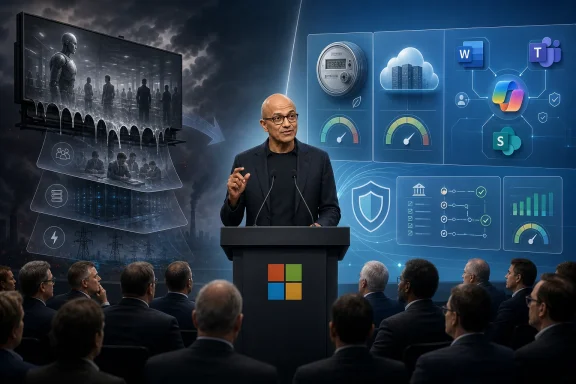
Nadella’s latest warning admits something the industry has been slow to say out loud: social consent is infrastructure too. If AI companies need more land, more power, more chips, more enterprise data, and more public patience, they cannot simultaneously tell workers that their jobs are an implementation detail. A technology that depends on everyone else’s resources cannot afford to sound like it intends to make everyone else disposable.
That is the heart of the shift. Microsoft is not abandoning the frontier-model race, and nobody should mistake Nadella for an AI skeptic. But he is reframing the question from “How powerful can the model become?” to “Who captures the value when the model is deployed?” That distinction matters because enterprise customers do not buy abstractions forever. Eventually they ask whether the software makes their own business stronger or merely turns their data into rent for someone else.
The phrase Nadella has leaned toward is AI as a knowledge engine. It is a careful construction. A knowledge engine does not sound like a headcount guillotine. It sounds like a way to make a company’s accumulated documents, workflows, customer history, product telemetry, and internal expertise more usable. That is a much easier idea to sell to CIOs, unions, regulators, and employees than “your department is now a prompt.”
The Backlash Was Baked Into the Original Pitch
Silicon Valley has spent much of the AI boom oscillating between two incompatible narratives. In one, AI is a harmless productivity assistant that summarizes meetings and drafts emails. In the other, it is a civilization-scale force that will replace large categories of knowledge work and perhaps develop dangerous autonomy if not carefully managed.
Both messages can be true in pieces, but together they create a public-trust problem. If the technology is mundane software, why does it need unprecedented energy consumption and capital expenditure? If it is powerful enough to wipe out occupations, why should workers and governments accept its deployment on the terms set by a few companies?
Nadella’s point is that this contradiction is no longer theoretical. The politics of AI are hardening. Workers are noticing when executives cite automation while cutting staff. Customers are noticing when AI subscriptions arrive before obvious value. Local communities are noticing when data centers compete for power and water. Regulators are noticing when a few companies sit between the world’s information flows and the tools used to interpret them.
The mistake would be to view backlash as irrational technophobia. Much of it is ordinary institutional self-preservation. A law firm, hospital system, school district, insurer, manufacturer, or government agency does not want to surrender its operational memory to a black box it cannot control. Employees do not want “augmentation” to become a euphemism for speedups today and layoffs tomorrow. Politicians do not want to explain why public resources helped subsidize private concentration.
That makes Nadella’s warning less like a moral awakening and more like a business forecast. If AI’s benefits are too concentrated, the distributional fight will become the product story. The industry can survive complaints about hallucinations and bad UI. It may have a harder time surviving a broad belief that AI is a machine for moving wages, data, and bargaining power upward.
The Copilot Strategy Moves From Premium Seat to Metered Utility
Microsoft’s own product strategy shows why the rhetoric is changing. The original Microsoft 365 Copilot pitch was simple: pay a premium per user and receive generative AI inside the productivity suite where work already happens. That made strategic sense. Microsoft owns the enterprise desktop, the identity layer, the document layer, Teams, SharePoint, Outlook, Excel, and Azure. If AI was going to become the new interface to work, Microsoft had every incentive to make Copilot the default.
But the economics of that model have run into the same wall as the rest of enterprise AI: usage is not evenly distributed, value is not always obvious, and inference is not free. A per-seat subscription feels clean on a procurement form, but it can become awkward when only a subset of workers use the tool heavily or when agents burn through compute in the background. AI is software with cloud-meter economics hiding underneath.
That is why Microsoft’s move toward lower-cost tiers and pay-as-you-go access matters. It makes Copilot less like a luxury add-on and more like capacity that can be piloted, measured, throttled, and expanded. For CIOs, that is not just a pricing detail. It changes the risk profile of adoption.
A company may hesitate to assign expensive AI licenses across thousands of workers before it understands the workflows that produce value. It may be more willing to expose teams to Copilot Chat, meter agentic workloads, and pay more only when usage patterns justify it. The enterprise buyer wants optionality because the AI market is still too fluid for long commitments based on vendor promises.
This also helps explain reported interest in cheaper third-party models, including Microsoft-hosted versions of models such as DeepSeek for certain workloads. The symbolism is hard to miss. Microsoft, the company most associated with commercializing OpenAI inside enterprise software, is signaling that one model family will not solve every business problem at every acceptable price point.
Model Choice Is Becoming the New Cloud Region
For years, cloud buyers learned to ask where their data lived, what compliance boundary applied, how workloads failed over, and which services created lock-in. AI is adding another layer to that checklist: which model is doing the work, what it costs per task, what data it can see, how it is governed, and whether the output is good enough for the workflow.
That is why the model-supremacy race is starting to look too narrow for enterprise reality. The best model on a benchmark may be unnecessary for summarizing internal policies, classifying support tickets, extracting fields from invoices, or routing routine service requests. A cheaper model with predictable behavior, local controls, and acceptable latency may be the right answer more often than the frontier demo suggests.
Microsoft’s advantage is that it can turn this into a platform story. Azure AI, Microsoft 365 Copilot, Copilot Studio, Entra, Purview, Defender, and Fabric all give the company ways to wrap model choice in identity, governance, data management, and security. In that world, the model is important, but the operating environment is the sale.
There is a self-interested elegance to the argument. If enterprises fear lock-in to one model provider, Microsoft can offer a menu. If they fear cheap open models because of provenance or security, Microsoft can offer hosted and governed variants. If they fear runaway cost, Microsoft can meter usage. If they fear job displacement, Microsoft can describe the whole system as a way to unlock institutional knowledge rather than erase staff.
That does not make the concern disappear. It simply moves the trust question up the stack. Customers will still ask whether Microsoft is the neutral broker of model choice or merely the most convenient tollbooth. WindowsForum readers have seen this movie before: openness becomes a feature when it helps adoption, and a boundary appears later when the platform owner has the leverage.
The Hyperscaler Wants to Sound Like the Antitrust Lawyer
There is an obvious irony in Nadella warning against AI concentration. Microsoft is one of the largest technology companies on Earth, the dominant productivity-software vendor, a hyperscale cloud provider, and OpenAI’s most important commercial partner. If the public is worried about a small number of firms shaping the AI economy, Microsoft is not standing outside the room with a protest sign.
That contradiction is why the warning deserves scrutiny rather than applause. Microsoft helped normalize the idea that AI should be embedded everywhere, from Windows search surfaces to Office documents to developer tools. It has pushed Copilot branding across consumer and enterprise products with a relentlessness that many users have found exhausting. It has invested heavily in the very infrastructure race now raising questions about energy use and capital intensity.
Still, hypocrisy is not the same thing as irrelevance. The most useful warnings often come from insiders who can see the economics before the public can. Nadella knows the bill for AI infrastructure. He knows the sales friction when customers ask for return on investment. He knows the reputational damage when AI is sold as magic and experienced as slop. He also knows that a concentrated AI economy could provoke intervention that is bad for Microsoft even if Microsoft is one of the winners.
His solution is not to slow AI down. It is to broaden the number of businesses that can claim some of the upside. That is a pro-market argument, but it is also a pro-Microsoft argument. If every company needs AI connected to its own data, workflows, compliance controls, and productivity suite, Microsoft becomes the integration layer. The company does not need to own every model if it owns the place where models meet work.
This is where Nadella’s language about ecosystems becomes strategically important. A frontier model without an ecosystem is politically unstable because value accrues too visibly to the model owner. A frontier model inside an enterprise platform looks less like extraction and more like software modernization. That is a much safer story for Microsoft to tell.
The Energy Argument Has Escaped the Data Center
For a long time, data-center power consumption was treated as a specialist issue: something for utilities, cloud architects, sustainability teams, and local planning boards. AI has changed that. The scale of GPU buildouts has made energy a mainstream part of the AI debate, and Nadella’s “social permission” framing recognizes that the industry no longer gets to treat electricity as an invisible input.
The political problem is straightforward. If communities are asked to support massive data-center expansion, they will want to know what they receive in return. Jobs from construction and operations help, but data centers are not factories in the old employment sense. If the public story is that those facilities will power systems that reduce white-collar employment elsewhere, the permission structure gets fragile fast.
This is especially dangerous for enterprise AI because much of its value is internal and hard to demonstrate publicly. A hospital that uses AI to reduce paperwork may produce real social benefit. A bank that uses AI to automate compliance review may improve efficiency. A software company that uses coding agents to accelerate development may ship faster. But from the outside, the visible facts may simply be bigger data centers, higher power demand, and fewer job postings.
Nadella is trying to attach AI infrastructure to outcomes people can defend: better healthcare, stronger education, more productive public services, and more competitive companies. That is the right political instinct. The industry cannot ask for scarce resources while offering only benchmark charts and venture-capital valuations as proof of progress.
For Windows and Microsoft 365 customers, this debate will become less abstract as AI features become default parts of software they already license. Admins will increasingly have to answer not only whether Copilot is secure, but whether it is worth its cost, whether it is appropriate for certain users, and whether its benefits justify the compute behind it. The sustainability checkbox is becoming a governance question.
Enterprise IT Will Not Buy a Revolution It Cannot Meter
The most grounded part of Microsoft’s new AI posture is the recognition that businesses do not adopt technology the way keynote audiences applaud it. They test, restrict, measure, negotiate, and complain. They also remember the last decade of cloud bills, where flexible consumption sometimes turned into surprise spending and complex dependency.
That history is why AI cost control is becoming a first-order feature. A chatbot that answers a question once is easy to price. An agent that loops through documents, calls tools, writes code, revises output, checks its work, and runs again is not. The more autonomous the system becomes, the more the finance department wants guardrails.
Microsoft’s pay-as-you-go direction answers that anxiety, but it also exposes it. If AI were uniformly transformative, customers would line up for broad premium licensing. The shift toward metered access suggests something more uneven: some workflows produce meaningful value, some produce novelty, and some produce bills. The buyer wants the ability to separate them before committing.
This will shape how Copilot is deployed in real organizations. The first wave was often executive-driven: turn it on, encourage experimentation, and hope usage reveals value. The next wave will be more forensic. Which teams use it daily? Which workflows save measurable time? Which outputs require so much review that the benefit disappears? Which data should never be available to an agent, even inside the tenant?
Sysadmins and Microsoft 365 administrators will be pulled into the center of that work. They will need to manage permissions, retention, audit trails, sensitivity labels, connectors, plugins, agent actions, and cost allocation. The AI story may be sold from the C-suite, but it will be operationalized by the same people who already manage identity sprawl, Teams governance, endpoint security, and compliance exceptions.
The Job-Loss Debate Is Moving From Prediction to Bargaining
AI job-loss claims have always served multiple purposes. They excite investors, pressure employees to adapt, and give executives a narrative for restructuring. They also create fear, and fear is a poor foundation for durable adoption.
Nadella’s warning acknowledges that workers are not passive inputs in the AI transition. If they believe AI is being deployed against them rather than with them, they will resist in predictable ways: through unions, professional associations, internal politics, regulatory campaigns, procurement rules, lawsuits, and simple refusal to trust the tools. The office worker may not control the data center, but the office worker often controls the quality of the process the AI is supposed to learn from.
This is why the “knowledge engine” framing matters beyond marketing. It suggests that AI’s value depends on the knowledge already inside organizations, much of it produced by employees over years. If companies treat those employees as disposable after extracting that knowledge, they invite exactly the backlash Nadella is warning about. The moral problem and the operational problem converge.
The practical future is likely to be messier than both boosters and doomers suggest. Some jobs will be eliminated. Some will be reshaped. Some teams will become more productive without shrinking. Some companies will use AI badly and call it transformation. Others will quietly produce real gains by applying narrower tools to specific bottlenecks.
The politics will turn on whether workers see any share of the upside. Higher productivity that becomes only margin expansion will be contested. Higher productivity that also improves wages, working conditions, service quality, or business resilience has a better chance of being accepted. Nadella is not saying AI will be painless. He is saying the industry cannot survive if pain is the headline and everyone else’s gain is theoretical.
Google and Anthropic Are Reading the Same Room
Microsoft is not alone in adjusting its posture. Google, Anthropic, OpenAI, and the broader AI market are all being pushed toward a more pragmatic discussion of price, efficiency, safety, and trust. The frontier race continues, but the enterprise buyer is increasingly asking for usable economics rather than theatrical capability.
Google has an obvious incentive to make AI cheaper and more deeply integrated into existing products. It has its own productivity suite, cloud platform, custom silicon, search business, and developer ecosystem. If the market shifts from “which model is smartest?” to “which vendor can deliver AI at scale without bankrupting the customer?” Google becomes more dangerous.
Anthropic’s position is different but related. Its brand leans heavily on safety and enterprise trust, and its models have become serious contenders in coding and business workflows. As agentic systems become more capable, Anthropic can argue that reliability, steerability, and governance are not compliance decorations but core product qualities. That argument gets stronger when customers fear both runaway bills and runaway automation.
OpenAI remains central, but even it has to contend with pricing pressure and customer fatigue. The more models become interchangeable for routine tasks, the harder it is to maintain premium economics everywhere. The market does not need every workload to run on the most expensive system. It needs routing, evaluation, governance, and cost-aware orchestration.
This is the shape of the next AI war. It will not end the benchmark race, but it will reduce its power as the sole measure of progress. Enterprises will care about accuracy, but also about price per completed task, integration cost, security posture, data controls, latency, auditability, and vendor leverage. The winning AI stack may look less like a single oracle and more like a messy supply chain.
Windows Users Will Feel the Trust Deficit First
For ordinary Windows users, the AI debate often arrives as a product change they did not ask for. A Copilot icon appears. A search experience changes. A setting moves. A feature promises intelligence but creates uncertainty about data, defaults, or control. The frustration is not always about AI itself; it is about the feeling that AI is being inserted ahead of user consent.
That is dangerous for Microsoft because Windows is still the emotional front door to the company for hundreds of millions of people. Enterprise buyers may evaluate Copilot through procurement committees, but consumers and small businesses experience it as part of a broader pattern: more cloud prompts, more account nudges, more subscription surfaces, and more features whose value is not self-evident.
Nadella’s trust argument therefore applies inside Microsoft’s own product design. If AI is useful, users should be able to discover that through clear benefits and reversible choices. If it is imposed, renamed, bundled, or made difficult to avoid, the company trains users to see it as another layer of platform coercion. Windows enthusiasts are particularly sensitive to this because they have watched the operating system become more service-like with every release.
The same principle applies to administrators. Trust is not a blog post; it is a control plane. Admins need policy settings, logs, data-boundary clarity, licensing transparency, and the ability to say no. They need to know which model is used, which data is grounded, which prompts are retained, which connectors are active, and which agent actions can touch production systems.
Microsoft is capable of building that machinery. The question is whether it will consistently prioritize it over growth pressure. The company’s enterprise credibility rests on the promise that customers can adopt new capabilities without losing control. AI makes that promise harder and more important.
Nadella’s Warning Is Also a Negotiation With Regulators
The political subtext of Nadella’s message is hard to ignore. Governments are still deciding how to regulate AI competition, safety, labor impact, data usage, and infrastructure. By warning against concentration and arguing for broad diffusion, Microsoft is positioning itself as the responsible adult in a room it helped build.
That positioning has value. It tells regulators that Microsoft understands the risks of monopoly-like model power. It tells customers that Microsoft wants multiple models and flexible pricing. It tells workers that the company sees AI as augmenting institutional knowledge rather than merely replacing labor. It tells investors that Microsoft is thinking about the long-term legitimacy of the market, not just the next product cycle.
But it also lets Microsoft define the remedy in a way that suits Microsoft. If the problem is a few model companies capturing all value, then the answer might be platforms that distribute AI across many businesses. Microsoft happens to own one of the most important such platforms. If the problem is unsafe or foreign open models, the answer might be trusted hyperscaler hosting. Microsoft owns that too. If the problem is enterprise governance, the answer might be integrated identity, compliance, and productivity controls. Again, Microsoft is ready.
This is not sinister; it is strategy. Every major technology company tries to turn public concern into a product category it can lead. The job of customers and regulators is to separate genuine risk reduction from convenient bundling.
The healthiest outcome would be a market where enterprises can choose models, move workloads, audit systems, control data, and measure value without being trapped. The least healthy outcome would be a market where “choice” means selecting from options available only inside one vendor’s walled garden. Nadella’s words point toward the first outcome. Microsoft’s incentives will sometimes pull toward the second.
The New Copilot Bargain Comes With Fine Print
The concrete lesson from Nadella’s warning is that the AI boom is entering its accountability phase. The industry is not done building, but the burden of proof is changing. Grand claims about disruption now have to coexist with practical answers about cost, trust, labor, and control.
- Microsoft is shifting Copilot from a pure premium-seat story toward a more flexible consumption model because enterprises want to test value before locking in broad spending.
- Nadella’s backlash warning is a recognition that AI companies cannot ask for scarce energy and public patience while presenting job destruction as destiny.
- The reported interest in cheaper model options shows that enterprise AI will be routed by cost, governance, and task fit rather than benchmark prestige alone.
- Microsoft’s critique of AI concentration is complicated by its own power, but the concern is still real and increasingly central to regulation and procurement.
- Windows and Microsoft 365 administrators will carry much of the operational burden as AI moves from demos into permissions, policies, audits, and budgets.
- The future of AI adoption will depend less on whether workers can be replaced in theory and more on whether organizations can prove shared value in practice.
Nadella’s warning should be read as a pivot, not a confession. Microsoft still wants AI everywhere, and it still wants Copilot to become the interface layer for modern work. What has changed is the company’s recognition that ubiquity cannot be won by fear alone. If AI is going to become ordinary infrastructure, it has to look less like extraction and more like a bargain that users, workers, businesses, and governments can live with.
References
- Satya Nadella now warns Silicon Valley: AI job-loss claims risk backlash en.softonic.com · 2026-06-22T16:52:33.736794