

Microsoft CEO Satya Nadella used a June 21, 2026 Wall Street Journal interview to warn that artificial intelligence power is concentrating among too few companies, even as Microsoft expands Copilot into a multi-model platform with cheaper options. The message was not a retreat from AI so much as a repositioning of who gets to control it. Nadella is arguing that the next phase of AI will not be won by the single smartest model, but by the company that turns model choice, governance, and cost control into infrastructure. For Windows users, developers, and IT departments, that may matter more than another benchmark crown.
The sharpest part of Nadella’s argument is not that AI is overhyped. Microsoft has spent too much money, political capital, and product energy on Copilot to make that case with a straight face. His point is more uncomfortable for the AI industry: companies cannot simultaneously tell the public that AI may eliminate large categories of white-collar work, become dangerous in the wrong hands, and still expect society to grant them limitless electricity, land, chips, and regulatory patience.
That is a different critique from the usual skeptic’s complaint that chatbots hallucinate or that generative AI is a bubble. Nadella is talking about legitimacy. If a small number of companies become the gatekeepers for workplace knowledge, software development, business research, and eventually personal computing behavior, they will need more than venture funding and cloud contracts to sustain that position.
This is where the politics of AI and the architecture of Windows start to overlap. The modern PC is no longer just a local machine running applications. Microsoft is turning Windows, Microsoft 365, GitHub, Edge, Azure, and security tooling into a fabric where AI agents can read, write, summarize, plan, and act. If those agents depend on a tiny set of frontier labs, then Microsoft risks making its own platform strategically dependent on vendors whose incentives do not always match Microsoft’s customers.
Nadella’s comments should therefore be read less as moral distancing and more as platform doctrine. Microsoft wants AI everywhere, but it does not want any one model company to become the toll collector for every high-value task inside the Microsoft ecosystem.
For a time, that arrangement looked like a masterstroke. Microsoft got a head start over Google in the AI narrative, made Bing relevant again, turned GitHub Copilot into a developer productivity symbol, and wrapped Microsoft 365 Copilot around the office suite that still defines enterprise work. Nadella could credibly claim that Microsoft had caught a platform shift early instead of watching it from the sidelines.
But platform shifts have a habit of punishing their earliest winners. If OpenAI, Anthropic, and Google end up owning the best reasoning systems, Microsoft becomes the landlord whose tenants have the real pricing power. Every Copilot task becomes a cost center, every agentic workflow becomes a metered dependency, and every customer demand for “the best model” becomes an invoice negotiation.
That explains why Microsoft’s newer posture is not anti-OpenAI. It is anti-dependence. The company can keep working with OpenAI and Anthropic while also making sure that Copilot is not simply a branded wrapper around someone else’s most expensive models.
The result is a delicate balancing act. Microsoft must reassure OpenAI that the partnership remains valuable, reassure regulators that AI is not being captured by a cartel of cloud-backed labs, and reassure CIOs that Copilot will not become a budgetary black hole once workers start delegating multi-step tasks to agents all day.
Microsoft’s Copilot strategy is moving squarely into that second wave. The company has been adding model choice across its AI stack, including access to OpenAI and Anthropic models in certain Copilot programs, Microsoft’s own models for narrower tasks, and potentially lower-cost open models for high-volume agentic work. This matters because not every AI task needs the most expensive model available.
An enterprise assistant that drafts a first-pass meeting agenda, classifies support tickets, checks calendar conflicts, or summarizes a known document corpus does not necessarily need frontier reasoning. It needs predictable performance at a price that does not make finance departments recoil. Conversely, a complex legal analysis, migration plan, or multi-repository coding task may justify a more expensive model if the output quality saves hours of expert time.
That is the operating-system logic Microsoft understands well. Windows historically succeeded not because Microsoft made every application, but because it became the environment in which many applications could coexist. Nadella’s AI platform bet is similar: Copilot should become the place where many models are brokered, governed, and consumed.
The difference is that AI models are not conventional applications. They are probabilistic services with security, privacy, sovereignty, and intellectual-property implications. Model choice sounds liberating until an administrator has to explain which model touched which data, whether that model was hosted in a compliant region, and whether sensitive corporate material was used to improve someone else’s system.
The appeal is obvious. Agentic tools are expensive because they do not just answer once. They loop. They search, plan, call tools, read files, revise outputs, and sometimes run through many model invocations before completing a task. A user who assigns hundreds of tasks a week to an enterprise agent can generate a very different cost profile from someone who asks a chatbot for occasional summaries.
That makes lower-cost models essential if Microsoft wants Copilot Cowork and similar tools to become normal enterprise infrastructure rather than executive demos. Usage-based pricing may be rational, but it also exposes the true cost of AI work. Once customers can see the meter running, Microsoft needs credible ways to keep that meter from scaring them away.
DeepSeek also brings political and trust complications. A Chinese-origin model, even self-hosted by Microsoft, will raise questions in Washington and inside risk-averse enterprises. Administrators will want to know where the model runs, what data it sees, what telemetry is retained, and whether the model’s behavior has been independently evaluated.
That is why the phrase “Microsoft-hosted” matters. Microsoft is not merely considering pointing Copilot at an external consumer service. The strategic value would be in taking a cheaper model architecture and wrapping it in Microsoft’s cloud controls, compliance posture, identity stack, and enterprise support. The model might be DeepSeek, or it might be another open or lower-cost option, but the architecture points in the same direction: Microsoft wants to own the trust boundary even when it does not own the model.
But from Microsoft’s point of view, model labs are suppliers as much as partners. Their business incentives are to sell access to the most capable models at prices that support vast compute investments. Microsoft’s incentive is to make AI adoption broad enough that Copilot becomes indispensable across work, development, security, and Windows experiences.
Those incentives overlap, but they are not identical. A frontier lab wants customers to believe that intelligence is scarce and worth paying a premium for. Microsoft wants customers to believe that intelligence is abundant, manageable, and embedded in the software they already license. That tension is now becoming visible.
The “not a zero-sum game” line from Microsoft is probably true in the narrow sense. Copilot can use OpenAI for some jobs, Anthropic for others, and cheaper models for routine tasks. But in budget terms, there is always a sum. If a company routes millions of low-complexity tasks to a cheaper model, that is revenue not flowing to a premium model provider.
This is the same platform dynamic Microsoft has used for decades. It embraces partners, abstracts them, commoditizes parts of their value, and then sells the management layer. In the AI era, the management layer is model routing, identity, compliance, context, and workflow integration.
That shift is already visible in Copilot’s evolution. The assistant is no longer just a sidebar experiment. It is moving across Windows, Edge, Microsoft 365, GitHub, Teams, and Azure. The strategic prize is not a chatbot window; it is persistent context across files, meetings, code, calendars, browsers, and business systems.
A multi-model strategy gives Microsoft room to tailor AI behavior to different surfaces. A local or efficient model may handle fast, low-risk tasks. A premium cloud model may handle deep reasoning. A specialized model may handle image, speech, security, or code. The user may see one Copilot brand, while administrators see a routing and governance problem underneath.
That abstraction could be good for users if Microsoft gets it right. Nobody wants to manually compare model cards every time they summarize a meeting or refactor a script. But it could also become opaque. If Copilot quietly chooses a model, changes behavior after an update, or shifts a workload to a new provider, enterprises will demand visibility.
The old Windows admin question was, “What changed in this patch?” The new one may become, “Which model handled this task, under what policy, and with what data access?” That is not a niche concern. It is the foundation of trust in AI-assisted work.
That triangle cannot hold forever. If AI truly reorganizes white-collar work, then companies deploying it will need to explain how roles change, what skills remain valuable, and how accountability survives when software agents perform parts of the job. If AI does not reorganize work, then the current infrastructure buildout becomes harder to justify.
Microsoft’s preferred answer is the “continuous learning system,” where humans and AI models interact inside workflows rather than one replacing the other wholesale. It is a plausible vision, especially in enterprises where work is messy, permissioned, and full of tacit knowledge. But it is also a convenient one, because it positions Microsoft’s software stack as the environment where that learning system lives.
The more AI becomes part of work, the more the data layer matters. Emails, documents, chats, tickets, repositories, calendars, and customer records are not just inputs. They are institutional memory. If a small number of model companies absorb that memory, companies risk commoditizing their own expertise.
That is why Microsoft’s argument about concentration is not just about consumer choice. It is about who captures the value of enterprise knowledge. Nadella is telling customers that their intellectual property should not become raw material for someone else’s model advantage.
That is the bull case in clean form. Microsoft does not need to own every frontier model if it owns the customer relationship, the enterprise identity layer, the productivity suite, and the cloud fabric. A multi-model Copilot could turn AI model competition into a feature rather than a threat.
The risk is that customers become more skeptical as costs and complexity rise. The first year of enterprise AI was full of pilots and executive enthusiasm. The next phase will be governed by renewals, utilization reports, security reviews, legal concerns, and user satisfaction data. CIOs will ask not whether Copilot is impressive, but whether it produces measurable value without creating unacceptable risk.
There is also a reputational risk. If Microsoft presents itself as the responsible counterweight to AI concentration while aggressively embedding Copilot into every corner of its ecosystem, critics will see contradiction. Microsoft’s answer will be that concentration at the model layer is different from integration at the platform layer. Whether regulators and customers accept that distinction remains to be seen.
For sysadmins, this means AI procurement will look less like buying a feature and more like managing a supply chain. Model providers, hosting locations, data retention policies, prompt logging, access controls, and billing mechanics will all become part of normal IT governance. The Copilot brand may simplify the user experience, but it will not simplify the accountability burden.
That does not mean frontier models are irrelevant. Some tasks genuinely benefit from more capable reasoning, longer context windows, better tool use, and stronger coding performance. Microsoft will keep selling access to those models because customers will keep needing them.
But the volume of AI work may shift toward cheaper models over time. Once agents are asked to perform routine research, formatting, triage, summarization, and workflow coordination, the winning economics look less like premium consulting and more like cloud infrastructure. Margins still matter, but so does utilization.
This is where Microsoft’s reported DeepSeek exploration becomes symbolic. It signals to the market that Microsoft is willing to use price competition at the model layer to protect adoption at the platform layer. That is uncomfortable for OpenAI and Anthropic, but it is rational for Microsoft.
It also gives enterprises leverage. If Copilot can route tasks across models, customers can demand policy controls, cost ceilings, model exclusions, and auditability. A single-model world asks customers to trust the vendor’s chosen brain. A multi-model world asks Microsoft to prove that its orchestration is trustworthy.
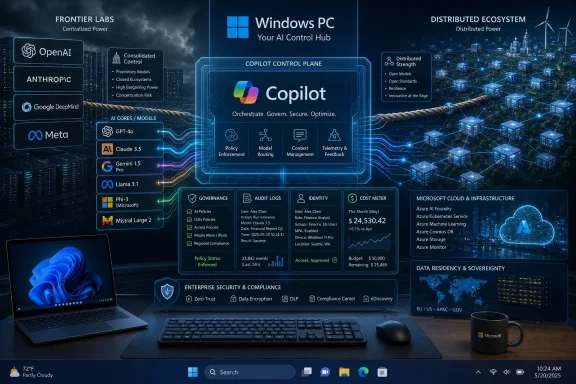
That control plane includes Azure AI Foundry, Microsoft 365 Copilot, GitHub Copilot, Entra identity, Purview compliance, Defender security signals, Windows endpoints, and the growing agent-management layer around enterprise software. If Microsoft can make all of that the default place where AI is selected, monitored, billed, and governed, it can afford a world with many model providers.
This is classic Microsoft strategy updated for the GPU age. The company does not need to manufacture every component if it defines how components are assembled into business systems. In the 1990s, that meant Windows APIs and Office file formats. In the cloud era, it meant Azure services, Active Directory lineage, and enterprise licensing. In the AI era, it may mean model routing and organizational context.
The danger is that a control plane can become its own form of concentration. A world where OpenAI, Anthropic, and Google do not dominate alone, but Microsoft mediates enterprise access to them, is not exactly decentralized. It may be more competitive at the model layer while still deeply centralized at the platform layer.
That is the tension Microsoft will have to navigate. Its customers want choice, but they also want simplicity. They want competition among model providers, but they also want one throat to choke. They want AI embedded in their tools, but they do not want silent lock-in disguised as convenience.
The concrete implications are already visible:
 Nadella Turns the AI Boom Against Its Own Sales Pitch
The sharpest part of Nadella’s argument is not that AI is overhyped. Microsoft has spent too much money, political capital, and product energy on Copilot to make that case with a straight face. His point is more uncomfortable for the AI industry: companies cannot simultaneously tell the public that AI may eliminate large categories of white-collar work, become dangerous in the wrong hands, and still expect society to grant them limitless electricity, land, chips, and regulatory patience.That is a different critique from the usual skeptic’s complaint that chatbots hallucinate or that generative AI is a bubble. Nadella is talking about legitimacy. If a small number of companies become the gatekeepers for workplace knowledge, software development, business research, and eventually personal computing behavior, they will need more than venture funding and cloud contracts to sustain that position.
This is where the politics of AI and the architecture of Windows start to overlap. The modern PC is no longer just a local machine running applications. Microsoft is turning Windows, Microsoft 365, GitHub, Edge, Azure, and security tooling into a fabric where AI agents can read, write, summarize, plan, and act. If those agents depend on a tiny set of frontier labs, then Microsoft risks making its own platform strategically dependent on vendors whose incentives do not always match Microsoft’s customers.
Nadella’s comments should therefore be read less as moral distancing and more as platform doctrine. Microsoft wants AI everywhere, but it does not want any one model company to become the toll collector for every high-value task inside the Microsoft ecosystem.
Microsoft Helped Create the Concentration It Now Wants to Manage
There is an obvious irony in Microsoft warning about concentrated AI power. The company’s OpenAI partnership was one of the decisive moves of the generative AI era. It gave OpenAI cloud capacity, enterprise credibility, and a distribution path into products that hundreds of millions of people already use.For a time, that arrangement looked like a masterstroke. Microsoft got a head start over Google in the AI narrative, made Bing relevant again, turned GitHub Copilot into a developer productivity symbol, and wrapped Microsoft 365 Copilot around the office suite that still defines enterprise work. Nadella could credibly claim that Microsoft had caught a platform shift early instead of watching it from the sidelines.
But platform shifts have a habit of punishing their earliest winners. If OpenAI, Anthropic, and Google end up owning the best reasoning systems, Microsoft becomes the landlord whose tenants have the real pricing power. Every Copilot task becomes a cost center, every agentic workflow becomes a metered dependency, and every customer demand for “the best model” becomes an invoice negotiation.
That explains why Microsoft’s newer posture is not anti-OpenAI. It is anti-dependence. The company can keep working with OpenAI and Anthropic while also making sure that Copilot is not simply a branded wrapper around someone else’s most expensive models.
The result is a delicate balancing act. Microsoft must reassure OpenAI that the partnership remains valuable, reassure regulators that AI is not being captured by a cartel of cloud-backed labs, and reassure CIOs that Copilot will not become a budgetary black hole once workers start delegating multi-step tasks to agents all day.
The New Copilot Strategy Is Choice, Not Awe
The first wave of generative AI products sold users on magic. Type a prompt, get a poem, a spreadsheet formula, a legal memo, a Python script, or a meeting summary. The second wave is less romantic: it is about latency, price per task, data boundaries, model routing, audit logs, and whether the tool can be trusted inside regulated workflows.Microsoft’s Copilot strategy is moving squarely into that second wave. The company has been adding model choice across its AI stack, including access to OpenAI and Anthropic models in certain Copilot programs, Microsoft’s own models for narrower tasks, and potentially lower-cost open models for high-volume agentic work. This matters because not every AI task needs the most expensive model available.
An enterprise assistant that drafts a first-pass meeting agenda, classifies support tickets, checks calendar conflicts, or summarizes a known document corpus does not necessarily need frontier reasoning. It needs predictable performance at a price that does not make finance departments recoil. Conversely, a complex legal analysis, migration plan, or multi-repository coding task may justify a more expensive model if the output quality saves hours of expert time.
That is the operating-system logic Microsoft understands well. Windows historically succeeded not because Microsoft made every application, but because it became the environment in which many applications could coexist. Nadella’s AI platform bet is similar: Copilot should become the place where many models are brokered, governed, and consumed.
The difference is that AI models are not conventional applications. They are probabilistic services with security, privacy, sovereignty, and intellectual-property implications. Model choice sounds liberating until an administrator has to explain which model touched which data, whether that model was hosted in a compliant region, and whether sensitive corporate material was used to improve someone else’s system.
DeepSeek Is the Cost Story Microsoft Cannot Ignore
Microsoft’s reported interest in hosting a version of DeepSeek for Copilot Cowork is the most provocative example of this strategy. DeepSeek became shorthand for the possibility that capable AI models could be built and operated far more cheaply than the U.S. frontier labs implied. For customers staring at fast-growing AI bills, that is not a philosophical point. It is procurement oxygen.The appeal is obvious. Agentic tools are expensive because they do not just answer once. They loop. They search, plan, call tools, read files, revise outputs, and sometimes run through many model invocations before completing a task. A user who assigns hundreds of tasks a week to an enterprise agent can generate a very different cost profile from someone who asks a chatbot for occasional summaries.
That makes lower-cost models essential if Microsoft wants Copilot Cowork and similar tools to become normal enterprise infrastructure rather than executive demos. Usage-based pricing may be rational, but it also exposes the true cost of AI work. Once customers can see the meter running, Microsoft needs credible ways to keep that meter from scaring them away.
DeepSeek also brings political and trust complications. A Chinese-origin model, even self-hosted by Microsoft, will raise questions in Washington and inside risk-averse enterprises. Administrators will want to know where the model runs, what data it sees, what telemetry is retained, and whether the model’s behavior has been independently evaluated.
That is why the phrase “Microsoft-hosted” matters. Microsoft is not merely considering pointing Copilot at an external consumer service. The strategic value would be in taking a cheaper model architecture and wrapping it in Microsoft’s cloud controls, compliance posture, identity stack, and enterprise support. The model might be DeepSeek, or it might be another open or lower-cost option, but the architecture points in the same direction: Microsoft wants to own the trust boundary even when it does not own the model.
OpenAI and Anthropic Become Partners Microsoft Must Discipline
Nadella’s comments landed awkwardly because they seemed aimed at the very companies Microsoft has helped finance or distribute. OpenAI remains central to Microsoft’s AI identity, and Anthropic has become increasingly important in enterprise AI conversations. Google, meanwhile, remains both a model rival and a productivity-suite competitor through Gemini and Workspace.But from Microsoft’s point of view, model labs are suppliers as much as partners. Their business incentives are to sell access to the most capable models at prices that support vast compute investments. Microsoft’s incentive is to make AI adoption broad enough that Copilot becomes indispensable across work, development, security, and Windows experiences.
Those incentives overlap, but they are not identical. A frontier lab wants customers to believe that intelligence is scarce and worth paying a premium for. Microsoft wants customers to believe that intelligence is abundant, manageable, and embedded in the software they already license. That tension is now becoming visible.
The “not a zero-sum game” line from Microsoft is probably true in the narrow sense. Copilot can use OpenAI for some jobs, Anthropic for others, and cheaper models for routine tasks. But in budget terms, there is always a sum. If a company routes millions of low-complexity tasks to a cheaper model, that is revenue not flowing to a premium model provider.
This is the same platform dynamic Microsoft has used for decades. It embraces partners, abstracts them, commoditizes parts of their value, and then sells the management layer. In the AI era, the management layer is model routing, identity, compliance, context, and workflow integration.
Windows Is Becoming the Front Door to a Multi-Model World
For WindowsForum readers, the immediate question is not whether Nadella’s argument is philosophically persuasive. It is what this means for the machines and systems people actually administer. Microsoft’s AI strategy increasingly treats Windows as one endpoint in a larger Copilot network, not as the whole product.That shift is already visible in Copilot’s evolution. The assistant is no longer just a sidebar experiment. It is moving across Windows, Edge, Microsoft 365, GitHub, Teams, and Azure. The strategic prize is not a chatbot window; it is persistent context across files, meetings, code, calendars, browsers, and business systems.
A multi-model strategy gives Microsoft room to tailor AI behavior to different surfaces. A local or efficient model may handle fast, low-risk tasks. A premium cloud model may handle deep reasoning. A specialized model may handle image, speech, security, or code. The user may see one Copilot brand, while administrators see a routing and governance problem underneath.
That abstraction could be good for users if Microsoft gets it right. Nobody wants to manually compare model cards every time they summarize a meeting or refactor a script. But it could also become opaque. If Copilot quietly chooses a model, changes behavior after an update, or shifts a workload to a new provider, enterprises will demand visibility.
The old Windows admin question was, “What changed in this patch?” The new one may become, “Which model handled this task, under what policy, and with what data access?” That is not a niche concern. It is the foundation of trust in AI-assisted work.
The Job-Loss Debate Is Really a Governance Debate
Nadella’s warning about “social permission” cuts through the industry’s preferred ambiguity. AI companies often want to claim transformative productivity gains without taking full responsibility for the labor-market consequences implied by those gains. They sell automation to executives, augmentation to workers, and safety caution to regulators.That triangle cannot hold forever. If AI truly reorganizes white-collar work, then companies deploying it will need to explain how roles change, what skills remain valuable, and how accountability survives when software agents perform parts of the job. If AI does not reorganize work, then the current infrastructure buildout becomes harder to justify.
Microsoft’s preferred answer is the “continuous learning system,” where humans and AI models interact inside workflows rather than one replacing the other wholesale. It is a plausible vision, especially in enterprises where work is messy, permissioned, and full of tacit knowledge. But it is also a convenient one, because it positions Microsoft’s software stack as the environment where that learning system lives.
The more AI becomes part of work, the more the data layer matters. Emails, documents, chats, tickets, repositories, calendars, and customer records are not just inputs. They are institutional memory. If a small number of model companies absorb that memory, companies risk commoditizing their own expertise.
That is why Microsoft’s argument about concentration is not just about consumer choice. It is about who captures the value of enterprise knowledge. Nadella is telling customers that their intellectual property should not become raw material for someone else’s model advantage.
The Stock Market Likes the Story, But IT Has to Live With It
Wall Street’s optimism around Microsoft is not hard to understand. The company sits at the intersection of cloud computing, enterprise software, developer tooling, cybersecurity, gaming, and AI infrastructure. If AI spending continues, Microsoft benefits from Azure. If AI applications spread, Microsoft benefits from Copilot. If model diversity increases, Microsoft benefits from being the broker.That is the bull case in clean form. Microsoft does not need to own every frontier model if it owns the customer relationship, the enterprise identity layer, the productivity suite, and the cloud fabric. A multi-model Copilot could turn AI model competition into a feature rather than a threat.
The risk is that customers become more skeptical as costs and complexity rise. The first year of enterprise AI was full of pilots and executive enthusiasm. The next phase will be governed by renewals, utilization reports, security reviews, legal concerns, and user satisfaction data. CIOs will ask not whether Copilot is impressive, but whether it produces measurable value without creating unacceptable risk.
There is also a reputational risk. If Microsoft presents itself as the responsible counterweight to AI concentration while aggressively embedding Copilot into every corner of its ecosystem, critics will see contradiction. Microsoft’s answer will be that concentration at the model layer is different from integration at the platform layer. Whether regulators and customers accept that distinction remains to be seen.
For sysadmins, this means AI procurement will look less like buying a feature and more like managing a supply chain. Model providers, hosting locations, data retention policies, prompt logging, access controls, and billing mechanics will all become part of normal IT governance. The Copilot brand may simplify the user experience, but it will not simplify the accountability burden.
Microsoft’s Cheapest AI May Become Its Most Strategic AI
The industry still talks as if the smartest model will inevitably win. Microsoft appears to be betting that the most deployable model may matter more. In enterprise computing, “good enough, governed, and affordable” has often beaten “best in class, expensive, and isolated.”That does not mean frontier models are irrelevant. Some tasks genuinely benefit from more capable reasoning, longer context windows, better tool use, and stronger coding performance. Microsoft will keep selling access to those models because customers will keep needing them.
But the volume of AI work may shift toward cheaper models over time. Once agents are asked to perform routine research, formatting, triage, summarization, and workflow coordination, the winning economics look less like premium consulting and more like cloud infrastructure. Margins still matter, but so does utilization.
This is where Microsoft’s reported DeepSeek exploration becomes symbolic. It signals to the market that Microsoft is willing to use price competition at the model layer to protect adoption at the platform layer. That is uncomfortable for OpenAI and Anthropic, but it is rational for Microsoft.
It also gives enterprises leverage. If Copilot can route tasks across models, customers can demand policy controls, cost ceilings, model exclusions, and auditability. A single-model world asks customers to trust the vendor’s chosen brain. A multi-model world asks Microsoft to prove that its orchestration is trustworthy.
The Real Copilot Battle Is Over the Control Plane
Nadella’s comments should not be mistaken for an altruistic call to decentralize AI. Microsoft is not trying to make AI power disappear. It is trying to move power from the model layer to the control plane.That control plane includes Azure AI Foundry, Microsoft 365 Copilot, GitHub Copilot, Entra identity, Purview compliance, Defender security signals, Windows endpoints, and the growing agent-management layer around enterprise software. If Microsoft can make all of that the default place where AI is selected, monitored, billed, and governed, it can afford a world with many model providers.
This is classic Microsoft strategy updated for the GPU age. The company does not need to manufacture every component if it defines how components are assembled into business systems. In the 1990s, that meant Windows APIs and Office file formats. In the cloud era, it meant Azure services, Active Directory lineage, and enterprise licensing. In the AI era, it may mean model routing and organizational context.
The danger is that a control plane can become its own form of concentration. A world where OpenAI, Anthropic, and Google do not dominate alone, but Microsoft mediates enterprise access to them, is not exactly decentralized. It may be more competitive at the model layer while still deeply centralized at the platform layer.
That is the tension Microsoft will have to navigate. Its customers want choice, but they also want simplicity. They want competition among model providers, but they also want one throat to choke. They want AI embedded in their tools, but they do not want silent lock-in disguised as convenience.
The Copilot Era Now Has a Price Tag and a Politics
Nadella’s warning gives Microsoft a cleaner story for the next phase of AI: model diversity, lower costs, enterprise control, and a claim that the company is helping society avoid an AI monoculture. The story is persuasive because it maps to real customer anxieties. It is also self-serving because Microsoft is best positioned to sell the layer that manages those anxieties.The concrete implications are already visible:
- Microsoft is positioning Copilot as a broker of multiple AI models rather than a single-model assistant tied exclusively to one frontier lab.
- Lower-cost models are becoming strategically important because agentic workflows can generate far more model calls than ordinary chatbot use.
- A Microsoft-hosted DeepSeek option would test whether enterprises will accept cheaper open or foreign-origin models when wrapped in Microsoft’s cloud controls.
- OpenAI and Anthropic remain critical Microsoft partners, but their pricing power is now something Microsoft has a reason to contain.
- Windows and Microsoft 365 administrators should expect model governance, auditability, and AI cost management to become routine parts of endpoint and productivity-suite administration.
- Nadella’s “social permission” argument is a signal that Microsoft wants to frame AI deployment as managed workplace transformation, not unchecked automation.
References
- Primary source: CoinCentral
Published: 2026-06-22T09:29:30.416576
- Related coverage: axios.com
Microsoft explores DeepSeek for Copilot Cowork
Microsoft will also shift to usage-based pricing for the enterprise agent.www.axios.com
- Related coverage: techradar.com
'The last thing any of us want': Microsoft CEO Satya Nadella warns AI dominance could 'hollow out entire industries' | TechRadar
Satya Nadella says current AI transition is like early years of globalizationwww.techradar.com - Official source: blogs.microsoft.com
Microsoft, NVIDIA and Anthropic announce strategic partnerships - The Official Microsoft Blog
Anthropic to scale Claude on Azure Anthropic to adopt NVIDIA architecture NVIDIA and Microsoft to invest in Anthropic Today Microsoft, NVIDIA and Anthropic announced new strategic partnerships. Anthropic is scaling its rapidly-growing Claude AI model on Microsoft Azure, powered by NVIDIA, which...blogs.microsoft.com - Related coverage: computerworld.com
Microsoft launches Copilot Cowork with usage-based pricing – Computerworld
Copilot Cowork customers can choose from Anthropic and OpenAI models to run the AI agent, while Microsoft reportedly plans to offer an open source model from DeepSeek to lower costs. www.computerworld.com
- Related coverage: windowscentral.com
Microsoft says its MAI-Image-2-Efficient AI model slashes costs by 41% while boosting speed by 22% (and maintaining quality) | Windows Central
Microsoft’s latest AI model makes photorealistic image generation faster, cheaper, and more efficient than ever before.www.windowscentral.com
- Related coverage: theinformation.com
Microsoft Mulls Using DeepSeek for Copilot Cowork — The Information
Microsoft is considering adding Chinese AI developer DeepSeek’s V4 as a cheaper model option for powering the Copilot Cowork AI assistant, Axios reported. The U.S. tech giant is exploring a Microsoft-hosted version of DeepSeek V4, or another open-source model, as a cheaper alternative to...www.theinformation.com - Related coverage: ca.finance.yahoo.com
Microsoft Weighs DeepSeek Models for Lower-Cost Copilot
The move could help Microsoft control AI costs as Copilot usage rises.ca.finance.yahoo.com - Related coverage: tomshardware.com
Microsoft is reportedly testing Copilot+ AI features with discrete GPUs instead of NPUs — a feature available on Windows App SDK with a Windows Insider Experimental Channel build and Developer Mode turned on | Tom's Hardware
Is this the beginning of the end for Copilot+ PCs?www.tomshardware.com - Related coverage: en.softonic.com
- Official source: azure.microsoft.com
- Related coverage: thenextweb.com
Microsoft DeepSeek: a Chinese model for Copilot Cowork?
Microsoft is weighing a self-hosted DeepSeek model to cut Copilot Cowork's costs, a Chinese-AI move likely to draw Trump-administration scrutiny.thenextweb.com - Related coverage: elpais.com
Microsoft y Nvidia calientan aún más la burbuja de la IA: invertirán 15.000 millones en Anthropic, rival de OpenAI | Economía | EL PAÍS
La compañía acelera su financiación con los principales socios de su gran competidorelpais.com - Official source: microsoft.com
- Related coverage: arturmarkus.com
Microsoft 365 Copilot Rolls Out 27 New Features in January 2026, Adds GPT-5.2 Model Selector with 3 Reasoning Modes
PDF documentwww.arturmarkus.com
