

Many people are now spending enough time with phones, watches, laptops, tablets, and game screens that physicians and researchers are treating the body itself as part of the technology story, with concerns ranging from neck strain and skin irritation to eyesight, grip strength, and childhood motor development. The warning, reported by UNB and published by The Daily Ittefaq on July 7, 2026, is not that screens are uniquely poisonous. It is that the modern digital routine quietly replaces movement, daylight, varied hand use, and neutral posture with hours of repetition. The result is a slower, more physical version of the screen-time debate than the one usually fought over attention spans and social media.
For years, the public argument over phones has centered on the mind. Parents worry about attention, sleep, anxiety, social comparison, and the dopamine economy of apps built to keep us scrolling. Employers worry about distraction and burnout. Schools worry about whether tablets help learning or merely digitize bad habits.
That debate matters, but it has also made the body look like an afterthought. The emerging picture is less dramatic than “phones are deforming us” and more useful: devices reward a narrow set of postures and gestures, and the body adapts to whatever it repeats. In that sense, the smartphone is not just a communications device. It is a posture machine, a hand-use machine, an indoor-time machine, and for many people a sitting-still machine.
The most important word here is gradual. A callus on a finger that props up a phone is visible and harmless enough to become a meme. Neck pain, dry eyes, weaker hands, irritated skin under a smartwatch, or reduced fine motor practice in children are easier to ignore because they arrive as background noise. By the time a habit becomes painful, it has often been running for years.
That makes this a particularly WindowsForum kind of problem. PC users, sysadmins, developers, gamers, students, and remote workers are not merely “using screens” in the abstract. They are building daily workflows around multi-monitor desks, laptops on couches, phones used as second brains, watches worn as health dashboards, and tablets handed to children as entertainment, school tools, and babysitters. The operating system may be Windows, iOS, Android, or watchOS; the biological interface is still the same neck, eyes, hands, skin, and spine.
Doctors and physiotherapists have been warning about this for years, and recent reporting has brought the issue back into focus because the behavior is now nearly universal. The Ittefaq report notes that experts associate prolonged downward phone use with pressure on the neck, muscle strain, spinal disc stress, joint wear, and even possible reductions in lung capacity. The claim is not that one evening of scrolling causes spinal damage. It is that thousands of hours of the same posture can turn a convenience into a chronic load.
This is where consumer tech’s ergonomics story gets uncomfortable. The phone is designed to be looked down at. The laptop is designed as a compromise between portability and posture, with the keyboard and screen joined in a way that practically forces either the hands or the eyes into a suboptimal position. The smartwatch encourages constant glances. The tablet, used in bed or on a sofa, invites the body into positions no office ergonomist would endorse.
The usual advice is sensible: raise the phone, lift the laptop screen, use an external keyboard and mouse, place monitors at eye level, and take short breaks. But the fact that the advice is so simple should not make the problem seem trivial. A worker who has a laptop, a kitchen chair, and six hours of video calls is not failing to “be mindful.” They are using hardware whose form factor was optimized for mobility, not physiology.
The old desktop PC, for all its cable clutter, had one underrated virtue: it made good posture easier. A monitor could sit at the right height, a keyboard could sit at the right distance, and a mouse could be moved around a desk. The mobile era took that stable setup and shattered it into dozens of micro-sessions: phone on train, laptop on lap, tablet in bed, smartwatch on wrist, second screen on the side. Convenience won. The neck got the bill.
That distinction matters because the beauty industry is very good at turning a plausible mechanism into a product category. Once a phrase like “tech neck” enters consumer language, creams, serums, masks, and anti-device treatments are never far behind. The science may be cautious, but the marketing rarely is.
This is a recurring pattern in consumer technology health stories. A real phenomenon appears. A simplified label catches on. The marketplace produces solutions faster than researchers can determine what is actually happening. Users then face a weird mix of reasonable advice and opportunistic selling, with the burden shifted back onto them to separate the two.
A better reading is that posture should be addressed first as function, not cosmetics. If a phone habit is creating pain, stiffness, headaches, or limited movement, the priority is ergonomic change and movement, not an expensive tube of cream. If skin appearance is the concern, consumers should be skeptical of products that imply a device-specific diagnosis without device-specific evidence.
Dermatologists quoted in the Ittefaq report point to a simple problem: the skin under a watch can become warm, damp, and poorly ventilated. That environment can encourage irritation, eczema, and yeast overgrowth. Continuous contact may also make some users more sensitive to materials such as nickel, rubber, latex, or acrylates.
This does not mean smartwatches are bad health devices. For many people, they encourage walking, prompt medical conversations, and provide useful data. But the wearable industry’s ideal usage pattern — never take it off, track everything, close every ring, monitor every night of sleep — collides with the skin’s need for breaks.
The fix is low-tech: remove the watch regularly, clean the band and skin, dry the area, avoid overly tight straps, and pay attention to irritation before it becomes persistent. Users who would never wear wet socks for two days may still wear a damp watch band through workouts, showers, sleep, and another workday. The device feels clean because it is digital. The skin experiences it as contact, pressure, moisture, and material chemistry.
There is a broader lesson here for the “quantified self” era. A device can measure health while also creating small health problems of its own. That does not make the device fraudulent. It makes the user’s body part of the system design.
Donald Mutti, an optometry professor at Ohio State University, has argued that decades of research do not strongly support the idea that close-up work alone — reading, phone use, or other near tasks — directly causes myopia. The stronger protective factor appears to be time outdoors. Bright outdoor light is believed to trigger dopamine release in the retina, which helps regulate healthy eye development.
That makes screens an indirect culprit rather than a simple villain. If a child spends an afternoon inside on a tablet instead of outside in daylight, the important biological loss may not be pixels. It may be sunlight, distance viewing, movement, and the visual variety of the outdoor world. A printed book read indoors for hours is not a screen, but it may share some of the same trade-offs if it displaces outdoor time.
This distinction should change how families, schools, and policymakers talk about eye health. “Less screen time” is a blunt instruction. “More outdoor time” is a more actionable and evidence-aligned intervention, especially for developing eyes. The goal is not to win a moral argument against tablets; it is to preserve the conditions in which children’s eyes evolved to develop.
Adults should not ignore the eye story either. Screen use is associated with digital eye strain, partly because people blink less when staring at displays. Dryness, irritation, headaches, and blurred vision are familiar to anyone who has spent a long day in front of a monitor and then “relaxed” by looking at a smaller screen. The eye does not care that one screen was work and the other was leisure.
For Windows users, the practical answer is not exotic. Use larger text, reduce glare, position monitors well, take visual breaks, and get outdoors. The old 20-20-20 rule — looking about 20 feet away for 20 seconds every 20 minutes — remains memorable because it attacks the real problem: unbroken near focus. But no reminder app can fully replace the habit of leaving the room.
The point is not that smartphones alone make hands weak. It is that modern digital life narrows the hand’s daily repertoire. We tap, swipe, pinch, scroll, type, and click. Those movements can be fast and precise, but they are not the same as carrying, pulling, climbing, kneading, cutting, writing at length, using tools, playing instruments, gardening, or lifting awkward objects.
A keyboard-heavy life can create its own hand and wrist problems, but at least typing uses a broader rhythm than the thumb-centric phone interface. The smartphone compresses much of the digital world into a few gestures performed on glass. Swiping is not a substitute for strength. Haptic feedback is not resistance training.
This is where the cultural meaning of “fitness” can mislead us. A person may have a gym membership, a step counter, and a standing desk while still living a day in which the hands barely do anything demanding. Grip strength is not built by wanting stronger hands. It is built by repeatedly asking the body to apply force in varied ways.
Specialized hand exercises can help, especially for rehabilitation or specific performance goals, but experts generally recommend broader strength and movement habits. Lift things. Carry things. Cook. Use tools. Play. The body’s maintenance plan is not hidden in a premium app. It is distributed across ordinary physical tasks that screens have quietly displaced.
Fine motor skills are built through messy, varied, physical work: drawing, handwriting, cutting, stacking, tying, cooking, building, threading, molding, sorting, and manipulating real objects. These tasks are slow, imperfect, and tactile. They give the fingers resistance, texture, weight, friction, and consequence.
A touchscreen offers precision without much physical richness. A child can move icons, trace shapes, and complete puzzles, but glass gives the same surface back every time. The hand learns the screen’s grammar well. It may not learn as much about paper, wood, dough, string, metal, clay, or a pencil fighting back against the page.
Research linking increased screen time with poorer motor development should be handled carefully. Family income, school environment, parental time, sleep, physical activity, and other factors can all shape outcomes. But the displacement argument is hard to dismiss: time spent with one kind of activity is time not spent with another.
The stakes go beyond handwriting nostalgia. Motor development is entangled with cognitive and academic development. Children learn through bodies as well as symbols. A school system that replaces too many tactile tasks with screens risks mistaking digital fluency for developmental completeness.
This is not an argument for banning devices from childhood. It is an argument against letting the easiest interface crowd out harder, richer ones. A child who cooks, draws, writes, builds, plays outside, uses scissors, learns an instrument, and also uses a tablet is living in a balanced sensorimotor world. A child who mostly taps glass is practicing a narrower future.
That matters because modern software is built to erase stopping points. Infinite scroll removed the bottom of the page. Autoplay removed the decision to continue. Notifications pull the user back after a break. Remote work tools turn the home into an always-available office. Games, feeds, streaming platforms, messaging apps, and dashboards all compete to make the next minute feel frictionless.
Health advice often treats the user as if they are freely choosing every session length. In reality, the most successful digital products are designed to make sessions longer, more frequent, and more automatic. The body becomes collateral damage in an attention economy that measures engagement but not neck angle, blink rate, grip strength, or daylight exposure.
Operating systems have started to acknowledge this problem with screen-time dashboards, focus modes, bedtime reminders, and wellness prompts. But most of these tools still frame the issue as time management or mental distraction. They rarely ask whether the user has moved, gone outside, changed posture, used their hands differently, or taken pressure off the eyes.
There is an opportunity here for platform designers. A genuinely health-aware device would not merely report that you spent six hours in apps. It would understand posture risk, encourage outdoor breaks, integrate ergonomic reminders, and treat long static sessions as a physical load. That sounds intrusive until you remember that watches already nag users to stand and breathe. The question is whether the prompts are smart enough to match the actual risks.
The shift to hybrid work made this more urgent. A corporate office may have adjustable chairs and monitor arms, but the home office may be a dining table, a couch, or a bed. A worker can be “fully equipped” from an IT asset perspective while being physically set up for chronic strain. A laptop, charger, VPN, and Teams license do not make a workstation.
The same is true in schools. A district can celebrate device access while ignoring furniture, outdoor time, handwriting, art, play, and physical education. One-to-one computing programs solve a digital divide problem, but they can create new imbalance if every lesson migrates to a screen. The best technology policy is not anti-screen. It is pro-body.
Employers should also be cautious about wellness theater. A monthly email about posture will not undo a hardware policy that leaves employees hunched over 13-inch laptops all day. A standing desk benefit will not help if workloads punish breaks. A smartwatch health challenge will not offset a culture of back-to-back video calls.
The practical standard should be simple: if a job requires hours of screen work, the organization should provide the physical conditions to do that work without predictable harm. That means proper displays, input devices, chairs, break norms, meeting discipline, and support for remote setups. Ergonomics is not a perk. It is part of the compute stack.
The boringness is a feature. Most of the risks described in the Ittefaq report come from repeated small exposures, so the countermeasures are repeated small corrections. A single ergonomic purchase may help, but the deeper fix is rhythm: movement interrupting stillness, daylight interrupting indoor focus, varied hand use interrupting glass gestures.
This also means users should be wary of cure-all gadgets. Blue-light accessories, posture braces, premium neck creams, productivity timers, ergonomic keyboards, and health-tracking wearables may all have a place for some people. None of them substitutes for movement, outdoor time, sleep, strength, and sensible workstation design.
Technology people like technical fixes because they feel precise. The body often needs something less precise and more consistent. It needs not to be held in the same position for too long. It needs load, rest, light, and variation.
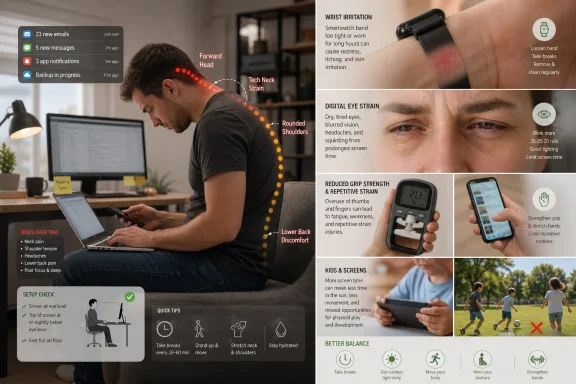 The Screen-Time Debate Has Been Looking in the Wrong Direction
For years, the public argument over phones has centered on the mind. Parents worry about attention, sleep, anxiety, social comparison, and the dopamine economy of apps built to keep us scrolling. Employers worry about distraction and burnout. Schools worry about whether tablets help learning or merely digitize bad habits.That debate matters, but it has also made the body look like an afterthought. The emerging picture is less dramatic than “phones are deforming us” and more useful: devices reward a narrow set of postures and gestures, and the body adapts to whatever it repeats. In that sense, the smartphone is not just a communications device. It is a posture machine, a hand-use machine, an indoor-time machine, and for many people a sitting-still machine.
The most important word here is gradual. A callus on a finger that props up a phone is visible and harmless enough to become a meme. Neck pain, dry eyes, weaker hands, irritated skin under a smartwatch, or reduced fine motor practice in children are easier to ignore because they arrive as background noise. By the time a habit becomes painful, it has often been running for years.
That makes this a particularly WindowsForum kind of problem. PC users, sysadmins, developers, gamers, students, and remote workers are not merely “using screens” in the abstract. They are building daily workflows around multi-monitor desks, laptops on couches, phones used as second brains, watches worn as health dashboards, and tablets handed to children as entertainment, school tools, and babysitters. The operating system may be Windows, iOS, Android, or watchOS; the biological interface is still the same neck, eyes, hands, skin, and spine.
“Tech Neck” Is a Design Problem Disguised as a Personal Failing
The phrase “tech neck” sounds like a lifestyle-magazine coinage, but the mechanics behind it are not frivolous. Looking down at a phone for long periods encourages a forward-head posture: the head moves in front of the shoulders, the upper back rounds, and the neck muscles work harder to hold the skull in place. The more static the position, the less forgiving the body becomes.Doctors and physiotherapists have been warning about this for years, and recent reporting has brought the issue back into focus because the behavior is now nearly universal. The Ittefaq report notes that experts associate prolonged downward phone use with pressure on the neck, muscle strain, spinal disc stress, joint wear, and even possible reductions in lung capacity. The claim is not that one evening of scrolling causes spinal damage. It is that thousands of hours of the same posture can turn a convenience into a chronic load.
This is where consumer tech’s ergonomics story gets uncomfortable. The phone is designed to be looked down at. The laptop is designed as a compromise between portability and posture, with the keyboard and screen joined in a way that practically forces either the hands or the eyes into a suboptimal position. The smartwatch encourages constant glances. The tablet, used in bed or on a sofa, invites the body into positions no office ergonomist would endorse.
The usual advice is sensible: raise the phone, lift the laptop screen, use an external keyboard and mouse, place monitors at eye level, and take short breaks. But the fact that the advice is so simple should not make the problem seem trivial. A worker who has a laptop, a kitchen chair, and six hours of video calls is not failing to “be mindful.” They are using hardware whose form factor was optimized for mobility, not physiology.
The old desktop PC, for all its cable clutter, had one underrated virtue: it made good posture easier. A monitor could sit at the right height, a keyboard could sit at the right distance, and a mouse could be moved around a desk. The mobile era took that stable setup and shattered it into dozens of micro-sessions: phone on train, laptop on lap, tablet in bed, smartwatch on wrist, second screen on the side. Convenience won. The neck got the bill.
The Wrinkle Panic Shows How Quickly Health Turns Into Marketing
The most visible “tech neck” worry is not pain but appearance. If bending the neck repeatedly folds the skin, could that contribute to wrinkles? Dermatologist Justine Hextall told reporters that the theory is plausible in the general sense that repeated folding can contribute to lines. But she also emphasized that there is not strong evidence proving phone use directly causes neck wrinkles.That distinction matters because the beauty industry is very good at turning a plausible mechanism into a product category. Once a phrase like “tech neck” enters consumer language, creams, serums, masks, and anti-device treatments are never far behind. The science may be cautious, but the marketing rarely is.
This is a recurring pattern in consumer technology health stories. A real phenomenon appears. A simplified label catches on. The marketplace produces solutions faster than researchers can determine what is actually happening. Users then face a weird mix of reasonable advice and opportunistic selling, with the burden shifted back onto them to separate the two.
A better reading is that posture should be addressed first as function, not cosmetics. If a phone habit is creating pain, stiffness, headaches, or limited movement, the priority is ergonomic change and movement, not an expensive tube of cream. If skin appearance is the concern, consumers should be skeptical of products that imply a device-specific diagnosis without device-specific evidence.
The Smartwatch Made the Wrist Into a Damp Little Data Center
Phones and laptops dominate the screen-time conversation, but wearables introduce their own physical trade-offs. Smartwatches are sold as wellness devices: step counters, heart-rate trackers, sleep monitors, fall detectors, ECG-capable companions, and notification screens. They are also objects strapped tightly to skin for most of the day and, increasingly, all night.Dermatologists quoted in the Ittefaq report point to a simple problem: the skin under a watch can become warm, damp, and poorly ventilated. That environment can encourage irritation, eczema, and yeast overgrowth. Continuous contact may also make some users more sensitive to materials such as nickel, rubber, latex, or acrylates.
This does not mean smartwatches are bad health devices. For many people, they encourage walking, prompt medical conversations, and provide useful data. But the wearable industry’s ideal usage pattern — never take it off, track everything, close every ring, monitor every night of sleep — collides with the skin’s need for breaks.
The fix is low-tech: remove the watch regularly, clean the band and skin, dry the area, avoid overly tight straps, and pay attention to irritation before it becomes persistent. Users who would never wear wet socks for two days may still wear a damp watch band through workouts, showers, sleep, and another workday. The device feels clean because it is digital. The skin experiences it as contact, pressure, moisture, and material chemistry.
There is a broader lesson here for the “quantified self” era. A device can measure health while also creating small health problems of its own. That does not make the device fraudulent. It makes the user’s body part of the system design.
Myopia Is Not Just a Screen Story, and That Is the Point
The rise in myopia, or nearsightedness, is often blamed on screens. It is an intuitive claim: children stare at tablets and phones more than previous generations, and more children are nearsighted. But intuition is not causation, and the eye research is more complicated.Donald Mutti, an optometry professor at Ohio State University, has argued that decades of research do not strongly support the idea that close-up work alone — reading, phone use, or other near tasks — directly causes myopia. The stronger protective factor appears to be time outdoors. Bright outdoor light is believed to trigger dopamine release in the retina, which helps regulate healthy eye development.
That makes screens an indirect culprit rather than a simple villain. If a child spends an afternoon inside on a tablet instead of outside in daylight, the important biological loss may not be pixels. It may be sunlight, distance viewing, movement, and the visual variety of the outdoor world. A printed book read indoors for hours is not a screen, but it may share some of the same trade-offs if it displaces outdoor time.
This distinction should change how families, schools, and policymakers talk about eye health. “Less screen time” is a blunt instruction. “More outdoor time” is a more actionable and evidence-aligned intervention, especially for developing eyes. The goal is not to win a moral argument against tablets; it is to preserve the conditions in which children’s eyes evolved to develop.
Adults should not ignore the eye story either. Screen use is associated with digital eye strain, partly because people blink less when staring at displays. Dryness, irritation, headaches, and blurred vision are familiar to anyone who has spent a long day in front of a monitor and then “relaxed” by looking at a smaller screen. The eye does not care that one screen was work and the other was leisure.
For Windows users, the practical answer is not exotic. Use larger text, reduce glare, position monitors well, take visual breaks, and get outdoors. The old 20-20-20 rule — looking about 20 feet away for 20 seconds every 20 minutes — remains memorable because it attacks the real problem: unbroken near focus. But no reminder app can fully replace the habit of leaving the room.
The Hands Are Losing the Variety War
Grip strength has become an unexpectedly important health metric. Researchers increasingly treat it as a rough indicator of overall physical function, and some studies associate weaker grip strength with poorer health outcomes. Johannes Beller, a professor of medical sociology in Germany, has suggested that desk-based and computer-focused lifestyles may be contributing to declining physical fitness, especially among younger people.The point is not that smartphones alone make hands weak. It is that modern digital life narrows the hand’s daily repertoire. We tap, swipe, pinch, scroll, type, and click. Those movements can be fast and precise, but they are not the same as carrying, pulling, climbing, kneading, cutting, writing at length, using tools, playing instruments, gardening, or lifting awkward objects.
A keyboard-heavy life can create its own hand and wrist problems, but at least typing uses a broader rhythm than the thumb-centric phone interface. The smartphone compresses much of the digital world into a few gestures performed on glass. Swiping is not a substitute for strength. Haptic feedback is not resistance training.
This is where the cultural meaning of “fitness” can mislead us. A person may have a gym membership, a step counter, and a standing desk while still living a day in which the hands barely do anything demanding. Grip strength is not built by wanting stronger hands. It is built by repeatedly asking the body to apply force in varied ways.
Specialized hand exercises can help, especially for rehabilitation or specific performance goals, but experts generally recommend broader strength and movement habits. Lift things. Carry things. Cook. Use tools. Play. The body’s maintenance plan is not hidden in a premium app. It is distributed across ordinary physical tasks that screens have quietly displaced.
Children Are Practicing the Wrong Kind of Precision
The motor-skills question is especially sensitive because digital devices are now woven into childhood. Sebastian Suggate, a developmental psychology professor at the University of Regensburg, has argued that screens may improve narrow digital skills such as tapping and swiping while having a negative effect on broader fine motor development. The concern is not that children learn nothing from screens. It is that they may practice too little of everything else.Fine motor skills are built through messy, varied, physical work: drawing, handwriting, cutting, stacking, tying, cooking, building, threading, molding, sorting, and manipulating real objects. These tasks are slow, imperfect, and tactile. They give the fingers resistance, texture, weight, friction, and consequence.
A touchscreen offers precision without much physical richness. A child can move icons, trace shapes, and complete puzzles, but glass gives the same surface back every time. The hand learns the screen’s grammar well. It may not learn as much about paper, wood, dough, string, metal, clay, or a pencil fighting back against the page.
Research linking increased screen time with poorer motor development should be handled carefully. Family income, school environment, parental time, sleep, physical activity, and other factors can all shape outcomes. But the displacement argument is hard to dismiss: time spent with one kind of activity is time not spent with another.
The stakes go beyond handwriting nostalgia. Motor development is entangled with cognitive and academic development. Children learn through bodies as well as symbols. A school system that replaces too many tactile tasks with screens risks mistaking digital fluency for developmental completeness.
This is not an argument for banning devices from childhood. It is an argument against letting the easiest interface crowd out harder, richer ones. A child who cooks, draws, writes, builds, plays outside, uses scissors, learns an instrument, and also uses a tablet is living in a balanced sensorimotor world. A child who mostly taps glass is practicing a narrower future.
The Real Risk Is Not the Screen, but the Unbroken Session
The most practical theme running through the evidence is continuity. The body is forgiving when positions and tasks change. It is less forgiving when a person sits still, looks down, focuses near, and repeats tiny gestures for hours without interruption.That matters because modern software is built to erase stopping points. Infinite scroll removed the bottom of the page. Autoplay removed the decision to continue. Notifications pull the user back after a break. Remote work tools turn the home into an always-available office. Games, feeds, streaming platforms, messaging apps, and dashboards all compete to make the next minute feel frictionless.
Health advice often treats the user as if they are freely choosing every session length. In reality, the most successful digital products are designed to make sessions longer, more frequent, and more automatic. The body becomes collateral damage in an attention economy that measures engagement but not neck angle, blink rate, grip strength, or daylight exposure.
Operating systems have started to acknowledge this problem with screen-time dashboards, focus modes, bedtime reminders, and wellness prompts. But most of these tools still frame the issue as time management or mental distraction. They rarely ask whether the user has moved, gone outside, changed posture, used their hands differently, or taken pressure off the eyes.
There is an opportunity here for platform designers. A genuinely health-aware device would not merely report that you spent six hours in apps. It would understand posture risk, encourage outdoor breaks, integrate ergonomic reminders, and treat long static sessions as a physical load. That sounds intrusive until you remember that watches already nag users to stand and breathe. The question is whether the prompts are smart enough to match the actual risks.
Enterprise IT Should Treat Ergonomics as Infrastructure
In the workplace, screen-related physical strain is often handled as an HR or facilities issue. That division is outdated. IT departments decide which laptops employees receive, whether external monitors are standard or optional, how hot-desking is configured, whether remote workers get equipment stipends, and how many systems demand constant notification attention. Those are ergonomic decisions, even when they are made in procurement language.The shift to hybrid work made this more urgent. A corporate office may have adjustable chairs and monitor arms, but the home office may be a dining table, a couch, or a bed. A worker can be “fully equipped” from an IT asset perspective while being physically set up for chronic strain. A laptop, charger, VPN, and Teams license do not make a workstation.
The same is true in schools. A district can celebrate device access while ignoring furniture, outdoor time, handwriting, art, play, and physical education. One-to-one computing programs solve a digital divide problem, but they can create new imbalance if every lesson migrates to a screen. The best technology policy is not anti-screen. It is pro-body.
Employers should also be cautious about wellness theater. A monthly email about posture will not undo a hardware policy that leaves employees hunched over 13-inch laptops all day. A standing desk benefit will not help if workloads punish breaks. A smartwatch health challenge will not offset a culture of back-to-back video calls.
The practical standard should be simple: if a job requires hours of screen work, the organization should provide the physical conditions to do that work without predictable harm. That means proper displays, input devices, chairs, break norms, meeting discipline, and support for remote setups. Ergonomics is not a perk. It is part of the compute stack.
The Consumer Fix Is Boring, Which Is Why It Works
The most reliable interventions are not glamorous. Hold the phone higher. Put the monitor at eye level. Use an external keyboard and mouse with a laptop. Take breaks before pain starts. Go outside. Exercise. Strength train. Remove and clean the smartwatch. Give children real-world hand tasks. Stop treating uninterrupted screen time as normal just because it is common.The boringness is a feature. Most of the risks described in the Ittefaq report come from repeated small exposures, so the countermeasures are repeated small corrections. A single ergonomic purchase may help, but the deeper fix is rhythm: movement interrupting stillness, daylight interrupting indoor focus, varied hand use interrupting glass gestures.
This also means users should be wary of cure-all gadgets. Blue-light accessories, posture braces, premium neck creams, productivity timers, ergonomic keyboards, and health-tracking wearables may all have a place for some people. None of them substitutes for movement, outdoor time, sleep, strength, and sensible workstation design.
Technology people like technical fixes because they feel precise. The body often needs something less precise and more consistent. It needs not to be held in the same position for too long. It needs load, rest, light, and variation.
The Body Is Sending the Error Messages First
The practical lesson from this new wave of screen-time reporting is not panic. It is early detection. The body usually reports a problem before it becomes a diagnosis, but digital routines train users to override those signals in favor of the next message, next meeting, next video, or next level.- A stiff neck after scrolling is not proof of permanent damage, but it is a warning that posture and session length need to change.
- A child’s tablet use should be balanced with outdoor light and hands-on activities, not merely capped by a timer.
- A smartwatch that improves health tracking can still irritate skin if it is worn continuously without cleaning, drying, and breaks.
- Myopia prevention should focus heavily on outdoor time, because the evidence for daylight as a protective factor is stronger than the simple claim that screens alone cause nearsightedness.
- Grip strength and fine motor skills depend on varied physical activity, not just digital precision on keyboards and touchscreens.
- Workplaces and schools should treat screens as physical environments, not just information tools.
References
- Primary source: The Daily Ittefaq
Published: 2026-07-07T07:52:08.414329
Loading…
en.ittefaq.com.bd - Related coverage: medicaldaily.com
Loading…
www.medicaldaily.com - Related coverage: theguardian.com
Loading…
www.theguardian.com - Related coverage: unb.com.bd
Loading…
unb.com.bd - Related coverage: webmd.com
Loading…
www.webmd.com - Related coverage: health.harvard.edu
Loading…
www.health.harvard.edu