

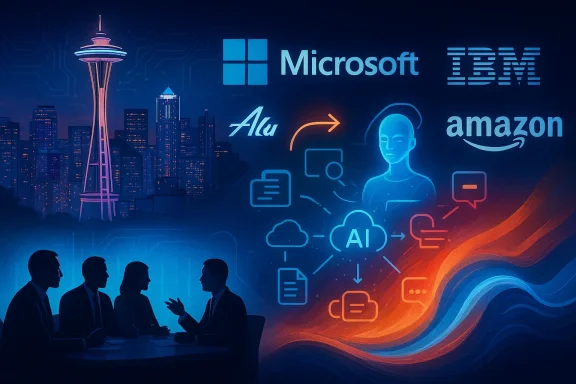
Microsoft’s latest round of executive moves underscores how aggressively the Seattle tech ecosystem is reshuffling around AI, talent, and the ongoing contest for enterprise relevance. The most eye-catching shift is Lindsay-Rae McIntyre’s move from Microsoft to Alaska Airlines, where she will become chief people officer just as the carrier integrates with Hawaiian Airlines and navigates a more complex post-merger culture. At the same time, HashiCorp co-founder and CTO Armon Dadgar is stepping away after the IBM acquisition, while a wave of Amazon veterans is carrying cloud and AI experience into companies from SAP to Artera and PixVerse.
The headline here is not merely that a few executives changed jobs. It is that the moves map neatly onto the biggest structural forces in tech right now: consolidation, AI platformization, and the rising premium on leaders who can translate technical change into organizational change. McIntyre’s jump to Alaska Airlines, for example, shows how a legacy industry is borrowing leadership talent from big tech to manage culture, transformation, and workforce strategy.
That is a meaningful signal because airlines, healthcare, ERP vendors, and infrastructure-software companies are all wrestling with the same problem in different forms: how to modernize without breaking trust. In that sense, these departures and arrivals are less about individual careers than about where institutional expertise is flowing in 2026. The people who know how to scale systems, guide teams through change, and operationalize AI are in high demand.
The timing also matters. Microsoft is in the middle of a deep product and organizational transition around Copilot, agentic AI, and new operating models for work. Amazon, meanwhile, remains a training ground for cloud and AI executives who often become the first experienced hires at startups and enterprise software firms trying to grow fast. HashiCorp’s transition into IBM adds another layer: the company that helped define infrastructure automation is now part of a larger portfolio, and its leadership evolution reflects what happens after a major acquisition settles in.
The result is a snapshot of a market in motion. Seattle remains one of the strongest talent hubs in the country, but the center of gravity is shifting from pure software prestige toward practical transformation leadership. That includes people who can run people functions, product functions, AI platforms, and technical organizations under heavier scrutiny and faster expectations.
This move also reflects a broader reality at Microsoft: the company has been reorganizing around a more aggressive AI agenda, and that creates both opportunity and churn. In recent weeks, Microsoft has publicly emphasized agentic AI and new Copilot capabilities across its product line, including a March 2026 push around Copilot and agents in Microsoft 365. Those changes are strategically important, but they also alter internal career paths and leadership priorities.
For Alaska Airlines, McIntyre’s hire is more than a headline-grabbing cross-industry recruitment. The airline is integrating Hawaiian Airlines, which means it needs a people leader who understands how culture, communication, and change management intersect. Hiring from Microsoft gives Alaska a leader who has worked inside a complex global organization and has seen what it takes to scale talent systems in a fast-moving environment.
McIntyre’s own framing of the move is revealing. She described Microsoft as a place helping “bend the arc of the future,” while also talking about family ties to aviation and a lifelong fascination with airplanes. That kind of narrative matters in executive hiring because it signals both mission alignment and emotional credibility. Employees generally respond better to change when the leader guiding them sounds invested in the business rather than merely imported to fix a problem.
The airline sector is especially sensitive to workforce dynamics. Pilots, flight attendants, mechanics, ground operations staff, and corporate teams each have their own cultures and labor realities. That makes the chief people officer role unusually strategic, because success depends on balancing continuity, morale, labor relations, and operational discipline. McIntyre will need to help Alaska preserve what works while making room for the combined airline’s next phase.
Dadgar’s note about pausing and recharging is perfectly understandable, especially for someone who helped build one of the most influential infrastructure companies of the last decade. HashiCorp products became foundational in cloud automation, and that kind of influence tends to come with heavy personal and organizational demands. It is also notable that he is relocating from Seattle to New York City, which suggests a deliberate reset rather than a simple career pivot.
The deeper implication is that IBM’s acquisition phase is entering a more mature stage. Once a founder exits, the acquired company becomes less of a standalone identity and more of a strategic asset within a broader platform. That can be healthy if the acquirer invests in product continuity and community trust; it can also create tension if customers or open-source users feel the original ethos is fading.
Atul Deo’s move to SAP is a strong example. He spent nearly 12 years at Amazon and was founder and general manager of Amazon Bedrock, AWS’s flagship generative AI platform. SAP says he will now lead AI Product Management and Partnerships, including work on the company’s AI assistant and broader AI platform, a role that fits the market’s current obsession with making AI useful inside business systems rather than merely impressive in demos.
Damon Lanphear’s move to Artera shows the same pattern in healthcare. He joins from Amazon, where he worked across multiple business units, after earlier serving as CTO of 98point6. Artera is explicitly positioning itself around agentic AI for patient communications, and Lanphear’s mix of consumer-scale engineering and health-tech experience makes him the kind of operator startups want when they are trying to grow without sacrificing reliability.
This is a sensible move for SAP because enterprise buyers are no longer impressed by AI as a standalone feature. They want AI embedded in procurement, finance, HR, supply chain, and decision workflows, where it can reduce labor and improve outcomes. That is why Deo’s own description of his new role — focusing on AI applied to business processes and systems of record — reads like a statement of strategy rather than just a job change.
The broader competitive context is tough. Microsoft, Salesforce, Oracle, and a range of specialized vendors are all trying to own the “agentic” layer of enterprise software. SAP’s advantage is its deep presence inside the systems businesses actually use every day, but it needs leaders who can make AI feel operational rather than decorative.
That statement lines up neatly with Microsoft’s recent product messaging. The company has been pushing Copilot deeper into Word, Excel, PowerPoint, Outlook, and Copilot Chat, and its messaging increasingly emphasizes agentic behavior rather than simple question-answering. In other words, Microsoft wants AI that can do work on behalf of the user, not merely provide suggestions.
That is important because the competitive field is changing quickly. Microsoft is no longer just competing with other office software vendors; it is competing with any platform that can become the default orchestration layer for knowledge work. Shahine’s move suggests Microsoft wants veteran product leaders who know the company’s legacy software DNA and can connect it to this new AI-first design philosophy.
Artera says it combines human and AI agent intelligence to improve patient communications, and it recently secured growth investment to support that work. That makes Lanphear’s arrival a strategic bet on technical leadership as the company scales. His background at 98point6 is especially relevant because telehealth companies live at the intersection of software engineering, clinical workflow, and user trust.
This is exactly the sort of role where Amazon-trained engineering discipline can pay off. Healthcare AI vendors need to manage reliability in production, not just intelligence in a demo. A CTO who understands how to run large systems and iterate quickly is often the difference between promising technology and a company that can actually expand into the market.
Meanwhile, Abdurazak Mudesir resigning from the T-Mobile board, effective immediately, is a reminder that governance changes at large public companies can be both routine and consequential. Board composition shapes oversight, risk tolerance, and strategic continuity, especially in sectors like wireless where spectrum, capital spending, and customer retention all matter.
These changes do not carry the same emotional weight as a founder departure or a marquee lateral move from Microsoft to Alaska Airlines. But boards often serve as a quiet indicator of how a company is preparing for its next chapter. When directors rotate, companies are sometimes signaling a shift in priorities, even if they do not say so directly.
The board addition matters because experienced venture and operating judgment can be critical when a company is trying to convince the market that an unconventional idea is commercially credible. Space-based data centers are still an emerging proposition, but in a world where compute demand keeps rising, investors are increasingly willing to examine alternatives that would have seemed speculative a few years ago.
This is where the broader market becomes fascinating. AI is pushing companies to think about energy, cooling, latency, and physical footprint in ways that cloud computing once made easy to ignore. Starcloud sits at that intersection of ambition and infrastructure constraint, and its board composition suggests it wants heavyweight guidance as it moves from concept to execution.
HashiCorp’s post-acquisition chapter will be equally important. Founder departures tend to be emotional milestones for customers and employees, and IBM will need to keep proving that HashiCorp’s innovation engine still has room to operate with autonomy and credibility. Meanwhile, the Amazon alumni landing at SAP, Artera, and other companies will be worth watching because they may become a template for how the next generation of AI and cloud operators spread through the market.
Source: GeekWire Tech Moves: C-suite exec leaves Microsoft for Alaska Airlines; Amazon leaders depart; HashiCorp CTO resigns
 Overview
The headline here is not merely that a few executives changed jobs. It is that the moves map neatly onto the biggest structural forces in tech right now: consolidation, AI platformization, and the rising premium on leaders who can translate technical change into organizational change. McIntyre’s jump to Alaska Airlines, for example, shows how a legacy industry is borrowing leadership talent from big tech to manage culture, transformation, and workforce strategy.That is a meaningful signal because airlines, healthcare, ERP vendors, and infrastructure-software companies are all wrestling with the same problem in different forms: how to modernize without breaking trust. In that sense, these departures and arrivals are less about individual careers than about where institutional expertise is flowing in 2026. The people who know how to scale systems, guide teams through change, and operationalize AI are in high demand.
The timing also matters. Microsoft is in the middle of a deep product and organizational transition around Copilot, agentic AI, and new operating models for work. Amazon, meanwhile, remains a training ground for cloud and AI executives who often become the first experienced hires at startups and enterprise software firms trying to grow fast. HashiCorp’s transition into IBM adds another layer: the company that helped define infrastructure automation is now part of a larger portfolio, and its leadership evolution reflects what happens after a major acquisition settles in.
The result is a snapshot of a market in motion. Seattle remains one of the strongest talent hubs in the country, but the center of gravity is shifting from pure software prestige toward practical transformation leadership. That includes people who can run people functions, product functions, AI platforms, and technical organizations under heavier scrutiny and faster expectations.
Microsoft’s Leadership Recalibration
Lindsay-Rae McIntyre’s departure from Microsoft is notable not because it is isolated, but because it comes from the very part of the company that has been asked to help absorb a period of rapid change. Microsoft said McIntyre had been chief diversity officer and corporate vice president of talent and learning, and Alaska Airlines announced she will start as chief people officer on April 1, based in Seattle. She brings nearly three decades of HR and organizational leadership experience, which is exactly the kind of background employers want when the workplace is being reshaped by AI and reorgs.This move also reflects a broader reality at Microsoft: the company has been reorganizing around a more aggressive AI agenda, and that creates both opportunity and churn. In recent weeks, Microsoft has publicly emphasized agentic AI and new Copilot capabilities across its product line, including a March 2026 push around Copilot and agents in Microsoft 365. Those changes are strategically important, but they also alter internal career paths and leadership priorities.
For Alaska Airlines, McIntyre’s hire is more than a headline-grabbing cross-industry recruitment. The airline is integrating Hawaiian Airlines, which means it needs a people leader who understands how culture, communication, and change management intersect. Hiring from Microsoft gives Alaska a leader who has worked inside a complex global organization and has seen what it takes to scale talent systems in a fast-moving environment.
Why this matters for Microsoft
Microsoft has long used internal mobility and lateral movement to keep its leadership bench fresh, but the pace of executive turnover can still influence perception. When a company leans hard into a new strategic era, some leaders choose to stay and build; others decide it is the right moment to apply their experience elsewhere. McIntyre appears to be doing the latter, and the timing suggests she is leaving at a point of strength rather than distress.- The move reinforces how human capital strategy has become a competitive function.
- It shows that culture leadership is now valued across industries, not just inside tech.
- It highlights Seattle as a talent market where employers still recruit aggressively from one another.
- It suggests Microsoft’s leadership changes are part of a larger AI-era reallocation of talent.
Alaska Airlines Bets on Culture and Change
Alaska Airlines is not hiring McIntyre just to fill a box on an org chart. The company is in the middle of one of the more consequential airline integrations in recent memory, and those situations often fail or succeed based on people leadership as much as on network planning or fleet strategy. A chief people officer with large-scale enterprise experience can be a stabilizing force when two companies are trying to become one.McIntyre’s own framing of the move is revealing. She described Microsoft as a place helping “bend the arc of the future,” while also talking about family ties to aviation and a lifelong fascination with airplanes. That kind of narrative matters in executive hiring because it signals both mission alignment and emotional credibility. Employees generally respond better to change when the leader guiding them sounds invested in the business rather than merely imported to fix a problem.
The airline sector is especially sensitive to workforce dynamics. Pilots, flight attendants, mechanics, ground operations staff, and corporate teams each have their own cultures and labor realities. That makes the chief people officer role unusually strategic, because success depends on balancing continuity, morale, labor relations, and operational discipline. McIntyre will need to help Alaska preserve what works while making room for the combined airline’s next phase.
The integration challenge
The integration of Alaska and Hawaiian raises a classic post-merger question: how do you keep the best parts of both organizations while building a new shared identity? That question is as much about trust as it is about process. A strong people leader can reduce uncertainty by clarifying expectations, reinforcing fairness, and making organizational decisions feel more coherent.- Employee morale can swing quickly during mergers.
- Cultural integration often lags behind legal and operational integration.
- Leadership consistency becomes a competitive advantage.
- Communication quality can determine whether change feels empowering or punitive.
HashiCorp After the IBM Deal
Armon Dadgar’s resignation marks another important milestone in the post-acquisition life of HashiCorp. Dadgar co-founded the company in 2012 with Mitchell Hashimoto, and HashiCorp was acquired by IBM for $6.4 billion in a deal completed in February 2025. After the acquisition, the company became part of IBM’s hybrid-cloud and automation portfolio, which means its founder-led phase was always going to give way to a different operating rhythm.Dadgar’s note about pausing and recharging is perfectly understandable, especially for someone who helped build one of the most influential infrastructure companies of the last decade. HashiCorp products became foundational in cloud automation, and that kind of influence tends to come with heavy personal and organizational demands. It is also notable that he is relocating from Seattle to New York City, which suggests a deliberate reset rather than a simple career pivot.
The deeper implication is that IBM’s acquisition phase is entering a more mature stage. Once a founder exits, the acquired company becomes less of a standalone identity and more of a strategic asset within a broader platform. That can be healthy if the acquirer invests in product continuity and community trust; it can also create tension if customers or open-source users feel the original ethos is fading.
What founders leave behind
Founder departures are never just personal. They also change how customers, partners, and employees interpret the future of the product. In HashiCorp’s case, the challenge is to keep the company’s technical credibility intact while operating inside a much larger corporate structure.- Customers watch founder exits for signs of strategic drift.
- Engineers often treat founder presence as a signal of product continuity.
- Post-deal retention is a key test of acquisition quality.
- Brand identity can shift quickly after a marquee acquisition.
Amazon’s Talent Export Continues
Amazon’s role in the Seattle talent economy remains immense, but increasingly it acts as both employer and exporter. Several of the moves in this week’s roundup involve executives with Amazon backgrounds landing in companies that need scale, technical depth, or AI platform experience. That is not a surprise; Amazon has spent years cultivating leaders who can operate at industrial scale, and those skills are highly portable.Atul Deo’s move to SAP is a strong example. He spent nearly 12 years at Amazon and was founder and general manager of Amazon Bedrock, AWS’s flagship generative AI platform. SAP says he will now lead AI Product Management and Partnerships, including work on the company’s AI assistant and broader AI platform, a role that fits the market’s current obsession with making AI useful inside business systems rather than merely impressive in demos.
Damon Lanphear’s move to Artera shows the same pattern in healthcare. He joins from Amazon, where he worked across multiple business units, after earlier serving as CTO of 98point6. Artera is explicitly positioning itself around agentic AI for patient communications, and Lanphear’s mix of consumer-scale engineering and health-tech experience makes him the kind of operator startups want when they are trying to grow without sacrificing reliability.
Why Amazon alumni are in demand
Amazon alumni tend to bring a very specific toolkit: comfort with metrics, operational rigor, and a bias toward building systems that scale. That is exactly what many enterprise AI companies and infrastructure startups need right now. As more firms move from proof-of-concept AI to production deployments, they want leaders who understand how to ship robust platforms, not just prototype ideas.- AWS experience translates well into enterprise AI strategy.
- Operators from Amazon often know how to balance speed with process.
- Health-tech startups value leaders who can scale under regulation.
- SAP and other enterprise firms want product leaders who can bridge AI and workflow.
SAP and the Enterprise AI Pivot
Atul Deo’s move to SAP is especially interesting because it sits at the intersection of two major trends: enterprise software’s push into AI and the growing importance of partnerships in that race. SAP has been expanding its AI ecosystem, including work with AWS and Amazon Bedrock, and Deo’s background suggests the company wants someone who understands both the technology stack and the business model around it.This is a sensible move for SAP because enterprise buyers are no longer impressed by AI as a standalone feature. They want AI embedded in procurement, finance, HR, supply chain, and decision workflows, where it can reduce labor and improve outcomes. That is why Deo’s own description of his new role — focusing on AI applied to business processes and systems of record — reads like a statement of strategy rather than just a job change.
The broader competitive context is tough. Microsoft, Salesforce, Oracle, and a range of specialized vendors are all trying to own the “agentic” layer of enterprise software. SAP’s advantage is its deep presence inside the systems businesses actually use every day, but it needs leaders who can make AI feel operational rather than decorative.
Enterprise buyers want outcomes, not hype
That shift in buyer expectation is why AI product management has become one of the hottest executive roles in tech. Companies need people who can align model capability, workflow design, partner ecosystems, and customer adoption. In other words, the market has moved past asking whether AI can do the task and started asking whether AI can survive the enterprise environment.- AI must integrate with systems of record.
- Customers want measurable productivity, not novelty.
- Partnerships matter because no vendor owns the entire stack.
- Security, governance, and reliability are now buying criteria, not afterthoughts.
Microsoft 365 and the Agentic AI Race
Omar Shahine’s new Microsoft assignment is another indication that the company is reorganizing around proactive assistance rather than passive productivity. Shahine, after nearly three decades at Microsoft, is now leading a team focused on personal assistants for Microsoft 365 customers. He described the goal as ushering in a new generation of assistants that can take on tasks end-to-end and step in proactively when they help.That statement lines up neatly with Microsoft’s recent product messaging. The company has been pushing Copilot deeper into Word, Excel, PowerPoint, Outlook, and Copilot Chat, and its messaging increasingly emphasizes agentic behavior rather than simple question-answering. In other words, Microsoft wants AI that can do work on behalf of the user, not merely provide suggestions.
That is important because the competitive field is changing quickly. Microsoft is no longer just competing with other office software vendors; it is competing with any platform that can become the default orchestration layer for knowledge work. Shahine’s move suggests Microsoft wants veteran product leaders who know the company’s legacy software DNA and can connect it to this new AI-first design philosophy.
The shift from chat to delegation
The difference between a chatbot and a proactive assistant is more than semantic. A chatbot answers, while an assistant acts. That implies a much more demanding architecture, including permissions, context, memory, workflow orchestration, and failure handling.- Agentic AI increases both utility and risk.
- Better assistants require deeper integration across apps.
- User trust depends on transparency and control.
- Microsoft’s challenge is to make autonomy feel helpful, not intrusive.
Artera and the Healthcare Use Case
Damon Lanphear’s appointment at Artera is a useful reminder that healthcare remains one of the most promising arenas for agentic AI. Patient communications are high-volume, repetitive, and operationally expensive, which makes them a natural target for automation. But healthcare is also unforgiving, so any AI system must be secure, accurate, and compliant.Artera says it combines human and AI agent intelligence to improve patient communications, and it recently secured growth investment to support that work. That makes Lanphear’s arrival a strategic bet on technical leadership as the company scales. His background at 98point6 is especially relevant because telehealth companies live at the intersection of software engineering, clinical workflow, and user trust.
This is exactly the sort of role where Amazon-trained engineering discipline can pay off. Healthcare AI vendors need to manage reliability in production, not just intelligence in a demo. A CTO who understands how to run large systems and iterate quickly is often the difference between promising technology and a company that can actually expand into the market.
Why healthcare is a special test
Healthcare is often described as an ideal AI market, but the reality is more complicated. The upside is obvious: fewer manual tasks, faster communication, and more timely outreach. The downside is that mistakes can affect care, compliance, and provider trust.- Patient-facing AI must be accurate and auditable.
- Security requirements are higher than in many other sectors.
- Workflow integration is more important than model quality alone.
- Adoption depends on clinician and administrative buy-in.
Boardroom and Governance Shifts
The news about Truveta and T-Mobile is smaller than the executive moves above, but it still matters because board and governance changes often foreshadow strategic shifts. Truveta naming Robin Damschroder as chair of its board suggests the health data company is refining its leadership as it continues to evolve. The company has been making leadership changes in recent months, which usually indicates a desire to tighten execution or reposition for its next phase.Meanwhile, Abdurazak Mudesir resigning from the T-Mobile board, effective immediately, is a reminder that governance changes at large public companies can be both routine and consequential. Board composition shapes oversight, risk tolerance, and strategic continuity, especially in sectors like wireless where spectrum, capital spending, and customer retention all matter.
These changes do not carry the same emotional weight as a founder departure or a marquee lateral move from Microsoft to Alaska Airlines. But boards often serve as a quiet indicator of how a company is preparing for its next chapter. When directors rotate, companies are sometimes signaling a shift in priorities, even if they do not say so directly.
Governance as a strategic signal
In the current market, boards are under pressure to understand AI, cybersecurity, regulation, and capital efficiency all at once. That means director selection is no longer just about prestige or resume length. It is about whether the board has the right mix of operating, financial, and technical judgment for the next phase of the business.- Board refreshes often accompany strategic resets.
- Health data companies need strong oversight on trust and compliance.
- Wireless carriers must balance innovation with regulatory discipline.
- Governance changes can quietly shape future investment decisions.
Starcloud and the Frontier of Infrastructure
Starcloud’s addition of Benchmark general partner Chetan Puttagunta to its board is another sign that investors are betting on infrastructure ideas that once sounded far-fetched but are now getting serious capital. The Redmond-based startup is building solar-powered, space-based data centers and said it reached unicorn status with a $1.1 billion valuation as part of a $170 million funding round announced Monday. That is a reminder that the AI boom is not only changing software; it is also creating demand for radical new infrastructure concepts.The board addition matters because experienced venture and operating judgment can be critical when a company is trying to convince the market that an unconventional idea is commercially credible. Space-based data centers are still an emerging proposition, but in a world where compute demand keeps rising, investors are increasingly willing to examine alternatives that would have seemed speculative a few years ago.
This is where the broader market becomes fascinating. AI is pushing companies to think about energy, cooling, latency, and physical footprint in ways that cloud computing once made easy to ignore. Starcloud sits at that intersection of ambition and infrastructure constraint, and its board composition suggests it wants heavyweight guidance as it moves from concept to execution.
Why infrastructure bets are becoming bolder
The AI era has turned compute into a strategic resource. That means companies are looking everywhere — including orbit — for ways to expand capacity. Whether or not space-based data centers prove practical at scale, the fact that serious capital is flowing into the idea says a lot about the pressure inside today’s infrastructure market.- Demand for compute is outpacing traditional assumptions.
- Energy and cooling constraints are becoming strategic issues.
- Investors are funding more speculative infrastructure models.
- Hardware innovation is now part of AI’s competitive story.
Strengths and Opportunities
This wave of moves highlights how richly interconnected the Seattle tech ecosystem remains, and how much value companies place on executives who can bridge software, operations, and organizational change. It also shows that enterprise AI is creating a new class of leadership roles, from people strategy to product management to platform engineering. In the near term, these hires could strengthen execution across multiple industries, especially as companies try to turn AI ambition into measurable business results.- Seattle still functions as a major executive talent marketplace.
- Big Tech alumni continue to be highly valued in startups and legacy industries.
- Agentic AI is creating new leadership opportunities across product and engineering.
- Post-merger integration is elevating the importance of people leadership.
- Enterprise software vendors are doubling down on AI inside core workflows.
- Healthcare AI and productivity AI remain strong hiring magnets.
- Investor confidence in infrastructure plays remains surprisingly high.
Risks and Concerns
These moves are promising, but they also reveal the risks that come with a fast-moving leadership market. Frequent executive turnover can create execution gaps, especially when companies are under pressure to deliver new product categories or merge cultures. There is also the danger that firms overestimate how transferable Big Tech experience is without accounting for differences in scale, regulation, and customer expectations.- Leadership churn can slow momentum if succession plans are thin.
- Cultural integration can fail when imported talent is not aligned with internal norms.
- Founder exits can unsettle customers and developers after acquisitions.
- AI hype can outpace the operational readiness of buyer organizations.
- Healthcare automation brings compliance and trust risks.
- Board changes can signal strategic uncertainty if they happen too frequently.
- Space infrastructure bets may face technical and financial reality checks.
Looking Ahead
The next few months will show whether these hires and departures were isolated career moves or part of a broader reordering of the Seattle-area tech and enterprise landscape. Alaska Airlines will be the most visible test of McIntyre’s people leadership, especially as it manages integration and employee alignment. Microsoft’s challenge is different: it must continue pushing Copilot and agentic AI forward while keeping its internal leadership bench stable enough to support that transformation.HashiCorp’s post-acquisition chapter will be equally important. Founder departures tend to be emotional milestones for customers and employees, and IBM will need to keep proving that HashiCorp’s innovation engine still has room to operate with autonomy and credibility. Meanwhile, the Amazon alumni landing at SAP, Artera, and other companies will be worth watching because they may become a template for how the next generation of AI and cloud operators spread through the market.
- Alaska Airlines’ integration execution will be a major test of its new people strategy.
- Microsoft’s Copilot roadmap will show whether its org changes translate into product gains.
- HashiCorp under IBM will reveal how much founder influence still matters after acquisition.
- SAP’s AI platform expansion will indicate how aggressively enterprise software can move beyond demos.
- Healthcare AI adoption will show whether agentic systems can earn real operational trust.
Source: GeekWire Tech Moves: C-suite exec leaves Microsoft for Alaska Airlines; Amazon leaders depart; HashiCorp CTO resigns
Last edited:
