

S. “Soma” Somasegar, the longtime Microsoft engineering leader who helped shape Windows NT, Visual Studio, .NET, and later Seattle’s cloud-and-AI startup ecosystem through Madrona, died Tuesday, May 19, 2026, at age 59. His death lands as more than the loss of a beloved executive; it closes a chapter in which Microsoft’s developer culture moved from boxed software and platform control toward open source, cloud services, and startup-style experimentation. Somasegar’s career is a reminder that developer platforms are not abstractions built by roadmaps alone. They are built by people who decide, sometimes before the market is ready, that programmers deserve better tools and broader reach.
Somasegar’s story reads almost too neatly as a map of Microsoft’s transformation. He arrived in Redmond in January 1989, when Microsoft was still an ascendant PC software company fighting to define the operating-system future. By the time he left in 2015, Microsoft was beginning to look like the cloud-and-developer-platform company that Satya Nadella would make unmistakable.
That 27-year span matters because it covers the hard middle of Microsoft history: the OS/2 split with IBM, the creation of Windows NT, the rise of Windows Server, the developer wars around Java and .NET, the company’s awkward years with open source, and its eventual pivot toward Linux, GitHub, Azure, and cross-platform tools. Somasegar was not a celebrity founder or a keynote showman in the consumer-tech mold. He was a builder of systems, teams, and ecosystems.
Born in Puducherry, India, in 1966, Somasegar came to the United States in 1987 for graduate study, first at Louisiana State University and then briefly at the State University of New York at Buffalo. The anecdote that he mistook “LA” for Los Angeles and discovered Louisiana only as his plane approached New Orleans has the texture of immigrant-tech lore, but it also captures the contingency of the industry that followed. The people who built modern computing often arrived through improbable routes, then turned those routes into institutions.
His early Microsoft work was far from glamorous. He joined as a software design engineer in test on OS/2, working on memory management and file systems, before being pulled into the Windows NT effort in 1990 as Microsoft’s partnership with IBM deteriorated. That move placed him inside one of the most important engineering projects in Microsoft history: a portable, enterprise-grade operating system that would eventually underpin Windows Server, workstation Windows, and much of Microsoft’s credibility in business computing.
One detail from his Microsoft years has become especially emblematic: the overnight stress-test program he designed for the NT team. Somasegar reportedly arrived before dawn to inspect machines, mark failures with yellow sticky notes, and bring the results into the morning bug process. In today’s language, that sounds like operational telemetry before telemetry became a dashboard business. In the culture of the 1990s, it was a reminder that enterprise trust was earned by boring repetition.
That lesson would carry through the rest of his career. Developer ecosystems tend to reward evangelism in public, but developers are won in private by tools that work, documentation that holds up, and platforms that do not collapse under real workloads. Somasegar’s NT background gave him a reliability-first sensibility at a company that sometimes preferred platform ambition to platform humility.
It also positioned him as a bridge between Windows as a product and Windows as a foundation. NT was not just another release train; it was the technical substrate for Microsoft’s enterprise future. To have come of age inside that project meant understanding that platforms are promises. If the promise fails at 3 a.m. in a data center, the brand damage is not theoretical.
That was a complicated moment. Microsoft had spent the previous decade fighting platform battles with Netscape, Sun, Java, and the open web. Its developer story was powerful but insular, built around the assumption that Windows would remain the center of gravity. The company had vast developer mindshare, but it also carried the baggage of a firm that often treated openness as a threat.
Somasegar’s tenure did not erase that overnight. Microsoft’s shift toward open source and cross-platform development was uneven, contested, and inseparable from larger changes in leadership and market pressure. But his Developer Division became one of the places where the turn was made real. Visual Studio evolved, .NET matured, and the company’s tooling increasingly had to reckon with a world that was no longer Windows-only.
The significance of that cannot be overstated for WindowsForum readers. Today, it is normal to run Linux workloads on Azure, use VS Code on macOS, push to GitHub, containerize .NET services, and treat Windows as one strong node in a broader developer graph. That normality was not inevitable. It required Microsoft to rethink what it meant to “win” with developers.
Somasegar was among the visible leaders associated with that shift. As head of the Developer Division, he represented the part of Microsoft that had to tell developers, in effect: we understand that your world is bigger than Windows. That was not a small statement from a company whose historical power came from making Windows the gravitational center of personal and business computing.
Open-sourcing .NET did several things at once. It gave developers more confidence that the platform would not be trapped inside Microsoft’s release machinery. It made .NET more credible for cloud-native and server-side workloads outside traditional Windows shops. It also signaled internally that Microsoft’s future would depend less on forcing allegiance and more on earning participation.
There is a temptation to describe that era as a clean moral conversion: Microsoft discovered openness, developers applauded, and the cloud future arrived. The reality was messier. Market pressure from Linux, AWS, mobile platforms, and web-first development forced Microsoft’s hand. But leadership still mattered, because large companies can recognize reality and still fail to act on it.
Somasegar’s legacy belongs in that uncomfortable middle ground. He was not the only architect of Microsoft’s open-source turn, and he did not single-handedly change the company. But he was one of the executives who helped turn a strategic necessity into a developer-facing product reality. In platform companies, that is often where the real work happens.
It is easy to flatten global engineering expansion into corporate real estate: offices, headcount, tax regimes, hiring pipelines. But the creation of serious engineering centers outside the U.S. changed the structure of the software industry. It widened where core product work could happen and helped normalize the idea that global talent should not be relegated to support or localization.
For Microsoft, the India Development Center became a strategic asset. For the Indian technology community, it was part of a broader shift in which multinational R&D work helped validate local engineering depth. Somasegar’s role in that expansion adds another layer to his developer legacy: he was not only building tools for developers, but helping build places where developers could shape Microsoft itself.
That matters in 2026 because the geography of software has only become more distributed. AI research, cloud infrastructure, security engineering, and developer tooling are no longer concentrated in a handful of American campuses. Somasegar saw that earlier than many executives of his generation, and his own life made the argument personal rather than abstract.
That combination was especially useful in Seattle. The region has long had extraordinary technical depth, anchored by Microsoft and Amazon, but for years it struggled to translate that depth into a startup ecosystem with the same cultural self-confidence as Silicon Valley. Madrona’s role has been to make the case that Pacific Northwest startups can build category-defining companies without treating Seattle as a branch office of the Bay Area.
Somasegar fit that mission almost perfectly. He understood Microsoft’s enterprise DNA, Amazon’s cloud-era gravity, and the needs of founders selling technical products to technical buyers. He could speak to a developer-tools founder about product architecture, to an enterprise founder about go-to-market patience, and to a first-time CEO about the human cost of scaling.
His portfolio work reflected that range. He was associated with investments and advisory roles across companies such as Snowflake, UiPath, Pulumi, Statsig, Common Room, RelationalAI, Rhythms, and others. Not every company in that universe is the same kind of bet, but the pattern is legible: infrastructure, automation, developer productivity, data, AI, and applications that embed intelligence into workflows.
In other words, Somasegar did not leave the developer ecosystem. He followed it downstream into the companies taking advantage of the platform shifts he had helped enable.
The reason is simple: developers now choose more of the enterprise stack than they once did. A tool adopted by engineers can become a department standard, then a company standard, then a procurement event. GitHub, Docker, Kubernetes, Terraform, VS Code, Datadog, Snowflake, and countless API platforms all benefited from this bottom-up or practitioner-led adoption pattern.
Somasegar’s career straddled both models. At Microsoft, he led a division in a company famous for top-down enterprise selling and integrated platform strategy. At Madrona, he backed companies whose path to power often started with individual developers, data teams, or operations engineers choosing tools that solved immediate pain. That dual fluency made him valuable.
It also explains why his death resonates beyond Seattle. He represented a generation of Microsoft leaders who learned the old platform game from the inside, then adapted to a world in which the platform was no longer a single operating system. The new platform might be a cloud, a framework, a data layer, an AI model, an automation graph, or a developer workflow. Somasegar’s instinct was to look for the people building the layer others would build on.
That instinct is still the central question for enterprise technology in 2026. AI has made the developer-tools market both more crowded and more consequential. The companies that win will not simply generate code; they will reshape how software is specified, tested, deployed, secured, and maintained. Somasegar’s portfolio focus anticipated that fight.
Seattle tech has always had an unusual civic texture. It is a city shaped by giant companies but still self-conscious about whether it has a coherent startup identity. It has deep engineering talent but sometimes resists the hype cycles that fuel other markets. It has enormous wealth creation and persistent civic strain, including housing affordability and homelessness.
Somasegar’s community work sits inside that contradiction. He was involved not only in venture and startups but also in regional philanthropy, sports ownership, and civic efforts such as All In Seattle. His participation in the Seattle Orcas cricket team and the Seattle Sounders ownership group points to another form of ecosystem-building: making the region feel culturally expansive enough to hold the people its technology economy attracts.
This is not incidental. Technology communities are built through institutions, but also through rituals and shared spaces. Conferences, sports teams, university boards, philanthropic campaigns, startup summits, alumni networks, and informal founder conversations all help determine whether a region becomes a durable ecosystem or merely a labor market.
Somasegar seemed to understand that the health of a tech community depends on more than exits and valuations. It depends on trust. That word appears often in venture marketing, but founders know the difference between a transactional investor and someone who will answer the call when the company is in trouble. Somasegar’s reputation suggests he belonged to the latter category.
That matters because Microsoft’s modern era is often narrated through strategy: cloud-first, mobile-first, AI platform, open source, subscription economics, market capitalization. But companies are also shaped by networks of trust among people who have worked together for decades. Nadella and Somasegar met in the early 1990s, when both were part of a Microsoft still defining its enterprise future. Their friendship spanned the company’s most combative years and its most visible reinvention.
The danger in writing about executives after their deaths is to turn every career into destiny. Microsoft did not become more developer-friendly because a small group of nice people decided kindness was a strategy. It changed because the market demanded it, because old assumptions failed, and because new competitors forced new behavior.
Still, culture determines how a company responds when the old model breaks. A defensive culture doubles down. A learning culture absorbs the lesson. Somasegar’s reputation for humility is relevant because humility, in platform companies, can become a technical advantage. It allows a company to admit that developers are not waiting for permission.
The Windows Subsystem for Linux, the rise of VS Code, the integration of GitHub workflows, the normalization of PowerShell across platforms, and the broader Azure developer story all belong to the same strategic family as the open-sourcing of .NET. They reflect a Microsoft that learned to make Windows valuable even when Windows was not the only target. That is a profound shift from the company Somasegar joined in 1989.
For sysadmins, this shift has been double-edged but mostly beneficial. Heterogeneous environments are harder to govern than monocultures, and the modern Microsoft stack asks administrators to understand identity, cloud policy, endpoint management, Linux workloads, containers, and developer pipelines. But it also gives IT teams more flexible tools and fewer artificial boundaries.
For developers, the change has been liberating. A .NET developer is no longer presumed to be a Windows-only developer. A Windows machine can be a first-class workstation for Linux-targeted cloud work. Visual Studio remains important, but Microsoft’s developer identity is now broader than any single IDE.
Somasegar’s role in this shift is best understood as part of a long relay. He helped carry Microsoft’s developer institutions from the Windows-first era into the open-cloud era. Others ran before and after him, but the baton he carried was heavy.
Snowflake helped define cloud data infrastructure as a central enterprise platform. UiPath rode the automation wave into the public markets. Pulumi represents infrastructure as code for developers who want familiar programming languages rather than domain-specific configuration alone. Statsig built experimentation and feature-management infrastructure for product teams, and its reported acquisition by OpenAI underscored how tightly AI companies now value product telemetry and deployment discipline.
The connective tissue is operational intelligence. Modern software companies do not simply ship applications; they observe, test, adapt, automate, and personalize them. AI intensifies that pattern by making systems more probabilistic, more data-hungry, and more dependent on feedback loops. The tooling around those systems becomes strategic infrastructure.
Somasegar’s Microsoft background would have made that obvious. Developer platforms are not just compilers and editors. They are the scaffolding around how organizations turn ideas into reliable systems. In the AI era, that scaffolding includes evaluation frameworks, model-routing layers, data governance, observability, compliance, and human-in-the-loop workflows.
His investment thesis, as reflected through Madrona’s public positioning and portfolio, was not merely “AI will be big.” It was that AI would need infrastructure, developer leverage, and intelligent applications built by teams that understood enterprise reality. That is a more durable thesis than chasing whatever model demo happens to be viral in a given week.
Developers are again being courted by powerful platform companies. This time the platforms are foundation models, AI coding assistants, cloud inference services, data clouds, and agent frameworks. The promise is productivity; the risk is dependency. The same old questions are back in new clothing: Who controls the runtime? Who owns the workflow? Can developers leave? Can they inspect the system? Can they trust the roadmap?
Microsoft learned, painfully, that developers resist platforms that feel like traps. The success of modern Microsoft developer tools came partly from giving developers credible escape routes: open-source .NET, cross-platform editors, Linux support, GitHub integration, and cloud services that acknowledge mixed environments. The AI industry would do well to remember that lesson.
Somasegar’s legacy is therefore not just celebratory. It is instructional. If AI platforms want durable developer trust, they will need more than dazzling demos and subsidized APIs. They will need reliability, openness where it matters, migration paths, governance, and respect for the messy environments where real software lives.
That is the throughline from NT stress testing to venture investing. Trust is built under load.
There is also something striking about the consistency of his focus. Whether in operating systems, developer tools, global engineering centers, venture capital, or civic life, he returned to the same basic pattern: create conditions in which talented people can build. That is less flashy than inventing a device or founding a social network. It may be more durable.
The technology industry often confuses visibility with impact. Somasegar was visible enough to be known, but his deeper influence came through institutions and networks. Those are harder to memorialize because they do not fit neatly into a product launch timeline. Yet they are exactly what outlast individual market cycles.
His death at 59 also interrupts a second act that was still very much in motion. He was active at Madrona, active in public conversations about AI and enterprise technology, and still being recognized as a leading early-stage investor. This was not a retired executive being honored at a distance. It was a working technologist-investor whose relevance had carried into the next platform shift.
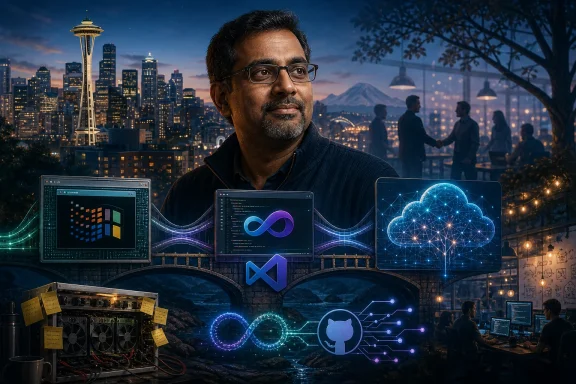 Soma Somasegar’s Career Traced Microsoft’s Own Reinvention
Somasegar’s story reads almost too neatly as a map of Microsoft’s transformation. He arrived in Redmond in January 1989, when Microsoft was still an ascendant PC software company fighting to define the operating-system future. By the time he left in 2015, Microsoft was beginning to look like the cloud-and-developer-platform company that Satya Nadella would make unmistakable.That 27-year span matters because it covers the hard middle of Microsoft history: the OS/2 split with IBM, the creation of Windows NT, the rise of Windows Server, the developer wars around Java and .NET, the company’s awkward years with open source, and its eventual pivot toward Linux, GitHub, Azure, and cross-platform tools. Somasegar was not a celebrity founder or a keynote showman in the consumer-tech mold. He was a builder of systems, teams, and ecosystems.
Born in Puducherry, India, in 1966, Somasegar came to the United States in 1987 for graduate study, first at Louisiana State University and then briefly at the State University of New York at Buffalo. The anecdote that he mistook “LA” for Los Angeles and discovered Louisiana only as his plane approached New Orleans has the texture of immigrant-tech lore, but it also captures the contingency of the industry that followed. The people who built modern computing often arrived through improbable routes, then turned those routes into institutions.
His early Microsoft work was far from glamorous. He joined as a software design engineer in test on OS/2, working on memory management and file systems, before being pulled into the Windows NT effort in 1990 as Microsoft’s partnership with IBM deteriorated. That move placed him inside one of the most important engineering projects in Microsoft history: a portable, enterprise-grade operating system that would eventually underpin Windows Server, workstation Windows, and much of Microsoft’s credibility in business computing.
Windows NT Was the School of Discipline
The Windows NT years were an education in reliability at scale. Somasegar spent roughly his first decade at Microsoft on the NT team, contributing to multiple Windows releases and rising through test leadership at a time when software testing was becoming an engineering discipline rather than a back-office chore. His reputation was not built on vaporous strategy decks. It was built on crashed machines, bug meetings, stress tests, and the daily mechanics of making a platform less fragile.One detail from his Microsoft years has become especially emblematic: the overnight stress-test program he designed for the NT team. Somasegar reportedly arrived before dawn to inspect machines, mark failures with yellow sticky notes, and bring the results into the morning bug process. In today’s language, that sounds like operational telemetry before telemetry became a dashboard business. In the culture of the 1990s, it was a reminder that enterprise trust was earned by boring repetition.
That lesson would carry through the rest of his career. Developer ecosystems tend to reward evangelism in public, but developers are won in private by tools that work, documentation that holds up, and platforms that do not collapse under real workloads. Somasegar’s NT background gave him a reliability-first sensibility at a company that sometimes preferred platform ambition to platform humility.
It also positioned him as a bridge between Windows as a product and Windows as a foundation. NT was not just another release train; it was the technical substrate for Microsoft’s enterprise future. To have come of age inside that project meant understanding that platforms are promises. If the promise fails at 3 a.m. in a data center, the brand damage is not theoretical.
The Developer Division Became His Larger Platform
When Somasegar took over Microsoft’s Developer Division in late 2003, he inherited one of the company’s most strategically sensitive jobs. Visual Studio and .NET were not merely tools; they were the instruments Microsoft used to keep developers building for Windows, Windows Server, SQL Server, and eventually Azure. The division sat at the junction of engineering culture, business strategy, and developer psychology.That was a complicated moment. Microsoft had spent the previous decade fighting platform battles with Netscape, Sun, Java, and the open web. Its developer story was powerful but insular, built around the assumption that Windows would remain the center of gravity. The company had vast developer mindshare, but it also carried the baggage of a firm that often treated openness as a threat.
Somasegar’s tenure did not erase that overnight. Microsoft’s shift toward open source and cross-platform development was uneven, contested, and inseparable from larger changes in leadership and market pressure. But his Developer Division became one of the places where the turn was made real. Visual Studio evolved, .NET matured, and the company’s tooling increasingly had to reckon with a world that was no longer Windows-only.
The significance of that cannot be overstated for WindowsForum readers. Today, it is normal to run Linux workloads on Azure, use VS Code on macOS, push to GitHub, containerize .NET services, and treat Windows as one strong node in a broader developer graph. That normality was not inevitable. It required Microsoft to rethink what it meant to “win” with developers.
Open-Sourcing .NET Was a Cultural Surrender That Became a Strategic Win
The 2014 decision to open-source major parts of .NET and push the framework toward Linux and macOS was one of those Microsoft announcements that looked obvious only in hindsight. At the time, it was a startling public admission that the old platform moat was no longer enough. If developers were building cloud services, mobile apps, and distributed systems across operating systems, Microsoft had to meet them there or watch its tools become legacy infrastructure.Somasegar was among the visible leaders associated with that shift. As head of the Developer Division, he represented the part of Microsoft that had to tell developers, in effect: we understand that your world is bigger than Windows. That was not a small statement from a company whose historical power came from making Windows the gravitational center of personal and business computing.
Open-sourcing .NET did several things at once. It gave developers more confidence that the platform would not be trapped inside Microsoft’s release machinery. It made .NET more credible for cloud-native and server-side workloads outside traditional Windows shops. It also signaled internally that Microsoft’s future would depend less on forcing allegiance and more on earning participation.
There is a temptation to describe that era as a clean moral conversion: Microsoft discovered openness, developers applauded, and the cloud future arrived. The reality was messier. Market pressure from Linux, AWS, mobile platforms, and web-first development forced Microsoft’s hand. But leadership still mattered, because large companies can recognize reality and still fail to act on it.
Somasegar’s legacy belongs in that uncomfortable middle ground. He was not the only architect of Microsoft’s open-source turn, and he did not single-handedly change the company. But he was one of the executives who helped turn a strategic necessity into a developer-facing product reality. In platform companies, that is often where the real work happens.
The India Development Center Was More Than a Satellite Office
Somasegar also founded Microsoft’s India Development Center in Hyderabad in 1998, a move that has grown in retrospect from an expansion decision into a major institutional milestone. Microsoft India is now one of the company’s most important engineering footprints outside the United States, and Hyderabad has become central to the broader global technology economy. For Somasegar, who had grown up in India in a family that prioritized education despite limited means, the project carried personal weight.It is easy to flatten global engineering expansion into corporate real estate: offices, headcount, tax regimes, hiring pipelines. But the creation of serious engineering centers outside the U.S. changed the structure of the software industry. It widened where core product work could happen and helped normalize the idea that global talent should not be relegated to support or localization.
For Microsoft, the India Development Center became a strategic asset. For the Indian technology community, it was part of a broader shift in which multinational R&D work helped validate local engineering depth. Somasegar’s role in that expansion adds another layer to his developer legacy: he was not only building tools for developers, but helping build places where developers could shape Microsoft itself.
That matters in 2026 because the geography of software has only become more distributed. AI research, cloud infrastructure, security engineering, and developer tooling are no longer concentrated in a handful of American campuses. Somasegar saw that earlier than many executives of his generation, and his own life made the argument personal rather than abstract.
Madrona Turned the Operator Into a Startup Multiplier
Somasegar’s move to Madrona after leaving Microsoft in 2015 could have been a comfortable post-executive landing. Instead, it became a second act that placed him close to the founders building the cloud, AI, developer-tool, and automation companies that now define enterprise software. He joined as a venture partner and became managing director in 2017, bringing a Microsoft operator’s discipline to early-stage company formation.That combination was especially useful in Seattle. The region has long had extraordinary technical depth, anchored by Microsoft and Amazon, but for years it struggled to translate that depth into a startup ecosystem with the same cultural self-confidence as Silicon Valley. Madrona’s role has been to make the case that Pacific Northwest startups can build category-defining companies without treating Seattle as a branch office of the Bay Area.
Somasegar fit that mission almost perfectly. He understood Microsoft’s enterprise DNA, Amazon’s cloud-era gravity, and the needs of founders selling technical products to technical buyers. He could speak to a developer-tools founder about product architecture, to an enterprise founder about go-to-market patience, and to a first-time CEO about the human cost of scaling.
His portfolio work reflected that range. He was associated with investments and advisory roles across companies such as Snowflake, UiPath, Pulumi, Statsig, Common Room, RelationalAI, Rhythms, and others. Not every company in that universe is the same kind of bet, but the pattern is legible: infrastructure, automation, developer productivity, data, AI, and applications that embed intelligence into workflows.
In other words, Somasegar did not leave the developer ecosystem. He followed it downstream into the companies taking advantage of the platform shifts he had helped enable.
Developer Tools Became the Center of Enterprise Power
The arc from Visual Studio to Pulumi, Statsig, and cloud infrastructure startups illustrates a larger industry change. Developer tools used to be treated as secondary products, useful but rarely glamorous. In the cloud era, they became leverage points for entire markets.The reason is simple: developers now choose more of the enterprise stack than they once did. A tool adopted by engineers can become a department standard, then a company standard, then a procurement event. GitHub, Docker, Kubernetes, Terraform, VS Code, Datadog, Snowflake, and countless API platforms all benefited from this bottom-up or practitioner-led adoption pattern.
Somasegar’s career straddled both models. At Microsoft, he led a division in a company famous for top-down enterprise selling and integrated platform strategy. At Madrona, he backed companies whose path to power often started with individual developers, data teams, or operations engineers choosing tools that solved immediate pain. That dual fluency made him valuable.
It also explains why his death resonates beyond Seattle. He represented a generation of Microsoft leaders who learned the old platform game from the inside, then adapted to a world in which the platform was no longer a single operating system. The new platform might be a cloud, a framework, a data layer, an AI model, an automation graph, or a developer workflow. Somasegar’s instinct was to look for the people building the layer others would build on.
That instinct is still the central question for enterprise technology in 2026. AI has made the developer-tools market both more crowded and more consequential. The companies that win will not simply generate code; they will reshape how software is specified, tested, deployed, secured, and maintained. Somasegar’s portfolio focus anticipated that fight.
Seattle’s Tech Community Lost a Connector, Not Just a Résumé
The public tributes to Somasegar have emphasized warmth, humility, steadiness, and generosity. Those words can become generic in memorial writing, but in Seattle’s technology community they point to a specific function. Somasegar was a connector between Microsoft alumni, startup founders, venture investors, university leaders, civic institutions, and the region’s increasingly global business networks.Seattle tech has always had an unusual civic texture. It is a city shaped by giant companies but still self-conscious about whether it has a coherent startup identity. It has deep engineering talent but sometimes resists the hype cycles that fuel other markets. It has enormous wealth creation and persistent civic strain, including housing affordability and homelessness.
Somasegar’s community work sits inside that contradiction. He was involved not only in venture and startups but also in regional philanthropy, sports ownership, and civic efforts such as All In Seattle. His participation in the Seattle Orcas cricket team and the Seattle Sounders ownership group points to another form of ecosystem-building: making the region feel culturally expansive enough to hold the people its technology economy attracts.
This is not incidental. Technology communities are built through institutions, but also through rituals and shared spaces. Conferences, sports teams, university boards, philanthropic campaigns, startup summits, alumni networks, and informal founder conversations all help determine whether a region becomes a durable ecosystem or merely a labor market.
Somasegar seemed to understand that the health of a tech community depends on more than exits and valuations. It depends on trust. That word appears often in venture marketing, but founders know the difference between a transactional investor and someone who will answer the call when the company is in trouble. Somasegar’s reputation suggests he belonged to the latter category.
Nadella’s Tribute Reveals the Human Side of Microsoft’s Leadership Class
Satya Nadella’s statement about Somasegar was notable not only for its professional praise but for its personal grief. Nadella described him as a dear friend and colleague, someone who brought humility and commitment to empowering developers. He also said the loss was deeply personal for him and his wife, Anu, because Somasegar had been present during some of their hardest moments.That matters because Microsoft’s modern era is often narrated through strategy: cloud-first, mobile-first, AI platform, open source, subscription economics, market capitalization. But companies are also shaped by networks of trust among people who have worked together for decades. Nadella and Somasegar met in the early 1990s, when both were part of a Microsoft still defining its enterprise future. Their friendship spanned the company’s most combative years and its most visible reinvention.
The danger in writing about executives after their deaths is to turn every career into destiny. Microsoft did not become more developer-friendly because a small group of nice people decided kindness was a strategy. It changed because the market demanded it, because old assumptions failed, and because new competitors forced new behavior.
Still, culture determines how a company responds when the old model breaks. A defensive culture doubles down. A learning culture absorbs the lesson. Somasegar’s reputation for humility is relevant because humility, in platform companies, can become a technical advantage. It allows a company to admit that developers are not waiting for permission.
The .NET Shift Still Echoes Through Windows
For Windows enthusiasts and administrators, Somasegar’s legacy is not confined to developer nostalgia. The decisions made around .NET, Visual Studio, and cross-platform tooling changed the practical experience of Windows itself. Windows today is a better development environment because Microsoft stopped insisting that all serious development orbit only around classic Windows assumptions.The Windows Subsystem for Linux, the rise of VS Code, the integration of GitHub workflows, the normalization of PowerShell across platforms, and the broader Azure developer story all belong to the same strategic family as the open-sourcing of .NET. They reflect a Microsoft that learned to make Windows valuable even when Windows was not the only target. That is a profound shift from the company Somasegar joined in 1989.
For sysadmins, this shift has been double-edged but mostly beneficial. Heterogeneous environments are harder to govern than monocultures, and the modern Microsoft stack asks administrators to understand identity, cloud policy, endpoint management, Linux workloads, containers, and developer pipelines. But it also gives IT teams more flexible tools and fewer artificial boundaries.
For developers, the change has been liberating. A .NET developer is no longer presumed to be a Windows-only developer. A Windows machine can be a first-class workstation for Linux-targeted cloud work. Visual Studio remains important, but Microsoft’s developer identity is now broader than any single IDE.
Somasegar’s role in this shift is best understood as part of a long relay. He helped carry Microsoft’s developer institutions from the Windows-first era into the open-cloud era. Others ran before and after him, but the baton he carried was heavy.
The Startup Bets Pointed Toward an AI-Native Software Stack
Somasegar’s Madrona work also offers a window into where enterprise software has been heading. His focus on machine learning, developer platforms, cloud infrastructure, robotic process automation, intelligent applications, and data systems reads today like a map of the AI-native stack. These are not separate categories anymore. They are converging.Snowflake helped define cloud data infrastructure as a central enterprise platform. UiPath rode the automation wave into the public markets. Pulumi represents infrastructure as code for developers who want familiar programming languages rather than domain-specific configuration alone. Statsig built experimentation and feature-management infrastructure for product teams, and its reported acquisition by OpenAI underscored how tightly AI companies now value product telemetry and deployment discipline.
The connective tissue is operational intelligence. Modern software companies do not simply ship applications; they observe, test, adapt, automate, and personalize them. AI intensifies that pattern by making systems more probabilistic, more data-hungry, and more dependent on feedback loops. The tooling around those systems becomes strategic infrastructure.
Somasegar’s Microsoft background would have made that obvious. Developer platforms are not just compilers and editors. They are the scaffolding around how organizations turn ideas into reliable systems. In the AI era, that scaffolding includes evaluation frameworks, model-routing layers, data governance, observability, compliance, and human-in-the-loop workflows.
His investment thesis, as reflected through Madrona’s public positioning and portfolio, was not merely “AI will be big.” It was that AI would need infrastructure, developer leverage, and intelligent applications built by teams that understood enterprise reality. That is a more durable thesis than chasing whatever model demo happens to be viral in a given week.
A Career Built on Empowering Developers Now Looks Like a Warning
The phrase “empowering developers” can sound like vendor wallpaper. Microsoft has used variations of it for decades, and nearly every platform company claims to love developers until developers ask for portability, transparency, or control. Somasegar’s career gives the phrase more substance, but it also highlights a tension that has returned with force in the AI era.Developers are again being courted by powerful platform companies. This time the platforms are foundation models, AI coding assistants, cloud inference services, data clouds, and agent frameworks. The promise is productivity; the risk is dependency. The same old questions are back in new clothing: Who controls the runtime? Who owns the workflow? Can developers leave? Can they inspect the system? Can they trust the roadmap?
Microsoft learned, painfully, that developers resist platforms that feel like traps. The success of modern Microsoft developer tools came partly from giving developers credible escape routes: open-source .NET, cross-platform editors, Linux support, GitHub integration, and cloud services that acknowledge mixed environments. The AI industry would do well to remember that lesson.
Somasegar’s legacy is therefore not just celebratory. It is instructional. If AI platforms want durable developer trust, they will need more than dazzling demos and subsidized APIs. They will need reliability, openness where it matters, migration paths, governance, and respect for the messy environments where real software lives.
That is the throughline from NT stress testing to venture investing. Trust is built under load.
The Measure of Soma’s Influence Is the Work Other People Could Do
The most meaningful technology careers are not always measured by products with a single name on the box. They are measured by the work they make possible for others. Somasegar’s influence runs through Windows engineers who learned reliability discipline, .NET developers who gained a broader platform, founders who received patient guidance, and a Seattle ecosystem that became more confident in its own technical center of gravity.There is also something striking about the consistency of his focus. Whether in operating systems, developer tools, global engineering centers, venture capital, or civic life, he returned to the same basic pattern: create conditions in which talented people can build. That is less flashy than inventing a device or founding a social network. It may be more durable.
The technology industry often confuses visibility with impact. Somasegar was visible enough to be known, but his deeper influence came through institutions and networks. Those are harder to memorialize because they do not fit neatly into a product launch timeline. Yet they are exactly what outlast individual market cycles.
His death at 59 also interrupts a second act that was still very much in motion. He was active at Madrona, active in public conversations about AI and enterprise technology, and still being recognized as a leading early-stage investor. This was not a retired executive being honored at a distance. It was a working technologist-investor whose relevance had carried into the next platform shift.
The Developer Champion’s Ledger Is Written Across Windows, Cloud, and Seattle
Somasegar’s life leaves a set of concrete markers that explain why his death is being felt across Microsoft, Madrona, and the broader technology community. They are not simply résumé entries; they are clues to how platform shifts actually happen.- He joined Microsoft in January 1989 and moved from OS/2 into Windows NT just as Microsoft’s operating-system strategy was being remade.
- He spent his first decade helping build and test Windows NT-era systems, where reliability became a practical discipline rather than a slogan.
- He led Microsoft’s Developer Division through the Visual Studio and .NET years when the company had to adapt from Windows-first assumptions to cloud and cross-platform reality.
- He was one of the Microsoft leaders associated with the 2014 open-source turn for .NET, a decision that helped reset the company’s relationship with developers.
- He founded Microsoft’s India Development Center in Hyderabad, helping establish one of the company’s most important engineering hubs outside the United States.
- He turned his post-Microsoft career at Madrona into a second platform role, backing and advising startups in cloud infrastructure, developer tools, automation, data, and AI.
References
- Primary source: GeekWire
Published: 2026-05-20T00:07:08.392579
S. 'Soma' Somasegar, 1966-2026: Microsoft and Madrona leader was a champion of developers and startups – GeekWire
Friends and colleagues remembered S. "Soma" Somasegar, the longtime Microsoft developer leader and Madrona managing director, as a generous mentor to developers and founders, and a fixture of Seattle's tech community.www.geekwire.com - Related coverage: techcrunch.com
Microsoft Launches .NET Foundation To Foster The .NET Open Source Ecosystem | TechCrunch
At its Build developer conference in San Francisco, Microsoft today announced the launch of the .NET Foundation. This new independent foundation aroundtechcrunch.com - Related coverage: madrona.com
Madrona Venture Group Names S. Somasegar Managing Director
Experienced Technologist, Executive and Investor Expands Role SEATTLE, WA – January 12, 2017 – Madrona Venture Group, an early-stage venture capital firm, announced today the ... www.madrona.com
- Related coverage: techradar.com
Microsoft to open source .NET, goes OS-agnostic and delivers free Visual Studio solution | TechRadar
Quite a shocker for everyonewww.techradar.com - Related coverage: opensource.com
Microsoft gets on board with open source
With news of Microsoft making the server side of .NET open source, we look at how the creation of the .NET foundation might foster open development and collaboration among open source communities.opensource.com - Related coverage: techxplore.com
- Related coverage: wired.com
Microsoft Open Sources .NET, Saying It Will Run on Linux and Mac | WIRED
Satya Nadella’s rapid reinvention of Microsoft continues. In yet another bid to make up lost ground in the long march to the future of computing, Microsoft is now open sourcing the very foundation of .NET—the software that millions of developers use to build and operate websites and other large...www.wired.com - Related coverage: goldi.ai
Goldilocks AI — Madrona Venture Group — Investment Portfolio & Profile
Madrona Venture Group focuses on early-stage through acceleration-stage technology companies, primarily in the Pacific Northwest and across the U.S., with a strong emphasis on intelligent applications, AI, machine learning, and enterprise software. Their strategy involves a hands-on partnership...goldi.ai - Related coverage: d1io3yog0oux5.cloudfront.net

