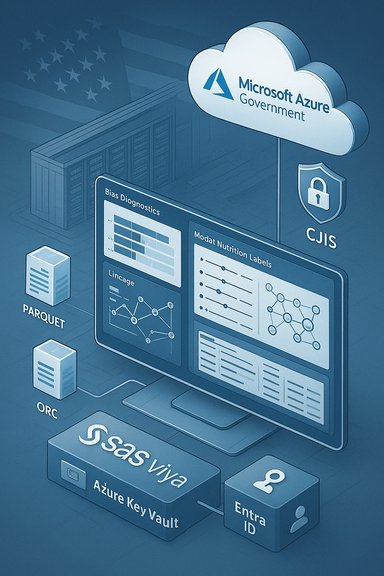
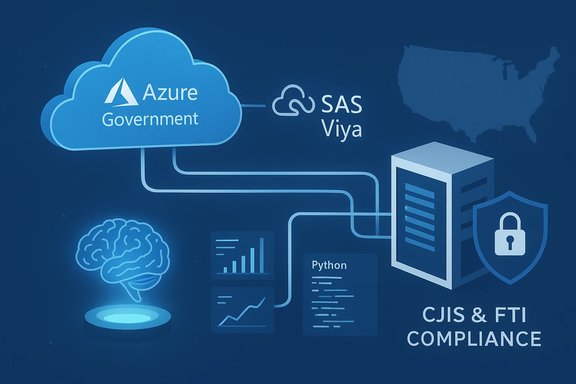
SAS’ cloud-native analytics platform Viya is now officially available to U.S. public sector organizations and the partner ecosystem through Microsoft Azure Government, opening a new on-ramp for agencies that need advanced analytics and AI inside a U.S.-sovereign, contractually isolated cloud environment. The arrangement—delivered as SAS Managed Cloud Services on Microsoft Azure Government—combines SAS’ Viya platform, SAS’ managed services and Microsoft’s Azure Government isolation and compliance controls to target mission-critical use cases that involve Criminal Justice Information (CJIS), Federal Tax Information (FTI) and other sensitive data types.
SAS Viya is SAS’ cloud-first data, analytics and AI platform. Over the last two years SAS has moved to offer Viya as both self-managed and managed deployments on major hyperscalers, and the new Azure Government option extends that managed offering into Microsoft’s physically isolated U.S. government cloud environment. SAS presents this as a turnkey path for agencies and the systems integrators that serve them to get rapid time-to-value for analytics, machine learning and explainable AI workloads while minimizing the operational burden of platform engineering. Microsoft Azure Government is purpose-built for U.S. federal, state and local government workloads and highlights physically isolated datacenters and networks located in the United States only, with additional contractual limits on who may access systems that process customer data. That isolation is central to the value proposition for agencies that must meet CJIS, IRS Publication 1075 (FTI) or other jurisdictional controls. Key marketing and practical claims from vendor materials include:
Source: StreetInsider SAS Viya now available to US public sector organizations and partners on Microsoft Azure Government
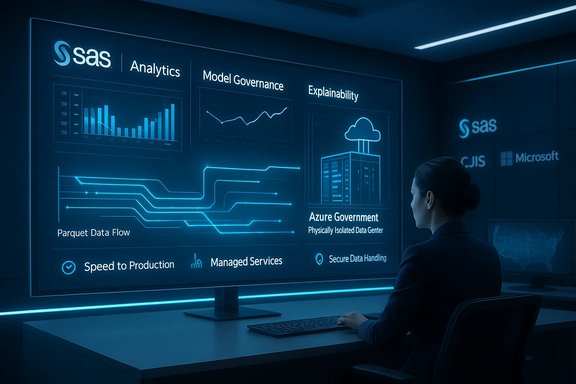 Background / Overview
SAS Viya is SAS’ cloud-first data, analytics and AI platform. Over the last two years SAS has moved to offer Viya as both self-managed and managed deployments on major hyperscalers, and the new Azure Government option extends that managed offering into Microsoft’s physically isolated U.S. government cloud environment. SAS presents this as a turnkey path for agencies and the systems integrators that serve them to get rapid time-to-value for analytics, machine learning and explainable AI workloads while minimizing the operational burden of platform engineering. Microsoft Azure Government is purpose-built for U.S. federal, state and local government workloads and highlights physically isolated datacenters and networks located in the United States only, with additional contractual limits on who may access systems that process customer data. That isolation is central to the value proposition for agencies that must meet CJIS, IRS Publication 1075 (FTI) or other jurisdictional controls. Key marketing and practical claims from vendor materials include:- Enhanced security and compliance posture for CJIS and FTI workloads.
- Managed operations and a short path to production via SAS Managed Cloud Services.
- Support for non‑proprietary data formats (so agencies can store data in open formats, reducing data lock‑in).
- Integration with Azure services for storage, identity and AI tooling.
What’s new — the essentials
SAS Managed Cloud Services on Azure Government: product components
- SAS Viya platform: cloud-native analytics, model development and ModelOps capabilities, including features for explainability and model governance.
- SAS-managed operations: SAS installs, configures, patches and operates Viya in an Azure Government tenancy under a managed-services contract, reducing the customer’s infrastructure and platform operations burden.
- Azure Government foundation: physically isolated datacenters, contractual commitments about US-only storage and personnel screening options that are designed to satisfy CJIS/FTI/IRS requirements.
Verified authorizations and compliance signals
- SAS states that SAS AI and Analytics for Government has achieved FedRAMP Moderate authorization and is listed in the FedRAMP/GovRAMP marketplaces for appropriate procurement channels. This provides a baseline assurance for federal procurement teams.
- Microsoft Azure Government publishes explicit guidance on CJIS, IRS 1075 and other compliance programs supported by the Azure Government environment; these programs are the reason agencies select Azure Government for regulated workloads.
Why this matters to public sector IT
Faster, lower‑risk delivery for analytics and AI
By combining a vendor-managed Viya stack with a government‑sovereign cloud tenancy, agencies gain:- Faster time-to-value: pre‑engineered deployment patterns and managed operations minimize the time from contract to production.
- Operational offload: SAS assumes platform engineering tasks (patching, scaling, operational monitoring), shifting operational risk from the agency to a vendor with deep domain experience.
- Integrated compliance posture: Azure Government’s contractual and technical safeguards—physically isolated datacenters, options for screened U.S. personnel, region-limited data storage—help agencies meet statutory constraints.
Practical benefits for data teams and partners
- Open data formats supported: SAS Viya’s CAS and compute layers support Apache Parquet and other open columnar formats in cloud object stores (ADLS Gen2, S3), which enables easier data sharing across analytics stacks and reduces vendor lock‑in risk. This is important for agencies that must make datasets accessible to multiple bureaus or contractors.
- Explainable AI and governance: Viya includes automated explanation and auditability features—critical in regulated decision-making contexts where transparency and model traceability are mandatory.
Technical verification — what we validated and how
- SAS’ FedRAMP and GovRAMP authorizations: confirmed via SAS’ government offering pages and PR announcements describing FedRAMP Moderate and GovRAMP moderate listings. These are the formal authorizations agencies rely on for procurement and accommodation of NIST/FedRAMP controls.
- Azure Government isolation and residency controls: validated against Microsoft documentation stating Azure Government uses physically isolated datacenters and U.S.-only networks, with contractual commitments and personnel screening options for restricted access. That isolation is central to CJIS/FTI suitability.
- CJIS and IRS 1075 suitability: Microsoft’s Azure Government compliance pages explicitly list CJIS and IRS Publication 1075 (FTI) among supported frameworks and describe the CJIS Security Addendum and state-level CJIS Management Agreements that agencies must coordinate. While Azure Government provides the environment to host CJI and FTI, agencies remain responsible for encryption, key control and operational decisions required by CJIS and IRS rules.
- Open data and format support: SAS Viya’s CAS has supported Parquet and ORC for some time; SAS documentation and community posts confirm CAS can read and write Parquet to Azure ADLS Gen2 and S3, enabling cross-platform data portability. This validates SAS’ marketing claim that client data can live in non‑proprietary formats.
- Service-level claims: SAS materials describe both a 99% uptime guarantee (in Managed Cloud Services product pages) and a 99.5% SLA referenced in packaged Viya Essentials materials. This is a concrete inconsistency to resolve in procurement: agencies must not rely on marketing text—request the exact SLA terms, RTO/RPO, covered components, and remedies in the executed contract.
Strengths — what this delivers well
- Clear compliance route for regulated data: Azure Government’s isolation and SAS’ FedRAMP/GovRAMP listings create a straightforward path for agencies that must keep data inside explicit jurisdictional boundaries. The combination reduces the procurement and technical complexity of standing up a secure analytics environment for CJI/FTI.
- Reduced operational burden and vendor accountability: by moving platform operations to SAS Managed Cloud Services, agencies can reallocate staff to domain projects while holding a single vendor accountable for platform health, patching and scaling—assuming those responsibilities are crystalized in the managed-services contract.
- Interoperability with modern data ecosystems: support for Parquet and object storage means Viya deployments can fit into a modern data lake architecture (OneLake / ADLS / Databricks / Fabric) and reduce future migration friction.
- Explainability and governance features built into the platform: Viya’s automated explanation tools and ModelOps controls help agencies implement auditable, traceable AI—an operational requirement for many public-sector decisions.
Risks, caveats and procurement red flags
While the offering addresses many key concerns, it does not remove all responsibility from agencies. The following are practical risks and contractual items that must be resolved before going to production.1) Don’t accept high-level marketing in lieu of contract specifics
- Verify which authorization levels apply to the concrete deployment (FedRAMP Moderate does not equal DoD IL or FedRAMP High). Confirm the SAS product listing(s) in FedRAMP/GovRAMP and the exact authorized deployment pattern. SAS’ marketing references FedRAMP and GovRAMP authorizations—procurement must check the exact ATO artifacts and Scope of Authorization.
2) SLA and uptime ambiguity
- SAS collateral alternates between a 99% uptime guarantee for Managed Cloud Services and a 99.5% SLA for Viya Essentials. Demand the final SLA in the contract with clear service definitions (what components are covered), RTO/RPO metrics, and credits for missed targets. Do not assume the marketing figure applies to your critical workloads.
3) Data residency and personnel access controls require active governance
- Azure Government’s contractual protections are real, but agencies must still implement encryption, key control (customer‑managed keys), and access controls to ensure compliance with CJIS and IRS requirements. CJIS in particular requires careful handling of personnel screening and encryption-at-rest/in-use decisions; Microsoft’s guidance lays out options but agencies must operationalize them.
4) Vendor lock‑in and data gravity
- Managed services that abstract operations often increase data gravity. Even though Viya supports Parquet, agencies should insist on tested, documented exit and data-export procedures (including format, access permissions, exports of ModelOps artifacts and lineage metadata). Vendor promises about open data are meaningful only if exports and migration runbooks are proven in a pre-production test.
5) Hidden or under‑estimated cost drivers
- Managed services often appear cost‑efficient but total cost of ownership includes Azure infrastructure consumption (compute, storage, egress), SAS managed-service fees, and potential third‑party integration costs. Request modeled TCOs for 1/3/5-year horizons that include Azure metered costs, egress scenarios and scaling profiles. Forum and procurement analyses repeatedly call out surprises in packaged cloud offers unless TCO is explicit.
6) AI governance and LLM risks
- SAS Viya has integrated explainability and bias detection tools, but agencies deploying generative or LLM-augmented decisioning must require lineage, human-in-the-loop controls, and test harnesses that measure hallucination risk and drift for production models. Marketing statements about “trustworthy AI” are helpful but organizations must validate governance features empirically.
Practical checklist for procurement and implementation teams
- Request the formal FedRAMP/GovRAMP ATO package and confirm the scope (which Viya components and which Azure services are covered).
- Obtain the definitive managed‑services contract with:
- Detailed SLA (components, exclusions, RTO/RPO).
- A shared responsibility matrix mapping security controls to SAS, Microsoft and the agency.
- An exit and data‑export runbook (format, sample run, timing, validators).
- Validate CJIS / FTI readiness:
- Confirm whether the agency needs the CJIS-specific agreement with Microsoft for their state; request Microsoft/Azure Government CJIS Management Agreement status for your jurisdiction.
- Specify encryption and key ownership (customer‑managed keys recommended).
- Run a scoped pilot using representative data:
- Measure latency, concurrency, model training cost and predictions per second.
- Validate lineage, explainability artifacts, model monitoring dashboards and drift alerts.
- Test integration with your SIEM, identity (Entra/Azure AD) and data catalog.
- Insist on performance benchmarks:
- Ask for workload‑specific benchmarks rather than vendor broad claims; benchmark on representative data shapes and peak-period scenarios.
- Validate data portability:
- Export a sample dataset in production-like scale and ensure it is usable by alternate platforms (Parquet, CSV, or agreed open format).
How partners and systems integrators should position themselves
- Systems integrators with Azure Government competency can use this offering to accelerate delivery of analytics-enabled public services—but they must add value by integrating strong governance, telemetry and cost-management practices into the managed deployment.
- Partners should prepare for mandatory procurement questions: mapping of security controls, proof of data export capability, and a tested go‑forward plan for disaster recovery and continuity.
- For SIs supporting CJIS or FTI customers, familiarity with CJIS Management Agreements and IRS Publication 1075 controls will be a differentiator: agencies will ask for hands-on evidence that the stack meets operational rules beyond the single-vendor marketing claim.
Final assessment — strengths, realistic expectations, and the bottom line
SAS Viya on Azure Government via SAS Managed Cloud Services is a credible, well‑engineered option for U.S. public sector analytics and AI—particularly for agencies that need the combined benefits of a mature analytics platform and the contractual, physical isolation Azure Government provides. The announcement is backed by concrete authorizations (FedRAMP and GovRAMP artifacts are available in vendor materials) and by Microsoft’s public documentation on Azure Government controls for CJIS, IRS 1075 and related frameworks. These two elements—platform capability plus sovereign hosting—are what make this offering meaningful. However, the value is realized only when procurement and engineering teams insist on specifics: the exact FedRAMP/GovRAMP authorization scope, a tested SLA, a verified data-export and exit strategy, documented key‑management and encryption responsibilities, and a pilot that stresses model governance and operational telemetry. Marketing claims about being “the most powerful AI platform” or about unspecified “cost savings” are promotional and should be validated by measured pilots and contractual guarantees. Where vendor collateral is ambiguous—SLA percentages, uptime guarantees, or pricing models—agencies must not assume consistency; they must require the binding contract language instead.Conclusion
For federal, state and local agencies that must modernize analytics while protecting sensitive data, SAS Viya on Microsoft Azure Government presents a practical and verifiable path: a proven analytics stack, delivered as a managed service, inside a U.S.-sovereign cloud environment that is explicitly designed to meet CJIS, IRS 1075 and FedRAMP constraints. The combination simplifies procurement and accelerates adoption—but it is not a substitute for disciplined procurement, rigorous pilot validation and contractual clarity. Agencies and their systems integrators will gain the most by demanding explicit artifacts—ATO packages, precise SLAs, key-management proof-points and tested data-export runbooks—before moving mission-critical decisioning into production. In short: the technical building blocks and compliance envelopes are in place; the remaining work is operational and contractual. Done right, this offering can deliver modern, explainable AI capabilities to heavily regulated government operations without compromising the data sovereignty and auditability those missions require.Source: StreetInsider SAS Viya now available to US public sector organizations and partners on Microsoft Azure Government