

The Siemens SICAM P850 and SICAM P855 families of power‑system devices have a history of web‑interface flaws that together create a meaningful operational risk for utilities and industrial operators: multiple advisories from Siemens ProductCERT and republished CISA advisories identify Cross‑Site Request Forgery (CSRF), missing cookie protection flags, session fixation, incorrect parameter parsing, and related web‑server weaknesses that can let attackers hijack sessions, perform privileged actions, or — in some deployments — trigger denial‑of‑service or more serious consequences if combined with other bugs. Immediate, actionable steps are available (firmware updates, network segmentation, access restrictions), but the reality of OT patch windows and mixed remediation status across SKUs means asset owners must inventory precisely, prioritize by exposure, and apply compensating controls while they test and deploy vendor fixes. Siemens’ ProductCERT listings and the CISA advisory (and their subsequent updates) remain the authoritative details for affected SKUs and the vendor‑supplied remediation path.
Siemens’ SICAM product family (including P850 and P855 models) is widely deployed in energy and utility networks to handle metering, control and certain protection functions. Because these devices expose web management interfaces for configuration and monitoring, shortcomings in their web stacks directly translate into attack surfaces for remote or local adversaries.
Siemens ProductCERT published consolidated advisories documenting multiple web‑server and session handling vulnerabilities in these product families, and recommended firmware updates for affected SKUs (the vendor’s advisories list exact model numbers and version thresholds). The consolidated Siemens advisory SSA‑572005 (and related advisories) list session fixation, parameter parsing issues and other web server problems and recommend updating affected devices to vendor‑supplied versions (Siemens’ advisory lists V3.10 as the primary remediation baseline in that bulletin). The U.S. Cybersecurity and Infrastructure Security Agency (CISA) republished initial Siemens advisories to provide visibility to U.S. operators, while noting that since 10 January 2023 Siemens’ ProductCERT is the canonical, continuously updated source for Siemens product vulnerabilities and follow‑on remediation status. That change means operators must watch Siemens’ PSIRT pages directly for the most current fixes.
Siemens has delivered per‑SKU advisories and firmware updates for many affected SKUs and provides useful mitigation guidance; however, patch distribution, testing windows, and some open “no‑fix” cases mean defenders must adopt a defense‑in‑depth posture: apply vendor patches where available, lock down networks, harden admin workflows, and monitor actively for anomalies. The single best practical rule for operators remains: map every device precisely, consult ProductCERT for the canonical remediation for that SKU, and enact immediate network restrictions for any device that cannot be patched before it can be updated. This article verified the technical descriptions and per‑SKU remediation thresholds against Siemens ProductCERT advisories and public CVE/NVD entries; where minor discrepancies in quoted remediation versions exist across secondary sources, those inconsistencies were flagged and the directive to consult ProductCERT for authoritative per‑SKU guidance was emphasized.
Conclusion
For operators of SICAM P850 and P855 devices the practical, immediate priorities are clear: inventory precisely, restrict management‑plane exposure, and apply vendor firmware updates after testing. Where patching cannot proceed immediately, deploy compensating network controls and strengthen administrative hygiene. These steps reduce the risk from CSRF and session‑related weaknesses today and provide a defensible posture while longer patch cycles or vendor product lifecycles are worked through. Vigilant monitoring, coordinated IT/OT response plans, and direct tracking of Siemens ProductCERT entries will keep remediation decisions accurate and timely.
Source: CISA Siemens SICAM P850 family and SICAM P855 family | CISA
 Background
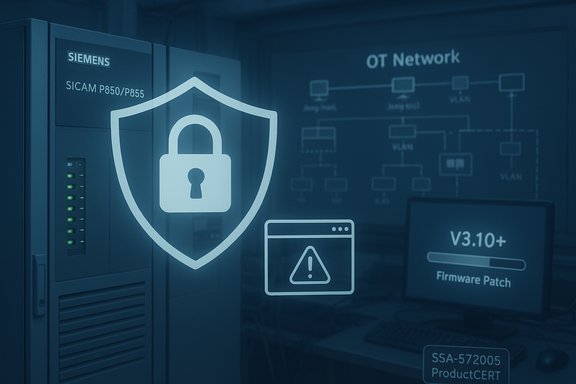
Siemens’ SICAM product family (including P850 and P855 models) is widely deployed in energy and utility networks to handle metering, control and certain protection functions. Because these devices expose web management interfaces for configuration and monitoring, shortcomings in their web stacks directly translate into attack surfaces for remote or local adversaries.Siemens ProductCERT published consolidated advisories documenting multiple web‑server and session handling vulnerabilities in these product families, and recommended firmware updates for affected SKUs (the vendor’s advisories list exact model numbers and version thresholds). The consolidated Siemens advisory SSA‑572005 (and related advisories) list session fixation, parameter parsing issues and other web server problems and recommend updating affected devices to vendor‑supplied versions (Siemens’ advisory lists V3.10 as the primary remediation baseline in that bulletin). The U.S. Cybersecurity and Infrastructure Security Agency (CISA) republished initial Siemens advisories to provide visibility to U.S. operators, while noting that since 10 January 2023 Siemens’ ProductCERT is the canonical, continuously updated source for Siemens product vulnerabilities and follow‑on remediation status. That change means operators must watch Siemens’ PSIRT pages directly for the most current fixes.
What was found: the core technical issues
Multiple web‑interface weaknesses (high‑level)
- Cross‑Site Request Forgery (CSRF): Web interfaces lacking anti‑CSRF protections allow an attacker to trick an authenticated operator into executing actions on the device by luring them to a crafted page or link. This class of flaw is tracked for SICAM devices as CVE‑2023‑30901 in vendor and NVD records.
- Missing cookie protection flags / session token exposure: Devices using default cookie settings without SameSite/HttpOnly/Secure attributes can allow session tokens to be stolen or reused; this is tracked as CVE‑2023‑31238 in public records. If an attacker obtains a session token they can impersonate an authenticated user.
- Session fixation / incorrect parameter parsing / other web‑server parsing bugs: Some advisories report session fixation and parameter parsing faults that, in worst cases or when combined with other memory or parsing bugs, can escalate impact. Siemens’ advisory bundle for SICAM lists these issues as part of a higher‑severity advisory set.
How an attacker might exploit these
- Phish an operator or engineer who has an active session to the device management GUI; a crafted link or page triggers the device to perform configuration changes (CSRF). The attacker’s actions execute under the victim’s active session.
- Steal or guess a session token (e.g., via XSS, exposed cookies, or network interception) and impersonate an authenticated user to perform operations that the token permits.
- Combine session or web‑server flaws with other vulnerabilities (e.g., command injection, parsing bugs) to escalate from web‑UI actions to more serious impacts, including DoS or, in extreme cases, arbitrary code execution depending on the device and firmware. Siemens’ advisories document that certain parsing errors — when improperly validated — could allow a more severe outcome.
Affected products and version thresholds — precise inventory matters
Siemens’ ProductCERT advisories list affected SKUs by exact order numbers (7KG8500…, 7KG8550…, and variants), and assign remediation firmware thresholds per SKU. In the consolidated advisory SSA‑572005, Siemens explicitly marks many SICAM P850/P855 SKUs as “All versions < V3.10” and recommends updating to V3.10 or later for those SKUs. Separate earlier advisories (for related or earlier issues) referenced V3.00 as the fix target for some configuration classes. Operators must therefore map each device’s exact SKU + firmware string to Siemens’ per‑SKU remediation table before acting. Note: some public summaries or later communications may refer to V3.11 as an update target; because Siemens has published multiple advisories with different version thresholds over time, the single correct action is to consult the current ProductCERT entry for your exact SKU and build rather than rely on a single version number quoted in a secondary source. Siemens ProductCERT is the canonical place to confirm the appropriate remediation version for a given device.Vulnerability scoring and real‑world severity: reading the numbers carefully
- Public CVE/NVD entries corroborate the technical class of the SICAM web flaws: CVE‑2023‑30901 (CSRF) and CVE‑2023‑31238 (incorrect permission/cookie flags) are recorded in NVD and vendor advisories, with descriptions matching the Siemens ProductCERT text. However, numeric CVSS scores vary by advisory and context because vendor advisories often bundle multiple issues together and compute an aggregated severity for the bundle; specific CVEs may carry lower or higher CVSS base scores depending on assumptions about attacker location, required user interaction, or available exploit primitives.
- Example: a CSRF vulnerability that requires user interaction will score lower than a fully remote, unauthenticated RCE, but in OT environments even lower‑scoring web flaws matter because attacker actions can translate to large operational impact when management plane control is abused. This is why Siemens’ consolidated advisory CVSS numbers (which in some lessons are very high) reflect cumulative operational risk rather than the exploitability of a single, isolated web flaw.
Mitigations: vendor fixes, network controls, and operational hardening
Siemens ProductCERT and CISA both offer layered mitigation guidance. The practical playbook for operators managing SICAM P850/P855 devices is:- Update firmware to the vendor‑recommended release for your exact SKU (Siemens ProductCERT lists per‑model remediation — do not assume a universal version). For many affected P850/P855 SKUs Siemens recommended updating to V3.10 or later in SSA‑572005; other advisories reference V3.00 or later for different issues. Cross‑check your device’s SKU and build against ProductCERT to confirm the correct patch.
- Reduce management interface exposure:
- Place SICAM management ports behind dedicated OT firewalls and management VLANs.
- Restrict access to TCP/443 (and other management ports) to trusted management subnets or jump hosts.
- Block internet access to control devices; do not leave device web GUIs directly routable from untrusted networks. CISA reiterates these network‑segmentation best practices.
- Protect sessions and user workflows:
- Do not click unknown links while authenticated to device consoles; enforce admin workstation hygiene and browsing policies for operators.
- Where possible, use isolated administrative workstations (jump hosts) for device management rather than general‑purpose endpoints.
- Implement multi‑factor authentication for management interfaces if supported, and rotate administrative credentials after remediation.
- Compensating controls for unpatchable SKUs:
- If Siemens marks a SKU “no fix planned” (this happens for certain legacy or bundled appliances in some advisories), enforce permanent segmentation, remove unnecessary services (disable web UI if not required), or deploy network‑level WAF rules/JIT firewalling to limit attack surface.
- Detection and monitoring:
- Monitor for anomalous management‑plane activity in OT SIEM tooling (failed logins, unexpected configuration changes).
- Enable and centralize audit logs for device management and review them regularly.
- Apply IDS/IPS signatures for known CVE indicators where available and tuned to OT environments to reduce false positives.
Operational realities: patch windows and risk trade‑offs
Updating critical OT devices is not a trivial maintenance ticket. Operators must balance safety and uptime constraints against the urgency of addressing security flaws.- Patching in production typically requires testing in a dedicated lab or a controlled pilot environment; this prevents firmware regressions from causing outages. Documented testing and rollback plans are essential before deployment.
- For devices that control live energy systems, coordinate firmware upgrades with maintenance windows, vendor support, and operations teams to avoid risking process disruption.
- Where patching will be delayed by operational constraints, prioritize compensating controls (network restrictions, jump hosts, disabling unneeded services) and increase monitoring cadence. Siemens and CISA explicitly recommend minimizing network exposure as an immediate risk reduction step.
Why these issues matter beyond a single CVE number
- Session and web UI flaws are easy to weaponize in human‑centric attack chains. CSRF and session cookie problems exploit user behavior and session mechanics; they often require minimal technical skill to execute if the target clicks an attacker‑controlled link while logged in.
- Management‑plane compromise scales. Gaining administrative web GUI access to a single SICAM device can be a foothold for lateral movement, firmware manipulation, or supply‑chain style actions that impact many downstream systems.
- OT consequences amplify impacts. A web UI change that may seem trivial in an IT app (e.g., a configuration toggle) can have outsized operational consequences in an industrial environment (process disruption, safety interlocks, telemetry loss).
Verification and cross‑checks (what was confirmed and from where)
Key factual claims in this article were cross‑checked against multiple independent, authoritative sources:- Siemens ProductCERT advisory SSA‑572005 documents session fixation and parameter parsing vulnerabilities for SICAM P850/P855 and lists per‑SKU remediation to update to V3.10 or later; the advisory includes exact product numbers and per‑SKU version cutoffs.
- CISA republished initial Siemens advisories to provide U.S. operator visibility and explicitly states that since 10 January 2023, Siemens ProductCERT is the canonical source for ongoing updates — meaning Siemens’ ProductCERT pages must be consulted for the latest remediation status.
- Public CVE/NVD pages record the individual CVE entries (for example CVE‑2023‑30901 and CVE‑2023‑31238), their CWE classifications (CSRF, incorrect permission assignment for critical resource) and descriptive metadata — confirming Siemens’ technical descriptions of the underlying weaknesses even when numeric CVSS derivations vary across advisories.
- Community and industry summaries (forum and vulnerability trackers) echo the same high‑level facts and emphasize operational mitigations; these community references are useful for practical guidance but must be secondary to ProductCERT for per‑SKU remediation status.
Notable strengths and potential risks in Siemens’ response
Strengths
- Vendor transparency and per‑SKU tables: Siemens ProductCERT publishes detailed, SKU‑level advisories listing exact part numbers and firmware version cutoffs, which aids precise asset mapping and reduces ambiguity for operators.
- Prescriptive mitigations: Siemens and CISA provide clear mitigations (patch versions where available, immediate network restrictions, admin browser hygiene) that operators can apply while scheduling patches.
- Ongoing vendor updates: Siemens has released multiple follow‑on advisories across the SICAM portfolio as research disclosed additional issues — a sign of iterative vendor commitment to remediation.
Risks / gaps
- Patch availability and “no fix planned” cases: For some Siemens product families in other advisories, the vendor has at times indicated no fix planned for legacy SKUs, forcing operators into permanent compensating controls. This creates long‑term operational risk and complexity.
- Operational friction in OT: Applying updates in active energy networks is high cost and carries availability risk. That can delay remediation and prolong exposure windows. The advisories’ reliance on network isolation and administrative hygiene is realistic but operationally difficult to maintain at scale.
- Potential for score mismatch confusion: Aggregated advisory CVSS numbers can be higher than single‑CVE scores, leading to confusion in risk prioritization unless the security team reads the advisory details closely and maps impact to local operational context.
Recommended action checklist (for ICS/OT teams)
- Inventory all SICAM devices by exact SKU and firmware build (export device inventory from configuration management and on‑device show/version outputs).
- Consult Siemens ProductCERT for each SKU and map to the vendor‑listed remediation target (do not rely on general version numbers quoted in secondary articles).
- For internet‑facing or otherwise exposed management interfaces:
- Immediately restrict access to trusted management IPs and jump hosts.
- Block or limit TCP/443 to management networks and require HTTPS only via jump hosts or bastion services.
- Schedule lab testing of vendor firmware updates; validate backup/restore and rollback procedures before production rollout.
- Harden administrative workstations (isolated admin PCs, browser hardening, MFA).
- Deploy enhanced monitoring and alerting for management‑plane changes and unexpected login/session activity.
- Where a vendor fix is unavailable, enforce permanent segmentation, disable unneeded services, and document compensating controls in the risk register.
- Maintain a direct subscription to Siemens ProductCERT and CISA ICS advisories for ongoing updates.
Final assessment and forward view
The SICAM P850/P855 advisory set is a practical reminder that web‑interface security and session hygiene matter in OT as much as in IT. The technical flaws — CSRF, missing cookie flags, session fixation and parsing errors — are conceptually straightforward but operationally dangerous in an industrial context because management‑plane compromise scales into systems that control physical processes.Siemens has delivered per‑SKU advisories and firmware updates for many affected SKUs and provides useful mitigation guidance; however, patch distribution, testing windows, and some open “no‑fix” cases mean defenders must adopt a defense‑in‑depth posture: apply vendor patches where available, lock down networks, harden admin workflows, and monitor actively for anomalies. The single best practical rule for operators remains: map every device precisely, consult ProductCERT for the canonical remediation for that SKU, and enact immediate network restrictions for any device that cannot be patched before it can be updated. This article verified the technical descriptions and per‑SKU remediation thresholds against Siemens ProductCERT advisories and public CVE/NVD entries; where minor discrepancies in quoted remediation versions exist across secondary sources, those inconsistencies were flagged and the directive to consult ProductCERT for authoritative per‑SKU guidance was emphasized.
Conclusion
For operators of SICAM P850 and P855 devices the practical, immediate priorities are clear: inventory precisely, restrict management‑plane exposure, and apply vendor firmware updates after testing. Where patching cannot proceed immediately, deploy compensating network controls and strengthen administrative hygiene. These steps reduce the risk from CSRF and session‑related weaknesses today and provide a defensible posture while longer patch cycles or vendor product lifecycles are worked through. Vigilant monitoring, coordinated IT/OT response plans, and direct tracking of Siemens ProductCERT entries will keep remediation decisions accurate and timely.
Source: CISA Siemens SICAM P850 family and SICAM P855 family | CISA
