

Security Affairs published Round 582 of Pierluigi Paganini’s international newsletter on June 21, 2026, collecting a week of ransomware, malware, vulnerability, data-breach, and cyber-policy stories that together show how much of today’s security crisis has moved to the exposed edge of ordinary enterprise infrastructure. The value of the roundup is not that every item is equally novel; it is that the list reads like a map of where defenders are still losing. Firewalls, WordPress sites, open-source repositories, medical research networks, gaming platforms, and consumer identity systems all appear in the same weekly digest because attackers no longer need to choose one lane. The modern intrusion economy is broad, automated, and patient enough to turn yesterday’s neglected configuration into tomorrow’s headline.
The most striking thing about Round 582 is not the volume of incidents. Security newsletters are always crowded, and Paganini’s weekly format is designed to reflect that churn. What stands out is the clustering: credential exposure, initial-access brokering, edge-device compromise, web supply-chain abuse, and ransomware playbooks all point to the same operational reality.
Attackers are not merely breaking into networks through exotic zero-days. They are chaining together stale passwords, exposed VPN portals, compromised plugins, poisoned code, leaked logs, and trusted update mechanisms. The result is a marketplace where access is discovered, packaged, resold, and monetized before many organizations have even finished assigning the ticket.
That is why this week’s stories feel less like separate breaches than a single industrial process. Fortinet credentials show up in massive collections. SocGholish is disrupted after years of using fake browser updates and compromised websites as delivery rails. WordPress plugins become beachheads. Open-source projects become malware couriers. Ransomware crews publish victim counts and operational material as if they were investor updates.
For Windows administrators and enterprise IT teams, the lesson is uncomfortable but familiar: the network perimeter did not disappear. It multiplied. Every appliance management page, VPN login, GitHub dependency, browser prompt, SaaS integration, and WordPress admin panel is now a perimeter, and most organizations still manage them as if they were secondary systems.
The important point is not whether the final count lands at 30,000, 74,000, or somewhere else. The important point is that attackers appear to have been able to operate at internet scale against devices that many enterprises treat as trusted anchors. A firewall or VPN appliance is not just another server. It is the doorframe through which remote workers, administrators, contractors, and sometimes third-party systems enter the corporate network.
That is what makes credential exposure on edge gear so damaging. A compromised VPN password is not equivalent to a leaked forum login. It may provide the attacker with a plausible route into internal systems, a way to impersonate legitimate remote access, and a basis for lateral movement that looks less suspicious than commodity malware beaconing from a random endpoint.
The reports around FortiBleed also revive a long-running issue in appliance security: upgrades do not always erase inherited risk. If older password storage, stale credentials, or unchanged administrative accounts remain in place after a patch, the device may be nominally updated but operationally exposed. Security teams know this in theory; the real world keeps proving how often the post-patch cleanup is the step that fails.
For Windows-heavy environments, the downstream risk is obvious. Once an attacker moves from VPN access into Active Directory, the story stops being about a firewall brand and becomes a domain compromise problem. The boundary between network appliance security and Windows identity security is thin, and adversaries know exactly how to walk across it.
Operation Endgame’s reported disruption of SocGholish infrastructure is significant because it targets a delivery mechanism used by multiple criminal actors. Taking down a malware loader or access pipeline can ripple outward, depriving ransomware crews and other groups of a convenient way to seed intrusions. That is why law-enforcement disruptions can matter even when they do not produce Hollywood-style arrests of every operator.
But defenders should resist the temptation to read disruption as eradication. Cybercrime infrastructure is modular because criminals learned from previous takedowns. Domains can be re-registered, traffic distribution systems can be rebuilt, affiliates can move to a rival loader, and compromised websites can be reused by the next group with a toolkit and a customer list.
SocGholish’s importance lies in its banality. It weaponizes the everyday web. A user lands on a legitimate but compromised site, sees a convincing update lure, and becomes the entry point into a much larger criminal supply chain. No single endpoint control, DNS filter, or awareness program solves that perfectly, which is why layered defense remains unfashionable but necessary.
For Windows admins, this is also a browser and privilege story. Fake-update malware depends on users being able to execute what they download, and it thrives in environments where application control is too difficult, too politically unpopular, or too inconsistently deployed. The hard controls that stop this class of attack are rarely glamorous, but they are often more useful than another dashboard.
A leaked playbook matters because it gives defenders a rare look at how a crew organizes repeatable crime. Ransomware is not merely malware deployed at the end of an intrusion. It is a workflow: initial access, reconnaissance, privilege escalation, data theft, backup destruction, encryption or threatened encryption, negotiation, and public pressure. The more standardized that workflow becomes, the easier it is for criminal affiliates to execute.
The Gentlemen’s reported victim count also illustrates the asymmetry. Defenders must get identity, patching, backups, monitoring, segmentation, endpoint controls, and incident response right across a sprawling estate. A ransomware affiliate needs one viable route to persistence and enough time to find the crown jewels. The imbalance is not new, but the professionalization of ransomware has made it harsher.
The Novo Nordisk incident listed in the newsletter adds another dimension. Healthcare and pharmaceutical organizations are attractive because they combine sensitive personal data, intellectual property, regulated operations, and low tolerance for downtime. Even when an incident is limited, the reputational pressure is high because patients, partners, regulators, and markets all read cybersecurity through the lens of trust.
Ransomware’s evolution also changes how enterprises should think about “impact.” Encryption is no longer the defining event. Data theft, extortion, operational disruption, legal exposure, and the secondary fraud enabled by stolen records may inflict damage before any ransom note appears. If an organization still writes its ransomware plan around restoring files from backup, it is planning for only one chapter of the attack.
The reported OptinMonster supply-chain attack affecting a large number of sites fits a pattern that has become depressingly familiar. Attackers compromise a component used across many installations, and the blast radius expands through trust. The victim organization may have done nothing more exotic than run a popular plugin, but popularity is precisely what turns a plugin into infrastructure.
The newsletter also notes WordPress plugin abuse involving database injection and dual webshells. That is the practical nightmare: once attackers plant webshells, a website becomes more than a defacement risk. It can host malware, redirect visitors, steal data, stage phishing pages, or serve as part of a larger command-and-control ecosystem.
For WindowsForum readers, this may sound like someone else’s Linux problem. It is not. Many Windows-centric organizations host WordPress externally or through agencies, then connect it to Microsoft 365 forms, CRM platforms, analytics tools, identity providers, and marketing automation. The compromise may begin in PHP but end in credential theft, OAuth abuse, or brand impersonation targeting employees and customers.
WordPress security is therefore less about winning arguments over content management systems and more about inventory discipline. If an organization cannot say which sites it owns, which plugins they run, who administers them, and how quickly they can be patched or isolated, it does not have a website problem. It has an unmanaged asset problem with a public IP address.
The phrase poisoning open source can cover multiple tactics: typosquatting, dependency confusion, malicious commits, compromised maintainer accounts, trojanized packages, fake proof-of-concept exploit code, and build-system abuse. The common feature is that the attacker does not need to breach every downstream organization directly. They compromise something developers voluntarily import.
This is especially dangerous in environments where developers have access to signing keys, cloud credentials, CI/CD secrets, production databases, or privileged internal tooling. A malicious package executed during a build can be closer to the center of the enterprise than a phishing email delivered to a receptionist. That inversion still has not fully registered in many risk programs.
The newsletter’s mention of phishing campaigns targeting developers to steal cryptocurrency sits in the same orbit. Developers are now high-value identity targets because their machines and accounts often bridge code, cloud, secrets, and production deployment. Criminals and intelligence services have both noticed.
Windows development shops should be particularly wary of the false comfort that supply-chain compromise is mostly a Unix ecosystem story. Windows endpoints run Node.js, Python, PowerShell modules, NuGet packages, Docker tooling, Git clients, IDE extensions, and cloud CLIs. The developer workstation is one of the most privileged and least consistently hardened systems in many companies.
Android bankers have evolved well beyond simple credential theft. Complete device takeover capabilities imply abuse of accessibility services, overlay attacks, session interception, notification capture, and sometimes remote-control features that allow criminals to operate inside the victim’s authenticated environment. Banks can block suspicious logins, but it is much harder when the transaction appears to originate from the user’s own phone.
Malicious Steam Workshop content demonstrates a different route into trust. Gamers download visual customizations, mods, wallpapers, and community content because that is part of the platform’s culture. Attackers follow users into those ecosystems because high-friction security warnings would break the experience, and low-friction environments are attractive targets.
Crypto clippers remain deceptively effective because they exploit a human weakness in cryptocurrency transactions: addresses are long, ugly, and hard to verify under pressure. Malware that watches the clipboard and swaps wallet addresses does not need to defeat blockchain cryptography. It only needs the victim to glance at the first and last few characters and click send.
These stories matter to enterprise defenders because personal and corporate security are no longer neatly separated. Bring-your-own-device policies, password reuse, personal browser profiles, remote work, and cross-device authentication all create bridges. A compromised personal phone or gaming PC can become a stepping stone into workplace identity, especially where MFA prompts, password managers, or recovery accounts overlap.
Research institutions and medical communities are attractive because they hold data and expertise that cannot be quickly recreated. Artificial intelligence only raises the value of that data. Training sets, model architectures, research notes, clinical trial material, and biomedical insights may all be useful to state-linked actors seeking strategic advantage.
At the same time, AI is becoming a lure for fraud. Scammers use synthetic voices, convincing text, fake support flows, and personalized social engineering to make old schemes more scalable and persuasive. Imposter scams were already profitable before generative AI lowered the cost of customization.
The policy stories matter because governments are trying to draw boundaries around technology that moves faster than export-control paperwork. Restrictions on model access, compute, chips, and advanced AI services are not just abstract geopolitical gestures. They shape what universities, startups, cloud providers, and multinational companies can share across borders.
Security teams should avoid both extremes: treating AI as magic, or treating it as merely another buzzword. The practical posture is more boring and more useful. Protect the data, audit the integrations, monitor the identities, constrain the automation, and assume that attackers will use the same productivity gains defenders are chasing.
Credential-stuffing campaigns thrive on scale. If attackers can combine leaked email addresses, passwords, session cookies, device fingerprints, and service-specific tokens, they can test access across consumer and corporate systems with frightening efficiency. Even when most attempts fail, the economics work because automation is cheap.
The Federal Trade Commission’s report of billions lost to imposter scams in 2025 reinforces the human side of the same problem. Identity is the attack surface. Criminals impersonate banks, employers, government agencies, relatives, executives, vendors, and support desks because people are trained to respond to authority and urgency.
For Microsoft 365 and Windows environments, this argues for phishing-resistant MFA, conditional access, device compliance, impossible-travel detection, and tighter controls around legacy authentication. But it also argues for a cultural change: organizations need to stop treating identity security as a login screen and start treating it as a continuous risk system.
The Maine data breach portal story in the roundup, involving closure to the public after fake reports, is a small but telling example. Even the mechanisms built for transparency and accountability can be abused. The security ecosystem itself is now part of the attack surface.
That does not mean defenders are lazy. It means the modern enterprise is too complex for heroic manual effort. Security programs built around periodic reviews and ticket queues are struggling against adversaries that continuously scan, test, automate, and monetize.
The right response is not panic. It is operational seriousness. Asset inventory, identity governance, patch validation, egress monitoring, backup isolation, application control, software provenance, and incident rehearsal are not fashionable topics, but they are the controls that keep this week’s headlines from becoming next week’s breach notification.
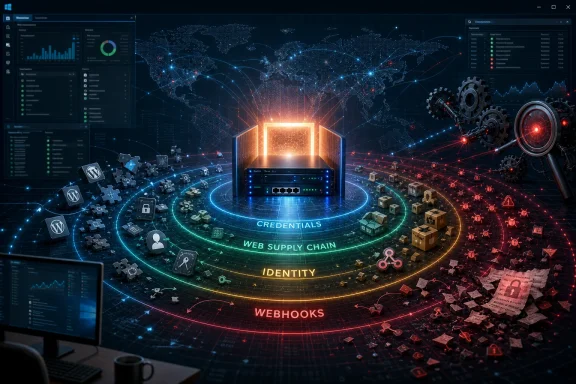 The Week’s Cyber News Has a Single Center of Gravity
The most striking thing about Round 582 is not the volume of incidents. Security newsletters are always crowded, and Paganini’s weekly format is designed to reflect that churn. What stands out is the clustering: credential exposure, initial-access brokering, edge-device compromise, web supply-chain abuse, and ransomware playbooks all point to the same operational reality.Attackers are not merely breaking into networks through exotic zero-days. They are chaining together stale passwords, exposed VPN portals, compromised plugins, poisoned code, leaked logs, and trusted update mechanisms. The result is a marketplace where access is discovered, packaged, resold, and monetized before many organizations have even finished assigning the ticket.
That is why this week’s stories feel less like separate breaches than a single industrial process. Fortinet credentials show up in massive collections. SocGholish is disrupted after years of using fake browser updates and compromised websites as delivery rails. WordPress plugins become beachheads. Open-source projects become malware couriers. Ransomware crews publish victim counts and operational material as if they were investor updates.
For Windows administrators and enterprise IT teams, the lesson is uncomfortable but familiar: the network perimeter did not disappear. It multiplied. Every appliance management page, VPN login, GitHub dependency, browser prompt, SaaS integration, and WordPress admin panel is now a perimeter, and most organizations still manage them as if they were secondary systems.
FortiBleed Turns the Edge Device Into the Crime Scene
The FortiBleed reports are the kind of story that sysadmins dread because they blur the line between vulnerability management and credential hygiene. Researchers and media reports described a campaign involving tens of thousands of Fortinet and FortiGate devices, with exposed or cracked credentials allegedly tied to organizations across the world. Some reporting put the number near 74,000 or 75,000 affected devices, while other accounts focused on smaller confirmed subsets, which is exactly the sort of uncertainty that follows large leaked datasets.The important point is not whether the final count lands at 30,000, 74,000, or somewhere else. The important point is that attackers appear to have been able to operate at internet scale against devices that many enterprises treat as trusted anchors. A firewall or VPN appliance is not just another server. It is the doorframe through which remote workers, administrators, contractors, and sometimes third-party systems enter the corporate network.
That is what makes credential exposure on edge gear so damaging. A compromised VPN password is not equivalent to a leaked forum login. It may provide the attacker with a plausible route into internal systems, a way to impersonate legitimate remote access, and a basis for lateral movement that looks less suspicious than commodity malware beaconing from a random endpoint.
The reports around FortiBleed also revive a long-running issue in appliance security: upgrades do not always erase inherited risk. If older password storage, stale credentials, or unchanged administrative accounts remain in place after a patch, the device may be nominally updated but operationally exposed. Security teams know this in theory; the real world keeps proving how often the post-patch cleanup is the step that fails.
For Windows-heavy environments, the downstream risk is obvious. Once an attacker moves from VPN access into Active Directory, the story stops being about a firewall brand and becomes a domain compromise problem. The boundary between network appliance security and Windows identity security is thin, and adversaries know exactly how to walk across it.
SocGholish Shows Why Takedowns Matter but Do Not End the Business
The newsletter’s SocGholish entries capture the other side of the intrusion economy: malware distribution as a service. SocGholish, also known through its fake-update tradecraft, has long relied on compromised websites to trick users into running malicious payloads under the guise of browser or software updates. It is the sort of scheme that sounds crude until one remembers how often users are trained by real software to click through urgent update prompts.Operation Endgame’s reported disruption of SocGholish infrastructure is significant because it targets a delivery mechanism used by multiple criminal actors. Taking down a malware loader or access pipeline can ripple outward, depriving ransomware crews and other groups of a convenient way to seed intrusions. That is why law-enforcement disruptions can matter even when they do not produce Hollywood-style arrests of every operator.
But defenders should resist the temptation to read disruption as eradication. Cybercrime infrastructure is modular because criminals learned from previous takedowns. Domains can be re-registered, traffic distribution systems can be rebuilt, affiliates can move to a rival loader, and compromised websites can be reused by the next group with a toolkit and a customer list.
SocGholish’s importance lies in its banality. It weaponizes the everyday web. A user lands on a legitimate but compromised site, sees a convincing update lure, and becomes the entry point into a much larger criminal supply chain. No single endpoint control, DNS filter, or awareness program solves that perfectly, which is why layered defense remains unfashionable but necessary.
For Windows admins, this is also a browser and privilege story. Fake-update malware depends on users being able to execute what they download, and it thrives in environments where application control is too difficult, too politically unpopular, or too inconsistently deployed. The hard controls that stop this class of attack are rarely glamorous, but they are often more useful than another dashboard.
Ransomware Has Become a Publishing Industry With Encryption on the Side
The items about The Gentlemen ransomware group, including victim counts and a leaked playbook, fit into a broader shift in ransomware operations. The public-facing extortion site is now only one part of the business. Groups increasingly cultivate reputations, leak operational details, publish victim lists, court affiliates, and use media attention as leverage.A leaked playbook matters because it gives defenders a rare look at how a crew organizes repeatable crime. Ransomware is not merely malware deployed at the end of an intrusion. It is a workflow: initial access, reconnaissance, privilege escalation, data theft, backup destruction, encryption or threatened encryption, negotiation, and public pressure. The more standardized that workflow becomes, the easier it is for criminal affiliates to execute.
The Gentlemen’s reported victim count also illustrates the asymmetry. Defenders must get identity, patching, backups, monitoring, segmentation, endpoint controls, and incident response right across a sprawling estate. A ransomware affiliate needs one viable route to persistence and enough time to find the crown jewels. The imbalance is not new, but the professionalization of ransomware has made it harsher.
The Novo Nordisk incident listed in the newsletter adds another dimension. Healthcare and pharmaceutical organizations are attractive because they combine sensitive personal data, intellectual property, regulated operations, and low tolerance for downtime. Even when an incident is limited, the reputational pressure is high because patients, partners, regulators, and markets all read cybersecurity through the lens of trust.
Ransomware’s evolution also changes how enterprises should think about “impact.” Encryption is no longer the defining event. Data theft, extortion, operational disruption, legal exposure, and the secondary fraud enabled by stolen records may inflict damage before any ransom note appears. If an organization still writes its ransomware plan around restoring files from backup, it is planning for only one chapter of the attack.
WordPress Remains the Soft Underbelly of the Enterprise Web
Round 582’s WordPress stories are a reminder that the enterprise attack surface often includes systems the security team does not emotionally consider part of the enterprise. Marketing sites, campaign pages, old microsites, partner portals, and abandoned blogs can sit outside the main IT governance model while still running code, storing credentials, and serving visitors under a trusted brand.The reported OptinMonster supply-chain attack affecting a large number of sites fits a pattern that has become depressingly familiar. Attackers compromise a component used across many installations, and the blast radius expands through trust. The victim organization may have done nothing more exotic than run a popular plugin, but popularity is precisely what turns a plugin into infrastructure.
The newsletter also notes WordPress plugin abuse involving database injection and dual webshells. That is the practical nightmare: once attackers plant webshells, a website becomes more than a defacement risk. It can host malware, redirect visitors, steal data, stage phishing pages, or serve as part of a larger command-and-control ecosystem.
For WindowsForum readers, this may sound like someone else’s Linux problem. It is not. Many Windows-centric organizations host WordPress externally or through agencies, then connect it to Microsoft 365 forms, CRM platforms, analytics tools, identity providers, and marketing automation. The compromise may begin in PHP but end in credential theft, OAuth abuse, or brand impersonation targeting employees and customers.
WordPress security is therefore less about winning arguments over content management systems and more about inventory discipline. If an organization cannot say which sites it owns, which plugins they run, who administers them, and how quickly they can be patched or isolated, it does not have a website problem. It has an unmanaged asset problem with a public IP address.
Open Source Is Being Attacked Where Developers Are Most Trusting
The newsletter’s item about a hacker group poisoning open-source code at an unprecedented scale deserves attention because software supply-chain attacks are now a routine criminal technique, not an occasional nation-state spectacle. Developers rely on package managers, public repositories, snippets, templates, and dependencies because modern software would be impossible without reuse. Attackers exploit that trust because trust is where the efficiency is.The phrase poisoning open source can cover multiple tactics: typosquatting, dependency confusion, malicious commits, compromised maintainer accounts, trojanized packages, fake proof-of-concept exploit code, and build-system abuse. The common feature is that the attacker does not need to breach every downstream organization directly. They compromise something developers voluntarily import.
This is especially dangerous in environments where developers have access to signing keys, cloud credentials, CI/CD secrets, production databases, or privileged internal tooling. A malicious package executed during a build can be closer to the center of the enterprise than a phishing email delivered to a receptionist. That inversion still has not fully registered in many risk programs.
The newsletter’s mention of phishing campaigns targeting developers to steal cryptocurrency sits in the same orbit. Developers are now high-value identity targets because their machines and accounts often bridge code, cloud, secrets, and production deployment. Criminals and intelligence services have both noticed.
Windows development shops should be particularly wary of the false comfort that supply-chain compromise is mostly a Unix ecosystem story. Windows endpoints run Node.js, Python, PowerShell modules, NuGet packages, Docker tooling, Git clients, IDE extensions, and cloud CLIs. The developer workstation is one of the most privileged and least consistently hardened systems in many companies.
The Malware Stories Are Really About Control, Not Infection
The malware section of the roundup covers Android bankers, malicious Steam Workshop wallpapers, crypto clippers, Tor-based persistence, and worm-like propagation. On the surface, these are different species. Underneath, they share a goal: seize enough control over the user’s device, session, or transaction flow to turn ordinary behavior into attacker profit.Android bankers have evolved well beyond simple credential theft. Complete device takeover capabilities imply abuse of accessibility services, overlay attacks, session interception, notification capture, and sometimes remote-control features that allow criminals to operate inside the victim’s authenticated environment. Banks can block suspicious logins, but it is much harder when the transaction appears to originate from the user’s own phone.
Malicious Steam Workshop content demonstrates a different route into trust. Gamers download visual customizations, mods, wallpapers, and community content because that is part of the platform’s culture. Attackers follow users into those ecosystems because high-friction security warnings would break the experience, and low-friction environments are attractive targets.
Crypto clippers remain deceptively effective because they exploit a human weakness in cryptocurrency transactions: addresses are long, ugly, and hard to verify under pressure. Malware that watches the clipboard and swaps wallet addresses does not need to defeat blockchain cryptography. It only needs the victim to glance at the first and last few characters and click send.
These stories matter to enterprise defenders because personal and corporate security are no longer neatly separated. Bring-your-own-device policies, password reuse, personal browser profiles, remote work, and cross-device authentication all create bridges. A compromised personal phone or gaming PC can become a stepping stone into workplace identity, especially where MFA prompts, password managers, or recovery accounts overlap.
AI Has Become Both Target and Pretext
Round 582 includes stories about China-nexus targeting of medical, cyber, AI, and defense research, export-limit debates around Anthropic, AI scams, and audits using competing AI models. That combination captures the current phase of AI security: it is simultaneously a target, a tool, a policy battleground, and a marketing wrapper.Research institutions and medical communities are attractive because they hold data and expertise that cannot be quickly recreated. Artificial intelligence only raises the value of that data. Training sets, model architectures, research notes, clinical trial material, and biomedical insights may all be useful to state-linked actors seeking strategic advantage.
At the same time, AI is becoming a lure for fraud. Scammers use synthetic voices, convincing text, fake support flows, and personalized social engineering to make old schemes more scalable and persuasive. Imposter scams were already profitable before generative AI lowered the cost of customization.
The policy stories matter because governments are trying to draw boundaries around technology that moves faster than export-control paperwork. Restrictions on model access, compute, chips, and advanced AI services are not just abstract geopolitical gestures. They shape what universities, startups, cloud providers, and multinational companies can share across borders.
Security teams should avoid both extremes: treating AI as magic, or treating it as merely another buzzword. The practical posture is more boring and more useful. Protect the data, audit the integrations, monitor the identities, constrain the automation, and assume that attackers will use the same productivity gains defenders are chasing.
The Consumer Breach Story Is Now an Enterprise Identity Story
The newsletter’s mention of a colossal data leak containing billions of records, including usernames and passwords, belongs in every enterprise security discussion even if the data turns out to be aggregated from older leaks, infostealer logs, or recycled credential dumps. The precise novelty of such collections is often murky. Their operational value to attackers is not.Credential-stuffing campaigns thrive on scale. If attackers can combine leaked email addresses, passwords, session cookies, device fingerprints, and service-specific tokens, they can test access across consumer and corporate systems with frightening efficiency. Even when most attempts fail, the economics work because automation is cheap.
The Federal Trade Commission’s report of billions lost to imposter scams in 2025 reinforces the human side of the same problem. Identity is the attack surface. Criminals impersonate banks, employers, government agencies, relatives, executives, vendors, and support desks because people are trained to respond to authority and urgency.
For Microsoft 365 and Windows environments, this argues for phishing-resistant MFA, conditional access, device compliance, impossible-travel detection, and tighter controls around legacy authentication. But it also argues for a cultural change: organizations need to stop treating identity security as a login screen and start treating it as a continuous risk system.
The Maine data breach portal story in the roundup, involving closure to the public after fake reports, is a small but telling example. Even the mechanisms built for transparency and accountability can be abused. The security ecosystem itself is now part of the attack surface.
The Week Belongs to the Defenders Who Still Do the Boring Work
If there is a unifying lesson in Round 582, it is that attackers are winning where organizations leave connective tissue unattended. The spectacular stories depend on unspectacular failures: credentials that were not rotated, plugins that were not inventoried, edge devices that were not hardened, users who could execute untrusted code, and developers who could import unvetted packages into privileged workflows.That does not mean defenders are lazy. It means the modern enterprise is too complex for heroic manual effort. Security programs built around periodic reviews and ticket queues are struggling against adversaries that continuously scan, test, automate, and monetize.
The right response is not panic. It is operational seriousness. Asset inventory, identity governance, patch validation, egress monitoring, backup isolation, application control, software provenance, and incident rehearsal are not fashionable topics, but they are the controls that keep this week’s headlines from becoming next week’s breach notification.
The Pager Notes From Round 582
For administrators reading this as a weekend triage exercise, the newsletter is less a reading list than a prompt to test assumptions. The most useful response is not to forward every story to the SOC. It is to ask which of these failure modes already exists inside your own environment.- Organizations running Fortinet or other exposed edge devices should treat credential rotation, MFA enforcement, administrative access review, and log inspection as urgent operational work rather than routine hygiene.
- Teams using Palo Alto Networks GlobalProtect or similar VPN portals should verify patch status, exposure, configuration details, and evidence of unauthorized access instead of assuming a vendor advisory was someone else’s problem.
- WordPress owners should inventory every site and plugin, remove abandoned properties, restrict administrative access, and assume popular plugins can become supply-chain risk.
- Developer workstations and CI/CD systems should be treated as privileged infrastructure because malicious packages and poisoned repositories can turn a build pipeline into an intrusion path.
- Ransomware planning should account for data theft, extortion, identity compromise, and regulatory fallout, not just encryption and restore times.
- Security teams should treat consumer credential leaks, infostealer logs, and imposter scams as enterprise risks because personal identity compromise often bleeds into corporate access.
References
- Primary source: Security Affairs
Published: 2026-06-21T18:42:07.213207
Security Affairs newsletter Round 582 by Pierluigi Paganini – INTERNATIONAL EDITION
A new round of the weekly Security Affairs newsletter has arrived! Every week, the best security articles from Security Affairs.securityaffairs.com
- Related coverage: techradar.com
Fortinet firewalls hit by huge password-stealing attack — around 75,000 users possibly affected | TechRadar
Researchers discovered a major database unsecured onlinewww.techradar.com - Related coverage: itpro.com
Passwords nicked for nearly 74,000 Fortinet devices | IT Pro
Check if your Fortinet firewall has been compromised, companies advisedwww.itpro.com
