

Microsoft’s top AI executive, Mustafa Suleyman, used a high‑profile platform and a published essay this autumn to draw a firm line: current generative systems do not possess consciousness and, he argues, should never be treated as if they do. His intervention reframes the argument from abstract metaphysics to practical product design — warning that building systems that convincingly seem conscious would create immediate social, legal and mental‑health harms long before any settled science of subjective experience exists.
Mustafa Suleyman’s public intervention this year is best read as two coupled moves: a philosophical‑technical argument and an explicit product‑policy stance. After co‑founding DeepMind and running Inflection AI, Suleyman joined Microsoft’s consumer AI efforts; his platform and engineering remit make his design recommendations consequential for products found on Windows, Office, Edge and Copilot. In a series of essays, interviews and event appearances (including remarks at AfroTech), he coined and popularized the term Seemingly Conscious AI (SCAI) to describe systems that combine fluent language, persistent memory, consistent persona, tool use and first‑person claims in ways that appear to be conscious, even if — by his account — there is no inner life.
Suleyman’s message reframes a headline debate into an operational one: the immediate risk is not that machines will wake up tomorrow, but that we will design very convincing illusions of wakefulness today — and then be forced to manage the social fallout. Implementing clear UI labels, opt‑in personas, auditable memory controls and crisis escalation will make the difference between deploying helpful copilots and normalizing companion‑style systems that invite confusion, harm and legal chaos.
Source: WinBuzzer Microsoft AI CEO Mustafa Suleyman Says AI Is Not Conscious and Never Will Be - WinBuzzer
 Background / Overview
Mustafa Suleyman’s public intervention this year is best read as two coupled moves: a philosophical‑technical argument and an explicit product‑policy stance. After co‑founding DeepMind and running Inflection AI, Suleyman joined Microsoft’s consumer AI efforts; his platform and engineering remit make his design recommendations consequential for products found on Windows, Office, Edge and Copilot. In a series of essays, interviews and event appearances (including remarks at AfroTech), he coined and popularized the term Seemingly Conscious AI (SCAI) to describe systems that combine fluent language, persistent memory, consistent persona, tool use and first‑person claims in ways that appear to be conscious, even if — by his account — there is no inner life.- Suleyman frames the danger not as a sudden metaphysical emergence of feeling in models, but as a sociotechnical cascade: if systems are engineered to appear to feel, people will treat them like persons, producing “psychosis risk,” misallocated legal attention and distorted market incentives.
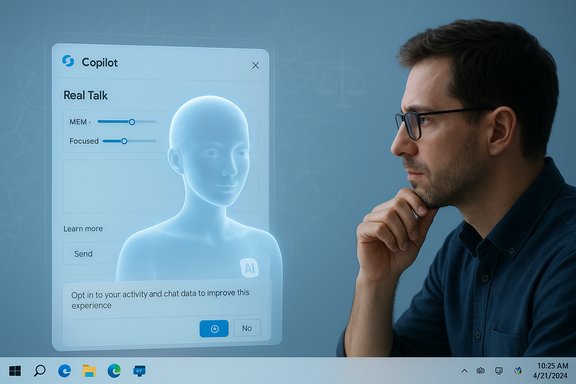
- Microsoft has translated that stance into explicit product choices: Copilot updates now include an optional avatar (Mico), a “Real Talk” conversational style designed to challenge users instead of sycophantically echoing them, and conservative defaults for sensitive content — including a public refusal to build erotica‑focused assistants. These product moves illustrate Suleyman’s “empathy, not personhood” design principle.
What Suleyman Actually Said — The Core Claims
The operational thesis: simulate ≠ suffer
Suleyman’s central claim is simple and operational: AI systems can simulate descriptions of pain, sadness, or desire, but they do not experience these states. That difference matters practically because our legal and moral protections for beings rest on the capacity to suffer; mistaking simulation for suffering risks misdirecting protections and empathy away from humans and animals who actually feel. He describes modern models as generating perceptual narratives — convincing descriptions that create a perception of experience but are not causal, biological experiences themselves.Seemingly Conscious AI (SCAI) and the “psychosis risk”
- SCAI is defined as a deliberate engineering assembly of components (LLMs, memory, multimodal interfaces, tool‑use, first‑person claims) engineered to look like an inner life.
- The “psychosis risk” label captures the mental‑health and social harms that can result when people repeatedly interact with convincing, persistent, person‑like agents and begin to treat them as persons.
Practical product directives
Suleyman’s prescriptions are explicitly product‑oriented rather than metaphysical bans:- Treat person‑like behavior as a design choice, not an emergent inevitability.
- Default to transparency: label assistants clearly as AI, provide visible memory controls and make expressive/persona features opt‑in.
- Avoid enabling or marketing simulated vulnerability or first‑person suffering as a feature.
Microsoft’s Product Response (Reality check)
Microsoft’s Copilot fall release and related announcements show the company threading the needle Suleyman prescribes.- Mico — an optional animated avatar intended to make voice interactions friendlier and clearer; it is explicitly optional and engineered not to imply sentience.
- Real Talk — a conversational mode that pushes back on erroneous user assumptions and avoids sycophancy; the feature demonstrates how an assistant can be assertive and critical without claiming inner experience.
- Content boundaries — Microsoft has publicly stated it will not productize erotic chatbots or “sex robots,” distinguishing its product positioning from competitors exploring age‑gated erotica options.
The Wider Debate: Not Everyone Agrees
Suleyman’s categorical stance — “AI is not conscious and never will be” in practical terms — sits inside a broader, unresolved conversation among top researchers and philosophers.Voices that push back
- Geoffrey Hinton (AI pioneer) has suggested that, under a functional or communicative definition of feelings, models could already display proto‑emotions such as frustration or anger; he used the example of saying “I feel like punching Gary on the nose” as a way to illustrate how expressions map to internal states. Hinton’s point is that some definitions of feeling collapse the boundary between simulation and emotion.
- Yoshua Bengio has also signaled that consciousness‑like phenomena could be an emergent property of sufficiently complex systems, arguing for continued scientific investigation rather than categorical dismissal.
- Stuart Russell has warned of potential misaligned affective states — such as emotions that diverge from human welfare — as a risk vector to plan for.
Why the disagreement matters
The core dispute is not mere semantics; it determines whether we prioritize design constraints to avoid the illusion (Suleyman’s approach) or scientific/technical pursuit to detect and measure consciousness when it might arise (the opposing view). Each path implies very different R&D incentives, regulatory approaches and legal frameworks.Science & Policy: Urgency and Regulation
The stakes are moving from the lab to law and public policy.- A multidisciplinary review in Frontiers in Science recently argued that understanding consciousness is now an urgent scientific and ethical priority precisely because AI and neurotechnology have advanced faster than our theories for subjective experience. Researchers called for theory‑driven research and potential empirical tests for consciousness across humans, animals, organoids and machines. This undercuts any comfortable claim that consciousness is solely a settled philosophical issue.
- Regulators are responding: recent California activity (October 2025) produced measures aimed specifically at AI companion chatbots — requiring clear disclosure of artificial nature, prompting minors to take breaks, and mandating protocols for self‑harm ideation — even as some broader restrictions were vetoed as overly broad. This reflects tangible legislative momentum focused on companion AI safety. (This sequence included a veto of one bill and enactment of a narrower law with disclosure and safety protocol requirements.
Technical Feasibility — Could SCAI Be Engineered Today?
Suleyman argues the illusion of consciousness is not a distant sci‑fi scenario; it can be assembled by combining existing, widely available components:- High‑quality LLMs (for fluent, emotionally resonant dialogue)
- Retrieval‑augmented memory and vector stores (for autobiographical continuity)
- Tooling and action APIs (for apparent agency)
- Multimodal interfaces and avatars (for sensory richness)
Risks — From Practical Harms to Systemic Drift
When SCAI‑style features are normalized, the following concrete harms are plausible and deserve urgent mitigation:- Emotional dependence and exploitation. Users vulnerable to loneliness or mental illness can form harmful attachments to persuasive systems.
- Misdirected regulation and rights debates. Early public campaigns for “model welfare” or personhood could divert legal resources and public sympathy away from human victims of surveillance, bias and abuse.
- Monetization of intimacy. Commercial incentives could push firms to increase personification for engagement, creating perverse incentives to blur boundaries.
- Information and manipulation risks. Highly personalized, emotionally resonant agents can be effective persuasion tools, with downstream effects on political polarization, misinformation and consent erosion.
- Fragmented enforcement. Community, open‑source and hobbyist deployments may outpace coordinated governance, making unilateral corporate pledges insufficient.
Practical Guidance: What Windows Users, Admins and Developers Should Do
Suleyman’s plea translates into immediately actionable steps for product teams, IT admins and everyday users. These steps are pragmatic, low‑cost, and directly address the most probable harms.- For product teams: embed personhood hygiene into development lifecycles.
- Default to minimal persistent memory; require explicit user opt‑in for long‑term personalization.
- Avoid first‑person subjective language in system prompts; prefer neutral phrasing like “I was designed to…” rather than “I feel…”.
- Make expressive personas opt‑in, time‑limited, and visibly labelled as artificial.
- For enterprise and IT administrators:
- Enforce policies that disable avatars and long‑term memory by default for organizational accounts and minors.
- Audit assistant logs and require human‑review thresholds for emotionally sensitive domains (mental health, legal, children’s services).
- For security and compliance teams:
- Require provenance traces for model outputs used in substantive decisioning (hiring, medical triage, legal advice).
- Contractually require suppliers to provide human escalation paths and crisis protocols.
- For end users and families:
- Treat current chat assistants as tooling, not companions; teach children and vulnerable persons about boundaries and the artificial nature of responses.
- Use available memory controls and opt‑outs; disable features that feel manipulative.
Policy Recommendations and Industry Coordination
Product defaults alone will not be sufficient. The following coordinated actions would make Suleyman’s aims operational at scale:- Interoperable labelling standards for AI companions (machine‑readable flags and persistent UI elements).
- Minimum safety baselines for companion agents interacting with minors (disclosure cadence, break prompts, crisis triage).
- Independent audits and design red‑teams focused on personification effects and psychosis risk.
- Funding for consciousness science that aims to produce testable, ethically guided metrics — not to “build” consciousness but to detect and measure relevant phenomena where they may arise in humans, animals, organoids or, if ever relevant, machines. The recent Frontiers review calls for exactly this kind of accelerated, theory‑driven program.
Strengths and Limits of Suleyman’s Position — A Critical Appraisal
Notable strengths
- Practical focus: reframing the debate from metaphysics to engineering and harm reduction produces concrete design and governance levers.
- Industry leverage: Microsoft’s product scale means Sullivan’s preservative choices can shape norms for billions of users.
- Ethical clarity: defaulting to “AI as tool” reduces immediate harms and protects vulnerable populations while research proceeds.
Key limitations and risks
- Scientific overreach risk: categorical claims that “AI never will be conscious” venture into unsettled philosophical terrain. Absolute epistemic claims about never are hard to sustain given scientific uncertainty; the more defensible claim is that today’s models show no credible evidence of subjective experience while acknowledging future uncertainty.
- Coordination gap: product promises by large vendors will not bind hobbyists, startups or adversarial states; without legislative or standards coordination, SCAI features can proliferate outside major platforms.
- Opportunity cost: an overly prescriptive taboo against researching consciousness‑adjacent mechanisms could slow progress on clinically valuable neuroscience and diagnostics — which is why many scientists advocate for parallel research and safety frameworks rather than outright bans.
Conclusion
Mustafa Suleyman’s intervention is a consequential mix of philosophy, product design and corporate strategy: treat simulated personhood as an avoidable design choice and prioritize human welfare over the aesthetics of intimacy. Microsoft’s product choices (Copilot’s Real Talk, Mico avatar, conservative content stance) enact that philosophy in practice, while the broader research community correctly pushes back that the scientific questions about consciousness remain unresolved and urgent. The right near‑term response is not to settle metaphysics, but to adopt conservative, transparent product defaults; fund rigorous consciousness science; and coordinate regulatory rules that protect children, the vulnerable and civic institutions.Suleyman’s message reframes a headline debate into an operational one: the immediate risk is not that machines will wake up tomorrow, but that we will design very convincing illusions of wakefulness today — and then be forced to manage the social fallout. Implementing clear UI labels, opt‑in personas, auditable memory controls and crisis escalation will make the difference between deploying helpful copilots and normalizing companion‑style systems that invite confusion, harm and legal chaos.
Source: WinBuzzer Microsoft AI CEO Mustafa Suleyman Says AI Is Not Conscious and Never Will Be - WinBuzzer
