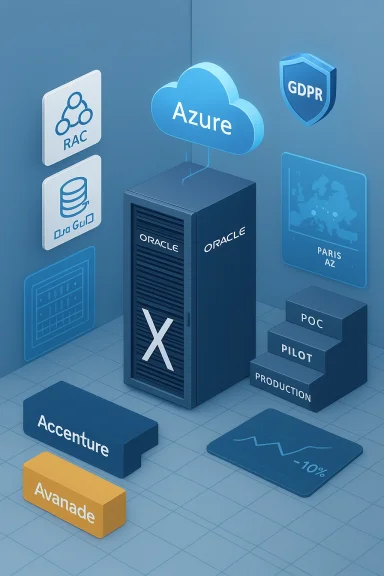
SEFE’s decision to run its Oracle estate on Oracle AI Database@Azure marks a practical — and revealing — example of how utilities and energy companies are balancing legacy database requirements with cloud‑first ambitions, and it underscores the growing reality of purpose‑built multicloud for mission‑critical systems. SEFE reports measurable gains in resilience, regulatory agility, and performance while avoiding an expensive on‑premises refresh; independent vendor materials show the migration delivered steady performance improvements during the pilot and early rollout, even as some vendor messaging around peak numbers is inconsistent and deserves careful scrutiny. (microsoft.com)
SEFE (Securing Energy for Europe) provides gas, electricity, and green energy services to tens of thousands of customers across Europe and operates a compact but business‑critical Oracle database footprint. Faced with aging IBM hardware, rising refresh costs, and tighter European regulatory requirements (notably around data residency and GDPR), SEFE’s leadership elected to consolidate operations on Microsoft Azure while retaining full Oracle Database capabilities — a combination that required a careful technical and commercial design. (microsoft.com)
The technical problem was straightforward but sticky: running production Oracle databases on Azure VMs introduces limitations for mission‑critical workloads — notably around licensing complexity, performance at scale, and lack of native Oracle Real Application Clusters (RAC) as a managed service — which can increase risk and operational burden. To avoid those pitfalls, SEFE evaluated Oracle AI Database@Azure (the branded, multicloud offering that colocates Oracle Exadata‑class infrastructure inside Azure datacenters) and concluded it offered the continuity of enterprise Oracle features together with native Azure integration.
For energy companies specifically, the migration pattern makes operational sense: these organisations often run regulatory, billing, and metering applications that must be preserved for continuity and compliance but also need to modernize to support analytics, market trading, and AI‑augmented operations. SEFE’s approach — staged, license‑aware, and partner‑assisted — is a pragmatic blueprint for similar organisations.
But the story also carries a persistent lesson: vendor claims must be validated with your own workloads and governance posture. SEFE’s measured average improvement (~10% midstream) is credible and meaningful; higher “up to” claims deserve skepticism unless reproduced in your environment. Finally, multicloud convenience comes with operational and contractual complexity — demand clear SLAs, incident playbooks, and an upfront commercial model that aligns with your long‑term TCO objectives. (microsoft.com)
In short: SEFE’s outcome is a win for a specific, well‑scoped business objective — modernize without rewrite, improve resilience, and preserve enterprise Oracle capabilities — and it offers a pragmatic template for utilities and other regulated sectors that need to balance legacy dependence with cloud‑native ambitions.
Source: Oracle https://www.oracle.com/customers/sefe/
 Background: why SEFE’s choice matters
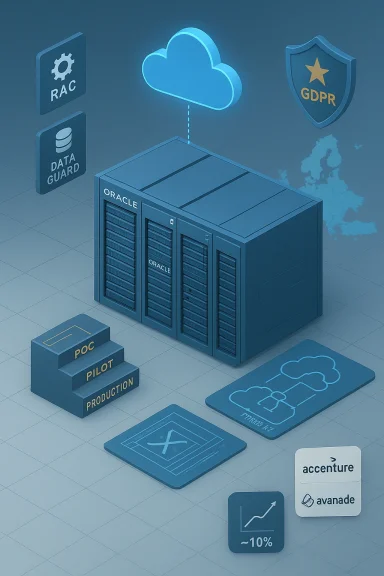
SEFE (Securing Energy for Europe) provides gas, electricity, and green energy services to tens of thousands of customers across Europe and operates a compact but business‑critical Oracle database footprint. Faced with aging IBM hardware, rising refresh costs, and tighter European regulatory requirements (notably around data residency and GDPR), SEFE’s leadership elected to consolidate operations on Microsoft Azure while retaining full Oracle Database capabilities — a combination that required a careful technical and commercial design. (microsoft.com)The technical problem was straightforward but sticky: running production Oracle databases on Azure VMs introduces limitations for mission‑critical workloads — notably around licensing complexity, performance at scale, and lack of native Oracle Real Application Clusters (RAC) as a managed service — which can increase risk and operational burden. To avoid those pitfalls, SEFE evaluated Oracle AI Database@Azure (the branded, multicloud offering that colocates Oracle Exadata‑class infrastructure inside Azure datacenters) and concluded it offered the continuity of enterprise Oracle features together with native Azure integration.
What SEFE actually did — a phased, risk‑aware migration
SEFE migrated 39 databases that support 13 business‑crit and metering among them) from legacy IBM hardware to a multicloud arrangement that places Oracle Exadata infrastructure inside Azure datacenters and runs Oracle Database as a managed service. The migration path was staged and conservative:- Build the business case (five‑year TCO) and validate licensing with Oracle to avoid surprises. (microsoft.com)
- Run a four‑week proof of concept (POC) focused on a subset of smaller workloads, supported by Accenture for OCI and Avanade for Azure integration.
- Expand from pilot to production progressively — first migrating non‑production environments, then the initial production instances, and finally the remainder of the Oracle estate. (microsoft.com)
The platform: what Oracle AI Database@Azure provides
Understanding SEFE’s choice requires clarity on what Oracle AI Database@Azure actually is. The offering places Oracle‑managed, Exadata‑class infrastructure into Azure datacenters and presents Oracle Database as a managed service with the following hallmarks:- Native Oracle feature parity for enterprises: support for Oracle RAC, Data Guard, GoldenGate, and other high‑availability and replication technologies that many mission‑critical applications depend on.
- Exadata performance characteristics (offloaded storage, Smart Scan, optimized I/O) delivered inside Azure to reduce network hops and latency between application and database layers.
- Multicloud procurement options and integrations that allow customers to buy and manage Oracle Database@Azure through Azure‑centric workflows while Oracle operates and manages the Exadata infrastructure.
Measured outcomes: performance, availability, and compliance
Vendor materials and SEFE’s own statements report concrete early outcomes from the POC and pilot phases:- Performance gains: SEFE reported that applications were running faster on Database@Azure than on the on‑premises hardware, with Microsoft’s published customer story citing an average improvement of about 10% halfway through the migration. Oracle’s own messaging about Database@Azure also references similar mid‑migration improvements. These mid‑migration numbers are conservative and reflect measurable operational gains in latency and consistency. (microsoft.com)
- Availability and disaster recovery: moving to Oracle Exadata inside Azure enabled SEFE to adopt multi‑zone and multi‑region topologies and to decommission a UK data center while moving disaster‑recovery workloads to the Azure Paris availability zone in response to new EU GDPR storage guidance — a practical example of how multicloud can simplify compliance and DR planning. This agility to rehouse DR workloads was demonstrated during the POC and pilot stages. (microsoft.com)
- Cost and TCO: SEFE’s finance and infrastructure teams modelled a five‑year business case and, after accounting for licensing adjustments and the avoided cost of refreshing aging IBM hardware, determined the move would be net positive. The ability to map Oracle licensing into Azure commercial terms, and to purchase via Azure marketplace channels, helped make the numbers add up. (microsoft.com)
Technical verification: Exadata, RAC, and what that means in Azure
Two key technical claims underwrite SEFE’s business case: that Oracle RAC and Exadata‑class availability are available inside Azure, and that these services materially reduce risk compared with running Oracle on Azure VMs.- Oracle’s documentation and multicloud messaging confirm that Oracle manages Exadata infrastructure inside Azure datacenters and exposes Oracle Database sal Application Clusters (RAC) — as part of Database@Azure offerings. That architecture is what enables typical enterprise availability patterns (multi‑instance clustering, transparent application failover, Data Guard replication) without customers provisioning their own VM‑level clusters. ps://docs.oracle.com/en-us/iaas/Content/database-at-azure-exadata/odexa-managing-exadata-database-services-azure.html)
- Azure technical guidance and Microsoft product pages describe the integration points (Azure networking, availability zones, and monitoring integrations into Azure Monitor) that reduce the friction of operating Oracle services from an Azure operator perspective. That integration matters operationally: logs, events, and metrics can be streamed into Azure native observability tools, giving Azure administrators visibility into the Oracle Exadata surface.
Business and operational strengths of SEFE’s approach
SEFE’s migration highlights several practical advantages that will interest WindowsForum readers, cloud architects, and utility IT teams:- Minimal application rework: by preserving Oracle Database behavior (RAC, features, and tooling), SEFE avoided the long tail of application refactoring that often makes cloud migrations expensive and risky. This reduces migration time and preserves the value of existing Oracle investments. (microsoft.com)
- Faster time to value: the staged POC and incremental migration path — pilot, non‑prod, initial prod, remainder — gave SEFE quick wins while validating operations and business continuity. Reported average performance gains during migration accelerated ROI. (microsoft.com)
- Regulatory and operational agility: colocating Oracle managed services inside Azure datacenters let SEFE meet GDPR storage requirements and move DR workloads between regions with less friction than re‑hosting on disparate platforms. The ability to fail over across Azure availability zones and regions supports stricter regulatory RTO/RPO expectatystem: SEFE used Accenture (for OCI/Oracle aspects) and Avanade (for Azure integration) to accelerate migration and reduce risk. Large transformation programs often succeed when vendors coordinate around a clear runbook and division of responsibility, which SEFE leveraged.
Risks, trade‑offs, and what to watch for
No migration is without trade‑offs. SEFE’s path reduces many risks but introduces others that organizations should evaluate before copying the model.- Vendor concentration and commercial complexity: although Database@Azure preserves Oracle features, it also centralises Oracle’s operational control over the Exadata layer. That model can make license and commercial negotiations more complex — and increases dependence on Oracle for operational fixes and changes. SEFE mitigated this by negotiating licensing upfront, but others may face different outcomes based on contract terms. (//www.microsoft.com/en/customers/story/25000-securing-energy-for-europe-oracle-database-at-azure))
- Multicloud operational complexity: running Oracle‑managed services inside Azure is a multicloud architecture in practice. While it keeps the database near Azure compute and services, it still means operating across two vendor control planes and reconciling tooling and processes between Oracle and Microsoft. Teams must guard against split responsibilities (who does what when incidents occur) and ensure clear SLAs.
- Performance variability and benchmarking pitfalls: vendor "up to" performance claims are not substitutes for organisation‑specific benchmarking. SEFE’s measured average improvement (~10% mid‑migration) is credible for their workloads, but other customers will see different outcomes depending on workload mix (OLTP vs OLAP vs analytical vector workloads). Always benchmark representative, production‑like workloads during your POC. (microsoft.com)
- Data gravity and egress considerations: consolidating core databases to Oracle‑managed Exadata in Azure reduces latency for Azure‑resident applications, but for hybrid landscapes (on‑prem systems, other clouds), data movement costs, egress fees, and cross‑region latencies still matter. Model these carefully.
- Geopolitical and governance risk: SEFE is a European energy company operating in a high‑regulation sector. Multicloud architectures can heighten governance exposure if control plane interactions cross legal jurisdictions or if procurement models create supply‑chain dependencies. For governments or utilities, these risks carry operational and reputational weight. SEFE’s move to Paris AZ for DR workloads is a prudent demonstration of regional control; others should mirror that discipline.
Practical guidance for enterprises considering the same path
If you manage Oracle workloads and are evaluating Database@Azure, SEFE’s journey suggests a pragmatic checklist:- Get licensing clarity up front: model BYOL versus license‑included scenarios and validate how Azure marketplace procurement maps to your existing Oracle contracts. This is a make‑or‑break commercial step. (microsoft.com)
- Run short, measurable POCs: migrate representative workloads, measure latency, throughput, and failover behaviour, and then expand. SEFE’s four‑week POC provided the data to justify a broader rollout.
- Use experienced partners for split responsibilities: large SIs and Microsoft‑centric partners (Avanade) or Oracle‑centric ones (Accenture’s Oracle practice) can reduce integration risk and speed time to production. SEFE’s use of Accenture and Avanade is a case in point.
- Define clear incident‑response and runbook boundaries between Oracle and Azure teams: who escalates what, and which portal/console serves as the system of record during outages? Multicloud incident choreography must be explicit.
How this fits the broader industry context
SEFE’s migration is emblematic of a larger trend: enterprises want to keep the proven characteristics of Oracle Database (RAC, Data Guard, mature tooling) while taking advantage of a hyperscaler’s energy efficiency, platform services, and AI ecosystem. Oracle and Microsoft’s co‑delivered Database@Azure solution is designed precisely to bridge that divide. Oracle’s 2025‑2026 multicloud expansion and new Exascale offerings demonstrate growing vendor investment in this approach, while Microsoft’s customer stories and technical guidance show how Azure integrates these managed Oracle services into its observability and governance surfaces.For energy companies specifically, the migration pattern makes operational sense: these organisations often run regulatory, billing, and metering applications that must be preserved for continuity and compliance but also need to modernize to support analytics, market trading, and AI‑augmented operations. SEFE’s approach — staged, license‑aware, and partner‑assisted — is a pragmatic blueprint for similar organisations.
Verification notes and cautionary flags
- Independent verification: Microsoft’s published customer story (August 25, 2025) documents SEFE’s migration and reports an average ~10% performance improvement halfway through the migration. Oracle’s Database@Azure materials reiterate similar mid‑migration outcomes in product blogs and highlight the platform capabilities. These independent vendor artifacts corroborate SEFE’s conservative measured improvements during the pilot. (microsoft.com)
- Discrepancies to watch for: some marketing summaries and third‑party writeups occasionally quote higher improvements (for specific workloads) or headline figures such as "20% performance boost" or "up to twice the performance for some applications." Those larger numbers often come from targeted benchmark cases or selected workloads and are not general guarantees for every customer. We were unable to find an independently audited public report validating a consistent, across‑the‑board 20% or 2x uplift for SEFE’s entire estate; organizations should therefore treat such claims as workload‑specific and validate with their own POCs. Caution is advised before relying on peak claims for financial modelling. (microsoft.com)
- Regulatory and operational proofs: SEFE’s decommissioning of a UK data center and moving DR workloads to the Paris availability zone is an operational detail SEFE used to demonstrate agility in responding to EU GDPR guidance. This is a concrete example of how cloud can simplify region‑level controls, but it does not eliminate the need for formal data‑governance policies and contractual assurances.
Bottom line: a pragmatic, balanced multicloud blueprint
SEFE’s migration to Oracle AI Database@Azure is an instructive, practical case for energy companies and other regulated enterprises: preserve proven database features, avoid expensive hardware refresh cycles, and gain operational flexibility by colocating Oracle Exadata infrastructure inside Azure datacenters. The migration’s staged POC approach, careful licensing negotiations, and partner support (Accenture + Avanade) are classic risk‑management techniques and a repeatable pattern for similar organizations. (microsoft.com)But the story also carries a persistent lesson: vendor claims must be validated with your own workloads and governance posture. SEFE’s measured average improvement (~10% midstream) is credible and meaningful; higher “up to” claims deserve skepticism unless reproduced in your environment. Finally, multicloud convenience comes with operational and contractual complexity — demand clear SLAs, incident playbooks, and an upfront commercial model that aligns with your long‑term TCO objectives. (microsoft.com)
In short: SEFE’s outcome is a win for a specific, well‑scoped business objective — modernize without rewrite, improve resilience, and preserve enterprise Oracle capabilities — and it offers a pragmatic template for utilities and other regulated sectors that need to balance legacy dependence with cloud‑native ambitions.
Source: Oracle https://www.oracle.com/customers/sefe/